

- Market Size (2026)
- USD 448.2 Mn
- Forecast (2036)
- USD 696.7 Mn
- CAGR (2026 to 2036)
- 4.5%
How big is Beverage Can Bodymaker Machines Market in 2026?
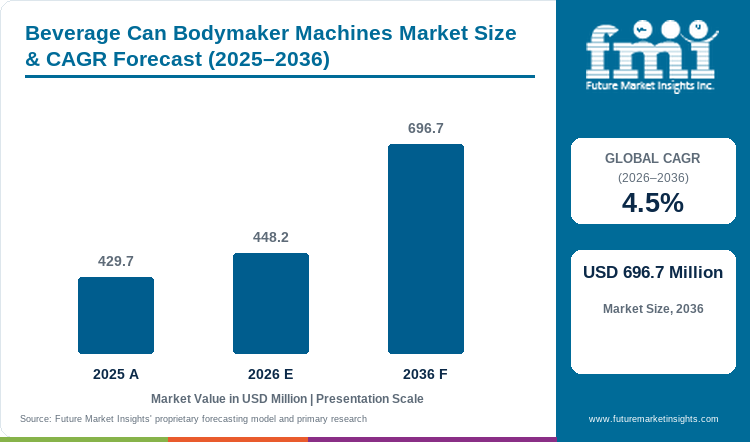
The beverage can bodymaker machines market is valued at USD 448.2 million in 2026 and is projected to reach USD 696.7 million by 2036, expanding at a CAGR of 4.5% over the 2026-2036 period.
The beverage can bodymaker machines market is valued at USD 448.2 million in 2026 and is projected to reach USD 696.7 million by 2036, expanding at a CAGR of 4.5% over the 2026-2036 period. The market was valued at USD 429.7 million in 2025. The estimate includes new DWI bodymakers plus major rebuilds and productivity upgrades used to form beverage can bodies. Cuppers and trimmers, along with neckers and food-can presses, are excluded unless sold as part of the bodymaker package.
The demand base comes from the drink cans market, where two-piece aluminum cans account for most beverage output. Bodymaker revenue follows new-line projects and replacement of installed presses rather than moving directly with annual can sales.
Key Takeaways
- The market is valued at USD 448.2 million in 2026 and is projected to expand by USD 248.5 million over the decade to reach USD 696.7 million by 2036.
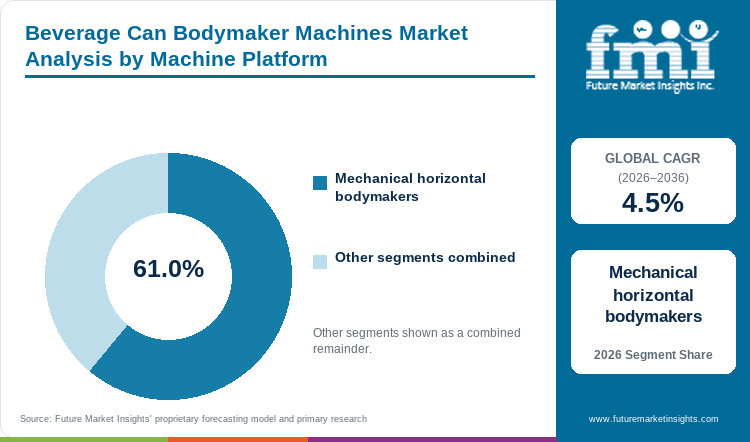
- Mechanical horizontal bodymakers are projected to capture 61.0% of machine platform demand in 2026, supported by an established global canmaking installed base engineered around proven horizontal drawn and ironed (DWI) press architectures.
- Aluminum containers are expected to account for 90.0% of substrate-specific equipment demand in 2026, driven by aluminum's continued dominance across high-speed two-piece beverage can manufacturing lines.
- Bodymakers rated above 350 cans per minute are forecast to generate 47.0% of rated speed demand in 2026, as canmakers prioritize higher volumetric yield and throughput density from existing front-end plant footprints.
- Operating at higher nominal stroke rates accelerates spoilage risks whenever ram alignment drifts, coolant delivery fluctuates, or ironed die rings degrade during long production runs.
- Leading original equipment manufacturers and engineering providers in this sector include Stolle Machinery, Belvac, CarnaudMetalbox Engineering, SLAC Precision Equipment, Pride Engineering, OKL Engineering, Minster Machine, Schuler, Mall + Herlan, and DRT Holdings.
Analyst Perspective
“Bodymaker economics depend on good cans produced per press hour. A speed increase adds value only when wall thickness, trim length and maintenance intervals remain within the plant's control plan.”
- Nandini Roy Choudhury, Principal Consultant, Future Market Insights
How is the beverage can bodymaker machines market segmented?
The beverage can bodymaker machines market is segmented by machine platform, can material, rated speed, can format, demand type, and region. Mechanical horizontal bodymakers lead the machine platform category with 61.0% of 2026 revenue.
The global beverage can bodymaker machines market is segmented across six core operational dimensions: by machine platform into mechanical horizontal bodymakers, servo-assisted bodymakers, hybrid drive bodymakers, and specialty compact presses; by can material into aluminum cans, steel cans, and specialty alloy containers; by rated speed into up to 250 cans per minute, 251 to 350 cans per minute, and above 350 cans per minute; by can format into standard two-piece beverage cans, sleek and slim cans, aluminum bottle preforms, and two-piece food and aerosol cans; by demand type into replacement and rebuilds, greenfield line equipment, capacity expansion units, and tooling-led performance upgrades.
Why do mechanical horizontal bodymakers lead the machine-platform category?
The established horizontal DWI configuration converts a drawn shallow cup through redraw and progressive wall-ironing dies in a single continuous high-speed stroke. Can manufacturing plants favor this architecture because maintenance routines, toolpack setups, and spare-parts supply chains are already mature across the global installed base.
- Mechanical horizontal bodymakers are projected to account for 61.0% of machine platform revenue in 2026, anchored by plant-level familiarity and the proven operational stability of horizontal DWI press kinematics.
- Stolle Machinery provides technical documentation for Standun horizontal bodymakers engineered for both aluminum and steel container bodies across two-piece beverage and specialty packaging lines.
How do aluminum cans shape machine demand?
Aluminum alloys permit extreme cup wall thinning under ironing loads while maintaining structural pressure ratings. Because aluminum comprises the vast majority of commercial drink can manufacturing, bodymaker engineering centers primarily on aluminum-specific lubrication chemistry, tungsten carbide ironing die profiles, and precise wall-thickness control.
- Aluminum container lines are estimated to represent 90.0% of bodymaker tooling and press demand in 2026, directly reflecting aluminum's dominance in two-piece container packaging.
- FMI market models establish aluminum cans at 75.0% of overall drink can end-product demand in 2026, sustaining steady equipment order books for aluminum-configured bodymakers.
Why do machines above 350 cans per minute lead speed-category value?
Modern packaging plants gang several bodymakers into parallel banks to feed continuous high-speed washers and decorators. Running individual presses above 350 cans per minute maximizes floor-space productivity and lowers unit labor requirements, provided dynamic ram alignment and cooling balance prevent spoilage spikes.
- Presses rated above 350 cans per minute are estimated to generate 47.0% of speed-category value in 2026 as plant designers aim to extract maximum volumetric throughput from fixed front-end square footage.
- Equipment manufacturers prioritize dynamic ram guidance, rapid toolpack changeover systems, and stroke repeatability over unconstrained nameplate speed.
What keeps standard two-piece beverage cans central to format demand?
The standard drawn-and-wall-ironed can body fitted with a double-seamed end remains the global packaging benchmark for beer, carbonated soft drinks, and ready-to-drink beverages. While can heights and diameters vary across standard, sleek, and slim profiles, the fundamental redraw and multiple-die ironing steps remain identical.
- Standard two-piece beverage cans are projected to account for 82.0% of format-related bodymaker demand in 2026, sustained by high-volume retail beverage contracts worldwide.
- Can Manufacturers Institute benchmark data highlights standard two-piece beverage cans as the primary volume anchor of domestic metal packaging output.
Why do replacement and rebuilds lead the demand-type category?
Bodymakers run under high-frequency cyclic impact loads and thermal stress, but their heavy cast-iron base frames often remain structurally sound across multi-decade lifecycles. Canmakers routinely opt for mid-life rebuilds, replacing worn rams, linear bearings, hydrostatic bushings, and mechanical drive linkages to restore factory tolerances without disrupting surrounding line infrastructure.
- Replacement and rebuild packages are estimated to capture 56.0% of demand-type spend in 2026, reflecting the compelling capital efficiency of mechanical refurbishments over full greenfield press installations.
- Tooling and service providers maintain specialized product lines dedicated to aftermarket ram retrofits, servo drive conversions, and high-precision toolpack modernization for established press fleets.
What are the drivers, restraints and opportunities in the Beverage Can Bodymaker Machines Market?
The key driver is new beverage can capacity that requires banks of bodymakers matched to washer and decorator throughput, the key restraint is full-line capital requirements of USD 100 million to USD 200 million that can delay projects when can contracts are uncertain, and the key opportunity is servo monitoring, faster tool change and ram-alignment upgrades that can raise accepted output on installed presses.
- Driver: New beverage can capacity requires banks of bodymakers matched to washer and decorator throughput.
- Restraint: A full line can require USD 100 million to USD 200 million, which can delay projects when can contracts are uncertain.
- Opportunity: Servo monitoring, faster tool changes and ram-alignment upgrades can increase accepted output from installed presses.
The aluminum cans market provides bodymaker suppliers with a predictable project pipeline as canmakers expand local front-end capacity to meet contracted retail demand. Purchase orders for new presses track committed volume thresholds directly, which dictate exactly how many parallel forming units are required to feed a continuous line without starving downstream assets.
Bodymakers never operate in isolation. Any variation in press speed immediately alters the operating cadence of trimming stations, the conveyor loading density of the multi-stage washer, and line feed into high-speed decorators. This tight line interdependence magnifies execution risk, leading plant managers to favor proven mechanical platforms supported by deep regional spare parts inventories and established field service infrastructure.
Concurrently, capital investments across the broader metal containers market drive interest in major equipment rebuild programs. Canmakers leverage condition monitoring systems, ram realignment retrofits, and modular drive replacements to extract higher yield from sound, existing machine beds, securing capacity gains at a fraction of greenfield plant expenditure.
Which country CAGRs are profiled in the Beverage Can Bodymaker Machines Market?
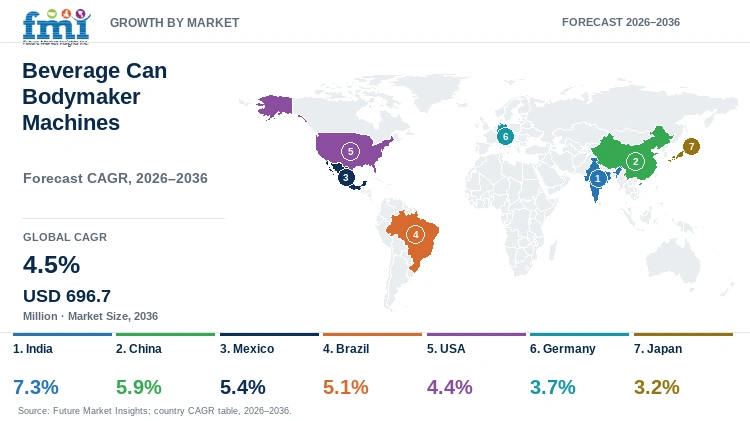
| Country | CAGR |
|---|---|
| India | 7.3% |
| China | 5.9% |
| Mexico | 5.4% |
| Brazil | 5.1% |
| USA | 4.4% |
| Germany | 3.7% |
| Japan | 3.2% |
How do country-level CAGRs compare in the Beverage Can Bodymaker Machines Market?
India and China lead global market expansion through large-scale capacity additions. Mexico and Brazil expand regional beverage packaging capacity, whereas United States demand centers primarily on mechanical rebuilds. Germany and Japan direct capital outlays toward engineering precision, resource efficiency, and long-term lifecycle reliability.
- India leads with a 7.3% CAGR, outpacing Japan by 4.1 percentage points and China by 1.4 percentage points as new two-piece beverage lines accelerate outlays for greenfield press installations.
- China surpasses Mexico by 0.5 percentage points and the USA by 1.5 percentage points as massive domestic output drives sustained procurement across new lines and fleet rebuilds.
- Mexico is 0.3 percentage points ahead of Brazil and 1.0 percentage point ahead of the USA, sustained by North American beverage supply chain integration.
- Brazil is 0.7 percentage points higher than the USA and 1.4 percentage points above Germany on resilient beer and soft drink production volumes.
- USA outpaces Germany by 0.7 percentage points and Japan by 1.2 percentage points as mature operations prioritize press rebuilds, ram realignments, and drive modernizations.
- Germany exceeds Japan by 0.5 percentage points but trailing India by 3.6 percentage points, with replacement decisions driven by energy standards and lubricant recovery.
- Japan trails USA by 1.2 percentage points and the global leader India by 4.1 percentage points, with investments anchored in precision retrofits for long-life press platforms.
Country-wise Analysis
- India is forecast to grow at a 7.3% CAGR through 2036. The domestic market is expanding from a lower installed base as beverage brands transition away from glass and plastic into canned formats. Canmakers prioritize original equipment manufacturers that provide strong on-site commissioning support and local tooling reconditioning services.
- China is forecast to grow at a 5.9% CAGR through 2036. Domestic machinery builders compete aggressively on unit capital cost, while facilities focused on international export standards continue to invest in proven, high-speed imported platforms to guarantee wall-thickness consistency.
- Mexico is forecast to grow at a 5.4% CAGR through 2036. Plants manufacturing for North American beverage brands require tight dimensional wall control, dependable redraw stability, and rapid turnaround on critical spare parts to avoid line stoppages.
- Brazil is forecast to grow at a 5.1% CAGR through 2036. Equipment decisions center on the total cost of ownership involved in maintaining older bodymaker banks, with buyers prioritizing suppliers offering responsive local technical service.
- USA is forecast to grow at a 4.4% CAGR through 2036. Capital allocation is dominated by brownfield retrofits and precision rebuilds designed to maximize accepted can yields without disrupting downstream washer and decorator balance.
- Germany is forecast to grow at a 3.7% CAGR through 2036. Plant engineering teams evaluate bodymakers based on coolant management, spoilage rates, and ease of mechanical maintenance alongside rated stroke speeds.
- Japan is forecast to grow at a 3.2% CAGR through 2036. Equipment procurement is governed by targeted machine replacement and multi-format tooling flexibility rather than greenfield line expansion.
Who are the notable companies in the Beverage Can Bodymaker Machines Market?
Stolle Machinery and Belvac are notable companies profiled in this market. CarnaudMetalbox Engineering and SLAC Precision Equipment are also profiled. The group further includes Pride Engineering and OKL Engineering as well as Minster Machine and Schuler. Mall + Herlan and DRT Holdings complete the list.
Direct competition in the beverage can bodymaker machines market centers on suppliers maintaining active mechanical press platforms and responsive regional field service networks. Specialized tooling manufacturers directly influence net plant output and rebuild economics, whereas general industrial press builders remain low in competitive relevance unless verified by current, public evidence in high-speed drawn and ironed (DWI) beverage can forming.
- Bodymaker platform suppliers include market leaders such as Stolle Machinery, Belvac, CarnaudMetalbox Engineering, and SLAC Precision Equipment, which provide primary horizontal DWI presses engineered for high-speed container lines.
- Tooling and rebuild specialists encompass Pride Engineering, OKL Engineering, and DRT Holdings, supplying critical wear components, redraw systems, and hydrostatic alignment retrofits that preserve press tolerances during long production runs.
- Adjacent metal-forming platform providers feature Minster Machine, Schuler, and Mall + Herlan, whose capabilities span cupping systems, impact extrusion, and heavy stamping presses that border the primary two-piece bodymaker cell.
Competitive Benchmarking: Beverage Can Bodymaker Machines Market
| Company | Direct Bodymaker Evidence | Rebuild Capability | Tooling Support | Geographic Reach |
|---|---|---|---|---|
| Stolle Machinery | High | High | High | Global |
| Belvac | High | High | High | Global |
| CarnaudMetalbox Engineering | High | High | High | Global |
| SLAC Precision Equipment | High | Medium | High | Asia, Americas |
| Pride Engineering | Medium | High | High | Global |
| OKL Engineering | Medium | High | Medium | North America, export |
| Minster Machine | Medium | High | High | Global |
| Schuler | Low | High | High | Global |
| Mall + Herlan | Low | Medium | Medium | Europe, global projects |
| DRT Holdings | Medium | High | Medium | North America, global |
Key Developments in the Beverage Can Bodymaker Machines Market
- In September 2025, Stolle introduced a high-performance inker upgrade for its Rutherford decorator, showing how downstream equipment continues to raise the output and quality expected from bodymaker banks.
- In August 2025, CMI published recycled-content calculation guidance for aluminum can sheet, giving can plants a common basis for material reporting.
- In April 2025, Stolle described continued investment in metal-packaging machinery and support for future canmaking capacity.
Key Players in the Beverage Can Bodymaker Machines Market
Bodymaker Platform Suppliers
- Stolle Machinery
- Belvac
- CarnaudMetalbox Engineering
- SLAC Precision Equipment
Tooling and Rebuild Specialists
- Pride Engineering
- OKL Engineering
- DRT Holdings
Adjacent Metal-Forming Platforms
- Minster Machine
- Schuler
- Mall + Herlan
Beverage Can Bodymaker Machines Market - Report Scope
| Coverage field | Report scope |
|---|---|
| Market Size | USD 448.2 million in 2026 and USD 696.7 million by 2036 at 4.5% CAGR. |
| Market Definition | High-speed presses that redraw and iron metal cups into seamless beverage can bodies, including new machines and major rebuild packages. |
| Segmentation | Machine platform, can material, rated speed, can format, demand type and region. |
| Regional Coverage | North America, Latin America, Western Europe, Eastern Europe, East Asia, South Asia and Pacific, and Middle East and Africa. |
| Countries Covered | India, China, Mexico, Brazil, USA, Germany, Japan and more than 20 countries included in the full report. |
| Key Companies Profiled | Stolle Machinery, Belvac, CarnaudMetalbox Engineering, SLAC Precision Equipment, Pride Engineering, OKL Engineering, Minster Machine, Schuler, Mall + Herlan, DRT Holdings. |
| Forecast Period | 2026 to 2036. |
| Approach | Bottom-up model using beverage-can line additions, bodymakers per line, installed-fleet replacement, rebuild spending and regional can output. |
Beverage Can Bodymaker Machines Market - Research Methodology
| Method | Approach |
|---|---|
| Primary Research | FMI analysts gathered input from manufacturers and system integrators as well as distributors and plant engineers. Procurement teams and application specialists also provided input. Interviews tested purchasing criteria and replacement cycles along with qualification work and technical-service requirements. |
| Desk Research | Desk research covered government statistics and standards as well as industry associations and technical literature. Patents and official product information were also reviewed alongside corporate announcements. Evidence was screened for scope and date as well as direct relevance. |
| Market Sizing and Forecasting | The bottom-up model uses beverage-can line additions and bodymakers per line. It also includes installed-fleet replacement and rebuild spending along with regional can output. |
| Data Validation | Estimates were checked against parent-market activity, installed-base indicators, product specifications and supplier participation. Adjacent products without the defined function were excluded. |
Beverage Can Bodymaker Machines Market by Segments
Beverage Can Bodymaker Machines Market segmented by Machine Platform:
- Mechanical horizontal bodymakers
- Servo-assisted bodymakers
- Hybrid drive bodymakers
- Specialty compact presses
Beverage Can Bodymaker Machines Market segmented by Can Material:
- Aluminum cans
- Steel cans
- Specialty alloy containers
Beverage Can Bodymaker Machines Market segmented by Rated Speed:
- Up to 250 cans per minute
- 251 to 350 cans per minute
- Above 350 cans per minute
Beverage Can Bodymaker Machines Market segmented by Can Format:
- Standard two-piece beverage cans
- Sleek and slim cans
- Aluminum bottle preforms
- Two-piece food and aerosol cans
Beverage Can Bodymaker Machines Market segmented by Demand Type:
- Replacement and rebuilds
- Greenfield line equipment
- Capacity expansion units
- Tooling-led performance upgrades
Beverage Can Bodymaker Machines Market by Region:
- North America
- United States
- Canada
- Latin America
- Brazil
- Mexico
- Argentina
- Chile
- Western Europe
- Germany
- France
- United Kingdom
- Italy
- Spain
- Benelux
- Nordics
- Eastern Europe
- Poland
- Czech Republic
- Romania
- Hungary
- East Asia
- China
- Japan
- South Korea
- South Asia and Pacific
- India
- ASEAN
- Australia and New Zealand
- Middle East and Africa
- GCC Countries
- South Africa
- Türkiye
- Israel
Research Sources and Bibliography
- Can Manufacturers Institute. (n.d.; accessed September 23, 2026). US metal can manufacturing statistics.
- Can Manufacturers Institute and The Aluminum Association. (2024, December 5). Aluminum Beverage Can Recycling Rate Report.
- Can Manufacturers Institute. (2025). Guidance for Calculating Recycled Content in Aluminum Beverage Can Sheet.
- International Aluminium Institute. (2024). Aluminium: The Sustainable Choice for Beverage Cans.
- United States Environmental Protection Agency. (n.d.; accessed September 23, 2026). Metal can manufacturing effluent guidelines.
- Future Market Insights. (2026). Drink Cans Market.
- Future Market Insights. (2026). Aluminum Cans Market.
- Stolle Machinery. (n.d.; accessed September 23, 2026). Beverage Can Line and Standun Bodymakers.
- The Canmaker Directory. (n.d.; accessed September 23, 2026). Bodymaker suppliers.
- Belvac. (n.d.; accessed September 23, 2026). Two-piece can machinery.
- Acumence. (2021, February 15). Monitoring Bodymaker and Trimmer Performance.
This bibliography is provided for reader reference and is not exhaustive. The full report contains the complete reference list and detailed citations.
This Report Answers
- How large is the beverage can bodymaker machines market in 2026 and 2036?
- Which product specification leads demand in 2026?
- What operating condition converts technical need into a purchase?
- Which constraint can delay qualification or replacement?
- How do country growth rates compare across the profiled markets?
- Which companies provide direct or adjacent market capability?
Frequently Asked Questions
How big is the beverage can bodymaker machines market in 2026?
The beverage can bodymaker machines market is valued at USD 448.2 million in 2026 and is projected to reach USD 696.7 million by 2036, expanding at a CAGR of 4.5% over the 2026–2036 period. The estimate covers revenue within the stated market definition and excludes adjacent equipment or chemicals sold without the required function.
What is the CAGR of the beverage can bodymaker machines market from 2026 to 2036?
The market is projected to grow at a 4.5% CAGR between 2026 and 2036. Expansion depends on end-market output and the rate at which plants adopt higher-specification products.
Which machine platform leads the beverage can bodymaker machines market?
Mechanical horizontal bodymakers are expected to hold a 61.0% share in 2026 because the installed canmaking base relies on proven horizontal DWI presses. Established tooling knowledge helps protect the platform during line expansions.
Which countries are projected to record higher growth?
India is projected to grow at a 7.3% CAGR, followed by China at 5.9% and Mexico at 5.4% through 2036. The comparison reflects local production investment and the timing of replacement or qualification cycles.
Which companies are active in the beverage can bodymaker machines market?
The profiled group includes Stolle Machinery and Belvac. CarnaudMetalbox Engineering and SLAC Precision Equipment are also included. The group further covers Pride Engineering and OKL Engineering as well as Minster Machine and Schuler. Mall + Herlan and DRT Holdings complete the group. Capability differs by product range and application evidence.
Preview the report firsthand - request a free sample
Get SampleGet the brochure for pricing and purchase details.
Get PDFTable of Content
- Key Takeaways
- Market Size and CAGR
- Top Growth Driver
- Fastest Growing Segment
- Leading Region
- Key Companies
- Emerging Opportunities
- Executive Summary
- Global Market Outlook
- Demand-side Trends
- Supply-side Trends
- Technology Roadmap Analysis
- Analysis and Recommendations
- Analyst Perspective (What is happening? Why now? What should investors know?)
- Key Questions Answered
- How large is the market?
- What is the CAGR?
- What are key trends?
- Which region dominates?
- Who are the leaders?
- Market Overview
- Market Coverage / Taxonomy
- Market Definition / Scope / Limitations
- Research Methodology
- Chapter Orientation
- Analytical Lens and Working Hypotheses
- Market Structure, Signals, and Trend Drivers
- Benchmarking and Cross-market Comparability
- Market Sizing, Forecasting, and Opportunity Mapping
- Research Design and Evidence Framework
- Desk Research Programme (Secondary Evidence)
- Expert Input and Fieldwork (Primary Evidence)
- Tooling, Models, and Reference Databases
- Data Engineering and Model Build
- Quality Assurance and Audit Trail
- Market Background
- Market Dynamics (Drivers, Restraints, Opportunity, Trends)
- Scenario Forecast (Optimistic, Likely, Conservative)
- Impact Analysis
- AI Impact
- Sustainability Impact
- Regulatory Impact
- Technology Impact
- Consumer / Buyer Analysis
- Purchase Drivers
- Adoption Barriers
- Buyer Journey
- Opportunity Map Analysis
- Product Life Cycle Analysis
- Supply Chain Analysis
- Investment Feasibility Matrix
- Value Chain Analysis
- PESTLE and Porter's Analysis
- Regulatory Landscape
- Regional Parent Market Outlook
- Production and Consumption Statistics
- Import and Export Statistics
- Global Market Analysis and Forecast, 2021 to 2036
- Historical Market Size Value (USD Million) Analysis, 2021 to 2025
- Current and Future Market Size Value (USD Million) Projections, 2026 to 2036
- Y-o-Y Growth Trend Analysis
- Absolute $ Opportunity Analysis
- Global Market Pricing Analysis, 2021 to 2036
- Global Market Analysis and Forecast, By Machine Platform, 2021 to 2036
- Introduction / Key Findings
- Historical Market Size Value (USD Million) Analysis By Machine Platform, 2021 to 2025
- Current and Future Market Size Value (USD Million) Analysis and Forecast By Machine Platform, 2026 to 2036
- Mechanical horizontal bodymakers
- Servo-assisted bodymakers
- Hybrid drive bodymakers
- Specialty compact presses
- Y-o-Y Growth Trend Analysis By Machine Platform, 2021 to 2025
- Absolute $ Opportunity Analysis By Machine Platform, 2026 to 2036
- Global Market Analysis and Forecast, By Can Material, 2021 to 2036
- Introduction / Key Findings
- Historical Market Size Value (USD Million) Analysis By Can Material, 2021 to 2025
- Current and Future Market Size Value (USD Million) Analysis and Forecast By Can Material, 2026 to 2036
- Aluminum cans
- Steel cans
- Specialty alloy containers
- Y-o-Y Growth Trend Analysis By Can Material, 2021 to 2025
- Absolute $ Opportunity Analysis By Can Material, 2026 to 2036
- Global Market Analysis and Forecast, By Rated Speed, 2021 to 2036
- Introduction / Key Findings
- Historical Market Size Value (USD Million) Analysis By Rated Speed, 2021 to 2025
- Current and Future Market Size Value (USD Million) Analysis and Forecast By Rated Speed, 2026 to 2036
- Up to 250 cans per minute
- 251 to 350 cans per minute
- Above 350 cans per minute
- Y-o-Y Growth Trend Analysis By Rated Speed, 2021 to 2025
- Absolute $ Opportunity Analysis By Rated Speed, 2026 to 2036
- Global Market Analysis and Forecast, By Can Format, 2021 to 2036
- Introduction / Key Findings
- Historical Market Size Value (USD Million) Analysis By Can Format, 2021 to 2025
- Current and Future Market Size Value (USD Million) Analysis and Forecast By Can Format, 2026 to 2036
- Standard two-piece beverage cans
- Sleek and slim cans
- Aluminum bottle preforms
- Two-piece food and aerosol cans
- Y-o-Y Growth Trend Analysis By Can Format, 2021 to 2025
- Absolute $ Opportunity Analysis By Can Format, 2026 to 2036
- Global Market Analysis and Forecast, By Demand Type, 2021 to 2036
- Introduction / Key Findings
- Historical Market Size Value (USD Million) Analysis By Demand Type, 2021 to 2025
- Current and Future Market Size Value (USD Million) Analysis and Forecast By Demand Type, 2026 to 2036
- Replacement and rebuilds
- Greenfield line equipment
- Capacity expansion units
- Tooling-led performance upgrades
- Y-o-Y Growth Trend Analysis By Demand Type, 2021 to 2025
- Absolute $ Opportunity Analysis By Demand Type, 2026 to 2036
- Global Market Analysis and Forecast, By Region, 2021 to 2036
- Introduction
- Historical Market Size Value (USD Million) Analysis By Region, 2021 to 2025
- Current Market Size Value (USD Million) Analysis and Forecast By Region, 2026 to 2036
- North America
- Latin America
- Western Europe
- Eastern Europe
- East Asia
- South Asia and Pacific
- Middle East and Africa
- Market Attractiveness Analysis By Region
- North America Market Analysis and Forecast, By Country, 2021 to 2036
- Historical Market Size Value (USD Million) Trend Analysis By Market Taxonomy, 2021 to 2025
- Market Size Value (USD Million) Forecast By Market Taxonomy, 2026 to 2036
- By Country
- United States
- Canada
- By Machine Platform
- By Can Material
- By Rated Speed
- By Can Format
- By Demand Type
- By Country
- Market Attractiveness Analysis
- By Country
- By Machine Platform
- By Can Material
- By Rated Speed
- By Can Format
- By Demand Type
- Key Takeaways
- Latin America Market Analysis and Forecast, By Country
- Historical Market Size Value (USD Million) Trend Analysis By Market Taxonomy, 2021 to 2025
- Market Size Value (USD Million) Forecast By Market Taxonomy, 2026 to 2036
- By Country
- Brazil
- Mexico
- Argentina
- Chile
- By Machine Platform
- By Can Material
- By Rated Speed
- By Can Format
- By Demand Type
- By Country
- Market Attractiveness Analysis
- By Country
- By Machine Platform
- By Can Material
- By Rated Speed
- By Can Format
- By Demand Type
- Key Takeaways
- Western Europe Market Analysis and Forecast, By Country
- Historical Market Size Value (USD Million) Trend Analysis By Market Taxonomy, 2021 to 2025
- Market Size Value (USD Million) Forecast By Market Taxonomy, 2026 to 2036
- By Country
- Germany
- France
- United Kingdom
- Italy
- Spain
- Benelux
- Nordics
- By Machine Platform
- By Can Material
- By Rated Speed
- By Can Format
- By Demand Type
- By Country
- Market Attractiveness Analysis
- By Country
- By Machine Platform
- By Can Material
- By Rated Speed
- By Can Format
- By Demand Type
- Key Takeaways
- Eastern Europe Market Analysis and Forecast, By Country
- Historical Market Size Value (USD Million) Trend Analysis By Market Taxonomy, 2021 to 2025
- Market Size Value (USD Million) Forecast By Market Taxonomy, 2026 to 2036
- By Country
- Poland
- Czech Republic
- Romania
- Hungary
- By Machine Platform
- By Can Material
- By Rated Speed
- By Can Format
- By Demand Type
- By Country
- Market Attractiveness Analysis
- By Country
- By Machine Platform
- By Can Material
- By Rated Speed
- By Can Format
- By Demand Type
- Key Takeaways
- East Asia Market Analysis and Forecast, By Country
- Historical Market Size Value (USD Million) Trend Analysis By Market Taxonomy, 2021 to 2025
- Market Size Value (USD Million) Forecast By Market Taxonomy, 2026 to 2036
- By Country
- China
- Japan
- South Korea
- By Machine Platform
- By Can Material
- By Rated Speed
- By Can Format
- By Demand Type
- By Country
- Market Attractiveness Analysis
- By Country
- By Machine Platform
- By Can Material
- By Rated Speed
- By Can Format
- By Demand Type
- Key Takeaways
- South Asia and Pacific Market Analysis and Forecast, By Country
- Historical Market Size Value (USD Million) Trend Analysis By Market Taxonomy, 2021 to 2025
- Market Size Value (USD Million) Forecast By Market Taxonomy, 2026 to 2036
- By Country
- India
- ASEAN
- Australia and New Zealand
- By Machine Platform
- By Can Material
- By Rated Speed
- By Can Format
- By Demand Type
- By Country
- Market Attractiveness Analysis
- By Country
- By Machine Platform
- By Can Material
- By Rated Speed
- By Can Format
- By Demand Type
- Key Takeaways
- Middle East and Africa Market Analysis and Forecast, By Country
- Historical Market Size Value (USD Million) Trend Analysis By Market Taxonomy, 2021 to 2025
- Market Size Value (USD Million) Forecast By Market Taxonomy, 2026 to 2036
- By Country
- GCC Countries
- South Africa
- Türkiye
- Israel
- By Machine Platform
- By Can Material
- By Rated Speed
- By Can Format
- By Demand Type
- By Country
- Market Attractiveness Analysis
- By Country
- By Machine Platform
- By Can Material
- By Rated Speed
- By Can Format
- By Demand Type
- Key Takeaways
- Key Countries Market Analysis
- United States
- Pricing Analysis
- Market Share Analysis, 2025
- By Machine Platform
- By Can Material
- By Rated Speed
- By Can Format
- By Demand Type
- Canada
- Pricing Analysis
- Market Share Analysis, 2025
- By Machine Platform
- By Can Material
- By Rated Speed
- By Can Format
- By Demand Type
- Mexico
- Pricing Analysis
- Market Share Analysis, 2025
- By Machine Platform
- By Can Material
- By Rated Speed
- By Can Format
- By Demand Type
- Brazil
- Pricing Analysis
- Market Share Analysis, 2025
- By Machine Platform
- By Can Material
- By Rated Speed
- By Can Format
- By Demand Type
- Chile
- Pricing Analysis
- Market Share Analysis, 2025
- By Machine Platform
- By Can Material
- By Rated Speed
- By Can Format
- By Demand Type
- Germany
- Pricing Analysis
- Market Share Analysis, 2025
- By Machine Platform
- By Can Material
- By Rated Speed
- By Can Format
- By Demand Type
- United Kingdom
- Pricing Analysis
- Market Share Analysis, 2025
- By Machine Platform
- By Can Material
- By Rated Speed
- By Can Format
- By Demand Type
- Italy
- Pricing Analysis
- Market Share Analysis, 2025
- By Machine Platform
- By Can Material
- By Rated Speed
- By Can Format
- By Demand Type
- Spain
- Pricing Analysis
- Market Share Analysis, 2025
- By Machine Platform
- By Can Material
- By Rated Speed
- By Can Format
- By Demand Type
- France
- Pricing Analysis
- Market Share Analysis, 2025
- By Machine Platform
- By Can Material
- By Rated Speed
- By Can Format
- By Demand Type
- India
- Pricing Analysis
- Market Share Analysis, 2025
- By Machine Platform
- By Can Material
- By Rated Speed
- By Can Format
- By Demand Type
- ASEAN
- Pricing Analysis
- Market Share Analysis, 2025
- By Machine Platform
- By Can Material
- By Rated Speed
- By Can Format
- By Demand Type
- Australia and New Zealand
- Pricing Analysis
- Market Share Analysis, 2025
- By Machine Platform
- By Can Material
- By Rated Speed
- By Can Format
- By Demand Type
- China
- Pricing Analysis
- Market Share Analysis, 2025
- By Machine Platform
- By Can Material
- By Rated Speed
- By Can Format
- By Demand Type
- Japan
- Pricing Analysis
- Market Share Analysis, 2025
- By Machine Platform
- By Can Material
- By Rated Speed
- By Can Format
- By Demand Type
- South Korea
- Pricing Analysis
- Market Share Analysis, 2025
- By Machine Platform
- By Can Material
- By Rated Speed
- By Can Format
- By Demand Type
- Poland
- Pricing Analysis
- Market Share Analysis, 2025
- By Machine Platform
- By Can Material
- By Rated Speed
- By Can Format
- By Demand Type
- Hungary
- Pricing Analysis
- Market Share Analysis, 2025
- By Machine Platform
- By Can Material
- By Rated Speed
- By Can Format
- By Demand Type
- Türkiye
- Pricing Analysis
- Market Share Analysis, 2025
- By Machine Platform
- By Can Material
- By Rated Speed
- By Can Format
- By Demand Type
- South Africa
- Pricing Analysis
- Market Share Analysis, 2025
- By Machine Platform
- By Can Material
- By Rated Speed
- By Can Format
- By Demand Type
- United States
- Market Structure Analysis
- Competition Dashboard
- Competition Benchmarking
- Market Share Analysis of Top Players
- By Regional
- By Machine Platform
- By Can Material
- By Rated Speed
- By Can Format
- By Demand Type
- Emerging Startups
- Innovation Benchmarking
- Competition Analysis
- Competition Deep Dive
- Stolle Machinery
- Overview
- Product Portfolio
- Profitability by Market Segments
- Sales Footprint
- Strategy Overview
- Marketing Strategy
- Product Strategy
- Channel Strategy
- Belvac
- CarnaudMetalbox Engineering
- SLAC Precision Equipment
- Pride Engineering
- OKL Engineering
- Minster Machine
- Schuler
- Mall + Herlan
- DRT Holdings
- Stolle Machinery
- Case Studies
- Success Stories
- Recent Developments
- Competition Deep Dive
- Assumptions & Acronyms Used


