

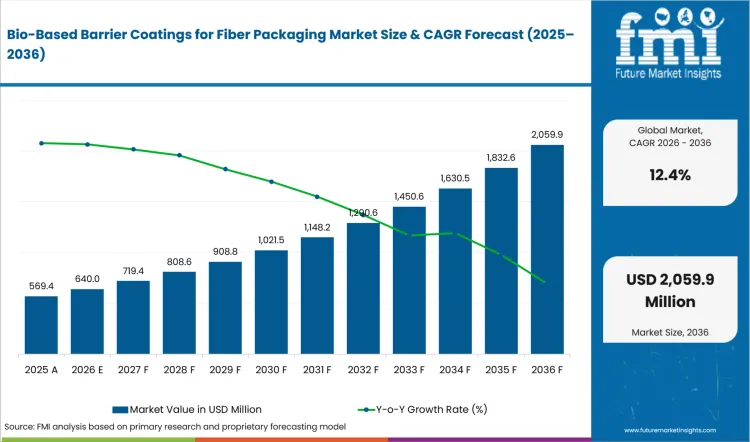
- Market Size (2026)
- USD 640.0 Mn
- Forecast (2036)
- USD 2059.9 Mn
- CAGR (2026 to 2036)
- 12.4%
How big is the bio-based barrier coatings for fiber packaging market size?
USD 640.0 million in 2026 and USD 2,059.9 million by 2036 at a 12.4% CAGR.
The bio-based barrier coatings for fiber packaging market is projected to expand at 12.4% CAGR between 2026 and 2036, increasing valuation from USD 640.0 million in 2026 to USD 2,059.9 million by 2036. Food and retail brands are actively replacing traditional plastic linings with protective coatings so fiber packaging can resist grease and handle sealing stress. Shifting toward eco-friendly alternatives is critical as countries work to reduce household trash. European Accreditation reported in January 2025 claiming packaging represents 36.0% of municipal solid waste in Europe. This extensive waste volume forces packaging producers to accelerate qualification testing for sustainable coated boards.
Purchasing priorities change depending on local food safety rules and manufacturing setups. Buyers in the United States and Germany focus heavily on food-contact documentation with proof of smooth coating-line performance. Sourcing teams in China and Sweden look for local application support and faster board qualification. New laws also dictate physical box dimensions and shipping volumes. European Union published Regulation (EU) 2025/40 on January 2025 setting a 50.0% maximum empty-space ratio for grouped and e-commerce packaging. Such strict volume rules compel companies to redesign containers around right-sized fiber packaging.
Key Takeaways of Bio-Based Barrier Coatings for Fiber Packaging Market
- Demand for bio-based barrier coatings for fiber packaging is driven by converters linking plastic-liner replacement with grease resistance and fiber recovery, with account decisions reflecting food-contact files and application support.
- By application, food & beverage is expected to lead with 63.0% share in 2026, as direct-contact packs require documented barrier performance.
- Paperboard is the dominant substrate segment, projected to hold 52.0% share in 2026, reflecting established carton and tray converting use.
- Food service cups & plates are estimated to lead the end-use category with 41.0% share in 2026, led by hot drink and takeaway pack needs.
- Repulping records and line trials remain critical to supplier evaluation, as brand owners face tighter policy scrutiny on plastic-lined formats and mill teams need technical assistance during coating transfer into production.
- China, Sweden, and Finland are expected to form the higher-growth country tier, advancing at 13.9%, 13.7%, and 13.2% CAGR respectively through 2036, supported by packaging manufacturing scale and fiber-based packaging substitution policy.
- Competition centers on Solenis, Kemira, Archroma, Michelman, Xampla, and Melodea, with vendors differentiating through paper chemistry depth, barrier coating proof, and converter application support.
Analyst Perspective
"The bio-based barrier coatings for fiber packaging market is gaining momentum as packaging converters and brand owners seek sustainable alternatives that meet demanding performance and food-contact requirements. Commercial decisions are guided by coating durability, compatibility with existing converting processes, and proven protection against moisture and grease under real packaging conditions. Suppliers that combine formulation expertise with application guidance, regulatory knowledge, and responsive technical service are likely to build lasting partnerships as fiber-based packaging adoption expands."
- Nandini Roy Choudhury, Principal Consultant for Packaging at Future Market Insights
Source: Future Market Insights analysis, 2026.
How is Bio-based Barrier Coatings For Fiber Packaging Market segmented?
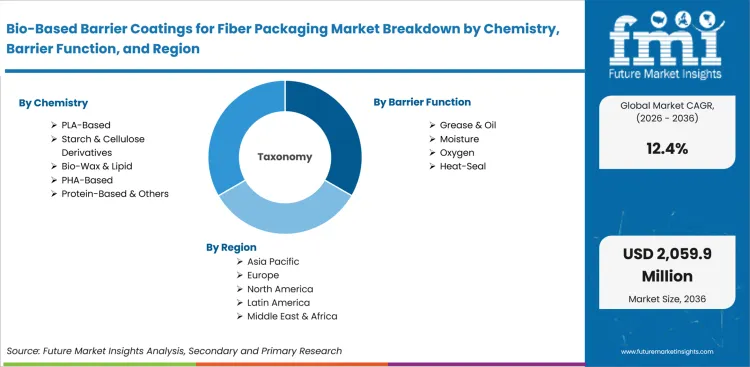
The bio-based barrier coatings for fiber packaging industry is segmented by chemistry, barrier function, substrate, application, end use, and region.
The bio-based barrier coatings for fiber packaging market covers five parent segments. Chemistry coverage includes PLA-based alongside starch & cellulose derivatives, bio-wax & lipid, PHA-based, and protein-based & others. Barrier function coverage includes grease & oil, moisture, oxygen, and heat-seal. Substrate coverage includes paperboard, kraft paper, and molded pulp. Application coverage includes food service cups & plates, flexible paper packaging, folding cartons, and molded fiber. End-use coverage includes food & beverage, cosmetics, e-commerce, and others. Regional coverage includes North America and Latin America. Coverage also includes Europe, East Asia, South Asia, Oceania, and Middle East and Africa.
How does PLA-based chemistry shape coating demand?
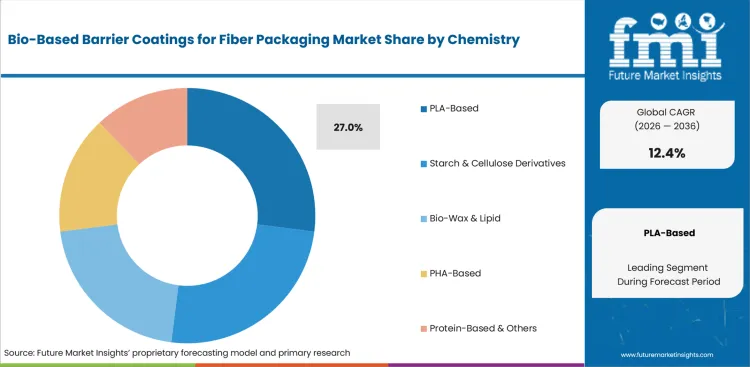
PLA-based chemistry is anticipated to support chemistry demand as converters compare plant-derived coatings against starch and protein options. Application teams review film formation and coating behavior before commercial paperboard runs. Bureau of International Recycling reported in June 2026 stating around 420 million tonnes of paper and cardboard are produced worldwide every year, indicating a wide substrate base for coating conversion.
- PLA-based chemistry is projected to capture 27.0% share in 2026, helped by plant-derived positioning and converter familiarity. Packaging developers compare PLA-based coatings through oil holdout and recovery records before account approval.
- Starch & cellulose derivatives and protein-based chemistries address specific barrier and process needs. PLA-based chemistry keeps review strength as developers use it as a recognized benchmark during coating qualification.
How does grease & oil support barrier function demand?
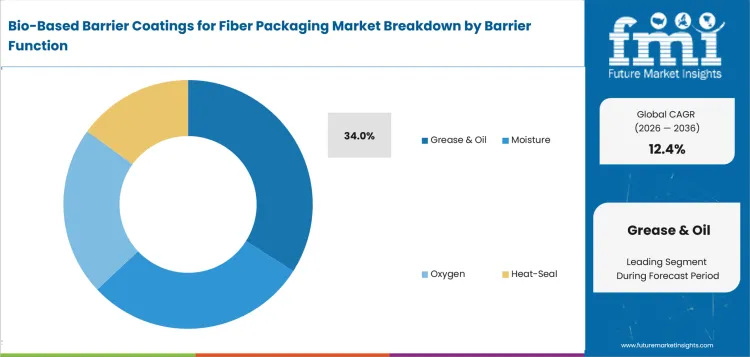
Regulation (EU) 2025/40 sets a 25 ppb limit for targeted individual non-polymeric PFAS in food-contact packaging, raising proof requirements for grease-resistant coatings. Grease & oil protection is anticipated to support barrier function demand as paper packs fail quickly if fats weaken fiber surfaces. Converters assess hot food exposure and repulping data before account approval.
- By barrier function, grease & oil is projected to capture 34.0% share in 2026 as plates and cartons require reliable oil holdout. Packaging teams validate grease barriers through hot-food exposure and recovery tests before switching from plastic-lined formats.
- Moisture and heat-seal functions support sealed wraps and shelf-life-sensitive packs. Grease & oil demand earns account attention since food brands need stain resistance without fluorinated coating systems.
How does paperboard shape substrate purchasing?
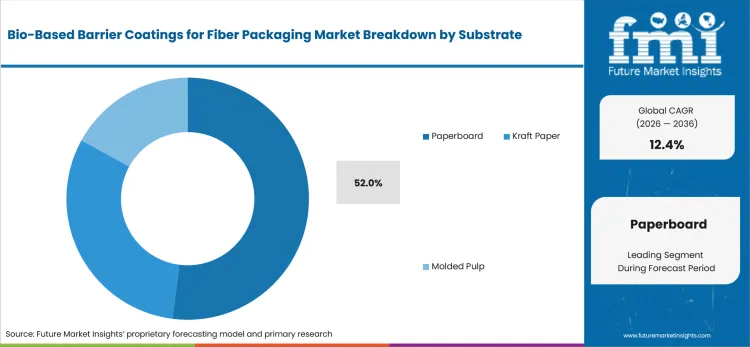
Paperboard is estimated to lead substrate purchasing as converters already process board for cartons and foodservice packs. Packaging teams value coating holdout and recovery records before approving coated fiber formats. Federal Ministry for the Environment reported in December 2025 stating Germany consumed 7,748.4 kt of paper and carton packaging in 2023, reinforcing substrate depth for coated paperboard programs.
- Based on substrate, paperboard is anticipated to represent 52.0% share in 2026 due to established carton and cup converting lines. Packaging teams approve paperboard coating programs after grease staining and repulping results meet account specifications.
- Kraft paper and molded pulp support wraps and formed-fiber packaging across food and retail accounts. Paperboard retains selection strength as converters move coating trials into repeat production without major equipment changes.
Why do food service cups & plates influence application demand?
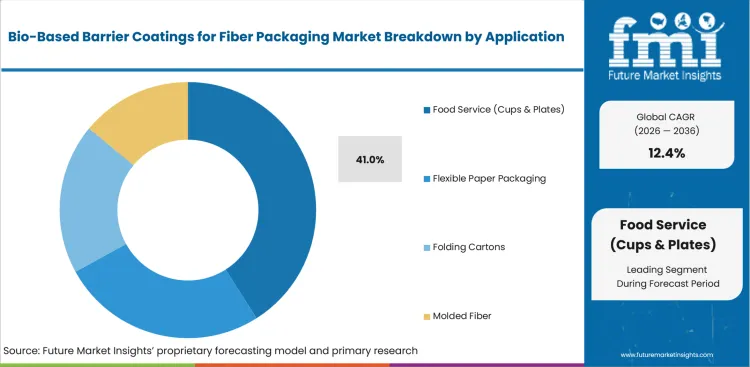
Food service cups & plates are anticipated to support application adoption oily foods and takeaway meals require durable fiber barriers. Operators assess leak resistance and surface staining before selecting coatings for chain-level formats. Confederation of European Paper Industries reported in July 2025 stating packaging paper and board production increased 6.7% in 2024, impacting converter trials for fiber-based foodservice packs.
- In 2026, food service cups & plates are predicted to garner 41.0% share since it is led by frequent exposure to liquids and grease. Restaurant and foodservice accounts shortlist coating systems due to cupstock trials showing oil resistance and stable forming performance.
- Flexible paper packaging and molded fiber serve dry food and protective-tray uses. Food service cups & plates keep selection strength driven by account pressure to replace plastic-lined and fluorinated grease barriers.
How does food & beverage shape end-use demand?
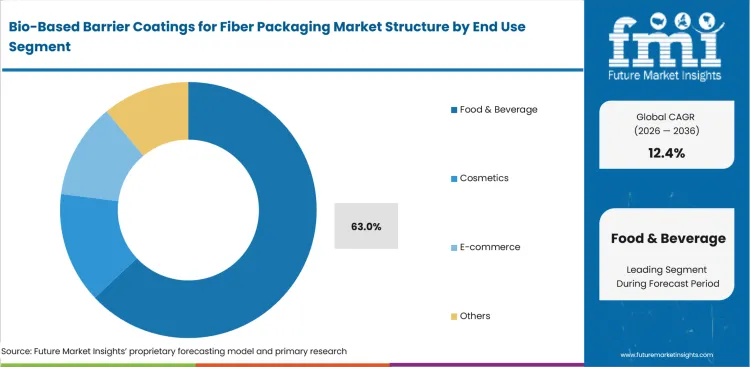
American Forest & Paper Association reported in May 2025 stating USA paper and paperboard production increased 3.2% in 2024, supporting coating evaluation across food-contact board supply chains. Food & beverage is expected to guide end-use led by direct-contact packs required to protect contents without plastic liners. Brand teams review barrier durability and pack performance before replacing established laminates.
- Food & beverage is estimated to secure 63.0% share of end-use demand in 2026, backed by cups and takeaway containers. Account teams require food-contact proof and repeated barrier records before larger coated-fiber packaging approvals.
- Cosmetics and other end uses add moisture control and presentation needs across specialty packs. Food & beverage demand remains central due to direct-contact requirements requiring stricter testing than general retail packaging.
What are drivers, restraints, and opportunities in Bio-Based Barrier Coatings For Fiber Packaging Market?
Purchasing decisions are shaped by plastic-liner replacement and coating proof gaps outlined below.
- Driver: Foodservice brands and converters are replacing plastic-lined and fluorinated barrier layers with bio-based coatings suited to recyclable fiber packs.
- Restraint: Adoption slows as line runnability and repulping performance face approval checks.
- Opportunity: Developers offering verified barrier data and application support improve approval chances across foodservice and molded-fiber accounts.
Food-contact packaging teams are expected to invest in bio-based coating systems as fluorinated grease barriers exit packaging supply. USA Food and Drug Administration reported in January 2025 announcing authorizations for 35 food-contact notifications related to PFAS as no longer being effective, strengthening replacement review for non-PFAS coating chemistries.
Adoption is likely to face longer approval cycles as PFAS documentation expectations tighten across food-contact packaging. Regulation (EU) 2025/40 includes a 250 ppb limit for total non-polymeric PFAS in food-contact packaging, raising compliance pressure on grease-barrier coating suppliers.
Opportunity is projected to improve for coating developers able to combine plastic replacement with fiber recovery proof. Confederation of European Paper Industries reported in February 2026 stating European paper and board production decreased 1.5% in 2025, encouraging higher-value coating programs across recyclable packaging applications.
What country CAGRs are profiled in Bio-Based Barrier Coatings For Fiber Packaging Market?
.webp "Top Country Growth Comparison Bio Based Barrier Coatings For Fiber Packaging Market Cagr (2026 2036)")
| Country | CAGR |
|---|---|
| China | 13.9% |
| Sweden | 13.7% |
| Finland | 13.2% |
| Germany | 12.8% |
| United Kingdom | 12.1% |
| United States | 11.6% |
| Japan | 10.4% |
Source: Future Market Insights analysis, 2026.
How do country-level CAGRs compare in Bio-Based Barrier Coatings For Fiber Packaging Market?
The country comparison spans 3.5 percentage points and highlights three closely connected growth tiers across the Bio-Based Barrier Coatings for Fiber Packaging Market. China, Sweden and Finland form the leading group with only 0.7 percentage points separating the three markets. Germany and the United Kingdom make up the middle tier within another 0.7-point range, while the United States and Japan complete the comparison with a 1.2-point spread. Markets with stronger commitments to sustainable packaging, fiber-based material innovation and plastic replacement initiatives generally demonstrate faster market expansion.
- China records the highest CAGR at 13.9% as rapid growth in sustainable packaging production, expanding e-commerce shipments and increasing adoption of fiber-based food packaging continue to accelerate demand for bio-based barrier coating technologies.
- Sweden follows just 0.2 percentage points behind China. Strong capabilities in pulp and paper manufacturing, combined with continuous investment in renewable packaging materials, reinforce the country's position as a key innovation hub for fiber barrier coatings.
- Finland stands 0.5 percentage points below Sweden, supported by its advanced forest products industry and ongoing development of high-performance bio-based coatings that improve moisture and grease resistance without compromising recyclability.
- Germany posts a CAGR of 12.8%, creating a 0.4-point gap from Finland. Demand is driven by packaging manufacturers introducing sustainable coating solutions that comply with evolving environmental regulations and circular economy objectives.
- The United Kingdom remains 0.7 percentage points below Germany as consumer preference for plastic-free packaging and retailer commitments to sustainable materials encourage wider adoption of fiber-based coated packaging.
- The United States records a CAGR of 11.6%, trailing the United Kingdom by 0.5 percentage points. Food service providers, consumer goods companies and packaging converters are increasingly evaluating bio-based barrier coatings as replacements for conventional polymer-based alternatives.
- Japan registers a CAGR of 10.4%, placing it 1.2 percentage points below the United States. Growth is supported by demand for premium packaging materials, efficient resource utilization and continued innovation in functional coatings that enhance the performance of recyclable fiber packaging
Comparable CAGRs can still produce different market entry conditions. Differences in packaging regulations, paper manufacturing capacity, sustainability targets, coating technology development and adoption of recyclable materials influence commercialization opportunities and long-term market development. The full report provides country-level CAGR analysis across North America, Latin America, Europe, East Asia, South Asia, Oceania and the Middle East and Africa.
Country-wise Analysis
- Green logistics and dense converting clusters are expected to guide China. State Council Information Office of China reported in June 2025 claiming for China to have handled over 175 billion parcels in 2024, showing coated fiber packaging review for e-commerce and express packaging formats. Bio-based barrier coatings market adoption in China is anticipated to scale at 13.9% CAGR during the forecast period, guided by packaging volume and green packaging rules strengthen coating trials.
- Industry in Sweden is likely to increase at 13.7% CAGR through 2036, aided by export-oriented paperboard producers and strong alignment with fiber-based packaging substitution. Swedish Forest Industries Federation reported in 2025 announcing Sweden to have produced 8 million tonnes of paper and board in 2024, promoting coating qualification across export-facing packaging accounts.
- Fiber packaging programs in Finland draw support from mill-linked coating trials and board application expertise. Finland’s Ministry of Agriculture and Forestry reported in 2025 stating paper and board production reached 6.7 million tonnes in 2024, influencing local trials for coated cartons and foodservice packs. Sector in Finland is projected to rise at 13.2% CAGR between 2026 and 2036 as mills and coating developers collaborate around board applications.
- The market in Germany is expected to record 12.8% CAGR by 2036, helped by policy-led plastic replacement and high-specification converting needs. German converter quality systems create a firm approval route for coating suppliers able to document barrier performance. DIE PAPIERINDUSTRIE reported in 2025 stating total paper and board production reached 19,191 thousand tonnes in 2024, impacting evaluation of coated paperboard across packaging lines.
- Confederation of Paper Industries reported in 2026 stating UK paper and board production fell to 3.18 million tonnes in 2025, encouraging coating developers to target higher-value foodservice and carton uses. Adoption in the United Kingdom is forecast to advance at 12.1% CAGR during the assessment period, aided by retailer packaging rules and import-linked supply checks lift interest in verified coating alternatives.
- USA paper converting capacity gives bio-based coatings a practical review path across foodservice and paperboard accounts. Demand in the United States is projected to rise at 11.6% CAGR by 2036 due to food-contact replacement needs and proof-based account approval. American Forest & Paper Association reported in May 2025 highlighting the total paper and paperboard operating rate having reached 87.5% in 2024, propelling coating trials at meaningful converter utilization levels.
- Japan packaging programs rely on strict quality routines and specification-led converter approval. Japan Paper Association reported in 2025 stating paper and paperboard production reached 21,604 thousand tonnes in 2024, reinforcing a quality-focused substrate base for coated fiber packaging. Sector in Japan is anticipated to expand at 10.4% CAGR during the study period, reflected by careful food-contact review and board-pack performance standards.
Who are notable companies in Bio-Based Barrier Coatings For Fiber Packaging Market?
Solenis and Kemira are expected to shape market direction. Archroma and Michelman add barrier coating and paper application depth. BASF and Stora Enso support materials science and fiber packaging breadth. Xampla and Melodea add plant-derived coating capability. Flint Group, Stahl, and Sun Chemical add packaging coating and print-converting relationships.
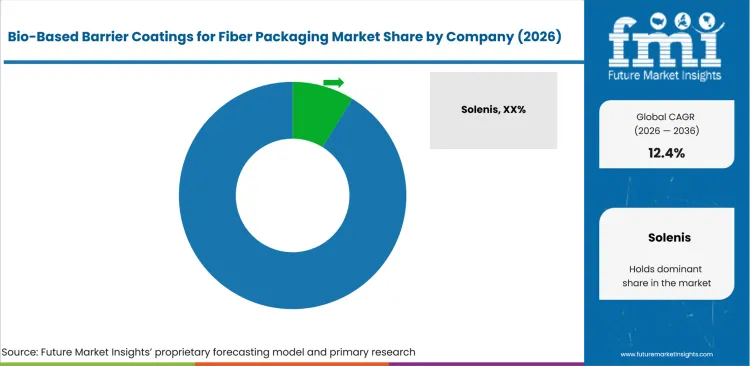
Competition in bio-based barrier coatings for fiber packaging is anticipated to center on coating performance and food-contact proof. Repulping data and local application response guide final vendor review. Account teams are likely to compare vendors based on pack proof files and support for repeat coating programs after first approval. Solenis and Kemira are expected to receive review attention due to paper chemistry depth. Archroma is anticipated to add PFAS-free barrier knowledge. Michelman is projected to compete led by coating application support. BASF and Stora Enso are estimated to support account review through materials and fiber packaging experience. Xampla and Melodea are forecast to support account demand due to plant-derived coating focus. Flint Group and Sun Chemical are likely to add converting and packaging coating relationships.
- Solenis and Kemira are expected to gain account attention based on pulp and surface chemistry knowledge. Mill-facing support is likely to promote programs needing coating trials and repeat operating discipline.
- Archroma and Michelman are anticipated to compete driven by barrier-coating proof and converter relationships. Application knowledge is projected to improve vendor review as brands assess non-PFAS performance before package release.
- BASF and Stora Enso are forecast to support demand through materials science and fiber packaging experience. Xampla and Melodea are expected to help buyers compare plant-derived coating options through focused plastic-replacement design.
- Flint Group, Stahl, and Sun Chemical are estimated to gain review strength depending on inks and packaging-converting access. Vendor attention is likely to improve as fiber packaging buyers need tested coating arrangements.
Competitive Benchmarking: Bio-Based Barrier Coatings for Fiber Packaging Market
| Company | Portfolio Depth | Substrate Match | Application Support | Service Reach |
|---|---|---|---|---|
| Solenis | High | High | High | Global |
| Kemira | High | Medium | High | Global |
| Archroma | High | Medium | High | Global |
| Michelman | High | Medium | High | Global |
| BASF | Medium | Medium | Medium | Global |
| Stora Enso | Medium | High | Medium | Europe and Asia |
| Xampla | Medium | Medium | Medium | Europe |
| Melodea | Medium | Medium | Medium | Europe and North America |
| Flint Group | Medium | Medium | Medium | Global |
| Stahl | Medium | Medium | Medium | Global |
| Sun Chemical | Medium | Focused | Medium | Global |
Source: Future Market Insights competitive analysis, 2026.
Key Developments in Bio-Based Barrier Coatings for Fiber Packaging Market
- In August 2025, Solenis announced plans to showcase sustainable paper and packaging solutions at FACHPACK 2025 and PACK EXPO Las Vegas 2025. Solenis stated eco-friendly barrier coating solutions help enable paperization through chemistry, promoting account review around plastic replacement and regulatory compliance.
- In March 2026, Xampla announced Just Eat Takeaway expanded Morro Coating packaging across 10 European markets through a new Huhtamaki range. Xampla stated plastic-free coated takeaway boxes entered many European nations, improving commercial proof for plant-derived barrier coatings.
- In April 2026, Michelman introduced Nuvita Life 4002 and Nuvita Life 4605 bio-based barrier coatings for paper packaging applications. Michelman stated both coatings are 100% bio-based in dry film, influencing recycling and compostability options for fiber-based retail food packaging.
Key Players in Bio-Based Barrier Coatings for Fiber Packaging Market
Paper chemistry and barrier coating developers
- Solenis
- Kemira
- Archroma
- Michelman
Fiber packaging and plant-derived coating developers
- BASF
- Stora Enso
- Xampla
- Melodea
Packaging coating and converting-material participants
- Flint Group
- Stahl
- Sun Chemical
Bio-Based Barrier Coatings for Fiber Packaging Market - Report Scope
| Coverage field | Report scope |
|---|---|
| Market breakdown | Bio-Based Barrier Coatings for Fiber Packaging Market breakdown by chemistry alongside barrier function, substrate, application, end use, and region |
| Market Definition | Bio-based barrier coatings for fiber packaging include plant-derived and bio-origin coating systems applied to paper, paperboard, molded fiber, wraps, cups, and cartons for grease, oil, moisture, oxygen, and heat-seal protection. |
| Regions Covered | North America and Latin America alongside Europe, East Asia, South Asia, Oceania, and Middle East and Africa |
| Countries Covered | United States and China alongside Canada, Brazil, Mexico, Germany, United Kingdom, France, Italy, Spain, Sweden, Finland, Japan, South Korea, India, Australia, New Zealand, GCC countries, South Africa, and Türkiye |
| Key Companies Profiled | Solenis and Kemira alongside Archroma, Michelman, BASF, Stora Enso, Xampla, Melodea, Flint Group, Stahl, and Sun Chemical |
| Forecast Period | 2026 to 2036 |
| Approach | Hybrid bottom-up and top-down methodology using segment share, country CAGR, packaging conversion needs, coating performance, food-contact readiness, company portfolio depth, and service exposure |
Source: Future Market Insights analysis, 2026.
Bio-Based Barrier Coatings for Fiber Packaging Market - Research Methodology
| Method | Approach |
|---|---|
| Primary Research | FMI analysts gathered input from manufacturers, service providers, technology developers, distributors, end users, procurement teams, and subject-matter experts. Interviews examined purchasing decisions, product or service evaluation, adoption barriers, approval requirements, pricing considerations, and expectations for technical or commercial support. Respondents were also asked what evidence is required before a trial, pilot, or initial order develops into regular purchasing. |
| Desk Research | Desk research covered government statistics, regulatory publications, trade data, industry associations, technical literature, standards, company filings, product information, and official corporate announcements. Sources were reviewed for relevance, publication date, geographic coverage, and consistency with the defined market scope. Claims relating to performance, applications, approvals, capacity, investment, and commercial activity were retained only when supported by credible public evidence. |
| Market Sizing and Forecasting | The market model combined the baseline value with historical performance, segment structure, pricing and volume indicators, adoption levels, company participation, and country-level demand conditions. Forecast assumptions considered economic activity, investment trends, regulatory developments, technology adoption, purchasing cycles, supply availability, and barriers to wider market use. Segment and regional estimates were reconciled before the final market total was calculated. |
| Data Validation | Data validation compares interview findings from converters, packaging brands, coating chemists, and application engineers against public agency records and company activity. Analysts test country-level expansion against segment shares, country CAGRs, company alignment, and official source signals. Forecasts are triangulated across coating qualification needs, recyclable packaging programs, and routine converter support cycles influencing bio-based barrier coatings demand. |
Source: Future Market Insights analysis, 2026.
Bio-Based Barrier Coatings for Fiber Packaging Market by Segments
Bio-Based Barrier Coatings for Fiber Packaging Market segmented by Chemistry:
- PLA-Based
- Starch & Cellulose Derivatives
- Bio-Wax & Lipid
- PHA-Based
- Protein-Based & Others
Bio-Based Barrier Coatings for Fiber Packaging Market segmented by Barrier Function:
- Grease & Oil
- Moisture
- Oxygen
- Heat-Seal
Bio-Based Barrier Coatings for Fiber Packaging Market segmented by Substrate:
- Paperboard
- Kraft Paper
- Molded Pulp
Bio-Based Barrier Coatings for Fiber Packaging Market segmented by Application:
- Food Service Cups & Plates
- Flexible Paper Packaging
- Folding Cartons
- Molded Fiber
Bio-Based Barrier Coatings for Fiber Packaging Market segmented by End Use:
- Food & Beverage
- Cosmetics
- E-commerce
- Others
Bio-Based Barrier Coatings for Fiber Packaging Market by Region:
- North America
- United States
- Canada
- Latin America
- Brazil
- Mexico
- Argentina
- Europe
- Germany
- United Kingdom
- France
- Italy
- Spain
- Sweden
- Finland
- East Asia
- China
- Japan
- South Korea
- South Asia
- India
- Thailand
- Indonesia
- Oceania
- Australia
- New Zealand
- Middle East and Africa
- GCC countries
- South Africa
- Türkiye
Research Sources and Bibliography
- American Forest & Paper Association. (2025, May 16). AF&PA details USA paper production and capacity trends.
- Bureau of International Recycling. (2026, June 27). Paper.
- Confederation of European Paper Industries. (2025, July). Key Statistics 2024.
- Confederation of European Paper Industries. (2026, February 17). New 2025 pulp and paper manufacturing figures show moderate resilience in a context of rising costs, increased competition, and industrial downturn.
- Confederation of Paper Industries. (2026). Annual Review 2025-26.
- DIE PAPIERINDUSTRIE. (2025). PAPIER 2025 - Ein Leistungsbericht.
- European Accreditation. (2025, January 24). Publication of the Regulation (EU) 2025/40 on packaging and packaging waste.
- European Union. (2025, January 22). Regulation (EU) 2025/40 of the European Parliament and of the Council of 19 December 2024 on packaging and packaging waste.
- Finland Ministry of Agriculture and Forestry. (2025). Use of wood in Finland.
- Japan Paper Association. (2025). Paper and paperboard production.
- Michelman. (2026, April 30). Bio-based, plastic-free barrier coatings for paper packaging.
- Solenis. (2025, August 13). Solenis to showcase sustainable paper and packaging solutions at FACHPACK 2025 and PACK EXPO Las Vegas 2025.
- State Council Information Office of China. (2025, June 5). China accelerates express delivery green packaging amid new regulations.
- Swedish Forest Industries Federation. (2025). Snapshot of the Swedish forest industry 2025.
- USA Food and Drug Administration. (2025, January 3). FDA determines authorization for 35 food contact notifications related to PFAS are no longer effective.
- Xampla. (2026, March 12). Just Eat Takeaway expands plastic-free Morro Coating range across Europe.
- Federal Ministry for the Environment, Climate Action, Nature Conservation and Nuclear Safety. (2025, December 19). Total packaging.
This bibliography is provided for reader reference and is not exhaustive. The full report contains the complete reference list and detailed citations.
This Report Answers
- What segments shape demand across chemistry, barrier function, substrate, application, and end use?
- How do converters evaluate bio-based barrier coatings before replacing plastic-lined fiber packaging?
- How do country CAGRs differ across profiled markets?
- What companies compete through coating depth and converter support?
- How are forecasts validated using a hybrid bottom-up and top-down approach?
- What factors do account teams address before larger account expansion?
- How do food-contact files and repulping evidence affect vendor selection?
- What limits return on investment for teams adding bio-based barrier coatings?
- How do grease resistance records and application support influence account approval?
- What vendor capabilities improve long-term account confidence?
Frequently Asked Questions
What supports demand in bio-based barrier coatings for fiber packaging market?
Demand is expected to be influenced by converters needing coatings protecting fiber packs from moisture and oxygen during food-contact use. Accounts are anticipated to favor vendors combining repulping records and application response.
Who are key players in bio-based barrier coatings for fiber packaging market?
Key companies are projected to include Solenis and Kemira among others to support competition. Competition is likely to be based on coating performance evidence and regional converter support coverage.
What restraint affects bio-based barrier coatings for fiber packaging market?
A major restraint is the proof burden created during food-contact review and coating line trials across converter teams. Accounts slow adoption led by coatings lacking acceptance evidence or vendor response needed for pack approval.
Why do executives track bio-based barrier coatings for fiber packaging market?
Executives are expected to track bio-based barrier coatings for fiber packaging as liner replacement choices affect brand claims and packaging continuity. Factors such as coating qualification and vendor support shape buyer reviews.
What business problem does bio-based barrier coatings for fiber packaging market address?
Bio-based barrier coatings for fiber packaging market addresses operational gaps created by fiber packs needing grease and oxygen protection without plastic liners. Paper converters and foodservice brands need coating systems supporting repeatable pack performance and field-ready service evidence.
What do account teams evaluate before selecting vendors?
Account teams are likely to evaluate coating resistance and repeat-run reliability before vendor approval. Food-contact documentation and technical support are expected to guide final vendor review.
What limits return on investment for purchasing teams?
Return on investment weakens if coating performance or account acceptance is not proven before production. Rework and delayed approvals reduce expected margin gains.
How do vendors build long-term account confidence?
Vendors build account confidence by providing consistent coating quality and evidence specific to bio-based barrier coatings for fiber packaging. Line records and responsive troubleshooting support are expected to influence repeat-order trust.
Preview the report firsthand - request a free sample
Get SampleGet the brochure for pricing and purchase details.
Get PDFTable of Content
- Key Takeaways
- Market Size and CAGR
- Top Growth Driver
- Fastest Growing Segment
- Leading Region
- Key Companies
- Emerging Opportunities
- Executive Summary
- Global Market Outlook
- Demand-side Trends
- Supply-side Trends
- Technology Roadmap Analysis
- Analysis and Recommendations
- Analyst Perspective (What is happening? Why now? What should investors know?)
- Key Questions Answered
- How large is the market?
- What is the CAGR?
- What are key trends?
- Which region dominates?
- Who are the leaders?
- Market Overview
- Market Coverage / Taxonomy
- Market Definition / Scope / Limitations
- Research Methodology
- Chapter Orientation
- Analytical Lens and Working Hypotheses
- Market Structure, Signals, and Trend Drivers
- Benchmarking and Cross-market Comparability
- Market Sizing, Forecasting, and Opportunity Mapping
- Research Design and Evidence Framework
- Desk Research Programme (Secondary Evidence)
- Expert Input and Fieldwork (Primary Evidence)
- Tooling, Models, and Reference Databases
- Data Engineering and Model Build
- Quality Assurance and Audit Trail
- Market Background
- Market Dynamics (Drivers, Restraints, Opportunity, Trends)
- Scenario Forecast (Optimistic, Likely, Conservative)
- Impact Analysis
- AI Impact
- Sustainability Impact
- Regulatory Impact
- Technology Impact
- Consumer / Buyer Analysis
- Purchase Drivers
- Adoption Barriers
- Buyer Journey
- Opportunity Map Analysis
- Product Life Cycle Analysis
- Supply Chain Analysis
- Investment Feasibility Matrix
- Value Chain Analysis
- PESTLE and Porter's Analysis
- Regulatory Landscape
- Regional Parent Market Outlook
- Production and Consumption Statistics
- Import and Export Statistics
- Global Market Analysis and Forecast, 2021 to 2036
- Historical Market Size Value (USD Million) Analysis, 2021 to 2025
- Current and Future Market Size Value (USD Million) Projections, 2026 to 2036
- Y-o-Y Growth Trend Analysis
- Absolute $ Opportunity Analysis
- Global Market Pricing Analysis, 2021 to 2036
- Global Market Analysis and Forecast, By Chemistry, 2021 to 2036
- Introduction / Key Findings
- Historical Market Size Value (USD Million) Analysis By Chemistry, 2021 to 2025
- Current and Future Market Size Value (USD Million) Analysis and Forecast By Chemistry, 2026 to 2036
- PLA-Based
- Starch & Cellulose Derivatives
- Bio-Wax & Lipid
- PHA-Based
- Protein-Based & Others
- PLA-Based
- Y-o-Y Growth Trend Analysis By Chemistry, 2021 to 2025
- Absolute $ Opportunity Analysis By Chemistry, 2026 to 2036
- Global Market Analysis and Forecast, By Barrier Function, 2021 to 2036
- Introduction / Key Findings
- Historical Market Size Value (USD Million) Analysis By Barrier Function, 2021 to 2025
- Current and Future Market Size Value (USD Million) Analysis and Forecast By Barrier Function, 2026 to 2036
- Grease & Oil
- Moisture
- Oxygen
- Heat-Seal
- Grease & Oil
- Y-o-Y Growth Trend Analysis By Barrier Function, 2021 to 2025
- Absolute $ Opportunity Analysis By Barrier Function, 2026 to 2036
- Global Market Analysis and Forecast, By Substrate, 2021 to 2036
- Introduction / Key Findings
- Historical Market Size Value (USD Million) Analysis By Substrate, 2021 to 2025
- Current and Future Market Size Value (USD Million) Analysis and Forecast By Substrate, 2026 to 2036
- Paperboard
- Kraft Paper
- Molded Pulp
- Paperboard
- Y-o-Y Growth Trend Analysis By Substrate, 2021 to 2025
- Absolute $ Opportunity Analysis By Substrate, 2026 to 2036
- Global Market Analysis and Forecast, By Application, 2021 to 2036
- Introduction / Key Findings
- Historical Market Size Value (USD Million) Analysis By Application, 2021 to 2025
- Current and Future Market Size Value (USD Million) Analysis and Forecast By Application, 2026 to 2036
- Food Service (Cups & Plates)
- Flexible Paper Packaging
- Folding Cartons
- Molded Fiber
- Food Service (Cups & Plates)
- Y-o-Y Growth Trend Analysis By Application, 2021 to 2025
- Absolute $ Opportunity Analysis By Application, 2026 to 2036
- Global Market Analysis and Forecast, By End Use, 2021 to 2036
- Introduction / Key Findings
- Historical Market Size Value (USD Million) Analysis By End Use, 2021 to 2025
- Current and Future Market Size Value (USD Million) Analysis and Forecast By End Use, 2026 to 2036
- Food & Beverage
- Cosmetics
- E-commerce
- Others
- Food & Beverage
- Y-o-Y Growth Trend Analysis By End Use, 2021 to 2025
- Absolute $ Opportunity Analysis By End Use, 2026 to 2036
- Global Market Analysis and Forecast, By Region, 2021 to 2036
- Introduction
- Historical Market Size Value (USD Million) Analysis By Region, 2021 to 2025
- Current Market Size Value (USD Million) Analysis and Forecast By Region, 2026 to 2036
- North America
- Latin America
- Western Europe
- Eastern Europe
- East Asia
- South Asia and Pacific
- Middle East & Africa
- Market Attractiveness Analysis By Region
- North America Market Analysis and Forecast, By Country, 2021 to 2036
- Historical Market Size Value (USD Million) Trend Analysis By Market Taxonomy, 2021 to 2025
- Market Size Value (USD Million) Forecast By Market Taxonomy, 2026 to 2036
- By Country
- USA
- Canada
- By Chemistry
- By Barrier Function
- By Substrate
- By Application
- By End Use
- By Country
- Market Attractiveness Analysis
- By Country
- By Chemistry
- By Barrier Function
- By Substrate
- By Application
- By End Use
- Key Takeaways
- Latin America Market Analysis and Forecast, By Country
- Historical Market Size Value (USD Million) Trend Analysis By Market Taxonomy, 2021 to 2025
- Market Size Value (USD Million) Forecast By Market Taxonomy, 2026 to 2036
- By Country
- Brazil
- Mexico
- Chile
- Rest of Latin America
- By Chemistry
- By Barrier Function
- By Substrate
- By Application
- By End Use
- By Country
- Market Attractiveness Analysis
- By Country
- By Chemistry
- By Barrier Function
- By Substrate
- By Application
- By End Use
- Key Takeaways
- Western Europe Market Analysis and Forecast, By Country
- Historical Market Size Value (USD Million) Trend Analysis By Market Taxonomy, 2021 to 2025
- Market Size Value (USD Million) Forecast By Market Taxonomy, 2026 to 2036
- By Country
- Germany
- UK
- Italy
- Spain
- France
- Nordic
- BENELUX
- Rest of Western Europe
- By Chemistry
- By Barrier Function
- By Substrate
- By Application
- By End Use
- By Country
- Market Attractiveness Analysis
- By Country
- By Chemistry
- By Barrier Function
- By Substrate
- By Application
- By End Use
- Key Takeaways
- Eastern Europe Market Analysis and Forecast, By Country
- Historical Market Size Value (USD Million) Trend Analysis By Market Taxonomy, 2021 to 2025
- Market Size Value (USD Million) Forecast By Market Taxonomy, 2026 to 2036
- By Country
- Russia
- Poland
- Hungary
- Balkan & Baltic
- Rest of Eastern Europe
- By Chemistry
- By Barrier Function
- By Substrate
- By Application
- By End Use
- By Country
- Market Attractiveness Analysis
- By Country
- By Chemistry
- By Barrier Function
- By Substrate
- By Application
- By End Use
- Key Takeaways
- East Asia Market Analysis and Forecast, By Country
- Historical Market Size Value (USD Million) Trend Analysis By Market Taxonomy, 2021 to 2025
- Market Size Value (USD Million) Forecast By Market Taxonomy, 2026 to 2036
- By Country
- China
- Japan
- South Korea
- By Chemistry
- By Barrier Function
- By Substrate
- By Application
- By End Use
- By Country
- Market Attractiveness Analysis
- By Country
- By Chemistry
- By Barrier Function
- By Substrate
- By Application
- By End Use
- Key Takeaways
- South Asia and Pacific Market Analysis and Forecast, By Country
- Historical Market Size Value (USD Million) Trend Analysis By Market Taxonomy, 2021 to 2025
- Market Size Value (USD Million) Forecast By Market Taxonomy, 2026 to 2036
- By Country
- India
- ASEAN
- Australia & New Zealand
- Rest of South Asia and Pacific
- By Chemistry
- By Barrier Function
- By Substrate
- By Application
- By End Use
- By Country
- Market Attractiveness Analysis
- By Country
- By Chemistry
- By Barrier Function
- By Substrate
- By Application
- By End Use
- Key Takeaways
- Middle East & Africa Market Analysis and Forecast, By Country
- Historical Market Size Value (USD Million) Trend Analysis By Market Taxonomy, 2021 to 2025
- Market Size Value (USD Million) Forecast By Market Taxonomy, 2026 to 2036
- By Country
- Kingdom of Saudi Arabia
- Other GCC Countries
- Türkiye
- South Africa
- Other African Union
- Rest of Middle East & Africa
- By Chemistry
- By Barrier Function
- By Substrate
- By Application
- By End Use
- By Country
- Market Attractiveness Analysis
- By Country
- By Chemistry
- By Barrier Function
- By Substrate
- By Application
- By End Use
- Key Takeaways
- Key Countries Market Analysis
- USA
- Pricing Analysis
- Market Share Analysis, 2025
- By Chemistry
- By Barrier Function
- By Substrate
- By Application
- By End Use
- Canada
- Pricing Analysis
- Market Share Analysis, 2025
- By Chemistry
- By Barrier Function
- By Substrate
- By Application
- By End Use
- Mexico
- Pricing Analysis
- Market Share Analysis, 2025
- By Chemistry
- By Barrier Function
- By Substrate
- By Application
- By End Use
- Brazil
- Pricing Analysis
- Market Share Analysis, 2025
- By Chemistry
- By Barrier Function
- By Substrate
- By Application
- By End Use
- Chile
- Pricing Analysis
- Market Share Analysis, 2025
- By Chemistry
- By Barrier Function
- By Substrate
- By Application
- By End Use
- Germany
- Pricing Analysis
- Market Share Analysis, 2025
- By Chemistry
- By Barrier Function
- By Substrate
- By Application
- By End Use
- UK
- Pricing Analysis
- Market Share Analysis, 2025
- By Chemistry
- By Barrier Function
- By Substrate
- By Application
- By End Use
- Italy
- Pricing Analysis
- Market Share Analysis, 2025
- By Chemistry
- By Barrier Function
- By Substrate
- By Application
- By End Use
- Spain
- Pricing Analysis
- Market Share Analysis, 2025
- By Chemistry
- By Barrier Function
- By Substrate
- By Application
- By End Use
- France
- Pricing Analysis
- Market Share Analysis, 2025
- By Chemistry
- By Barrier Function
- By Substrate
- By Application
- By End Use
- India
- Pricing Analysis
- Market Share Analysis, 2025
- By Chemistry
- By Barrier Function
- By Substrate
- By Application
- By End Use
- ASEAN
- Pricing Analysis
- Market Share Analysis, 2025
- By Chemistry
- By Barrier Function
- By Substrate
- By Application
- By End Use
- Australia & New Zealand
- Pricing Analysis
- Market Share Analysis, 2025
- By Chemistry
- By Barrier Function
- By Substrate
- By Application
- By End Use
- China
- Pricing Analysis
- Market Share Analysis, 2025
- By Chemistry
- By Barrier Function
- By Substrate
- By Application
- By End Use
- Japan
- Pricing Analysis
- Market Share Analysis, 2025
- By Chemistry
- By Barrier Function
- By Substrate
- By Application
- By End Use
- South Korea
- Pricing Analysis
- Market Share Analysis, 2025
- By Chemistry
- By Barrier Function
- By Substrate
- By Application
- By End Use
- Russia
- Pricing Analysis
- Market Share Analysis, 2025
- By Chemistry
- By Barrier Function
- By Substrate
- By Application
- By End Use
- Poland
- Pricing Analysis
- Market Share Analysis, 2025
- By Chemistry
- By Barrier Function
- By Substrate
- By Application
- By End Use
- Hungary
- Pricing Analysis
- Market Share Analysis, 2025
- By Chemistry
- By Barrier Function
- By Substrate
- By Application
- By End Use
- Kingdom of Saudi Arabia
- Pricing Analysis
- Market Share Analysis, 2025
- By Chemistry
- By Barrier Function
- By Substrate
- By Application
- By End Use
- Türkiye
- Pricing Analysis
- Market Share Analysis, 2025
- By Chemistry
- By Barrier Function
- By Substrate
- By Application
- By End Use
- South Africa
- Pricing Analysis
- Market Share Analysis, 2025
- By Chemistry
- By Barrier Function
- By Substrate
- By Application
- By End Use
- USA
- Market Structure Analysis
- Competition Dashboard
- Competition Benchmarking
- Market Share Analysis of Top Players
- By Regional
- By Chemistry
- By Barrier Function
- By Substrate
- By Application
- By End Use
- Emerging Startups
- Innovation Benchmarking
- Competition Analysis
- Competition Deep Dive
- Solenis
- Overview
- Product Portfolio
- Profitability by Market Segments
- Sales Footprint
- Strategy Overview
- Marketing Strategy
- Product Strategy
- Channel Strategy
- Kemira
- Archroma
- Michelman
- BASF
- Melodea
- Xampla
- Sun Chemical
- Cargill
- Stora Enso
- Solenis
- Case Studies
- Success Stories
- Recent Developments
- Competition Deep Dive
- Assumptions & Acronyms Used


