

- Market Size (2026)
- USD 6.3 Bn
- Forecast (2036)
- USD 16.6 Bn
- CAGR (2026 to 2036)
- 10.2%
How big is Bio-Based & Biodegradable Rigid Packaging Materials Market in 2026?
USD 6.3 billion in 2026 and USD 16.6 billion by 2036 at a 10.2% CAGR.
Demand for bio-based and biodegradable rigid packaging is projected to push industry valuation from USD 6.3 billion in 2026 to USD 16.6 billion by 2036, with a 10.2% CAGR between 2026 and 2036. Brands in the industry are protecting barrier performance and filling speed before changing bottles or capsules on commercial lines. For instance, NatureWorks and FLO Group introduced the KEYGEA coffee pod in March 2025 for North American filling partners. Its high-barrier PLA body links product protection with industrial composting certification during commercial package qualification. That approach gives bioplastics packaging demand a practical route into rigid formats because packaging manufacturers receive testable evidence before commercial trials.
European packaging manufacturers are preparing for more strict design and compliance assessments as Regulation (EU) 2025/40 moves toward broader implementation from August 2026. In India, industry discussions such as FSSAI's national packaging consultation held in Mumbai in April 2025 reflect growing attention to packaging compliance and sustainability requirements. Across both markets, suppliers must demonstrate that disposal claims align with available collection and recovery infrastructure before brands expand adoption beyond pilot programs. Commercial approval also depends on production performance, with plant teams evaluating melt behavior and drop resistance before materials are qualified for repeat commercial use.
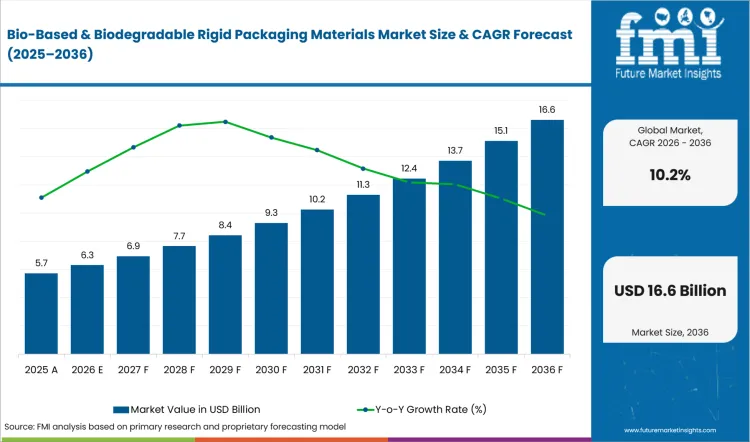
| Metric | Value |
|---|---|
| 2025 Market Size | USD 5.72 billion |
| 2026 Market Size | USD 6.3 billion |
| 2036 Market Size | USD 16.6 billion |
| Forecast CAGR (2026-2036) | 10.2% |
| Material Focus | PLA (34.0% share in 2026) |
| Product Focus | Bottles & Jars (36.0% share in 2026) |
| Degradability Focus | Industrially Compostable (44.0% share in 2026) |
Summary of the Bio-Based & Biodegradable Rigid Packaging Materials Market
| Market Signal | Commercial Impact |
|---|---|
| Demand and Growth Drivers | Commercial adoption depends largely on packaging performance during production and use, rather than sustainability claims alone. Materials that run reliably on existing equipment and protect products effectively are more likely to gain long-term acceptance.
|
| Product and Segment View | PLA remains a commonly evaluated material because manufacturers are familiar with its processing characteristics and commercial limitations. Bottles and jars attract particular attention, as barrier performance and heat resistance directly affect product quality and shelf life.
|
| Geography and Growth Outlook | Regional adoption patterns are influenced by manufacturing capabilities, regulatory frameworks, and waste-management systems. While Asia supports expanding pilot activity, European markets place greater emphasis on compliance and documented sustainability performance. >
|
| Competitive Landscape | Competitive success depends on more than material innovation alone. Key players in the sector increasingly differentiate themselves through technical support and proven production performance.
|
| Analyst Perspective | Long-term commercial success requires both reliable package performance and a practical recovery pathway after use. Suppliers that can demonstrate these capabilities through real-world applications are better positioned to accelerate adoption.
|
Source: FMI's proprietary forecasting model and primary research
How is the bio-based & biodegradable rigid packaging materials market segmented?
The bio-based & biodegradable rigid packaging materials industry is segmented by material, product, degradability, end use, channel, and region.
The industry is segmented by material, product, degradability, end use, channel, and region. Material coverage includes PLA, bio-PE or bio-PET, starch blends, PHA, and cellulose-based options used in rigid packaging. Product coverage includes bottles and jars, trays and containers, cups and tubs, and caps and closures. Degradability separates industrially compostable formats from durable bio-based and home-compostable alternatives during this market analysis. End-use analysis covers food and beverage, consumer goods, cosmetics, and pharmaceuticals across rigid package programs. Channel analysis distinguishes business-to-business supply from business-to-consumer routes across direct and retail sales programs worldwide. Regional coverage spans North America, Latin America, Europe, East Asia, South Asia and Pacific, Oceania, and the Middle East and Africa within wider bio-based biodegradable plastics demand.
What supports demand for PLA within the material category?
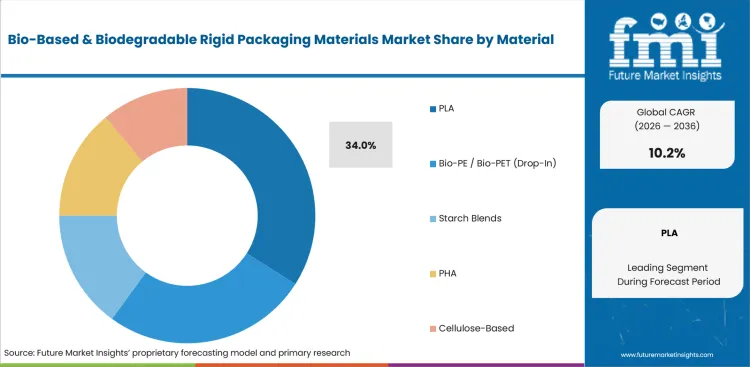
PLA enters qualification with an advantage because rigid-pack producers already understand thermoforming and injection molding behavior. NatureWorks expanded its Ingeo range in March 2025 with a grade designed for faster disintegration and better film processing. The development supports capsule components and related packaging structures where sealing performance affects commercial output. Packaging engineers continue to test heat resistance and impact behavior before approving PLA for repeated filling runs.
- By material, PLA is projected to hold 34.0% share in 2026 owing to its established supply base and broad fit across capsules or cups. Trays and injection-molded parts provide additional applications for established grades across food or consumer programs. Its familiar processing window limits equipment changes during initial trials, although package geometry and service temperature determine final approval.
- Rigid-pack producers are increasingly purchasing PLA led by clear resin specifications and available processing guides. Teams serving polylactic acid supply chains compare crystallization control and seal performance before choosing grades for hot-fill or chilled-food packs. Cosmetic applications require separate reviews of finish quality and dimensional stability before tooling receives commercial approval.
How do packaging teams evaluate bottles and jars within the product category?
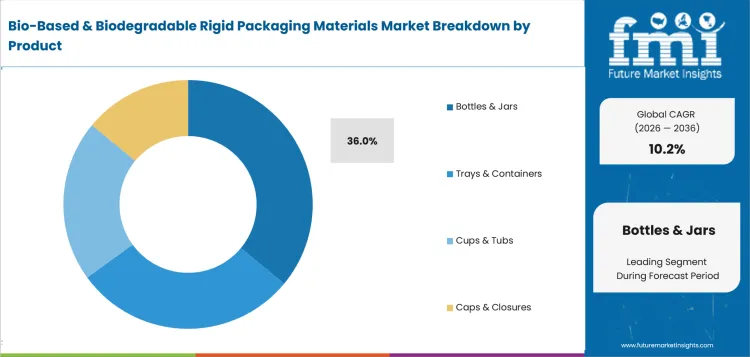
Bottle and jar programs expose barrier loss or stress cracking early because package walls carry product protection duties. TotalEnergies Corbion presented a label-free PLA water bottle for South Korea during February 2026 commercial trials. Embossed branding removed a separate label and supported cleaner material sorting within a closed-loop system.
- In 2026, bottles and jars are expected to lead the product category with 36.0% share because brands use these formats across beverages and cosmetics. Household products provide another repeat-use route for rigid containers that need stable walls and controlled dosing. Their geometry exposes barrier loss or drop-performance problems during early qualification on commercial filling equipment trials.
- Bottles and jars are drawing demand from brand teams owing to shelf visibility and repeated filling-line use. Programs connected to plant-based food packaging demand require resin data covering migration and sealing before commercial release.
What makes industrially compostable formats central to the degradability category?
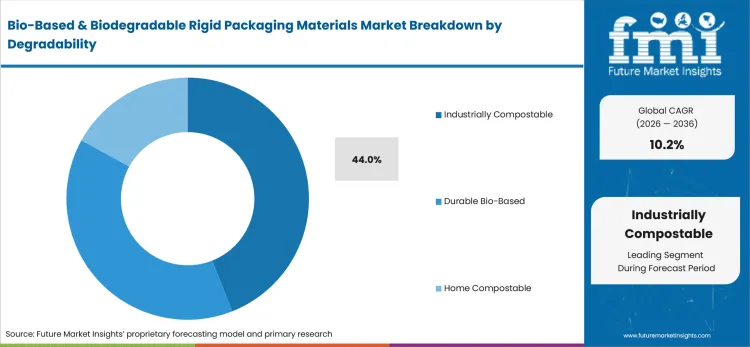
Industrial compostability creates commercial value only where certified items reach a managed organic-waste system after use. Sulapac and TripleW reported a closed-loop cup pilot during November 2025 that linked collection with chemical recycling. The project shows why disposal claims need operating partners and clear acceptance rules across each collection program. Packaging teams therefore review certification scope and local collection access beside resin performance during supplier qualification.
- Industrially compostable formats are likely to capture 44.0% share in 2026 attributable to clearer certification routes than broad biodegradable claims. Their position remains linked to foodservice and specialty packs that reach controlled collection systems after use.
- Sales of industrially compostable formats are forecast to gain traction in foodservice and capsule applications reinforced by certified collection pathways. Companies are also tracking biodegradable packaging demand analysis to compare facility acceptance and contamination risk before placing disposal language on finished packs.
What are the drivers, restraints, and opportunities in the bio-based & biodegradable rigid packaging materials market?
Demand is projected to rise where familiar conversion routes protect output. Heat limits and weak collection access constrain adoption, while grades that fit existing tools create the clearest commercial opening.
- Driver: Packaging manufacturers are expected to test bio-based resins where brands need lower fossil input without rebuilding established filling lines.
- Restraint: Heat limits and unclear collection routes are expected to delay approval because disposal claims must remain credible after consumer use.
- Opportunity: Existing thermoforming and blow-molding assets are projected to support grades that match conventional cycle times and food-contact rules.
Material conversion is entering operating budgets for bottle and container programs that once remained at the design stage. Braskem reported expanded renewable ethylene output during May 2025 after its Brazilian unit exceeded the original nameplate level. The broader supply base gives packaging producers more room to test drop-in bio-PE without changing established molding routines. Commercial adoption depends on documented renewable content and repeatable resin supply across each planned commercial production campaign.
Disposal language remains a hard qualification problem because biodegradable packs often enter several waste routes after consumer use. The USA Environmental Protection Agency revised federal foodservice guidance during October 2025 and tied compostable purchasing to local facility acceptance. Suppliers therefore need to explain the intended collection system before a brand approves disposal language. Reputational risk rises after certified packaging reaches a facility that rejects the material or lacks separate collection.
A lucrative opportunity for players in the market exists in rigid formats that run on existing tools with limited process change. For instance, Avantium signed a conditional offtake agreement in June 2025 for plant-based PEF juice bottles supplied to Hoogesteger. The project connects barrier performance with commercial bottle production and measurable retail use across fresh juice programs. Suppliers in the compostable plastic packaging industry are expected to secure trials after proving process fit and credible recovery routes together.
Which country CAGRs are profiled in the bio-based & biodegradable rigid packaging materials market?
.webp "Top Country Growth Comparison Bio Based & Biodegradable Rigid Packaging Materials Market Cagr (2026 2036)")
| Country | CAGR |
|---|---|
| United States | 9.4% |
| China | 11.6% |
| India | 12.3% |
| Germany | 10.8% |
| United Kingdom | 10.5% |
| France | 10.2% |
| Japan | 8.7% |
Source: FMI's proprietary forecasting model and primary research
How do country-level CAGRs compare in the bio-based & biodegradable rigid packaging materials market?
Country growth is projected to separate markets with local resin access from markets that depend on imported specialty grades. India and China are expected to expand notably because packaging processors pair output growth with local trial capacity. Germany and France face tighter evidence requirements during design reviews under European packaging rules from 2026. The United Kingdom adds tax exposure and producer-responsibility costs to supplier reviews during material selection. The United States offers broad food and consumer demand despite uneven composting access across local collection systems. Japan favors stable specifications and recycling compatibility before repeated commercial orders enter multi-plant production programs.
- Foodservice and consumer brands create a broad trial base for alternative rigid materials across the United States. Adoption is estimated to expand at 9.4% CAGR from 2026 to 2036 due to recurring package redesign and varied state waste rules. Federal foodservice guidance now links compostable purchasing with local facility acceptance and separate collection requirements. NatureWorks supports domestic PLA programs from Minnesota while converters test cups and capsules beside selected rigid containers. Companies serving compostable foodservice packaging demand need regional recovery evidence beside processing data before receiving repeat orders.
- Manufacturing clusters give Chinese packaging processors access to local tooling and shorter feedback cycles for packaging trials. Large delivery channels create recurring demand for rigid cups and containers across several industrial regions. Bio-based and biodegradable rigid packaging demand is forecast to rise at 11.6% CAGR from 2026 to 2036 supported by conversion capacity and waste-reduction programs. A revised express-delivery regulation strengthened attention on packaging material reduction during June 2025 implementation reviews. Domestic resin producers are competing beside international suppliers during repeated tests on high-output commercial molding lines.
- Food packaging reviews in India increasingly combine safety requirements with material evidence and defensible disposal claims. FSSAI convened a national consultation in Mumbai during April 2025 to connect regulators with food businesses and packaging specialists. India is estimated to post 12.3% CAGR from 2026 to 2036 attributable to expanding conversion activity and regional brand trials. Local packaging processors often use smaller runs before national launches and correct molding settings during those pilots. Suppliers in the starch-based bioplastics packaging sector are expected to compete on price stability and processing support.
- German packaging teams operate within a dense network of standards and qualification routines for rigid formats. Food and personal-care applications require careful migration reviews before commercial packaging trials begin across production plants. Bio-based and biodegradable rigid packaging is predicted to advance at 10.8% CAGR from 2026 to 2036 owing to formal design reviews and material substitution programs. Regulation (EU) 2025/40 brings recyclability and waste handling into earlier packaging design and supplier review work. Companies such as FKuR supply bio-based and compostable compounds for jars and molded packaging from German operations. Documentation shortens approval only after the material fits existing equipment and the intended rigid package geometry.
- United Kingdom procurement teams screen new rigid materials against tax exposure and producer-responsibility duties before approving commercial trials. Retail programs require evidence that disposal language matches the collection route available to consumers across local markets. The national outlook is anticipated to advance at 10.5% CAGR from 2026 to 2036 reinforced by package redesign and compliance work. HM Revenue & Customs updated Plastic Packaging Tax guidance during February 2026 for registered packaging businesses. Local conversion partners are expected to value distributors that explain grade availability and compliance files without delaying trials.
- French brand owners face the European packaging framework but work across a distinct mix of food and cosmetics programs. The sector is projected to record 10.2% CAGR from 2026 to 2036 led by package redesign and demand for traceable material claims. Regulation (EU) 2025/40 generally applies from August 2026 and gives converters a defined review timetable. Cosmetics programs create openings for rigid jars and compacts where surface quality remains visible during consumer use. Suppliers are expected to earn repeat orders after proving finish consistency and recovery compatibility within the same project. The commercial tension sits between premium appearance and material-processing limits during repeated cosmetics packaging production.
- Japanese package development emphasizes specification control and careful communication between resin producers and local converters. Recycling compatibility receives attention beside renewable feedstock claims during detailed material reviews for multilayer bottles. Avantium received Japanese approval during November 2025 for releaf PEF use within multilayer PET bottles. Bio-based and biodegradable rigid packaging sales are forecast to expand at 8.7% CAGR from 2026 to 2036 shaped by controlled qualification and material-science partnerships. Kaneka Corporation supplies Green Planet PHBH from an established Japanese material platform serving packaging applications.
Who are the notable companies in the bio-based & biodegradable rigid packaging materials market?
NatureWorks, TotalEnergies Corbion, Braskem, Novamont, CJ Biomaterials, Kaneka Corporation, Avantium, Sulapac, Paboco, and FKuR are the notable companies shaping this market.
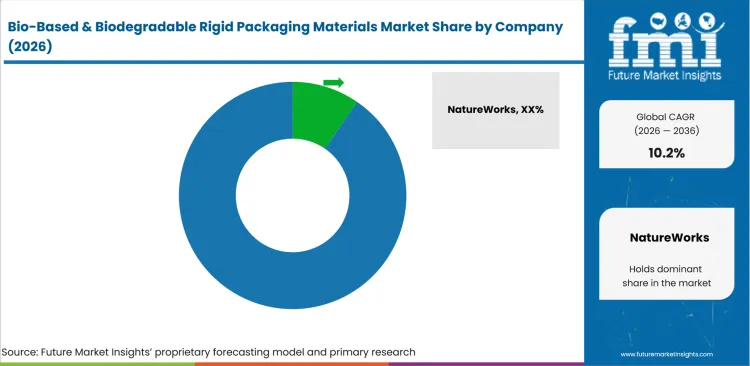
The competitive outlook includes players engaged in polymer production as well as application development activities required to qualify finished rigid packages for commercial use. Suppliers that offer consistent resin performance and strong technical support during product testing are often better positioned to secure commercial business. Companies specializing in packaging applications add value by demonstrating that bottles, capsules and fiber-based containers can be produced efficiently at scale. Companies serving bioplastic and biopolymer demand are expected to separate themselves through test data and clear end-of-life instructions.
- NatureWorks and TotalEnergies Corbion compete on PLA grades and application guidance for thermoformed or molded packs. Their commercial value rests on processing data and documented trials across capsules or bottles beside trays and foodservice containers. Bottle and capsule trials reveal where each supplier’s technical support creates practical value during commercial qualification.
- Braskem and FKuR support drop-in or compounded material routes that reduce equipment changes for rigid packaging manufacturers. Their portfolios cover bio-based polyethylene and compostable compounds suited to bottles or jars beside containers and molded accessories. Local distributors shorten grade selection and troubleshooting during early production trials across regional customer programs.
- Novamont and CJ Biomaterials compete on biodegradable polymer platforms that present different processing profiles for packaging producers. Kaneka Corporation adds PHBH capability for applications that need biodegradability beside resin performance and clear certification boundaries. Their differences become visible during heat testing and certification review for specific rigid packaging applications.
- Avantium and Sulapac connect new materials with finished package concepts across bottles or cosmetic formats. Paboco adds a fiber-bottle platform that shifts competition toward package architecture and integrated barrier performance. Each company competes on package proof instead of relying on resin volume or corporate scale alone.
Competitive Benchmarking: Bio-Based & Biodegradable Rigid Packaging Materials Market
| Company | Material Portfolio | Rigid Format Evidence | Technical Support | Service Reach |
|---|---|---|---|---|
| NatureWorks | High | High | High | Global |
| TotalEnergies Corbion | High | High | High | Global |
| Braskem | High | High | Medium | Global |
| Novamont | High | Medium | High | Europe and selected export markets |
| CJ Biomaterials | High | Medium | High | Global |
| Kaneka Corporation | High | Medium | Medium | Asia-Pacific and selected global markets |
| Avantium | Medium | High | High | Europe and partner markets |
| Sulapac | Medium | High | High | Europe and partner markets |
| Paboco | Low | High | Medium | Europe and partner markets |
| FKuR | High | Medium | High | Europe and international distribution |
Scoring basis: High indicates substantial direct capability in the stated dimension, while Medium indicates relevant but partial or indirect capability. Low indicates limited direct evidence for the stated dimension and does not imply an absence of adjacent capability.
Source: Future Market Insights competitive analysis, 2026. Ratings reflect relative portfolio relevance and workflow fit. Service capability and geographic reach shape the remaining comparison.
Key Developments in the Bio-Based & Biodegradable Rigid Packaging Materials Market
- January 2026, Braskem, presented its new I'm green bio-based Medcol VV7040 grade at Pharmapack Europe for pharmaceutical blow-fill-seal packaging. The renewable polyethylene grade combines stiffness and temperature performance with regulatory support for pharmaceutical package qualification.
- May 2026, Sulapac, worked with G&Co Thermoforming to present a cosmetic compact made with a thermoformed bio-based body and cellulose flocking. The pack uses established thermoforming methods and avoids conventional plastic flocking during cosmetic package production.
- June 2026, Avantium, started a collaboration with Gepack and Frubaça to test small releaf PEF bottles for functional beverage shots. Gepack produces the small bottles before Frubaça evaluates filling performance across functional beverage production trials.
- July 2026, TotalEnergies Corbion, launched Luminy FOAM 50F for rigid foam trays and foodservice containers made on established polystyrene foam equipment. The PLA grade supports rigid clamshells and bowls with limited process change on established foam equipment.
Key Players in the Bio-Based & Biodegradable Rigid Packaging Materials Market
Resin and polymer platform suppliers
- NatureWorks
- TotalEnergies Corbion
- Braskem
- Novamont
- CJ Biomaterials
- Kaneka Corporation
- FKuR
Rigid package application specialists
- Sulapac
- Paboco
Plant-based bottle material developer
- Avantium
Bio-Based & Biodegradable Rigid Packaging Materials Market - Report Scope
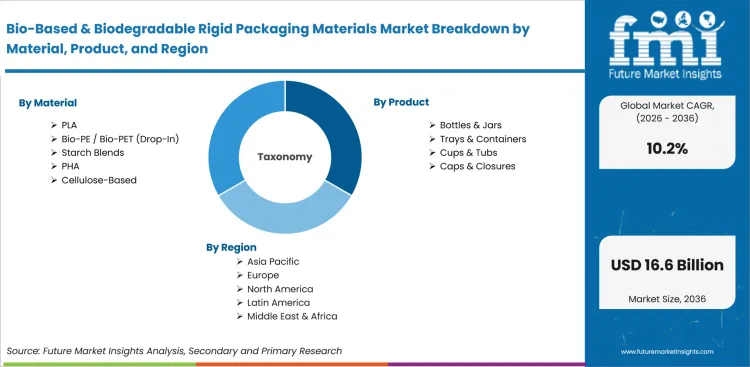
| Coverage field | Report scope |
|---|---|
| Market breakdown | Material, product, degradability, end use, channel, country, and regional analysis. |
| Market Definition | Rigid packaging materials made partly or fully from renewable feedstocks. The scope includes durable bio-based plastics and materials designed for industrial or home composting. |
| Regions Covered | North America, Latin America, Europe, East Asia, South Asia and Pacific, Oceania, and the Middle East and Africa. |
| Countries Covered | United States, China, India, Germany, United Kingdom, France, Japan, and more than 30 additional countries. |
| Key Companies Profiled | NatureWorks, TotalEnergies Corbion, Braskem, Novamont, CJ Biomaterials, Kaneka Corporation, Avantium, Sulapac, Paboco, and FKuR. |
| Forecast Period | 2026 to 2036, with 2025 used as the historical market-size reference. |
| Approach | Hybrid bottom-up and top-down sizing that combines supplier evidence with application adoption patterns and country-level packaging conditions. |
Source: Future Market Insights - analysis driven by proprietary forecasting models and primary research
Bio-Based & Biodegradable Rigid Packaging Materials Market - Research Methodology
| Method | Approach |
|---|---|
| Primary Research | Interviews with resin producers and rigid packaging manufacturers test whether material claims match thermoforming or injection molding requirements. Discussions with brand teams assess qualification timing and expected order size before commercial approval across planned package programs. Researchers examine food-contact files and technical support before reviewing supply continuity across planned commercial production. They also assess whether local collection routes support industrially compostable bottles or trays beside cups and closures. |
| Desk Research | Official regulations and standards establish the policy baseline for package design and waste claims across each profiled country. Company technical pages and dated announcements provide evidence on resin grades or bottle projects for rigid applications. Application pages show whether materials support thermoforming and molded formats across rigid packaging applications. Certification records clarify whether compostable claims match the intended package and recovery system during commercial use. Documented plants or distributors establish geographic service coverage across each target market and customer base. |
| Market Sizing and Forecasting | The forecast starts with material revenue linked to rigid packaging applications and then reconciles product or end-use adoption. Segment shares reflect processing fit and established commercial use across bottles or jars beside trays and closures. Country CAGRs reflect converter capacity and regulatory pressure alongside material availability and local qualification speed. |
| Data Validation | Researchers compare supplier interviews with feedback from packaging producers and official application evidence before finalizing adoption assumptions. Material revenue is checked against rigid-format use and expected qualification timing across the forecast period. Country estimates are tested against local packaging rules and conversion capacity across each profiled national market. Final forecasts are challenged through bottom-up supplier estimates and top-down end-use demand before the model settles on one consistent market path for publication. |
Source: Future Market Insights (FMI) analysis, based on proprietary forecasting model and primary research
Bio-Based & Biodegradable Rigid Packaging Materials Market by Segments
Bio-Based & Biodegradable Rigid Packaging Materials Market segmented by Material:
- PLA
- Bio-PE / Bio-PET (Drop-In)
- Starch Blends
- PHA
- Cellulose-Based
Bio-Based & Biodegradable Rigid Packaging Materials Market segmented by Product:
- Bottles & Jars
- Trays & Containers
- Cups & Tubs
- Caps & Closures
Bio-Based & Biodegradable Rigid Packaging Materials Market segmented by Degradability:
- Industrially Compostable
- Durable Bio-Based
- Home Compostable
Bio-Based & Biodegradable Rigid Packaging Materials Market segmented by End Use:
- Food & Beverage
- Consumer Goods
- Cosmetics
- Pharmaceuticals
Bio-Based & Biodegradable Rigid Packaging Materials Market segmented by Channel:
- Business-to-Business
- Business-to-Consumer
Bio-Based & Biodegradable Rigid Packaging Materials Market by Region:
- North America
- United States
- Canada
- Latin America
- Brazil
- Mexico
- Argentina
- Europe
- Germany
- United Kingdom
- France
- Italy
- Spain
- Benelux
- Nordics
- Rest of Europe
- East Asia
- China
- Japan
- South Korea
- South Asia and Pacific
- India
- ASEAN
- Australia and New Zealand
- Rest of South Asia and Pacific
- Oceania
- Australia
- New Zealand
- Pacific Island markets
- Middle East and Africa
- Gulf Cooperation Council countries
- South Africa
- Türkiye
- North Africa
- Rest of Middle East and Africa
Research Sources and Bibliography
- European Commission. (2025). Packaging waste.
- USA Environmental Protection Agency. (2025, October 22). Identifying sustainable food service and food service ware.
- HM Revenue & Customs. (2026, February 12). Plastic Packaging Tax: steps to take.
- Department for Environment, Food & Rural Affairs. (2025, June 30). Extended Producer Responsibility for Packaging: 2025 base fees.
- Press Information Bureau. (2025, April 17). Union MoS for Health & Family Welfare inaugurates FSSAI's National Stakeholder Consultation on Sustainable Packaging.
- State Council Information Office of China. (2025, June 5). China accelerates express delivery green packaging amid mid-year shopping festival.
- Ministry of Economy, Trade and Industry. (2025). Circular economy action in Japan.
- NatureWorks. (2025, March 18). Ingeo Extend: An exceptional solution offering unprecedented manufacturing efficiency and faster biodegradability of BOPLA films.
- NatureWorks. (2025, March 25). FLO Group and NatureWorks present KEYGEA: The Ingeo-based compostable coffee pod set to revolutionize the North American market.
- TotalEnergies Corbion. (2026, February 19). Embossed, label-free PLA water bottle design simplifies circularity.
- TotalEnergies Corbion. (2026, July 7). A new polystyrene alternative: Low-carbon, circular PLA foam.
- Braskem. (2025, May 6). Celebrating 15 years of I'm green bio-based with operation rates above nameplate capacity after expansion.
- Braskem. (2026, January 21). Braskem showcases new I'm green bio-based grade at Pharmapack 2026.
- Avantium. (2025, June 4). Avantium collaborates with Hoogesteger on PEF bottles for fresh juices.
- Avantium. (2025, November 4). Avantium's releaf receives CPBR approval for recycling in Japan.
- Avantium. (2026, June 29). Avantium collaborates with Gepack and Frubaça on small PEF bottles for functional beverage shots.
- Sulapac. (2025, November 21). Breakthrough in bio-composite recycling: From post-consumer waste into lactic acid at scale.
- Sulapac. (2026, May 27). G&Co Thermoforming launches Sulapac packaging with bio-based flocking.
- CJ Biomaterials. (2025, October 1). CJ Biomaterials launches new PHA platform for extrusion coatings.
- Kaneka Corporation. (2026). How does Kaneka Biodegradable Polymer Green Planet make the world healthy?
- Novamont. (2025). Impact report 2024.
- Paboco. (2026). The paper bottle platform.
- FKuR. (2026). Boxes and jars from bio-based or biodegradable plastics.
This bibliography is provided for reader reference and uses primary government, standards-body, official trade body, and company sources.
This Report Answers
- What is the estimated value of the Bio-Based & Biodegradable Rigid Packaging Materials Market in 2026 and 2036?
- What CAGR is projected for the Bio-Based & Biodegradable Rigid Packaging Materials Market from 2026 to 2036?
- Which material and rigid product formats account for the disclosed 2026 segment shares?
- Which operating pressures support adoption of bio-based or biodegradable rigid packaging materials?
- How do country CAGRs differ across the United States, China, India, Germany, the United Kingdom, France, and Japan?
- Which competitive dimensions separate polymer suppliers from rigid package application specialists?
- How does Future Market Insights validate market values and company relevance?
- What should converters address before selecting a bio-based or biodegradable resin for rigid packaging?
- How do food-contact files and disposal claims affect supplier selection?
Frequently Asked Questions
What is driving growth in the Bio-Based & Biodegradable Rigid Packaging Materials Market?
Brand package redesign supports demand for resins that fit established molding equipment and protect commercial production output. Policy reviews are expected to increase requests for documented performance and credible disposal claims during supplier qualification.
Who are the key players in the Bio-Based & Biodegradable Rigid Packaging Materials Market?
NatureWorks and TotalEnergies Corbion compete through PLA platforms supported by application guidance for rigid packaging converters. Braskem and specialist suppliers add drop-in materials or finished-package evidence across bottles and molded containers.
What is a considerable restraint in the Bio-Based & Biodegradable Rigid Packaging Materials Market?
Heat resistance and barrier limits delay qualification for bottles or food containers during repeated production trials. Commercial progress also weakens where local facilities reject certified compostable packaging after consumers discard it.
Why should executives track the Bio-Based & Biodegradable Rigid Packaging Materials Market?
The market affects material sourcing across food and consumer categories that rely on rigid packaging formats. Executives need early visibility into conversion costs and evidence requirements before approving package redesign programs.
What business problem does the Bio-Based & Biodegradable Rigid Packaging Materials Market address?
These materials reduce fossil feedstock use or support controlled composting routes for selected rigid packaging applications. They also preserve product protection and dimensional stability expected from bottles or molded containers during distribution.
What should procurement leaders evaluate before selecting suppliers?
Procurement leaders should review processing data and food-contact files for the intended equipment and package geometry. They should confirm supply continuity and technical response before approving commercial volume across repeated production campaigns.
What limits return on investment for purchasers?
Return weakens after converters need repeated tooling changes or longer production cycles during commercial package production. Limited recovery access also reduces the value of compostable claims after consumers discard the finished packaging.
How do suppliers build long-term account confidence?
Suppliers build confidence by maintaining stable resin specifications and documented performance across repeated commercial orders. Technical teams strengthen relationships after resolving molding problems and explaining certification limits to brand procurement teams.
Preview the report firsthand - request a free sample
Get SampleGet the brochure for pricing and purchase details.
Get PDFTable of Content
- Key Takeaways
- Market Size and CAGR
- Top Growth Driver
- Fastest Growing Segment
- Leading Region
- Key Companies
- Emerging Opportunities
- Executive Summary
- Global Market Outlook
- Demand-side Trends
- Supply-side Trends
- Technology Roadmap Analysis
- Analysis and Recommendations
- Analyst Perspective (What is happening? Why now? What should investors know?)
- Key Questions Answered
- How large is the market?
- What is the CAGR?
- What are key trends?
- Which region dominates?
- Who are the leaders?
- Market Overview
- Market Coverage / Taxonomy
- Market Definition / Scope / Limitations
- Research Methodology
- Chapter Orientation
- Analytical Lens and Working Hypotheses
- Market Structure, Signals, and Trend Drivers
- Benchmarking and Cross-market Comparability
- Market Sizing, Forecasting, and Opportunity Mapping
- Research Design and Evidence Framework
- Desk Research Programme (Secondary Evidence)
- Expert Input and Fieldwork (Primary Evidence)
- Tooling, Models, and Reference Databases
- Data Engineering and Model Build
- Quality Assurance and Audit Trail
- Market Background
- Market Dynamics (Drivers, Restraints, Opportunity, Trends)
- Scenario Forecast (Optimistic, Likely, Conservative)
- Impact Analysis
- AI Impact
- Sustainability Impact
- Regulatory Impact
- Technology Impact
- Consumer / Buyer Analysis
- Purchase Drivers
- Adoption Barriers
- Buyer Journey
- Opportunity Map Analysis
- Product Life Cycle Analysis
- Supply Chain Analysis
- Investment Feasibility Matrix
- Value Chain Analysis
- PESTLE and Porter's Analysis
- Regulatory Landscape
- Regional Parent Market Outlook
- Production and Consumption Statistics
- Import and Export Statistics
- Global Market Analysis and Forecast, 2021 to 2036
- Historical Market Size Value (USD Billion) Analysis, 2021 to 2025
- Current and Future Market Size Value (USD Billion) Projections, 2026 to 2036
- Y-o-Y Growth Trend Analysis
- Absolute $ Opportunity Analysis
- Global Market Pricing Analysis, 2021 to 2036
- Global Market Analysis and Forecast, By Material, 2021 to 2036
- Introduction / Key Findings
- Historical Market Size Value (USD Billion) Analysis By Material, 2021 to 2025
- Current and Future Market Size Value (USD Billion) Analysis and Forecast By Material, 2026 to 2036
- PLA
- Bio-PE / Bio-PET (Drop-In)
- Starch Blends
- PHA
- Cellulose-Based
- PLA
- Y-o-Y Growth Trend Analysis By Material, 2021 to 2025
- Absolute $ Opportunity Analysis By Material, 2026 to 2036
- Global Market Analysis and Forecast, By Product, 2021 to 2036
- Introduction / Key Findings
- Historical Market Size Value (USD Billion) Analysis By Product, 2021 to 2025
- Current and Future Market Size Value (USD Billion) Analysis and Forecast By Product, 2026 to 2036
- Bottles & Jars
- Trays & Containers
- Cups & Tubs
- Caps & Closures
- Bottles & Jars
- Y-o-Y Growth Trend Analysis By Product, 2021 to 2025
- Absolute $ Opportunity Analysis By Product, 2026 to 2036
- Global Market Analysis and Forecast, By Degradability, 2021 to 2036
- Introduction / Key Findings
- Historical Market Size Value (USD Billion) Analysis By Degradability, 2021 to 2025
- Current and Future Market Size Value (USD Billion) Analysis and Forecast By Degradability, 2026 to 2036
- Industrially Compostable
- Durable Bio-Based
- Home Compostable
- Industrially Compostable
- Y-o-Y Growth Trend Analysis By Degradability, 2021 to 2025
- Absolute $ Opportunity Analysis By Degradability, 2026 to 2036
- Global Market Analysis and Forecast, By End Use, 2021 to 2036
- Introduction / Key Findings
- Historical Market Size Value (USD Billion) Analysis By End Use, 2021 to 2025
- Current and Future Market Size Value (USD Billion) Analysis and Forecast By End Use, 2026 to 2036
- Food & Beverage
- Consumer Goods
- Cosmetics
- Pharma
- Food & Beverage
- Y-o-Y Growth Trend Analysis By End Use, 2021 to 2025
- Absolute $ Opportunity Analysis By End Use, 2026 to 2036
- Global Market Analysis and Forecast, By Channel, 2021 to 2036
- Introduction / Key Findings
- Historical Market Size Value (USD Billion) Analysis By Channel, 2021 to 2025
- Current and Future Market Size Value (USD Billion) Analysis and Forecast By Channel, 2026 to 2036
- B2B
- B2C
- B2B
- Y-o-Y Growth Trend Analysis By Channel, 2021 to 2025
- Absolute $ Opportunity Analysis By Channel, 2026 to 2036
- Global Market Analysis and Forecast, By Region, 2021 to 2036
- Introduction
- Historical Market Size Value (USD Billion) Analysis By Region, 2021 to 2025
- Current Market Size Value (USD Billion) Analysis and Forecast By Region, 2026 to 2036
- North America
- Latin America
- Western Europe
- Eastern Europe
- East Asia
- South Asia and Pacific
- Middle East & Africa
- Market Attractiveness Analysis By Region
- North America Market Analysis and Forecast, By Country, 2021 to 2036
- Historical Market Size Value (USD Billion) Trend Analysis By Market Taxonomy, 2021 to 2025
- Market Size Value (USD Billion) Forecast By Market Taxonomy, 2026 to 2036
- By Country
- USA
- Canada
- By Material
- By Product
- By Degradability
- By End Use
- By Channel
- By Country
- Market Attractiveness Analysis
- By Country
- By Material
- By Product
- By Degradability
- By End Use
- By Channel
- Key Takeaways
- Latin America Market Analysis and Forecast, By Country
- Historical Market Size Value (USD Billion) Trend Analysis By Market Taxonomy, 2021 to 2025
- Market Size Value (USD Billion) Forecast By Market Taxonomy, 2026 to 2036
- By Country
- Brazil
- Mexico
- Chile
- Rest of Latin America
- By Material
- By Product
- By Degradability
- By End Use
- By Channel
- By Country
- Market Attractiveness Analysis
- By Country
- By Material
- By Product
- By Degradability
- By End Use
- By Channel
- Key Takeaways
- Western Europe Market Analysis and Forecast, By Country
- Historical Market Size Value (USD Billion) Trend Analysis By Market Taxonomy, 2021 to 2025
- Market Size Value (USD Billion) Forecast By Market Taxonomy, 2026 to 2036
- By Country
- Germany
- UK
- Italy
- Spain
- France
- Nordic
- BENELUX
- Rest of Western Europe
- By Material
- By Product
- By Degradability
- By End Use
- By Channel
- By Country
- Market Attractiveness Analysis
- By Country
- By Material
- By Product
- By Degradability
- By End Use
- By Channel
- Key Takeaways
- Eastern Europe Market Analysis and Forecast, By Country
- Historical Market Size Value (USD Billion) Trend Analysis By Market Taxonomy, 2021 to 2025
- Market Size Value (USD Billion) Forecast By Market Taxonomy, 2026 to 2036
- By Country
- Russia
- Poland
- Hungary
- Balkan & Baltic
- Rest of Eastern Europe
- By Material
- By Product
- By Degradability
- By End Use
- By Channel
- By Country
- Market Attractiveness Analysis
- By Country
- By Material
- By Product
- By Degradability
- By End Use
- By Channel
- Key Takeaways
- East Asia Market Analysis and Forecast, By Country
- Historical Market Size Value (USD Billion) Trend Analysis By Market Taxonomy, 2021 to 2025
- Market Size Value (USD Billion) Forecast By Market Taxonomy, 2026 to 2036
- By Country
- China
- Japan
- South Korea
- By Material
- By Product
- By Degradability
- By End Use
- By Channel
- By Country
- Market Attractiveness Analysis
- By Country
- By Material
- By Product
- By Degradability
- By End Use
- By Channel
- Key Takeaways
- South Asia and Pacific Market Analysis and Forecast, By Country
- Historical Market Size Value (USD Billion) Trend Analysis By Market Taxonomy, 2021 to 2025
- Market Size Value (USD Billion) Forecast By Market Taxonomy, 2026 to 2036
- By Country
- India
- ASEAN
- Australia & New Zealand
- Rest of South Asia and Pacific
- By Material
- By Product
- By Degradability
- By End Use
- By Channel
- By Country
- Market Attractiveness Analysis
- By Country
- By Material
- By Product
- By Degradability
- By End Use
- By Channel
- Key Takeaways
- Middle East & Africa Market Analysis and Forecast, By Country
- Historical Market Size Value (USD Billion) Trend Analysis By Market Taxonomy, 2021 to 2025
- Market Size Value (USD Billion) Forecast By Market Taxonomy, 2026 to 2036
- By Country
- Kingdom of Saudi Arabia
- Other GCC Countries
- Türkiye
- South Africa
- Other African Union
- Rest of Middle East & Africa
- By Material
- By Product
- By Degradability
- By End Use
- By Channel
- By Country
- Market Attractiveness Analysis
- By Country
- By Material
- By Product
- By Degradability
- By End Use
- By Channel
- Key Takeaways
- Key Countries Market Analysis
- USA
- Pricing Analysis
- Market Share Analysis, 2025
- By Material
- By Product
- By Degradability
- By End Use
- By Channel
- Canada
- Pricing Analysis
- Market Share Analysis, 2025
- By Material
- By Product
- By Degradability
- By End Use
- By Channel
- Mexico
- Pricing Analysis
- Market Share Analysis, 2025
- By Material
- By Product
- By Degradability
- By End Use
- By Channel
- Brazil
- Pricing Analysis
- Market Share Analysis, 2025
- By Material
- By Product
- By Degradability
- By End Use
- By Channel
- Chile
- Pricing Analysis
- Market Share Analysis, 2025
- By Material
- By Product
- By Degradability
- By End Use
- By Channel
- Germany
- Pricing Analysis
- Market Share Analysis, 2025
- By Material
- By Product
- By Degradability
- By End Use
- By Channel
- UK
- Pricing Analysis
- Market Share Analysis, 2025
- By Material
- By Product
- By Degradability
- By End Use
- By Channel
- Italy
- Pricing Analysis
- Market Share Analysis, 2025
- By Material
- By Product
- By Degradability
- By End Use
- By Channel
- Spain
- Pricing Analysis
- Market Share Analysis, 2025
- By Material
- By Product
- By Degradability
- By End Use
- By Channel
- France
- Pricing Analysis
- Market Share Analysis, 2025
- By Material
- By Product
- By Degradability
- By End Use
- By Channel
- India
- Pricing Analysis
- Market Share Analysis, 2025
- By Material
- By Product
- By Degradability
- By End Use
- By Channel
- ASEAN
- Pricing Analysis
- Market Share Analysis, 2025
- By Material
- By Product
- By Degradability
- By End Use
- By Channel
- Australia & New Zealand
- Pricing Analysis
- Market Share Analysis, 2025
- By Material
- By Product
- By Degradability
- By End Use
- By Channel
- China
- Pricing Analysis
- Market Share Analysis, 2025
- By Material
- By Product
- By Degradability
- By End Use
- By Channel
- Japan
- Pricing Analysis
- Market Share Analysis, 2025
- By Material
- By Product
- By Degradability
- By End Use
- By Channel
- South Korea
- Pricing Analysis
- Market Share Analysis, 2025
- By Material
- By Product
- By Degradability
- By End Use
- By Channel
- Russia
- Pricing Analysis
- Market Share Analysis, 2025
- By Material
- By Product
- By Degradability
- By End Use
- By Channel
- Poland
- Pricing Analysis
- Market Share Analysis, 2025
- By Material
- By Product
- By Degradability
- By End Use
- By Channel
- Hungary
- Pricing Analysis
- Market Share Analysis, 2025
- By Material
- By Product
- By Degradability
- By End Use
- By Channel
- Kingdom of Saudi Arabia
- Pricing Analysis
- Market Share Analysis, 2025
- By Material
- By Product
- By Degradability
- By End Use
- By Channel
- Türkiye
- Pricing Analysis
- Market Share Analysis, 2025
- By Material
- By Product
- By Degradability
- By End Use
- By Channel
- South Africa
- Pricing Analysis
- Market Share Analysis, 2025
- By Material
- By Product
- By Degradability
- By End Use
- By Channel
- USA
- Market Structure Analysis
- Competition Dashboard
- Competition Benchmarking
- Market Share Analysis of Top Players
- By Regional
- By Material
- By Product
- By Degradability
- By End Use
- By Channel
- Emerging Startups
- Innovation Benchmarking
- Competition Analysis
- Competition Deep Dive
- NatureWorks
- Overview
- Product Portfolio
- Profitability by Market Segments
- Sales Footprint
- Strategy Overview
- Marketing Strategy
- Product Strategy
- Channel Strategy
- TotalEnergies Corbion
- Braskem
- Novamont
- Danimer Scientific
- Mitsubishi Chemical
- Eastman
- Sulapac
- Paboco
- Origin Materials
- NatureWorks
- Case Studies
- Success Stories
- Recent Developments
- Competition Deep Dive
- Assumptions & Acronyms Used


