

- Industry Size (2026)
- USD 2.5 Bn
- Forecast (2036)
- USD 4.7 Bn
- CAGR (2026 to 2036)
- 6.50%
Ceramic Filler Powders Market Forecast and Outlook 2026 to 2036
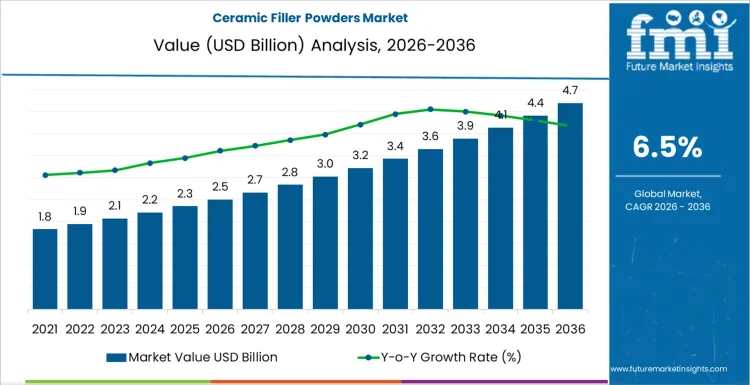
The ceramic filler powders market begins the forecast period at USD 2.5 billion in 2026 and is expected to scale to USD 4.7 billion by 2036, expanding at 6.50% CAGR. The ceramic filler powders market is progressing steadily as manufacturers across plastics, coatings, adhesives, electronics, and construction materials increasingly rely on mineral fillers to enhance mechanical strength, thermal stability, electrical insulation, and dimensional control. Ceramic fillers such as alumina, silica, zirconia, and titania are widely incorporated to improve wear resistance, heat tolerance, and durability while maintaining formulation cost efficiency.
Demand is reinforced by the rising use of engineered plastics, high-performance composites, and functional coatings in automotive, industrial equipment, electronics packaging, and infrastructure applications. Material selection is strongly influenced by particle size distribution, surface treatment, and compatibility with polymer and resin systems, as these factors directly affect dispersion quality, processing behavior, and long-term performance. Growth is further supported by automation in manufacturing and tightening quality standards, which favor consistent, high-purity filler grades.
Quick Stats for Ceramic Filler Powders Market
- Ceramic Filler Powders Market Value (2026): USD 2.5 Billion
- Ceramic Filler Powders Market Forecast Value (2036): USD 4.7 Billion
- Ceramic Filler Powders Market Forecast CAGR 2026 to 2036: 6.50%
- Leading Material Type in Ceramic Filler Powders Market: Alumina-Based Fillers (38% share)
- Leading Application in Ceramic Filler Powders Market: Polymer Compounds & Plastics (34% share)
- Key Growth Regions in Ceramic Filler Powders Market: Asia Pacific, Europe, North America, Latin America, Middle East & Africa
- Top Key Players in Ceramic Filler Powders Market: 3M, Saint-Gobain, Henkel, Momentive, Showa Denko Materials, Imerys, CeramTec, H.C. Starck (MHC Group), Sumitomo Chemical, Mitsubishi Chemical Group
Ceramic Filler Powders Market Key Takeaways
| Metric | Value |
|---|---|
| Ceramic Filler Powders Market Value (2026) | USD 2.5 Billion |
| Ceramic Filler Powders Market Forecast Value (2036) | USD 4.7 Billion |
| Ceramic Filler Powders Market Forecast CAGR 2026 to 2036 | 6.50% |
How are Material Reinforcement Needs and Thermal Performance Requirements Driving the Ceramic Filler Powders Market?
The ceramic filler powders market is expanding as manufacturers seek materials that enhance mechanical strength, thermal stability, and electrical insulation in polymer, composite, and coating systems. Ceramic fillers such as alumina, silica, zirconia, and calcium carbonate are widely used to improve hardness, wear resistance, and dimensional stability while maintaining cost efficiency. Growth in construction materials, industrial coatings, electronics packaging, and automotive components is increasing demand for fillers that can withstand high temperatures and harsh operating environments.
Formulation performance and particle characteristics play a central role in purchasing decisions. End users evaluate ceramic filler powders based on particle size distribution, surface treatment, and compatibility with different resin systems. In polymers and elastomers, optimized ceramic fillers improve flow behavior, reduce shrinkage, and enhance long-term durability. In electronics and electrical applications, ceramic fillers contribute to thermal management and dielectric performance, supporting miniaturization and reliability in advanced components.
Industrial scaling and application diversification are further reinforcing market growth. Rising use of high-performance composites, energy-efficient building materials, and advanced manufacturing techniques is broadening the application base for ceramic fillers. At the same time, process automation and tighter quality standards are driving demand for consistent, high-purity filler powders. For suppliers, competitive advantage increasingly depends on particle engineering capabilities, application-specific customization, and reliable supply positioning ceramic filler powders as a foundational material across multiple performance-driven industries.
How is the Ceramic Filler Powders Market Structured by Material Type and Application?
The ceramic filler powders market is structured by material type and application, reflecting how hardness, thermal stability, and compatibility with host matrices influence filler selection. By material type, alumina-based fillers represent the leading segment, widely used for reinforcing mechanical strength and improving thermal performance. Other material categories include silica and silicate fillers, titania and zirconia fillers, and other ceramic fillers selected for specific functional requirements. By application, polymer compounds and plastics account for the largest demand, followed by coatings and paints, adhesives and sealants, and other uses where dimensional stability and durability are required.
Why Do Alumina-Based Fillers Lead Material Type Adoption in the Ceramic Filler Powders Market?
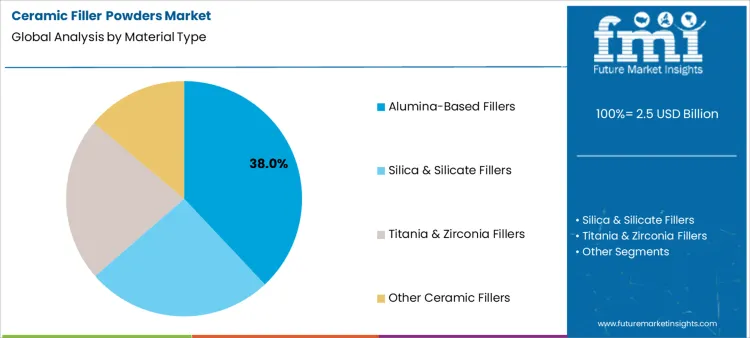
Alumina-based fillers account for 38% share of the ceramic filler powders market because they offer a strong combination of hardness, thermal resistance, and chemical stability. These fillers improve wear resistance, stiffness, and heat tolerance when incorporated into polymers, coatings, and composites. Manufacturers favor alumina fillers due to their consistent particle size control and broad compatibility with thermoplastics and thermosets. Their ability to enhance performance without significantly increasing formulation complexity supports wide adoption. Established supply chains and proven processing behavior further reinforce usage. These performance reliability and processing advantages explain why alumina-based fillers remain the most widely used material type.
Why Do Polymer Compounds And Plastics Dominate Application Demand In The Ceramic Filler Powders Market?
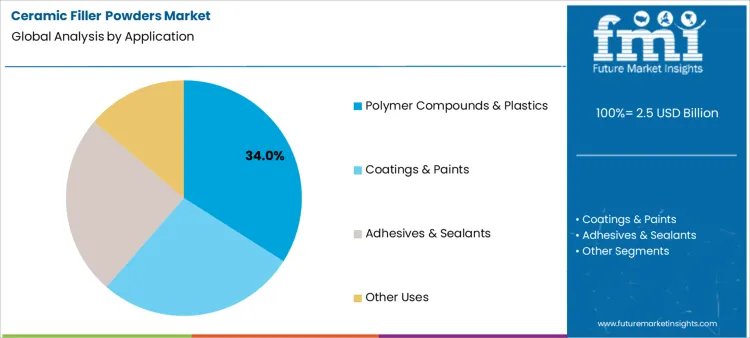
Polymer compounds and plastics hold 34% share of the ceramic filler powders market because fillers are extensively used to enhance mechanical strength, thermal stability, and dimensional control in molded plastic components. Automotive, electrical, and industrial plastic parts rely on ceramic fillers to improve durability under mechanical and thermal stress. High-volume plastic processing drives continuous demand for filler materials. Compounders prioritize fillers that disperse uniformly and maintain processability during extrusion and injection molding. These volume-driven production dynamics and performance enhancement needs explain why polymer compounds and plastics remain the leading application segment.
What are the Key Dynamics of the Ceramic Filler Powders Market?
The ceramic filler powders market is driven by growing demand for functional fillers that enhance mechanical strength, thermal stability, electrical insulation, and wear resistance across polymers, coatings, adhesives, sealants, and electronic materials. Ceramic fillers such as alumina, silica, zirconia, and boron nitride are used to modify material properties while maintaining dimensional stability and chemical resistance. Expanding applications in electronics, automotive components, construction materials, and industrial equipment support market growth. For material suppliers and compounders, particle size distribution, purity, surface treatment, and consistency are key factors influencing material selection and long-term adoption.
How Do Application Trends and Industry Requirements Shape This Market?
Application trends and industry requirements are shaping the ceramic filler powders market as manufacturers seek materials that deliver reliable performance under increasingly demanding operating conditions. In electronics and electrical applications, ceramic fillers provide thermal management and electrical insulation for encapsulants and substrates. Automotive and industrial uses require fillers that improve wear resistance and thermal durability without compromising processability. In construction and infrastructure coatings, ceramic fillers enhance durability and resistance to abrasion and chemicals. Compatibility with different polymer matrices, uniform dispersion, and suitability for high-volume processing are critical considerations for end users.
Why Do Processing Complexity and Cost Pressures Restrain Market Growth?
Processing complexity and cost pressures restrain growth in the ceramic filler powders market, particularly in applications requiring tight control over particle size and surface characteristics. Achieving uniform dispersion and preventing agglomeration can be technically challenging, increasing formulation effort and processing costs. High-purity or specialty ceramic fillers involve energy-intensive production processes, impacting pricing and availability. Balancing filler loading levels with mechanical and rheological performance requires extensive testing, extending development and qualification timelines. These factors can limit adoption in cost-sensitive segments where conventional fillers remain dominant.
How is the Ceramic Filler Powders Market Growing across Key Countries?
The ceramic filler powders market is expanding steadily as manufacturers across plastics, coatings, construction materials, electronics, and industrial composites increase use of mineral fillers to enhance mechanical strength, thermal stability, abrasion resistance, and dimensional control. Ceramic fillers such as alumina, silica, zirconia, and titania are widely incorporated to improve performance while managing formulation costs. Country-wise growth varies based on industrial output, construction activity, and adoption of high-performance material systems. High-growth markets are driven by expanding manufacturing and infrastructure demand, while mature regions focus on precision filler grades, quality consistency, and application-specific performance optimization.
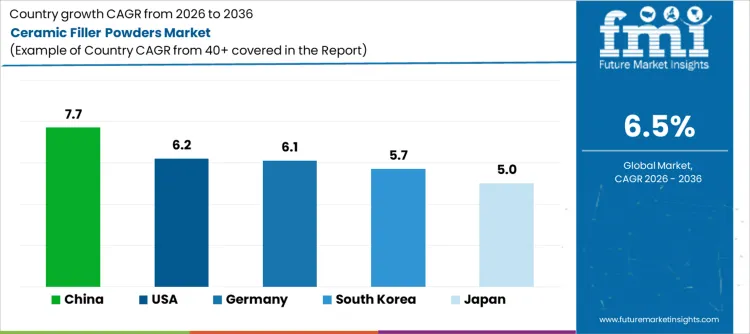
| Country | CAGR (%) |
|---|---|
| China | 7.7 |
| Brazil | 7.3 |
| United Kingdom | 6.2 |
| Germany | 6.1 |
| South Korea | 5.7 |
Why is China Leading the Ceramic Filler Powders Market?
China’s ceramic filler powders market is expanding at a CAGR of 7.7% during 2026 to 2036, driven by strong demand from construction materials, plastics compounding, coatings, and electronics manufacturing. Ceramic fillers are extensively used in polymer compounds, architectural coatings, tiles, and industrial components to enhance strength, heat resistance, and durability. China’s large-scale infrastructure development and manufacturing output continue to generate high-volume demand for filler materials. Chinese manufacturers prioritize filler powders that offer consistent particle size distribution, good dispersion, and compatibility with high-throughput processing. Domestic producers benefit from abundant raw material availability and large-scale milling and classification capabilities, enabling cost-effective supply across multiple industries. Adoption is strongest in plastics compounding, coatings, and building materials. Procurement decisions emphasize cost efficiency, supply reliability, and batch consistency.
Why is Brazil Emerging as a High-Growth Market for Ceramic Filler Powders?
Brazil’s ceramic filler powders market is growing at a CAGR of 7.3% during 2026 to 2036, supported by expansion in construction, plastics processing, and industrial manufacturing. Ceramic fillers are widely used in cementitious materials, polymer compounds, paints, and coatings to improve mechanical properties and cost performance. Growth is particularly strong in infrastructure development and residential construction. Brazilian buyers value filler powders that perform reliably under humid and warm climatic conditions while maintaining consistent quality. Adoption is strong in construction materials, PVC compounds, and industrial coatings. Cost-performance balance remains a key purchasing criterion. Procurement decisions often favor suppliers offering regional production, stable supply, and technical support for formulation optimization. Market growth is supported by infrastructure upgrades, rising construction activity, and increasing use of mineral-filled polymer systems.
What is Driving Demand for Ceramic Filler Powders in the United Kingdom?
The United Kingdom ceramic filler powders market is expanding at a CAGR of 6.2% during 2026 to 2036, driven by demand from construction materials, specialty coatings, and advanced polymer applications. Ceramic fillers are used to enhance durability, thermal stability, and surface finish in building products and industrial formulations. UK manufacturers emphasize consistency, controlled particle size, and compliance with quality standards. Demand is strongest in architectural coatings, insulation materials, and engineered polymer compounds rather than mass-volume construction products. Procurement decisions prioritize supplier reliability, technical documentation, and consistent quality. Market growth is reinforced by refurbishment activity, demand for high-quality building materials, and steady consumption of specialty industrial products.
How Is Germany Supporting Growth in the Ceramic Filler Powders Market?
Germany’s ceramic filler powders market is growing at a CAGR of 6.1% during 2026 to 2036, supported by strong demand from automotive, industrial manufacturing, and advanced materials applications. German manufacturers use ceramic fillers to enhance mechanical performance, thermal resistance, and dimensional stability in engineered plastics and coatings. Buyers prioritize tight particle size control, reproducible quality, and compatibility with precision processing. Adoption is driven by performance optimization and quality requirements rather than volume expansion. Procurement decisions favor suppliers with certified quality systems, advanced processing capabilities, and long-term supply assurance. Market growth is reinforced by Germany’s focus on high-performance materials and precision manufacturing.
How is South Korea Expanding Use of Ceramic Filler Powders?
South Korea’s ceramic filler powders market is expanding at a CAGR of 5.7% during 2026 to 2036, driven by demand from electronics, industrial coatings, and advanced polymer applications. Ceramic fillers are used to improve thermal management, electrical insulation, and mechanical stability in electronics-related materials. South Korean manufacturers emphasize filler purity, dispersion quality, and compatibility with automated manufacturing processes. Adoption is strongest in electronics, specialty coatings, and export-oriented industrial products. Procurement decisions are influenced by supplier technical capability, quality consistency, and alignment with advanced manufacturing standards. Market growth is supported by steady industrial output and continued investment in advanced material technologies.
How are Suppliers Competing in the Ceramic Filler Powders Market?
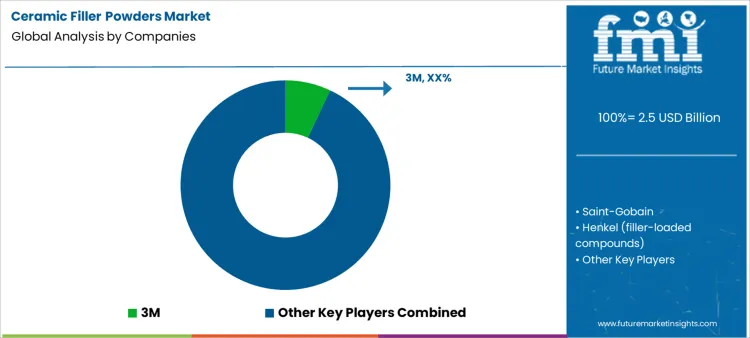
Competition in the ceramic filler powders market is driven by particle size precision, thermal and dielectric performance, and seamless integration with polymers, composites, coatings, and functional materials. Ceramic fillers are critical for enhancing stiffness, heat dissipation, dielectric properties, and dimensional stability in electronics, automotive, aerospace, and industrial applications. 3M positions its ceramic filler powders with technical materials emphasizing engineered particle size distributions and surface treatments that improve dispersion and interfacial bonding in high-performance polymer matrices. Its solutions are often specified where thermal management and mechanical reinforcement are priorities.
Global engineered materials leaders compete through broad oxide and advanced ceramic portfolios. Saint-Gobain offers specialty alumina, zirconia, and silica fillers with consistent quality and tight tolerance control, appealing to demanding applications such as electronics substrates and high-temp composites. Henkel integrates ceramic fillers into compound systems, differentiating through turnkey pre-loaded formulations with predictable rheology and processing behavior. Momentive and Showa Denko Materials emphasize ceramic fillers tailored for thermal interface materials and dielectric enhancement in electronics and power modules.
Specialty mineral and engineering producers strengthen positioning with application-focused solutions. Imerys competes through engineered silicate and alumina fillers that optimize abrasion resistance and modulus. CeramTec offers high-performance ceramic powders for tribological and high-temp structural composites. H.C. Starck brings specialty oxides and nitrides with high purity and narrow size distributions. Sumitomo Chemical and Mitsubishi Chemical Group round out competition with ceramic fillers designed for automotive, coatings, and high-strength composite applications. Across the market, competitive advantage is defined by verified performance gains, filler quality consistency, and formulation support rather than pricing alone.
Key Players in Ceramic Filler Powders Market
- 3M
- Saint-Gobain
- Henkel (filler-loaded compounds)
- Momentive
- Showa Denko Materials
- Imerys
- CeramTec
- H.C. Starck (now MHC group)
- Sumitomo Chemical
- Mitsubishi Chemical Group
Scope of Report
| Attribute | Details |
|---|---|
| Market Size Unit | USD Billion |
| Material Type Covered | Alumina-Based Fillers, Silica & Silicate Fillers, Titania & Zirconia Fillers, Other Ceramic Fillers |
| Application Covered | Polymer Compounds & Plastics, Coatings & Paints, Adhesives & Sealants, Other Uses |
| Countries Covered | China, Japan, South Korea, India, Australia & New Zealand, ASEAN, Rest of Asia Pacific, Germany, United Kingdom, France, Italy, Spain, Nordic, BENELUX, Rest of Europe, United States, Canada, Mexico, Brazil, Chile, Rest of Latin America, Kingdom of Saudi Arabia, Other GCC Countries, Turkey, South Africa, Other African Union, Rest of Middle East & Africa |
| Regions Covered | Asia Pacific, Europe, North America, Latin America, Middle East & Africa |
| Key Companies Profiled | 3M, Saint-Gobain, Henkel, Momentive, Showa Denko Materials, Imerys, CeramTec, H.C. Starck (MHC Group), Sumitomo Chemical, Mitsubishi Chemical Group |
| Additional Attributes | Dollar sales of ceramic filler powders are analyzed by material type and end-use application across plastics, coatings, and adhesive formulations. The scope evaluates particle size distribution, surface treatment, thermal stability, electrical insulation, and reinforcement performance. Country-level analysis reflects growth in engineered plastics, infrastructure coatings, electronics and thermal management applications, and rising demand for high-performance, filler-modified material systems across industrial value chains. |
Ceramic Filler Powders Market by Key Segments
Material Type
- Alumina-Based Fillers
- Silica & Silicate Fillers
- Titania & Zirconia Fillers
- Other Ceramic Fillers
Application
- Polymer Compounds & Plastics
- Coatings & Paints
- Adhesives & Sealants
- Other Uses
Region
- Asia Pacific
- China
- Japan
- South Korea
- India
- Australia & New Zealand
- ASEAN
- Rest of Asia Pacific
- Europe
- Germany
- United Kingdom
- France
- Italy
- Spain
- Nordic
- BENELUX
- Rest of Europe
- North America
- United States
- Canada
- Mexico
- Latin America
- Brazil
- Chile
- Rest of Latin America
- Middle East & Africa
- Kingdom of Saudi Arabia
- Other GCC Countries
- Turkey
- South Africa
- Other African Union
- Rest of Middle East & Africa
Bibliography
- Ding, T., Ma, W.-X., & Zhao, Z.-B. (2025). Review of alumina-based filler/epoxy resin composites for thermally conductive materials. Polymer Engineering & Science.
- Li, P., Ma, L., Ren, Z., Xie, E., Wang, Z., Xie, L., Gao, H., Zhou, X., & Wu, J. (2022). Application of dual silane coupling agent-assisted surface-modified quartz powder in epoxy matrix for performance enhancement. Minerals, 12(7), 784.
- Lin, Z., Sun, Z., Fu, W., Lin, Y.-C., Moon, K.-S., & Wong, C. P. (2025). Thermally conductive and electrically insulative alumina/epoxy composites for advanced electronic packaging applications: A comprehensive review of filler morphologies and surface modifications. Materials Today, 86, 393–413.
- Niu, H., Cao, Y., Yang, K., Dong, H., Cheng, Q., & Chen, Y. (2025). Review of boron nitride based polymer composites with ultrahigh thermal conductivity: Critical strategies and applications. Composites Part A: Applied Science and Manufacturing, 200, 109289.
Frequently Asked Questions
How big is the ceramic filler powders market in 2026?
The global ceramic filler powders market is estimated to be valued at USD 2.5 billion in 2026.
What will be the size of ceramic filler powders market in 2036?
The market size for the ceramic filler powders market is projected to reach USD 4.7 billion by 2036.
How much will be the ceramic filler powders market growth between 2026 and 2036?
The ceramic filler powders market is expected to grow at a 6.5% CAGR between 2026 and 2036.
What are the key product types in the ceramic filler powders market?
The key product types in ceramic filler powders market are alumina-based fillers, silica & silicate fillers, titania & zirconia fillers and other ceramic fillers.
Which application segment to contribute significant share in the ceramic filler powders market in 2026?
In terms of application, polymer compounds & plastics segment to command 34.0% share in the ceramic filler powders market in 2026.
Preview the report firsthand - request a free sample
Get SampleGet the brochure for pricing and purchase details.
Get PDFTable of Content
- Executive Summary
- Global Market Outlook
- Demand-side Trends
- Supply-side Trends
- Technology Roadmap Analysis
- Analysis and Recommendations
- Market Overview
- Market Coverage / Taxonomy
- Market Definition / Scope / Limitations
- Market Background
- Market Dynamics
- Drivers
- Restraints
- Opportunity
- Trends
- Scenario Forecast
- Demand in Optimistic Scenario
- Demand in Likely Scenario
- Demand in Conservative Scenario
- Opportunity Map Analysis
- Product Life Cycle Analysis
- Supply Chain Analysis
- Investment Feasibility Matrix
- Value Chain Analysis
- PESTLE and Porter’s Analysis
- Regulatory Landscape
- Regional Parent Market Outlook
- Production and Consumption Statistics
- Import and Export Statistics
- Market Dynamics
- Global Market Analysis 2021 to 2025 and Forecast, 2026 to 2036
- Historical Market Size Value (USD Million) Analysis, 2021 to 2025
- Current and Future Market Size Value (USD Million) Projections, 2026 to 2036
- Y-o-Y Growth Trend Analysis
- Absolute $ Opportunity Analysis
- Global Market Pricing Analysis 2021 to 2025 and Forecast 2026 to 2036
- Global Market Analysis 2021 to 2025 and Forecast 2026 to 2036, By Material Type
- Introduction / Key Findings
- Historical Market Size Value (USD Million) Analysis By Material Type, 2021 to 2025
- Current and Future Market Size Value (USD Million) Analysis and Forecast By Material Type, 2026 to 2036
- Alumina-Based Fillers
- Silica & Silicate Fillers
- Titania & Zirconia Fillers
- Other Ceramic Fillers
- Alumina-Based Fillers
- Y-o-Y Growth Trend Analysis By Material Type, 2021 to 2025
- Absolute $ Opportunity Analysis By Material Type, 2026 to 2036
- Global Market Analysis 2021 to 2025 and Forecast 2026 to 2036, By Application
- Introduction / Key Findings
- Historical Market Size Value (USD Million) Analysis By Application, 2021 to 2025
- Current and Future Market Size Value (USD Million) Analysis and Forecast By Application, 2026 to 2036
- Polymer Compounds & Plastics
- Coatings & Paints
- Adhesives & Sealants
- Other Uses
- Polymer Compounds & Plastics
- Y-o-Y Growth Trend Analysis By Application, 2021 to 2025
- Absolute $ Opportunity Analysis By Application, 2026 to 2036
- Global Market Analysis 2021 to 2025 and Forecast 2026 to 2036, By Particle Size
- Introduction / Key Findings
- Historical Market Size Value (USD Million) Analysis By Particle Size, 2021 to 2025
- Current and Future Market Size Value (USD Million) Analysis and Forecast By Particle Size, 2026 to 2036
- Micron-Sized
- Sub-Micron
- Nano-Sized
- Other Sectors
- Micron-Sized
- Y-o-Y Growth Trend Analysis By Particle Size, 2021 to 2025
- Absolute $ Opportunity Analysis By Particle Size, 2026 to 2036
- Global Market Analysis 2021 to 2025 and Forecast 2026 to 2036, By End-Use Sector
- Introduction / Key Findings
- Historical Market Size Value (USD Million) Analysis By End-Use Sector, 2021 to 2025
- Current and Future Market Size Value (USD Million) Analysis and Forecast By End-Use Sector, 2026 to 2036
- Electronics & Electrical
- Automotive & Transport
- Industrial & Construction
- Electronics & Electrical
- Y-o-Y Growth Trend Analysis By End-Use Sector, 2021 to 2025
- Absolute $ Opportunity Analysis By End-Use Sector, 2026 to 2036
- Global Market Analysis 2021 to 2025 and Forecast 2026 to 2036, By Region
- Introduction
- Historical Market Size Value (USD Million) Analysis By Region, 2021 to 2025
- Current Market Size Value (USD Million) Analysis and Forecast By Region, 2026 to 2036
- North America
- Latin America
- Western Europe
- Eastern Europe
- East Asia
- South Asia and Pacific
- Middle East & Africa
- Market Attractiveness Analysis By Region
- North America Market Analysis 2021 to 2025 and Forecast 2026 to 2036, By Country
- Historical Market Size Value (USD Million) Trend Analysis By Market Taxonomy, 2021 to 2025
- Market Size Value (USD Million) Forecast By Market Taxonomy, 2026 to 2036
- By Country
- USA
- Canada
- Mexico
- By Material Type
- By Application
- By Particle Size
- By End-Use Sector
- By Country
- Market Attractiveness Analysis
- By Country
- By Material Type
- By Application
- By Particle Size
- By End-Use Sector
- Key Takeaways
- Latin America Market Analysis 2021 to 2025 and Forecast 2026 to 2036, By Country
- Historical Market Size Value (USD Million) Trend Analysis By Market Taxonomy, 2021 to 2025
- Market Size Value (USD Million) Forecast By Market Taxonomy, 2026 to 2036
- By Country
- Brazil
- Chile
- Rest of Latin America
- By Material Type
- By Application
- By Particle Size
- By End-Use Sector
- By Country
- Market Attractiveness Analysis
- By Country
- By Material Type
- By Application
- By Particle Size
- By End-Use Sector
- Key Takeaways
- Western Europe Market Analysis 2021 to 2025 and Forecast 2026 to 2036, By Country
- Historical Market Size Value (USD Million) Trend Analysis By Market Taxonomy, 2021 to 2025
- Market Size Value (USD Million) Forecast By Market Taxonomy, 2026 to 2036
- By Country
- Germany
- UK
- Italy
- Spain
- France
- Nordic
- BENELUX
- Rest of Western Europe
- By Material Type
- By Application
- By Particle Size
- By End-Use Sector
- By Country
- Market Attractiveness Analysis
- By Country
- By Material Type
- By Application
- By Particle Size
- By End-Use Sector
- Key Takeaways
- Eastern Europe Market Analysis 2021 to 2025 and Forecast 2026 to 2036, By Country
- Historical Market Size Value (USD Million) Trend Analysis By Market Taxonomy, 2021 to 2025
- Market Size Value (USD Million) Forecast By Market Taxonomy, 2026 to 2036
- By Country
- Russia
- Poland
- Hungary
- Balkan & Baltic
- Rest of Eastern Europe
- By Material Type
- By Application
- By Particle Size
- By End-Use Sector
- By Country
- Market Attractiveness Analysis
- By Country
- By Material Type
- By Application
- By Particle Size
- By End-Use Sector
- Key Takeaways
- East Asia Market Analysis 2021 to 2025 and Forecast 2026 to 2036, By Country
- Historical Market Size Value (USD Million) Trend Analysis By Market Taxonomy, 2021 to 2025
- Market Size Value (USD Million) Forecast By Market Taxonomy, 2026 to 2036
- By Country
- China
- Japan
- South Korea
- By Material Type
- By Application
- By Particle Size
- By End-Use Sector
- By Country
- Market Attractiveness Analysis
- By Country
- By Material Type
- By Application
- By Particle Size
- By End-Use Sector
- Key Takeaways
- South Asia and Pacific Market Analysis 2021 to 2025 and Forecast 2026 to 2036, By Country
- Historical Market Size Value (USD Million) Trend Analysis By Market Taxonomy, 2021 to 2025
- Market Size Value (USD Million) Forecast By Market Taxonomy, 2026 to 2036
- By Country
- India
- ASEAN
- Australia & New Zealand
- Rest of South Asia and Pacific
- By Material Type
- By Application
- By Particle Size
- By End-Use Sector
- By Country
- Market Attractiveness Analysis
- By Country
- By Material Type
- By Application
- By Particle Size
- By End-Use Sector
- Key Takeaways
- Middle East & Africa Market Analysis 2021 to 2025 and Forecast 2026 to 2036, By Country
- Historical Market Size Value (USD Million) Trend Analysis By Market Taxonomy, 2021 to 2025
- Market Size Value (USD Million) Forecast By Market Taxonomy, 2026 to 2036
- By Country
- Kingdom of Saudi Arabia
- Other GCC Countries
- Turkiye
- South Africa
- Other African Union
- Rest of Middle East & Africa
- By Material Type
- By Application
- By Particle Size
- By End-Use Sector
- By Country
- Market Attractiveness Analysis
- By Country
- By Material Type
- By Application
- By Particle Size
- By End-Use Sector
- Key Takeaways
- Key Countries Market Analysis
- USA
- Pricing Analysis
- Market Share Analysis, 2025
- By Material Type
- By Application
- By Particle Size
- By End-Use Sector
- Canada
- Pricing Analysis
- Market Share Analysis, 2025
- By Material Type
- By Application
- By Particle Size
- By End-Use Sector
- Mexico
- Pricing Analysis
- Market Share Analysis, 2025
- By Material Type
- By Application
- By Particle Size
- By End-Use Sector
- Brazil
- Pricing Analysis
- Market Share Analysis, 2025
- By Material Type
- By Application
- By Particle Size
- By End-Use Sector
- Chile
- Pricing Analysis
- Market Share Analysis, 2025
- By Material Type
- By Application
- By Particle Size
- By End-Use Sector
- Germany
- Pricing Analysis
- Market Share Analysis, 2025
- By Material Type
- By Application
- By Particle Size
- By End-Use Sector
- UK
- Pricing Analysis
- Market Share Analysis, 2025
- By Material Type
- By Application
- By Particle Size
- By End-Use Sector
- Italy
- Pricing Analysis
- Market Share Analysis, 2025
- By Material Type
- By Application
- By Particle Size
- By End-Use Sector
- Spain
- Pricing Analysis
- Market Share Analysis, 2025
- By Material Type
- By Application
- By Particle Size
- By End-Use Sector
- France
- Pricing Analysis
- Market Share Analysis, 2025
- By Material Type
- By Application
- By Particle Size
- By End-Use Sector
- India
- Pricing Analysis
- Market Share Analysis, 2025
- By Material Type
- By Application
- By Particle Size
- By End-Use Sector
- ASEAN
- Pricing Analysis
- Market Share Analysis, 2025
- By Material Type
- By Application
- By Particle Size
- By End-Use Sector
- Australia & New Zealand
- Pricing Analysis
- Market Share Analysis, 2025
- By Material Type
- By Application
- By Particle Size
- By End-Use Sector
- China
- Pricing Analysis
- Market Share Analysis, 2025
- By Material Type
- By Application
- By Particle Size
- By End-Use Sector
- Japan
- Pricing Analysis
- Market Share Analysis, 2025
- By Material Type
- By Application
- By Particle Size
- By End-Use Sector
- South Korea
- Pricing Analysis
- Market Share Analysis, 2025
- By Material Type
- By Application
- By Particle Size
- By End-Use Sector
- Russia
- Pricing Analysis
- Market Share Analysis, 2025
- By Material Type
- By Application
- By Particle Size
- By End-Use Sector
- Poland
- Pricing Analysis
- Market Share Analysis, 2025
- By Material Type
- By Application
- By Particle Size
- By End-Use Sector
- Hungary
- Pricing Analysis
- Market Share Analysis, 2025
- By Material Type
- By Application
- By Particle Size
- By End-Use Sector
- Kingdom of Saudi Arabia
- Pricing Analysis
- Market Share Analysis, 2025
- By Material Type
- By Application
- By Particle Size
- By End-Use Sector
- Turkiye
- Pricing Analysis
- Market Share Analysis, 2025
- By Material Type
- By Application
- By Particle Size
- By End-Use Sector
- South Africa
- Pricing Analysis
- Market Share Analysis, 2025
- By Material Type
- By Application
- By Particle Size
- By End-Use Sector
- USA
- Market Structure Analysis
- Competition Dashboard
- Competition Benchmarking
- Market Share Analysis of Top Players
- By Regional
- By Material Type
- By Application
- By Particle Size
- By End-Use Sector
- Competition Analysis
- Competition Deep Dive
- 3M
- Overview
- Product Portfolio
- Profitability by Market Segments (Product/Age /Sales Channel/Region)
- Sales Footprint
- Strategy Overview
- Marketing Strategy
- Product Strategy
- Channel Strategy
- Saint-Gobain
- Henkel (filler-loaded compounds)
- Momentive
- Showa Denko Materials
- Imerys
- CeramTec
- H.C. Starck (now MHC group)
- Sumitomo Chemical
- Mitsubishi Chemical Group
- 3M
- Competition Deep Dive
- Assumptions & Acronyms Used
- Research Methodology


