

- Market Size (2026)
- USD 225.0 Mn
- Forecast (2036)
- USD 644.6 Mn
- CAGR (2026 to 2036)
- 11.1%
How big is the cleanroom cobot workstations market in 2026?
USD 225.0 million in 2026 and USD 644.6 million by 2036 at an 11.1% CAGR.
The cleanroom cobot workstations industry value is forecast to grow from USD 202.5 million in 2025 to USD 644.6 million by 2036 at 11.1% CAGR as controlled manufacturers adopt validated cells for material handling, inspection, assembly, and packaging. The 5-20 kg payload range is expected to represent 52.0% share in 2026 because trays, carriers, and fixture-loaded parts often fall within this practical handling band. Collaborative Robots are projected to account for 46.0% share in 2026, led by compact placement and operator-supervised cleanroom workflows.
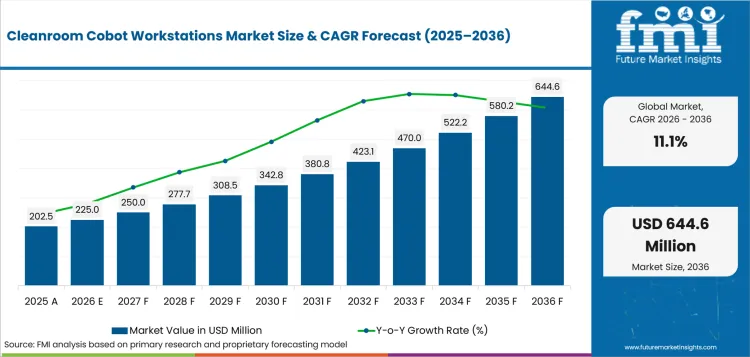
Cleanroom Cobot Workstations Market Overview: Size and Forecast
- 2026 Market Size: USD 225.0 million
- 2036 Market Size: USD 644.6 million
- Forecast CAGR: 11.1% from 2026 to 2036
- Leading Payload: 5-20 kg
- 5-20 kg Payload Share in 2026: 52.0%
- Leading Robot Type: Collaborative Robots
- Collaborative Robots Share in 2026: 46.0%
- Fastest-growing Country: China
- China CAGR: 12.4% by 2036
Summary of the Cleanroom Cobot Workstations Market
- Demand and Growth Drivers
- Cleanroom users are automating transfer and loading tasks to reduce direct operator contact inside contamination-sensitive production areas.
- Electronics and semiconductor facilities are adding compact workstations near tools where large fixed automation is difficult to install.
- Pharmaceutical and medical device buyers are favoring documented workcells that support cleaning procedures and qualification reviews.
- Product and Segment View
- The 5-20 kg payload range is projected to hold 52.0% share in 2026, led by broad use in trays, carriers, and fixture handling.
- Collaborative Robots are forecast to represent 46.0% share in 2026, supported by compact placement and supervised cleanroom workflows.
- Fixed Bench Workstations are expected to secure 44.0% share in 2026, influenced by tool-side installation and stable validation layouts.
- Geography and Competitive Outlook
- China is projected to record 12.4% CAGR by 2036, backed by semiconductor scale and electronics manufacturing depth.
- India is expected to expand at 12.1% CAGR by 2036 through semiconductor incentives and pharmaceutical cleanroom automation demand.
- ABB, FANUC, KUKA, Universal Robots, Stäubli, Yaskawa, and Hanwha Robotics compete through certified robot families and service depth.
- Specialist integrators focus on cleanroom benches, end effectors, airflow-safe guarding, and validation packages around standard robot arms.
- Analyst Opinion
- Nikhil Kaitwade, Principal Consultant at Future Market Insights for industrial domain, says, “Cleanroom cobot workstations should be evaluated as validated workcells rather than standalone robot purchases. Buyers need evidence that the arm, gripper, bench, cabling, and loading method will not add particles or disturb airflow. The strongest suppliers will combine cleanroom-rated hardware with integration records, cleaning guidance, and local service support. Electronics users will value tool-side fit and cycle consistency, while pharmaceutical users will prioritize documentation and cleaning proof before speed.”
The cleanroom cobot workstations market is expected to witness strong growth through 2036, driven by demand from electronics and pharmaceutical manufacturers seeking validated automation in controlled production spaces. Market expansion is further supported by semiconductor capacity programs, cleanroom robot certification, and the need to reduce direct manual handling around sensitive products.
Quality control is the main pressure point as cleanroom buyers review low-particle workstations before approving automation inside validated spaces. IFR stated in September 2025 that factories installed 542,000 industrial robots worldwide in 2024, showing the wider base for industrial automation. NIST states CHIPS for America is investing USD 11 billion into semiconductor R&D and dedicating USD 39 billion to incentives for facilities and equipment. IFR reported in April 2026 that Western Europe reached 267 robots per 10,000 manufacturing employees in 2024, while North America reached 204 and Asia reached 131, giving suppliers a clear signal that automated handling is becoming mainstream in advanced factories.
Which factors support expansion in the cleanroom cobot workstations market?
Validated workstation revenue, cleanroom integration support, and certified robot arm availability support market value across controlled manufacturing channels.
- Market value is supported by integrated workcell revenue before grippers, guarding, and validation services add incremental supplier margin.
- Supplier pricing improves when cleanroom certification, controller integration, and documented tooling are sold as one workstation package.
- Semiconductor users pay premiums for low-particle systems that fit reticle, wafer, carrier, and inspection handling workflows.
- Pharmaceutical buyers evaluate cleanability and documentation before speed, which favors integrators with validation support.
Why is the cleanroom cobot workstations market growing?
Cleanroom users are reducing direct manual contact in transfer, loading, inspection, and packaging steps to lower contamination exposure and improve repeatability.
Growth outlook has become more structured as cleanroom users connect automation choices with electronics capacity, sterile production discipline, and operator safety planning. IFR reported in October 2025 that electronics became the largest robotics customer industry again in 2024 with 128,899 installations and 2.5% growth. This supports cleanroom cobot workstation demand because electronics buyers need repeatable handling around wafers, carriers, devices, and precision components. Compact workstations gain acceptance when they automate frequent transfers without changing airflow patterns or forcing large fixed systems into validated rooms. Suppliers with documented tooling and service support can convert pilot cells into repeat workstation orders.
How is the cleanroom cobot workstations market segmented?
The cleanroom cobot workstations industry is segmented by payload, robot type, workstation configuration, end-use industry, and application.
- The 5-20 kg payload range is projected to secure 52.0% share in 2026, led by trays, carriers, fixtures, and packaged parts that fit this practical cleanroom handling band.
- Collaborative Robots are anticipated to hold 46.0% share in 2026 since cleanroom users prefer supervised operation near staff and easier integration into compact workcells.
- Fixed Bench Workstations are expected to capture 44.0% share in 2026 due to stable layouts that simplify cleaning access, wiring control, and validation documentation.
- Electronics is forecast to represent 38.0% share in 2026, guided by wafer-adjacent and precision component workflows that need low-particle handling.
- Material Handling is projected to account for 34.0% share in 2026, reflected by repeatable transfer tasks that create visible payback before complex inspection use.
Which payload range leads the cleanroom cobot workstations market?
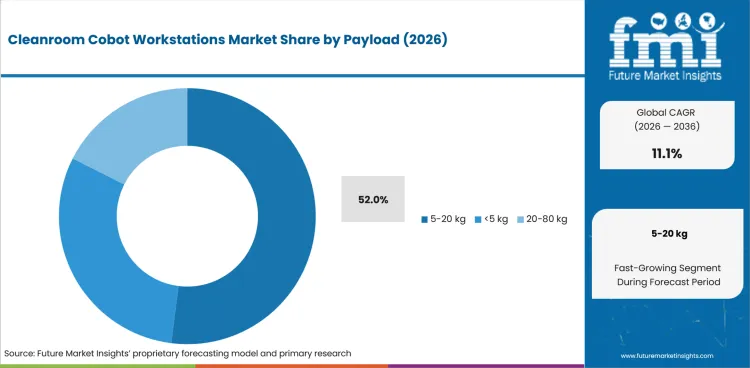
- The 5-20 kg range is anticipated to hold 52.0% share in 2026 through tray, carrier, fixture, and packaged device handling needs.
- Lower payload systems support inspection and small-parts assembly, while heavier payload cells serve bulkier fixtures and packaged components.
Why do Collaborative Robots dominate the cleanroom cobot workstations market?
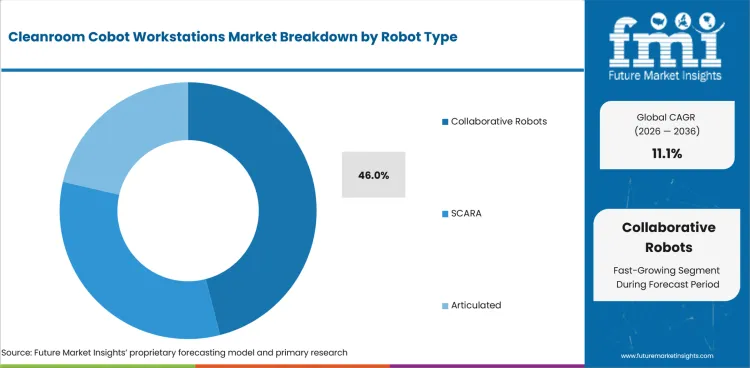
- Collaborative Robots are projected to account for 46.0% share in 2026, influenced by operator-supervised transfer work and compact cleanroom placement.
- SCARA and Articulated robots gain use when speed, reach, or specialized tool loading requires a more traditional arm design.
Which workstation configuration leads the cleanroom cobot workstations market?
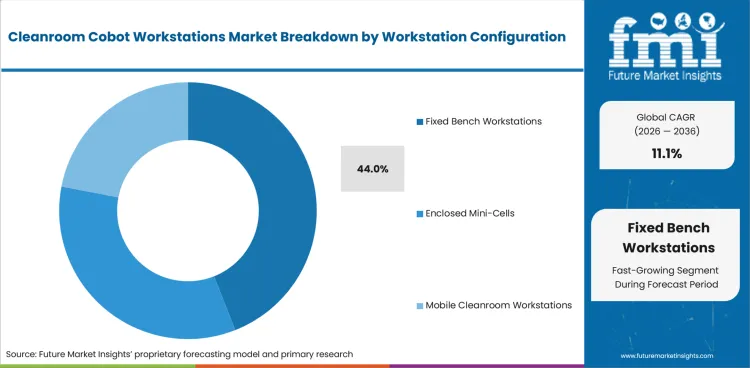
- Fixed Bench Workstations are forecast to secure 44.0% share in 2026, reflected by stable layouts and easier validation near process tools.
- Mobile Cleanroom Workstations gain attention as semiconductor plants evaluate material transport and local buffering between equipment areas.
Which end-use industry leads the cleanroom cobot workstations market?
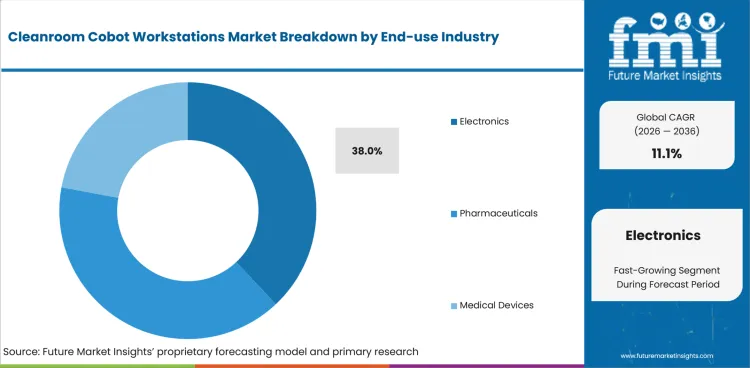
- Electronics is projected to account for 38.0% share in 2026, led by wafer-adjacent, device, and precision component handling requirements.
- Pharmaceuticals and medical devices create added demand when cleaning records and validated handling reduce operator exposure inside controlled rooms.
Which application leads the cleanroom cobot workstations market?
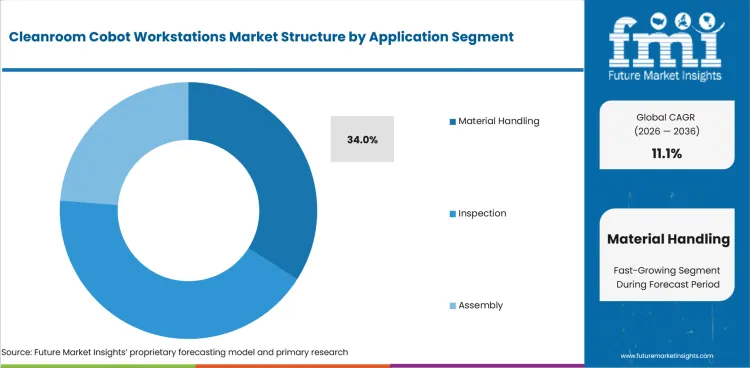
- Material Handling is expected to represent 34.0% share in 2026, shaped by frequent transfer tasks and visible labor savings in clean spaces.
- Inspection and assembly uses expand when vision systems and end effectors can be documented with the same cleanroom workcell package.
What are the driver, restraints, and opportunities in the cleanroom cobot workstations market?
Contamination-proof handling and compact workstation design support growth while validation requirements restrict faster adoption.
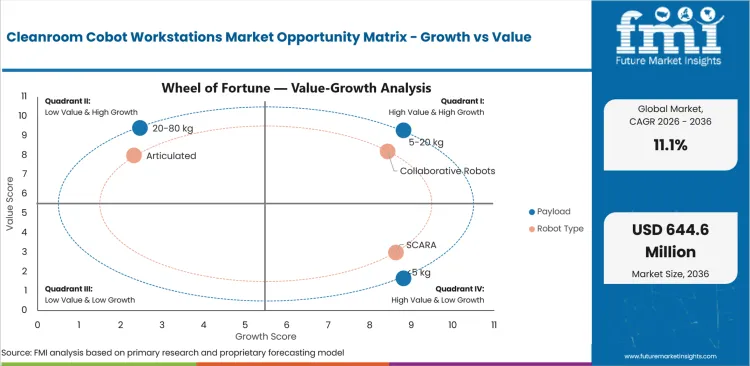
- Driver: Cleanroom users are automating repeatable transfer tasks that place operators close to sensitive products and process tools.
- Restraint: Validation work can delay adoption when grippers, cables, benches, and airflow effects are not documented with the robot arm.
- Opportunity: Mobile and modular workstations can expand cleanroom automation beyond fixed benches into tool-side transport and local buffering.
Cleanroom Workcell Demand Outlook
Demand outlook is moving toward workstations designed around contamination control rather than robot selection alone. ABB states that its cleanroom robots are certified to ISO 14644-1 and support life sciences, medical device, biotechnology, pharmaceutical, semiconductor, and electronics manufacturing applications. This supports workstation demand because buyers need proof across the full cell and not only the arm. Suppliers that document surface finish, cable routing, cleaning access, and end-effector material compatibility can shorten approval cycles and defend stronger pricing.
Validation and Documentation Barrier
Adoption slows when documentation work becomes larger than the hardware decision. FDA states that finished pharmaceutical CGMP rules require cleaning and use logs for non-dedicated equipment under 21 CFR 211.182, while equipment identification is referenced under 21 CFR 211.105. Cleanroom cobot workstations therefore need cleaning procedures, status records, and component traceability before pharmaceutical buyers accept them. The restraint favors experienced integrators over low-cost robot resellers that cannot support qualification files.
Modular Automation Opportunity
Opportunity is strongest where cleanrooms need handling nodes instead of large fixed automation. KUKA introduced KMR iisy CR in 2025 as a mobile manipulator with low-particle properties, ESD certification, and suitability for 11 kg or 15 kg cobot payload categories. This expands the workstation concept into tool-side transport, local buffering, pick-and-place, and mobile handling. Suppliers can win by proving compact placement and repeatable motion without forcing a full cleanroom layout change.
Which countries are growing fastest in the cleanroom cobot workstations market?
China 12.4% CAGR, India 12.1% CAGR, South Korea 11.8% CAGR, United States 11.4% CAGR, Japan 10.9% CAGR, Germany 10.5% CAGR, France 9.8% CAGR, and United Kingdom 9.2% CAGR through 2036.
.webp "Top Country Growth Comparison Cleanroom Cobot Workstations Market Cagr (2026 2036)")
| Country | CAGR |
|---|---|
| China | 12.4% |
| India | 12.1% |
| South Korea | 11.8% |
| United States | 11.4% |
| Japan | 10.9% |
| Germany | 10.5% |
| France | 9.8% |
| United Kingdom | 9.2% |
Source: Future Market Insights, 2026.
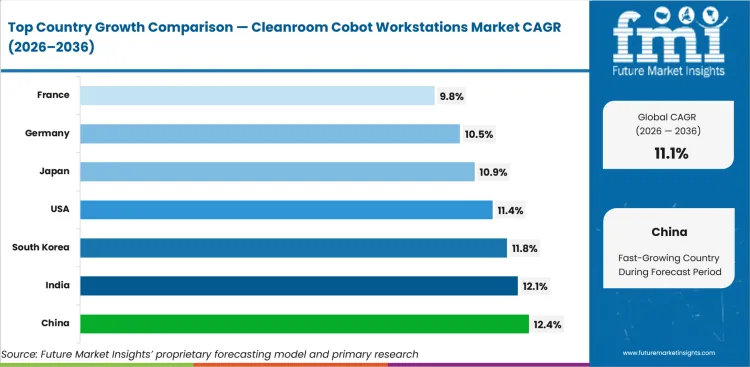
How do country-level CAGRs compare in the cleanroom cobot workstations market?
China leads country growth while the United Kingdom records the most cautious expansion outlook among profiled markets.
- China is forecast to record 12.4% CAGR by 2036 as semiconductor scale supports faster cleanroom automation programs.
- India is expected to rise at 12.1% CAGR by 2036 as chip incentives and pharma automation raise workstation trials.
- South Korea is projected to post 11.8% CAGR by 2036 due to semiconductor cluster depth and cleanroom certification focus.
- The United States is expected to expand at 11.4% CAGR by 2036 as controlled manufacturing investment supports validated workstation adoption.
- Japan is expected to advance at 10.9% CAGR by 2036 as domestic robot OEM depth supports cleanroom automation trials.
- Germany is forecast to grow at 10.5% CAGR by 2036 as engineering-led procurement supports documented workstation installation.
- France is estimated to increase at 9.8% CAGR by 2036 through focused demand in microelectronics and bioproduction.
- The United Kingdom is projected to grow at 9.2% CAGR by 2036 as life sciences and compound semiconductor niches guide adoption.
How fast is the cleanroom cobot workstations market growing in China?
A 12.4% CAGR through 2036 reflects cleanroom automation demand shaped by electronics, pharma, and country-level manufacturing investment.
Country Market Snapshot Table
| Parameter | Value |
|---|---|
| Market Size in 2025 (Value) | USD 48.0 million |
| Market Size in 2026 (Value) | USD 54.0 million |
| Market Forecast in 2036 (Value) | USD 173.8 million |
| CAGR (2026 to 2036) | 12.4% |
| Years Considered | 2021 to 2036 |
| Base Year | 2025 |
| Forecast Period | 2026 to 2036 |
| Units Considered | Value (USD million) |
| Leading Sub-Region | Yangtze River Delta, Pearl River Delta, and inland electronics manufacturing corridors |
China Cleanroom Cobot Workstations Market Outlook
China demand is the fastest among profiled countries because cleanroom capacity and robot deployment are scaling together. Semiconductor, display, battery, and electronics plants need workstations that can be duplicated across lines and supported locally.
Competition is intense as domestic robot suppliers and global brands compete for the same cleanroom automation programs. Buyers will reward cells that demonstrate repeatable contamination control, short commissioning times, and local service coverage.
Key Growth Drivers
- IFR stated China installed 295,000 industrial robots in 2024, representing 54% of global deployments and the largest national base.
- China’s National Bureau of Statistics reported 447,121 industrial robots produced from January to July 2025, up 32.9% year on year.
- Electronics plants use compact cobot cells to automate repetitive inspection and transfer work across duplicated production lines.
- Local integrator networks can replicate workstation designs across multiple factory sites once the first cleanroom cell is approved.
Key Restraints
- KUKA describes KMR iisy CR for 11 kg and 15 kg payload categories, raising feature expectations for fixed and mobile cleanroom cells.
- Price-sensitive buyers may select lower-cost cells with weaker validation support when plant margins are under pressure.
- Export controls and supply limits can affect premium robot and controller availability in advanced cleanroom projects.
What makes China unique
China is unique because robot installation scale and cleanroom manufacturing expansion create the strongest volume opportunity.
Key Companies
- ABB China
- FANUC China
- KUKA China
- Yaskawa China
- Universal Robots China
- Siasun
- Estun Automation
Sales & Marketing Channels
- Direct factory automation sales
- Local cleanroom integrators
- Semiconductor equipment contractors
- Electronics OEM procurement
- Regional distributor networks
- Government-influenced industrial projects
Country Segment Breakdown Table
| Segment | Sub-Segments |
|---|---|
| By Payload | <5 kg, 5-20 kg, 20-80 kg, >80 kg |
| By Robot Type | Collaborative Robots, SCARA, Articulated, AMR/AGV, Delta Robots |
| By Workstation Configuration | Fixed Bench Workstations, Enclosed Mini-Cells, Mobile Cleanroom Workstations, Pass-Through Stations |
| By End-use Industry | Electronics, Pharmaceuticals, Medical Devices, Automotive Electronics, Food & Beverage |
| By Application | Material Handling, Inspection, Assembly, Packaging, Machine Tending |
| Key Sub-Regions Covered, Cleanroom Manufacturing Corridors | Shanghai, Suzhou, Shenzhen, Guangzhou, Wuhan, Chengdu |
Frequently Asked Questions
How fast is China cleanroom cobot workstations market growing?
Sales in China are ready to scale at 12.4% CAGR from 2026 to 2036, guided by cleanroom automation projects and local integration support.
Who leads China cleanroom cobot workstations market?
ABB China, FANUC China, KUKA China, and Yaskawa China compete based on cleanroom-capable robot portfolios and service access.
What is driving adoption in China cleanroom cobot workstations market?
Electronics, pharmaceutical, and medical device users are moving toward validated workstations that lower direct handling inside controlled spaces.
How fast is the cleanroom cobot workstations market growing in India?
A 12.1% CAGR through 2036 reflects cleanroom automation demand shaped by electronics, pharma, and country-level manufacturing investment.
Country Market Snapshot Table
| Parameter | Value |
|---|---|
| Market Size in 2025 (Value) | USD 8.9 million |
| Market Size in 2026 (Value) | USD 10.0 million |
| Market Forecast in 2036 (Value) | USD 31.3 million |
| CAGR (2026 to 2036) | 12.1% |
| Years Considered | 2021 to 2036 |
| Base Year | 2025 |
| Forecast Period | 2026 to 2036 |
| Units Considered | Value (USD million) |
| Leading Sub-Region | Gujarat, Tamil Nadu, Karnataka, and Telangana electronics manufacturing corridors |
India Cleanroom Cobot Workstations Market Outlook
India cleanroom cobot workstation demand is emerging from semiconductor projects, electronics assembly, and pharmaceutical manufacturing. Buyers usually want affordable cells that can be serviced locally and demonstrated before wider cleanroom deployment.
Pharma and electronics users are likely to test compact workstations before large-scale purchases. Suppliers with training centers, local spares, and simple validation support can gain trust among first-time cleanroom automation buyers.
Key Growth Drivers
- India’s Press Information Bureau reported 10 semiconductor projects worth ₹1.60 lakh crore approved across 6 states by December 2025.
- IFR stated India installed a record 9,100 industrial robots in 2024, up 7% from the prior year.
- Pharmaceutical manufacturers use cleanroom handling pilots where documentation and cleaning support can reduce validation concerns.
- Electronics assembly clusters need affordable workstations that can be serviced locally after commissioning.
Key Restraints
- Yaskawa lists HD7 as certified to Cleanroom Class 5 and GMP Class A, setting a high proof level for life science workstation suppliers.
- Price sensitivity remains high outside global-standard semiconductor and pharmaceutical facilities.
- Limited in-house automation depth can make training, service, and spare parts support decisive for repeat orders.
What makes India unique
India is unique because semiconductor incentives and pharmaceutical production depth create early demand for locally supported cleanroom workstations.
Key Companies
- ABB India
- FANUC India
- Yaskawa India
- Universal Robots India
- Epson India
- KUKA India
- Omron Automation India
Sales & Marketing Channels
- Distributor-supported robot channels
- Pharma automation integrators
- Semiconductor project contractors
- Direct enterprise sales
- Training-led demo centers
- Local service partners
Country Segment Breakdown Table
| Segment | Sub-Segments |
|---|---|
| By Payload | <5 kg, 5-20 kg, 20-80 kg, >80 kg |
| By Robot Type | Collaborative Robots, SCARA, Articulated, AMR/AGV, Delta Robots |
| By Workstation Configuration | Fixed Bench Workstations, Enclosed Mini-Cells, Mobile Cleanroom Workstations, Pass-Through Stations |
| By End-use Industry | Electronics, Pharmaceuticals, Medical Devices, Automotive Electronics, Food & Beverage |
| By Application | Material Handling, Inspection, Assembly, Packaging, Machine Tending |
| Key Sub-Regions Covered, Cleanroom Manufacturing Corridors | Gujarat, Tamil Nadu, Karnataka, Maharashtra, Telangana, Uttar Pradesh |
Frequently Asked Questions
How fast is India cleanroom cobot workstations market growing?
Sales in India are ready to scale at 12.1% CAGR from 2026 to 2036, guided by cleanroom automation projects and local integration support.
Who leads India cleanroom cobot workstations market?
ABB India, FANUC India, Yaskawa India, and Universal Robots India compete based on cleanroom-capable robot portfolios and service access.
What is driving adoption in India cleanroom cobot workstations market?
Electronics, pharmaceutical, and medical device users are moving toward validated workstations that lower direct handling inside controlled spaces.
How fast is the cleanroom cobot workstations market growing in South Korea?
A 11.8% CAGR through 2036 reflects cleanroom automation demand shaped by electronics, pharma, and country-level manufacturing investment.
Country Market Snapshot Table
| Parameter | Value |
|---|---|
| Market Size in 2025 (Value) | USD 19.7 million |
| Market Size in 2026 (Value) | USD 22.0 million |
| Market Forecast in 2036 (Value) | USD 67.1 million |
| CAGR (2026 to 2036) | 11.8% |
| Years Considered | 2021 to 2036 |
| Base Year | 2025 |
| Forecast Period | 2026 to 2036 |
| Units Considered | Value (USD million) |
| Leading Sub-Region | Gyeonggi mega semiconductor cluster and biopharma production corridors |
South Korea Cleanroom Cobot Workstations Market Outlook
South Korea demand is concentrated around semiconductor, display, and biopharmaceutical manufacturing corridors. Large buyers require cleanroom workstations that can prove motion stability, particle discipline, and supplier support before line-wide deployment.
The country benefits from local cobot certification signals and deep electronics manufacturing scale. Workstation vendors must handle demanding procurement reviews from a small group of high-volume cleanroom buyers.
Key Growth Drivers
- MSIT states the mega semiconductor cluster will add 16 new fabs through KRW 622 trillion of private investment by 2047.
- IFR reported 30,600 robot installations in South Korea during 2024, keeping the country among the largest robot markets.
- Memory and display plants need repeatable handling near clean process equipment and inspection tools.
- Biopharma investment supports workstation trials where controlled handling can reduce direct operator contact.
Key Restraints
- Hanwha Robotics said HCR-14 received Cleanroom Class 1 certification in July 2025, raising local proof expectations for competing cobot cells.
- Large electronics buyers require long approval cycles for new workstation suppliers before line-wide installation.
- Supplier concentration can make smaller integrators dependent on a few major semiconductor and display accounts.
What makes South Korea unique
South Korea is unique due to concentrated semiconductor buyers and a local Cleanroom Class 1 cobot certification signal.
Key Companies
- Hanwha Robotics
- ABB Korea
- FANUC Korea
- KUKA Korea
- Yaskawa Korea
- Universal Robots Korea
- Kawasaki Robotics Korea
Sales & Marketing Channels
- Direct enterprise sales
- Semiconductor supplier programs
- Cleanroom integrator partnerships
- Biopharma automation projects
- OEM-approved service networks
- Display equipment contractors
Country Segment Breakdown Table
| Segment | Sub-Segments |
|---|---|
| By Payload | <5 kg, 5-20 kg, 20-80 kg, >80 kg |
| By Robot Type | Collaborative Robots, SCARA, Articulated, AMR/AGV, Delta Robots |
| By Workstation Configuration | Fixed Bench Workstations, Enclosed Mini-Cells, Mobile Cleanroom Workstations, Pass-Through Stations |
| By End-use Industry | Electronics, Pharmaceuticals, Medical Devices, Automotive Electronics, Food & Beverage |
| By Application | Material Handling, Inspection, Assembly, Packaging, Machine Tending |
| Key Sub-Regions Covered, Cleanroom Manufacturing Corridors | Gyeonggi, Yongin, Pyeongtaek, Hwaseong, Icheon, Cheongju |
Frequently Asked Questions
How fast is South Korea cleanroom cobot workstations market growing?
Sales in South Korea are ready to scale at 11.8% CAGR from 2026 to 2036, guided by cleanroom automation projects and local integration support.
Who leads South Korea cleanroom cobot workstations market?
Hanwha Robotics, ABB Korea, FANUC Korea, and KUKA Korea compete based on cleanroom-capable robot portfolios and service access.
What is driving adoption in South Korea cleanroom cobot workstations market?
Electronics, pharmaceutical, and medical device users are moving toward validated workstations that lower direct handling inside controlled spaces.
How fast is the cleanroom cobot workstations market growing in United States?
A 11.4% CAGR through 2036 reflects cleanroom automation demand shaped by electronics, pharma, and country-level manufacturing investment.
Country Market Snapshot Table
| Parameter | Value |
|---|---|
| Market Size in 2025 (Value) | USD 43.1 million |
| Market Size in 2026 (Value) | USD 48.0 million |
| Market Forecast in 2036 (Value) | USD 141.3 million |
| CAGR (2026 to 2036) | 11.4% |
| Years Considered | 2021 to 2036 |
| Base Year | 2025 |
| Forecast Period | 2026 to 2036 |
| Units Considered | Value (USD million) |
| Leading Sub-Region | Southwest semiconductor corridor and medical device clusters |
United States Cleanroom Cobot Workstations Market Outlook
United States cleanroom cobot workstation demand is shaped by semiconductor fabs, sterile drug plants, and medical device production that need controlled handling near validated equipment. Buyers often use system integrators to test grippers, benches, and cleaning procedures before approving workstation scale-up.
Retail-style robot sales are less important than application proof in this market. Suppliers with local service teams and complete qualification files can support cleanroom buyers that need compact cells without changing facility airflow or existing process routes.
Key Growth Drivers
- CHIPS for America supports fab and equipment investment, with NIST noting USD 39 billion for incentives and USD 11 billion for semiconductor R&D programs.
- IFR reported 34,200 industrial robot installations in the United States in 2024, giving cleanroom integrators a measurable base for tool-side automation work.
- Medical device clusters in Minnesota and California support compact cells for validated small-part handling and transfer work.
- Domestic system integrators give overseas robot brands local service reach before cleanroom users approve full workstation packages.
Key Restraints
- FDA CGMP guidance cites 21 CFR 211.182 and 21 CFR 211.105 for equipment cleaning and identification records, keeping documentation work central for pharma cleanrooms.
- Robot import dependence can stretch lead times when electronics projects and medical device upgrades peak at the same time.
- Pharmaceutical validation teams may postpone projects when grippers, cable covers, and bench materials lack complete cleaning evidence.
What makes United States unique
The United States is unique due to semiconductor policy support, FDA documentation culture, and a mature system integrator channel.
Key Companies
- ABB Robotics
- FANUC America
- Universal Robots USA
- KUKA Robotics USA
- Stäubli North America
- Yaskawa Motoman
- Epson Robots
Sales & Marketing Channels
- Direct enterprise sales
- Cleanroom system integrators
- Semiconductor equipment contractors
- Medical device automation specialists
- Distributor-supported robot channels
- Validation consultants
Country Segment Breakdown Table
| Segment | Sub-Segments |
|---|---|
| By Payload | <5 kg, 5-20 kg, 20-80 kg, >80 kg |
| By Robot Type | Collaborative Robots, SCARA, Articulated, AMR/AGV, Delta Robots |
| By Workstation Configuration | Fixed Bench Workstations, Enclosed Mini-Cells, Mobile Cleanroom Workstations, Pass-Through Stations |
| By End-use Industry | Electronics, Pharmaceuticals, Medical Devices, Automotive Electronics, Food & Beverage |
| By Application | Material Handling, Inspection, Assembly, Packaging, Machine Tending |
| Key Sub-Regions Covered, Cleanroom Manufacturing Corridors | Arizona, Texas, Ohio, New York, California, Minnesota |
Frequently Asked Questions
How fast is United States cleanroom cobot workstations market growing?
Sales in United States are ready to scale at 11.4% CAGR from 2026 to 2036, guided by cleanroom automation projects and local integration support.
Who leads United States cleanroom cobot workstations market?
ABB Robotics, FANUC America, Universal Robots USA, and KUKA Robotics USA compete based on cleanroom-capable robot portfolios and service access.
What is driving adoption in United States cleanroom cobot workstations market?
Electronics, pharmaceutical, and medical device users are moving toward validated workstations that lower direct handling inside controlled spaces.
How fast is the cleanroom cobot workstations market growing in Japan?
A 10.9% CAGR through 2036 reflects cleanroom automation demand shaped by electronics, pharma, and country-level manufacturing investment.
Country Market Snapshot Table
| Parameter | Value |
|---|---|
| Market Size in 2025 (Value) | USD 22.5 million |
| Market Size in 2026 (Value) | USD 25.0 million |
| Market Forecast in 2036 (Value) | USD 70.3 million |
| CAGR (2026 to 2036) | 10.9% |
| Years Considered | 2021 to 2036 |
| Base Year | 2025 |
| Forecast Period | 2026 to 2036 |
| Units Considered | Value (USD million) |
| Leading Sub-Region | Tokyo, Kumamoto, and Hokkaido electronics and semiconductor corridors |
Japan Cleanroom Cobot Workstations Market Outlook
Japan demand is supported by strong robot OEM depth and disciplined cleanroom operations. Semiconductor, optics, medical device, and electronics plants evaluate compact workstations when they need reliable handling near validated tools.
Cleanroom cobot adoption is usually measured and evidence-led because factory qualification practices are conservative. Suppliers that combine domestic service, precise motion, and contamination-control records can win repeat projects around process equipment.
Key Growth Drivers
- JETRO states Japan aims to raise domestic semiconductor company revenue above JPY 15 trillion by 2030 and secure JPY 12 trillion in public and private investment.
- IFR reported Japan installed 44,500 industrial robots in 2024, giving buyers one of the deepest robot service ecosystems worldwide.
- Kumamoto and Hokkaido semiconductor projects create demand for transfer cells around new production and inspection equipment.
- Domestic robot OEMs shorten service response when validated workstation users need spare parts and application engineering.
Key Restraints
- FANUC’s LR Mate/10-11A food and cleanroom model has a 10 kg payload and 1.1 m reach, so larger cleanroom loads need other arm classes.
- Conservative factory qualification can slow workstation changeovers until pilot cells prove stable across long production runs.
- Some facilities prefer established fixed automation for high-throughput wafer movement before adopting operator-near cobot cells.
What makes Japan unique
Japan is unique because cleanroom demand sits beside domestic robot OEM depth and disciplined process validation.
Key Companies
- FANUC
- Yaskawa Electric
- Kawasaki Robotics
- Epson Robots
- Universal Robots Japan
- ABB Japan
- KUKA Japan
Sales & Marketing Channels
- Robot OEM direct sales
- Semiconductor equipment partners
- Precision automation houses
- Medical device integrators
- Distributor-led cobot packages
- Tool supplier partnerships
Country Segment Breakdown Table
| Segment | Sub-Segments |
|---|---|
| By Payload | <5 kg, 5-20 kg, 20-80 kg, >80 kg |
| By Robot Type | Collaborative Robots, SCARA, Articulated, AMR/AGV, Delta Robots |
| By Workstation Configuration | Fixed Bench Workstations, Enclosed Mini-Cells, Mobile Cleanroom Workstations, Pass-Through Stations |
| By End-use Industry | Electronics, Pharmaceuticals, Medical Devices, Automotive Electronics, Food & Beverage |
| By Application | Material Handling, Inspection, Assembly, Packaging, Machine Tending |
| Key Sub-Regions Covered, Electronics and Semiconductor Corridors | Tokyo, Kumamoto, Hokkaido, Osaka, Aichi, Fukuoka |
Frequently Asked Questions
How fast is Japan cleanroom cobot workstations market growing?
Sales in Japan are ready to scale at 10.9% CAGR from 2026 to 2036, guided by cleanroom automation projects and local integration support.
Who leads Japan cleanroom cobot workstations market?
FANUC, Yaskawa Electric, Kawasaki Robotics, and Epson Robots compete based on cleanroom-capable robot portfolios and service access.
What is driving adoption in Japan cleanroom cobot workstations market?
Electronics, pharmaceutical, and medical device users are moving toward validated workstations that lower direct handling inside controlled spaces.
How fast is the cleanroom cobot workstations market growing in Germany?
A 10.5% CAGR through 2036 reflects cleanroom automation demand shaped by electronics, pharma, and country-level manufacturing investment.
Country Market Snapshot Table
| Parameter | Value |
|---|---|
| Market Size in 2025 (Value) | USD 19.0 million |
| Market Size in 2026 (Value) | USD 21.0 million |
| Market Forecast in 2036 (Value) | USD 57.0 million |
| CAGR (2026 to 2036) | 10.5% |
| Years Considered | 2021 to 2036 |
| Base Year | 2025 |
| Forecast Period | 2026 to 2036 |
| Units Considered | Value (USD million) |
| Leading Sub-Region | Saxony semiconductor cluster and southern automation supply base |
Germany Cleanroom Cobot Workstations Market Outlook
Germany cleanroom cobot workstation demand is shaped by advanced manufacturing discipline and strict qualification expectations. Semiconductor, automotive electronics, and pharmaceutical buyers compare cycle-time proof with particle behavior and safety documentation.
Domestic engineering depth supports technically demanding workstation projects. Buyers expect robot suppliers and integrators to show validated tooling, reliable service, and clear process fit before any cleanroom installation moves beyond a pilot cell.
Key Growth Drivers
- GTAI states Germany semiconductor industry revenue exceeded EUR 17 billion in 2025, supporting wafer and device handling demand.
- IFR reported 26,982 industrial robot installations in Germany during 2024, keeping the country as Europe’s largest robot market.
- Automotive electronics plants need low-particle handling near precision components and power electronics assembly areas.
- KUKA’s domestic presence supports engineering confidence when buyers require service and safety documentation in German production sites.
Key Restraints
- KUKA describes KMR iisy CR for 11 kg and 15 kg payload categories, raising feature expectations for fixed and mobile cleanroom cells.
- Long validation cycles can delay cleanroom workstations when safety files and particle evidence must pass several engineering reviews.
- High labor and engineering costs can raise integration budgets above the price of the robot arm alone.
What makes Germany unique
Germany stands out through automation engineering depth and cleanroom demand tied to semiconductor and automotive electronics clusters.
Key Companies
- KUKA
- ABB Robotics
- FANUC Deutschland
- Stäubli Robotics
- Yaskawa Europe
- Universal Robots Germany
- Epson Deutschland
Sales & Marketing Channels
- Engineering-led direct sales
- Semiconductor automation integrators
- OEM-approved supplier frameworks
- Pharma equipment qualification routes
- Regional robotics distributors
- Machine-builder partnerships
Country Segment Breakdown Table
| Segment | Sub-Segments |
|---|---|
| By Payload | <5 kg, 5-20 kg, 20-80 kg, >80 kg |
| By Robot Type | Collaborative Robots, SCARA, Articulated, AMR/AGV, Delta Robots |
| By Workstation Configuration | Fixed Bench Workstations, Enclosed Mini-Cells, Mobile Cleanroom Workstations, Pass-Through Stations |
| By End-use Industry | Electronics, Pharmaceuticals, Medical Devices, Automotive Electronics, Food & Beverage |
| By Application | Material Handling, Inspection, Assembly, Packaging, Machine Tending |
| Key Sub-Regions Covered, Automation and Semiconductor Corridors | Saxony, Bavaria, Baden-Württemberg, North Rhine-Westphalia, Hesse, Thuringia |
Frequently Asked Questions
How fast is Germany cleanroom cobot workstations market growing?
Sales in Germany are ready to scale at 10.5% CAGR from 2026 to 2036, guided by cleanroom automation projects and local integration support.
Who leads Germany cleanroom cobot workstations market?
KUKA, ABB Robotics, FANUC Deutschland, and Stäubli Robotics compete based on cleanroom-capable robot portfolios and service access.
What is driving adoption in Germany cleanroom cobot workstations market?
Electronics, pharmaceutical, and medical device users are moving toward validated workstations that lower direct handling inside controlled spaces.
How fast is the cleanroom cobot workstations market growing in France?
A 9.8% CAGR through 2036 reflects cleanroom automation demand shaped by electronics, pharma, and country-level manufacturing investment.
Country Market Snapshot Table
| Parameter | Value |
|---|---|
| Market Size in 2025 (Value) | USD 12.8 million |
| Market Size in 2026 (Value) | USD 14.0 million |
| Market Forecast in 2036 (Value) | USD 35.7 million |
| CAGR (2026 to 2036) | 9.8% |
| Years Considered | 2021 to 2036 |
| Base Year | 2025 |
| Forecast Period | 2026 to 2036 |
| Units Considered | Value (USD million) |
| Leading Sub-Region | Grenoble microelectronics, Paris region research, and bioproduction clusters |
France Cleanroom Cobot Workstations Market Outlook
France cleanroom cobot workstation demand is focused around microelectronics, bioproduction, and high-value precision assembly. Buyers tend to require structured supplier qualification before installing robotic cells inside controlled environments.
The opportunity is smaller than Germany but commercially useful for suppliers with European service and cleanroom knowledge. Workstation acceptance improves when the cell supports documented transfer, inspection, and packaging steps without adding airflow risk.
Key Growth Drivers
- France 2030 has a budget of EUR 54 billion for industrial competitiveness and future technologies, giving advanced manufacturing projects a support frame.
- Stäubli cleanroom robot ranges cite ISO 14644-1 Class 2 and Class 4 conformity, giving French buyers a local benchmark for low-particle equipment.
- Grenoble microelectronics creates demand for compact transfer, inspection, and wafer-adjacent cleanroom workstations.
- Bioproduction projects support clean handling around sterile and low-bioburden workflows where operators are costly to add.
Key Restraints
- IFR reported 4,900 robot installations in France during 2024, down 24% from the prior year, making buyers more selective on payback proof.
- Qualification processes can delay workstation rollout when pharma facilities require cleaning records and airflow checks.
- Suppliers without French-language service and validation support may struggle to pass structured buyer reviews.
What makes France unique
France is unique due to focused cleanroom demand in Grenoble microelectronics and bioproduction rather than broad automation volume.
Key Companies
- Stäubli Robotics
- ABB France
- FANUC France
- KUKA France
- Universal Robots France
- Yaskawa France
- Staubli Faverges
Sales & Marketing Channels
- Direct industrial sales
- Pharma validation consultants
- Semiconductor project contractors
- Regional automation integrators
- OEM supplier qualification routes
- Cleanroom equipment partners
Country Segment Breakdown Table
| Segment | Sub-Segments |
|---|---|
| By Payload | <5 kg, 5-20 kg, 20-80 kg, >80 kg |
| By Robot Type | Collaborative Robots, SCARA, Articulated, AMR/AGV, Delta Robots |
| By Workstation Configuration | Fixed Bench Workstations, Enclosed Mini-Cells, Mobile Cleanroom Workstations, Pass-Through Stations |
| By End-use Industry | Electronics, Pharmaceuticals, Medical Devices, Automotive Electronics, Food & Beverage |
| By Application | Material Handling, Inspection, Assembly, Packaging, Machine Tending |
| Key Sub-Regions Covered, Microelectronics and Bioproduction Corridors | Grenoble, Paris Region, Lyon, Toulouse, Normandy, Grand Est |
Frequently Asked Questions
How fast is France cleanroom cobot workstations market growing?
Sales in France are ready to scale at 9.8% CAGR from 2026 to 2036, guided by cleanroom automation projects and local integration support.
Who leads France cleanroom cobot workstations market?
Stäubli Robotics, ABB France, FANUC France, and KUKA France compete based on cleanroom-capable robot portfolios and service access.
What is driving adoption in France cleanroom cobot workstations market?
Electronics, pharmaceutical, and medical device users are moving toward validated workstations that lower direct handling inside controlled spaces.
How fast is the cleanroom cobot workstations market growing in United Kingdom?
A 9.2% CAGR through 2036 reflects cleanroom automation demand shaped by electronics, pharma, and country-level manufacturing investment.
Country Market Snapshot Table
| Parameter | Value |
|---|---|
| Market Size in 2025 (Value) | USD 11.4 million |
| Market Size in 2026 (Value) | USD 12.5 million |
| Market Forecast in 2036 (Value) | USD 30.1 million |
| CAGR (2026 to 2036) | 9.2% |
| Years Considered | 2021 to 2036 |
| Base Year | 2025 |
| Forecast Period | 2026 to 2036 |
| Units Considered | Value (USD million) |
| Leading Sub-Region | Cambridge-Oxford-London life sciences corridor and Wales compound semiconductor area |
United Kingdom Cleanroom Cobot Workstations Market Outlook
United Kingdom demand is concentrated in life sciences manufacturing, diagnostics, and selected compound semiconductor facilities. Buyers usually prefer retrofit workstations that protect existing cleanroom layouts and limit disruption during validation.
Capital approval is more selective than in larger automation markets, so workstation suppliers must connect contamination reduction with practical integration savings. Local integrator expertise matters where cleanroom users need small cells and documented maintenance support.
Key Growth Drivers
- The United Kingdom government states the Life Sciences Innovative Manufacturing Fund commits up to £520 million for life sciences manufacturing projects.
- The Life Sciences Sector Plan says the sector employs over 300,000 people, supporting controlled manufacturing skills outside London and the Southeast.
- Retrofit workstation demand is strongest where facilities must protect validated cleanroom layouts and avoid long shutdowns.
- Compound semiconductor activity in Wales creates technical demand for inspection and tray-handling cells in controlled rooms.
Key Restraints
- IFR reported UK industrial robot installations fell 35% to 2,500 units in 2024, showing a limited general automation base for integrators.
- Grant-linked capital planning can slow buying when projects wait for funding windows and internal board approval.
- Specialist integrator capacity is narrower than in Germany or the United States, which can extend commissioning schedules.
What makes United Kingdom unique
The United Kingdom is unique because life sciences grants and compound semiconductor niches create selective but high-proof workstation demand.
Key Companies
- ABB Robotics UK
- FANUC UK
- KUKA Robotics UK
- Stäubli Robotics UK
- Universal Robots UK
- Yaskawa UK
- Omron UK
Sales & Marketing Channels
- Life sciences grant-backed projects
- Specialist automation integrators
- Pharma capital equipment buying
- Semiconductor facility contractors
- Distributor-assisted cobot sales
- University-linked pilot lines
Country Segment Breakdown Table
| Segment | Sub-Segments |
|---|---|
| By Payload | <5 kg, 5-20 kg, 20-80 kg, >80 kg |
| By Robot Type | Collaborative Robots, SCARA, Articulated, AMR/AGV, Delta Robots |
| By Workstation Configuration | Fixed Bench Workstations, Enclosed Mini-Cells, Mobile Cleanroom Workstations, Pass-Through Stations |
| By End-use Industry | Electronics, Pharmaceuticals, Medical Devices, Automotive Electronics, Food & Beverage |
| By Application | Material Handling, Inspection, Assembly, Packaging, Machine Tending |
| Key Sub-Regions Covered, Life Sciences and Semiconductor Clusters | London, Cambridge, Oxford, Manchester, Cardiff, Glasgow |
Frequently Asked Questions
How fast is United Kingdom cleanroom cobot workstations market growing?
Sales in United Kingdom are ready to scale at 9.2% CAGR from 2026 to 2036, guided by cleanroom automation projects and local integration support.
Who leads United Kingdom cleanroom cobot workstations market?
ABB Robotics UK, FANUC UK, KUKA Robotics UK, and Stäubli Robotics UK compete based on cleanroom-capable robot portfolios and service access.
What is driving adoption in United Kingdom cleanroom cobot workstations market?
Electronics, pharmaceutical, and medical device users are moving toward validated workstations that lower direct handling inside controlled spaces.
Who are the leading companies in the cleanroom cobot workstations market?
ABB, FANUC, KUKA, Stäubli and Universal Robots are listed with Yaskawa, Hanwha Robotics, Epson, Kawasaki Robotics and Omron among other suppliers.
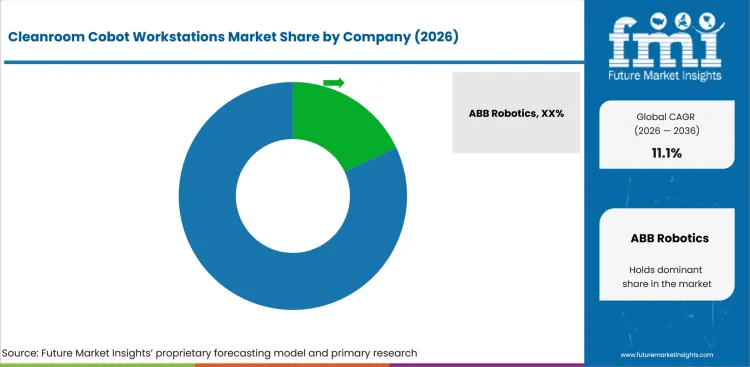
- Certified robot OEMs hold an advantage through cleanroom-rated arms, controller reliability, payload coverage, and service networks.
- Specialist integrators gain share by combining benches, grippers, guarding, cable routing, and validation documents into complete workcells.
- Regional channel partners gain acceptance when they provide demonstrations, training, spares, and local cleanroom commissioning support.
- Workstation-ready packaging of hardware and documentation supports trial by reducing buyer uncertainty during qualification reviews.
Robot OEMs in this space compete by connecting certified hardware with buyers comparing demand for robotics market signals and particle-control proof. ABB, Stäubli, FANUC, KUKA, Universal Robots, Yaskawa, and Hanwha Robotics are relevant because their cleanroom-capable arms give integrators a documented starting point. Buyers still compare workstation-level evidence because an uncertified gripper or exposed cable can weaken the full cell. Capability advantage comes from matching the robot, bench, airflow, and loading method to the cleanroom task.
Supplier positioning also draws support from collaborative robots market outlook as more buyers accept operator-near automation inside compact cells. Universal Robots and FANUC show two paths to share gain through faster collaborative motion and cleanroom-focused arm design. One path expands compact workstation productivity and another broadens payload coverage for hygienic handling. The strongest integrators will be those that document airflow impact, cleaning method, cycle consistency, and service support from the start.
Workstation demand connects closely with semiconductor manufacturing equipment market analysis because fabs need automation around tools without adding contamination risk. Pharmaceutical users compare cleanroom workstation decisions with pharma automation as sterile teams examine cleaning records and validation evidence. Mobile cleanroom handling can also draw lessons from mobile robotics when plants evaluate local buffering and tool-to-tool movement.
How do top cleanroom cobot workstations companies compare?
ABB, FANUC, KUKA, Stäubli and Yaskawa score strongly on cleanroom-capable robot depth while Universal Robots and Hanwha strengthen the collaborative workstation case.
Competitive Benchmarking: Cleanroom Cobot Workstations Market
| Company | Relevance to Market Title | Cleanroom Certification Depth | Compact Workcell Fit | Regulated Industry Fit | Geographic Footprint |
|---|---|---|---|---|---|
| ABB Robotics | Very High | Very Strong | Strong | Very Strong | Global |
| FANUC | Very High | Very Strong | Strong | Very Strong | Global |
| KUKA | Very High | Very Strong | Very Strong | Strong | Global |
| Stäubli | Very High | Strong | Strong | Strong | Global |
| Universal Robots | High | Strong | Very Strong | Strong | Global |
| Yaskawa Motoman | High | Strong | Strong | Strong | Global |
| Hanwha Robotics | High | Moderate | Strong | Moderate | Asia and Europe |
| Epson Robots | Moderate | Moderate | Strong | Moderate | Global |
| Kawasaki Robotics | Moderate | Moderate | Moderate | Moderate | Global |
| Omron | Moderate | Strong | Strong | Moderate | Global |
Source: Future Market Insights competitive analysis, 2026.
Who are the key players in the cleanroom cobot workstations market?
ABB Robotics, FANUC and KUKA are listed with Stäubli, Universal Robots, Yaskawa and Hanwha among other suppliers.
Key global companies leading the cleanroom cobot workstations market include:
- ABB Robotics
- FANUC
- KUKA
- Stäubli Robotics
- Universal Robots
- Yaskawa Motoman
- Hanwha Robotics
- Epson Robots
- Kawasaki Robotics
- Omron
Key Developments in Cleanroom Cobot Workstations Market
- In May 2025, Universal Robots introduced UR15 with 5 m/s maximum TCP speed and up to 30% cycle time improvement for pick-and-place applications.
- In August 2025, FANUC developed food and cleanroom specification models for LR Mate/10-11A and M-710 robots, expanding payload options for clean handling.
- In June 2026, Yaskawa launched MOTOMAN-HD7 and HD8 with cleanroom Class 5 and Class 4 compliance based on ISO 14644-1.
Key Players in the Cleanroom Cobot Workstations Market
Certified Robot OEMs
- ABB Robotics
- FANUC
- KUKA
- Stäubli Robotics
- Universal Robots
- Yaskawa Motoman
- Hanwha Robotics
Workstation Integrators
- Cleanroom automation integrators
- Semiconductor handling cell builders
- Pharmaceutical automation integrators
- Medical device automation specialists
Regional Controlled-Environment Specialists
- Epson Robots
- Kawasaki Robotics
- Omron
- Local cobot distributors
- Validation service partners
Cleanroom Cobot Workstations Market - Report Scope
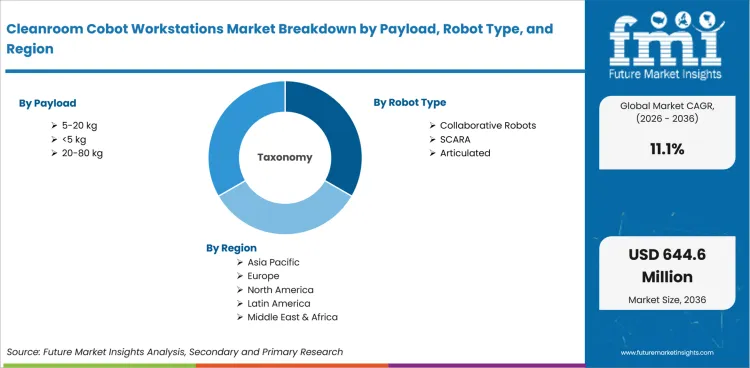
| Parameter | Details |
|---|---|
| Forecast period | 2026 to 2036 |
| Historical period | 2021 to 2025 |
| Quantitative unit | Revenue in USD million |
| By payload | <5 kg, 5-20 kg, 20-80 kg, >80 kg |
| By robot type | Collaborative Robots, SCARA, Articulated, AMR/AGV, Delta Robots |
| By workstation configuration | Fixed Bench Workstations, Enclosed Mini-Cells, Mobile Cleanroom Workstations, Pass-Through Stations |
| By end-use industry | Electronics, Pharmaceuticals, Medical Devices, Automotive Electronics, Food & Beverage |
| By application | Material Handling, Inspection, Assembly, Packaging, Machine Tending |
| Regions covered | North America, Latin America, Europe, East Asia, South Asia and Pacific, Middle East and Africa |
| Countries covered | China, India, South Korea, United States, Japan, Germany, France, United Kingdom |
| Key companies profiled | ABB, FANUC, KUKA, Stäubli, Universal Robots, Yaskawa, Hanwha Robotics, Epson, Kawasaki Robotics, Omron |
| Approach | Bottom-up workstation-boundary approach using robot configuration mix, cleanroom density, end-use demand, channel presence, and country-level automation trends |
Source: Future Market Insights, 2026.
Cleanroom Cobot Workstations Market - Scope & Definition
| Attribute | Detail |
|---|---|
| Market Definition | Integrated cleanroom work cells combining cobots or compact robots with cleanroom-rated fixtures, controls, end effectors, benches, guarding, and process tooling. |
| Functions Covered | Low-particle handling, tool-side transfer, inspection support, assembly assistance, packaging support, machine tending, and cleanroom workflow automation. |
| Applications Covered | Material handling, inspection, assembly, packaging, and machine tending inside controlled environments. |
| End-Use Industries | Electronics, semiconductors, pharmaceuticals, medical devices, automotive electronics, and selected food and beverage clean production environments. |
| Payloads Covered | <5 kg, 5-20 kg, 20-80 kg, and >80 kg payload classes. |
| Inclusions | Integrated cleanroom robotic workstations, cleanroom-capable robot arms, workstation frames, guarding, cleanroom fixtures, end effectors, and validated controls sold as part of workcell projects. |
| Exclusions | General industrial cobots outside cleanrooms, warehouse robots without cleanroom certification, non-robotic cleanroom furniture, HVAC systems, and laboratory automation without workstation integration. |
Cleanroom Cobot Workstations Market - Research Methodology
| Method | Description |
|---|---|
| Primary Research | FMI analyst interviews with robotics suppliers, cleanroom integrators, automation engineers, semiconductor buyers, pharmaceutical manufacturers, and medical device production teams across key markets. |
| Desk Research | Review of ISO 14644 references, official robotics statistics, company cleanroom robot specifications, sterile manufacturing guidance, semiconductor investment programs, and regulatory evidence. |
| Market Sizing & Forecasting | Bottom-up workstation-boundary approach using eligible workcell revenue, robot configuration mix, cleanroom density, country automation patterns, and end-use adoption trends. |
| Data Validation | Cross-verification using robot installation statistics, country semiconductor programs, cleanroom robot certifications, supplier portfolios, channel checks, and cleanroom integration evidence. |
Cleanroom Cobot Workstations Market Breakdown by Payload, Robot Type, Workstation Configuration, End-use Industry, Application, and Region
Cleanroom Cobot Workstations Market Segmented by Payload
- <5 kg
- 5-20 kg
- 20-80 kg
- >80 kg
Cleanroom Cobot Workstations Market Segmented by Robot Type
- Collaborative Robots
- SCARA
- Articulated
- AMR/AGV
- Delta Robots
Cleanroom Cobot Workstations Market Segmented by Workstation Configuration
- Fixed Bench Workstations
- Enclosed Mini-Cells
- Mobile Cleanroom Workstations
- Pass-Through Stations
Cleanroom Cobot Workstations Market Segmented by End-use Industry
- Electronics
- Pharmaceuticals
- Medical Devices
- Automotive Electronics
- Food & Beverage
Cleanroom Cobot Workstations Market Segmented by Application
- Material Handling
- Inspection
- Assembly
- Packaging
- Machine Tending
Cleanroom Cobot Workstations Market by Region
- North America
- Latin America
- Europe
- East Asia
- South Asia and Pacific
- Middle East and Africa
Research Sources and Bibliography
- ABB Robotics. (2026). Cleanroom robots.
- Department for Business and Trade. (2025, July 16). Life Sciences Sector Plan to grow economy and transform NHS.
- Department for Science, Innovation and Technology. (2025, September 5). Life Sciences Innovative Manufacturing Fund: Expression of interest.
- FANUC Corporation. (2025, August). ROBOT new product: Food/Cleanroom specification robot.
- Germany Trade & Invest. (2026). Semiconductor industry in Germany.
- Hanwha Robotics. (2025, July 1). Hanwha collaborative robot achieves Cleanroom Class 1 certification.
- International Federation of Robotics. (2025, September 25). Global robot demand in factories doubles over 10 years.
- International Federation of Robotics. (2025, October 22). Automation is a cornerstone of modern manufacturing.
- International Federation of Robotics. (2026, April 8). Robot density surges in Europe, Asia, and Americas.
- Japan External Trade Organization. (2026). Semiconductors and microelectronics: Attractive markets.
- KUKA. (2025, June 17). KMR iisy CR mobile manipulator for cleanroom solutions.
- Ministry of Science and ICT. (2024, January 15). Government to establish the world’s largest and most advanced mega semiconductor cluster.
- National Bureau of Statistics of China. (2025, August 21). Industrial production operation in July 2025.
- National Institute of Standards and Technology. (2026). CHIPS for America.
- Press Information Bureau. (2026, February 7). India Semiconductor Mission 2.0.
- Stäubli International. (2026). Cleanroom industrial robot range.
- Universal Robots. (2025, May 12). Universal Robots introduces its fastest ever cobot to enable unprecedented performance in collaborative automation.
- USA Food and Drug Administration. (2024, May 22). Questions and answers on current good manufacturing practice regulations for production and process controls.
- Yaskawa Electric Corporation. (2026, June 1). Launch of MOTOMAN-HD7 and HD8 for hygienic environments markets.
- Yaskawa Europe. (2026). Yaskawa HD7 robot: Hygienic 6-axis cleanroom automation.
- French Government. (2026). Understanding France 2030.
This bibliography is provided for reader reference and is not exhaustive. The full report contains the complete reference list and detailed citations.
This Report Answers
- Market size estimates for 2026 and forecasts through 2036 for the cleanroom cobot workstations market.
- Insights across regional and country-level markets using cleanroom automation adoption signals.
- Analysis of demand drivers, contamination-control priorities, validation barriers, and purchasing behavior.
- Evaluation of payload, robot type, workstation configuration, end-use industry, and application segments.
- Assessment of semiconductor, pharmaceutical, electronics, and medical device demand influences on market development.
- Identification of growth opportunities across compact workstations, mobile cleanroom handling, and validated tooling packages.
- Evaluation of supplier positioning, certification depth, integration channels, and service support requirements.
- Country-level growth analysis covering China, India, South Korea, United States, Japan, Germany, France, and United Kingdom.
- Assessment of the competitive landscape, including leading robot OEMs, workstation integrators, and regional channel specialists.
- Analysis of cleanroom workstation buyer requirements, market penetration trends, and emerging automation opportunities.
- Regional outlooks across North America, Europe, East Asia, South Asia and Pacific, Latin America, and Middle East and Africa.
- Delivery of market data, forecasts, and supporting analysis in PDF and Excel formats.
Frequently Asked Questions
What is the growth prospect for cleanroom cobot workstations?
Demand for cleanroom cobot workstations is expected to rise at a considerable pace as electronics and life sciences users adopt validated automation cells.
Which companies are expected to shape the cleanroom cobot workstations market?
ABB, FANUC, KUKA, Stäubli, Universal Robots, Yaskawa, Hanwha Robotics, Epson, Kawasaki Robotics, and Omron are expected to shape market competition.
Why are leading robot companies investing in cleanroom cobot workstations?
Leading robot companies are investing in cleanroom cobot workstations to serve manufacturers that need compact automation without adding contamination risk.
Why are cleanroom integrators important in this market?
Cleanroom integrators are important because buyers need complete workcells with benches, grippers, cable routing, guarding, and validation support.
Which workstation formats are gaining attention in cleanroom cobot workstations?
Fixed bench workstations and mobile cleanroom workstations are gaining attention as plants automate transfer work near process tools.
How do regulations influence cleanroom cobot workstation launches?
Regulations influence launches by pushing suppliers to provide cleaning records, component traceability, and documented contamination-control evidence.
Why is payload selection important for cleanroom cobot workstations?
Payload selection is important because gripper weight, cable sleeves, trays, carriers, and fixtures can change the effective handling limit inside cleanrooms.
What role does cleanroom certification play in workstation adoption?
Cleanroom certification supports adoption by giving buyers confidence that robot motion and surface design will not add unwanted particles.
How do semiconductor fabs use cleanroom cobot workstations?
Semiconductor fabs use cleanroom cobot workstations for carrier transfer, inspection support, local buffering, and tool-side material handling.
Preview the report firsthand - request a free sample
Get SampleGet the brochure for pricing and purchase details.
Get PDFTable of Content
- Executive Summary
- Global Market Outlook
- Demand-side Trends
- Supply-side Trends
- Technology Roadmap Analysis
- Analysis and Recommendations
- Market Overview
- Market Coverage / Taxonomy
- Market Definition / Scope / Limitations
- Research Methodology
- Chapter Orientation
- Analytical Lens and Working Hypotheses
- Market Structure, Signals, and Trend Drivers
- Benchmarking and Cross-market Comparability
- Market Sizing, Forecasting, and Opportunity Mapping
- Research Design and Evidence Framework
- Desk Research Programme (Secondary Evidence)
- Company Annual and Sustainability Reports
- Peer-reviewed Journals and Academic Literature
- Corporate Websites, Product Literature, and Technical Notes
- Earnings Decks and Investor Briefings
- Statutory Filings and Regulatory Disclosures
- Technical White Papers and Standards Notes
- Trade Journals, Industry Magazines, and Analyst Briefs
- Conference Proceedings, Webinars, and Seminar Materials
- Government Statistics Portals and Public Data Releases
- Press Releases and Reputable Media Coverage
- Specialist Newsletters and Curated Briefings
- Sector Databases and Reference Repositories
- FMI Internal Proprietary Databases and Historical Market Datasets
- Subscription Datasets and Paid Sources
- Social Channels, Communities, and Digital Listening Inputs
- Additional Desk Sources
- Expert Input and Fieldwork (Primary Evidence)
- Primary Modes
- Qualitative Interviews and Expert Elicitation
- Quantitative Surveys and Structured Data Capture
- Blended Approach
- Why Primary Evidence is Used
- Field Techniques
- Interviews
- Surveys
- Focus Groups
- Observational and In-context Research
- Social and Community Interactions
- Stakeholder Universe Engaged
- C-suite Leaders
- Board Members
- Presidents and Vice Presidents
- R&D and Innovation Heads
- Technical Specialists
- Domain Subject-matter Experts
- Scientists
- Physicians and Other Healthcare Professionals
- Governance, Ethics, and Data Stewardship
- Research Ethics
- Data Integrity and Handling
- Primary Modes
- Tooling, Models, and Reference Databases
- Desk Research Programme (Secondary Evidence)
- Data Engineering and Model Build
- Data Acquisition and Ingestion
- Cleaning, Normalisation, and Verification
- Synthesis, Triangulation, and Analysis
- Quality Assurance and Audit Trail
- Market Background
- Market Dynamics
- Drivers
- Restraints
- Opportunity
- Trends
- Scenario Forecast
- Demand in Optimistic Scenario
- Demand in Likely Scenario
- Demand in Conservative Scenario
- Opportunity Map Analysis
- Product Life Cycle Analysis
- Supply Chain Analysis
- Investment Feasibility Matrix
- Value Chain Analysis
- PESTLE and Porter’s Analysis
- Regulatory Landscape
- Regional Parent Market Outlook
- Production and Consumption Statistics
- Import and Export Statistics
- Market Dynamics
- Global Market Analysis 2021 to 2025 and Forecast, 2026 to 2036
- Historical Market Size Value (USD Million) Analysis, 2021 to 2025
- Current and Future Market Size Value (USD Million) Projections, 2026 to 2036
- Y-o-Y Growth Trend Analysis
- Absolute $ Opportunity Analysis
- Global Market Pricing Analysis 2021 to 2025 and Forecast 2026 to 2036
- Global Market Analysis 2021 to 2025 and Forecast 2026 to 2036, By Payload
- Introduction / Key Findings
- Historical Market Size Value (USD Million) Analysis By Payload , 2021 to 2025
- Current and Future Market Size Value (USD Million) Analysis and Forecast By Payload , 2026 to 2036
- 5-20 kg
- <5 kg
- 20-80 kg
- 5-20 kg
- Y-o-Y Growth Trend Analysis By Payload , 2021 to 2025
- Absolute $ Opportunity Analysis By Payload , 2026 to 2036
- Global Market Analysis 2021 to 2025 and Forecast 2026 to 2036, By Robot Type
- Introduction / Key Findings
- Historical Market Size Value (USD Million) Analysis By Robot Type, 2021 to 2025
- Current and Future Market Size Value (USD Million) Analysis and Forecast By Robot Type, 2026 to 2036
- Collaborative Robots
- SCARA
- Articulated
- Collaborative Robots
- Y-o-Y Growth Trend Analysis By Robot Type, 2021 to 2025
- Absolute $ Opportunity Analysis By Robot Type, 2026 to 2036
- Global Market Analysis 2021 to 2025 and Forecast 2026 to 2036, By Workstation Configuration
- Introduction / Key Findings
- Historical Market Size Value (USD Million) Analysis By Workstation Configuration, 2021 to 2025
- Current and Future Market Size Value (USD Million) Analysis and Forecast By Workstation Configuration, 2026 to 2036
- Fixed Bench Workstations
- Enclosed Mini-Cells
- Mobile Cleanroom Workstations
- Fixed Bench Workstations
- Y-o-Y Growth Trend Analysis By Workstation Configuration, 2021 to 2025
- Absolute $ Opportunity Analysis By Workstation Configuration, 2026 to 2036
- Global Market Analysis 2021 to 2025 and Forecast 2026 to 2036, By End-use Industry
- Introduction / Key Findings
- Historical Market Size Value (USD Million) Analysis By End-use Industry, 2021 to 2025
- Current and Future Market Size Value (USD Million) Analysis and Forecast By End-use Industry, 2026 to 2036
- Electronics
- Pharmaceuticals
- Medical Devices
- Electronics
- Y-o-Y Growth Trend Analysis By End-use Industry, 2021 to 2025
- Absolute $ Opportunity Analysis By End-use Industry, 2026 to 2036
- Global Market Analysis 2021 to 2025 and Forecast 2026 to 2036, By Application
- Introduction / Key Findings
- Historical Market Size Value (USD Million) Analysis By Application, 2021 to 2025
- Current and Future Market Size Value (USD Million) Analysis and Forecast By Application, 2026 to 2036
- Material Handling
- Inspection
- Assembly
- Material Handling
- Y-o-Y Growth Trend Analysis By Application, 2021 to 2025
- Absolute $ Opportunity Analysis By Application, 2026 to 2036
- Global Market Analysis 2021 to 2025 and Forecast 2026 to 2036, By Region
- Introduction
- Historical Market Size Value (USD Million) Analysis By Region, 2021 to 2025
- Current Market Size Value (USD Million) Analysis and Forecast By Region, 2026 to 2036
- North America
- Latin America
- Western Europe
- Eastern Europe
- East Asia
- South Asia and Pacific
- Middle East & Africa
- Market Attractiveness Analysis By Region
- North America Market Analysis 2021 to 2025 and Forecast 2026 to 2036, By Country
- Historical Market Size Value (USD Million) Trend Analysis By Market Taxonomy, 2021 to 2025
- Market Size Value (USD Million) Forecast By Market Taxonomy, 2026 to 2036
- By Country
- USA
- Canada
- Mexico
- By Payload
- By Robot Type
- By Workstation Configuration
- By End-use Industry
- By Application
- By Country
- Market Attractiveness Analysis
- By Country
- By Payload
- By Robot Type
- By Workstation Configuration
- By End-use Industry
- By Application
- Key Takeaways
- Latin America Market Analysis 2021 to 2025 and Forecast 2026 to 2036, By Country
- Historical Market Size Value (USD Million) Trend Analysis By Market Taxonomy, 2021 to 2025
- Market Size Value (USD Million) Forecast By Market Taxonomy, 2026 to 2036
- By Country
- Brazil
- Chile
- Rest of Latin America
- By Payload
- By Robot Type
- By Workstation Configuration
- By End-use Industry
- By Application
- By Country
- Market Attractiveness Analysis
- By Country
- By Payload
- By Robot Type
- By Workstation Configuration
- By End-use Industry
- By Application
- Key Takeaways
- Western Europe Market Analysis 2021 to 2025 and Forecast 2026 to 2036, By Country
- Historical Market Size Value (USD Million) Trend Analysis By Market Taxonomy, 2021 to 2025
- Market Size Value (USD Million) Forecast By Market Taxonomy, 2026 to 2036
- By Country
- Germany
- UK
- Italy
- Spain
- France
- Nordic
- BENELUX
- Rest of Western Europe
- By Payload
- By Robot Type
- By Workstation Configuration
- By End-use Industry
- By Application
- By Country
- Market Attractiveness Analysis
- By Country
- By Payload
- By Robot Type
- By Workstation Configuration
- By End-use Industry
- By Application
- Key Takeaways
- Eastern Europe Market Analysis 2021 to 2025 and Forecast 2026 to 2036, By Country
- Historical Market Size Value (USD Million) Trend Analysis By Market Taxonomy, 2021 to 2025
- Market Size Value (USD Million) Forecast By Market Taxonomy, 2026 to 2036
- By Country
- Russia
- Poland
- Hungary
- Balkan & Baltic
- Rest of Eastern Europe
- By Payload
- By Robot Type
- By Workstation Configuration
- By End-use Industry
- By Application
- By Country
- Market Attractiveness Analysis
- By Country
- By Payload
- By Robot Type
- By Workstation Configuration
- By End-use Industry
- By Application
- Key Takeaways
- East Asia Market Analysis 2021 to 2025 and Forecast 2026 to 2036, By Country
- Historical Market Size Value (USD Million) Trend Analysis By Market Taxonomy, 2021 to 2025
- Market Size Value (USD Million) Forecast By Market Taxonomy, 2026 to 2036
- By Country
- China
- Japan
- South Korea
- By Payload
- By Robot Type
- By Workstation Configuration
- By End-use Industry
- By Application
- By Country
- Market Attractiveness Analysis
- By Country
- By Payload
- By Robot Type
- By Workstation Configuration
- By End-use Industry
- By Application
- Key Takeaways
- South Asia and Pacific Market Analysis 2021 to 2025 and Forecast 2026 to 2036, By Country
- Historical Market Size Value (USD Million) Trend Analysis By Market Taxonomy, 2021 to 2025
- Market Size Value (USD Million) Forecast By Market Taxonomy, 2026 to 2036
- By Country
- India
- ASEAN
- Australia & New Zealand
- Rest of South Asia and Pacific
- By Payload
- By Robot Type
- By Workstation Configuration
- By End-use Industry
- By Application
- By Country
- Market Attractiveness Analysis
- By Country
- By Payload
- By Robot Type
- By Workstation Configuration
- By End-use Industry
- By Application
- Key Takeaways
- Middle East & Africa Market Analysis 2021 to 2025 and Forecast 2026 to 2036, By Country
- Historical Market Size Value (USD Million) Trend Analysis By Market Taxonomy, 2021 to 2025
- Market Size Value (USD Million) Forecast By Market Taxonomy, 2026 to 2036
- By Country
- Kingdom of Saudi Arabia
- Other GCC Countries
- Turkiye
- South Africa
- Other African Union
- Rest of Middle East & Africa
- By Payload
- By Robot Type
- By Workstation Configuration
- By End-use Industry
- By Application
- By Country
- Market Attractiveness Analysis
- By Country
- By Payload
- By Robot Type
- By Workstation Configuration
- By End-use Industry
- By Application
- Key Takeaways
- Key Countries Market Analysis
- USA
- Pricing Analysis
- Market Share Analysis, 2025
- By Payload
- By Robot Type
- By Workstation Configuration
- By End-use Industry
- By Application
- Canada
- Pricing Analysis
- Market Share Analysis, 2025
- By Payload
- By Robot Type
- By Workstation Configuration
- By End-use Industry
- By Application
- Mexico
- Pricing Analysis
- Market Share Analysis, 2025
- By Payload
- By Robot Type
- By Workstation Configuration
- By End-use Industry
- By Application
- Brazil
- Pricing Analysis
- Market Share Analysis, 2025
- By Payload
- By Robot Type
- By Workstation Configuration
- By End-use Industry
- By Application
- Chile
- Pricing Analysis
- Market Share Analysis, 2025
- By Payload
- By Robot Type
- By Workstation Configuration
- By End-use Industry
- By Application
- Germany
- Pricing Analysis
- Market Share Analysis, 2025
- By Payload
- By Robot Type
- By Workstation Configuration
- By End-use Industry
- By Application
- UK
- Pricing Analysis
- Market Share Analysis, 2025
- By Payload
- By Robot Type
- By Workstation Configuration
- By End-use Industry
- By Application
- Italy
- Pricing Analysis
- Market Share Analysis, 2025
- By Payload
- By Robot Type
- By Workstation Configuration
- By End-use Industry
- By Application
- Spain
- Pricing Analysis
- Market Share Analysis, 2025
- By Payload
- By Robot Type
- By Workstation Configuration
- By End-use Industry
- By Application
- France
- Pricing Analysis
- Market Share Analysis, 2025
- By Payload
- By Robot Type
- By Workstation Configuration
- By End-use Industry
- By Application
- India
- Pricing Analysis
- Market Share Analysis, 2025
- By Payload
- By Robot Type
- By Workstation Configuration
- By End-use Industry
- By Application
- ASEAN
- Pricing Analysis
- Market Share Analysis, 2025
- By Payload
- By Robot Type
- By Workstation Configuration
- By End-use Industry
- By Application
- Australia & New Zealand
- Pricing Analysis
- Market Share Analysis, 2025
- By Payload
- By Robot Type
- By Workstation Configuration
- By End-use Industry
- By Application
- China
- Pricing Analysis
- Market Share Analysis, 2025
- By Payload
- By Robot Type
- By Workstation Configuration
- By End-use Industry
- By Application
- Japan
- Pricing Analysis
- Market Share Analysis, 2025
- By Payload
- By Robot Type
- By Workstation Configuration
- By End-use Industry
- By Application
- South Korea
- Pricing Analysis
- Market Share Analysis, 2025
- By Payload
- By Robot Type
- By Workstation Configuration
- By End-use Industry
- By Application
- Russia
- Pricing Analysis
- Market Share Analysis, 2025
- By Payload
- By Robot Type
- By Workstation Configuration
- By End-use Industry
- By Application
- Poland
- Pricing Analysis
- Market Share Analysis, 2025
- By Payload
- By Robot Type
- By Workstation Configuration
- By End-use Industry
- By Application
- Hungary
- Pricing Analysis
- Market Share Analysis, 2025
- By Payload
- By Robot Type
- By Workstation Configuration
- By End-use Industry
- By Application
- Kingdom of Saudi Arabia
- Pricing Analysis
- Market Share Analysis, 2025
- By Payload
- By Robot Type
- By Workstation Configuration
- By End-use Industry
- By Application
- Turkiye
- Pricing Analysis
- Market Share Analysis, 2025
- By Payload
- By Robot Type
- By Workstation Configuration
- By End-use Industry
- By Application
- South Africa
- Pricing Analysis
- Market Share Analysis, 2025
- By Payload
- By Robot Type
- By Workstation Configuration
- By End-use Industry
- By Application
- USA
- Market Structure Analysis
- Competition Dashboard
- Competition Benchmarking
- Market Share Analysis of Top Players
- By Regional
- By Payload
- By Robot Type
- By Workstation Configuration
- By End-use Industry
- By Application
- Competition Analysis
- Competition Deep Dive
- ABB Robotics
- Overview
- Product Portfolio
- Profitability by Market Segments (Product/Age /Sales Channel/Region)
- Sales Footprint
- Strategy Overview
- Marketing Strategy
- Product Strategy
- Channel Strategy
- FANUC
- KUKA
- Stäubli Robotics
- Universal Robots
- ABB Robotics
- Competition Deep Dive
- Assumptions & Acronyms Used


