

- Industry Size (2026)
- USD 4.85 Bn
- Forecast (2036)
- USD 8.29 Bn
- CAGR (2026 to 2036)
- 5.5%
Continuous Ambulatory Peritoneal Dialysis Bags Market Size, Market Forecast and Outlook By FMI
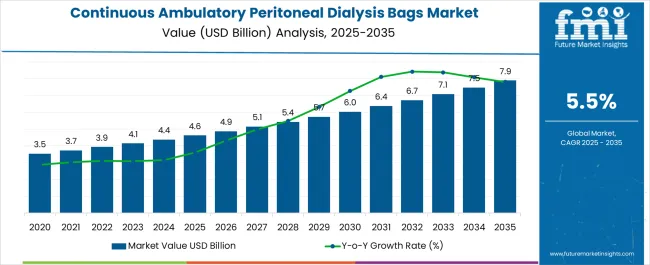
The continuous ambulatory peritoneal dialysis bags market was valued at USD Billion 4.60 billion in 2025, projected to reach USD 4.85 billion in 2026, and is forecast to expand to USD 8.29 billion by 2036 at a 5.5% CAGR. Reimbursement reforms in developed economies and growing chronic kidney disease diagnosis rates in emerging markets have sustained demand for CAPD consumables over the past decade.
Summary of Continuous Ambulatory Peritoneal Dialysis Bags Market
- Market Snapshot
- The continuous ambulatory peritoneal dialysis bags market is valued at USD Billion 4.60 billion in 2025 and is projected to reach USD Billion 8.29 billion by 2036.
- The industry is expected to grow at a 5.5% CAGR from 2026 to 2036, creating an incremental opportunity of USD Billion 3.44 billion.
- The market is a clinically regulated, procedure-volume driven category where reimbursement policies, chronic kidney disease prevalence, and home dialysis adoption rates define competitive positioning.
- Demand and Growth Drivers
- Demand is rising as ESRD patient populations expand and national health systems introduce reimbursement incentives for home-based peritoneal dialysis programs.
- Adoption of twin-bag disconnect systems and non-PVC biocompatible materials is accelerating as regulators tighten plasticizer exposure standards for dialysis consumables.
- Growth is further supported by expanding dialysis access programs in emerging economies, where government-funded renal care coverage is increasing patient treatment initiation rates.
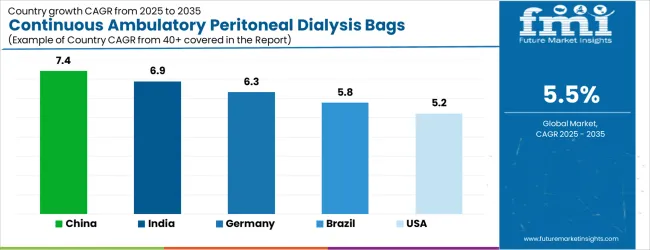
- Among key countries, China at 7.4%, India at 6.9%, Germany at 6.3%, Brazil at 5.8%, USA at 5.2%, UK at 4.7%, Japan at 4.1%.
- Product and Segment View
- The market covers These bags enable gravity-driven peritoneal fluid exchange in home and clinical settings, allowing patients to perform dialysis without machine assistance.
- Hospitals leads by Application with 42.7% share in 2026.
- 500 Ml-1000 Ml leads by Capacity with 39.4% share in 2026.
- Market scope covers CAPD fluid bags across all fill volumes, including PVC and non-PVC materials, twin-bag and Y-set disconnect systems, and accessories integrated within single-use dialysis exchange kits.
- The scope excludes automated peritoneal dialysis (APD) cassette systems, hemodialysis consumables, peritoneal dialysis solutions sold separately without bags, and capital equipment such as cyclers and warmers.
- Geography and Competitive Outlook
- China and India are the fastest-growing markets, while UK and Japan represent mature demand bases with steady replacement cycles.
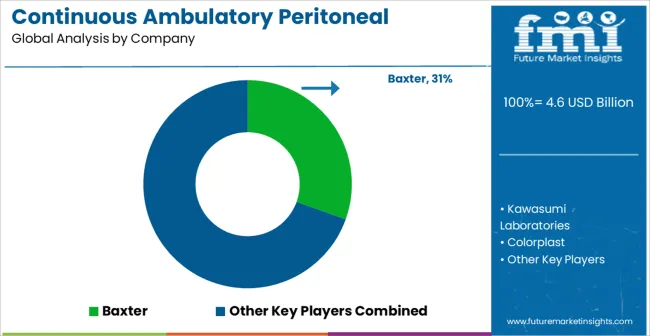
- Competition is shaped by concentrated market share among established players, with key players including Baxter, Kawasumi Laboratories, Colorplast, Mitra Industries, Maco Pharma.
- Baxter holds approximately 31% market share, positioning it as the category leader.
- Analyst Opinion at FMI
- Ismail Sutaria, Principal Consultant, opines: 'In my analysis, I have observed that the real inflection point in the CAPD bags category is not patient volume growth alone but the regulatory-driven material transition from PVC to non-PVC bags. Procurement directors operating under tightening plasticizer limits face a binary compliance timeline that will restructure supplier shortlists by 2030. Organizations delaying their non-PVC bag qualification pipelines risk permanent displacement from preferred vendor programs in publicly funded renal care networks.'
- Strategic Implications / Executive Takeaways
- CAPD bag manufacturers must accelerate non-PVC material qualification timelines to maintain eligibility for publicly funded renal care procurement contracts.
- Distribution network operators should secure cold-chain and sterile logistics capabilities to support expanding home delivery programs for peritoneal dialysis consumables.
- Procurement directors must evaluate twin-bag system standardization to reduce peritonitis infection rates and meet evolving clinical safety benchmarks.
Continuous Ambulatory Peritoneal Dialysis Bags Market Key Takeaways
| Metric | Details |
|---|---|
| Industry Size (2026) | USD 4.85 billion |
| Industry Value (2036) | USD 8.29 billion |
| CAGR (2026-2036) | 5.5% |
Source: Future Market Insights, 2026
FMI analysts observe a structural transition underway, where hospital-centric dialysis models are giving ground to patient-managed home peritoneal dialysis programs. This shift is accelerating bag consumption per patient-year while also raising quality expectations around biocompatibility and connection safety. Non-PVC bag materials are gaining traction as regulatory agencies tighten plasticizer exposure limits, pushing unit prices higher even as procedure volumes stabilize in mature markets.
All major markets reflect differentiated growth trajectories. China at 7.4% CAGR, India at 6.9% CAGR, Germany at 6.3% CAGR, Brazil at 5.8% CAGR, USA at 5.2% CAGR, UK at 4.7% CAGR, Japan at 4.1% CAGR. Each country path is shaped by local regulatory frameworks, healthcare infrastructure maturity, and industrial demand patterns specific to the region.
Continuous Ambulatory Peritoneal Dialysis Bags Market Definition
The Continuous Ambulatory Peritoneal Dialysis Bags Market covers single-use, pre-filled or fillable PVC and non-PVC bags designed for continuous ambulatory peritoneal dialysis (CAPD) procedures. These bags enable gravity-driven peritoneal fluid exchange in home and clinical settings, allowing patients to perform dialysis without machine assistance. Core product categories span across different fill capacities suited for varying prescription volumes.
Continuous Ambulatory Peritoneal Dialysis Bags Market Inclusions
Market scope covers CAPD fluid bags across all fill volumes, including PVC and non-PVC materials, twin-bag and Y-set disconnect systems, and accessories integrated within single-use dialysis exchange kits. Regional and country-level market sizes, forecast period from 2026 to 2036, and segmentation by application and capacity are included.
Continuous Ambulatory Peritoneal Dialysis Bags Market Exclusions
The scope excludes automated peritoneal dialysis (APD) cassette systems, hemodialysis consumables, peritoneal dialysis solutions sold separately without bags, and capital equipment such as cyclers and warmers. Reusable container systems are also excluded.
Continuous Ambulatory Peritoneal Dialysis Bags Market Research Methodology
- Primary Research: Analysts conducted structured interviews with nephrology procurement directors, peritoneal dialysis program coordinators, and home therapy distribution managers across key geographies.
- Desk Research: Data collection included renal care registry publications, national kidney foundation reports, public health insurance reimbursement schedules, and regulatory filings from major medical device agencies.
- Market-Sizing and Forecasting: Baseline values derive from a bottom-up aggregation of peritoneal dialysis patient registries, applying region-specific home therapy adoption curves to project bag consumption volumes through 2036.
- Data Validation and Update Cycle: Projections are cross-validated against publicly reported renal care expenditure data from national health systems and dialysis provider financial disclosures.
Why is the Continuous Ambulatory Peritoneal Dialysis Bags Market Growing?
The Continuous Ambulatory Peritoneal Dialysis Bags market is witnessing consistent growth, driven by the increasing prevalence of chronic kidney disease and the rising demand for home-based dialysis solutions. Hospitals and healthcare facilities are prioritizing patient-centric therapies that allow for continuous treatment while minimizing hospital visits and associated costs. The market is being supported by advancements in bag materials, sterilization techniques, and fluid composition, which improve safety, biocompatibility, and patient comfort.
Growing awareness among patients and caregivers about the benefits of peritoneal dialysis over hemodialysis is enhancing adoption rates. Integration of these dialysis bags with standardized treatment protocols ensures regulatory compliance and operational efficiency in clinical settings.
The focus on reducing infection risks, improving fluid exchange efficiency, and enhancing patient quality of life is further propelling demand As healthcare providers and governments invest in infrastructure for renal care, the market is expected to sustain growth, driven by technological innovation, increased awareness, and a shift toward outpatient and home-based dialysis solutions across both developed and emerging economies.
Segmental Analysis
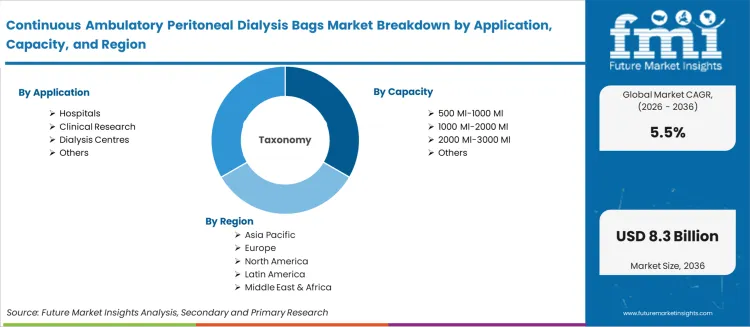
The continuous ambulatory peritoneal dialysis bags market is segmented by application, capacity, and geographic regions. By application, continuous ambulatory peritoneal dialysis bags market is divided into Hospitals, Clinical Research, Dialysis Centres, and Others. In terms of capacity, continuous ambulatory peritoneal dialysis bags market is classified into 500 Ml-1000 Ml, 1000 Ml-2000 Ml, 2000 Ml-3000 Ml, and Others. Regionally, the continuous ambulatory peritoneal dialysis bags industry is classified into North America, Latin America, Western Europe, Eastern Europe, Balkan & Baltic Countries, Russia & Belarus, Central Asia, East Asia, South Asia & Pacific, and the Middle East & Africa.
Insights into the Hospitals Application Segment
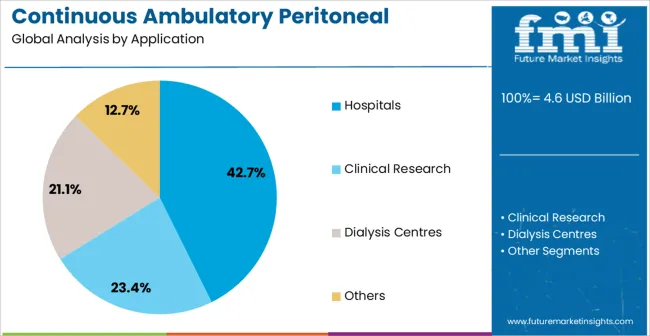
The hospitals application segment is projected to hold 42.7% of the market revenue in 2026, establishing it as the leading application area. Growth in this segment is being driven by the increasing requirement for reliable, safe, and standardized peritoneal dialysis solutions in clinical environments. Hospitals prefer these bags due to their ability to provide consistent fluid delivery, maintain sterility, and integrate seamlessly into patient treatment protocols.
Adoption is further enhanced by the availability of advanced dialysis bags that support continuous therapy, reduce peritonitis risk, and improve patient compliance. Training programs for healthcare professionals, combined with structured monitoring and fluid management systems, strengthen the preference for hospital use.
The segment is also being supported by government and private investments in renal care facilities, increasing the availability of dialysis services As hospitals continue to prioritize patient safety, treatment efficacy, and operational efficiency, the hospitals application segment is expected to maintain its leadership, driven by reliable performance, regulatory adherence, and clinical acceptance.
Insights into the 500 Ml-1000 Ml Capacity Segment
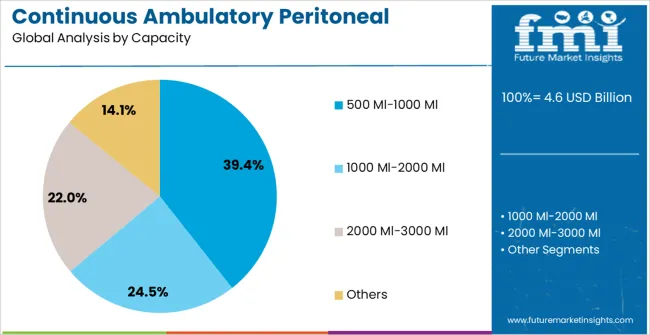
The 500 Ml-1000 Ml capacity segment is expected to account for 39.4% of the market revenue in 2026, establishing it as the leading capacity category. Its growth is being driven by the optimal balance it provides between fluid volume, exchange frequency, and patient comfort during continuous ambulatory peritoneal dialysis. This capacity range enables effective toxin and fluid removal while reducing the risk of complications and maintaining physiological stability.
Hospitals and patients prefer this capacity for both clinical efficiency and ease of handling, as it simplifies storage, transportation, and administration. The development of high-quality, sterilized bags with precise volume control enhances reliability and ensures regulatory compliance.
Adoption is further reinforced by educational initiatives for patients and caregivers, promoting safe and effective home-based dialysis management As the prevalence of chronic kidney disease rises and healthcare systems emphasize patient-centric and outpatient therapies, the 500 Ml-1000 Ml capacity segment is expected to sustain its leading position, driven by operational convenience, clinical effectiveness, and patient safety considerations.
Market Overview
The continuous ambulatory peritoneal dialysis bags are witnessing an unprecedented surge in demand in recent years. This surge in demand can be attributed to their aiding in maintaining various biological samples in sterilized conditions without any leakage. These bags are becoming extremely convenient for the hospital sector in sterile packaging. Eternal feeding, urine sample collection, and others.
The industry is concentrated with the top few players and is characterized by continuous developments, a diversified product portfolio, and an increasing regional presence. Acquisition and new product development are key strategies adopted by the industry players to increase their revenue share and improve their value chain integration.
It has been identified during analyzing the market that some start-ups in the continuous ambulatory peritoneal dialysis bags market are stirring up the dynamics and ceding a silver lining for further propulsion of the continuous ambulatory peritoneal dialysis bags market globally.
To resolve the problem of unnecessary deaths due to cholera, many manufacturers are developing intravenous continuous ambulatory peritoneal dialysis bags that can be shipped empty of fluid and filled at the site with any available liquid source.
These bags weigh only 2oz. each and are being shipped flat. The expert analysts identify at FMI that the continuous ambulatory peritoneal dialysis bags are made to use forward osmosis to create sterile saline solutions for the treatment of cholera patients.
Some manufacturers are underlining product innovation and creating dual chamber continuous ambulatory peritoneal dialysis bags for better and effective utilization in the hospital sector. Therefore, it is anticipated that the continuous ambulatory peritoneal dialysis bags market is likely to remain competitive during the projection period and have significant growth through 2036.
Analysis of Continuous Ambulatory Peritoneal Dialysis Bags Market By Key Countries
.webp "Top Country Growth Comparison Continuous Ambulatory Peritoneal Dialysis Bags Market Cagr (2026 2036)")
| Country | CAGR |
|---|---|
| China | 7.4% |
| India | 6.9% |
| Germany | 6.3% |
| Brazil | 5.8% |
| USA | 5.2% |
| UK | 4.7% |
| Japan | 4.1% |
Source: FMI analysis based on primary research and proprietary forecasting model
Country-wise Analysis
The Continuous Ambulatory Peritoneal Dialysis Bags Market is expected to register a CAGR of 5.5% during the forecast period, exhibiting varied country level momentum. China leads with the highest CAGR of 7.4%, followed by India at 6.9%. Developed markets such as Germany, France, and the UK continue to expand steadily, while the USA is likely to grow at consistent rates. Japan posts the lowest CAGR at 4.1%, yet still underscores a broadly positive trajectory for the global Continuous Ambulatory Peritoneal Dialysis Bags Market. In 2024, Germany held a dominant revenue in the Western Europe market and is expected to grow with a CAGR of 6.3%. The USA Continuous Ambulatory Peritoneal Dialysis Bags Market is estimated to be valued at USD 1.6 billion in 2026 and is anticipated to reach a valuation of USD 1.6 billion by 2036. Sales are projected to rise at a CAGR of 0.0% over the forecast period between 2026 and 2036. While Japan and South Korea markets are estimated to be valued at USD 246.5 million and USD 132.2 million respectively in 2026.
Key Players in the Continuous Ambulatory Peritoneal Dialysis Bags Market
- Baxter
- Kawasumi Laboratories
- Colorplast
- Mitra Industries
- Maco Pharma
Scope of the Report
| Metric | Value |
|---|---|
| Quantitative Units | USD Billion 4.85 to USD Billion 8.29 billion, at a CAGR of 5.5% |
| Market Definition | The Continuous Ambulatory Peritoneal Dialysis Bags Market covers single-use, pre-filled or fillable PVC and non-PVC bags designed for continuous ambulatory peritoneal dialysis (CAPD) procedures. These bags enable gravity-driven peritoneal fluid exchange in home and clinical settings, allowing patients to perform dialysis without machine assistance. |
| Segmentation | Application: Hospitals, Clinical Research, Dialysis Centres, Others; Capacity: 500 Ml-1000 Ml, 1000 Ml-2000 Ml, 2000 Ml-3000 Ml, Others |
| Regions Covered | North America, Latin America, Europe, East Asia, South Asia, Oceania, Middle East & Africa |
| Countries Covered | China, India, Germany, Brazil, USA, UK, Japan, and 40 plus countries |
| Key Companies Profiled | Baxter, Kawasumi Laboratories, Colorplast, Mitra Industries, Maco Pharma |
| Forecast Period | 2026 to 2036 |
| Approach | Baseline values derive from a bottom-up aggregation of peritoneal dialysis patient registries, applying region-specific home therapy adoption curves to project bag consumption volumes through 2036. |
Continuous Ambulatory Peritoneal Dialysis Bags Market by Segments
Application:
- Hospitals
- Clinical Research
- Dialysis Centres
- Others
Capacity:
- 500 Ml-1000 Ml
- 1000 Ml-2000 Ml
- 2000 Ml-3000 Ml
- Others
Region:
- North America
- USA
- Canada
- Mexico
- Latin America
- Brazil
- Chile
- Rest of Latin America
- Western Europe
- Germany
- UK
- Italy
- Spain
- France
- Nordic
- BENELUX
- Rest of Western Europe
- Eastern Europe
- Russia
- Poland
- Hungary
- Balkan & Baltic
- Rest of Eastern Europe
- East Asia
- China
- Japan
- South Korea
- South Asia and Pacific
- India
- ASEAN
- Australia & New Zealand
- Rest of South Asia and Pacific
- Middle East & Africa
- Kingdom of Saudi Arabia
- Other GCC Countries
- Turkiye
- South Africa
- Other African Union
- Rest of Middle East & Africa
Bibliography
- 1. World Health Organization. (2024). Global status report on kidney disease. WHO.
- 2. International Society of Peritoneal Dialysis. (2024). ISPD peritoneal dialysis guidelines update. ISPD.
- 3. European Medicines Agency. (2024). Scientific assessment of PVC medical devices containing plasticizers. EMA.
- 4. United States Renal Data System. (2024). USRDS 2024 annual data report. National Institutes of Health.
- 5. Baxter International Inc. (2025). 2024 annual report. Baxter International.
This bibliography is provided for reader reference. The full Future Market Insights report contains the complete reference list with primary research documentation.
Frequently Asked Questions
How large is the demand for Continuous Ambulatory Peritoneal Dialysis Bags Market in the global market in 2026?
Demand for continuous ambulatory peritoneal dialysis bags market in the global market is estimated to be valued at USD Billion 4.85 billion in 2026.
What will be the market size of Continuous Ambulatory Peritoneal Dialysis Bags Market in the global market by 2036?
Market size for continuous ambulatory peritoneal dialysis bags market is projected to reach USD Billion 8.29 billion by 2036.
What is the expected demand growth for Continuous Ambulatory Peritoneal Dialysis Bags Market between 2026 and 2036?
Demand for continuous ambulatory peritoneal dialysis bags market is expected to grow at a CAGR of 5.5% between 2026 and 2036.
Which Application segment is poised to lead global sales by 2026?
Hospitals accounts for 42.7% of application share in 2026.
Which Capacity segment is poised to lead global sales by 2026?
500 Ml-1000 Ml accounts for 39.4% of capacity share in 2026.
What is driving demand in China?
China is projected to grow at a CAGR of 7.4% during 2026 to 2036, supported by local regulatory developments and expanding end-use demand.
What is Continuous Ambulatory Peritoneal Dialysis Bags Market and what is it mainly used for?
The Continuous Ambulatory Peritoneal Dialysis Bags Market covers single-use, pre-filled or fillable PVC and non-PVC bags designed for continuous ambulatory peritoneal dialysis (CAPD) procedures. These bags enable gravity-driven peritoneal fluid exchange in home and clinical settings, allowing patients to perform dialysis without machine assistance.
How does FMI build and validate the Continuous Ambulatory Peritoneal Dialysis Bags Market forecast?
Baseline values derive from a bottom-up aggregation of peritoneal dialysis patient registries, applying region-specific home therapy adoption curves to project bag consumption volumes through 2036. Projections are cross-validated against publicly reported renal care expenditure data from national health systems and dialysis provider financial disclosures.
Preview the report firsthand - request a free sample
Get SampleGet the brochure for pricing and purchase details.
Get PDFTable of Content
- Executive Summary
- Global Market Outlook
- Demand-side Trends
- Supply-side Trends
- Technology Roadmap Analysis
- Analysis and Recommendations
- Market Overview
- Market Coverage / Taxonomy
- Market Definition / Scope / Limitations
- Research Methodology
- Chapter Orientation
- Analytical Lens and Working Hypotheses
- Market Structure, Signals, and Trend Drivers
- Benchmarking and Cross-market Comparability
- Market Sizing, Forecasting, and Opportunity Mapping
- Research Design and Evidence Framework
- Desk Research Programme (Secondary Evidence)
- Company Annual and Sustainability Reports
- Peer-reviewed Journals and Academic Literature
- Corporate Websites, Product Literature, and Technical Notes
- Earnings Decks and Investor Briefings
- Statutory Filings and Regulatory Disclosures
- Technical White Papers and Standards Notes
- Trade Journals, Industry Magazines, and Analyst Briefs
- Conference Proceedings, Webinars, and Seminar Materials
- Government Statistics Portals and Public Data Releases
- Press Releases and Reputable Media Coverage
- Specialist Newsletters and Curated Briefings
- Sector Databases and Reference Repositories
- FMI Internal Proprietary Databases and Historical Market Datasets
- Subscription Datasets and Paid Sources
- Social Channels, Communities, and Digital Listening Inputs
- Additional Desk Sources
- Expert Input and Fieldwork (Primary Evidence)
- Primary Modes
- Qualitative Interviews and Expert Elicitation
- Quantitative Surveys and Structured Data Capture
- Blended Approach
- Why Primary Evidence is Used
- Field Techniques
- Interviews
- Surveys
- Focus Groups
- Observational and In-context Research
- Social and Community Interactions
- Stakeholder Universe Engaged
- C-suite Leaders
- Board Members
- Presidents and Vice Presidents
- R&D and Innovation Heads
- Technical Specialists
- Domain Subject-matter Experts
- Scientists
- Physicians and Other Healthcare Professionals
- Governance, Ethics, and Data Stewardship
- Research Ethics
- Data Integrity and Handling
- Primary Modes
- Tooling, Models, and Reference Databases
- Desk Research Programme (Secondary Evidence)
- Data Engineering and Model Build
- Data Acquisition and Ingestion
- Cleaning, Normalisation, and Verification
- Synthesis, Triangulation, and Analysis
- Quality Assurance and Audit Trail
- Market Background
- Market Dynamics
- Drivers
- Restraints
- Opportunity
- Trends
- Scenario Forecast
- Demand in Optimistic Scenario
- Demand in Likely Scenario
- Demand in Conservative Scenario
- Opportunity Map Analysis
- Product Life Cycle Analysis
- Supply Chain Analysis
- Investment Feasibility Matrix
- Value Chain Analysis
- PESTLE and Porter’s Analysis
- Regulatory Landscape
- Regional Parent Market Outlook
- Production and Consumption Statistics
- Import and Export Statistics
- Market Dynamics
- Global Market Analysis 2021 to 2025 and Forecast, 2026 to 2036
- Historical Market Size Value (USD Million) Analysis, 2021 to 2025
- Current and Future Market Size Value (USD Million) Projections, 2026 to 2036
- Y-o-Y Growth Trend Analysis
- Absolute $ Opportunity Analysis
- Global Market Pricing Analysis 2021 to 2025 and Forecast 2026 to 2036
- Global Market Analysis 2021 to 2025 and Forecast 2026 to 2036, By Application
- Introduction / Key Findings
- Historical Market Size Value (USD Million) Analysis By Application , 2021 to 2025
- Current and Future Market Size Value (USD Million) Analysis and Forecast By Application , 2026 to 2036
- Hospitals
- Clinical Research
- Dialysis Centres
- Others
- Hospitals
- Y-o-Y Growth Trend Analysis By Application , 2021 to 2025
- Absolute $ Opportunity Analysis By Application , 2026 to 2036
- Global Market Analysis 2021 to 2025 and Forecast 2026 to 2036, By Capacity
- Introduction / Key Findings
- Historical Market Size Value (USD Million) Analysis By Capacity, 2021 to 2025
- Current and Future Market Size Value (USD Million) Analysis and Forecast By Capacity, 2026 to 2036
- 500 Ml-1000 Ml
- 1000 Ml-2000 Ml
- 2000 Ml-3000 Ml
- Others
- 500 Ml-1000 Ml
- Y-o-Y Growth Trend Analysis By Capacity, 2021 to 2025
- Absolute $ Opportunity Analysis By Capacity, 2026 to 2036
- Global Market Analysis 2021 to 2025 and Forecast 2026 to 2036, By Region
- Introduction
- Historical Market Size Value (USD Million) Analysis By Region, 2021 to 2025
- Current Market Size Value (USD Million) Analysis and Forecast By Region, 2026 to 2036
- North America
- Latin America
- Western Europe
- Eastern Europe
- East Asia
- South Asia and Pacific
- Middle East & Africa
- Market Attractiveness Analysis By Region
- North America Market Analysis 2021 to 2025 and Forecast 2026 to 2036, By Country
- Historical Market Size Value (USD Million) Trend Analysis By Market Taxonomy, 2021 to 2025
- Market Size Value (USD Million) Forecast By Market Taxonomy, 2026 to 2036
- By Country
- USA
- Canada
- Mexico
- By Application
- By Capacity
- By Country
- Market Attractiveness Analysis
- By Country
- By Application
- By Capacity
- Key Takeaways
- Latin America Market Analysis 2021 to 2025 and Forecast 2026 to 2036, By Country
- Historical Market Size Value (USD Million) Trend Analysis By Market Taxonomy, 2021 to 2025
- Market Size Value (USD Million) Forecast By Market Taxonomy, 2026 to 2036
- By Country
- Brazil
- Chile
- Rest of Latin America
- By Application
- By Capacity
- By Country
- Market Attractiveness Analysis
- By Country
- By Application
- By Capacity
- Key Takeaways
- Western Europe Market Analysis 2021 to 2025 and Forecast 2026 to 2036, By Country
- Historical Market Size Value (USD Million) Trend Analysis By Market Taxonomy, 2021 to 2025
- Market Size Value (USD Million) Forecast By Market Taxonomy, 2026 to 2036
- By Country
- Germany
- UK
- Italy
- Spain
- France
- Nordic
- BENELUX
- Rest of Western Europe
- By Application
- By Capacity
- By Country
- Market Attractiveness Analysis
- By Country
- By Application
- By Capacity
- Key Takeaways
- Eastern Europe Market Analysis 2021 to 2025 and Forecast 2026 to 2036, By Country
- Historical Market Size Value (USD Million) Trend Analysis By Market Taxonomy, 2021 to 2025
- Market Size Value (USD Million) Forecast By Market Taxonomy, 2026 to 2036
- By Country
- Russia
- Poland
- Hungary
- Balkan & Baltic
- Rest of Eastern Europe
- By Application
- By Capacity
- By Country
- Market Attractiveness Analysis
- By Country
- By Application
- By Capacity
- Key Takeaways
- East Asia Market Analysis 2021 to 2025 and Forecast 2026 to 2036, By Country
- Historical Market Size Value (USD Million) Trend Analysis By Market Taxonomy, 2021 to 2025
- Market Size Value (USD Million) Forecast By Market Taxonomy, 2026 to 2036
- By Country
- China
- Japan
- South Korea
- By Application
- By Capacity
- By Country
- Market Attractiveness Analysis
- By Country
- By Application
- By Capacity
- Key Takeaways
- South Asia and Pacific Market Analysis 2021 to 2025 and Forecast 2026 to 2036, By Country
- Historical Market Size Value (USD Million) Trend Analysis By Market Taxonomy, 2021 to 2025
- Market Size Value (USD Million) Forecast By Market Taxonomy, 2026 to 2036
- By Country
- India
- ASEAN
- Australia & New Zealand
- Rest of South Asia and Pacific
- By Application
- By Capacity
- By Country
- Market Attractiveness Analysis
- By Country
- By Application
- By Capacity
- Key Takeaways
- Middle East & Africa Market Analysis 2021 to 2025 and Forecast 2026 to 2036, By Country
- Historical Market Size Value (USD Million) Trend Analysis By Market Taxonomy, 2021 to 2025
- Market Size Value (USD Million) Forecast By Market Taxonomy, 2026 to 2036
- By Country
- Kingdom of Saudi Arabia
- Other GCC Countries
- Turkiye
- South Africa
- Other African Union
- Rest of Middle East & Africa
- By Application
- By Capacity
- By Country
- Market Attractiveness Analysis
- By Country
- By Application
- By Capacity
- Key Takeaways
- Key Countries Market Analysis
- USA
- Pricing Analysis
- Market Share Analysis, 2025
- By Application
- By Capacity
- Canada
- Pricing Analysis
- Market Share Analysis, 2025
- By Application
- By Capacity
- Mexico
- Pricing Analysis
- Market Share Analysis, 2025
- By Application
- By Capacity
- Brazil
- Pricing Analysis
- Market Share Analysis, 2025
- By Application
- By Capacity
- Chile
- Pricing Analysis
- Market Share Analysis, 2025
- By Application
- By Capacity
- Germany
- Pricing Analysis
- Market Share Analysis, 2025
- By Application
- By Capacity
- UK
- Pricing Analysis
- Market Share Analysis, 2025
- By Application
- By Capacity
- Italy
- Pricing Analysis
- Market Share Analysis, 2025
- By Application
- By Capacity
- Spain
- Pricing Analysis
- Market Share Analysis, 2025
- By Application
- By Capacity
- France
- Pricing Analysis
- Market Share Analysis, 2025
- By Application
- By Capacity
- India
- Pricing Analysis
- Market Share Analysis, 2025
- By Application
- By Capacity
- ASEAN
- Pricing Analysis
- Market Share Analysis, 2025
- By Application
- By Capacity
- Australia & New Zealand
- Pricing Analysis
- Market Share Analysis, 2025
- By Application
- By Capacity
- China
- Pricing Analysis
- Market Share Analysis, 2025
- By Application
- By Capacity
- Japan
- Pricing Analysis
- Market Share Analysis, 2025
- By Application
- By Capacity
- South Korea
- Pricing Analysis
- Market Share Analysis, 2025
- By Application
- By Capacity
- Russia
- Pricing Analysis
- Market Share Analysis, 2025
- By Application
- By Capacity
- Poland
- Pricing Analysis
- Market Share Analysis, 2025
- By Application
- By Capacity
- Hungary
- Pricing Analysis
- Market Share Analysis, 2025
- By Application
- By Capacity
- Kingdom of Saudi Arabia
- Pricing Analysis
- Market Share Analysis, 2025
- By Application
- By Capacity
- Turkiye
- Pricing Analysis
- Market Share Analysis, 2025
- By Application
- By Capacity
- South Africa
- Pricing Analysis
- Market Share Analysis, 2025
- By Application
- By Capacity
- USA
- Market Structure Analysis
- Competition Dashboard
- Competition Benchmarking
- Market Share Analysis of Top Players
- By Regional
- By Application
- By Capacity
- Competition Analysis
- Competition Deep Dive
- Baxter
- Overview
- Product Portfolio
- Profitability by Market Segments (Product/Age /Sales Channel/Region)
- Sales Footprint
- Strategy Overview
- Marketing Strategy
- Product Strategy
- Channel Strategy
- Kawasumi Laboratories
- Colorplast
- Mitra Industries
- Maco Pharma
- Baxter
- Competition Deep Dive
- Assumptions & Acronyms Used


