

- Industry Size (2026)
- USD 348.8 Mn
- Forecast (2036)
- USD 825.7 Mn
- CAGR (2026 to 2036)
- 9.0%
Contrast-Enhanced Mammography Market Forecast and Outlook 2026 to 2036
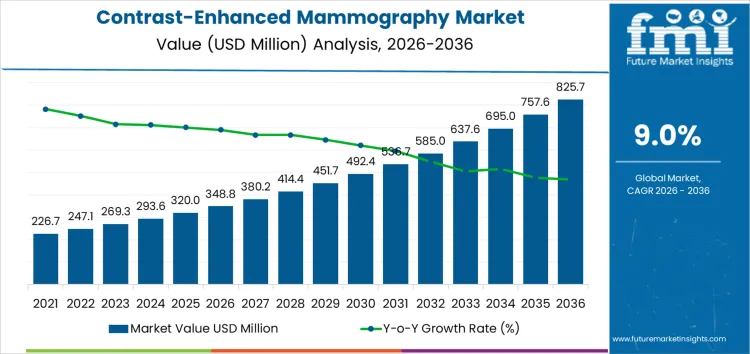
The Contrast-Enhanced Mammography market is projected at USD 348.8 million in 2026 and is expected to reach USD 825.7 million by 2036, growing at a CAGR of 9.0%. CEM systems account for 50% of the product segment, with diagnostics as the leading application at 60%. Hospitals are the dominant end users at 70%, supported by imaging centers and OEM channels. Key companies include GE HealthCare, Siemens Healthineers, Hologic, Canon Medical, and Philips.
Growth is fueled by rising breast cancer incidence, increased adoption of advanced imaging technologies, and the need for more precise diagnostics. Contrast media usage as a screening adjunct is expanding due to improved sensitivity and reduced false positives. Software and service solutions enhance workflow efficiency and image analysis capabilities. Market penetration is strengthened by strategic collaborations between OEMs and healthcare providers, as well as regional infrastructure expansion in diagnostics.
Quick Stats for Contrast Enhanced Mammography Market
- Contrast Enhanced Mammography Market Value (2026): USD 348.8 million
- Contrast Enhanced Mammography Market Forecast Value (2036): USD 825.7 million
- Contrast Enhanced Mammography Market Forecast CAGR: 9.0%
- Leading Type in Contrast Enhanced Mammography Market: CEM Systems
- Key Growth Regions in Contrast Enhanced Mammography Market: North America, Europe, and Asia Pacific
- Top Players in Contrast Enhanced Mammography Market: GE HealthCare, Siemens Healthineers, Hologic, Canon Medical, Philips
What is the Growth Forecast for the Contrast-Enhanced Mammography Market through 2036?
From 2026 to 2031, the contrast-enhanced mammography market grows from USD 348.8 million to approximately USD 492.4 million, representing the early adoption phase. Annual value additions rise from USD 28.8 million in 2026 to USD 57.6 million in 2031. Growth is driven by adoption in diagnostic imaging centers, hospitals, and breast cancer screening programs, where contrast-enhanced mammography improves lesion detectability, diagnostic accuracy, and patient outcomes. North America and Europe account for roughly 65% of early adoption, supported by reimbursement policies, clinical validation, and integration into standard screening protocols.
Between 2031 and 2036, the market expands from roughly USD 492.4 million to USD 825.7 million, illustrating the late adoption phase characterized by structural deployment across hospital networks and imaging chains. Annual increments increase from USD 57.6 million to USD 113.2 million, supported by repeat procurement, multi-site adoption, and rising demand in emerging markets in Asia Pacific and Latin America. Early-stage growth relied on selective high-value hospitals and pilot programs, whereas later expansion reflects portfolio-wide integration, normalized adoption, and broad implementation in breast imaging facilities globally.
Contrast Enhanced Mammography Market Key Takeaways
| Metric | Value |
|---|---|
| Market Value (2026) | USD 348.8 million |
| Forecast Value (2036) | USD 825.7 million |
| Forecast CAGR (2026 to 2036) | 9.0% |
How Is Contrast Enhanced Mammography Changing Breast Imaging Decision Making?
Contrast enhanced mammography gained traction because clinicians needed better tools for cases where standard imaging produced uncertainty. Dense breast tissue, postoperative changes, and overlapping structures often limited lesion visibility on conventional mammograms. MRI offered higher sensitivity but introduced access, cost, and scheduling constraints. Contrast enhanced mammography filled this gap by combining vascular contrast information with familiar mammographic workflows. Early demand came from diagnostic settings, not population screening. Radiologists used it to clarify indeterminate findings, assess extent of disease, and reduce reliance on additional imaging steps. Historical adoption followed diagnostic inefficiencies rather than screening expansion or technology substitution.
Future demand reflects changing clinical pathways rather than imaging novelty. Breast imaging protocols increasingly emphasize risk stratification and targeted diagnostics. Contrast enhanced mammography is being positioned as a problem solving and staging tool where MRI is impractical or unnecessary. Hospitals value shorter exam times, lower infrastructure burden, and easier integration into existing mammography units. Evidence supporting sensitivity in dense breasts is influencing guideline discussions and reimbursement decisions. Demand growth will follow protocol adoption, workflow efficiency, and documented diagnostic confidence rather than broad replacement of standard screening mammography.
What Factors Are Affecting the Demand for Contrast Enhanced Mammography Market in Terms of Product Type, Application, and End User?
The contrast enhanced mammography market is driven by demand for improved diagnostic clarity in breast imaging, particularly in dense breast tissue and indeterminate cases. Adoption is strongest where CEM complements existing mammography infrastructure and reduces reliance on more complex imaging modalities. Market leadership reflects diagnostic utility, workflow compatibility, and institutional readiness rather than expansion of routine screening volumes. Demand patterns are shaped by equipment capabilities and clinical use cases rather than consumable intensity alone.
What Is Driving Leadership by Product Type in the Contrast Enhanced Mammography Market?
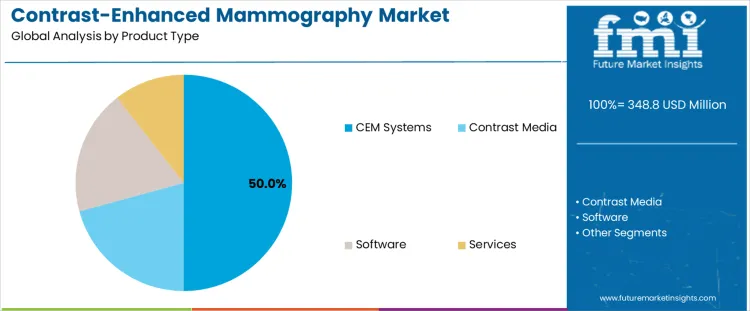
CEM systems account for about 50% of demand because they represent the core enabling technology that integrates contrast imaging into standard mammography workflows. These systems allow radiologists to evaluate lesion vascularity while preserving familiar positioning, compression, and acquisition protocols. Hospitals favor CEM systems because they extend diagnostic capability without requiring separate imaging suites or substantially longer exam times. This makes CEM a practical alternative to breast MRI in selected diagnostic scenarios. Contrast media demand is directly tied to procedure volume rather than capital investment decisions, positioning it as a dependent segment rather than a demand driver. Software solutions enhance image processing, subtraction, and interpretation but are typically bundled with systems or purchased after hardware installation. Service offerings support training, calibration, and compliance but do not influence initial adoption. Product type leadership therefore reflects the centrality of imaging hardware that enables contrast studies, long equipment replacement cycles, and the need for integrated, validated systems in regulated diagnostic environments.
What Is Driving Leadership by Application and End User in the Contrast Enhanced Mammography Market?
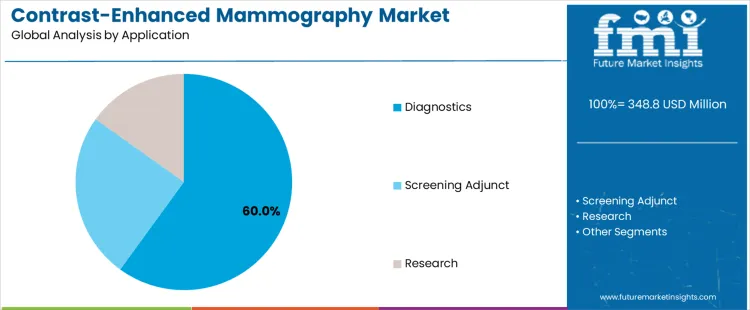
Diagnostic applications account for about 60% of demand because contrast enhanced mammography is primarily positioned as a problem solving tool rather than a frontline screening modality. CEM is used to further assess suspicious findings, evaluate extent of disease, and support treatment planning when conventional mammography or ultrasound results are inconclusive. Its role in screening remains adjunctive and limited to specific patient populations. Hospitals represent about 70% of end user demand due to their concentration of diagnostic breast imaging services, access to contrast administration protocols, and integration with oncology pathways. Hospitals manage higher case complexity and multidisciplinary decision making, which aligns with CEM use. Imaging centers focus on high volume screening efficiency and adopt CEM selectively. Research applications remain limited to protocol development and comparative studies. Leadership by application and end user reflects clinical complexity, infrastructure availability, and positioning of CEM within diagnostic care pathways rather than population scale screening adoption.
How Is the Contrast Enhanced Mammography Market Being Applied Across Diagnostic Imaging Centers?
Use appears in hospitals, specialized breast imaging centers, and oncology clinics where improved detection of malignant lesions is critical. Contrast-enhanced mammography (CEM) combines traditional X-ray imaging with intravenous contrast agents to highlight vascularized tissues, aiding in the identification of tumors that may be obscured in dense breast tissue. Radiologists adopt CEM to complement or, in some cases, substitute MRI for screening high-risk patients or evaluating equivocal findings. These applications reflect diagnostic and operational priorities rather than aesthetic objectives, with adoption driven by enhanced lesion detection, workflow efficiency, and patient management.
What Operational and Material Conditions Support Adoption of Contrast Enhanced Mammography?
Selection aligns with imaging facilities equipped with dual-energy digital mammography systems and trained personnel for intravenous contrast administration. Contrast agents must be compatible with patient safety protocols, with careful monitoring for allergic reactions and renal function. Radiology teams optimize imaging timing, exposure parameters, and post-processing to maximize diagnostic value. Facilities integrate CEM with electronic medical records and PACS for efficient image review and multidisciplinary consultation. These conditions emerge from diagnostic accuracy, operational workflow efficiency, and patient safety priorities in structured imaging workflows.
Which Practical Considerations Limit Wider Use of Contrast Enhanced Mammography?
High equipment and contrast agent costs may restrict adoption to tertiary centers or specialized clinics. Patient contraindications, including contrast allergies or impaired renal function, limit use. Regulatory approval and clinical guideline compliance vary by region. Staff training for contrast administration and dual-energy image interpretation is required. These factors result in selective deployment where improved detection rates, diagnostic confidence, and workflow efficiency justify incremental cost and procedural management.
What is the Demand for Contrast Enhanced Mammography by Country?
| Country | CAGR (%) |
|---|---|
| USA | 10.0% |
| Brazil | 10.5% |
| China | 11.0% |
| India | 11.2% |
| Germany | 8.2% |
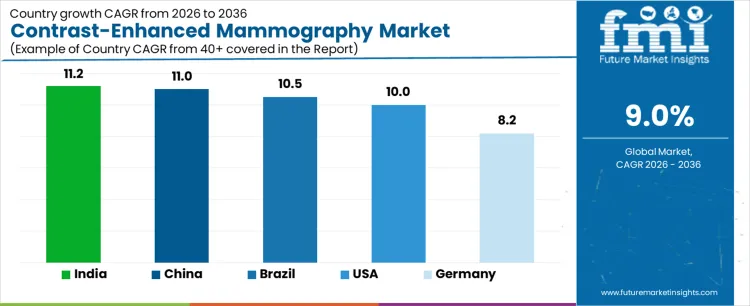
The demand for contrast enhanced mammography varies across countries, driven by breast cancer screening programs, advanced diagnostic adoption, and healthcare infrastructure expansion. India leads with an 11.2% CAGR, supported by rising breast cancer prevalence, growing awareness, and investment in modern imaging technologies. China follows at 11.0%, driven by hospital modernization, increased screening initiatives, and adoption of enhanced imaging techniques. Brazil records 10.5%, shaped by expanding healthcare services and early detection programs. The USA grows at 10.0%, reflecting established screening infrastructure and adoption of advanced mammography technologies. Germany posts 8.2%, supported by mature healthcare systems and steady diagnostic imaging adoption.
How Is Contrast-Enhanced Mammography Advancing Breast Imaging in the United States?
In the United States, revenue from the Contrast-Enhanced Mammography Market is expanding at a CAGR of 10% through 2036, driven by adoption of imaging systems that combine traditional mammography with contrast agents to improve detection sensitivity for breast lesions. Hospitals, diagnostic centers, and specialized imaging clinics are integrating contrast-enhanced mammography to enhance diagnostic accuracy, facilitate early detection, and support treatment planning. Demand is concentrated in urban healthcare facilities, cancer centers, and academic hospitals. Domestic suppliers provide high-performance imaging systems and compatible contrast agents. Rising awareness of breast cancer, preventive screening programs, and recurring diagnostic imaging are sustaining consistent adoption nationwide.
- Hospitals, diagnostic centers, and cancer clinics drive adoption
- Imaging systems improve detection sensitivity and early diagnosis
- Domestic suppliers provide high-performance systems and contrast agents
- Recurring screening programs sustain consistent adoption
How Are Breast Cancer Screening Programs Supporting Growth in Brazil?
In Brazil, the market is growing at a CAGR of 10.5% through 2036, supported by expanding breast cancer screening initiatives and healthcare infrastructure development. Manufacturers are deploying contrast-enhanced mammography systems to improve lesion visualization, diagnostic accuracy, and patient outcomes. Demand is concentrated in urban hospitals, imaging centers, and specialized oncology clinics. Local technology providers are offering high-performance systems compatible with existing imaging workflows. Expansion of screening programs, increasing patient awareness, and recurring diagnostic procedures are sustaining adoption nationwide.
- Urban hospitals, imaging centers, and oncology clinics drive adoption
- Systems enhance lesion visualization and diagnostic accuracy
- Local providers supply high-performance, workflow-compatible systems
- Recurring diagnostic procedures sustain adoption
How Is Imaging Technology Integration Accelerating Adoption in China?
China is witnessing growth at a CAGR of 11% through 2036, driven by rapid adoption of contrast-enhanced mammography in hospitals and specialized imaging centers. Manufacturers are integrating advanced imaging platforms with contrast agents to improve sensitivity and early detection of breast cancer. Demand is concentrated in urban hospitals, tertiary medical centers, and cancer treatment facilities. Domestic suppliers are scaling production of high-performance, imaging-compatible systems. Expanding healthcare infrastructure, government screening programs, and recurring diagnostic imaging are sustaining rapid adoption nationwide.
- Urban hospitals, tertiary centers, and cancer treatment facilities drive adoption
- Systems improve detection sensitivity and early breast cancer diagnosis
- Domestic suppliers scale imaging-compatible, high-performance systems
- Recurring diagnostic imaging sustains rapid adoption
How Is Breast Imaging Expansion Supporting Growth in India?
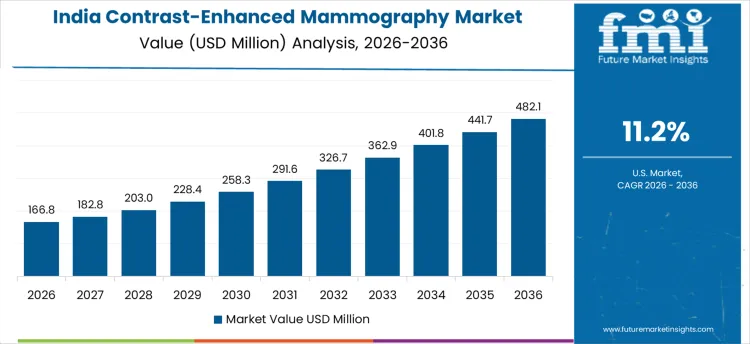
In India, revenue from the Contrast-Enhanced Mammography Market is expanding at a CAGR of 11.2% through 2036, supported by rising breast cancer prevalence and growing investment in diagnostic imaging. Hospitals and imaging centers are adopting contrast-enhanced mammography systems to improve lesion detection, enable early intervention, and support treatment planning. Demand is concentrated in urban hospitals, cancer centers, and specialty clinics. Domestic suppliers provide high-performance systems and contrast agents compatible with existing imaging infrastructure. Expansion of screening programs, awareness campaigns, and recurring diagnostic procedures are sustaining robust adoption nationwide.
- Urban hospitals, cancer centers, and specialty clinics drive adoption
- Systems improve lesion detection and enable early intervention
- Domestic suppliers provide high-performance, compatible systems
- Recurring diagnostic procedures sustain robust adoption
How Are Diagnostic Standards Supporting Adoption in Germany?
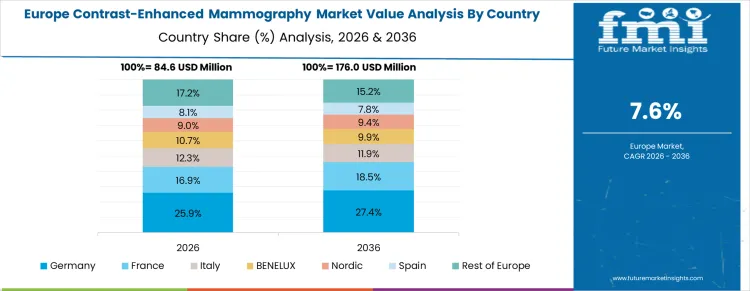
Germany is witnessing growth at a CAGR of 8.2% through 2036, driven by adoption of contrast-enhanced mammography for early detection of breast cancer in hospitals and diagnostic centers. Manufacturers are integrating advanced imaging platforms with contrast agents to improve diagnostic accuracy and patient outcomes. Demand is concentrated in urban hospitals, oncology centers, and specialized imaging clinics. Domestic suppliers provide high-performance, imaging-compatible systems suitable for clinical workflows. Regulatory standards, preventive screening programs, and recurring diagnostic imaging are sustaining consistent procurement nationwide.
- Urban hospitals, oncology centers, and imaging clinics anchor demand
- Systems enhance diagnostic accuracy and patient outcomes
- Domestic suppliers provide high-performance, imaging-compatible systems
- Recurring diagnostic imaging sustains consistent procurement
Which Companies Shape Competition in The Contrast Enhanced Mammography Market Through Clinical Evidence and Workflow Integration?
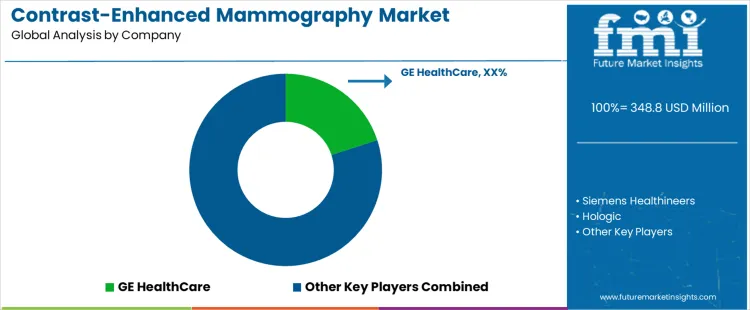
Competition in the Contrast Enhanced Mammography Market is driven by how imaging systems fit into breast cancer diagnostic pathways rather than by detector specifications alone. GE HealthCare has established a strong position through early clinical validation and system designs that integrate contrast imaging with standard mammography workflows. Siemens Healthineers approaches the segment by aligning contrast enhanced mammography with its broader imaging and informatics platforms, emphasizing consistency across radiology departments. Hologic competes by leveraging its installed base in breast imaging, positioning contrast capability as an extension of existing mammography systems rather than a separate modality. Adoption is influenced by radiologist confidence, reading efficiency, and the ability to incorporate contrast studies without disrupting screening and diagnostic throughput.
Strategic differentiation increasingly reflects regulatory strategy, training, and evidence generation. Canon Medical and Philips participate by adapting digital mammography platforms to support contrast workflows, often targeting institutions seeking modality flexibility rather than single use systems. These companies emphasize image consistency, dose management, and compatibility with existing contrast administration protocols. Smaller and emerging participants typically enter through pilot programs or limited regional deployments, focusing on specific clinical niches. Across the market, competitive positioning depends on peer reviewed outcomes, reimbursement alignment, and radiologist acceptance. Long qualification cycles, guideline inclusion, and hospital capital planning timelines shape adoption more strongly than rapid feature development or short term pricing strategies.
Key Players in the Contrast Enhanced Mammography Market
- GE HealthCare
- Siemens Healthineers
- Hologic
- Canon Medical
- Philips
- Others
Scope of the Report
| Items | Values |
|---|---|
| Quantitative Units (2026) | USD million |
| Product Type | CEM Systems, Contrast Media, Software, Services |
| Application | Diagnostics, Screening Adjunct, Research |
| End-Use Industry | Hospitals, Imaging Centers, OEM Channels |
| Region | Asia Pacific (China, Japan, South Korea, India, Australia & New Zealand, ASEAN, Rest of Asia Pacific), Europe (Germany, United Kingdom, France, Italy, Spain, Nordic, BENELUX, Rest of Europe), North America (United States, Canada, Mexico), Latin America (Brazil, Chile, Rest of Latin America), Middle East & Africa (KSA, Other GCC Countries, Turkey, South Africa, Other African Union, Rest of Middle East & Africa) |
| Key Companies Profiled | GE HealthCare, Siemens Healthineers, Hologic, Canon Medical, Philips, Others |
| Additional Attributes | Dollar by sales by product type, Dollar by sales by application, Dollar by sales by end-user, Dollar by sales by region, Diagnostic sensitivity improvements, Dense breast tissue imaging efficacy, Workflow integration and PACS compatibility, Contrast agent safety and regulatory approval, Radiologist training and protocol adoption, Multi-site hospital network penetration, Repeat procurement and replacement cycles, Clinical validation and guideline inclusion, Early detection and patient outcome improvements, Adoption in tertiary and specialty imaging centers, Regional reimbursement and policy support |
Contrast Enhanced Mammography Market Segmentation
Product Type:
- CEM Systems
- Contrast Media
- Software
- Services
Application:
- Diagnostics
- Screening Adjunct
- Research
End User:
- Hospitals
- Imaging Centers
- OEM Channels
Region
- Asia Pacific
- China
- Japan
- South Korea
- India
- Australia & New Zealand
- ASEAN
- Rest of Asia Pacific
- Europe
- Germany
- United Kingdom
- France
- Italy
- Spain
- Nordic
- BENELUX
- Rest of Europe
- North America
- United States
- Canada
- Mexico
- Latin America
- Brazil
- Chile
- Rest of Latin America
- Middle East & Africa
- Kingdom of Saudi Arabia
- Other GCC Countries
- Turkey
- South Africa
- Other African Union
- Rest of Middle East & Africa
Bibliography
- Dromain, C., Balleyguier, C., Adler, G., Garbay, J. R., & Delaloge, S. (2011). Contrast-enhanced digital mammography. European Journal of Radiology, 78(3), 378-382.
- Jochelson, M. S., Lobbes, M. B. I., & Greenwood, H. I. (2020). Contrast-enhanced mammography: State of the art. Radiology, 295(1), 36-48.
Frequently Asked Questions
How big is the contrast-enhanced mammography market in 2026?
The global contrast-enhanced mammography market is estimated to be valued at USD 348.8 million in 2026.
What will be the size of contrast-enhanced mammography market in 2036?
The market size for the contrast-enhanced mammography market is projected to reach USD 825.7 million by 2036.
How much will be the contrast-enhanced mammography market growth between 2026 and 2036?
The contrast-enhanced mammography market is expected to grow at a 9.0% CAGR between 2026 and 2036.
What are the key product types in the contrast-enhanced mammography market?
The key product types in contrast-enhanced mammography market are cem systems, contrast media, software and services.
Which application segment to contribute significant share in the contrast-enhanced mammography market in 2026?
In terms of application, diagnostics segment to command 60.0% share in the contrast-enhanced mammography market in 2026.
Preview the report firsthand - request a free sample
Get SampleGet the brochure for pricing and purchase details.
Get PDFTable of Content
- Executive Summary
- Global Market Outlook
- Demand-side Trends
- Supply-side Trends
- Technology Roadmap Analysis
- Analysis and Recommendations
- Market Overview
- Market Coverage / Taxonomy
- Market Definition / Scope / Limitations
- Market Background
- Market Dynamics
- Drivers
- Restraints
- Opportunity
- Trends
- Scenario Forecast
- Demand in Optimistic Scenario
- Demand in Likely Scenario
- Demand in Conservative Scenario
- Opportunity Map Analysis
- Product Life Cycle Analysis
- Supply Chain Analysis
- Investment Feasibility Matrix
- Value Chain Analysis
- PESTLE and Porter’s Analysis
- Regulatory Landscape
- Regional Parent Market Outlook
- Production and Consumption Statistics
- Import and Export Statistics
- Market Dynamics
- Global Market Analysis 2021 to 2025 and Forecast, 2026 to 2036
- Historical Market Size Value (USD Million) Analysis, 2021 to 2025
- Current and Future Market Size Value (USD Million) Projections, 2026 to 2036
- Y-o-Y Growth Trend Analysis
- Absolute $ Opportunity Analysis
- Global Market Pricing Analysis 2021 to 2025 and Forecast 2026 to 2036
- Global Market Analysis 2021 to 2025 and Forecast 2026 to 2036, By Product Type
- Introduction / Key Findings
- Historical Market Size Value (USD Million) Analysis By Product Type , 2021 to 2025
- Current and Future Market Size Value (USD Million) Analysis and Forecast By Product Type , 2026 to 2036
- CEM Systems
- Contrast Media
- Software
- Services
- CEM Systems
- Y-o-Y Growth Trend Analysis By Product Type , 2021 to 2025
- Absolute $ Opportunity Analysis By Product Type , 2026 to 2036
- Global Market Analysis 2021 to 2025 and Forecast 2026 to 2036, By Application
- Introduction / Key Findings
- Historical Market Size Value (USD Million) Analysis By Application, 2021 to 2025
- Current and Future Market Size Value (USD Million) Analysis and Forecast By Application, 2026 to 2036
- Diagnostics
- Screening Adjunct
- Research
- Diagnostics
- Y-o-Y Growth Trend Analysis By Application, 2021 to 2025
- Absolute $ Opportunity Analysis By Application, 2026 to 2036
- Global Market Analysis 2021 to 2025 and Forecast 2026 to 2036, By End User
- Introduction / Key Findings
- Historical Market Size Value (USD Million) Analysis By End User, 2021 to 2025
- Current and Future Market Size Value (USD Million) Analysis and Forecast By End User, 2026 to 2036
- Hospitals
- Imaging Centers
- OEM Channels
- Hospitals
- Y-o-Y Growth Trend Analysis By End User, 2021 to 2025
- Absolute $ Opportunity Analysis By End User, 2026 to 2036
- Global Market Analysis 2021 to 2025 and Forecast 2026 to 2036, By Region
- Introduction
- Historical Market Size Value (USD Million) Analysis By Region, 2021 to 2025
- Current Market Size Value (USD Million) Analysis and Forecast By Region, 2026 to 2036
- North America
- Latin America
- Western Europe
- Eastern Europe
- East Asia
- South Asia and Pacific
- Middle East & Africa
- Market Attractiveness Analysis By Region
- North America Market Analysis 2021 to 2025 and Forecast 2026 to 2036, By Country
- Historical Market Size Value (USD Million) Trend Analysis By Market Taxonomy, 2021 to 2025
- Market Size Value (USD Million) Forecast By Market Taxonomy, 2026 to 2036
- By Country
- USA
- Canada
- Mexico
- By Product Type
- By Application
- By End User
- By Country
- Market Attractiveness Analysis
- By Country
- By Product Type
- By Application
- By End User
- Key Takeaways
- Latin America Market Analysis 2021 to 2025 and Forecast 2026 to 2036, By Country
- Historical Market Size Value (USD Million) Trend Analysis By Market Taxonomy, 2021 to 2025
- Market Size Value (USD Million) Forecast By Market Taxonomy, 2026 to 2036
- By Country
- Brazil
- Chile
- Rest of Latin America
- By Product Type
- By Application
- By End User
- By Country
- Market Attractiveness Analysis
- By Country
- By Product Type
- By Application
- By End User
- Key Takeaways
- Western Europe Market Analysis 2021 to 2025 and Forecast 2026 to 2036, By Country
- Historical Market Size Value (USD Million) Trend Analysis By Market Taxonomy, 2021 to 2025
- Market Size Value (USD Million) Forecast By Market Taxonomy, 2026 to 2036
- By Country
- Germany
- UK
- Italy
- Spain
- France
- Nordic
- BENELUX
- Rest of Western Europe
- By Product Type
- By Application
- By End User
- By Country
- Market Attractiveness Analysis
- By Country
- By Product Type
- By Application
- By End User
- Key Takeaways
- Eastern Europe Market Analysis 2021 to 2025 and Forecast 2026 to 2036, By Country
- Historical Market Size Value (USD Million) Trend Analysis By Market Taxonomy, 2021 to 2025
- Market Size Value (USD Million) Forecast By Market Taxonomy, 2026 to 2036
- By Country
- Russia
- Poland
- Hungary
- Balkan & Baltic
- Rest of Eastern Europe
- By Product Type
- By Application
- By End User
- By Country
- Market Attractiveness Analysis
- By Country
- By Product Type
- By Application
- By End User
- Key Takeaways
- East Asia Market Analysis 2021 to 2025 and Forecast 2026 to 2036, By Country
- Historical Market Size Value (USD Million) Trend Analysis By Market Taxonomy, 2021 to 2025
- Market Size Value (USD Million) Forecast By Market Taxonomy, 2026 to 2036
- By Country
- China
- Japan
- South Korea
- By Product Type
- By Application
- By End User
- By Country
- Market Attractiveness Analysis
- By Country
- By Product Type
- By Application
- By End User
- Key Takeaways
- South Asia and Pacific Market Analysis 2021 to 2025 and Forecast 2026 to 2036, By Country
- Historical Market Size Value (USD Million) Trend Analysis By Market Taxonomy, 2021 to 2025
- Market Size Value (USD Million) Forecast By Market Taxonomy, 2026 to 2036
- By Country
- India
- ASEAN
- Australia & New Zealand
- Rest of South Asia and Pacific
- By Product Type
- By Application
- By End User
- By Country
- Market Attractiveness Analysis
- By Country
- By Product Type
- By Application
- By End User
- Key Takeaways
- Middle East & Africa Market Analysis 2021 to 2025 and Forecast 2026 to 2036, By Country
- Historical Market Size Value (USD Million) Trend Analysis By Market Taxonomy, 2021 to 2025
- Market Size Value (USD Million) Forecast By Market Taxonomy, 2026 to 2036
- By Country
- Kingdom of Saudi Arabia
- Other GCC Countries
- Turkiye
- South Africa
- Other African Union
- Rest of Middle East & Africa
- By Product Type
- By Application
- By End User
- By Country
- Market Attractiveness Analysis
- By Country
- By Product Type
- By Application
- By End User
- Key Takeaways
- Key Countries Market Analysis
- USA
- Pricing Analysis
- Market Share Analysis, 2025
- By Product Type
- By Application
- By End User
- Canada
- Pricing Analysis
- Market Share Analysis, 2025
- By Product Type
- By Application
- By End User
- Mexico
- Pricing Analysis
- Market Share Analysis, 2025
- By Product Type
- By Application
- By End User
- Brazil
- Pricing Analysis
- Market Share Analysis, 2025
- By Product Type
- By Application
- By End User
- Chile
- Pricing Analysis
- Market Share Analysis, 2025
- By Product Type
- By Application
- By End User
- Germany
- Pricing Analysis
- Market Share Analysis, 2025
- By Product Type
- By Application
- By End User
- UK
- Pricing Analysis
- Market Share Analysis, 2025
- By Product Type
- By Application
- By End User
- Italy
- Pricing Analysis
- Market Share Analysis, 2025
- By Product Type
- By Application
- By End User
- Spain
- Pricing Analysis
- Market Share Analysis, 2025
- By Product Type
- By Application
- By End User
- France
- Pricing Analysis
- Market Share Analysis, 2025
- By Product Type
- By Application
- By End User
- India
- Pricing Analysis
- Market Share Analysis, 2025
- By Product Type
- By Application
- By End User
- ASEAN
- Pricing Analysis
- Market Share Analysis, 2025
- By Product Type
- By Application
- By End User
- Australia & New Zealand
- Pricing Analysis
- Market Share Analysis, 2025
- By Product Type
- By Application
- By End User
- China
- Pricing Analysis
- Market Share Analysis, 2025
- By Product Type
- By Application
- By End User
- Japan
- Pricing Analysis
- Market Share Analysis, 2025
- By Product Type
- By Application
- By End User
- South Korea
- Pricing Analysis
- Market Share Analysis, 2025
- By Product Type
- By Application
- By End User
- Russia
- Pricing Analysis
- Market Share Analysis, 2025
- By Product Type
- By Application
- By End User
- Poland
- Pricing Analysis
- Market Share Analysis, 2025
- By Product Type
- By Application
- By End User
- Hungary
- Pricing Analysis
- Market Share Analysis, 2025
- By Product Type
- By Application
- By End User
- Kingdom of Saudi Arabia
- Pricing Analysis
- Market Share Analysis, 2025
- By Product Type
- By Application
- By End User
- Turkiye
- Pricing Analysis
- Market Share Analysis, 2025
- By Product Type
- By Application
- By End User
- South Africa
- Pricing Analysis
- Market Share Analysis, 2025
- By Product Type
- By Application
- By End User
- USA
- Market Structure Analysis
- Competition Dashboard
- Competition Benchmarking
- Market Share Analysis of Top Players
- By Regional
- By Product Type
- By Application
- By End User
- Competition Analysis
- Competition Deep Dive
- GE HealthCare
- Overview
- Product Portfolio
- Profitability by Market Segments (Product/Age /Sales Channel/Region)
- Sales Footprint
- Strategy Overview
- Marketing Strategy
- Product Strategy
- Channel Strategy
- Siemens Healthineers
- Hologic
- Canon Medical
- Philips
- Others
- GE HealthCare
- Competition Deep Dive
- Assumptions & Acronyms Used
- Research Methodology


