

- Industry Size (2026)
- USD 3.0 Bn
- Forecast (2036)
- USD 4.6 Bn
- CAGR (2026 to 2036)
- 4.4%
Corrugated Cardboard Cutting Machine Market Forecast and Outlook 2026 to 2036
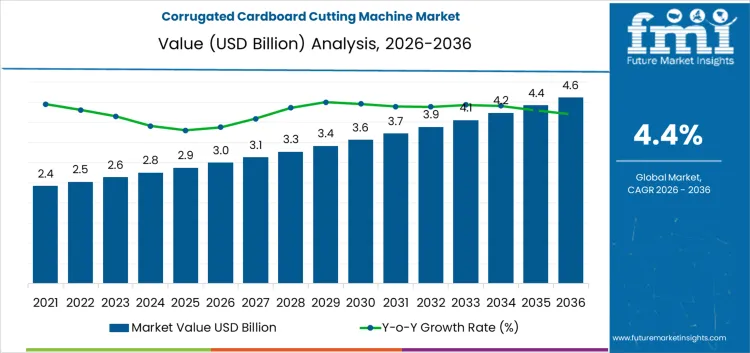
The corrugated cardboard cutting machine market is projected at USD 3.0 billion in 2026 and reaches USD 4.6 billion by 2036 at a 4.4% CAGR. The growth trajectory is primarily driven by strategic investments made by converters, who prioritize factors such as box mixes, flute profiles, sheet dimensions, and tolerance thresholds during the purchasing process. The planning of daily output is heavily influenced by the availability of tools and the efficiency of changeover times, rather than just the peak speed of the machinery. It is common for managers to focus on metrics related to crease accuracy, waste production, and equipment uptime, all while ensuring financing arrangements correlate payments with successful acceptance runs.
Installation timelines are often dependent on a variety of factors, including the quality of the power supply, foundational requirements, and the necessary training for operators. In this context, site approval is crucial for ensuring that all elements are aligned for optimal operation.
As conversion lines evolve, considerations related to feeder width, knife wear, and anvil longevity set the benchmarks for achievable throughput. Key quality metrics spotlight elements such as cut squareness, score depth, and edge integrity. To maximize efficiency, facilities often organize shifts that facilitate quick changeovers and maintain a steady flow of pallets. Service teams play a critical role in contract renewals, significantly influenced by their response times and availability of spare parts. Additionally, distributors frequently position tooling kits close to customer sites to minimize the risk of production halts.
Software advancements for nesting and job ticketing have notably reduced waste, surpassing the impact of purely mechanical adjustments. Training initiatives aimed at operators not only decrease the frequency of jams and blade wear but also enhance overall productivity. Contracts in this industry typically underscore the importance of acceptance testing and clauses regarding uptime. Profitability hinges on yield rates, reliable staffing, and rigorous maintenance practices, with capacity expansions aligned to awarded box programs and regional demand patterns.
Quick Stats for Corrugated Cardboard Cutting Machine Market
- Corrugated Cardboard Cutting Machine Market Value (2026): USD 3.0 billion
- Corrugated Cardboard Cutting Machine Market Forecast Value (2036): USD 4.6 billion
- Corrugated Cardboard Cutting Machine Market Forecast CAGR 2026 to 2036: 4.4%
- Leading Machine Type in Corrugated Cardboard Cutting Machine Market: Automatic corrugated cardboard cutters
- Leading End Use Industry in Corrugated Cardboard Cutting Machine Market: Packaging and box manufacturing
- Key Growth Regions in Corrugated Cardboard Cutting Machine Market: Asia Pacific, Europe, North America
- Top Players in Corrugated Cardboard Cutting Machine Market: BOBST, Masterwork Machinery, Sanwa Machinery, Zünd Systemtechnik, Koenig & Bauer
What Is the Growth Forecast for the Corrugated Cardboard Cutting Machine Market through 2036?
Plant layout decisions and order mix determine investment timing in the corrugated cardboard cutting machine market more than short term packaging volume changes. In 2026, at about USD 3.0 billion, purchases are concentrated among box plants upgrading finishing lines to handle higher SKU counts and shorter production runs. Machine selection is tied to board grades, sheet sizes, and downstream converting equipment, which fixes specifications across long operating periods. Demand builds as producers reorganize floor space, add automation steps, and seek tighter cutting accuracy to reduce waste. The steady rise reflects incremental capacity tuning and process upgrades rather than large scale greenfield plant construction.
Through the later years, operating efficiency and uptime economics guide spending in the corrugated cardboard cutting machine market. As value approaches roughly USD 4.6 billion by 2036, buyers focus on changeover time, maintenance access, and spare parts standardization. Suppliers respond with more modular designs and longer service intervals. Production planning at customer sites favors equipment that supports mixed order books without frequent mechanical adjustment. The move from the low three billion into the mid four billion comes from cumulative modernization across many existing plants rather than a single expansion cycle. Machine builders that combine dependable service support, stable mechanical performance, and predictable delivery schedules tend to secure repeat business.
Corrugated Cardboard Cutting Machine Market Key Takeaways
| Metric | Value |
|---|---|
| Market Value (2026) | USD 3.0 billion |
| Forecast Value (2036) | USD 4.6 billion |
| Forecast CAGR 2026 to 2036 | 4.4% |
How Is the Corrugated Cardboard Cutting Machine Market Structuring Throughput and Box Quality Control?
Corrugated cardboard cutting machines convert printed or plain sheets into blanks with defined dimensions, slots, and creases. Earlier plants depended on manual setups and slower die cutting lines, which limited batch size control and increased trim loss. Current systems integrate servo drives, registration control, and faster changeover to match shorter order runs. Buyers in box plants, sheet plants, and integrated converters specify these machines by sheet size range, cut accuracy, waste rate, and uptime under mixed job schedules. Performance is measured by repeatability across shifts, not by peak speed alone. Layout decisions link the cutter to printers, flexo folder gluers, and stackers, since line balance determines actual output. Investment follows demand for shorter lead times, consistent fit at customer packing lines, and predictable material usage.
Purchase decisions are usually led by operations and engineering teams because cutting accuracy affects downstream folding, gluing, and pallet stability. Earlier buying patterns favored heavy customization, which increased commissioning time and spare parts complexity. Current tenders prefer modular platforms with defined options for scoring, slotting, and automatic order change. Manufacturers compete on knife life management, waste extraction, and control software reliability rather than frame weight alone. Converters evaluate total cost through board yield, setup labor, and rework rates, not machine price. Service access, training, and local parts stock influence brand choice. Over time, demand tracks growth in short run packaging, e commerce box variety, and pressure to control fiber usage while holding consistent pack dimensions across customers and production sites.
What Factors Are Shaping the Demand for Corrugated Cardboard Cutting Machine Market in 2026 by Machine Type and End Use Industry?
Capital allocation in Corrugated Cardboard Cutting Machine Market is governed by throughput targets, labor structure, and order profile stability. Cutting capacity is planned as part of line balancing decisions, not as a stand-alone equipment purchase. Once box formats, changeover frequency, and shift patterns are defined, machine specification becomes fixed within the production system. This links demand to packaging capacity additions, plant consolidation projects, and automation programs rather than to short term box order fluctuations. Segment structure reflects differences in automation level, control precision, and integration with upstream and downstream processes. Buyers evaluate equipment on uptime predictability, format change discipline, and maintenance standardization rather than on nominal cutting speed alone.
How Does Machine Type Selection Shape Production Economics and Process Control in the Corrugated Cardboard Cutting Machine Market?
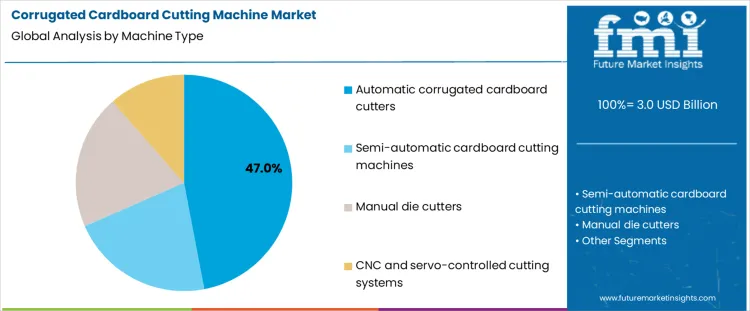
Automatic corrugated cardboard cutters account for about 47% of demand in the Corrugated Cardboard Cutting Machine Market because high volume packaging lines require stable throughput with limited manual intervention. These systems integrate with feeders, stackers, and conveying equipment, which supports continuous operation and predictable labor deployment. Semi-automatic machines serve plants that manage moderate volumes with frequent format changes, where operator involvement remains acceptable. Manual die cutters are used in short run or specialty operations, where setup flexibility matters more than speed. CNC and servo controlled systems address complex cutting patterns and tight dimensional tolerances, increasing programming and calibration requirements. Each category implies different staffing models, training needs, and inspection routines.
From an investment perspective, machine type selection fixes the operating structure of a plant. Automatic systems concentrate cost in capital equipment and maintenance capability while reducing per unit labor input. Semi-automatic and manual machines reduce capital exposure but increase dependence on skilled operators and supervision. CNC and servo controlled equipment shifts cost toward software, controls, and technical support functions. Once a line is configured, changing machine class requires rebalancing material flow, staffing, and quality control procedures. Demand by machine type therefore follows long term production strategy and plant layout decisions rather than short term changes in order volume or customer mix.
Why Does End Use Industry Define Capacity Scale and Equipment Specification in the Corrugated Cardboard Cutting Machine Market?
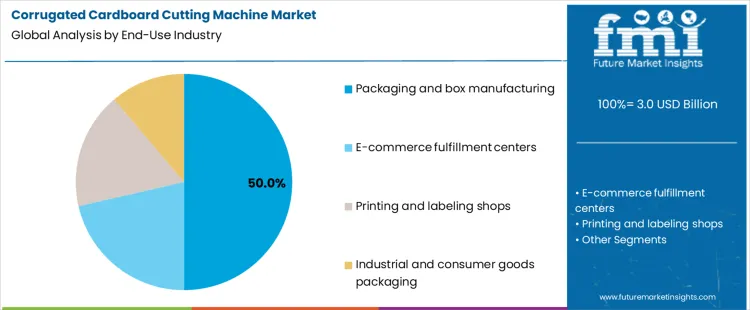
Packaging and box manufacturing represents about 50% of demand in the Corrugated Cardboard Cutting Machine Market because these operations process large, continuous volumes with standardized product ranges. This environment favors high throughput and stable, automated cutting solutions. E commerce fulfillment centers require frequent size variation and rapid turnaround, which increases the value of flexible setup and quick change capability. Printing and labeling shops operate at smaller batch sizes and shorter runs, which supports continued use of manual or semi-automatic systems. Industrial and consumer goods packaging combines higher presentation requirements with variable formats, increasing demand for precise and programmable cutting systems.
End use industry also shapes procurement and approval processes. Large packaging producers invest through multi-year capacity plans and standardize equipment across plants. E commerce operators expand in phases aligned with warehouse openings and order growth. Printing shops purchase on a project or contract basis, producing irregular demand patterns. Industrial brand owners align purchases with product launch cycles and packaging redesigns. The resulting structure concentrates volume in core packaging production, while other segments contribute smaller, specification driven orders. Segment shares therefore move with packaging capacity investment, automation programs, and distribution infrastructure expansion rather than with short term fluctuations in retail demand.
How Is the Corrugated Cardboard Cutting Machine Market Being Defined by Throughput Discipline and Order Variability?
The Corrugated Cardboard Cutting Machine Market is shaped by how packaging producers balance production speed, changeover time, and order mix variability. Converters handle short runs, mixed box formats, and frequent size changes, which makes cutting accuracy and setup efficiency as important as raw output speed. Buyers evaluate machines based on uptime, waste control, and operator workflow rather than only on nominal cutting capacity. Investment decisions are closely tied to plant layout, labor availability, and scheduling pressure. This positions corrugated cardboard cutting machines as production flow assets rather than as isolated pieces of finishing equipment.
How Is Order Fragmentation Changing Equipment Expectations in The Corrugated Cardboard Cutting Machine Market?
Packaging buyers increasingly place smaller, more frequent orders with higher format variation. This changes expectations in the Corrugated Cardboard Cutting Machine Market toward machines that handle fast setup changes and stable accuracy across mixed job queues. Plants want equipment that keeps throughput steady even when batch sizes shrink. As a result, machine selection focuses on registration control, waste reduction during changeovers, and ease of job switching. Operators also value predictable maintenance behavior because unplanned downtime disrupts tight production schedules. Equipment value is now measured by how smoothly it supports daily scheduling pressure, not only by maximum line speed.
Where Is Capacity Expansion and Replacement Demand Coming from in The Corrugated Cardboard Cutting Machine Market?
Demand is being built both from capacity additions and from replacement of older, labor-intensive equipment. New plants and line expansions require cutting systems that fit modern production layouts and material handling flows. At the same time, many converters are replacing aging machines to reduce scrap, stabilize quality, and lower operator workload. The Corrugated Cardboard Cutting Machine Market also benefits from format diversification, where one machine must cover a wider range of box sizes and board grades. Suppliers that can support layout planning, integration, and operator training are better positioned to secure repeat orders across multi-line facilities.
Why Do Capital Intensity and Production Disruption Risk Slow Investment Cycles in The Corrugated Cardboard Cutting Machine Market?
Cutting machines represent large capital purchases that directly affect core production flow. Any installation or commissioning problem can interrupt order fulfillment and customer commitments. This makes buyers cautious and extends evaluation cycles. The Corrugated Cardboard Cutting Machine Market also faces internal competition for capital against other bottleneck equipment such as printers and folder-gluers. In some plants, existing machines are kept running beyond ideal replacement timing to avoid risk. These factors slow decision-making and concentrate purchases around major expansion or full-line upgrade projects rather than frequent incremental investments.
What is the Demand for Corrugated Cardboard Cutting Machine by Country?
| Country | CAGR |
|---|---|
| USA | 4.0% |
| UK | 3.8% |
| China | 4.8% |
| India | 5.0% |
| Brazil | 4.2% |
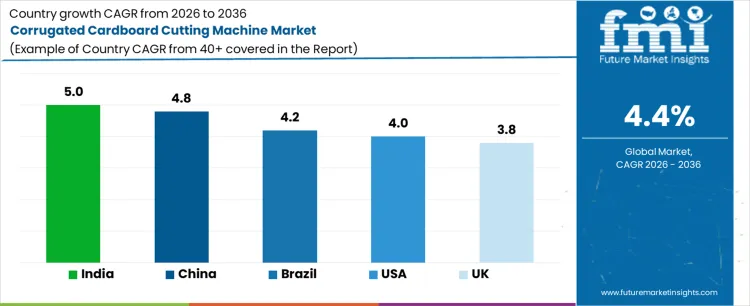
Demand for corrugated cardboard cutting machines is increasing as packaging producers expand capacity to serve e commerce, food delivery, and consumer goods distribution. India leads with a 5.0% CAGR, supported by growth in domestic packaging manufacturing, rising organized retail, and investment in automated converting lines. China follows at 4.8%, driven by large export oriented packaging volumes and continuous upgrades in box making equipment. Brazil records 4.2%, reflecting capacity additions by regional converters and higher use of corrugated packaging in food and beverage logistics. The USA grows at 4.0%, shaped by replacement of older machinery and demand from high volume e commerce fulfillment. The UK, at 3.8%, reflects steady but mature investment cycles in packaging converting.
How Do Packaging Automation and Plant Modernization Shape Demand in the United States?
Packaging line upgrades keep the corrugated cardboard cutting machine market in the United States on a 4.0% CAGR path. Demand comes from box plants serving e commerce, consumer goods, and industrial distribution. Procurement teams focus on cutting accuracy, throughput stability, and integration with printing and folding lines. Purchases usually occur within broader converting line investments rather than as isolated machine orders. Maintenance managers track blade life, downtime, and spare parts availability. Plant layout influences equipment footprint choices. Training programs affect acceptance of higher automation levels. Replacement cycles follow reliability records and energy efficiency targets. System integrators influence specification lists during project design stages. Financing decisions link to capacity utilization plans. Commercial position depends on inclusion in multi-line upgrade projects and service coverage rather than competition for single machine sales to small workshops.
Why Do Productivity Targets and Compliance Standards Guide Adoption in the United Kingdom?
Manufacturing efficiency programs place the corrugated cardboard cutting machine market in the United Kingdom on a 3.8% CAGR trajectory. Box producers serving food, retail, and industrial sectors represent the main buyers. Equipment selection follows safety certification, guarding standards, and controlled supplier lists. Orders move through capital expenditure plans covering complete converting lines. Floor space constraints influence machine configuration choices. Changeover speed receives attention due to short production runs. Maintenance teams value predictable service access and parts supply. Operator training affects uptime consistency. Replacement decisions follow performance audits and energy consumption reviews. System houses participate in line integration work. Import reliance shapes delivery scheduling. Commercial access depends on meeting compliance requirements and integrator approval rather than price competition for single machine purchases by small independent converters.
What Role Do Scale Production and Standardized Lines Play in China?
High volume packaging output places the corrugated cardboard cutting machine market in China on a 4.8% growth path. Large box plants serving export and domestic brands account for most installations. Production lines follow standardized layouts approved by corporate engineering groups. Domestic manufacturing supports equipment availability and parts supply. Procurement flows through group purchasing structures. Installation schedules align with plant expansion plans. Quality teams monitor cut accuracy, waste rates, and machine stability. Blade management and wear tracking receive routine attention. Replacement activity links to capacity expansion rather than age alone. Operator training programs support consistent output. Payment schedules follow investment milestones. Commercial success depends on placement within large plant buildouts and modernization programs rather than sales to small independent workshops operating at limited scale.
How Do Capacity Expansion and Contract Packaging Shape Demand in India?
Growing packaged goods output fixes the corrugated cardboard cutting machine market in India at a 5.0% CAGR. Box plants serving food, pharmaceuticals, and consumer products represent core customers. Procurement decisions focus on price performance balance, service access, and ease of operation. Many machines enter service within turnkey plant projects. Power stability and floor conditions influence equipment selection. Training programs for operators affect acceptance of automation features. Maintenance planning centers on blade replacement and drive reliability. Replacement demand follows utilization intensity across shifts. Distributor coverage shapes regional preference. Financing terms influence purchase timing. Quality audits by brand owners influence specification choices. Commercial results depend on participation in plant expansion projects and maintaining service support rather than competition for isolated machine sales to small manual cutting operations.
How Do Industrial Packaging and Regional Distribution Shape Spending in Brazil?
Packaging supply chain development keeps the corrugated cardboard cutting machine market in Brazil near a 4.2% CAGR. Box producers serving agriculture, retail, and industrial goods form the main customer base. Equipment choice reflects durability, service availability, and operating cost control. Procurement often occurs through plant upgrade projects and capacity additions. Import procedures and local assembly affect delivery schedules. Floor layout and power availability shape configuration decisions. Operator training influences productivity outcomes. Maintenance teams monitor blade wear and alignment accuracy. Replacement cycles follow performance records and downtime costs. Distributor networks manage regional service coverage. Financing structures influence purchase timing. Documentation for safety compliance remains part of acceptance checks. Commercial position depends on distributor reach and project inclusion rather than competition for single machine sales to small converters.
How Do Equipment Builders Compete for Plant Standardization in the Corrugated Cardboard Cutting Machine Market?
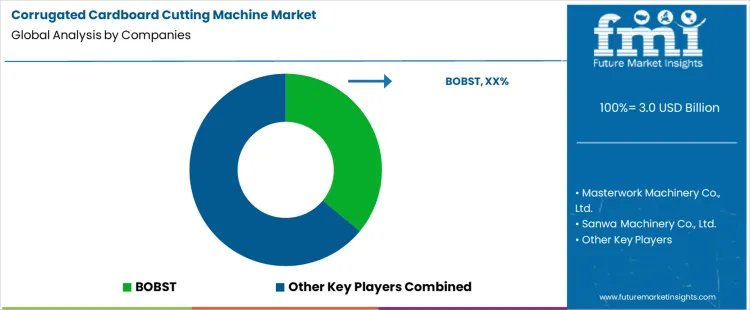
Corrugated cardboard cutting machine investment follows box plant layout, product mix, and changeover discipline rather than catalog comparison. Converters define sheet sizes, flute profiles, die library strategy, and takt time before naming platforms. BOBST, Masterwork Machinery, Sanwa Machinery, Zund, Koenig and Bauer compete during line architecture decisions. Once a machine family enters the layout, downstream tooling, operator training, and maintenance routines align around it. BOBST holds positions in high volume plants that value throughput stability and automation depth. Masterwork Machinery serves cost sensitive expansions with broad format coverage. Sanwa Machinery focuses on Japanese plants that require precision registration and long service life. Zund targets digital cutting cells for short runs. Koenig and Bauer links cutting with converting lines and finishing modules.
Competitive position reflects uptime records, tooling ecosystems, service staffing, and retrofit paths rather than headline cutting speed. Plant managers compare changeover time, waste rates, spare part availability, and software control depth. Large groups favor suppliers that support multi-site standardization and shared operator training. Independent converters favor machines that accept varied die libraries and board grades. BOBST benefits from installed base and automation roadmaps that protect earlier investments. Masterwork Machinery competes on delivery timing and budget control for new capacity. Sanwa Machinery retains accounts through mechanical durability and consistent registration accuracy. Zund secures placements where digital workflows replace steel rule dies. Koenig and Bauer uses system level integration across printing, die cutting, and folding. Market positions vary by run length profile, labor cost structure, and capital approval culture.
Key Players in the Corrugated Cardboard Cutting Machine Market
- BOBST
- Masterwork Machinery Co., Ltd.
- Sanwa Machinery Co., Ltd.
- Zünd Systemtechnik AG
- Koenig & Bauer AG
Scope of the Report
| Items | Values |
|---|---|
| Quantitative Units (2026) | USD billion |
| Machine Type | Automatic corrugated cardboard cutters, Semi-automatic cardboard cutting machines, Manual die cutters, CNC and servo-controlled cutting systems |
| End-Use Industry | Packaging and box manufacturing, E-commerce fulfillment centers, Printing and labeling shops, Industrial and consumer goods packaging |
| Region | Asia Pacific, Europe, North America, Latin America, Middle East & Africa |
| Countries Covered | China, Japan, South Korea, India, Australia & New Zealand, ASEAN, Germany, United Kingdom, France, Italy, Spain, Nordic, BENELUX, United States, Canada, Mexico, Brazil, Chile, Saudi Arabia, Turkey, South Africa, and other regional markets |
| Key Companies Profiled | BOBST, Masterwork Machinery Co., Ltd., Sanwa Machinery Co., Ltd., Zünd Systemtechnik AG, Koenig & Bauer AG |
| Additional Attributes | Dollar by sales by machine type and end use; demand driven by plant modernization and short-run packaging growth; purchasing shaped by changeover time, waste control, uptime, tooling ecosystem, service support, and integration with printing and finishing lines rather than nominal cutting speed. |
Corrugated Cardboard Cutting Machine Market Segmentation
Machine Type:
- Automatic corrugated cardboard cutters
- Semi-automatic cardboard cutting machines
- Manual die cutters
- CNC and servo-controlled cutting systems
End-Use Industry:
- Packaging and box manufacturing
- E-commerce fulfillment centers
- Printing and labeling shops
- Industrial and consumer goods packaging
Region:
- Asia Pacific
- China
- Japan
- South Korea
- India
- Australia & New Zealand
- ASEAN
- Rest of Asia Pacific
- Europe
- Germany
- United Kingdom
- France
- Italy
- Spain
- Nordic
- BENELUX
- Rest of Europe
- North America
- United States
- Canada
- Mexico
- Latin America
- Brazil
- Chile
- Rest of Latin America
- Middle East & Africa
- Kingdom of Saudi Arabia
- Other GCC Countries
- Turkey
- South Africa
- Other African Union
- Rest of Middle East & Africa
Bibliography
- International Organization for Standardization. (2023). Corrugated fibreboard—Determination of board bending resistance (ISO 3039). ISO.
- International Organization for Standardization. (2023). Corrugated fibreboard—Determination of edgewise crush resistance (edge crush test) (ISO 3037). ISO.
- International Organization for Standardization. (2024). Packaging—Complete, filled transport packages—Compression and stacking tests using a compression tester (ISO 12048). ISO.
- European Committee for Standardization. (2023). EN 415 series: Safety of packaging machines. CEN.
Frequently Asked Questions
How big is the corrugated cardboard cutting machine market in 2026?
The global corrugated cardboard cutting machine market is estimated to be valued at USD 3.0 billion in 2026.
What will be the size of corrugated cardboard cutting machine market in 2036?
The market size for the corrugated cardboard cutting machine market is projected to reach USD 4.6 billion by 2036.
How much will be the corrugated cardboard cutting machine market growth between 2026 and 2036?
The corrugated cardboard cutting machine market is expected to grow at a 4.4% CAGR between 2026 and 2036.
What are the key product types in the corrugated cardboard cutting machine market?
The key product types in corrugated cardboard cutting machine market are automatic corrugated cardboard cutters, semi‑automatic cardboard cutting machines, manual die cutters and cnc and servo‑controlled cutting systems.
Which end‑use industry segment to contribute significant share in the corrugated cardboard cutting machine market in 2026?
In terms of end‑use industry, packaging and box manufacturing segment to command 50.0% share in the corrugated cardboard cutting machine market in 2026.
Preview the report firsthand - request a free sample
Get SampleGet the brochure for pricing and purchase details.
Get PDFTable of Content
- Executive Summary
- Global Market Outlook
- Demand-side Trends
- Supply-side Trends
- Technology Roadmap Analysis
- Analysis and Recommendations
- Market Overview
- Market Coverage / Taxonomy
- Market Definition / Scope / Limitations
- Market Background
- Market Dynamics
- Drivers
- Restraints
- Opportunity
- Trends
- Scenario Forecast
- Demand in Optimistic Scenario
- Demand in Likely Scenario
- Demand in Conservative Scenario
- Opportunity Map Analysis
- Product Life Cycle Analysis
- Supply Chain Analysis
- Investment Feasibility Matrix
- Value Chain Analysis
- PESTLE and Porter’s Analysis
- Regulatory Landscape
- Regional Parent Market Outlook
- Production and Consumption Statistics
- Import and Export Statistics
- Market Dynamics
- Global Market Analysis 2021 to 2025 and Forecast, 2026 to 2036
- Historical Market Size Value (USD Million) Analysis, 2021 to 2025
- Current and Future Market Size Value (USD Million) Projections, 2026 to 2036
- Y-o-Y Growth Trend Analysis
- Absolute $ Opportunity Analysis
- Global Market Pricing Analysis 2021 to 2025 and Forecast 2026 to 2036
- Global Market Analysis 2021 to 2025 and Forecast 2026 to 2036, By Machine Type
- Introduction / Key Findings
- Historical Market Size Value (USD Million) Analysis By Machine Type , 2021 to 2025
- Current and Future Market Size Value (USD Million) Analysis and Forecast By Machine Type , 2026 to 2036
- Automatic corrugated cardboard cutters
- Semi‑automatic cardboard cutting machines
- Manual die cutters
- CNC and servo‑controlled cutting systems
- Automatic corrugated cardboard cutters
- Y-o-Y Growth Trend Analysis By Machine Type , 2021 to 2025
- Absolute $ Opportunity Analysis By Machine Type , 2026 to 2036
- Global Market Analysis 2021 to 2025 and Forecast 2026 to 2036, By End‑Use Industry
- Introduction / Key Findings
- Historical Market Size Value (USD Million) Analysis By End‑Use Industry, 2021 to 2025
- Current and Future Market Size Value (USD Million) Analysis and Forecast By End‑Use Industry, 2026 to 2036
- Packaging and box manufacturing
- E‑commerce fulfillment centers
- Printing and labeling shops
- Industrial and consumer goods packaging
- Packaging and box manufacturing
- Y-o-Y Growth Trend Analysis By End‑Use Industry, 2021 to 2025
- Absolute $ Opportunity Analysis By End‑Use Industry, 2026 to 2036
- Global Market Analysis 2021 to 2025 and Forecast 2026 to 2036, By Region
- Introduction
- Historical Market Size Value (USD Million) Analysis By Region, 2021 to 2025
- Current Market Size Value (USD Million) Analysis and Forecast By Region, 2026 to 2036
- North America
- Latin America
- Western Europe
- Eastern Europe
- East Asia
- South Asia and Pacific
- Middle East & Africa
- Market Attractiveness Analysis By Region
- North America Market Analysis 2021 to 2025 and Forecast 2026 to 2036, By Country
- Historical Market Size Value (USD Million) Trend Analysis By Market Taxonomy, 2021 to 2025
- Market Size Value (USD Million) Forecast By Market Taxonomy, 2026 to 2036
- By Country
- USA
- Canada
- Mexico
- By Machine Type
- By End‑Use Industry
- By Country
- Market Attractiveness Analysis
- By Country
- By Machine Type
- By End‑Use Industry
- Key Takeaways
- Latin America Market Analysis 2021 to 2025 and Forecast 2026 to 2036, By Country
- Historical Market Size Value (USD Million) Trend Analysis By Market Taxonomy, 2021 to 2025
- Market Size Value (USD Million) Forecast By Market Taxonomy, 2026 to 2036
- By Country
- Brazil
- Chile
- Rest of Latin America
- By Machine Type
- By End‑Use Industry
- By Country
- Market Attractiveness Analysis
- By Country
- By Machine Type
- By End‑Use Industry
- Key Takeaways
- Western Europe Market Analysis 2021 to 2025 and Forecast 2026 to 2036, By Country
- Historical Market Size Value (USD Million) Trend Analysis By Market Taxonomy, 2021 to 2025
- Market Size Value (USD Million) Forecast By Market Taxonomy, 2026 to 2036
- By Country
- Germany
- UK
- Italy
- Spain
- France
- Nordic
- BENELUX
- Rest of Western Europe
- By Machine Type
- By End‑Use Industry
- By Country
- Market Attractiveness Analysis
- By Country
- By Machine Type
- By End‑Use Industry
- Key Takeaways
- Eastern Europe Market Analysis 2021 to 2025 and Forecast 2026 to 2036, By Country
- Historical Market Size Value (USD Million) Trend Analysis By Market Taxonomy, 2021 to 2025
- Market Size Value (USD Million) Forecast By Market Taxonomy, 2026 to 2036
- By Country
- Russia
- Poland
- Hungary
- Balkan & Baltic
- Rest of Eastern Europe
- By Machine Type
- By End‑Use Industry
- By Country
- Market Attractiveness Analysis
- By Country
- By Machine Type
- By End‑Use Industry
- Key Takeaways
- East Asia Market Analysis 2021 to 2025 and Forecast 2026 to 2036, By Country
- Historical Market Size Value (USD Million) Trend Analysis By Market Taxonomy, 2021 to 2025
- Market Size Value (USD Million) Forecast By Market Taxonomy, 2026 to 2036
- By Country
- China
- Japan
- South Korea
- By Machine Type
- By End‑Use Industry
- By Country
- Market Attractiveness Analysis
- By Country
- By Machine Type
- By End‑Use Industry
- Key Takeaways
- South Asia and Pacific Market Analysis 2021 to 2025 and Forecast 2026 to 2036, By Country
- Historical Market Size Value (USD Million) Trend Analysis By Market Taxonomy, 2021 to 2025
- Market Size Value (USD Million) Forecast By Market Taxonomy, 2026 to 2036
- By Country
- India
- ASEAN
- Australia & New Zealand
- Rest of South Asia and Pacific
- By Machine Type
- By End‑Use Industry
- By Country
- Market Attractiveness Analysis
- By Country
- By Machine Type
- By End‑Use Industry
- Key Takeaways
- Middle East & Africa Market Analysis 2021 to 2025 and Forecast 2026 to 2036, By Country
- Historical Market Size Value (USD Million) Trend Analysis By Market Taxonomy, 2021 to 2025
- Market Size Value (USD Million) Forecast By Market Taxonomy, 2026 to 2036
- By Country
- Kingdom of Saudi Arabia
- Other GCC Countries
- Turkiye
- South Africa
- Other African Union
- Rest of Middle East & Africa
- By Machine Type
- By End‑Use Industry
- By Country
- Market Attractiveness Analysis
- By Country
- By Machine Type
- By End‑Use Industry
- Key Takeaways
- Key Countries Market Analysis
- USA
- Pricing Analysis
- Market Share Analysis, 2025
- By Machine Type
- By End‑Use Industry
- Canada
- Pricing Analysis
- Market Share Analysis, 2025
- By Machine Type
- By End‑Use Industry
- Mexico
- Pricing Analysis
- Market Share Analysis, 2025
- By Machine Type
- By End‑Use Industry
- Brazil
- Pricing Analysis
- Market Share Analysis, 2025
- By Machine Type
- By End‑Use Industry
- Chile
- Pricing Analysis
- Market Share Analysis, 2025
- By Machine Type
- By End‑Use Industry
- Germany
- Pricing Analysis
- Market Share Analysis, 2025
- By Machine Type
- By End‑Use Industry
- UK
- Pricing Analysis
- Market Share Analysis, 2025
- By Machine Type
- By End‑Use Industry
- Italy
- Pricing Analysis
- Market Share Analysis, 2025
- By Machine Type
- By End‑Use Industry
- Spain
- Pricing Analysis
- Market Share Analysis, 2025
- By Machine Type
- By End‑Use Industry
- France
- Pricing Analysis
- Market Share Analysis, 2025
- By Machine Type
- By End‑Use Industry
- India
- Pricing Analysis
- Market Share Analysis, 2025
- By Machine Type
- By End‑Use Industry
- ASEAN
- Pricing Analysis
- Market Share Analysis, 2025
- By Machine Type
- By End‑Use Industry
- Australia & New Zealand
- Pricing Analysis
- Market Share Analysis, 2025
- By Machine Type
- By End‑Use Industry
- China
- Pricing Analysis
- Market Share Analysis, 2025
- By Machine Type
- By End‑Use Industry
- Japan
- Pricing Analysis
- Market Share Analysis, 2025
- By Machine Type
- By End‑Use Industry
- South Korea
- Pricing Analysis
- Market Share Analysis, 2025
- By Machine Type
- By End‑Use Industry
- Russia
- Pricing Analysis
- Market Share Analysis, 2025
- By Machine Type
- By End‑Use Industry
- Poland
- Pricing Analysis
- Market Share Analysis, 2025
- By Machine Type
- By End‑Use Industry
- Hungary
- Pricing Analysis
- Market Share Analysis, 2025
- By Machine Type
- By End‑Use Industry
- Kingdom of Saudi Arabia
- Pricing Analysis
- Market Share Analysis, 2025
- By Machine Type
- By End‑Use Industry
- Turkiye
- Pricing Analysis
- Market Share Analysis, 2025
- By Machine Type
- By End‑Use Industry
- South Africa
- Pricing Analysis
- Market Share Analysis, 2025
- By Machine Type
- By End‑Use Industry
- USA
- Market Structure Analysis
- Competition Dashboard
- Competition Benchmarking
- Market Share Analysis of Top Players
- By Regional
- By Machine Type
- By End‑Use Industry
- Competition Analysis
- Competition Deep Dive
- BOBST
- Overview
- Product Portfolio
- Profitability by Market Segments (Product/Age /Sales Channel/Region)
- Sales Footprint
- Strategy Overview
- Marketing Strategy
- Product Strategy
- Channel Strategy
- Masterwork Machinery Co., Ltd.
- Sanwa Machinery Co., Ltd.
- Zünd Systemtechnik AG
- Koenig & Bauer AG
- BOBST
- Competition Deep Dive
- Assumptions & Acronyms Used
- Research Methodology


