

- Industry Size (2026)
- USD 513 Mn
- Forecast (2036)
- USD 1367.3 Mn
- CAGR (2026 to 2036)
- 10.3%
Drought-Hardening Osmoprotectant Spray Market Forecast and Outlook 2026 to 2036
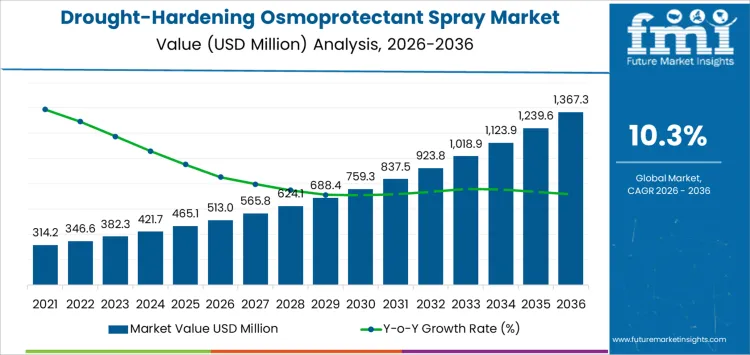
The global drought-hardening osmoprotectant spray market is expected to grow significantly from USD 513 million in 2026 to USD 1,367.3 million by 2036, with a CAGR of 10.3%. The demand for these sprays is increasing due to the growing need for agricultural solutions that help crops withstand drought and water scarcity. Cereals and grains, which account for 34% of the market, lead the demand for osmoprotectant sprays due to their high vulnerability to water stress. The foliar spray method, holding a 61% share, remains the dominant application method due to its efficiency in delivering rapid protection, especially for crops like cereals, oilseeds, and vegetables. Other application methods, such as seed treatment and soil application, also contribute to the market, reflecting diverse crop needs and farming systems.
Quick Stats for Drought-Hardening Osmoprotectant Spray Market
- Drought-Hardening Osmoprotectant Spray Market Value (2026): USD 513 million
- Drought-Hardening Osmoprotectant Spray Market Forecast Value (2036): USD 1,367.3 million
- Drought-Hardening Osmoprotectant Spray Market Forecast CAGR (2026 to 2036): 10.3%
- Leading Crop Type in Drought-Hardening Osmoprotectant Spray Market: Cereals & Grains (34%)
- Key Growth Regions in Drought-Hardening Osmoprotectant Spray Market: Asia Pacific, North America
- Top Players in Drought-Hardening Osmoprotectant Spray Market: BASF SE, Bayer CropScience, Syngenta Group, UPL Limited, Corteva Agriscience
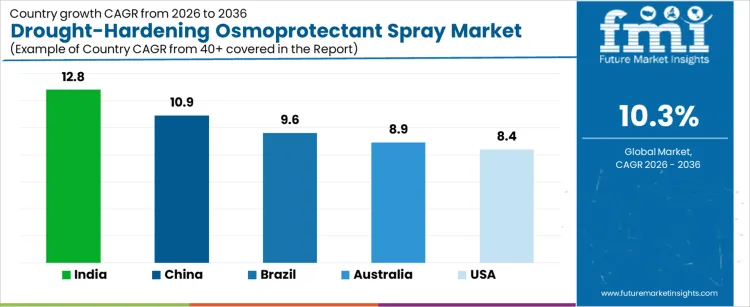
Key regions such as India leading with a 12.8% CAGR, driven by its large agricultural base and the growing impact of climate change. China follows closely with a 10.9% growth rate, influenced by its need to safeguard agricultural production. Brazil and Australia are also experiencing robust growth at 9.6% and 8.9%, respectively, due to their extensive agricultural sectors and recurrent drought challenges. The USA, with a steady 8.4% growth rate, is focusing on enhancing agricultural resilience. As drought conditions become more prevalent, the market for drought-hardening osmoprotectant sprays is expected to grow steadily across these key regions.
Drought‑Hardening Osmoprotectant Spray Market Key Takeaways
| Metric | Value |
|---|---|
| Industry Value (2026) | USD 513 million |
| Forecast Value (2036) | USD 1,367.3 million |
| Forecast CAGR (2026 to 2036) | 10.3% |
How is the Global Drought-Hardening Osmoprotectant Spray Sector Advancing?
The global drought-hardening osmoprotectant spray market is growing rapidly as agricultural producers adopt solutions that help crops withstand water scarcity and drought conditions. Osmoprotectant sprays contain compounds that support plant cells in maintaining water balance and protecting cellular structures under stress, improving crop resilience and productivity in arid and semi-arid regions. Rising frequency of droughts, climate change impacts, and increasing water scarcity have elevated the need for agronomic tools that mitigate environmental stress, driving demand for these sprays across cereals, fruits, vegetables, and high-value cash crops.
As the agriculture sector places more emphasis on climate-adaptation strategies, drought-hardening sprays are becoming a key component of integrated crop management. Advances in formulation technologies have improved the efficacy, plant uptake, and stress-response enhancement of these products. Growers are increasingly combining osmoprotectant sprays with other crop inputs to support overall plant health and yield stability under stress. Furthermore, research into mode of action and field performance continues to expand the range of crop types and geographies where these sprays are effective.
Market growth will be supported by rising awareness of eco-friendly crop stress management, government and industry initiatives to address climate change impacts, and the need to secure food production in drought-prone regions. Challenges such as variability in field responses, cost considerations for growers, and the requirement for tailored application guidance across diverse crops and environments may influence adoption rates. Despite these challenges, the focus on enhancing drought tolerance in plants will sustain strong demand for drought-hardening osmoprotectant sprays.
What is the Segment-Wise Analysis for the Global Drought-Hardening Osmoprotectant Spray Market?
The global drought-hardening osmoprotectant spray market is segmented by crop type and application method. Cereals & grains lead the market with a 34% share due to their high susceptibility to drought stress. Other key crop types include oilseeds & pulses, fruits & vegetables, and turf & plantation crops. In terms of application methods, foliar spray holds the largest share at 61%, followed by seed treatment and soil application. This segmentation reflects the need for targeted and efficient drought protection strategies across different crops and application methods.
Why Do Cereals & Grains Lead the Global Drought-Hardening Osmoprotectant Spray Market?
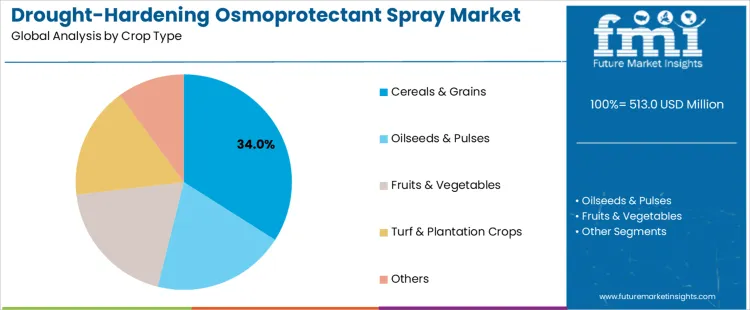
Cereals & grains hold a 34% share in the global drought-hardening osmoprotectant spray market due to their susceptibility to water stress, especially during critical growth stages. Crops like wheat, rice, and maize, which are vital for global food production, face significant risks from drought, impacting both yield and quality. Osmoprotectant sprays, which help plants retain moisture and tolerate drought, are particularly effective for these crops. As climate change increases the frequency and intensity of droughts, there is a growing need for eco-friendly agricultural practices that ensure crop resilience. This demand for drought protection, coupled with the importance of maintaining consistent crop production, continues to drive the adoption of osmoprotectant sprays in the cereal and grain sectors.
Why Does Foliar Spray Hold the Largest Market Share in the Global Market?
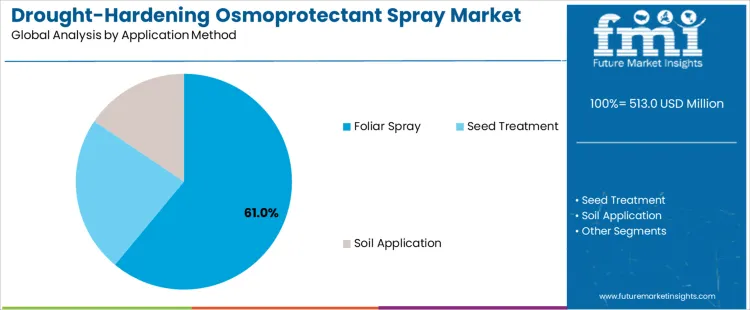
Foliar spray holds the largest share of 61% in the global drought-hardening osmoprotectant spray market due to its efficiency in delivering rapid protection to crops. This application method involves directly spraying the osmoprotectant onto the leaves, ensuring quick absorption and immediate drought stress relief. Foliar spray is widely used across crops like cereals, oilseeds, and vegetables, offering targeted protection with minimal disruption to plant growth. It allows farmers to efficiently apply drought-hardening agents during critical growth periods, enhancing water retention and reducing stress. The speed, effectiveness, and ease of use of foliar sprays contribute to their dominance in the market, especially for crops experiencing drought conditions.
What is Shaping the Drought-Hardening Osmoprotectant Spray Market?
The drought-hardening osmoprotectant spray market is shaped by increasing frequency and severity of drought conditions due to climate change and water scarcity. Osmoprotectant sprays contain compounds such as glycine betaine, proline, and other compatible solutes that help plants maintain cell turgor, protect cellular structures, and sustain metabolic functions under water deficit. As growers face pressure to stabilize yields in water-limited environments, demand for agronomic tools that enhance crop resilience is rising.
What Challenges Are Limiting the Adoption of Drought-Hardening Osmoprotectant Sprays?
Adoption is constrained by concerns over cost and inconsistent performance under varying drought intensities and crop conditions. Some growers remain uncertain about return on investment, particularly where drought stress is unpredictable or uneven across fields. There can also be challenges related to optimal timing and frequency of application to maximize benefits, requiring agronomic expertise. Limited awareness or accessibility in developing regions and regulatory variations for novel chemistries can slow broader market uptake.
What Key Trends Are Shaping the Drought-Hardening Osmoprotectant Spray Market?
Key trends include the development of more efficient, low-toxicity formulations that combine osmoprotectants with nutrients or bio-stimulants for multi-functional crop support. There is growing interest in integrating osmoprotectant sprays with digital agronomy platforms and weather-based advisory systems that recommend precise application windows. Bio-based and eco-friendly ingredient sourcing is gaining traction as growers and regulators emphasize eco-friendly crop inputs. Field-level performance data and case studies are helping build confidence in osmoprotectant technologies, accelerating adoption across diverse crop systems.
What is the Growth Outlook for the Drought-Hardening Osmoprotectant Spray Market by Country?
| Country | CAGR (%) |
|---|---|
| India | 12.8% |
| China | 10.9% |
| USA | 8.4% |
| Brazil | 9.6% |
| Australia | 8.9% |
The drought-hardening osmoprotectant spray market is growing at a strong pace, with India leading at a 12.8% CAGR, driven by its agricultural reliance and the increasing impact of climate change. China follows closely with 10.9%, supported by its vast agricultural sector and the need to protect crops from frequent droughts. Brazil's market grows at 9.6%, fueled by the growing demand for crop protection solutions in response to changing weather patterns. Australia shows steady growth at 8.9%, influenced by its ongoing drought challenges in agricultural regions. The USA’s market grows at 8.4%, driven by both environmental pressures and the push for improved agricultural resilience.
Why is India Leading in the Drought-Hardening Osmoprotectant Spray Market?
India’s drought-hardening osmoprotectant spray market is growing at 12.8%, driven by the country's heavy reliance on agriculture, where drought conditions significantly affect crop yields. As India faces more frequent and severe droughts, the need for effective solutions to protect crops from water stress is increasing. Drought-hardening osmoprotectant sprays offer a solution to enhance crops' resilience to water scarcity by stabilizing cellular processes and maintaining productivity during dry conditions. Government initiatives to improve agricultural practices and reduce the impact of climate change are further accelerating the adoption of these sprays. As farmers seek to ensure stable crop yields and food security, India’s market for drought-hardening osmoprotectant sprays is expected to continue growing rapidly.
What is Driving the Growth of the Drought-Hardening Osmoprotectant Spray Market in China?
China’s drought-hardening osmoprotectant spray market is growing at 10.9%, driven by the country’s need to safeguard its vast agricultural production from the increasing threat of drought. With large areas of farmland experiencing more frequent and intense droughts, the demand for crop protection solutions like osmoprotectant sprays is rising. The Chinese government’s focus on agricultural productivity and environmental protection is encouraging the adoption of drought-resistant technologies. As China’s agricultural sector continues to modernize and address climate change’s effects on crop production, the market for drought-hardening osmoprotectants is expected to expand. These sprays help enhance crop resilience, reduce yield losses, and improve water use efficiency, making them crucial for the country's food security.
How is the Drought-Hardening Osmoprotectant Spray Market Expanding in Brazil?
Brazil’s drought-hardening osmoprotectant spray market is growing at 9.6%, driven by the country’s significant agricultural sector, which is particularly vulnerable to drought. Brazil is one of the world’s largest producers of crops such as soybeans, coffee, and sugarcane, and as climate change exacerbates drought conditions, the need for solutions that protect crops from water stress is increasing. Drought-hardening osmoprotectant sprays offer a way to enhance the resilience of these crops during dry spells. With the growing awareness of climate risks and government initiatives aimed at improving agricultural sustainability, Brazil’s market for osmoprotectants is expected to continue growing as farmers look for ways to safeguard their crops against drought and extreme weather conditions.
What is Contributing to the Growth of the Drought-Hardening Osmoprotectant Spray Market in Australia?
Australia’s drought-hardening osmoprotectant spray market is growing at 8.9%, driven by the country’s recurrent drought challenges, particularly in agricultural regions. As one of the driest continents, Australia’s farmers face significant challenges in maintaining crop productivity during prolonged dry spells. Drought-hardening osmoprotectant sprays are gaining popularity as they offer a solution to improve crops' resistance to water stress, enhancing yields even under difficult conditions. The Australian government’s focus on improving water efficiency and eco-friendly agricultural practices is also contributing to the adoption of these sprays. As the effects of climate change continue to influence Australia’s agricultural landscape, the market for drought-hardening osmoprotectants is expected to expand steadily, offering a viable solution for maintaining crop health during droughts.
What is Driving the Growth of the Drought-Hardening Osmoprotectant Spray Market in the USA?
The USA’s drought-hardening osmoprotectant spray market is growing at 8.4%, driven by the increasing frequency and severity of droughts across key agricultural regions. As the agricultural sector faces challenges due to water scarcity, the demand for products that improve crops' drought resistance is rising. Osmoprotectant sprays are gaining traction as they help crops retain productivity during periods of water stress, which is critical for maintaining food security. The USA's ongoing focus on improving agricultural resilience through innovative solutions, combined with increasing climate variability, is driving the market for drought-hardening osmoprotectants. With rising awareness of the need for water-efficient farming practices, the market for these sprays is expected to grow steadily across the country.
How Are Companies Competing in the Drought‑Hardening Osmoprotectant Spray Market?
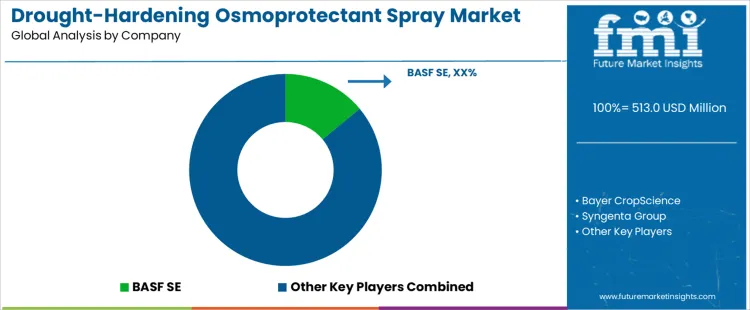
In the drought‑hardening osmoprotectant spray market BASF SE, Bayer CropScience, Syngenta Group, UPL Limited, and Corteva Agriscience are focused on product brochures that highlight formulation performance and crop resilience benefits. BASF SE is promoted with foliar protectant solutions that support plant water balance and cellular protection under heat and moisture stress. These brochures emphasize scientific data, application timing, and crop compatibility to build confidence among agronomists.
Bayer CropScience materials present drought‑hardening sprays often grouped with broader stress mitigation portfolios, with detailed usage guidance and trial results that demonstrate yield improvements. Syngenta Group is depicted as an agricultural science leader offering stress‑adaptive foliar products backed by research and global field data, with brochures tailored to regional needs and cropping systems. Syngenta’s broader crop protection and stress support focus is tied to its core product range and research heritage.
UPL Limited’s collateral positions its osmoprotectant sprays within integrated crop management plans, with attention drawn to their role in bolstering plant resilience in semi‑arid and arid zones. Product brochures are crafted to speak to growers and advisors looking for tools that can be used alongside conventional protections. Corteva Agriscience is portrayed with a strong emphasis on innovation in its stress protection aids, noted for formulation quality and agronomic support materials that help growers make informed decisions. Corteva’s standing in seeds and crop protection underscores its ability to integrate osmoprotectant solutions into broader farm strategies.
Key Players in Drought-Hardening Osmoprotectant Spray Market
- BASF SE
- Bayer CropScience
- Syngenta Group
- UPL Limited
- Corteva Agriscience
Scope of Report
| Items | Values |
|---|---|
| Quantitative Units (2026) | USD million |
| Crop Type | Cereals & Grains, Oilseeds & Pulses, Fruits & Vegetables, Turf & Plantation Crops, Others |
| Application Method | Foliar Spray, Seed Treatment, Soil Application |
| Regions Covered | Asia Pacific, Europe, North America, Latin America, Middle East & Africa |
| Countries Covered | USA, China, Japan, South Korea, India, Australia & New Zealand, ASEAN, Germany, UK, France, Italy, Spain, Nordic, BENELUX, Brazil, Chile, Mexico, Saudi Arabia, Other GCC Countries, Turkey, South Africa, Other African Union |
| Key Companies Profiled | BASF SE, Bayer CropScience, Syngenta Group, UPL Limited, Corteva Agriscience |
| Additional Attributes | Dollar sales by crop type, application method, and region; regional CAGR and growth outlook; distribution channels including agricultural cooperatives, field service providers, and distributors; innovation trends in drought-hardening solutions; competitive positioning of global vs regional suppliers. |
Drought-Hardening Osmoprotectant Spray Market by Segments
Crop Type
- Cereals & Grains
- Oilseeds & Pulses
- Fruits & Vegetables
- Turf & Plantation Crops
- Others
Application Method
- Foliar Spray
- Seed Treatment
- Soil Application
Region:
- Asia Pacific
- China
- Japan
- South Korea
- India
- Australia & New Zealand
- ASEAN
- Rest of Asia Pacific
- Europe
- Germany
- United Kingdom
- France
- Italy
- Spain
- Nordic
- BENELUX
- Rest of Europe
- North America
- United States
- Canada
- Mexico
- Latin America
- Brazil
- Chile
- Rest of Latin America
- Middle East & Africa
- Kingdom of Saudi Arabia
- Other GCC Countries
- Turkey
- South Africa
- Other African Union
- Rest of Middle East & Africa
Frequently Asked Questions
How big is the drought-hardening osmoprotectant spray market in 2026?
The global drought-hardening osmoprotectant spray market is estimated to be valued at USD 513.0 million in 2026.
What will be the size of drought-hardening osmoprotectant spray market in 2036?
The market size for the drought-hardening osmoprotectant spray market is projected to reach USD 1,367.3 million by 2036.
How much will be the drought-hardening osmoprotectant spray market growth between 2026 and 2036?
The drought-hardening osmoprotectant spray market is expected to grow at a 10.3% CAGR between 2026 and 2036.
What are the key product types in the drought-hardening osmoprotectant spray market?
The key product types in drought-hardening osmoprotectant spray market are cereals & grains, oilseeds & pulses, fruits & vegetables, turf & plantation crops and others.
Which application method segment to contribute significant share in the drought-hardening osmoprotectant spray market in 2026?
In terms of application method, foliar spray segment to command 61.0% share in the drought-hardening osmoprotectant spray market in 2026.
Preview the report firsthand - request a free sample
Get SampleGet the brochure for pricing and purchase details.
Get PDFTable of Content
- Executive Summary
- Global Market Outlook
- Demand-side Trends
- Supply-side Trends
- Technology Roadmap Analysis
- Analysis and Recommendations
- Market Overview
- Market Coverage / Taxonomy
- Market Definition / Scope / Limitations
- Market Background
- Market Dynamics
- Drivers
- Restraints
- Opportunity
- Trends
- Scenario Forecast
- Demand in Optimistic Scenario
- Demand in Likely Scenario
- Demand in Conservative Scenario
- Opportunity Map Analysis
- Product Life Cycle Analysis
- Supply Chain Analysis
- Investment Feasibility Matrix
- Value Chain Analysis
- PESTLE and Porter’s Analysis
- Regulatory Landscape
- Regional Parent Market Outlook
- Production and Consumption Statistics
- Import and Export Statistics
- Market Dynamics
- Global Market Analysis 2021 to 2025 and Forecast, 2026 to 2036
- Historical Market Size Value (USD Million) Analysis, 2021 to 2025
- Current and Future Market Size Value (USD Million) Projections, 2026 to 2036
- Y-o-Y Growth Trend Analysis
- Absolute $ Opportunity Analysis
- Global Market Pricing Analysis 2021 to 2025 and Forecast 2026 to 2036
- Global Market Analysis 2021 to 2025 and Forecast 2026 to 2036, By Crop Type
- Introduction / Key Findings
- Historical Market Size Value (USD Million) Analysis By Crop Type , 2021 to 2025
- Current and Future Market Size Value (USD Million) Analysis and Forecast By Crop Type , 2026 to 2036
- Cereals & Grains
- Oilseeds & Pulses
- Fruits & Vegetables
- Turf & Plantation Crops
- Others
- Y-o-Y Growth Trend Analysis By Crop Type , 2021 to 2025
- Absolute $ Opportunity Analysis By Crop Type , 2026 to 2036
- Global Market Analysis 2021 to 2025 and Forecast 2026 to 2036, By Application Method
- Introduction / Key Findings
- Historical Market Size Value (USD Million) Analysis By Application Method, 2021 to 2025
- Current and Future Market Size Value (USD Million) Analysis and Forecast By Application Method, 2026 to 2036
- Foliar Spray
- Seed Treatment
- Soil Application
- Y-o-Y Growth Trend Analysis By Application Method, 2021 to 2025
- Absolute $ Opportunity Analysis By Application Method, 2026 to 2036
- Global Market Analysis 2021 to 2025 and Forecast 2026 to 2036, By Region
- Introduction
- Historical Market Size Value (USD Million) Analysis By Region, 2021 to 2025
- Current Market Size Value (USD Million) Analysis and Forecast By Region, 2026 to 2036
- North America
- Latin America
- Western Europe
- Eastern Europe
- East Asia
- South Asia and Pacific
- Middle East & Africa
- Market Attractiveness Analysis By Region
- North America Market Analysis 2021 to 2025 and Forecast 2026 to 2036, By Country
- Historical Market Size Value (USD Million) Trend Analysis By Market Taxonomy, 2021 to 2025
- Market Size Value (USD Million) Forecast By Market Taxonomy, 2026 to 2036
- By Country
- USA
- Canada
- Mexico
- By Crop Type
- By Application Method
- By Country
- Market Attractiveness Analysis
- By Country
- By Crop Type
- By Application Method
- Key Takeaways
- Latin America Market Analysis 2021 to 2025 and Forecast 2026 to 2036, By Country
- Historical Market Size Value (USD Million) Trend Analysis By Market Taxonomy, 2021 to 2025
- Market Size Value (USD Million) Forecast By Market Taxonomy, 2026 to 2036
- By Country
- Brazil
- Chile
- Rest of Latin America
- By Crop Type
- By Application Method
- By Country
- Market Attractiveness Analysis
- By Country
- By Crop Type
- By Application Method
- Key Takeaways
- Western Europe Market Analysis 2021 to 2025 and Forecast 2026 to 2036, By Country
- Historical Market Size Value (USD Million) Trend Analysis By Market Taxonomy, 2021 to 2025
- Market Size Value (USD Million) Forecast By Market Taxonomy, 2026 to 2036
- By Country
- Germany
- UK
- Italy
- Spain
- France
- Nordic
- BENELUX
- Rest of Western Europe
- By Crop Type
- By Application Method
- By Country
- Market Attractiveness Analysis
- By Country
- By Crop Type
- By Application Method
- Key Takeaways
- Eastern Europe Market Analysis 2021 to 2025 and Forecast 2026 to 2036, By Country
- Historical Market Size Value (USD Million) Trend Analysis By Market Taxonomy, 2021 to 2025
- Market Size Value (USD Million) Forecast By Market Taxonomy, 2026 to 2036
- By Country
- Russia
- Poland
- Hungary
- Balkan & Baltic
- Rest of Eastern Europe
- By Crop Type
- By Application Method
- By Country
- Market Attractiveness Analysis
- By Country
- By Crop Type
- By Application Method
- Key Takeaways
- East Asia Market Analysis 2021 to 2025 and Forecast 2026 to 2036, By Country
- Historical Market Size Value (USD Million) Trend Analysis By Market Taxonomy, 2021 to 2025
- Market Size Value (USD Million) Forecast By Market Taxonomy, 2026 to 2036
- By Country
- China
- Japan
- South Korea
- By Crop Type
- By Application Method
- By Country
- Market Attractiveness Analysis
- By Country
- By Crop Type
- By Application Method
- Key Takeaways
- South Asia and Pacific Market Analysis 2021 to 2025 and Forecast 2026 to 2036, By Country
- Historical Market Size Value (USD Million) Trend Analysis By Market Taxonomy, 2021 to 2025
- Market Size Value (USD Million) Forecast By Market Taxonomy, 2026 to 2036
- By Country
- India
- ASEAN
- Australia & New Zealand
- Rest of South Asia and Pacific
- By Crop Type
- By Application Method
- By Country
- Market Attractiveness Analysis
- By Country
- By Crop Type
- By Application Method
- Key Takeaways
- Middle East & Africa Market Analysis 2021 to 2025 and Forecast 2026 to 2036, By Country
- Historical Market Size Value (USD Million) Trend Analysis By Market Taxonomy, 2021 to 2025
- Market Size Value (USD Million) Forecast By Market Taxonomy, 2026 to 2036
- By Country
- Kingdom of Saudi Arabia
- Other GCC Countries
- Turkiye
- South Africa
- Other African Union
- Rest of Middle East & Africa
- By Crop Type
- By Application Method
- By Country
- Market Attractiveness Analysis
- By Country
- By Crop Type
- By Application Method
- Key Takeaways
- Key Countries Market Analysis
- USA
- Pricing Analysis
- Market Share Analysis, 2025
- By Crop Type
- By Application Method
- Canada
- Pricing Analysis
- Market Share Analysis, 2025
- By Crop Type
- By Application Method
- Mexico
- Pricing Analysis
- Market Share Analysis, 2025
- By Crop Type
- By Application Method
- Brazil
- Pricing Analysis
- Market Share Analysis, 2025
- By Crop Type
- By Application Method
- Chile
- Pricing Analysis
- Market Share Analysis, 2025
- By Crop Type
- By Application Method
- Germany
- Pricing Analysis
- Market Share Analysis, 2025
- By Crop Type
- By Application Method
- UK
- Pricing Analysis
- Market Share Analysis, 2025
- By Crop Type
- By Application Method
- Italy
- Pricing Analysis
- Market Share Analysis, 2025
- By Crop Type
- By Application Method
- Spain
- Pricing Analysis
- Market Share Analysis, 2025
- By Crop Type
- By Application Method
- France
- Pricing Analysis
- Market Share Analysis, 2025
- By Crop Type
- By Application Method
- India
- Pricing Analysis
- Market Share Analysis, 2025
- By Crop Type
- By Application Method
- ASEAN
- Pricing Analysis
- Market Share Analysis, 2025
- By Crop Type
- By Application Method
- Australia & New Zealand
- Pricing Analysis
- Market Share Analysis, 2025
- By Crop Type
- By Application Method
- China
- Pricing Analysis
- Market Share Analysis, 2025
- By Crop Type
- By Application Method
- Japan
- Pricing Analysis
- Market Share Analysis, 2025
- By Crop Type
- By Application Method
- South Korea
- Pricing Analysis
- Market Share Analysis, 2025
- By Crop Type
- By Application Method
- Russia
- Pricing Analysis
- Market Share Analysis, 2025
- By Crop Type
- By Application Method
- Poland
- Pricing Analysis
- Market Share Analysis, 2025
- By Crop Type
- By Application Method
- Hungary
- Pricing Analysis
- Market Share Analysis, 2025
- By Crop Type
- By Application Method
- Kingdom of Saudi Arabia
- Pricing Analysis
- Market Share Analysis, 2025
- By Crop Type
- By Application Method
- Turkiye
- Pricing Analysis
- Market Share Analysis, 2025
- By Crop Type
- By Application Method
- South Africa
- Pricing Analysis
- Market Share Analysis, 2025
- By Crop Type
- By Application Method
- USA
- Market Structure Analysis
- Competition Dashboard
- Competition Benchmarking
- Market Share Analysis of Top Players
- By Regional
- By Crop Type
- By Application Method
- Competition Analysis
- Competition Deep Dive
- BASF SE
- Overview
- Product Portfolio
- Profitability by Market Segments (Product/Age /Sales Channel/Region)
- Sales Footprint
- Strategy Overview
- Marketing Strategy
- Product Strategy
- Channel Strategy
- Bayer CropScience
- Syngenta Group
- UPL Limited
- Corteva Agriscience
- BASF SE
- Competition Deep Dive
- Assumptions & Acronyms Used
- Research Methodology


