

- Industry Size (2026)
- USD 253.2 Mn
- Forecast (2036)
- USD 432.5 Mn
- CAGR (2026 to 2036)
- 5.5%
Embryo Transfer Catheter Market Forecast and Outlook 2026 to 2036
The embryo transfer catheter market is expected to grow from USD 253.2 million in 2026 to USD 432.5 million by 2036, reflecting a compound annual growth rate (CAGR) of 5.5%. Embryo transfer catheters are essential medical devices used in assisted reproductive technologies (ART), particularly in in vitro fertilization (IVF) procedures, to transfer embryos into the uterus. The growth of this market is driven by the increasing prevalence of infertility, advancements in IVF techniques, and rising adoption of assisted reproductive technologies globally. As healthcare systems continue to improve access to fertility treatments and success rates in ART increase, the demand for high-quality embryo transfer catheters is expected to rise.
Additionally, the growing awareness of fertility issues and the increasing willingness of patients to undergo ART procedures contribute to the market’s growth. Improvements in the design and materials used in these catheters, aimed at reducing procedural complications and improving success rates, will further stimulate market expansion. The demand for advanced, minimally invasive, and more effective medical devices in fertility treatments will continue to drive the growth of the embryo transfer catheter market.
Quick Stats for Embryo Transfer Catheter Market
- Embryo Transfer Catheter Market Value (2026): USD 253.2 million
- Embryo Transfer Catheter Market Forecast Value (2036): USD 432.5 million
- Embryo Transfer Catheter Market Global Forecast CAGR (2026–2036): 5.5%
- Top Application by Share in Embryo Transfer Catheter Market: Routine Embryo Transfer (60%)
- Key Growth Regions in Embryo Transfer Catheter Market: India, China, Brazil, USA, UK
- Top Players in Embryo Transfer Catheter Market: Cook Medical, Merck KGaA, MediTech
What is the Growth Forecast for the Embryo Transfer Catheter Market through 2036?
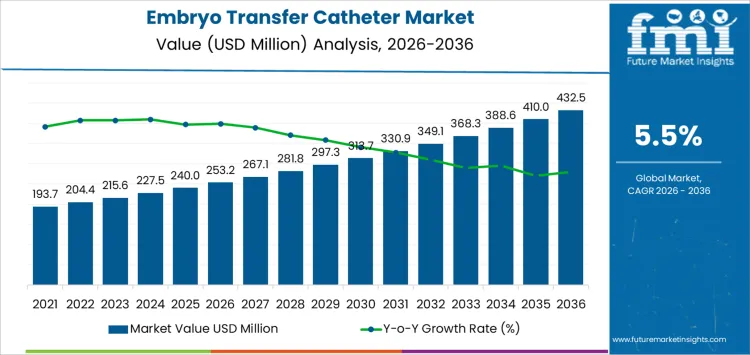
The absolute dollar opportunity for the embryo transfer catheter market shows a steady increase in value throughout the forecast period. Starting at USD 253.2 million in 2026, the market grows to USD 267.1 million in 2027 and USD 281.8 million in 2028. These early years reflect moderate growth as fertility clinics adopt more advanced embryo transfer techniques and increase their reliance on specialized medical devices.
From 2028 to 2030, the market continues its steady upward trend, reaching USD 297.3 million in 2029 and USD 313.7 million in 2030. This period reflects growing global access to fertility treatments, driven by rising awareness and more affordable ART options. By 2035, the market is projected to reach USD 409.9 million, with the final value of USD 432.5 million expected by 2036. The absolute dollar opportunity analysis indicates that the market will experience consistent growth, with a significant portion of the growth driven by ongoing innovations in ART technologies and the increasing demand for effective and reliable embryo transfer devices.
Embryo Transfer Catheter Market Key Takeaways
| Metric | Value |
|---|---|
| Industry Sales Value (2026) | USD 253.2 million |
| Industry Forecast Value (2036) | USD 432.5 million |
| Industry Forecast CAGR (2026-2036) | 5.5% |
What Is Driving the Demand for the Embryo Transfer Catheter Market Globally?
The global demand for embryo transfer catheters is driven by rising use of assisted reproductive technologies (ART), particularly in vitro fertilisation (IVF), as couples and individuals seek solutions for infertility. Infertility prevalence has been increasing due to factors such as delayed childbearing, lifestyle influences, and reproductive health conditions, which has led to greater utilisation of IVF and related procedures that require reliable embryo transfer tools. Embryo transfer catheters are critical devices used to place embryos into the uterine cavity with minimal trauma and high precision, affecting implantation success. Improving access to fertility services, growth of fertility clinics, and expanding healthcare infrastructure in emerging markets support broader adoption of these tools. Clinicians focus on catheters that balance ease of use, atraumatic design, and consistent performance to improve clinical outcomes. The trend toward personalised reproductive care and higher expectations for procedure success has encouraged manufacturers to develop a range of flexible, soft, and ultrasound compatible catheters that address diverse patient anatomies and clinical scenarios.
Future demand for embryo transfer catheters is expected to grow as ART usage continues to expand and technology improvements enhance procedural efficacy. Advances in catheter design, such as improved tip flexibility, visibility under imaging, and reduced risk of uterine irritation, will support clinician confidence and patient comfort. Growth will also be supported by greater awareness of fertility treatment options and continued improvements in reimbursement policies for ART in certain regions. Expansion of fertility services into new geographic areas, combined with demographic shifts and sustained demand for parenthood solutions, will sustain long term uptake of embryo transfer catheters. Training and education around best practices in embryo transfer techniques may further boost procedural success rates, reinforcing the value of high quality catheters in reproductive medicine. Overall, the interplay of clinical demand, technological advancement, and growing acceptance of ART will drive market expansion through the coming years.
What Are the Key Segments in Embryo Transfer Catheter Market?
The embryo transfer catheter market is segmented by product type and application. Soft-tip catheters lead the product type segment with 45% of the market share, offering enhanced safety and comfort during embryo transfer procedures. Routine embryo transfer dominates the application segment with 60%, driven by the high demand for standard fertility treatments. The market is expanding as assisted reproductive technologies (ART) continue to grow in popularity, and the need for precision and comfort in embryo transfer procedures increases.
Which Product Type Drives Embryo Transfer Catheter Market Demand Globally?
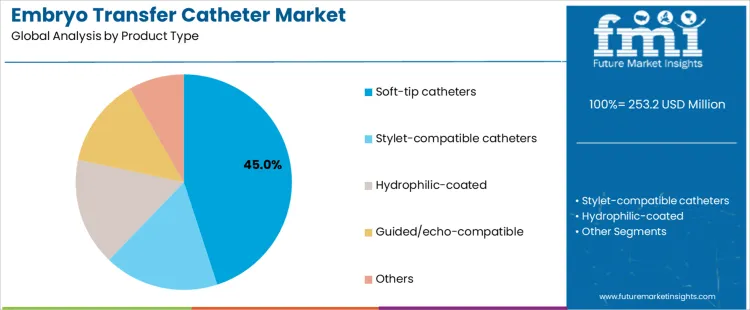
Soft-tip catheters account for 45% of the market share. These catheters are designed with a soft, flexible tip to minimize discomfort and potential injury during embryo transfer procedures. The gentle design of soft-tip catheters enhances the safety of the procedure, particularly when navigating through delicate tissues. The adoption of soft-tip catheters is increasing as they reduce trauma to the cervical canal and endometrium, which can improve the success rates of embryo transfers. As fertility treatments become more prevalent, the demand for safer, more comfortable transfer options is driving the growth of the soft-tip catheter segment. Their popularity is also fueled by their effectiveness in reducing complications, making them a preferred choice for routine embryo transfers in assisted reproductive technologies (ART).
Which Application Drives Embryo Transfer Catheter Market Demand Globally?
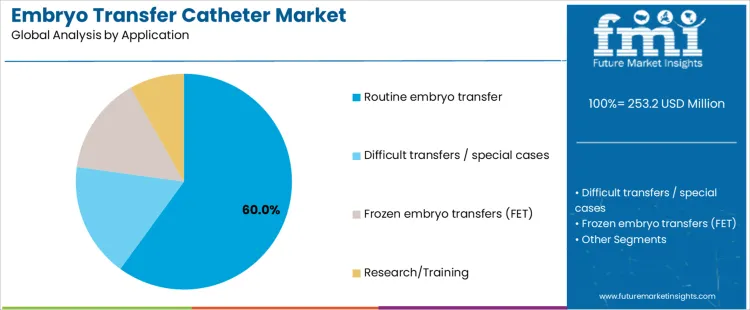
Routine embryo transfer leads the application segment with 60% of the market share. Routine embryo transfer is the most common procedure in assisted reproductive technologies (ART), where embryos are transferred into the uterus to establish a pregnancy. The high demand for ART procedures, including in vitro fertilization (IVF), is a significant factor driving the demand for embryo transfer catheters. As the success of ART heavily depends on the precision and comfort of the embryo transfer process, the use of high-quality catheters is critical. Soft-tip and stylet-compatible catheters are particularly useful for routine transfers, as they allow for accurate placement of the embryo with minimal trauma. While other applications such as difficult transfers, frozen embryo transfers (FET), and research/training contribute to the market, routine embryo transfer remains the dominant application due to its widespread use in fertility clinics globally.
What are the Key Dynamics of the Global Embryo Transfer Catheter Market?
The global embryo transfer catheter market is growing as assisted reproductive technologies expand and infertility treatment demand rises. Embryo transfer catheters are essential tools used to place embryos into the uterine cavity during in vitro fertilisation procedures. Growth of fertility clinics, wider acceptance of reproductive assistance and investment in patient care capabilities support market expansion. Adoption is seen in both developed and emerging regions where access to reproductive health services is improving. The market reflects focus on precision, safety and comfort in embryo transfer, driving development of specialised catheter designs and materials.
What are the Key Drivers for the Global Embryo Transfer Catheter Market?
Rising incidence of infertility and delayed childbearing are driving demand for in vitro fertilisation and related procedures. Clinics are increasing utilisation of embryo transfer catheters as part of standard IVF protocols to improve implantation success and patient outcomes. Technological improvements in catheter design, such as soft tips, ergonomic handling and visibility enhancements, help clinicians perform transfers with better precision and reduced trauma. Growing healthcare infrastructure, insurance support in certain regions and awareness about reproductive options encourage patients to seek fertility treatments that include embryo transfer. Expanding number of fertility centres is supporting broader adoption of specialised catheters.
What are the Restraints for the Global Embryo Transfer Catheter Market?
One restraint is the cost of fertility treatments, which can limit access in regions without insurance coverage or public support for assisted reproductive technologies. Expense of specialised equipment adds to overall procedure cost, potentially affecting adoption in low resource settings. Strict regulatory environments for medical devices require robust validation and compliance processes for catheters, which can slow product introduction. Variation in clinical practice and preference among practitioners can influence selection of catheter types, with some clinicians favouring traditional designs. Limited awareness among patients about specific device enhancements may reduce demand for advanced catheters where basic options are accepted.
What is the Key Trends in the Global Embryo Transfer Catheter Market?
A notable trend is development of catheters with improved flexibility, atraumatic tips and enhanced imaging compatibility to support smoother embryo placement and reduce uterine irritation. Manufacturers are focusing on user centric design improvements that support ease of use for clinicians and comfort for patients. Training and procedural standardisation are increasing as clinics adopt best practices to enhance success rates. Collaboration between device developers and fertility specialists is helping refine product features based on clinical feedback. There is also movement toward single use, sterile packaged catheters to reduce infection risk and support streamlined clinic workflows. Use of digital and simulation based training tools is emerging to support proficiency in embryo transfer techniques.
What is the Country-Wise Outlook for the Embryo Transfer Catheter Market?
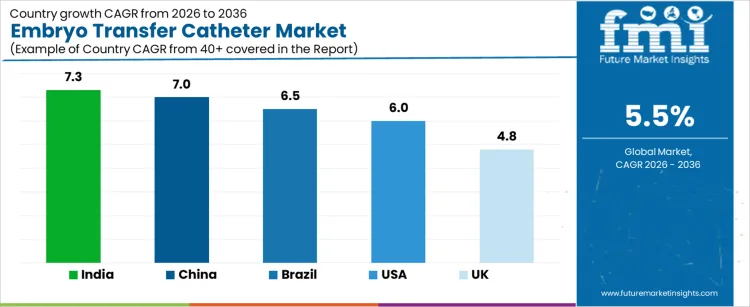
The Embryo Transfer Catheter market is experiencing steady growth, driven by increasing demand for assisted reproductive technologies (ART), advancements in fertility treatments, and rising awareness about infertility. Countries like India, China, and Brazil are witnessing strong growth in this market due to the increasing prevalence of infertility issues, coupled with the expansion of healthcare infrastructure and rising acceptance of fertility treatments. Embryo transfer catheters are critical tools in ART procedures, enabling the safe and accurate transfer of embryos into the uterus, thus improving pregnancy outcomes. As the demand for fertility services continues to grow globally, the market for embryo transfer catheters is expected to expand across these regions.
| Country | CAGR (2026-2036) |
|---|---|
| India | 7.3% |
| China | 7% |
| Brazil | 6.5% |
| USA | 6% |
| UK | 4.8% |
What is Driving the Growth of the Embryo Transfer Catheter Market in India?
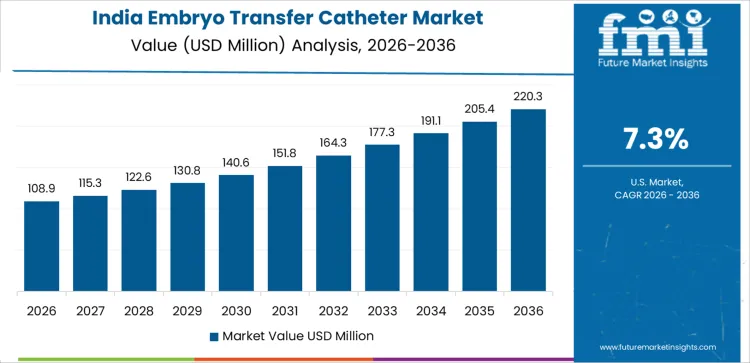
India’s Embryo Transfer Catheter market is projected to grow at a CAGR of 7.3%. The increasing prevalence of infertility in India, along with the growing awareness of ART procedures, is driving the demand for embryo transfer catheters. India’s large population, coupled with the rising number of individuals seeking fertility treatments, has created a significant market for these medical devices. Additionally, advancements in healthcare technology, the expansion of fertility clinics, and the increasing acceptance of assisted reproductive methods contribute to the market’s growth. As the Indian government continues to focus on improving healthcare infrastructure and fertility services, the demand for embryo transfer catheters is expected to rise steadily in the coming years.
What is Contributing to the Growth of the Embryo Transfer Catheter Market in China?
China’s Embryo Transfer Catheter market is expected to grow at a CAGR of 7%. The growing demand for fertility treatments in China, driven by an aging population and lifestyle factors affecting fertility, is contributing to the expansion of the embryo transfer catheter market. The Chinese government’s focus on healthcare reform, including improvements in ART access and fertility services, is further accelerating market growth. In addition, increased awareness and social acceptance of fertility treatments, along with the growing prevalence of infertility, are key factors driving demand for embryo transfer catheters. As ART procedures become more widely available across the country, the demand for embryo transfer catheters is expected to increase significantly.
What is Driving the Embryo Transfer Catheter Market Growth in Brazil?
Brazil’s Embryo Transfer Catheter market is projected to grow at a CAGR of 6.5%. The rise in infertility rates, along with increasing awareness about fertility treatments and assisted reproductive technologies, is driving the demand for embryo transfer catheters in Brazil. Fertility treatments are becoming more common and accessible, leading to an expansion in the use of ART procedures. Brazil’s growing number of fertility clinics, along with advancements in medical technology, is contributing to the increasing adoption of embryo transfer catheters. As the country continues to invest in improving reproductive healthcare and expanding ART services, the demand for these medical devices is expected to rise steadily.
What is Influencing the Growth of the Embryo Transfer Catheter Market in the USA?
The USA Embryo Transfer Catheter market is projected to grow at a CAGR of 6%. The demand for fertility treatments in the USA continues to rise due to factors such as delayed childbearing, lifestyle changes, and increasing rates of infertility. As one of the global leaders in ART procedures, the USA has a high demand for specialized medical devices like embryo transfer catheters. Additionally, the increasing awareness of fertility issues, growing acceptance of reproductive technologies, and advancements in medical devices are driving the market. The availability of sophisticated healthcare infrastructure and a growing number of fertility clinics are expected to contribute to the continued growth of the embryo transfer catheter market in the USA
What is Contributing to the Growth of the Embryo Transfer Catheter Market in the UK?
The UK Embryo Transfer Catheter market is expected to grow at a CAGR of 4.8%. The rise in infertility rates, combined with increased awareness of ART options and greater access to fertility treatments, is driving the demand for embryo transfer catheters. The UK has a well-established healthcare system, and fertility treatments are increasingly available through both public and private clinics. However, compared to other regions, the market in the UK is growing at a slower pace due to relatively lower demand for ART services, though it is still seeing steady growth driven by advancements in fertility care and technology. As more people seek assistance for fertility issues, the market for embryo transfer catheters in the UK is expected to expand gradually.
What is the Competitive Landscape for the Embryo Transfer Catheter Market?
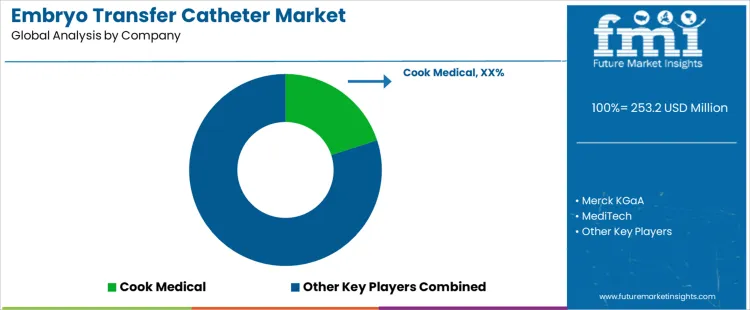
Global demand for embryo transfer catheters is expanding as assisted reproductive technologies (ART) become more widely adopted and infertility rates rise. Embryo transfer catheters are critical tools used in in vitro fertilisation (IVF) procedures to place embryos into the uterine cavity with precision and minimal trauma. As awareness of fertility treatments grows, and as access improves in emerging markets alongside established healthcare systems in North America, Europe and Asia Pacific, clinics seek high quality, reliable devices that support successful clinical outcomes. Drivers include delayed parenthood trends, supportive insurance coverage in some regions, and ongoing innovation in fertility care protocols that prioritise ease of use and patient comfort.
Cook Medical is recognised as a leading player with a broad portfolio of embryo transfer catheters valued for design, reliability and clinical preference among reproductive specialists. Merck KGaA also competes in this segment with reproductive health solutions that address various phases of the IVF cycle, including embryo transfer accessories that support consistency and sterility. MediTech contributes specialised catheter options focused on ergonomic design and performance. Competition among these companies centres on product design features that enhance ease of insertion, reduce uterine irritation, support accurate placement, and improve clinician confidence. Other factors include catheter consistency, compatibility with standard IVF workflows, packaging quality, regulatory approvals, and after sales support. Firms that combine strong clinical evidence, user centric design and reliable supply chains are well positioned to meet the growing needs of fertility clinics and patients seeking effective and comfortable embryo transfer solutions worldwide.
Key Players of the Embryo Transfer Catheter Market
- Cook Medical
- Merck KGaA
- MediTech
- Others
Scope of the Report
| Items | Values |
|---|---|
| Quantitative Units (2026) | USD Million |
| Product Type | Soft-tip Catheters, Stylet-Compatible Catheters, Hydrophilic-Coated Catheters, Guided/Echo-Compatible Catheters, Others |
| Application | Routine Embryo Transfer, Difficult Transfers/Special Cases, Frozen Embryo Transfers (FET), Research/Training |
| End User | IVF Clinics, Hospital Fertility Centers, Academic Centers, Retail Distributors |
| Companies | Cook Medical, Merck KGaA, MediTech |
| Regions Covered | North America, Latin America, Western Europe, Eastern Europe, South Asia and Pacific, East Asia, Middle East & Africa |
| Countries Covered | United States, Canada, Mexico, Brazil, Argentina, Germany, France, United Kingdom, Italy, Spain, Netherlands, China, India, Japan, South Korea, ANZ, GCC Countries, South Africa |
| Additional Attributes | Dollar by sales by product type, application, end-user, and region. Includes market trends in embryo transfer catheters, performance in various embryo transfer applications (routine, difficult transfers, FET, research), cost-effectiveness, sustainability practices, regulatory compliance, market share and competitive positioning of key companies, and the role of embryo transfer catheters in improving the success rates of assisted reproduction and fertility treatments across IVF clinics, hospital fertility centers, and academic settings. |
Embryo Transfer Catheter Market Segmentation
Product Type
- Soft-tip catheters
- Stylet-compatible catheters
- Hydrophilic-coated catheters
- Guided/echo-compatible catheters
- Others
Application
- Routine embryo transfer
- Difficult transfers / special cases
- Frozen embryo transfers (FET)
- Research/Training
End User
- IVF clinics
- Hospital fertility centers
- Academic centers
- Retail distributors
Region
- Asia Pacific
- China
- Japan
- South Korea
- India
- Australia & New Zealand
- ASEAN
- Rest of Asia Pacific
- Europe
- Germany
- United Kingdom
- France
- Italy
- Spain
- Nordic
- BENELUX
- Rest of Europe
- North America
- United States
- Canada
- Mexico
- Latin America
- Brazil
- Chile
- Rest of Latin America
- Middle East & Africa
- Kingdom of Saudi Arabia
- Other GCC Countries
- Turkey
- South Africa
- Other African Union
- Rest of Middle East & Africa
Frequently Asked Questions
How big is the embryo transfer catheter market in 2026?
The global embryo transfer catheter market is estimated to be valued at USD 253.2 million in 2026.
What will be the size of embryo transfer catheter market in 2036?
The market size for the embryo transfer catheter market is projected to reach USD 432.5 million by 2036.
How much will be the embryo transfer catheter market growth between 2026 and 2036?
The embryo transfer catheter market is expected to grow at a 5.5% CAGR between 2026 and 2036.
What are the key product types in the embryo transfer catheter market?
The key product types in embryo transfer catheter market are soft-tip catheters, stylet-compatible catheters, hydrophilic-coated, guided/echo-compatible and others.
Which application segment to contribute significant share in the embryo transfer catheter market in 2026?
In terms of application, routine embryo transfer segment to command 60.0% share in the embryo transfer catheter market in 2026.
Preview the report firsthand - request a free sample
Get SampleGet the brochure for pricing and purchase details.
Get PDFTable of Content
- Executive Summary
- Global Market Outlook
- Demand-side Trends
- Supply-side Trends
- Technology Roadmap Analysis
- Analysis and Recommendations
- Market Overview
- Market Coverage / Taxonomy
- Market Definition / Scope / Limitations
- Market Background
- Market Dynamics
- Drivers
- Restraints
- Opportunity
- Trends
- Scenario Forecast
- Demand in Optimistic Scenario
- Demand in Likely Scenario
- Demand in Conservative Scenario
- Opportunity Map Analysis
- Product Life Cycle Analysis
- Supply Chain Analysis
- Investment Feasibility Matrix
- Value Chain Analysis
- PESTLE and Porter’s Analysis
- Regulatory Landscape
- Regional Parent Market Outlook
- Production and Consumption Statistics
- Import and Export Statistics
- Market Dynamics
- Global Market Analysis 2021 to 2025 and Forecast, 2026 to 2036
- Historical Market Size Value (USD Million) Analysis, 2021 to 2025
- Current and Future Market Size Value (USD Million) Projections, 2026 to 2036
- Y-o-Y Growth Trend Analysis
- Absolute $ Opportunity Analysis
- Global Market Pricing Analysis 2021 to 2025 and Forecast 2026 to 2036
- Global Market Analysis 2021 to 2025 and Forecast 2026 to 2036, By Product Type
- Introduction / Key Findings
- Historical Market Size Value (USD Million) Analysis By Product Type , 2021 to 2025
- Current and Future Market Size Value (USD Million) Analysis and Forecast By Product Type , 2026 to 2036
- Soft-tip catheters
- Stylet-compatible catheters
- Hydrophilic-coated
- Guided/echo-compatible
- Others
- Y-o-Y Growth Trend Analysis By Product Type , 2021 to 2025
- Absolute $ Opportunity Analysis By Product Type , 2026 to 2036
- Global Market Analysis 2021 to 2025 and Forecast 2026 to 2036, By Application
- Introduction / Key Findings
- Historical Market Size Value (USD Million) Analysis By Application, 2021 to 2025
- Current and Future Market Size Value (USD Million) Analysis and Forecast By Application, 2026 to 2036
- Routine embryo transfer
- Difficult transfers / special cases
- Frozen embryo transfers (FET)
- Research/Training
- Y-o-Y Growth Trend Analysis By Application, 2021 to 2025
- Absolute $ Opportunity Analysis By Application, 2026 to 2036
- Global Market Analysis 2021 to 2025 and Forecast 2026 to 2036, By End User
- Introduction / Key Findings
- Historical Market Size Value (USD Million) Analysis By End User, 2021 to 2025
- Current and Future Market Size Value (USD Million) Analysis and Forecast By End User, 2026 to 2036
- IVF clinics
- Hospital fertility centers
- Academic centers
- Retail distributors
- Y-o-Y Growth Trend Analysis By End User, 2021 to 2025
- Absolute $ Opportunity Analysis By End User, 2026 to 2036
- Global Market Analysis 2021 to 2025 and Forecast 2026 to 2036, By Region
- Introduction
- Historical Market Size Value (USD Million) Analysis By Region, 2021 to 2025
- Current Market Size Value (USD Million) Analysis and Forecast By Region, 2026 to 2036
- North America
- Latin America
- Western Europe
- Eastern Europe
- East Asia
- South Asia and Pacific
- Middle East & Africa
- Market Attractiveness Analysis By Region
- North America Market Analysis 2021 to 2025 and Forecast 2026 to 2036, By Country
- Historical Market Size Value (USD Million) Trend Analysis By Market Taxonomy, 2021 to 2025
- Market Size Value (USD Million) Forecast By Market Taxonomy, 2026 to 2036
- By Country
- USA
- Canada
- Mexico
- By Product Type
- By Application
- By End User
- By Country
- Market Attractiveness Analysis
- By Country
- By Product Type
- By Application
- By End User
- Key Takeaways
- Latin America Market Analysis 2021 to 2025 and Forecast 2026 to 2036, By Country
- Historical Market Size Value (USD Million) Trend Analysis By Market Taxonomy, 2021 to 2025
- Market Size Value (USD Million) Forecast By Market Taxonomy, 2026 to 2036
- By Country
- Brazil
- Chile
- Rest of Latin America
- By Product Type
- By Application
- By End User
- By Country
- Market Attractiveness Analysis
- By Country
- By Product Type
- By Application
- By End User
- Key Takeaways
- Western Europe Market Analysis 2021 to 2025 and Forecast 2026 to 2036, By Country
- Historical Market Size Value (USD Million) Trend Analysis By Market Taxonomy, 2021 to 2025
- Market Size Value (USD Million) Forecast By Market Taxonomy, 2026 to 2036
- By Country
- Germany
- UK
- Italy
- Spain
- France
- Nordic
- BENELUX
- Rest of Western Europe
- By Product Type
- By Application
- By End User
- By Country
- Market Attractiveness Analysis
- By Country
- By Product Type
- By Application
- By End User
- Key Takeaways
- Eastern Europe Market Analysis 2021 to 2025 and Forecast 2026 to 2036, By Country
- Historical Market Size Value (USD Million) Trend Analysis By Market Taxonomy, 2021 to 2025
- Market Size Value (USD Million) Forecast By Market Taxonomy, 2026 to 2036
- By Country
- Russia
- Poland
- Hungary
- Balkan & Baltic
- Rest of Eastern Europe
- By Product Type
- By Application
- By End User
- By Country
- Market Attractiveness Analysis
- By Country
- By Product Type
- By Application
- By End User
- Key Takeaways
- East Asia Market Analysis 2021 to 2025 and Forecast 2026 to 2036, By Country
- Historical Market Size Value (USD Million) Trend Analysis By Market Taxonomy, 2021 to 2025
- Market Size Value (USD Million) Forecast By Market Taxonomy, 2026 to 2036
- By Country
- China
- Japan
- South Korea
- By Product Type
- By Application
- By End User
- By Country
- Market Attractiveness Analysis
- By Country
- By Product Type
- By Application
- By End User
- Key Takeaways
- South Asia and Pacific Market Analysis 2021 to 2025 and Forecast 2026 to 2036, By Country
- Historical Market Size Value (USD Million) Trend Analysis By Market Taxonomy, 2021 to 2025
- Market Size Value (USD Million) Forecast By Market Taxonomy, 2026 to 2036
- By Country
- India
- ASEAN
- Australia & New Zealand
- Rest of South Asia and Pacific
- By Product Type
- By Application
- By End User
- By Country
- Market Attractiveness Analysis
- By Country
- By Product Type
- By Application
- By End User
- Key Takeaways
- Middle East & Africa Market Analysis 2021 to 2025 and Forecast 2026 to 2036, By Country
- Historical Market Size Value (USD Million) Trend Analysis By Market Taxonomy, 2021 to 2025
- Market Size Value (USD Million) Forecast By Market Taxonomy, 2026 to 2036
- By Country
- Kingdom of Saudi Arabia
- Other GCC Countries
- Turkiye
- South Africa
- Other African Union
- Rest of Middle East & Africa
- By Product Type
- By Application
- By End User
- By Country
- Market Attractiveness Analysis
- By Country
- By Product Type
- By Application
- By End User
- Key Takeaways
- Key Countries Market Analysis
- USA
- Pricing Analysis
- Market Share Analysis, 2025
- By Product Type
- By Application
- By End User
- Canada
- Pricing Analysis
- Market Share Analysis, 2025
- By Product Type
- By Application
- By End User
- Mexico
- Pricing Analysis
- Market Share Analysis, 2025
- By Product Type
- By Application
- By End User
- Brazil
- Pricing Analysis
- Market Share Analysis, 2025
- By Product Type
- By Application
- By End User
- Chile
- Pricing Analysis
- Market Share Analysis, 2025
- By Product Type
- By Application
- By End User
- Germany
- Pricing Analysis
- Market Share Analysis, 2025
- By Product Type
- By Application
- By End User
- UK
- Pricing Analysis
- Market Share Analysis, 2025
- By Product Type
- By Application
- By End User
- Italy
- Pricing Analysis
- Market Share Analysis, 2025
- By Product Type
- By Application
- By End User
- Spain
- Pricing Analysis
- Market Share Analysis, 2025
- By Product Type
- By Application
- By End User
- France
- Pricing Analysis
- Market Share Analysis, 2025
- By Product Type
- By Application
- By End User
- India
- Pricing Analysis
- Market Share Analysis, 2025
- By Product Type
- By Application
- By End User
- ASEAN
- Pricing Analysis
- Market Share Analysis, 2025
- By Product Type
- By Application
- By End User
- Australia & New Zealand
- Pricing Analysis
- Market Share Analysis, 2025
- By Product Type
- By Application
- By End User
- China
- Pricing Analysis
- Market Share Analysis, 2025
- By Product Type
- By Application
- By End User
- Japan
- Pricing Analysis
- Market Share Analysis, 2025
- By Product Type
- By Application
- By End User
- South Korea
- Pricing Analysis
- Market Share Analysis, 2025
- By Product Type
- By Application
- By End User
- Russia
- Pricing Analysis
- Market Share Analysis, 2025
- By Product Type
- By Application
- By End User
- Poland
- Pricing Analysis
- Market Share Analysis, 2025
- By Product Type
- By Application
- By End User
- Hungary
- Pricing Analysis
- Market Share Analysis, 2025
- By Product Type
- By Application
- By End User
- Kingdom of Saudi Arabia
- Pricing Analysis
- Market Share Analysis, 2025
- By Product Type
- By Application
- By End User
- Turkiye
- Pricing Analysis
- Market Share Analysis, 2025
- By Product Type
- By Application
- By End User
- South Africa
- Pricing Analysis
- Market Share Analysis, 2025
- By Product Type
- By Application
- By End User
- USA
- Market Structure Analysis
- Competition Dashboard
- Competition Benchmarking
- Market Share Analysis of Top Players
- By Regional
- By Product Type
- By Application
- By End User
- Competition Analysis
- Competition Deep Dive
- Cook Medical
- Overview
- Product Portfolio
- Profitability by Market Segments (Product/Age /Sales Channel/Region)
- Sales Footprint
- Strategy Overview
- Marketing Strategy
- Product Strategy
- Channel Strategy
- Merck KGaA
- MediTech
- Others
- Cook Medical
- Competition Deep Dive
- Assumptions & Acronyms Used
- Research Methodology


