

- Market Size (2026)
- USD 1230.8 Mn
- Forecast (2036)
- USD 2913.8 Mn
- CAGR (2026 to 2036)
- 9.0%
How big is Catheter-Based Pulmonary Embolism Thrombectomy Market in 2026?
USD 1,230.8 million in 2026 and USD 2,913.8 million by 2036 at a 9.0% CAGR.
Sales of catheter-based pulmonary embolism thrombectomy are projected to expand at 9.0% CAGR from 2026 to 2036. Market value is projected to rise from USD 1230.8 million in 2026 to USD 2913.8 million by 2036. Demand is expected to come from hospitals that require faster clot removal for selected acute pulmonary embolism cases. The American Heart Association reported in February 2026 that about 470,000 people are hospitalized with PE in the United States each year. The update stated that 1 in 5 high-risk patients die. This burden keeps clinical teams focused on rapid diagnosis and prompt escalation.
FDA 510(k) records show FlowTriever2 Catheter from Inari Medical received substantial equivalence on March 13 2025. The same database records later decisions for AlphaVac and Penumbra aspiration systems. These records give hospitals a practical way to check device status before building a catheter-based PE program. Purchase approval is expected to depend on evidence and training depth with clear monitoring responsibility.
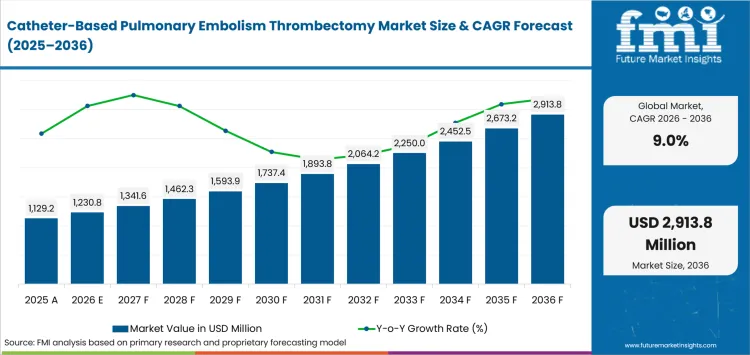
Key Takeaways of Catheter-Based Pulmonary Embolism Thrombectomy Market
- Demand for catheter-based pulmonary embolism thrombectomy is driven by acute PE burden and hospital readiness for rapid clot removal, with FDA-cleared aspiration and mechanical systems providing device-specific evidence for program approval.
- Aspiration catheters hold the leading device type share at 40.6% in 2026, supported by direct clot removal through suction during catheter access where hospitals compare blood-loss management and workflow fit before broader purchasing.
- Hospitals account for 30.7% end-user share in 2026, driven by their control over emergency diagnosis, CT imaging, intervention planning, and post-procedure monitoring within one accountable care pathway.
- Acute pulmonary embolism leads the application category at 33.4% share in 2026, reflecting urgency keeping this application closest to intervention decisions where clot burden and right-heart strain require disciplined case selection.
- Percutaneous thrombectomy leads the procedure type category at 44.3% share in 2026, driven by its fit with catheter-based access across specialist centers managing high-acuity vascular care.
- South Korea, Germany, and Japan record CAGRs of 10.9%, 8.8%, and 8.1% respectively through 2036, with Stryker and Inari Medical holding the strongest PE thrombectomy association, while Penumbra, AngioDynamics, and Imperative Care compete through aspiration systems and newer trial signals.
Analyst Perspective
"Commercial adoption will depend on whether ECG screening improves early cardiovascular detection while fitting seamlessly into routine clinical workflows. Healthcare providers are evaluating diagnostic accuracy, follow-up efficiency, and interoperability with existing cardiology systems as distinct measures of value. Companies that support evidence-based implementation and integrated patient management will be better positioned to expand adoption."
Anurag Sharma, Principal Analyst at Future Market Insights
Source: FMI's proprietary forecasting model and primary research
How is the Catheter-Based Pulmonary Embolism Thrombectomy Market segmented?
The catheter-based pulmonary embolism thrombectomy market is segmented by device type, end user, application, procedure type, and region.
The segmentation framework separates the device used from the care setting and the clinical indication. Device Type covers aspiration and mechanical catheters along with rheolytic and combination systems. End User analysis separates hospitals from cardiac centers and specialty clinics. Application coverage focuses on acute pulmonary embolism and risk-defined PE groups. Procedure Type analysis compares percutaneous thrombectomy with catheter-directed and hybrid procedures. Regional analysis shows how specialist capacity and reimbursement affect adoption across countries.
What supports demand for aspiration Catheters within the device type category?
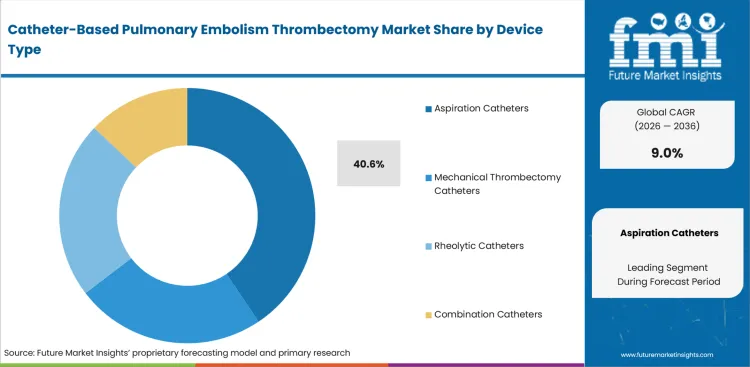
Aspiration catheters form the clearest device group in catheter-based PE thrombectomy. These systems remove thrombus through suction during catheter access. Hospitals are expected to compare suction control and blood-loss management before broader use. Device proof carries more weight than a broad cardiovascular product range.
- With an estimated 40.6% share in 2026, Aspiration Catheters are anticipated to lead Device Type revenue through direct support for clot removal in selected acute PE cases. The segment gives physicians a practical way to assess vessel access and procedure control.
- Combination and mechanical systems remain relevant when local protocols favor more active clot engagement. Clinical teams are expected to compare procedure time and safety handling before moving beyond a familiar aspiration workflow.
How do hospitals shape demand within the end user category?
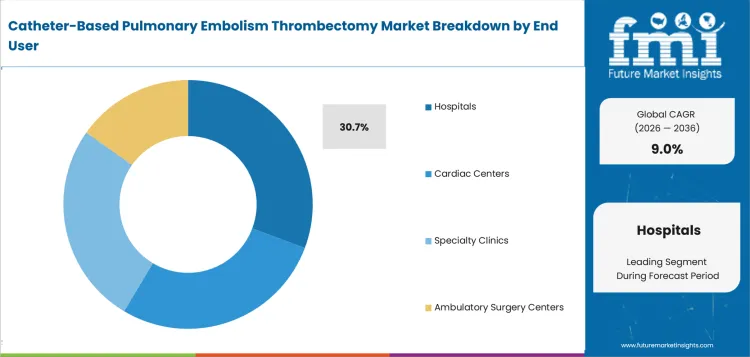
Hospitals lead the End User category since catheter-based PE thrombectomy depends on services working in sequence. Emergency assessment and CT imaging are expected to move into the same pathway as intervention. Anesthesia support and intensive-care monitoring usually remain in the same setting.
- By end user, Hospitals are expected to dominate with 30.7% share in 2026 due to their control over diagnosis and intervention planning. The setting keeps imaging and post-procedure monitoring under one accountable care pathway.
- Cardiac centers and specialty clinics remain relevant where procedure teams already manage high-acuity vascular care. Ambulatory surgery centers are expected to stay selective when acute PE intervention requires emergency backup.
Why does acute pulmonary embolism lead the application category?
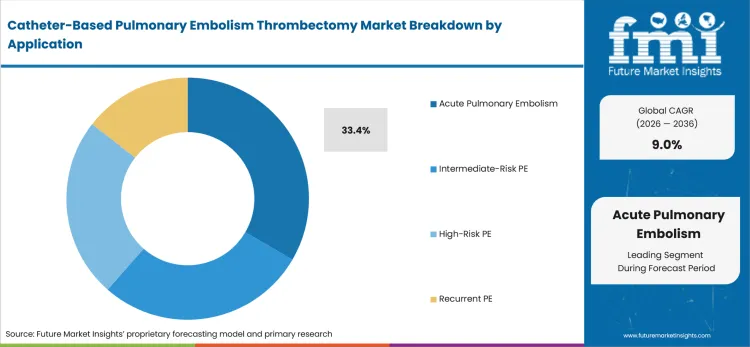
Acute pulmonary embolism remains the clearest use case since timing affects escalation decisions. The clinical aim is to reduce clot burden and relieve right-heart strain in selected patients. Trial activity around intermediate-risk PE is expected to support more structured evaluation of acute cases. Hospitals still require disciplined case selection since not every PE patient requires an invasive clot-removal procedure.
- Acute Pulmonary Embolism is projected to hold 33.4% share in 2026 where urgency keeps this application closest to intervention decisions. The segment leads when clot burden and right-heart strain are clearly documented.
- Intermediate-risk PE and high-risk PE create separate evaluation paths. Recurrent PE remains smaller but important when treatment history and bleeding risk affect intervention planning.
How is percutaneous thrombectomy positioned within the procedure type category?
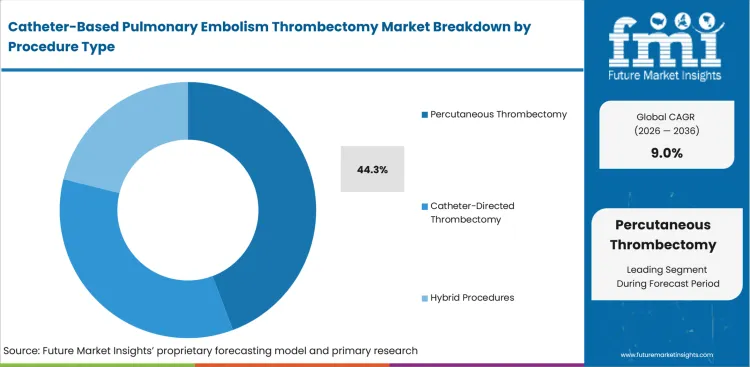
Percutaneous thrombectomy leads Procedure Type through a catheter-based route to clot removal without open surgery. The procedure fits hospital workflows that already use fluoroscopy and vascular access. Post-procedure observation remains part of the same care path. This gives device companies a defined setting for training and clinical support. Growth depends on early patient identification and team readiness.
- Percutaneous Thrombectomy is forecast to represent 44.3% share in 2026 due to its fit with interventional PE response workflows. The procedure type gives hospitals a defined operating route for selected cases.
- Catheter-directed thrombectomy and hybrid procedures remain part of the procedure mix where local protocols combine aspiration with mechanical removal. Thrombolysis and supportive care remain part of patient selection decisions.
What drives and restrains the catheter-based Pulmonary Embolism Thrombectomy Market and where is the opportunity?
High-acuity PE cases are accelerating demand for devices that fit rapid diagnosis and controlled catheter-based intervention.
- Driver: FDA clearances and trial activity are expected to improve confidence in PE-specific thrombectomy systems.
- Restraint: Adoption slows when patient selection and post-procedure responsibility are unclear.
- Opportunity: Hospital PE response programs create a defined route for devices with repeatable evidence.
Device availability is expected to improve when PE-specific systems pass through FDA review and clinical programs. FDA listed FlowTriever2 under K250088 with a March 13 2025 decision. The agency listed Penumbra Lightning Flash tubing with LINK under K251949 with a February 5 2026 decision. These entries help hospitals avoid relying on general catheter claims. Adoption is expected to rise when approvals and studies explain which patients are suitable for intervention.
Adoption is restrained by patient selection and staffing. The AHA/ACC 2026 guideline recommends hospitalization for symptomatic patients with higher clinical severity. That guidance keeps thrombectomy tied to centers with imaging and emergency backup. Smaller facilities are expected to refer complex cases when they lack interventional coverage.
Opportunity grows where hospitals build PE response programs. ClinicalTrials.gov listed PEERLESS II as a randomized trial of large-bore thrombectomy versus anticoagulation in intermediate-risk PE with a June 2026 update. Such study designs are expected to give teams clearer comparison points. Companies that help hospitals document outcomes are likely to gain more trial-to-routine conversion.
Which country CAGRs are profiled in the Catheter-Based Pulmonary Embolism Thrombectomy Market?
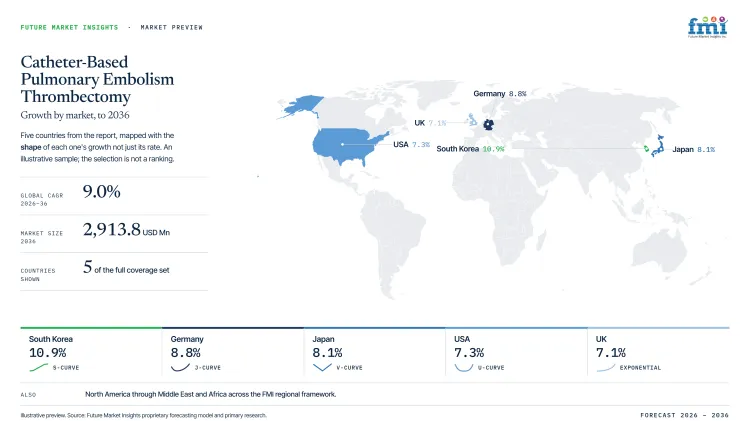
| Country | CAGR |
|---|---|
| USA | 7.3% |
| UK | 7.1% |
| Germany | 8.8% |
| Japan | 8.1% |
| South Korea | 10.9% |
How do country-level CAGRs compare in the Catheter-Based Pulmonary Embolism Thrombectomy Market?
A global growth rate represents the weighted average of all markets included in the analysis. It can therefore exceed the growth rates of several individual countries when other covered markets expand more rapidly or carry greater weight in the calculation. The five countries presented are illustrative examples, and their comparison with the global figure makes this difference visible.
- The countries are distinguished less by their individual CAGRs and more by the spacing between them. The total range across the five profiled markets is 3.8 percentage points, with South Korea positioned separately from the remaining group.
- South Korea shows a more pronounced growth position through concentrated adoption in tertiary hospitals with imaging and intensive-care support. Germany and Japan form a measured middle group, although their market-development routes differ. Germany relies on formal procedure evaluation and hospital procurement review, while Japan depends more heavily on careful device qualification and staged specialist adoption.
- The USA and the UK remain closely aligned within a compact lower cluster. The USA follows an approval-led commercial route through FDA-cleared systems and hospital pulmonary embolism response programs. The UK follows a guidance-led pathway where patient selection, staffing availability and specialist judgment shape procedure use.
- Markets with broadly similar CAGRs can therefore follow substantially different development paths. These variations become relevant when comparing entry conditions, training requirements and the timing of hospital deployment across the countries covered.
The full report examines these dynamics for every market included in the study. It provides country-level CAGR analysis across North America, Latin America, Europe, East Asia, South Asia, Oceania, and the Middle East and Africa.
Country-wise Analysis
- USA hospitals have the clearest device approval record with several FDA decisions after 2024. Demand in the USA is projected to rise at 7.3% CAGR from 2026 to 2036. The market is expected to move through hospitals that already coordinate emergency imaging and interventional teams. FDA entries for FlowTriever2 and Penumbra systems give committees a verified starting point for product review. Hospital purchasing teams require evidence on blood-loss handling and post-procedure monitoring before wider adoption. Wider use is expected to remain concentrated in centers with PE response pathways.
- UK adoption is shaped by guidance review and careful selection for intermediate-risk or high-risk acute PE. The UK market is estimated to expand at 7.1% CAGR through 2036. NICE migrated percutaneous thrombectomy guidance for PE into its HealthTech guidance structure in January 2026. That framework keeps the procedure tied to defined patient groups and specialist judgment. Hospitals are expected to move carefully where staffing and emergency backup differ by region. Commercial progress depends on training support and evidence that helps local teams defend procedure use.
- Germany shows a stronger growth profile where reimbursement and method evaluation give new procedures a formal route. The German market is forecast to record 8.8% CAGR from 2026 to 2036. The Gemeinsamer Bundesausschuss began a procedure for in-toto thrombectomy using retriever or aspiration systems in acute pulmonary embolism in March 2025. This review activity supports structured debate on patient selection and hospital responsibility. Device companies require clear evidence packages for hospital committees. Adoption is expected to move fastest in centers that already handle complex vascular intervention.
- Japan is expected to grow through specialist hospitals that prefer careful device qualification before broad use. The Japanese market is projected to advance at 8.1% CAGR over the forecast period. PMDA records show continuing medical-device review activity and a post-market use-result survey for Inari Medical thrombectomy technology in Japan. The evidence culture favors staged adoption with training and monitoring requirements. Device companies require local education and documentation support before hospitals expand procedure use. Demand remains tied to specialist access and confidence in procedural risk control.
- South Korea leads the profiled country set with large hospitals centralizing complex cardiovascular intervention and post-procedure care. Demand in South Korea is anticipated to advance at 10.9% CAGR from 2026 to 2036. MFDS published a 2025 Medical Device Approval Report to explain approval trends and improve visibility for overseas companies. That regulatory context helps companies plan local documentation and review requirements. Adoption is expected to concentrate in tertiary centers with imaging and intensive-care coverage. Hospitals still require evidence that identifies which PE patients benefit from catheter-based intervention.
Who are the notable companies in the Catheter-Based Pulmonary Embolism Thrombectomy Market?
Notable companies include Stryker Corporation/Inari Medical, Penumbra, AngioDynamics, Imperative Care, Boston Scientific, and Expanse Medical.
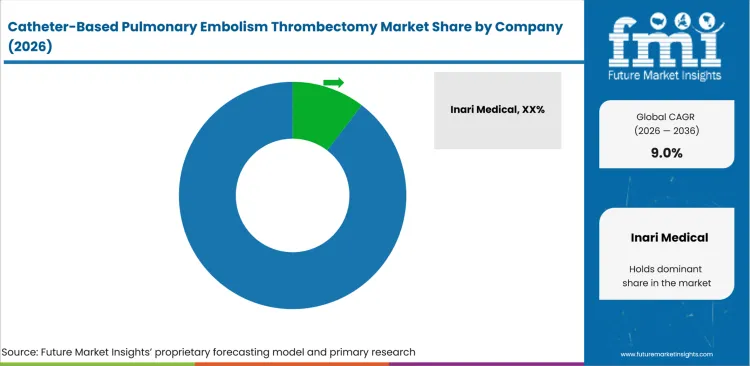
The competitive outlook combines PE-specific thrombectomy systems with catheter-directed therapy and emerging entrants. Stryker gained a direct venous thrombectomy position after completing the Inari Medical acquisition in February 2025. Penumbra and AngioDynamics compete through aspiration platforms with visible FDA review records. Imperative Care adds trial evidence and FDA clearance for its Symphony system. Boston Scientific remains relevant through catheter-directed PE therapy and hospital cardiovascular reach. Expanse Medical adds a newer aspiration-system clearance signal that is expected to affect future procedure choices.
- Stryker and Inari Medical compete through FlowTriever systems and specialist support for venous thromboembolism procedures. Their commercial strength depends on training depth and hospital confidence in PE-specific evidence.
- Penumbra and AngioDynamics compete through aspiration technologies that hospitals are expected to compare through FDA records. Their growth path depends on procedure efficiency and confidence in blood-loss control.
- Imperative Care and Expanse Medical add newer competitive pressure through PE thrombectomy trial or clearance activity. Boston Scientific remains adjacent through EKOS catheter-directed therapy and clinical familiarity.
Competitive Benchmarking: Catheter-Based Pulmonary Embolism Thrombectomy Market
| Company | PE Thrombectomy Alignment | Aspiration Capability | Clinical Evidence Signal | Geographic Reach |
|---|---|---|---|---|
| Stryker Corporation / Inari Medical | High | High | High | Global |
| Penumbra, Inc. | High | High | High | United States and selected international markets |
| AngioDynamics, Inc. | High | High | Medium | North America and selected international markets |
| Imperative Care, Inc. | High | High | High | United States |
| Boston Scientific Corporation | Medium | Low | Medium | Global |
| Expanse Medical, Inc. | Medium | High | Medium | United States |
Key Developments in the catheter-based pulmonary embolism thrombectomy market
- In February 2025, Stryker completed the acquisition of Inari Medical. The deal gave Stryker a direct position in venous thromboembolism devices and added the FlowTriever franchise to its vascular portfolio. The acquisition is expected to raise competitive pressure around clinical support and sales coverage for PE thrombectomy programs.
- In May 2025, Imperative Care completed enrollment in the SYMPHONY-PE IDE study for acute pulmonary embolism. The company later reported FDA clearance and presented positive trial evidence in 2025. This gives the market another PE-specific entrant with a documented study pathway.
- In March 2026, FDA recorded substantial equivalence for Expanse Medical FLOWRUNNER Aspiration System under K254208. The clearance adds another aspiration-system signal to the market. Entry by newer companies is expected to increase the requirement for careful device-by-device comparison.
Key Providers in the Catheter-Based Pulmonary Embolism Thrombectomy Market
Pulmonary Embolism Thrombectomy System Providers
- Stryker Corporation / Inari Medical
- Penumbra, Inc.
- AngioDynamics, Inc.
- Imperative Care, Inc.
Catheter-Directed and Emerging PE Intervention Providers
- Boston Scientific Corporation
- Expanse Medical, Inc.
Catheter-Based Pulmonary Embolism Thrombectomy Market - Report Scope
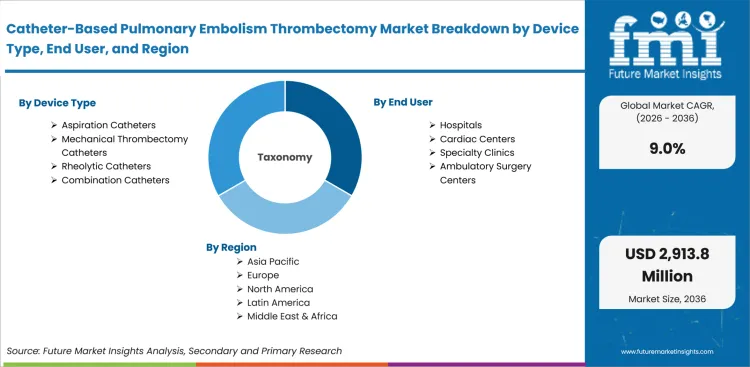
| Coverage field | Report scope |
|---|---|
| Market breakdown | Device Type, End User, Application, Procedure Type, and Region. |
| Quantitative Units | Revenue in USD Million, CAGR in %. |
| Market Definition | Catheter-based systems and procedure support used to mechanically remove thrombus from pulmonary arteries during selected pulmonary embolism intervention. |
| Regions Covered | North America through Middle East and Africa across the FMI regional framework. |
| Countries Covered | USA with the UK plus Germany, Japan and South Korea. |
| Key Companies Profiled | Stryker Corporation/Inari Medical with Penumbra and five other profiled providers. |
| Forecast Period | 2026 to 2036. |
| Approach | Hybrid bottom-up and top-down market sizing supported by primary interviews and official desk research. |
Catheter-Based Pulmonary Embolism Thrombectomy Market - Research Methodology
| Method | Approach |
|---|---|
| Primary Research | FMI analysts gathered input from manufacturers, service providers, technology developers, distributors, end users, procurement teams, and subject-matter experts. Interviews examined purchasing decisions, product or service evaluation, adoption barriers, approval requirements, pricing considerations, and expectations for technical or commercial support. Respondents were also asked what evidence is required before a trial, pilot, or initial order develops into regular purchasing. |
| Desk Research | Desk research covered government statistics, regulatory publications, trade data, industry associations, technical literature, standards, company filings, product information, and official corporate announcements. Sources were reviewed for relevance, publication date, geographic coverage, and consistency with the defined market scope. Claims relating to performance, applications, approvals, capacity, investment, and commercial activity were retained only when supported by credible public evidence. |
| Market Sizing and Forecasting | The market model combined the baseline value with historical performance, segment structure, pricing and volume indicators, adoption levels, company participation, and country-level demand conditions. Forecast assumptions considered economic activity, investment trends, regulatory developments, technology adoption, purchasing cycles, supply availability, and barriers to wider market use. Segment and regional estimates were reconciled before the final market total was calculated. |
| Data Validation | Estimates were checked against multiple independent indicators, including public data, company activity, trade patterns, industry developments, and findings from primary interviews. Validation also tested whether products, services, applications, and company revenues fell within the defined market boundaries. Adjacent categories, unsupported claims, overlapping revenues, and activities without direct market relevance were excluded to reduce double counting and maintain consistency across segments and countries. |
Catheter-Based Pulmonary Embolism Thrombectomy Market by Segments
Catheter-Based Pulmonary Embolism Thrombectomy Market segmented by Device Type:
- Aspiration Catheters
- Mechanical Thrombectomy Catheters
- Rheolytic Catheters
- Combination Catheter Systems
Catheter-Based Pulmonary Embolism Thrombectomy Market segmented by End User:
- Hospitals
- Cardiac Centers
- Specialty Clinics
- Ambulatory Surgery Centers
Catheter-Based Pulmonary Embolism Thrombectomy Market segmented by Application:
- Acute Pulmonary Embolism
- Intermediate-Risk Pulmonary Embolism
- High-Risk Pulmonary Embolism
- Recurrent Pulmonary Embolism
Catheter-Based Pulmonary Embolism Thrombectomy Market segmented by Procedure Type:
- Percutaneous Thrombectomy
- Catheter-Directed Thrombectomy
- Hybrid Procedures
Catheter-Based Pulmonary Embolism Thrombectomy Market by Region:
- North America
- United States
- Canada
- Latin America
- Brazil
- Mexico
- Argentina
- Chile
- Western Europe
- Germany
- France
- United Kingdom
- Italy
- Spain
- Benelux
- Nordics
- Eastern Europe
- Poland
- Czech Republic
- Romania
- Hungary
- East Asia
- China
- Japan
- South Korea
- South Asia and Pacific
- India
- ASEAN
- Australia and New Zealand
- Middle East and Africa
- GCC Countries
- South Africa
- Türkiye
- Israel
Research Sources and Bibliography
- American Heart Association. (2026, February 19). First AHA/ACC acute pulmonary embolism guideline: Prompt diagnosis and treatment are key.
- USA Food and Drug Administration. (2025, March 13). 510(k) premarket notification K250088: FlowTriever2 catheter.
- USA Food and Drug Administration. (2025, November 24). 510(k) premarket notification K252509: AlphaVac multipurpose mechanical aspiration system F1885.
- National Library of Medicine. (2026). The PEERLESS II study (ClinicalTrials.gov Identifier NCT06055920). ClinicalTrials.gov.
- Stryker Corporation. (2025, February 19). Stryker completes acquisition of Inari Medical.
- Imperative Care. (2025, May 13). Imperative Care announces completion of enrollment in the SYMPHONY-PE IDE study for treatment of pulmonary embolism.
This bibliography is provided for reader reference and is not exhaustive. The full report contains the complete reference list and detailed citations.
This Report Answers
- How large is the catheter-based pulmonary embolism thrombectomy market in 2026 and 2036?
- Which clinical and hospital factors support procedure adoption through 2036?
- Why do Aspiration Catheters hold the leading Device Type share in 2026?
- How do Hospitals control adoption within the End User category?
- Why does Acute Pulmonary Embolism remain the leading application area?
- How do country growth rates differ across the five profiled markets?
- Which companies provide PE thrombectomy systems and adjacent catheter-based therapies?
- What limits wider use of catheter-based PE thrombectomy?
- Which evidence signals do hospitals review before purchasing new systems?a
Frequently Asked Questions
How big is the Catheter-Based Pulmonary Embolism Thrombectomy Market in 2026?
The catheter-based pulmonary embolism thrombectomy market is valued at USD 1,230.8 million in 2026 and is forecast to reach USD 2,913.8 million by 2036.
What is the CAGR of the Catheter-Based Pulmonary Embolism Thrombectomy Market from 2026 to 2036?
The catheter-based pulmonary embolism thrombectomy market is projected to grow at a CAGR of 9.0% between 2026 and 2036, supported by FDA clearances and trial activity improving confidence in PE-specific thrombectomy systems across hospital intervention programs.
Which device type leads the Catheter-Based Pulmonary Embolism Thrombectomy Market?
Aspiration catheters account for 40.6% of the catheter-based pulmonary embolism thrombectomy market by device type in 2026, driven by direct clot removal through suction during catheter access where hospitals compare blood-loss management and workflow fit before broader purchasing.
Which segment is growing fastest in the Catheter-Based Pulmonary Embolism Thrombectomy Market?
Percutaneous thrombectomy is the fastest-growing segment in the catheter-based pulmonary embolism thrombectomy market, holding 44.3% share by procedure type in 2026, driven by its fit with interventional PE response workflows across specialist centers managing high-acuity vascular care.
Who are the leading companies in the Catheter-Based Pulmonary Embolism Thrombectomy Market?
Leading companies in the catheter-based pulmonary embolism thrombectomy market include Stryker Corporation/Inari Medical, Penumbra, AngioDynamics, Imperative Care, Boston Scientific, and Expanse Medical, competing across PE-specific thrombectomy systems, aspiration platforms, and catheter-directed intervention therapies.
Preview the report firsthand - request a free sample
Get SampleGet the brochure for pricing and purchase details.
Get PDFTable of Content
- Key Takeaways
- Market Size and CAGR
- Top Growth Driver
- Fastest Growing Segment
- Leading Region
- Key Companies
- Emerging Opportunities
- Executive Summary
- Global Market Outlook
- Demand-side Trends
- Supply-side Trends
- Technology Roadmap Analysis
- Analysis and Recommendations
- Analyst Perspective (What is happening? Why now? What should investors know?)
- Key Questions Answered
- How large is the market?
- What is the CAGR?
- What are key trends?
- Which region dominates?
- Who are the leaders?
- Market Overview
- Market Coverage / Taxonomy
- Market Definition / Scope / Limitations
- Research Methodology
- Chapter Orientation
- Analytical Lens and Working Hypotheses
- Market Structure, Signals, and Trend Drivers
- Benchmarking and Cross-market Comparability
- Market Sizing, Forecasting, and Opportunity Mapping
- Research Design and Evidence Framework
- Desk Research Programme (Secondary Evidence)
- Expert Input and Fieldwork (Primary Evidence)
- Tooling, Models, and Reference Databases
- Data Engineering and Model Build
- Quality Assurance and Audit Trail
- Market Background
- Market Dynamics (Drivers, Restraints, Opportunity, Trends)
- Scenario Forecast (Optimistic, Likely, Conservative)
- Impact Analysis
- AI Impact
- Sustainability Impact
- Regulatory Impact
- Technology Impact
- Consumer / Buyer Analysis
- Purchase Drivers
- Adoption Barriers
- Buyer Journey
- Opportunity Map Analysis
- Product Life Cycle Analysis
- Supply Chain Analysis
- Investment Feasibility Matrix
- Value Chain Analysis
- PESTLE and Porter's Analysis
- Regulatory Landscape
- Regional Parent Market Outlook
- Production and Consumption Statistics
- Import and Export Statistics
- Global Market Analysis and Forecast, 2021 to 2036
- Historical Market Size Value (USD Million) Analysis, 2021 to 2025
- Current and Future Market Size Value (USD Million) Projections, 2026 to 2036
- Y-o-Y Growth Trend Analysis
- Absolute $ Opportunity Analysis
- Global Market Pricing Analysis, 2021 to 2036
- Global Market Analysis and Forecast, By Device Type, 2021 to 2036
- Introduction / Key Findings
- Historical Market Size Value (USD Million) Analysis By Device Type, 2021 to 2025
- Current and Future Market Size Value (USD Million) Analysis and Forecast By Device Type, 2026 to 2036
- Aspiration Catheters
- Mechanical Thrombectomy Catheters
- Rheolytic Catheters
- Combination Catheters
- Aspiration Catheters
- Y-o-Y Growth Trend Analysis By Device Type, 2021 to 2025
- Absolute $ Opportunity Analysis By Device Type, 2026 to 2036
- Global Market Analysis and Forecast, By End User, 2021 to 2036
- Introduction / Key Findings
- Historical Market Size Value (USD Million) Analysis By End User, 2021 to 2025
- Current and Future Market Size Value (USD Million) Analysis and Forecast By End User, 2026 to 2036
- Hospitals
- Cardiac Centers
- Specialty Clinics
- Ambulatory Surgery Centers
- Hospitals
- Y-o-Y Growth Trend Analysis By End User, 2021 to 2025
- Absolute $ Opportunity Analysis By End User, 2026 to 2036
- Global Market Analysis and Forecast, By Application, 2021 to 2036
- Introduction / Key Findings
- Historical Market Size Value (USD Million) Analysis By Application, 2021 to 2025
- Current and Future Market Size Value (USD Million) Analysis and Forecast By Application, 2026 to 2036
- Acute Pulmonary Embolism
- Intermediate-Risk PE
- High-Risk PE
- Recurrent PE
- Acute Pulmonary Embolism
- Y-o-Y Growth Trend Analysis By Application, 2021 to 2025
- Absolute $ Opportunity Analysis By Application, 2026 to 2036
- Global Market Analysis and Forecast, By Procedure Type, 2021 to 2036
- Introduction / Key Findings
- Historical Market Size Value (USD Million) Analysis By Procedure Type, 2021 to 2025
- Current and Future Market Size Value (USD Million) Analysis and Forecast By Procedure Type, 2026 to 2036
- Percutaneous Thrombectomy
- Catheter-Directed Thrombectomy
- Hybrid Procedures
- Percutaneous Thrombectomy
- Y-o-Y Growth Trend Analysis By Procedure Type, 2021 to 2025
- Absolute $ Opportunity Analysis By Procedure Type, 2026 to 2036
- Global Market Analysis and Forecast, By Region, 2021 to 2036
- Introduction
- Historical Market Size Value (USD Million) Analysis By Region, 2021 to 2025
- Current Market Size Value (USD Million) Analysis and Forecast By Region, 2026 to 2036
- North America
- Latin America
- Western Europe
- Eastern Europe
- East Asia
- South Asia and Pacific
- Middle East & Africa
- Market Attractiveness Analysis By Region
- North America Market Analysis and Forecast, By Country, 2021 to 2036
- Historical Market Size Value (USD Million) Trend Analysis By Market Taxonomy, 2021 to 2025
- Market Size Value (USD Million) Forecast By Market Taxonomy, 2026 to 2036
- By Country
- USA
- Canada
- By Device Type
- By End User
- By Application
- By Procedure Type
- By Country
- Market Attractiveness Analysis
- By Country
- By Device Type
- By End User
- By Application
- By Procedure Type
- Key Takeaways
- Latin America Market Analysis and Forecast, By Country
- Historical Market Size Value (USD Million) Trend Analysis By Market Taxonomy, 2021 to 2025
- Market Size Value (USD Million) Forecast By Market Taxonomy, 2026 to 2036
- By Country
- Brazil
- Mexico
- Chile
- Rest of Latin America
- By Device Type
- By End User
- By Application
- By Procedure Type
- By Country
- Market Attractiveness Analysis
- By Country
- By Device Type
- By End User
- By Application
- By Procedure Type
- Key Takeaways
- Western Europe Market Analysis and Forecast, By Country
- Historical Market Size Value (USD Million) Trend Analysis By Market Taxonomy, 2021 to 2025
- Market Size Value (USD Million) Forecast By Market Taxonomy, 2026 to 2036
- By Country
- Germany
- UK
- Italy
- Spain
- France
- Nordic
- BENELUX
- Rest of Western Europe
- By Device Type
- By End User
- By Application
- By Procedure Type
- By Country
- Market Attractiveness Analysis
- By Country
- By Device Type
- By End User
- By Application
- By Procedure Type
- Key Takeaways
- Eastern Europe Market Analysis and Forecast, By Country
- Historical Market Size Value (USD Million) Trend Analysis By Market Taxonomy, 2021 to 2025
- Market Size Value (USD Million) Forecast By Market Taxonomy, 2026 to 2036
- By Country
- Russia
- Poland
- Hungary
- Balkan & Baltic
- Rest of Eastern Europe
- By Device Type
- By End User
- By Application
- By Procedure Type
- By Country
- Market Attractiveness Analysis
- By Country
- By Device Type
- By End User
- By Application
- By Procedure Type
- Key Takeaways
- East Asia Market Analysis and Forecast, By Country
- Historical Market Size Value (USD Million) Trend Analysis By Market Taxonomy, 2021 to 2025
- Market Size Value (USD Million) Forecast By Market Taxonomy, 2026 to 2036
- By Country
- China
- Japan
- South Korea
- By Device Type
- By End User
- By Application
- By Procedure Type
- By Country
- Market Attractiveness Analysis
- By Country
- By Device Type
- By End User
- By Application
- By Procedure Type
- Key Takeaways
- South Asia and Pacific Market Analysis and Forecast, By Country
- Historical Market Size Value (USD Million) Trend Analysis By Market Taxonomy, 2021 to 2025
- Market Size Value (USD Million) Forecast By Market Taxonomy, 2026 to 2036
- By Country
- India
- ASEAN
- Australia & New Zealand
- Rest of South Asia and Pacific
- By Device Type
- By End User
- By Application
- By Procedure Type
- By Country
- Market Attractiveness Analysis
- By Country
- By Device Type
- By End User
- By Application
- By Procedure Type
- Key Takeaways
- Middle East & Africa Market Analysis and Forecast, By Country
- Historical Market Size Value (USD Million) Trend Analysis By Market Taxonomy, 2021 to 2025
- Market Size Value (USD Million) Forecast By Market Taxonomy, 2026 to 2036
- By Country
- Kingdom of Saudi Arabia
- Other GCC Countries
- Türkiye
- South Africa
- Other African Union
- Rest of Middle East & Africa
- By Device Type
- By End User
- By Application
- By Procedure Type
- By Country
- Market Attractiveness Analysis
- By Country
- By Device Type
- By End User
- By Application
- By Procedure Type
- Key Takeaways
- Key Countries Market Analysis
- USA
- Pricing Analysis
- Market Share Analysis, 2025
- By Device Type
- By End User
- By Application
- By Procedure Type
- Canada
- Pricing Analysis
- Market Share Analysis, 2025
- By Device Type
- By End User
- By Application
- By Procedure Type
- Mexico
- Pricing Analysis
- Market Share Analysis, 2025
- By Device Type
- By End User
- By Application
- By Procedure Type
- Brazil
- Pricing Analysis
- Market Share Analysis, 2025
- By Device Type
- By End User
- By Application
- By Procedure Type
- Chile
- Pricing Analysis
- Market Share Analysis, 2025
- By Device Type
- By End User
- By Application
- By Procedure Type
- Germany
- Pricing Analysis
- Market Share Analysis, 2025
- By Device Type
- By End User
- By Application
- By Procedure Type
- UK
- Pricing Analysis
- Market Share Analysis, 2025
- By Device Type
- By End User
- By Application
- By Procedure Type
- Italy
- Pricing Analysis
- Market Share Analysis, 2025
- By Device Type
- By End User
- By Application
- By Procedure Type
- Spain
- Pricing Analysis
- Market Share Analysis, 2025
- By Device Type
- By End User
- By Application
- By Procedure Type
- France
- Pricing Analysis
- Market Share Analysis, 2025
- By Device Type
- By End User
- By Application
- By Procedure Type
- India
- Pricing Analysis
- Market Share Analysis, 2025
- By Device Type
- By End User
- By Application
- By Procedure Type
- ASEAN
- Pricing Analysis
- Market Share Analysis, 2025
- By Device Type
- By End User
- By Application
- By Procedure Type
- Australia & New Zealand
- Pricing Analysis
- Market Share Analysis, 2025
- By Device Type
- By End User
- By Application
- By Procedure Type
- China
- Pricing Analysis
- Market Share Analysis, 2025
- By Device Type
- By End User
- By Application
- By Procedure Type
- Japan
- Pricing Analysis
- Market Share Analysis, 2025
- By Device Type
- By End User
- By Application
- By Procedure Type
- South Korea
- Pricing Analysis
- Market Share Analysis, 2025
- By Device Type
- By End User
- By Application
- By Procedure Type
- Russia
- Pricing Analysis
- Market Share Analysis, 2025
- By Device Type
- By End User
- By Application
- By Procedure Type
- Poland
- Pricing Analysis
- Market Share Analysis, 2025
- By Device Type
- By End User
- By Application
- By Procedure Type
- Hungary
- Pricing Analysis
- Market Share Analysis, 2025
- By Device Type
- By End User
- By Application
- By Procedure Type
- Kingdom of Saudi Arabia
- Pricing Analysis
- Market Share Analysis, 2025
- By Device Type
- By End User
- By Application
- By Procedure Type
- Türkiye
- Pricing Analysis
- Market Share Analysis, 2025
- By Device Type
- By End User
- By Application
- By Procedure Type
- South Africa
- Pricing Analysis
- Market Share Analysis, 2025
- By Device Type
- By End User
- By Application
- By Procedure Type
- USA
- Market Structure Analysis
- Competition Dashboard
- Competition Benchmarking
- Market Share Analysis of Top Players
- By Regional
- By Device Type
- By End User
- By Application
- By Procedure Type
- Emerging Startups
- Innovation Benchmarking
- Competition Analysis
- Competition Deep Dive
- Inari Medical
- Overview
- Product Portfolio
- Profitability by Market Segments
- Sales Footprint
- Strategy Overview
- Marketing Strategy
- Product Strategy
- Channel Strategy
- Penumbra
- Boston Scientific
- Abbott
- Medtronic
- Teleflex
- AngioDynamics
- Edwards Lifesciences
- Becton Dickinson
- Johnson & Johnson MedTech
- Inari Medical
- Case Studies
- Success Stories
- Recent Developments
- Competition Deep Dive
- Assumptions & Acronyms Used


