

- Market Size (2026)
- USD 718.3 Mn
- Forecast (2036)
- USD 1967.4 Mn
- CAGR (2026 to 2036)
- 10.6%
How big is Mechanical Thrombectomy System Market in 2026?
USD 718.3 million in 2026 and USD 1967.4 million by 2036 at a 10.6% CAGR.
Sales of mechanical thrombectomy systems are projected to rise from USD 718.3 million in 2026 to USD 1967.4 million by 2036, at 10.6% CAGR, driven by a larger pool of patients reaching catheter-based treatment within usable clinical windows. The World Health Organization reported in December 2025 that 11.9 million new stroke cases occurred during 2021. The disease burden gives manufacturers a clear reason to improve access, navigation and clot engagement across stroke catheters.
Country-based demand follows distinct operating conditions in each major country and cannot be inferred from disease prevalence alone. The USA has a broad installed base and greater replacement activity, whereas Japan places more weight on compact workflows for an older population. A treatable case still requires rapid imaging, specialist acceptance, catheter-lab readiness and monitored recovery in sequence. Stryker Corporation announced in January 2025 that its agreement to acquire Inari Medical carried an equity value of about USD 4.9 billion. The transaction shows that suppliers are paying for pulmonary and venous capability beyond established stroke care. The portfolio strategy connects mechanical thrombectomy with the wider peripheral vascular devices field and raises the value of cross-territory clinical support.
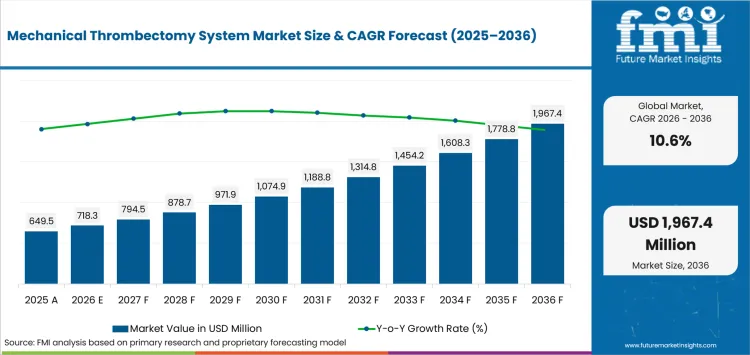
Key Takeaways of Mechanical Thrombectomy System Market
- Demand for mechanical thrombectomy systems is driven by broader stroke pathways and expanding pulmonary embolism use, with procedure volume depending on how quickly health systems can identify eligible clots and move patients into equipped intervention rooms.
- By product type, aspiration thrombectomy systems hold the leading share at 40.2% in 2026, attributable to direct clot ingestion across neurovascular and peripheral procedures through a single platform supporting repeat catheter use across several vessel sizes.
- Ischemic stroke leads the application category at 42.7% share in 2026, driven by established large-vessel occlusion protocols and specialist referral networks that combine immediate brain imaging with neurointerventional coverage and monitored post-procedure recovery.
- Hospitals account for 35.0% end-user share in 2026, owing to their control over emergency imaging, angiography rooms, specialist staffing, and recurring catheter inventories required for urgent clot removal across vascular territories.
- Catheter-based mechanical thrombectomy leads the technology category at 30.4% share in 2026, reinforced by direct access to obstructed vessels through familiar catheter-lab workflows without repeated device exchanges.
- Japan, Germany, and South Korea record CAGRs of 11.5%, 10.1%, and 9.4% respectively through 2036, shaped by population aging, established stroke unit infrastructure, and dense tertiary-care capacity alongside demographic pressure.
- Competition centers on Penumbra, Stryker, Medtronic, and Boston Scientific, with vendors differentiating through aspiration and retrieval platforms spanning multiple vascular territories, catheter compatibility with existing laboratory workflows, and clinical education alongside emergency stock coverage during hospital tender processes.
Analyst Perspective
"The mechanical thrombectomy system market is increasingly evaluated on procedural outcomes rather than device performance alone. Healthcare providers are assessing first-pass success, total procedure efficiency, and anatomical suitability as distinct measures of clinical value. Companies that demonstrate consistent real-world performance, support evidence-based adoption, and align with diverse neurovascular and peripheral treatment pathways will be better positioned to strengthen long-term market acceptance."
- Anurag Sharma, Principal Analyst at Future Market Insights
Source: FMI's proprietary forecasting model and primary research
How is the Mechanical Thrombectomy System Market segmented?
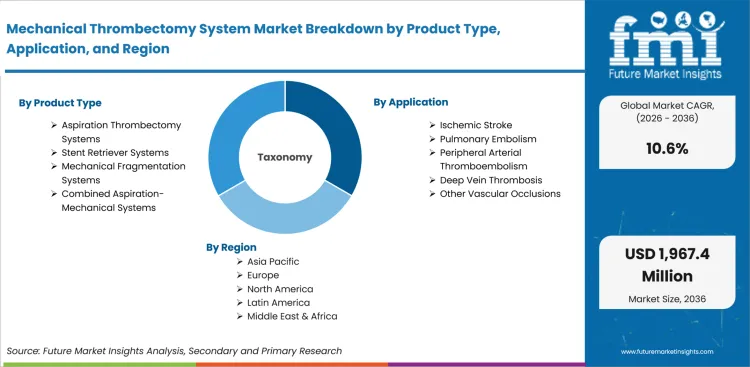
The market is segmented by Product Type, Application, End User, Technology and Region.
The segmentation framework separates device design from the condition being treated and the care setting that controls purchasing. Product Type covers aspiration systems and stent retrievers alongside fragmentation and combined platforms for clot removal. Application analysis distinguishes ischemic stroke from pulmonary embolism, peripheral arterial thromboembolism, deep vein thrombosis and other vascular occlusions. End User analysis compares hospitals with specialist intervention sites that may have different staffing and recovery resources. Technology analysis separates catheter-based removal from vacuum-assisted, wire-based and imaging-guided systems used during endovascular treatment. Each dimension changes the required catheter inventory, training plan, service coverage and purchasing rationale for hospitals.
What supports demand for aspiration thrombectomy systems within the product type category?
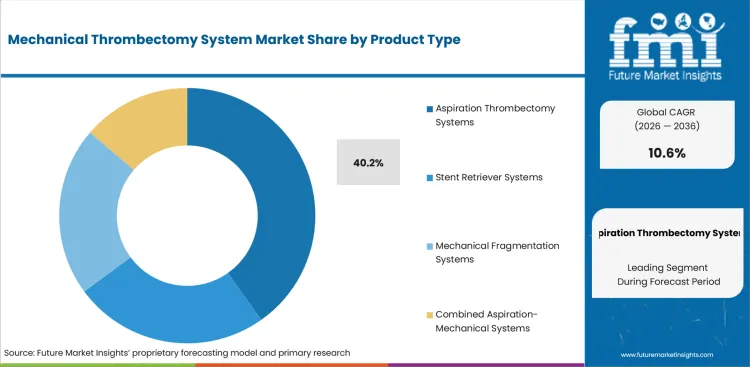
Aspiration systems remove thrombus through controlled suction and can reduce the number of device exchanges during suitable procedures. Penumbra, Inc. reported in August 2025 that interim STRIKE-PE analysis covered 164 pulmonary embolism patients treated with Lightning Flash technology. The evidence gives hospital teams a product-specific basis for judging hemodynamic improvement and workflow use beyond neurovascular care. Related ischemic stroke aspiration systems keep catheter deliverability and stable aspiration response central to product selection across difficult cerebral anatomy.
- By product type, aspiration thrombectomy systems are projected to account for 40.2% share in 2026, attributable to direct clot ingestion across neurovascular and peripheral procedures. A single aspiration platform can support repeat catheter use across several vessel sizes, provided the pump and tubing preserve stable flow during clinical engagement.
- Interventional neurologists and vascular specialists purchase aspiration systems for different clinical and operational reasons during procurement. Neurovascular teams emphasize trackability and atraumatic vessel contact, whereas pulmonary and venous teams place greater weight on clot volume, blood-loss control and cannula size. Platform value therefore depends on whether the system fits the procedure mix at the treating hospital.
How does ischemic stroke shape demand within the application category?
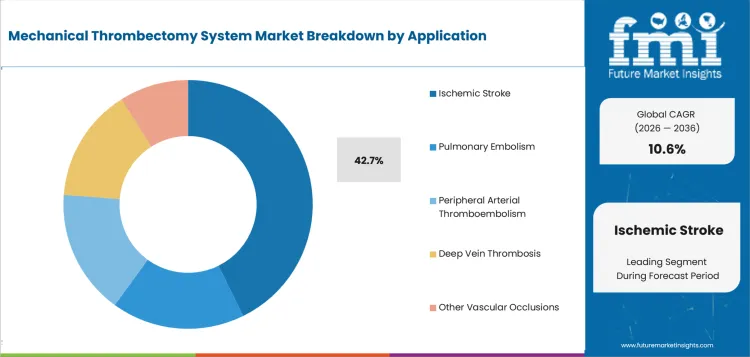
Ischemic stroke remains the application with the clearest emergency pathway for catheter-based clot removal after imaging confirms a treatable obstruction. Penumbra, Inc. announced in June 2026 that THUNDERBOLT received FDA clearance for acute ischemic stroke. The clearance expands computer-assisted aspiration into cerebral use and gives stroke centers another platform to compare with stent retrieval. The clearance connects cerebral aspiration with the wider blood clot retrieval devices category and expands the product comparisons available to stroke centers.
- In 2026, Ischemic Stroke is forecast to represent 42.7% share, led by established large-vessel occlusion protocols and specialist referral networks. Demand is concentrated in hospitals that can combine immediate brain imaging with neurointerventional coverage, anesthesia support and monitored recovery after the procedure, which makes pathway reliability part of the purchasing case.
- Comprehensive stroke centers favor systems that preserve several treatment options during a difficult endovascular case. A catheter may begin with aspiration and then support a stent retriever if clot engagement remains incomplete. Vessel anatomy, thrombus composition and access difficulty can change the treatment plan inside the angiography room. A platform that supports aspiration and retrieval gives the stroke team more options during the case.
What makes hospitals central to the end user category?
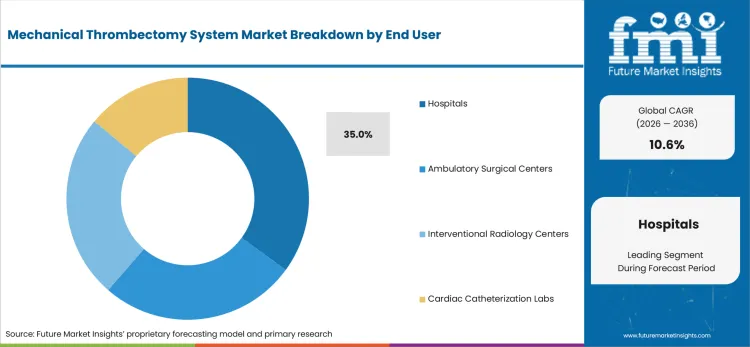
Hospitals control the imaging, intervention room, specialist staffing and critical-care resources needed for urgent clot removal. NHS England reported in December 2025 that thrombectomy rates at participating hospitals using an artificial-intelligence imaging tool doubled from 2.3% to 4.6%. The result shows that procedure capacity depends on the whole treatment pathway rather than device inventory alone. Investment in vascular closure devices can influence the same post-access workflow by shortening recovery steps and standardizing access-site management.
- Based on end user, hospitals are estimated to hold 35.0% share in 2026, supported by emergency imaging and post-procedure monitoring within one care network. The share reflects purchasing control over angiography rooms, specialist coverage and recurring catheter inventories rather than merely the physical location where a physician removes the clot.
- Hospital stroke teams evaluate vendor support beside catheter performance during every product standardization decision process. Training must cover imaging review, device preparation, access management and complication response across several departments. A product that performs well in a trial can still face limited use when the institution lacks round-the-clock staffing or a dependable transfer route from smaller hospitals.
How is catheter-based mechanical thrombectomy positioned within the technology category?
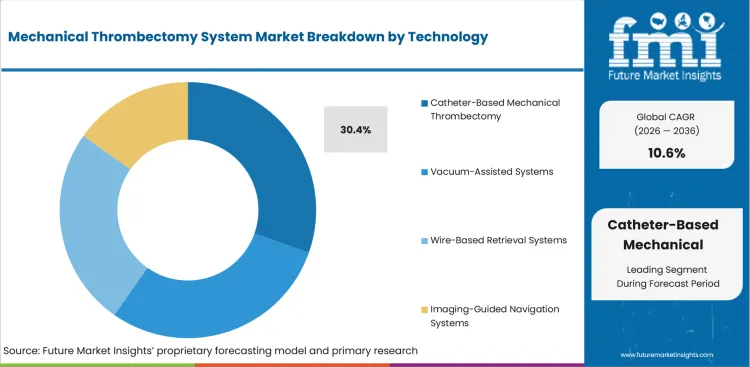
Catheter-based technology reaches the obstruction through a percutaneous access route and supports aspiration, retrieval, or combined clot-removal techniques. The USA Food and Drug Administration recorded clearance for the pRESET Delta and pRESET LITE device family in February 2025 under submission K242676. The FDA decision confirms continuing product activity in catheter-delivered neurovascular retrieval systems for acute ischemic stroke treatment. The clearance activity sits within the broader neurovascular devices field and keeps delivery-system compatibility within the purchasing review.
- The Technology category is forecast to be led by Catheter-Based Mechanical Thrombectomy at 30.4% share in 2026, owing to direct clot access through established endovascular workflows. The technology allows clinicians to choose aspiration, retrieval, or combined action without converting the patient to open surgery during the same treatment episode.
- Neurointerventional and vascular teams compare navigation, lumen size, aspiration response and guide-catheter compatibility before standardizing a system. Imaging quality remains necessary, but the clot-removal device must still reach the target without excessive friction. Technical value is therefore measured across the complete catheter path rather than at the distal tip alone.
What are the drivers, restraints and opportunities in the Mechanical Thrombectomy System Market?
Demand growth is supported by faster referral pathways; clinical uncertainty limits expansion into smaller vessels; pulmonary and peripheral systems create a second commercial route.
- Driver: Faster imaging and referral decisions increase the number of patients who reach an equipped intervention room within the treatment window.
- Restraint: Evidence remains specific to vessel location and patient selection, which limits broad purchasing claims for distal cerebral occlusions.
- Opportunity: Pulmonary embolism and peripheral arterial procedures can diversify revenue beyond the established neurovascular case base.
The continued effort to link clot detection with a defined treatment pathway is anticipated to drive market growth. Penumbra, Inc. launched the STRIDE II clinical study in May 2025 to evaluate computer-assisted vacuum thrombectomy for lower-extremity acute limb ischemia. The program broadens evidence beyond stroke and gives hospitals a clearer basis for protocol development across arterial procedures. Similar workflow investment supports demand for medical imaging software that accelerates image transfer and specialist review.
One of the factors limiting growth is the uneven clinical benefit across vessel sizes and stroke subgroups. The American Heart Association reported in February 2025 that the DISTAL trial enrolled 543 patients and found no meaningful disability benefit from mechanical thrombectomy for selected medium or distal vessel occlusions. Hospital procurement committees therefore need indication-specific evidence before they standardize inventory for smaller cerebral vessels. A catheter that reaches a smaller artery does not automatically justify routine use in that anatomy.
An emerging opportunity is the use of mechanical systems across arterial and venous clot burdens that require rapid flow restoration. Stryker Corporation launched the Artix thrombectomy system in March 2025 for a broad spectrum of arterial thrombus cases. The launch gives vascular specialists another defined approach for arterial clot removal outside stroke care. Commercial success depends on training and clear patient selection, since the wider catheter market contains products with different access and support requirements.
Which country CAGRs are profiled in the Mechanical Thrombectomy System Market?
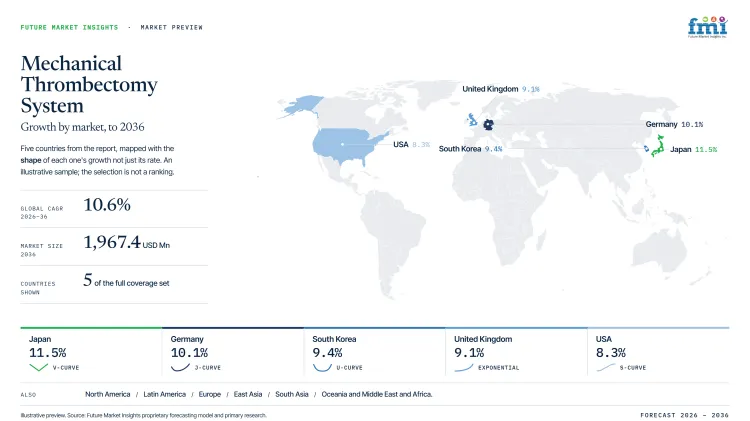
| Country | CAGR |
|---|---|
| USA | 8.3% |
| United Kingdom | 9.1% |
| Germany | 10.1% |
| Japan | 11.5% |
| South Korea | 9.4% |
How do country-level CAGRs compare in the Mechanical Thrombectomy System Market?
The country comparison spans 3.2 percentage points and shows one distinct upper position alongside a compact middle group. Japan sits apart from Germany while the United Kingdom and South Korea remain closely aligned within the central cluster. The United States forms the lower edge of the comparison yet remains close to the two mid-range markets. This pattern suggests measured differences in thrombectomy adoption across stroke centers rather than a sharp division between national markets.
- Japan shows a notable expansion profile as hospitals are expected to widen thrombectomy access across organized stroke-treatment pathways.
- Germany occupies an intermediate position that reflects continued device adoption across established neurovascular centers and connected referral networks.
- South Korea remains closely aligned with the United Kingdom despite differences in hospital concentration and specialist treatment access.
- The United Kingdom shows measured growth as thrombectomy services are anticipated to expand through coordinated stroke networks and regional treatment hubs.
- The United States sits below the central group while its established procedure base supports continued system replacement and technology upgrades.
Markets with similar CAGRs are expected to follow different adoption paths as treatment capacity and referral speed vary. These differences shape device demand through stroke-center coverage and interventional staffing alongside access to advanced imaging. The full report provides country-level CAGR analysis across North America and Latin America as well as Europe and East Asia alongside South Asia and Oceania plus the Middle East and Africa..
- American hospital systems operate a broad mechanical thrombectomy base, but access remains uneven outside major urban referral networks. USA is estimated to post 8.3% CAGR over the forecast period, reinforced by replacement demand and continued expansion of organized stroke transport. The American Heart Association reported in January 2026 that nearly 800,000 people have a stroke in the United States each year. The annual case burden sustains recurring neurovascular inventory, although procedure conversion still depends on imaging and transfer speed across regional networks. Comprehensive stroke centers compare service coverage and catheter availability across several campuses before signing systemwide supply contracts. Procurement favors suppliers that can maintain training and emergency stock without adding inconsistent setup steps.
- National purchasing gives the United Kingdom a clear route for spreading imaging and referral protocols across regional stroke networks. Mechanical thrombectomy demand in the United Kingdom is forecast to rise at 9.1% CAGR between 2026 and 2036, supported by technology-enabled case identification and coordinated transfer. NHS England reported in November 2024 that an e-Stroke deployment processed more than 150,000 cases and detected over 6,500 suspected large-vessel occlusions across more than 35 hospitals. The deployment data connect image analysis with practical referral volume across participating NHS stroke networks. NHS trusts need systems that fit shared protocols across primary stroke centers and tertiary neuroscience hubs. Tender decisions therefore place service continuity and shared training protocols beside the initial device price.
- Germany combines an established stroke-unit network with a large annual burden that sustains demand for emergency neurovascular treatment. The German mechanical thrombectomy system sector is projected to record 10.1% CAGR during the forecast period, driven by structured referrals and specialist hospital coverage. The German Stroke Foundation reported in April 2025 that about 270,000 people experience a stroke in Germany each year. The figure supports continued device use, yet regional access and staffing determine how many patients reach thrombectomy. Certified stroke units and university hospitals remain the main institutional users because they can maintain specialist coverage and emergency angiography access. Suppliers need dependable local inventory and clinical education that can support both high-volume centers and connected referral hospitals.
- Japan requires thrombectomy platforms that fit concentrated specialist centers and a health system managing a large older population. Adoption of mechanical thrombectomy systems in Japan is estimated to expand at 11.5% CAGR through 2036, led by demographic pressure and continuing refinement of stroke treatment guidance. The Statistics Bureau of Japan reported in September 2025 that 36.243 million people were aged 65 or older in 2024, representing 29.3% of the population. Population aging supports long-term procedure demand, but neurointerventional hospitals still need compact inventories and reliable technical support. Manufacturers gain an advantage when catheter sizes, instructions and clinical education align with local practice patterns across concentrated specialist centers.
- South Korea has dense tertiary-care coverage and short travel distances in major cities, which can support rapid transfer into specialist stroke services. Mechanical thrombectomy system sales in South Korea are forecast to expand at 9.4% CAGR by 2036, attributable to demographic aging and hospital concentration. The Ministry of Data and Statistics reported in September 2024 that people aged 65 or older represented 19.2% of the national population. The demographic shift strengthens the clinical need for acute stroke capacity within a hospital system centered on large university institutions. Large university hospitals remain the main procurement centers for neurovascular systems and structured specialist training within the country.
Who are the notable companies in the Mechanical Thrombectomy System Market?
Penumbra, Medtronic, Stryker, Boston Scientific, Johnson & Johnson MedTech, Terumo, AngioDynamics, Edwards Lifesciences, Philips Healthcare and Inari Medical
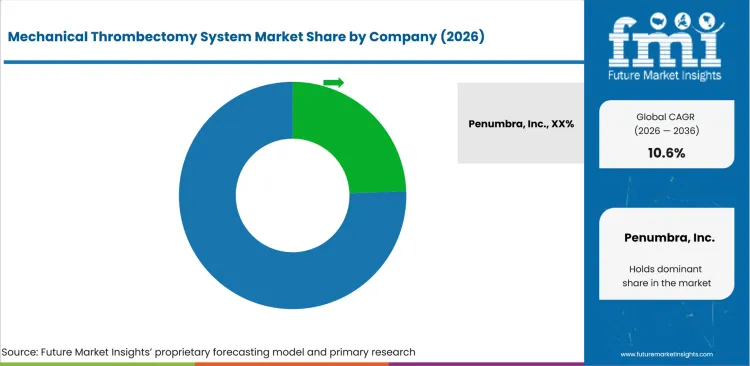
Competition is divided between companies that sell complete thrombectomy platforms and companies with a narrower product position in selected vascular territories. Penumbra, Medtronic, Stryker, Boston Scientific, Johnson & Johnson MedTech, Terumo, AngioDynamics, Edwards Lifesciences, Philips Healthcare and Inari Medical each maintain an active clot-removal product or system. Their commercial roles differ substantially across cerebral treatment and pulmonary, venous, or peripheral intervention pathways. The comparison therefore looks at portfolio fit and support coverage rather than treating every participant as interchangeable within the wider medical devices sector.
- Penumbra and Stryker compete across several thrombectomy territories through established catheter and console portfolios worldwide. Penumbra emphasizes computer-assisted vacuum platforms, while Stryker combines neurovascular retrieval with Inari systems for pulmonary embolism and venous disease. Recurring catheter demand can support broader hospital account relationships for both companies over longer commercial cycles.
- Medtronic and Boston Scientific address peripheral clot removal through the Liberant and AngioJet systems within broader cardiovascular portfolios. Existing hospital relationships across cardiovascular departments can simplify contracting for both product portfolios during formal tenders. Product evaluation still depends on blood-loss control, vessel compatibility and the training burden attached to each platform.
- Johnson & Johnson MedTech and Terumo maintain neurovascular portfolios that support aspiration and retrieval during ischemic stroke procedures. Their commercial position depends on access catheters and compatibility across the full treatment chain and established procedural workflows. Stroke centers compare the complete procedural chain rather than a single clot-retrieval component in isolation.
- AngioDynamics, Philips Healthcare and Edwards Lifesciences serve more focused clot-management needs in selected vascular procedures. AlphaVac targets pulmonary and venous use, QuickClear addresses peripheral arterial and venous thrombus and Fogarty catheters support arterial embolectomy. Commercial reach depends on the exact procedure mix within each hospital system and its regional referral network.
Competitive Benchmarking: Mechanical Thrombectomy System Market
| Company | Neurovascular Portfolio | Peripheral and Venous Portfolio | Aspiration or Mechanical Breadth | Imaging Integration | Geographic Reach |
|---|---|---|---|---|---|
| Penumbra, Inc. | High | High | High | Low | Global |
| Medtronic plc | High | High | High | Low | Global |
| Stryker Corporation | High | High | High | Low | Global |
| Boston Scientific Corporation | Low | High | Medium | Low | Global |
| Johnson & Johnson MedTech | High | Low | Medium | Low | Global |
| Terumo Corporation | High | Low | Medium | Low | Global |
| AngioDynamics, Inc. | Low | High | Medium | Low | USA and selected international markets |
| Edwards Lifesciences Corporation | Low | Medium | Low | Low | Global vascular surgery coverage |
| Philips Healthcare | Low | Medium | Medium | High | Global |
| Inari Medical (Stryker) | Low | High | High | Low | USA and selected international markets |
Key Developments in the Mechanical Thrombectomy System Market
-
On January 26, 2026, Penumbra Inc. launched the Lightning Flash 3.0 computer-assisted vacuum thrombectomy system for pulmonary and venous thrombus removal in the United States. The updated system features an enhanced clot-detection algorithm with increased sensitivity to thrombus and blood, enlarged tubing, and an automated backflush feature for large thrombus burdens. Penumbra reported bench results of 1.3 times faster clot removal and 60% fluid savings versus Lightning Flash 2.0, supported by Level 1 clinical evidence from the STORM-PE randomized controlled trial published in Circulation, which demonstrated superior reduction in right heart strain with CAVT plus anticoagulation over anticoagulation alone. The launch coincided with Boston Scientific's announcement of a definitive agreement to acquire Penumbra in a $14.5 billion cash and stock transaction.
-
On December 10, 2025, Medtronic plc announced the first commercial use of the Liberant thrombectomy system, with the procedure performed by Ajit Rao, MD, at Mount Sinai Hospital in New York on November 21, 2025. Liberant is FDA-cleared for the removal of fresh, soft emboli or thrombi from peripheral arterial and venous vessels, using an ultrasonic sensor and an intelligent algorithm that automatically adjusts pulse rate, which Medtronic reported results in 35% less blood loss compared with alternative devices. The system is also compatible with Contego Medical's Excipio thrombectomy devices, enabling combined aspiration and clot disruption in complex cases. Medtronic described the launch as the first milestone in a broader series of investments in peripheral and venous thrombectomy.
-
In September 2025, Johnson & Johnson MedTech received CE Mark approval for the CEREGLIDE 92 Aspiration System and outlined a phased European rollout, with the milestone highlighted at the ESMINT annual congress in Marseille. The system had previously launched in the United States in February 2025 and features a 0.092-inch inner diameter catheter co-packaged with the INNERGLIDE 9 delivery aid, providing large distal access, flow reduction in the M1, and full catheter visibility under fluoroscopy. CEREGLIDE 92 supports both direct aspiration thrombectomy and combined aspiration with stent retriever approaches for removing emboli and thrombi from the cerebral vasculature, addressing the vessel tortuosity present in approximately 50% of mechanical thrombectomy cases.
-
On June 23, 2025, AngioDynamics Inc. enrolled the first patient in the RECOVER-AV trial, a prospective, multicenter, multinational, single-arm study evaluating the AlphaVac Multipurpose Mechanical Aspiration F1885 System for the treatment of acute intermediate-risk pulmonary embolism. The trial enrolls patients across up to 20 hospital sites in Europe, with follow-up extending to 12 months and outcomes assessed at 30 days and 12 months, including Cardiac MRI and exercise testing for a comprehensive view of long-term recovery. The study builds on the prior APEX-AV trial conducted in the United States and is designed to support global market adoption of the AlphaVac system.
Key Players in the Mechanical Thrombectomy System Market
Neurovascular and Multi-Territory Thrombectomy Suppliers
- Penumbra, Inc.
- Medtronic plc
- Stryker Corporation
- Johnson & Johnson MedTech
- Terumo Corporation
Peripheral, Venous and Focused Clot-Management Suppliers
- Boston Scientific Corporation
- AngioDynamics, Inc.
- Edwards Lifesciences Corporation
- Philips Healthcare
- Inari Medical (Stryker)
Mechanical Thrombectomy System Market - Report Scope
| Coverage field | Report scope |
|---|---|
| Market breakdown | Product Type, Application, End User, Technology and Region. |
| Market Definition | Mechanical thrombectomy systems include catheter-based aspiration, retrieval, fragmentation and combined devices used to remove intravascular thrombus. The scope excludes stand-alone thrombolytic drugs and open surgical instruments without a catheter-based system. |
| Regions Covered | North America, Latin America, Europe, East Asia, South Asia, Oceania and Middle East and Africa. |
| Countries Covered | USA, United Kingdom, Germany, Japan, South Korea and 30+ countries within the regional model. |
| Key Companies Profiled | Penumbra, Inc.; Medtronic plc; Stryker Corporation; Boston Scientific Corporation; Johnson & Johnson MedTech; Terumo Corporation; AngioDynamics, Inc.; Edwards Lifesciences Corporation; Philips Healthcare; Inari Medical (Stryker). |
| Forecast Period | 2026 to 2036. |
| Approach | Hybrid bottom-up and top-down market sizing supported by primary interviews and official desk research. |
Mechanical Thrombectomy System Market - Research Methodology
| Method | Approach |
|---|---|
| Primary Research | FMI analysts gathered input from manufacturers, service providers, technology developers, distributors, end users, procurement teams and subject-matter experts. Interviews examined purchasing decisions, product or service evaluation, adoption barriers, approval requirements, pricing considerations and expectations for technical or commercial support. Respondents were also asked what evidence is required before a trial, pilot, or initial order develops into regular purchasing. |
| Desk Research | Desk research covered government statistics, regulatory publications, trade data, industry associations, technical literature, standards, company filings, product information and official corporate announcements. Sources were reviewed for relevance, publication date, geographic coverage and consistency with the defined market scope. Claims relating to performance, applications, approvals, capacity, investment and commercial activity were retained only when supported by credible public evidence. |
| Market Sizing and Forecasting | The market model combined the baseline value with historical performance, segment structure, pricing and volume indicators, adoption levels, company participation and country-level demand conditions. Forecast assumptions considered economic activity, investment trends, regulatory developments, technology adoption, purchasing cycles, supply availability and barriers to wider market use. Segment and regional estimates were reconciled before the final market total was calculated. |
| Data Validation | Estimates were checked against multiple independent indicators, including public data, company activity, trade patterns, industry developments and findings from primary interviews. Validation also tested whether products, services, applications and company revenues fell within the defined market boundaries. Adjacent categories, unsupported claims, overlapping revenues and activities without direct market relevance were excluded to reduce double counting and maintain consistency across segments and countries. |
Mechanical Thrombectomy System Market by Segments
By Product Type
- Aspiration Thrombectomy Systems
- Stent Retriever Systems
- Mechanical Fragmentation Systems
- Combined Aspiration-Mechanical Systems
By Application
- Ischemic Stroke
- Pulmonary Embolism
- Peripheral Arterial Thromboembolism
- Deep Vein Thrombosis
- Other Vascular Occlusions
By End User
- Hospitals
- Ambulatory Surgical Centers
- Interventional Radiology Centers
- Cardiac Catheterization Labs
By Technology
- Catheter-Based Mechanical Thrombectomy
- Vacuum-Assisted Systems
- Wire-Based Retrieval Systems
- Imaging-Guided Navigation Systems
Mechanical Thrombectomy System Market by Region:
- North America
- USA
- Canada
- Latin America
- Brazil
- Mexico
- Rest of Latin America
- Europe
- United Kingdom
- Germany
- France
- Italy
- Spain
- Rest of Europe
- East Asia
- Japan
- South Korea
- China
- South Asia
- India
- ASEAN countries
- Rest of South Asia
- Oceania
- Australia
- New Zealand
- Middle East and Africa
- GCC countries
- South Africa
- Türkiye
- Rest of Middle East and Africa
Research Sources and Bibliography
- World Health Organization. (2025, December 19). Stroke.
- Stryker Corporation. (2025, January 6). Stryker announces definitive agreement to acquire Inari Medical, Inc., providing entry into high-growth peripheral vascular segment.
- Penumbra, Inc. (2025, August 27). Interim STRIKE-PE data shows CAVT with Lightning Flash improve clinical and functional outcomes.
- Penumbra, Inc. (2026, June 11). Penumbra’s THUNDERBOLT receives FDA clearance: Bringing computer assisted vacuum thrombectomy technology to stroke.
- NHS England. (2025, December 2). Life-changing AI support helping stroke patients get a second chance.
- USA Food and Drug Administration. (2025, February). 510(k) Premarket Notification K242676.
- Penumbra, Inc. (2025, May 7). Penumbra launches STRIDE II clinical study to further evaluate Penumbra’s CAVT technology for lower-extremity acute limb ischemia.
- American Heart Association. (2025, February 5). Clot-buster meds and mechanical retrieval equally reduce disability from some strokes.
- Stryker Corporation. (2025, March 6). Inari Medical, now part of Stryker, launches Artix Thrombectomy System.
- American Heart Association. (2026, January 26). New guideline expands stroke treatment for adults, offers first pediatric stroke guidance.
- NHS England. (2024, November 29). The Innovation Ecosystem Programme: How the UK can lead the way globally in health gains and life sciences powered growth.
- German Stroke Foundation. (2025, April 25). Viele kennen ihr Risiko nicht.
- Statistics Bureau of Japan. (2025, September). Statistical Handbook of Japan 2025.
- Ministry of Data and Statistics, Republic of Korea. (2024, September 26). 2024 고령자 통계 [2024 Statistics on the Aged].
- Penumbra, Inc. (2026, January 26). Penumbra launches Lightning Flash 3.0: The next evolution in CAVT technology.
- Medtronic plc. (2025, December 10). Medtronic announces successful early commercial use of Liberant thrombectomy system.
- Johnson & Johnson MedTech. (2025, September 4). Johnson & Johnson advances neurovascular innovation at ESMINT 2025.
- AngioDynamics, Inc. (2025, June 23). AngioDynamics announces first patient enrolled in RECOVER-AV clinical trial evaluating AlphaVac F18 85 System for treatment of acute pulmonary embolism.
- Boston Scientific Corporation. (n.d.). AngioJet Peripheral Thrombectomy System.
- Edwards Lifesciences Corporation. (n.d.). Clot management.
- Philips Healthcare. (2020, September 24). Philips expands peripheral vascular disease portfolio with the QuickClear mechanical thrombectomy system for blood clot removal.
- Terumo Neuro. (2025, February 5). Terumo Neuro showcases fully integrated, comprehensive stroke portfolio at the International Stroke Conference.
This bibliography is provided for reader reference and is not exhaustive. The full report contains the complete reference list and detailed citations
This Report Answers
- How large is the mechanical thrombectomy system market in 2026 and 2036?
- Which clinical and operational factors support the 10.6% CAGR from 2026 to 2036?
- Why do aspiration thrombectomy systems account for 40.2% share in 2026?
- How does ischemic stroke shape application demand and hospital workflow?
- Why do hospitals hold 35.0% of end-user demand in 2026?
- How do country CAGRs compare across the USA, United Kingdom, Germany, Japan and South Korea?
- Which companies supply neurovascular, pulmonary, venous and peripheral thrombectomy systems?
- What limits expansion into medium and distal cerebral vessels?
- How can pulmonary embolism and peripheral applications diversify supplier revenue?
- Which product capabilities should hospital teams compare during procurement?
Frequently Asked Questions
How big is the Mechanical Thrombectomy System Market in 2026?
The mechanical thrombectomy system market is valued at USD 718.3 million in 2026 and is forecast to reach USD 1967.4 million by 2036. Growth reflects expanding stroke intervention pathways, greater adoption in pulmonary embolism treatment, and wider access to catheter-based clot removal procedures.
What is the CAGR of the Mechanical Thrombectomy System Market from 2026 to 2036?
The mechanical thrombectomy system market is projected to grow at a CAGR of 10.6% between 2026 and 2036, supported by faster stroke diagnosis, expanding catheter-based intervention, and increasing treatment of pulmonary and peripheral thrombotic conditions.
Which product type leads the Mechanical Thrombectomy System Market?
Aspiration thrombectomy systems account for 40.2% of the mechanical thrombectomy system market by product type in 2026, reflecting their ability to provide direct clot aspiration across neurovascular, pulmonary, and peripheral vascular procedures using a single platform.
How much will the Mechanical Thrombectomy System Market add between 2026 and 2036?
The mechanical thrombectomy system market is set to add USD 1,249.1 million between 2026 and 2036, growing from USD 718.3 million to USD 1967.4 million as hospitals expand emergency stroke treatment capacity, catheter-based thrombectomy adoption, and pulmonary embolism intervention services.
Who are the leading companies in the Mechanical Thrombectomy System Market?
Leading companies in the mechanical thrombectomy system market include Penumbra, Inc., Medtronic plc, Stryker Corporation, Boston Scientific Corporation, Johnson & Johnson MedTech, Terumo Corporation, AngioDynamics, Inc., Edwards Lifesciences Corporation, Philips Healthcare, and Inari Medical (Stryker), competing across neurovascular, pulmonary, venous, and peripheral thrombectomy systems.
Preview the report firsthand - request a free sample
Get SampleGet the brochure for pricing and purchase details.
Get PDFTable of Content
- Key Takeaways
- Market Size and CAGR
- Top Growth Driver
- Fastest Growing Segment
- Leading Region
- Key Companies
- Emerging Opportunities
- Executive Summary
- Global Market Outlook
- Demand-side Trends
- Supply-side Trends
- Technology Roadmap Analysis
- Analysis and Recommendations
- Analyst Perspective (What is happening? Why now? What should investors know?)
- Key Questions Answered
- How large is the market?
- What is the CAGR?
- What are key trends?
- Which region dominates?
- Who are the leaders?
- Market Overview
- Market Coverage / Taxonomy
- Market Definition / Scope / Limitations
- Research Methodology
- Chapter Orientation
- Analytical Lens and Working Hypotheses
- Market Structure, Signals, and Trend Drivers
- Benchmarking and Cross-market Comparability
- Market Sizing, Forecasting, and Opportunity Mapping
- Research Design and Evidence Framework
- Desk Research Programme (Secondary Evidence)
- Expert Input and Fieldwork (Primary Evidence)
- Tooling, Models, and Reference Databases
- Data Engineering and Model Build
- Quality Assurance and Audit Trail
- Market Background
- Market Dynamics (Drivers, Restraints, Opportunity, Trends)
- Scenario Forecast (Optimistic, Likely, Conservative)
- Impact Analysis
- AI Impact
- Sustainability Impact
- Regulatory Impact
- Technology Impact
- Consumer / Buyer Analysis
- Purchase Drivers
- Adoption Barriers
- Buyer Journey
- Opportunity Map Analysis
- Product Life Cycle Analysis
- Supply Chain Analysis
- Investment Feasibility Matrix
- Value Chain Analysis
- PESTLE and Porter's Analysis
- Regulatory Landscape
- Regional Parent Market Outlook
- Production and Consumption Statistics
- Import and Export Statistics
- Global Market Analysis and Forecast, 2021 to 2036
- Historical Market Size Value (USD Million) Analysis, 2021 to 2025
- Current and Future Market Size Value (USD Million) Projections, 2026 to 2036
- Y-o-Y Growth Trend Analysis
- Absolute $ Opportunity Analysis
- Global Market Pricing Analysis, 2021 to 2036
- Global Market Analysis and Forecast, By Product Type, 2021 to 2036
- Introduction / Key Findings
- Historical Market Size Value (USD Million) Analysis By Product Type, 2021 to 2025
- Current and Future Market Size Value (USD Million) Analysis and Forecast By Product Type, 2026 to 2036
- Aspiration Thrombectomy Systems
- Stent Retriever Systems
- Mechanical Fragmentation Systems
- Combined Aspiration-Mechanical Systems
- Aspiration Thrombectomy Systems
- Y-o-Y Growth Trend Analysis By Product Type, 2021 to 2025
- Absolute $ Opportunity Analysis By Product Type, 2026 to 2036
- Global Market Analysis and Forecast, By Application, 2021 to 2036
- Introduction / Key Findings
- Historical Market Size Value (USD Million) Analysis By Application, 2021 to 2025
- Current and Future Market Size Value (USD Million) Analysis and Forecast By Application, 2026 to 2036
- Ischemic Stroke
- Pulmonary Embolism
- Peripheral Arterial Thromboembolism
- Deep Vein Thrombosis
- Other Vascular Occlusions
- Ischemic Stroke
- Y-o-Y Growth Trend Analysis By Application, 2021 to 2025
- Absolute $ Opportunity Analysis By Application, 2026 to 2036
- Global Market Analysis and Forecast, By End User, 2021 to 2036
- Introduction / Key Findings
- Historical Market Size Value (USD Million) Analysis By End User, 2021 to 2025
- Current and Future Market Size Value (USD Million) Analysis and Forecast By End User, 2026 to 2036
- Hospitals
- Ambulatory Surgical Centers
- Interventional Radiology Centers
- Cardiac Catheterization Labs
- Hospitals
- Y-o-Y Growth Trend Analysis By End User, 2021 to 2025
- Absolute $ Opportunity Analysis By End User, 2026 to 2036
- Global Market Analysis and Forecast, By Technology, 2021 to 2036
- Introduction / Key Findings
- Historical Market Size Value (USD Million) Analysis By Technology, 2021 to 2025
- Current and Future Market Size Value (USD Million) Analysis and Forecast By Technology, 2026 to 2036
- Catheter-Based Mechanical Thrombectomy
- Vacuum-Assisted Systems
- Wire-Based Retrieval Systems
- Imaging-Guided Navigation Systems
- Catheter-Based Mechanical Thrombectomy
- Y-o-Y Growth Trend Analysis By Technology, 2021 to 2025
- Absolute $ Opportunity Analysis By Technology, 2026 to 2036
- Global Market Analysis and Forecast, By Region, 2021 to 2036
- Introduction
- Historical Market Size Value (USD Million) Analysis By Region, 2021 to 2025
- Current Market Size Value (USD Million) Analysis and Forecast By Region, 2026 to 2036
- North America
- Latin America
- Western Europe
- Eastern Europe
- East Asia
- South Asia and Pacific
- Middle East & Africa
- Market Attractiveness Analysis By Region
- North America Market Analysis and Forecast, By Country, 2021 to 2036
- Historical Market Size Value (USD Million) Trend Analysis By Market Taxonomy, 2021 to 2025
- Market Size Value (USD Million) Forecast By Market Taxonomy, 2026 to 2036
- By Country
- USA
- Canada
- By Product Type
- By Application
- By End User
- By Technology
- By Country
- Market Attractiveness Analysis
- By Country
- By Product Type
- By Application
- By End User
- By Technology
- Key Takeaways
- Latin America Market Analysis and Forecast, By Country
- Historical Market Size Value (USD Million) Trend Analysis By Market Taxonomy, 2021 to 2025
- Market Size Value (USD Million) Forecast By Market Taxonomy, 2026 to 2036
- By Country
- Brazil
- Mexico
- Chile
- Rest of Latin America
- By Product Type
- By Application
- By End User
- By Technology
- By Country
- Market Attractiveness Analysis
- By Country
- By Product Type
- By Application
- By End User
- By Technology
- Key Takeaways
- Western Europe Market Analysis and Forecast, By Country
- Historical Market Size Value (USD Million) Trend Analysis By Market Taxonomy, 2021 to 2025
- Market Size Value (USD Million) Forecast By Market Taxonomy, 2026 to 2036
- By Country
- Germany
- UK
- Italy
- Spain
- France
- Nordic
- BENELUX
- Rest of Western Europe
- By Product Type
- By Application
- By End User
- By Technology
- By Country
- Market Attractiveness Analysis
- By Country
- By Product Type
- By Application
- By End User
- By Technology
- Key Takeaways
- Eastern Europe Market Analysis and Forecast, By Country
- Historical Market Size Value (USD Million) Trend Analysis By Market Taxonomy, 2021 to 2025
- Market Size Value (USD Million) Forecast By Market Taxonomy, 2026 to 2036
- By Country
- Russia
- Poland
- Hungary
- Balkan & Baltic
- Rest of Eastern Europe
- By Product Type
- By Application
- By End User
- By Technology
- By Country
- Market Attractiveness Analysis
- By Country
- By Product Type
- By Application
- By End User
- By Technology
- Key Takeaways
- East Asia Market Analysis and Forecast, By Country
- Historical Market Size Value (USD Million) Trend Analysis By Market Taxonomy, 2021 to 2025
- Market Size Value (USD Million) Forecast By Market Taxonomy, 2026 to 2036
- By Country
- China
- Japan
- South Korea
- By Product Type
- By Application
- By End User
- By Technology
- By Country
- Market Attractiveness Analysis
- By Country
- By Product Type
- By Application
- By End User
- By Technology
- Key Takeaways
- South Asia and Pacific Market Analysis and Forecast, By Country
- Historical Market Size Value (USD Million) Trend Analysis By Market Taxonomy, 2021 to 2025
- Market Size Value (USD Million) Forecast By Market Taxonomy, 2026 to 2036
- By Country
- India
- ASEAN
- Australia & New Zealand
- Rest of South Asia and Pacific
- By Product Type
- By Application
- By End User
- By Technology
- By Country
- Market Attractiveness Analysis
- By Country
- By Product Type
- By Application
- By End User
- By Technology
- Key Takeaways
- Middle East & Africa Market Analysis and Forecast, By Country
- Historical Market Size Value (USD Million) Trend Analysis By Market Taxonomy, 2021 to 2025
- Market Size Value (USD Million) Forecast By Market Taxonomy, 2026 to 2036
- By Country
- Kingdom of Saudi Arabia
- Other GCC Countries
- Türkiye
- South Africa
- Other African Union
- Rest of Middle East & Africa
- By Product Type
- By Application
- By End User
- By Technology
- By Country
- Market Attractiveness Analysis
- By Country
- By Product Type
- By Application
- By End User
- By Technology
- Key Takeaways
- Key Countries Market Analysis
- USA
- Pricing Analysis
- Market Share Analysis, 2025
- By Product Type
- By Application
- By End User
- By Technology
- Canada
- Pricing Analysis
- Market Share Analysis, 2025
- By Product Type
- By Application
- By End User
- By Technology
- Mexico
- Pricing Analysis
- Market Share Analysis, 2025
- By Product Type
- By Application
- By End User
- By Technology
- Brazil
- Pricing Analysis
- Market Share Analysis, 2025
- By Product Type
- By Application
- By End User
- By Technology
- Chile
- Pricing Analysis
- Market Share Analysis, 2025
- By Product Type
- By Application
- By End User
- By Technology
- Germany
- Pricing Analysis
- Market Share Analysis, 2025
- By Product Type
- By Application
- By End User
- By Technology
- UK
- Pricing Analysis
- Market Share Analysis, 2025
- By Product Type
- By Application
- By End User
- By Technology
- Italy
- Pricing Analysis
- Market Share Analysis, 2025
- By Product Type
- By Application
- By End User
- By Technology
- Spain
- Pricing Analysis
- Market Share Analysis, 2025
- By Product Type
- By Application
- By End User
- By Technology
- France
- Pricing Analysis
- Market Share Analysis, 2025
- By Product Type
- By Application
- By End User
- By Technology
- India
- Pricing Analysis
- Market Share Analysis, 2025
- By Product Type
- By Application
- By End User
- By Technology
- ASEAN
- Pricing Analysis
- Market Share Analysis, 2025
- By Product Type
- By Application
- By End User
- By Technology
- Australia & New Zealand
- Pricing Analysis
- Market Share Analysis, 2025
- By Product Type
- By Application
- By End User
- By Technology
- China
- Pricing Analysis
- Market Share Analysis, 2025
- By Product Type
- By Application
- By End User
- By Technology
- Japan
- Pricing Analysis
- Market Share Analysis, 2025
- By Product Type
- By Application
- By End User
- By Technology
- South Korea
- Pricing Analysis
- Market Share Analysis, 2025
- By Product Type
- By Application
- By End User
- By Technology
- Russia
- Pricing Analysis
- Market Share Analysis, 2025
- By Product Type
- By Application
- By End User
- By Technology
- Poland
- Pricing Analysis
- Market Share Analysis, 2025
- By Product Type
- By Application
- By End User
- By Technology
- Hungary
- Pricing Analysis
- Market Share Analysis, 2025
- By Product Type
- By Application
- By End User
- By Technology
- Kingdom of Saudi Arabia
- Pricing Analysis
- Market Share Analysis, 2025
- By Product Type
- By Application
- By End User
- By Technology
- Türkiye
- Pricing Analysis
- Market Share Analysis, 2025
- By Product Type
- By Application
- By End User
- By Technology
- South Africa
- Pricing Analysis
- Market Share Analysis, 2025
- By Product Type
- By Application
- By End User
- By Technology
- USA
- Market Structure Analysis
- Competition Dashboard
- Competition Benchmarking
- Market Share Analysis of Top Players
- By Regional
- By Product Type
- By Application
- By End User
- By Technology
- Emerging Startups
- Innovation Benchmarking
- Competition Analysis
- Competition Deep Dive
- Penumbra, Inc.
- Overview
- Product Portfolio
- Profitability by Market Segments
- Sales Footprint
- Strategy Overview
- Marketing Strategy
- Product Strategy
- Channel Strategy
- Medtronic plc
- Stryker Corporation
- Boston Scientific Corporation
- Johnson & Johnson MedTech
- Terumo Corporation
- AngioDynamics, Inc.
- Edwards Lifesciences Corporation
- Philips Healthcare
- Inari Medical (Stryker)
- Penumbra, Inc.
- Case Studies
- Success Stories
- Recent Developments
- Competition Deep Dive
- Assumptions & Acronyms Used


