

- Industry Size (2026)
- USD 1.9 Bn
- Forecast (2036)
- USD 3.8 Bn
- CAGR (2026 to 2036)
- 6.8%
Enzyme Activity Assays Market Forecast and Outlook 2026 to 2036
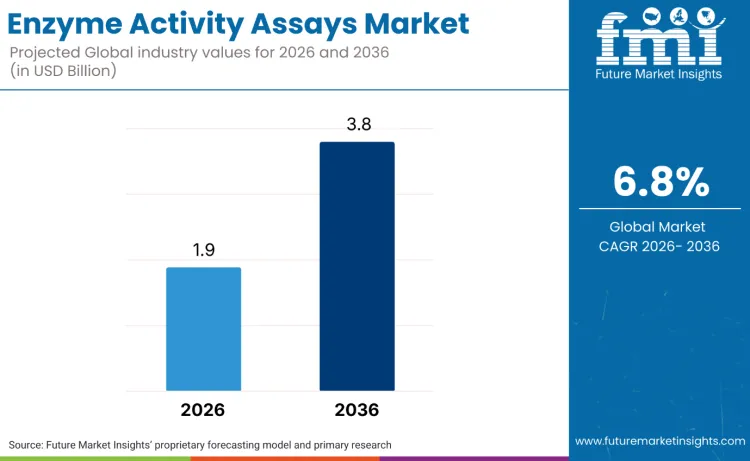
The global enzyme activity assays market is forecasted to reach USD 1.9 billion in 2026 and expand to USD 3.8 billion by 2036, advancing at a CAGR of 6.8%. As per FMI, this outlook shows a transformation in pharmaceutical development toward precision medicine approaches, where traditional screening methods are transitioning toward high-throughput, targeted assay platforms. For instance, in March 2023, Pfizer Inc. unveiled to acquire Seagen Inc., a biotechnology giant to broaden its breast cancer, genitourinary cancer, hematology and precision medicine portfolio. Expansion is driven by the rising complexity of drug discovery pipelines, driven by biologics developers and precision medicine companies embracing target-specific enzyme analysis across research institutions globally.
Technological advances toward advanced screening platforms are increasing exposure to high-throughput enzyme characterization and kinetic studies, while evolving pharmaceutical development protocols and regulatory requirements are introducing more stringent enzyme validation procedures. These forces are elevating demand for sophisticated assay products, pushing biotechnology companies and research institutions to develop comprehensive enzyme profiling capabilities earlier in the drug development cycle. Laboratory suppliers and research organizations increasingly view enzyme activity assay portfolios as core revenue drivers rather than specialized offerings. Precision detection technologies are also gaining wide traction.
"Over the past decade we’ve taken bold new approaches to translating scientific research into effective medicines for people living with cancer, and we have pioneered several breakthroughs in breast cancer, genitourinary cancer, hematological malignancies and precision medicine," - Chris Boshoff, Chief Development Officer Oncology and Rare Disease, Pfizer.
As per FMI’s opinion, the industry's value proposition is shifting from volume-based commodity sales toward precision-focused analytical positioning. Advanced assay manufacturers are integrating comprehensive detection techniques, streamlined workflow systems, and flexible platform designs to reduce assay standardization challenges while improving target specificity. In 2025, Revvity, Inc. launched pHSense™ reagent technology to accelerate next-generation targeted therapeutics. Research-positioned brands and specialized assay developers are gaining preference, enabling direct laboratory partnerships and customized assay development across pharmaceutical and academic research channels.
Summary of the Enzyme Activity Assays Market
What Is the Growth Outlook on the Enzyme Activity Assays Market as per Future Market Insights Projection?
Future Market Insights projects the enzyme activity assays market to grow at a CAGR of 6.8% from 2026 to 2036, expanding from USD 1.9 billion in 2026 to USD 3.8 billion by 2036.
FMI research approach:
- FMI proprietary bottom-up forecasting model by product type and end user
- Revenue normalization across pharma, biotech, academic, and diagnostic laboratories
- Assay adoption mapping aligned with biologics and precision medicine pipelines
- Validation against historical growth in analytical and life science tools markets
How Do FMI Analysts Perceive the Enzyme Activity Assays Market to Evolve?
FMI analysts perceive the market evolving from batch-based, manual enzyme testing toward automated, high-throughput, and precision-positioned analytical platforms integrated earlier in drug discovery and biologics development workflows.
FMI research approach:
- Rising integration of AI and machine learning into enzyme characterization
- Shift from commodity assay kits toward target-specific analytical systems
- Earlier deployment of enzyme profiling in preclinical and discovery stages
- Growing preference for workflow-integrated and customizable assay platforms
Which Country Holds the Largest Share in the Global Enzyme Activity Assays Market?
The United States is expected to hold the largest share of the global enzyme activity assays market by value.
FMI research approach:
- FMI country-level revenue modeling across pharma, biotech, and CRO demand
- High penetration of biologics R&D and high-throughput screening infrastructure
- Strong adoption of precision medicine and advanced analytical platforms
- Concentration of leading assay manufacturers and research institutions
How Large Will the Enzyme Activity Assays Market Be by 2036?
The global enzyme activity assays market is projected to reach USD 3.8 billion by 2036.
FMI research approach:
- Long-term FMI revenue projections by assay type and application
- Scaling assumptions for high-throughput screening and kinetic analysis tools
- Explicit exclusion of non-analytical enzyme products and therapeutic enzymes
- Cross-validation with growth trends in life science instrumentation markets
How Does Future Market Insights Define the Enzyme Activity Assays Market?
The enzyme activity assays market comprises commercially deployed analytical platforms, kits, and reagents used to measure enzyme kinetics, activity levels, and mechanistic behavior across research, diagnostic, and pharmaceutical development settings.
FMI research approach:
- FMI market taxonomy and inclusion-exclusion framework
- Product scope validation across microplate-based, fluorometric, and specialized assays
- Application mapping across discovery research, bioprocess QC, and diagnostics
- Exclusion of enzyme preparations, therapies, and non-analytical tools
What Are the Globally Unique Trends Shaping the Enzyme Activity Assays Market?
Globally unique trends include AI-enabled enzyme characterization, automation-driven high-throughput screening, and the emergence of decentralized and point-of-care enzymatic diagnostics.
FMI research approach:
- Integration of AI-driven predictive enzymology and digital modeling
- Expansion of high-throughput and miniaturized assay formats
- Growing focus on ambient-stable reagents and cold-chain reduction
- Increasing alignment with green chemistry and sustainable manufacturing goals
Enzyme Activity Assays Market Key Takeaways
| Metric | Value |
|---|---|
| Market Value (2026) | USD 1.9 billion |
| Market Forecast Value (2036) | USD 3.8 billion |
| Forecast CAGR (2026-2036) | 6.8% |
Source: Future Market Insights (FMI) historical analysis and forecast data.
Which Factors Propel Adoption of Enzyme Activity Assays?
The combination of precision medicine mandates, digital modeling, and decentralized testing requirements is expected to accelerate adoption of advanced enzyme activity assays. Regulatory and R&D standardization pressures will increasingly favor high-throughput, target-specific platforms that integrate with digital twin models to simulate enzyme behavior prior to physical validation. FMI analysts anticipate that this shift will push pharmaceutical and biotech developers toward AI-enabled assay systems capable of supporting predictive enzymology and faster decision cycles. Danaher Life Sciences explicitly supports AI/ML tools in life sciences applications, including advanced analytical insights and automated data processing. Adoption is also expected to extend beyond centralized laboratories, as demand rises for point-of-care diagnostics using miniaturized and stabilized enzyme assays. This trajectory is likely to be reinforced by ongoing assay innovation and workflow automation, positioning enzyme activity assays as foundational infrastructure across discovery, bioprocessing, and decentralized clinical testing.
How is the Enzyme Activity Assays Market Segmented?
The enzyme activity assays market has been segment based on product type, application, end user, and region. In terms of product type, the market is divided into microplate-based enzyme assay kits, fluorometric activity assay kits, colorimetric activity assay kits, luminescent activity assay kits, radiometric/specialized assays, and custom assay development. By application, the market is divided into high-throughput screening, enzyme kinetics studies, bioprocess QC, clinical research, and academic research. By end user, the market is segmented into pharma & biotech, CROs, academic labs, diagnostic labs, and industrial biotech. Regionally, the market is divided into North America, Europe, Asia Pacific, Latin America, and Middle East & Africa.
Why Do Microplate-based Enzyme Assay Kits Dominate the Enzyme Activity Assays Market?
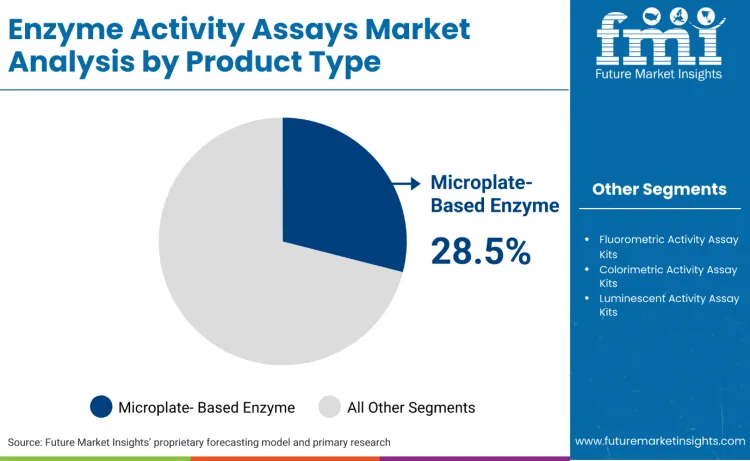
Microplate-based enzyme assay kits continue to lead the market, accounting for 28.5% of the share, driven by their widespread use in high-throughput screening, automated workflows, and standardized research applications. This product type offers the efficiency needed for large-scale experiments and high-volume sample processing, making it ideal for academic, pharmaceutical, and industrial laboratories. Fluorometric activity assay kits capture 22.0% of the market, supporting highly sensitive detection and real-time monitoring, particularly in kinetic analysis applications. Their precision is critical for experiments where subtle changes in enzyme activity need to be tracked. Colorimetric activity assay kits, holding 18.0% of the market, remain a popular choice for routine analysis, offering cost-effective solutions for visual detection where high sensitivity is not a critical requirement. Thermo Fisher Scientific offers enzyme activity assays designed for microplate formats, including fluorescent and colorimetric enzyme activity kits compatible with high-throughput plate readers.
How Do Application Requirements Influence Enzyme Activity Assays Selection?
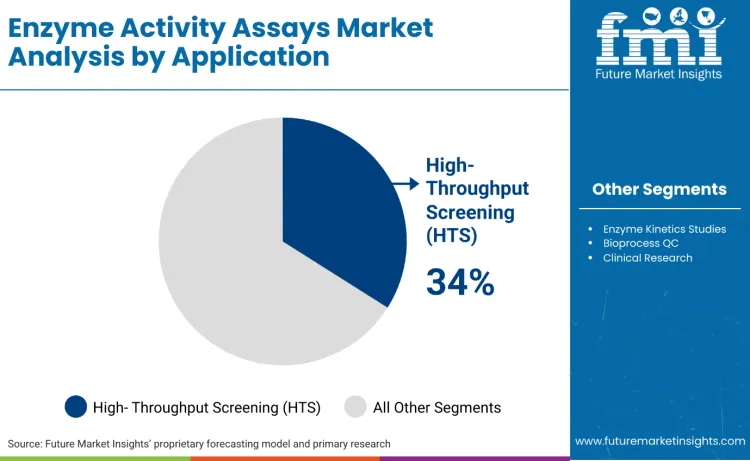
High-throughput screening (HTS) stands as the dominant segment, commanding 34.0% of the market share. By automating the evaluation of vast chemical libraries, HTS allows researchers to bypass the traditional trial-and-error approach that once bottlenecked drug development. This methodology is preferred because it maximizes the probability of identifying unique bioactive "hits" across a diverse range of targets, even when the underlying structure of a protein is not yet fully understood. By accelerating the transition from target identification to lead optimization, HTS significantly shortens the overall research lifecycle and allows organizations to allocate their capital toward only the most promising candidates. Bio-Rad highlights high-throughput screening as a central part of drug discovery and automated testing of large libraries for biological activity, which aligns with its role in screening platforms used in research and discovery.
Beyond mere speed, the preference for HTS is rooted in radical operational efficiency and the creation of high-value data assets. Through extreme miniaturization and the use of sensitive microplate technologies, HTS minimizes the consumption of expensive reagents and rare enzyme samples, transforming the economics of the lab. This scalable approach produces massive, standardized datasets that are essential for training the predictive models and artificial intelligence platforms that will define the next decade of biotechnology. Consequently, HTS serves as both a physical screening tool and a digital foundation, enabling firms to build a more resilient and data-driven research pipeline.
How Is Regulatory and Method Standardization Raising Entry Barriers in Enzyme Activity Assays?
Analytical standardization in pharmaceutical development is moving enzyme activity assays from optional research tools to regulated validation assets. As regulatory bodies and internal QA frameworks increasingly demand reproducible, auditable enzyme kinetics data across preclinical and bioprocess stages, assay providers are required to demonstrate lifecycle consistency, data traceability, and platform interoperability. This shift favors suppliers with validated detection chemistries, automation-ready formats, and long-term performance documentation. FMI observes that smaller assay vendors without standardized validation frameworks are finding it harder to qualify for pharma-scale procurement, raising structural entry barriers and reinforcing concentration around established analytical platform providers.
How Is the Transition from Commodity Kits to Precision Analytical Infrastructure Unfolding?
The enzyme activity assays market is undergoing a repositioning from batch-based reagent supply toward precision analytical infrastructure embedded early in drug discovery workflows. Pharma and biotech developers are increasingly integrating high-throughput and target-specific enzyme assays into decision-making pipelines, using them to support kinetic modeling, mechanism validation, and predictive enzymology. Investments in advanced reagent technologies, such as Revvity’s pHSense™ platform, illustrate how assay innovation is aligning with biologics-driven R&D complexity. This evolution is transforming enzyme assays into foundational data-generation systems rather than auxiliary laboratory consumables, strengthening their role in precision medicine development.
What Impact Is Portfolio Realignment Having on Competitive Agility?
Large life science groups are reshaping assay portfolios to improve speed, specialization, and integration with digital research ecosystems. Strategic moves such as Pfizer’s precision oncology expansion show rising internal demand for scalable, high-fidelity enzyme characterization tools that can support complex biologics pipelines. FMI notes that suppliers capable of aligning assay development with AI-enabled modeling, automation, and customized workflows are gaining disproportionate competitive advantage. As analytical requirements intensify, the market is shifting toward a landscape where agility is driven by platform depth and software compatibility rather than breadth of low-cost kit offerings.
How Is the Enzyme Activity Assays Market Evolving Globally?
Global demand for enzyme activity assay products is increasing as researchers expand analytical capabilities while addressing precision detection, kinetic characterization, and mechanism validation application requirements. Growth demonstrates rising use of automated analytical platforms, target-specific assay positioning, and sensitivity-optimized detection specifications across pharmaceutical institutions, specialized research facilities, and precision medicine development. Product selection focuses on detection sensitivity, analytical throughput, and platform performance under various research scenarios. China records 14.7% CAGR, India records 13.1% CAGR, Brazil records 11.5% CAGR, USA records 7.1% CAGR, and Germany records 5.1% CAGR. Adoption remains driven by precision analytical requirements and detection capabilities rather than volume expansion alone.
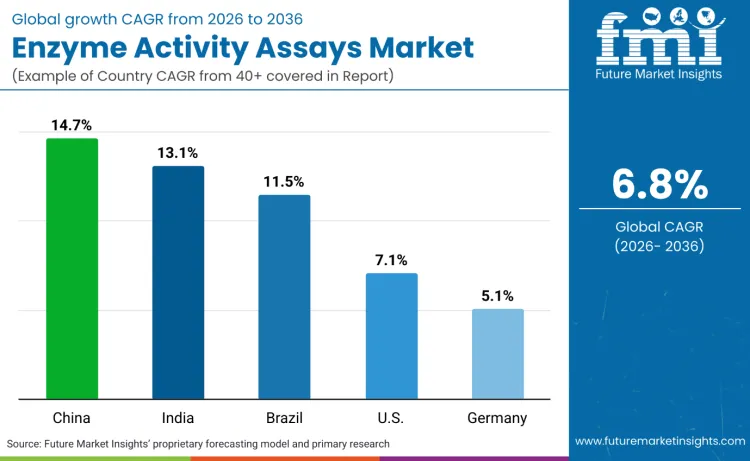
| Country | CAGR (2025-2035) |
|---|---|
| China | 14.7% |
| India | 13.1% |
| Brazil | 11.5% |
| USA | 7.1% |
| Germany | 5.1% |
Source: Future Market Insights (FMI) historical analysis and forecast data.
China: How is the Rising Pharmaceutical Development Infrastructure Driving Advanced Assay Adoption?
The primary driver in China is the unprecedented growth of domestic pharmaceutical development capabilities and personalized medicine research institutions. With the 2025 expansion of biotechnology research facilities, Chinese metropolitan areas are now experiencing millions of new analytical platform implementations, making traditional enzyme detection methods insufficient. A key development is the "Precision Medicine Initiative", which has promoted advanced analytical platform adoption for domestic pharmaceutical development to ensure research capabilities and detection innovation. Driven by this national scale of analytical capability expansion, the Chinese enzyme activity assays market is set to grow at a 14.7% CAGR during the study period, led by massive demand in pharmaceutical development and research sectors.
Over the next five years, the most significant opportunity lies in the integration of AI-powered discovery informatics with high-throughput assay hardware. As China targets "manufacturing sovereignty" in biologics, there is a burgeoning demand for specialized assays that support complex modalities like mRNA gene editing and cell-therapy characterization. Additionally, the push for decentralized healthcare will catalyze a shift toward thermostable, point-of-care enzymatic diagnostics, bypassing traditional cold-chain constraints in lower-tier cities.
India: Is the "Research Excellence" Movement Elevating Analytical Standards?
In India, the market is dominated by the evolution toward research excellence and precision-positioned analytical categories. This allows Indian research institutions to position advanced analytical platforms alongside international research capabilities from a single quality framework. This "precision-first" approach is essential for Indian researchers currently competing with international research standards in domestic pharmaceutical development applications. Reflecting this maturity, the Indian enzyme activity assays market is projected to grow at a 13.1% CAGR during the study period.
Over the next five years, the rise of biologics and biosimilars manufacturing, supported by expanded infrastructure, will necessitate high-precision enzyme assays for real-time process monitoring and quality control. Second, India's growing role as a global hub for drug discovery services creates a massive opening for high-throughput screening services tailored to lead optimization. There is a burgeoning demand for diagnostic kits that use stabilized enzymes, addressing the healthcare needs of tier-2 and tier-3 cities while bypassing cold-chain logistics.
Brazil: Will Expanding Biotechnology Sector Accelerate Platform Integration?
Brazil's enzyme activity assays market is uniquely shaped by biotechnology sector expansion and research infrastructure development. Brazilian researchers are increasingly adopting precision analytical platforms, maintaining research positioning for capability assurance while using accessible pricing for broader research appeal. The Brazilian enzyme activity assays market is expected to grow at a 11.5% CAGR during the study period, as research-focused organizations invest in validated analytical and precision detection categories.
Over the next five years, the market will shift toward high-growth niches. As domestic pharmaceutical leaders transition from generic drug production to complex biologics and biosimilars, there is an immediate opportunity to provide high-precision validation assays for protein characterization. Furthermore, the integration of AI-driven screening into Brazil's expansive natural genetic library will likely redefine discovery timelines, allowing organizations to capitalize on unique Amazonian enzymes for global industrial and therapeutic applications.
Germany: Is the "Analytical Innovation" Strategy Revitalizing Research Capabilities?
Growth in the Germany enzyme activity assays market is driven by sustained public investment in analytical research infrastructure, strong university-industry collaboration, and rising adoption of precision medicine workflows. National bioeconomy programs and EU-aligned research funding are strengthening demand for standardized, high-sensitivity enzyme characterization tools. Increasing use of automated screening, green chemistry mandates, and expansion of biologics research further reinforce uptake across academic, pharmaceutical, and industrial biotechnology laboratories. As German institutions prioritize analytical innovation and research excellence, the German enzyme activity assays market is set to grow at a 5.1% CAGR during the study period, focusing heavily on precision and analytical capability enhancement.
Over the next five years, the most lucrative opportunities reside in the convergence of digital health and companion diagnostics. As the German government streamlines regulatory barriers for in vitro diagnostics (IVDs) through 2026, there is a significant opening for firms to develop AI-integrated assays that support personalized oncology and rare disease therapies. Additionally, the mandate for "Green Labs" is creating a surge in demand for sustainable, solvent-free enzymatic processes, offering a high-margin niche for providers of automated, eco-friendly screening platforms.
USA: How is the "Precision Research Renaissance" Driving Analytical Innovation?
The USA market is increasingly focused on the innovation and diversity of precision analytical applications. This transition aims at reducing dependence on standard analytical methods while improving domestic research platform competitiveness. Supported by these research development mandates, the USA enzyme activity assays market is set to grow at a 7.1% CAGR during the study period.
Growth in the United States enzyme activity assays market is driven by expanded federal research funding, widespread adoption of advanced analytical platforms, and a strong precision medicine ecosystem. Initiatives prioritizing non-animal testing models and AI-enabled discovery tools are accelerating demand for high-throughput and predictive enzyme assays across drug development and diagnostics. Robust pharmaceutical R&D infrastructure, coupled with federated data networks and automation integration, further amplifies market uptake. The NIH Common Fund’s Bridge to Artificial Intelligence (Bridge2AI) program is set to bolster the adoption of AI in diagnostics.
Who are the Major Players Active in the Enzyme Activity Assays Market?
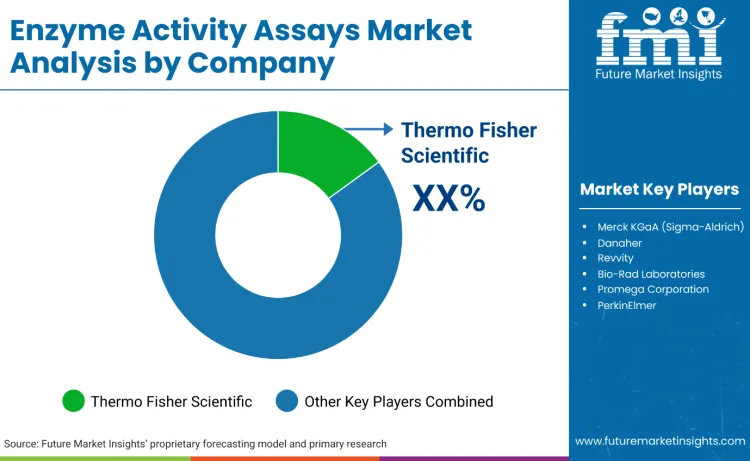
The competitive landscape for the enzyme activity assays market is defined by a strategic transition toward AI-guided high-throughput screening and the integration of ambient-stable reagents to reduce cold-chain dependency. As biopharmaceutical pipelines prioritize complex modalities like mRNA and gene therapies, the market features a highly intensive rivalry focused on increasing the sensitivity and speed of detection. FMI analysis indicates that market leaders are aggressively pursuing vertical integration, acquiring niche automation firms to offer "sample-to-insight" workflows that minimize manual intervention. This shift is particularly evident in the rapid adoption of recombinant DNA technology and directed evolution, which have shortened enzyme development cycles from years to months, allowing players to capture high-value applications in diagnostic validation and green chemistry.
Market leader Thermo Fisher Scientific maintains dominance through the successful expansion of its Gallery Enzyme Masteranalyzers, which automate complex kinetic measurements for the food and pharma sectors. Merck KGaA has strategically positioned its Sigma-Aldrich portfolio toward sustainable biocatalysis, launching plant-derived enzymes to meet tightening ESG regulations. Meanwhile, Danaher (via Molecular Devices) is gaining significant ground by integrating AI-driven predictive analytics into its microplate readers to streamline toxicity screening. Specialized players like Promega and Revvity are competing on detection modality, with Promega’s bioluminescent Glo® technologies providing real-time monitoring of protease activity, while Revvity focuses on "mix-and-read" HTRF® assays for high-volume drug discovery. Bio-Rad continues to boost its position in the molecular segment, leveraging ddPCR for high-precision quantification of DNA-modifying enzymes.
Key Industry Developments:
- In October 2025, Merck KGaA formed a multi-year collaboration with Promega (late 2025) to co-develop bioluminescent assays for 3D-cell drug discovery and launched "green chemistry" plant-derived enzyme lines.
- In August 2023, Danaher Corporation finalized the landmark USD 5.7 billion acquisition of Abcam (completed mid-2024), integrating one of the world's largest libraries of validated antibodies and enzyme assays into its Life Sciences segment.
Key Players in the Enzyme Activity Assays Market
- Thermo Fisher Scientific Inc.
- Merck KGaA (operating life science business as Sigma-Aldrich)
- Danaher Corporation
- Revvity, Inc.
- Bio-Rad Laboratories, Inc.
- Promega Corporation
- PerkinElmer, Inc.
- Abcam plc
- BioVision, Inc.
- Cell Signaling Technology, Inc.
Market Definition
The enzyme activity assays market refers to the global research and analytical applications of biochemical detection platforms designed to measure enzyme kinetics, activity levels, and mechanistic characteristics. It includes both precision and standard analytical offerings, with segments that cater to various research applications such as high-throughput screening, kinetic analysis, and biomarker characterization. The market size is measured in USD billion and analyzed over the 2026 to 2036 period.
The enzyme activity assays market includes product types such as microplate-based kits, fluorometric assays, colorimetric assays, and specialized detection platforms, utilized through both research institutions and pharmaceutical development applications. The market is expanding due to growing interest in precision medicine development, analytical platform innovations, and evolving research requirements toward higher-sensitivity and more specialized enzyme characterization capabilities.
Market Inclusion
Included in the enzyme activity assays market scope are analytical products categorized by type (microplate-based, fluorometric, colorimetric, and specialized detection), with segmentation based on applications (high-throughput screening, kinetic studies, bioprocess quality control), research focus (pharmaceutical, academic, diagnostic), and analytical requirements (sensitivity, throughput, automation compatibility). The scope includes enzyme assay platforms with a focus on analytical precision, research capabilities, and detection innovation, particularly those marketed through specialized suppliers, research institutions, and pharmaceutical development facilities.
Geographically, the market encompasses key regions such as North America, Europe, Asia Pacific, Latin America, and the Middle East & Africa, with country-level analysis for significant markets like China, India, Brazil, USA, and Germany.
Market Exclusion
Excluded from the enzyme activity assays market scope are non-enzyme detection platforms and analytical methods not designed for enzyme characterization, such as protein quantification assays, cell viability measurements, and nucleic acid detection platforms. Additionally, products not intended for research or pharmaceutical applications are not included.
The market excludes non-analytical enzyme products, as well as enzyme-related products that are not marketed as analytical platforms, such as enzyme preparations or enzyme-based therapeutic products. Furthermore, products with non-compliant analytical specifications or those that do not meet regional regulatory standards for research applications are outside the market's defined scope.
Scope of the Report
| Items | Values |
|---|---|
| Quantitative Units | USD billion |
| Product Type | Microplate-based Enzyme Assay Kits; Fluorometric Activity Assay Kits; Colorimetric Activity Assay Kits; Luminescent Activity Assay Kits; Radiometric/Specialized Assays; Custom Assay Development |
| Application | High-throughput Screening; Enzyme Kinetics Studies; Bioprocess QC; Clinical Research; Academic Research |
| End User | Pharma & Biotech; CROs; Academic Labs; Diagnostic Labs; Industrial Biotech |
| Regions Covered | North America, Europe, Asia Pacific, Latin America, Middle East & Africa |
| Countries Covered | China, India, Brazil, USA, Germany, and 40+ countries |
| Key Companies Profiled | Thermo Fisher Scientific; Merck KGaA ; Danaher; Revvity ; Bio-Rad Laboratories; Others |
| Additional Attributes | Revenue analysis by product type, application, and end user; performance in research applications and analytical capabilities across pharmaceutical institutions, research facilities, and diagnostic applications; analytical sensitivity enhancement, detection optimization, and platform benefits under research applications; impact on research outcomes, analytical precision, and platform differentiation during procurement processes; compatibility with research protocols and analytical preferences; procurement dynamics driven by precision positioning, analytical innovation programs, and long-term research partnerships. |
Enzyme Activity Assays Market by SegmentBibliography
Product Type:
- Microplate-based Enzyme Assay Kits
- Fluorometric Activity Assay Kits
- Colorimetric Activity Assay Kits
- Luminescent Activity Assay Kits
- Radiometric/Specialized Assays
- Custom Assay Development
Application:
- High-throughput Screening
- Enzyme Kinetics Studies
- Bioprocess QC
- Clinical Research
- Academic Research
End User:
- Pharma & Biotech
- CROs
- Academic Labs
- Diagnostic Labs
- Industrial Biotech
Region:
- Asia Pacific
- China
- Japan
- South Korea
- India
- Australia & New Zealand
- Thailand
- Rest of Asia Pacific
- Europe
- Germany
- United Kingdom
- France
- Italy
- Spain
- Nordic
- Netherlands
- Rest of Europe
- North America
- USA
- Canada
- Mexico
- Latin America
- Brazil
- Chile
- Colombia
- Argentina
- Rest of Latin America
- Middle East & Africa
- Kingdom of Saudi Arabia
- Other GCC Countries
- Turkey
- South Africa
- Other African Union
- Rest of Middle East & Africa
Bibliography
- International Analytical Chemistry Association. (2023). Detection Standards for Enzyme Activity Assays: Analytical Guidelines. IACA.
- Global Biochemical Research Council. (2023). Platform Specifications for Enzyme Assay Products: Sensitivity and Validation Requirements. GBRC.
- Pharmaceutical Research Institute. (2024). PRI Guidelines for Analytical Positioning in Enzyme Detection (updated precision specifications for research and pharmaceutical applications). PRI.
Frequently Asked Questions
How big is the enzyme activity assays market in 2026?
The global enzyme activity assays market is estimated to be valued at USD 1.9 billion in 2026.
What will be the size of the enzyme activity assays market in 2036?
The market size for the enzyme activity assays market is projected to reach USD 3.8 billion by 2036.
How much will the enzyme activity assays market grow between 2026 and 2036?
The enzyme activity assays market is expected to grow at a 6.8% CAGR between 2026 and 2036.
What are the key product types in the enzyme activity assays market?
The key product types in the enzyme activity assays market include microplate-based enzyme assay kits, fluorometric activity assay kits, colorimetric activity assay kits, and luminescent activity assay kits.
Which end user will contribute a significant share in the enzyme activity assays market in 2026?
In terms of end user, the pharma and biotech segment is set to command a 38.0% share in the enzyme activity assays market in 2026.
Preview the report firsthand - request a free sample
Get SampleGet the brochure for pricing and purchase details.
Get PDFTable of Content
- Executive Summary
- Global Market Overview
- Key Insights
- Market Forecast
- Strategic Recommendations
- Market Overview
- Market Definition
- Market Taxonomy
- Scope and Limitations
- Research Methodology
- Research Approach
- Data Sources
- Analytical Framework
- Market Dynamics
- Drivers
- Restraints
- Opportunities
- Trends
- Market Sizing and Forecast
- Market Value (2026-2036)
- Y-o-Y Growth Analysis
- Market Share by Product Type
- Market Share by Application
- Market Share by End User
- Market Segmentation Analysis
- Product Type
- Microplate-based Enzyme Assay Kits
- Fluorometric Activity Assay Kits
- Colorimetric Activity Assay Kits
- Luminescent Activity Assay Kits
- Radiometric/Specialized Assays
- Custom Assay Development
- Application
- High-throughput Screening
- Enzyme Kinetics Studies
- Bioprocess QC
- Clinical Research
- Academic Research
- End User
- Pharma & Biotech
- CROs
- Academic Labs
- Diagnostic Labs
- Industrial Biotech
- Product Type
- Regional Market Analysis
- Asia Pacific
- North America
- Europe
- Latin America
- Middle East & Africa
- Competitive Landscape
- Market Share of Key Players
- Competitive Benchmarking
- Key Player Strategies
- Key Takeaways
- Market Summary
- Future Trends and Forecast
- Strategic Recommendations


