

- Market Size (2026)
- USD 37.7 Mn
- Forecast (2036)
- USD 64.5 Mn
- CAGR (2026 to 2036)
- 5.5%
How big is the estriol market in 2026?
USD 37.7 million in 2026 and USD 64.5 million by 2036 at a 5.5% CAGR.
The estriol market is expected to grow from USD 35.5 million in 2025 to USD 64.5 million by 2036. Demand is forecast to rise at a 5.5% CAGR from 2026 to 2036 with compliance-based supplier screening. By purity grade, ≥99% API is predicted to hold 52.0% share in 2026.
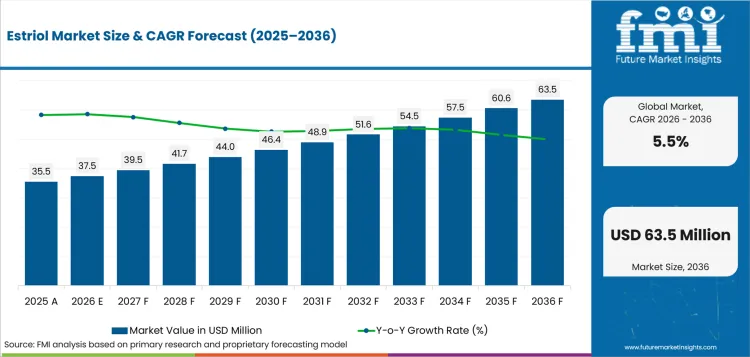
| Metric | Value |
|---|---|
| 2026 Market Size | USD 37.7 million |
| 2036 Market Size | USD 64.5 million |
| Forecast CAGR (2026-2036) | 5.5% |
| Leading Purity Grade | ≥99% API |
| ≥99% API Share (2026) | 52.0% |
| Leading Form | Creams & Gels |
| Creams & Gels Share (2026) | 46.0% |
| Fastest-growing Country | China |
| China CAGR by 2036 | 6.4% |
| Market Signal | Commercial Impact |
|---|---|
| Demand and Growth Drivers | Growing menopause management and women's health therapies are increasing demand for estriol-based products.
|
| Product and Segment View | High-purity APIs, creams & gels, direct sales, and Europe lead their respective market segments.
|
| Geography and Growth Outlook | China and India are expected to deliver the strongest growth, while the United States remains a regulated compliance-focused market.
|
| Competitive Landscape | Competition is centered on regulatory documentation, API quality, and supply reliability.
|
| Analyst Perspective | Estriol remains a documentation-intensive API market where product quality outweighs price competition.
- Anurag Sharma, Principal Analyst at Future Market Insights |
Estriol demand is anticipated to be supported by local estrogen therapy and documented API supply because buyers need a clear link between menopausal care and regulated product availability. FDA reported in February 2026 that about 41 million USA women were ages 45 to 64 in 2020. It also noted that only about 2 million women ages 46 to 65 received a hormone-therapy prescription. Aspen’s Estriol 1mg/g cream listing was last updated on eMC in May 2026 and identifies estriol as the active ingredient for prescription vaginal therapy. These records support informed supplier selection by linking estriol formulations to documented therapeutic use.
Which factors support expansion in the estriol market?
Regulated API sourcing and local estrogen dosage forms support market value across specialty pharmaceutical channels.
- Market value is supported by estriol API revenue before finished medicines add downstream sales.
- Supplier pricing reflects purity grade and file support before micronization affects formulation value.
- Revenue improves when licensed product holders maintain repeat demand for low-dose local estrogen forms.
- Buyer confidence rises when suppliers provide impurity data and audit answers on request.
Why is the estriol market growing?
Regulatory listings and continued clinical use supporting market growth
Estriol demand is rising in markets where local estrogen products remain active prescribing options. The United Kingdom medicines compendium lists Estriol 1mg/g cream for vaginal estrogen deficiency symptoms. DailyMed lists an estriol cream with 0.2% active ingredient. These records show a controlled sourcing market built around product-route evidence.
How is the estriol market segmented?
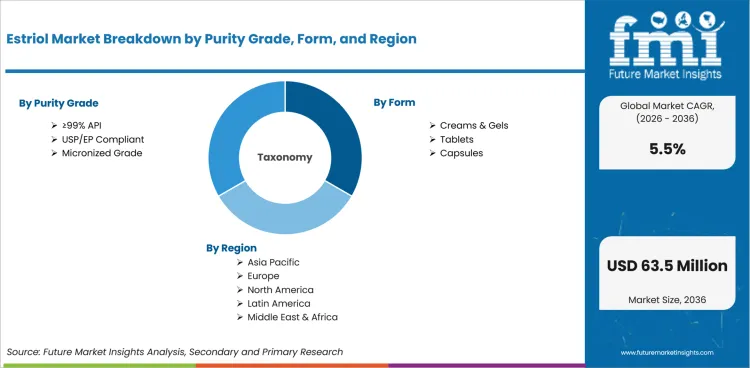
The estriol market is segmented by purity grade, form, and sales channel
- ≥99% API is projected to secure 52.0% share in 2026, supported by regulated buyer focus on impurity control.
- Creams & Gels are expected to account for 46.0% share in 2026 through localized estrogen delivery.
- Direct Sales are anticipated to represent 57.0% share in 2026 with buyers seeking direct supplier files.
- Europe is forecast to account for 31.0% share in 2026 through licensed estriol products supporting API qualification.
Why does ≥99% API lead the estriol market?
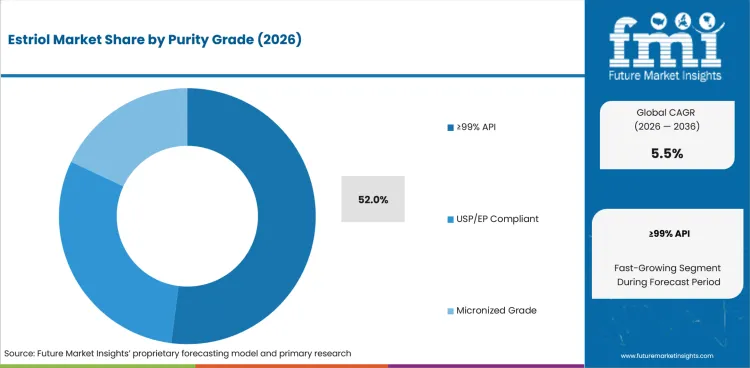
- ≥99% API is projected to account for 52.0% share in 2026, supported by regulated buyer screening of impurity profiles.
- USP/EP compliant material retains demand when filings need compendial alignment and supplier documentation.
Why do creams and gels lead estriol API demand?
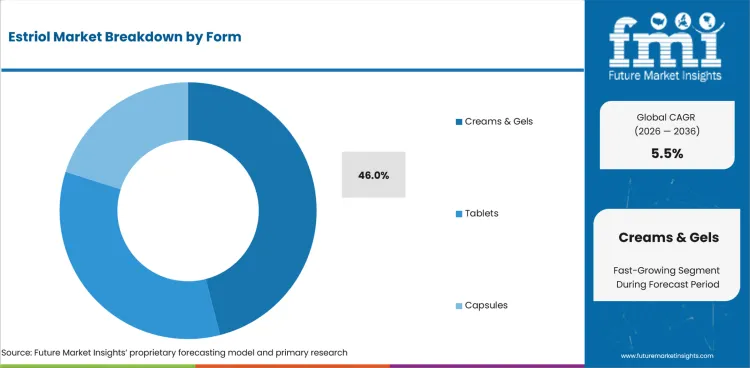
- Creams & Gels are expected to represent 46.0% share in 2026 through local estrogen use.
- Micronized grade gains value when formulators need better dispersion in cream batches.
Which sales channel leads the estriol market?
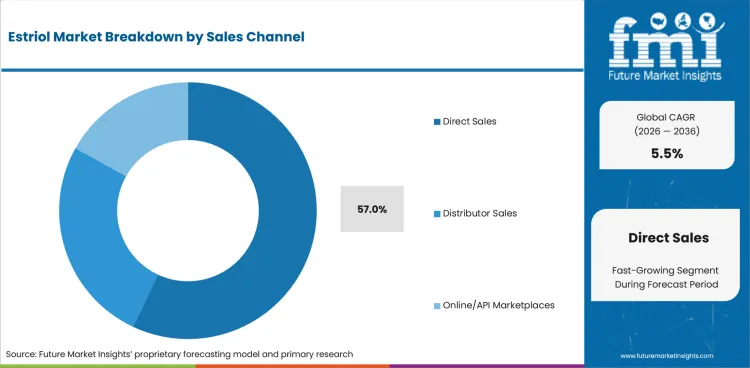
- Direct Sales are anticipated to hold 57.0% share in 2026, supported by faster supplier-file access.
- Distributor sales keep a role in smaller markets that need controlled lower-volume API access.
What supports or limits the estriol market?
Local estrogen product listings support demand. U.S. approval limits and documentation gaps restrain scale.
- Driver: Local estrogen therapy demand supports API use in cream and vaginal product formats with established medicine listings.
- Driver: Quality documentation is expected to shape supplier choice through impurity-risk controls for steroid hormones.
- Restraint: U.S. regulatory limits restrict mainstream expansion under FDA’s no-approved-drug position on estriol.
- Opportunity: Micronized estriol creates room for suppliers that can prove particle-size control.
- Opportunity: China and India offer supply-side advantages through steroid API manufacturing depth.
Estriol API Demand Outlook Around Local Estrogen Therapy
Industry outlook is expected to depend on local estrogen therapy and finished-dose continuity. FDA approved labeling changes to menopausal hormone therapy products in February 2026. The FDA notice covers approved therapies for vaginal dryness and discomfort. Estriol is outside U.S. approved-drug coverage, so buyers should view U.S. demand through a controlled compounding route.
Estriol Buyer Segmentation and Purchase Behavior Analysis
Finished-dose manufacturers and compounding pharmacies form the main buyer groups. FDA’s March 2025 compounding bulk-substance list includes estriol in the 503B Category 1 group. That status supports continued buyer review of legal sourcing routes. Laboratory buyers form a separate pool through method work and reference-standard purchasing.
Estriol Supplier Selection and Qualification Drivers
Purchase decisions are shaped by impurity data and supplier response time during audits. FDA’s May 2026 CERSI project list includes work on compounded estrogen hormone products. This keeps buyer attention on product quality and clinical-use evidence. Suppliers with ready files reduce buyer workload during qualification.
Which countries are growing fastest in the estriol market?
China leads country growth. Japan records the most cautious expansion outlook among profiled markets.
.webp "Top Country Growth Comparison Estriol Market Cagr (2026 2036)")
| Country | CAGR |
|---|---|
| China | 6.4% |
| India | 6.1% |
| South Korea | 5.7% |
| United States | 5.2% |
| United Kingdom | 5.0% |
| Germany | 4.9% |
| France | 4.8% |
| Japan | 4.7% |
Source: Future Market Insights, 2026.
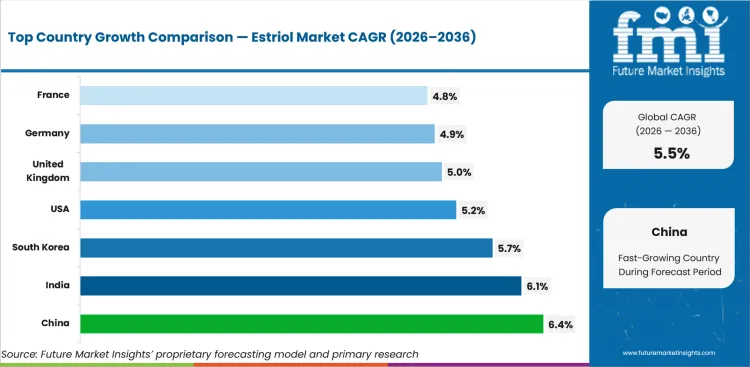
How do country-level CAGRs compare in the estriol market?
China leads the country outlook and Japan records the most cautious profile in the selected group.
- China is forecast to record 6.4% CAGR by 2036, supported by steroid API supply depth for export sourcing.
- India is expected to expand at 6.1% CAGR during the forecast period with domestic formulation and export routes.
- South Korea is projected to grow at 5.7% CAGR by 2036 through regulated importer routes and selective demand.
- The United States is anticipated to grow at 5.2% CAGR by 2036. Approval limits keep estriol sourcing cautious across the U.S. channel.
- The United Kingdom is estimated to rise at 5.0% CAGR by 2036 with licensed local estrogen products supporting demand.
- Germany is forecast to post 4.9% CAGR over the assessment period with pharmacy discipline limiting faster uptake.
- France is expected to record 4.8% CAGR by the end of 2036 through public product listings and steady sourcing.
- Japan is projected to advance at 4.7% CAGR over the ten-year period with older product routes limiting faster growth.
How fast is the estriol market growing in China?
A 6.4% CAGR by 2036 reflects supply-side strength in steroid API production.
Country Market Snapshot Table
| Parameter | Value |
|---|---|
| Market Size in 2025 (Value) | USD 4.7 million |
| Market Size in 2026 (Value) | USD 5.0 million |
| Market Forecast in 2036 (Value) | USD 9.3 million |
| CAGR (2026 to 2036) | 6.4% |
| Years Considered | 2021 to 2036 |
| Base Year | 2025 |
| Forecast Period | 2026 to 2036 |
| Units Considered | Value (USD million) |
| Leading Sub-Region | Zhejiang and eastern China API clusters |
China Estriol Market Outlook
China’s estriol opportunity is mainly supply-side. National data showed 310.31 million people aged 60 and above at the end of 2024. This supports long-term women’s health demand. Suppliers still win through export-ready quality files.
International buyers use Chinese suppliers for cost-sensitive steroid API sourcing. NewChem’s profile places Zhejiang Xianju in steroid and hormone production. Buyers still need audit readiness before qualification.
Key Growth Drivers
- China’s age profile supports women’s health demand. The National Bureau of Statistics reported 310.31 million people aged 60 and above at end-2024.
- NewChem lists Zhejiang Xianju with 53 APIs mainly covering steroids and hormones.
- Export buyers use China when they need cost-sensitive steroid ingredient options.
- Supplier screening is expected to favor plants that can show GMP files quickly.
Key Restraints
- NewChem lists 36 finished pharmaceutical products at Xianju, so estriol-specific evidence still needs product-level checks.
- Audit and trade risk can slow qualification with regulated-market buyers.
- Suppliers without direct estriol proof may lose buyers even when they have steroid capacity.
What makes China unique
China is the best selected supply-side growth country due to steroid API capacity for global sourcing decisions.
Key Companies
- Zhejiang Xianju Pharmaceutical supports steroid and hormone API supply coverage.
- NewChem links European API distribution with Xianju production relationships.
Sales & Marketing Channels
- Direct export API sales support regulated buyers.
- CPHI sourcing routes provide supplier discovery.
- Local regulatory agent channels manage documentation.
- Distributor supply reaches Asian formulators.
- Contract manufacturing relationships support scaled sourcing.
Country Segment Breakdown Table
| Segment | Sub-Segments |
|---|---|
| By Purity Grade | ≥99% API · USP/EP Compliant · Micronized Grade |
| By Form | Creams & Gels · Tablets · Capsules · Injections |
| By Sales Channel | Direct Sales · Distributor Sales · Online/API Marketplaces · Others |
| Key Sub-Regions Covered, Pharmaceutical Clusters | Zhejiang and eastern China API clusters |
Frequently Asked Questions
How fast is China estriol market growing?
Sales in China are expected to grow at 6.4% CAGR from 2026 to 2036, guided by documented API sourcing needs.
Who leads China estriol market?
Zhejiang Xianju Pharmaceutical and qualified API distributors shape local competition.
What is driving adoption in China estriol market?
Adoption is driven by local estrogen product routes and buyer preference for documented steroid API supply.
How is the estriol market performing in India?
A 6.1% CAGR by 2036 reflects domestic formulation routes and steroid API capability.
Country Market Snapshot Table
| Parameter | Value |
|---|---|
| Market Size in 2025 (Value) | USD 2.4 million |
| Market Size in 2026 (Value) | USD 2.5 million |
| Market Forecast in 2036 (Value) | USD 4.5 million |
| CAGR (2026 to 2036) | 6.1% |
| Years Considered | 2021 to 2036 |
| Base Year | 2025 |
| Forecast Period | 2026 to 2036 |
| Units Considered | Value (USD million) |
| Leading Sub-Region | Indore and Hyderabad API corridors · Western India API base |
India Estriol Market Outlook
India combines domestic demand potential with steroid API manufacturing capability. Pharmexcil reported pharmaceutical exports of USD 30.47 billion in FY25. That export base supports buyer confidence in specialty ingredient sourcing.
Domestic buyers remain price-sensitive and file quality still controls access. Suppliers with cleaner audit packs can serve local formulators and export-oriented buyers.
Key Growth Drivers
- Pharmexcil reported pharmaceutical exports of USD 30.47 billion in FY25, supporting India’s API export credibility.
- Symbiotec reported fiscal 2025 leadership in steroidal-hormone API volume.
- Gynecology prescription routes keep estrogen therapies within specialist-led demand.
- Indian steroid API producers can serve domestic and export-oriented buyers.
Key Restraints
- CDSCO records show estriol tablet approval references from 2020, so current public evidence remains limited.
- Price-sensitive purchasing can limit micronized or premium-grade API uptake.
- Public product data gaps make current market tracking harder for new entrants.
What makes India unique
India has demand-side formulation channels and supply-side steroid API depth within the selected country group.
Key Companies
- Symbiotec Pharmalab is relevant through steroidal-hormone API capability.
Sales & Marketing Channels
- Direct supply reaches finished-dose manufacturers.
- Domestic API distributor networks support smaller buyers.
- Gynecology prescription channels guide finished-dose demand.
- Export-oriented procurement supports file-based sourcing.
- Regulatory consultant-supported sourcing helps manage CDSCO documentation.
Country Segment Breakdown Table
| Segment | Sub-Segments |
|---|---|
| By Purity Grade | ≥99% API · USP/EP Compliant · Micronized Grade |
| By Form | Creams & Gels · Tablets · Capsules · Injections |
| By Sales Channel | Direct Sales · Distributor Sales · Online/API Marketplaces · Others |
| Key Sub-Regions Covered, Pharmaceutical Clusters | Indore and Hyderabad API corridors · Western India API base |
Frequently Asked Questions
How fast is India estriol market growing?
Sales in India are expected to grow at 6.1% CAGR from 2026 to 2036, guided by documented API sourcing needs.
Who leads India estriol market?
Symbiotec Pharmalab and qualified API distributors shape local competition.
What is driving adoption in India estriol market?
Adoption is driven by local estrogen product routes and buyer preference for documented steroid API supply.
What is the estriol market outlook in South Korea?
A 5.7% CAGR by 2036 reflects regulated importer routes and selective women’s health demand.
Country Market Snapshot Table
| Parameter | Value |
|---|---|
| Market Size in 2025 (Value) | USD 1.7 million |
| Market Size in 2026 (Value) | USD 1.8 million |
| Market Forecast in 2036 (Value) | USD 3.1 million |
| CAGR (2026 to 2036) | 5.7% |
| Years Considered | 2021 to 2036 |
| Base Year | 2025 |
| Forecast Period | 2026 to 2036 |
| Units Considered | Value (USD million) |
| Leading Sub-Region | Seoul metropolitan pharmaceutical import corridors |
South Korea Estriol Market Outlook
South Korea’s estriol demand is selective and shaped by regulated medicine channels. MFDS published the 2024 Drug Approval Report in 2025. That source shows why documentation guides API sourcing.
Public estriol-specific evidence is narrower than Japan or France. API sellers should use regulatory partners and documented import routes.
Key Growth Drivers
- MFDS published the 2024 Drug Approval Report to show current drug approval trends.
- MFDS released the 2024 Medical Device Approval Report in June 2025, showing higher approval transparency.
- Local pharma buyers use structured importer routes for specialty API qualification.
- Prescription channels support selective demand for women’s health therapies.
Key Restraints
- Public estriol-specific evidence is narrower than Japan, reducing visible demand confidence for API suppliers.
- Import documentation requirements can slow supplier switching for small-volume APIs.
- Broad online promotion is less useful than partner-supported registration.
What makes South Korea unique
South Korea is a regulated specialty sourcing market where API access depends on importer competence and clear documentation.
Key Companies
- Regulatory agents manage MFDS documentation routes.
Sales & Marketing Channels
- Licensed pharmaceutical importer channels guide access.
- Direct API supply reaches local formulation firms.
- Regulatory agent-supported registration reduces filing friction.
- Hospital and prescription distribution support demand.
- Distributor-led sourcing handles smaller volumes.
Country Segment Breakdown Table
| Segment | Sub-Segments |
|---|---|
| By Purity Grade | ≥99% API · USP/EP Compliant · Micronized Grade |
| By Form | Creams & Gels · Tablets · Capsules · Injections |
| By Sales Channel | Direct Sales · Distributor Sales · Online/API Marketplaces · Others |
| Key Sub-Regions Covered, Pharmaceutical Clusters | Seoul metropolitan pharmaceutical import corridors |
Frequently Asked Questions
How fast is South Korea estriol market growing?
Sales in South Korea are expected to grow at 5.7% CAGR from 2026 to 2036, guided by documented API sourcing needs.
Who leads South Korea estriol market?
Local pharmaceutical importers and qualified API distributors shape regulated API access for estriol buyers.
What is driving adoption in South Korea estriol market?
Adoption is driven by local estrogen product routes and buyer preference for documented steroid API supply.
What is the estriol market outlook in the United States?
A 5.2% CAGR by 2036 reflects compounding exposure and topical-channel demand.
Country Market Snapshot Table
| Parameter | Value |
|---|---|
| Market Size in 2025 (Value) | USD 6.7 million |
| Market Size in 2026 (Value) | USD 7.1 million |
| Market Forecast in 2036 (Value) | USD 11.8 million |
| CAGR (2026 to 2036) | 5.2% |
| Years Considered | 2021 to 2036 |
| Base Year | 2025 |
| Forecast Period | 2026 to 2036 |
| Units Considered | Value (USD million) |
| Leading Sub-Region | Compounding pharmacy corridors and women’s health clinics |
United States Estriol Market Outlook
United States demand is shaped by compounding and topical product listings. The Census Bureau reported 61.2 million people aged 65 and older in 2024. This creates a large women’s health context but FDA approval limits keep estriol sourcing cautious.
Supplier selection is controlled by documentation quality and claim discipline. Buyers need identity and impurity records before accepting a source.
Key Growth Drivers
- The Census Bureau reported 61.2 million U.S. residents aged 65 and older in 2024, supporting long-term women’s health demand.
- DailyMed listed an estriol cream with 0.2% active ingredient in March 2026, confirming topical-channel visibility.
- Compounding pharmacies continue to need estriol API for physician-directed preparations.
- USP-grade expectations support suppliers with traceable impurity documentation.
Key Restraints
- FDA states 0 FDA-approved drugs contain estriol, limiting broad approved-drug commercialization.
- Claim risk makes pharmacies cautious about promotional language and supplier selection.
- Supplier switching is slow when quality teams need audit data before API qualification.
What makes United States unique
The United States is unique due to visible estriol listings and FDA non-approval for estriol-containing drugs.
Key Companies
- Aspen API supports direct estriol API supply evidence.
- Steraloids supports research and analytical standard access.
Sales & Marketing Channels
- Direct API supply reaches finished-dose formulators.
- Compounding pharmacy networks support selective demand.
- Qualified distributors serve lower-volume purchases.
- Online API marketplaces require careful quality screening.
- Women’s health clinics influence physician-directed demand.
Country Segment Breakdown Table
| Segment | Sub-Segments |
|---|---|
| By Purity Grade | ≥99% API · USP/EP Compliant · Micronized Grade |
| By Form | Creams & Gels · Tablets · Capsules · Injections |
| By Sales Channel | Direct Sales · Distributor Sales · Online/API Marketplaces · Others |
| Key Sub-Regions Covered, Pharmaceutical Clusters | Compounding pharmacy corridors and women’s health clinics |
Frequently Asked Questions
How fast is United States estriol market growing?
Sales in United States are expected to grow at 5.2% CAGR from 2026 to 2036, guided by documented API sourcing needs.
Who leads United States estriol market?
Aspen API and qualified API distributors shape local competition.
What is driving adoption in United States estriol market?
Adoption is driven by local estrogen product routes and buyer preference for documented steroid API supply.
How is the estriol market performing in the United Kingdom?
A 5.0% CAGR by 2036 reflects licensed local estrogen products and NHS access routes.
Country Market Snapshot Table
| Parameter | Value |
|---|---|
| Market Size in 2025 (Value) | USD 3.2 million |
| Market Size in 2026 (Value) | USD 3.4 million |
| Market Forecast in 2036 (Value) | USD 5.5 million |
| CAGR (2026 to 2036) | 5.0% |
| Years Considered | 2021 to 2036 |
| Base Year | 2025 |
| Forecast Period | 2026 to 2036 |
| Units Considered | Value (USD million) |
| Leading Sub-Region | England pharmacy and women’s health prescribing corridors |
United Kingdom Estriol Market Outlook
United Kingdom demand is anchored in licensed local estrogen products and NHS medicine access. GOV.UK lists the HRT PPC at £19.80 for 12 months. This lowers repeat cost friction for eligible HRT medicines.
The medicines compendium lists Estriol 1mg/g cream for vaginal estrogen deficiency symptoms. That product record supports a conventional sourcing route for API buyers.
Key Growth Drivers
- GOV.UK lists the HRT PPC at £19.80 for 12 months, lowering recurring cost friction.
- The medicines compendium lists Estriol 1mg/g cream for vaginal estrogen deficiency symptoms.
- NHS prescription channels make patient access more predictable than private-only routes.
- Licensed product status supports dossier-controlled procurement.
Key Restraints
- NHSBSA states each prescription item usually costs £9.90, keeping price sensitivity visible for finished products.
- Supplier switching is slow when established product files specify qualified API sources.
- Community pharmacy access depends on product inclusion and prescription rules.
What makes United Kingdom unique
The United Kingdom combines licensed estriol products with a defined NHS HRT access route.
Key Companies
- Aspen API is relevant where UK buyers need documented API files.
Sales & Marketing Channels
- Direct supplier sales reach finished-dose holders.
- NHS prescription channels guide patient access.
- Community pharmacy dispensing supports repeat demand.
- Specialty distributors handle smaller API volumes.
- Private women’s health clinics influence selective prescribing.
Country Segment Breakdown Table
| Segment | Sub-Segments |
|---|---|
| By Purity Grade | ≥99% API · USP/EP Compliant · Micronized Grade |
| By Form | Creams & Gels · Tablets · Capsules · Injections |
| By Sales Channel | Direct Sales · Distributor Sales · Online/API Marketplaces · Others |
| Key Sub-Regions Covered, Pharmaceutical Clusters | England pharmacy and women’s health prescribing corridors |
Frequently Asked Questions
How fast is United Kingdom estriol market growing?
Sales in United Kingdom are expected to grow at 5.0% CAGR from 2026 to 2036, guided by documented API sourcing needs.
Who leads United Kingdom estriol market?
Aspen API and qualified API distributors shape local competition.
What is driving adoption in United Kingdom estriol market?
Adoption is driven by local estrogen product routes and buyer preference for documented steroid API supply.
How is the estriol market performing in Germany?
A 4.9% CAGR over the assessment period reflects careful pharmacy access and strict estrogen review.
Country Market Snapshot Table
| Parameter | Value |
|---|---|
| Market Size in 2025 (Value) | USD 3.0 million |
| Market Size in 2026 (Value) | USD 3.1 million |
| Market Forecast in 2036 (Value) | USD 5.0 million |
| CAGR (2026 to 2036) | 4.9% |
| Years Considered | 2021 to 2036 |
| Base Year | 2025 |
| Forecast Period | 2026 to 2036 |
| Units Considered | Value (USD million) |
| Leading Sub-Region | North Rhine-Westphalia and Bavaria pharmaceutical corridors |
Germany Estriol Market Outlook
Germany demand is supported by ageing demographics and pharmacy-led medicine access. Destatis reported people aged 65 or older at 23.2% of the population in 2024. This supports long-term demand for local estrogen therapies.
Regulatory caution keeps growth measured. BfArM communicates the European risk review on high-strength estradiol creams. That caution influences how buyers treat estrogen product evidence.
Key Growth Drivers
- Destatis reported people aged 65 or older at 23.2% of Germany’s population in 2024.
- Destatis projected the 67-plus share could reach 25% to 27% by 2038, supporting longer-term therapy demand.
- European compendial standards favor suppliers with CEP or ASMF-ready documentation.
- Pharmacy distribution supports repeat use once products are established.
Key Restraints
- BfArM communicates a 4-week limit for high-strength vaginal estradiol creams, reinforcing caution around estrogen exposure.
- Statutory pricing rules reduce room for finished-dose firms to absorb API cost increases.
- Supplier qualification cycles can slow entry for new API sources without European documentation.
What makes Germany unique
Germany is a cautious estrogen market where pharmacy discipline and documentation strength shape buyer preference.
Key Companies
- German finished-dose holders influence estriol API qualification.
Sales & Marketing Channels
- Direct API supply reaches finished-dose manufacturers.
- Wholesaler channels support pharmacy availability.
- Gynecology prescription routes guide demand.
- European distributors support active-substance sourcing.
- Public reimbursement discipline influences price tolerance.
Country Segment Breakdown Table
| Segment | Sub-Segments |
|---|---|
| By Purity Grade | ≥99% API · USP/EP Compliant · Micronized Grade |
| By Form | Creams & Gels · Tablets · Capsules · Injections |
| By Sales Channel | Direct Sales · Distributor Sales · Online/API Marketplaces · Others |
| Key Sub-Regions Covered, Pharmaceutical Clusters | North Rhine-Westphalia and Bavaria pharmaceutical corridors |
Frequently Asked Questions
How fast is Germany estriol market growing?
Sales in Germany are expected to grow at 4.9% CAGR from 2026 to 2036, guided by documented API sourcing needs.
Who leads Germany estriol market?
German finished-dose holders and qualified API distributors influence estriol API qualification.
What is driving adoption in Germany estriol market?
Adoption is driven by local estrogen product routes and buyer preference for documented steroid API supply.
What is the estriol market forecast for France?
A 4.8% CAGR by 2036 reflects visible product listings and steady pharmacy access.
Country Market Snapshot Table
| Parameter | Value |
|---|---|
| Market Size in 2025 (Value) | USD 2.9 million |
| Market Size in 2026 (Value) | USD 3.0 million |
| Market Forecast in 2036 (Value) | USD 4.8 million |
| CAGR (2026 to 2036) | 4.8% |
| Years Considered | 2021 to 2036 |
| Base Year | 2025 |
| Forecast Period | 2026 to 2036 |
| Units Considered | Value (USD million) |
| Leading Sub-Region | Ile-de-France and national pharmacy channels |
France Estriol Market Outlook
France has visible estriol product availability through public medicine listings. The public medicine database lists GYDRELLE 0.1% vaginal cream. This gives buyers a conventional product anchor for API sourcing.
Clinical review keeps buyer behavior measured. HAS began a hormone therapy reassessment after a 2024 ministry request. Suppliers need product-specific evidence before gaining higher traction.
Key Growth Drivers
- France’s public medicine database lists GYDRELLE 0.1% vaginal cream for menopause-related vaginal symptoms.
- HAS began reassessing menopause hormone therapy after a 2024 ministry request.
- Pharmacy dispensing supports repeat purchasing for approved local products.
- French finished-dose holders value established active-substance documentation.
Key Restraints
- HAS assessment records identify GYDRELLE 0.1% estriol vaginal cream, keeping review product-specific.
- Medical service assessments can limit commercial upside for older hormone therapies.
- Substitution pressure can reduce buyer tolerance for API price volatility.
What makes France unique
France is unique through public product records and health-technology review that keeps demand controlled.
Key Companies
- Wholesalers and pharmacies shape finished-dose access.
Sales & Marketing Channels
- Direct supply reaches French finished-dose holders.
- Hospital and gynecology prescription routes guide demand.
- Community pharmacies support patient access.
- European distributor networks fill smaller sourcing needs.
- Reimbursement channels influence finished-dose pricing.
Country Segment Breakdown Table
| Segment | Sub-Segments |
|---|---|
| By Purity Grade | ≥99% API · USP/EP Compliant · Micronized Grade |
| By Form | Creams & Gels · Tablets · Capsules · Injections |
| By Sales Channel | Direct Sales · Distributor Sales · Online/API Marketplaces · Others |
| Key Sub-Regions Covered, Pharmaceutical Clusters | Ile-de-France and national pharmacy channels |
Frequently Asked Questions
How fast is France estriol market growing?
Sales in France are expected to grow at 4.8% CAGR from 2026 to 2036, guided by documented API sourcing needs.
Who leads France estriol market?
Local pharmaceutical marketers and qualified API distributors support estriol cream availability.
What is driving adoption in France estriol market?
Adoption is driven by local estrogen product routes and buyer preference for documented steroid API supply.
What is the estriol market outlook in Japan?
A 4.7% CAGR over the ten-year period reflects mature product listings and cautious replacement cycles.
Country Market Snapshot Table
| Parameter | Value |
|---|---|
| Market Size in 2025 (Value) | USD 2.7 million |
| Market Size in 2026 (Value) | USD 2.8 million |
| Market Forecast in 2036 (Value) | USD 4.4 million |
| CAGR (2026 to 2036) | 4.7% |
| Years Considered | 2021 to 2036 |
| Base Year | 2025 |
| Forecast Period | 2026 to 2036 |
| Units Considered | Value (USD million) |
| Leading Sub-Region | Kanto and Kansai pharmaceutical clusters |
Japan Estriol Market Outlook
Japan has direct estriol product records through PMDA-related drug information. Public records list Estouril vaginal tablet 0.5mg and oral tablet strengths. This creates a clear route for regulated API demand.
The market favors suppliers with disciplined quality systems. Growth stays measured due to older products serving established prescribing routes.
Key Growth Drivers
- PMDA-related records list Estouril vaginal tablet 0.5mg, creating a direct regulated product signal.
- PMDA safety revisions in October 2025 included estriol oral dosage forms.
- Local marketing authorization holders need reliable API files for lifecycle maintenance.
- Japanese buyers place high weight on package inserts and safety updates.
Key Restraints
- PMDA records show Estouril tablet approvals dating back to 1960, reflecting mature product status.
- Japanese supplier qualification cycles can slow entry for new foreign API sources.
- Measured prescribing limits rapid volume changes in older estrogen products.
What makes Japan unique
Japan has clear public regulator records for estriol product strengths and local marketing holders.
Key Companies
- Mochida Pharmaceutical is relevant through PMDA-listed estriol products.
- Fuji Pharma is relevant through Japanese estriol tablet information.
- Local trading houses support regulated API and ingredient procurement.
Sales & Marketing Channels
- Direct API supply reaches marketing authorization holders.
- Japanese distributor channels support controlled procurement.
- Hospital pharmacy and gynecology prescribing guide demand.
- PMDA document-supported sourcing aids supplier screening.
- Quality audit-based onboarding controls new suppliers.
Country Segment Breakdown Table
| Segment | Sub-Segments |
|---|---|
| By Purity Grade | ≥99% API · USP/EP Compliant · Micronized Grade |
| By Form | Creams & Gels · Tablets · Capsules · Injections |
| By Sales Channel | Direct Sales · Distributor Sales · Online/API Marketplaces · Others |
| Key Sub-Regions Covered, Pharmaceutical Clusters | Kanto and Kansai pharmaceutical clusters |
Frequently Asked Questions
How fast is Japan estriol market growing?
Sales in Japan are expected to grow at 4.7% CAGR from 2026 to 2036, guided by documented API sourcing needs.
Who leads Japan estriol market?
Mochida Pharmaceutical and qualified API distributors shape local competition.
What is driving adoption in Japan estriol market?
Adoption is driven by local estrogen product routes and buyer preference for documented steroid API supply.
Who are the leading companies in the estriol market?
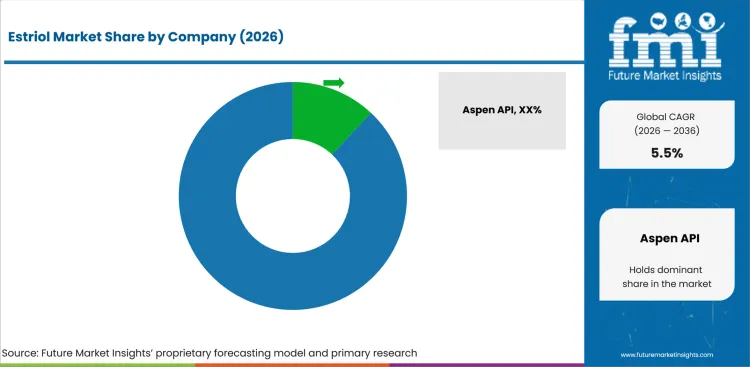
Aspen API and Zhejiang Xianju Pharmaceutical lead API evidence. Symbiotec Pharmalab and NewChem support wider supply routes. Steraloids adds testing-material coverage for estriol standards and method work.
- API suppliers compete on file depth and steroid-hormone manufacturing proof before price comparison begins.
- European API distributors gain buyer confidence through traceable sourcing and quality-document response.
- Reference-standard suppliers support method work through estriol materials used by laboratories and quality teams.
- Direct supplier access is expected to stay important through audit needs and change-control review.
Bulk API competition is centered on quality files and route evidence. Aspen API lists estriol with CEP/ASMF and US-DMF support. That gives buyers a faster path for regulated filings and audit responses. Traders without clear source documentation face a weaker position.
| Company | Relevance to Market Title | Regulatory Filing Depth | Estriol Evidence | Channel Reach | Best-fit Buyer |
|---|---|---|---|---|---|
| Aspen API | Very High | Very High | Very High | High | Finished-dose makers needing files |
| Zhejiang Xianju Pharmaceutical | High | Moderate | Moderate | High | Export buyers qualifying China sources |
| Symbiotec Pharmalab | High | High | Moderate | Moderate | Buyers assessing Indian steroid APIs |
| NewChem | Moderate | Moderate | Moderate | High | European buyers needing API distribution |
| Industriale Chimica | Moderate | Moderate | Limited | Moderate | Buyers needing European alternatives |
| Steraloids | High for standards | Not applicable | Very High | Moderate | Laboratories and method teams |
Chinese and Indian suppliers compete through steroid-hormone manufacturing depth. NewChem lists Zhejiang Xianju with 53 APIs and four production sites. Symbiotec reports a steroidal-hormone API specialization. Buyers still separate broad steroid capacity from estriol-specific proof during qualification.
Reference-material suppliers have a different role. EDQM’s June 2026 catalogue includes estriol for system suitability. Steraloids supports research access through a broad steroid index. These suppliers strengthen testing and method work instead of bulk API scale.
How do top estriol companies compare?
Aspen API scores strongest on filing evidence. Zhejiang Xianju leads supply-side breadth.
- Source: Future Market Insights competitive analysis, 2026.
- Which companies are profiled in the estriol market?
- Aspen API and Zhejiang Xianju Pharmaceutical are listed with Symbiotec and Steraloids among other suppliers.
- Companies active in estriol supply include:
- Aspen API
- Zhejiang Xianju Pharmaceutical
- Symbiotec Pharmalab
- NewChem
Key Developments in the Estriol Market
- In March 2026, DailyMed updated an estriol cream label listing 0.2% estriol under active ingredient.
- In June 2026, EDQM’s reference standard catalogue included estriol for system suitability.
- In October 2025, PMDA safety revisions covered estriol oral dosage forms in Japan.
- In November 2025, FDA announced hormone therapy labeling changes for menopause treatment.
Key Companies in the Estriol Market
API Suppliers
- Aspen API
- Zhejiang Xianju Pharmaceutical
- Symbiotec Pharmalab
- NewChem
- Industriale Chimica
Reference Standard and Laboratory Suppliers
- Steraloids
- USP Reference Standards
- EDQM Reference Standards
Regional and Cautious-Inclusion Companies
- Hubei Gedian Humanwell
- Bayer Bitterfeld API
- Qualified local API distributors
Estriol Market - Report Scope
| Parameter | Details |
|---|---|
| Forecast period | 2026 to 2036 |
| Historical period | 2021 to 2025 |
| Quantitative unit | Revenue in USD million |
| Market definition | Galantamine and galantamine hydrobromide active pharmaceutical ingredient sold for regulated pharmaceutical manufacturing. |
| Segments covered | Form · Purity Grade · Application · Sales Channel · Region |
| Countries covered | China · India · South Korea · Germany · United States · France · United Kingdom · Japan |
| Leading segment | Powder |
| Leading purity grade | ≥99.5% |
| Leading application | Alzheimer’s Disease (Mild-to-Moderate) |
| Leading channel | Direct Sales |
| Leading region | East Asia |
| Fastest-growing country | China |
Source: Future Market Insights, 2026.
Estriol Market - Scope & Definition
| Attribute | Detail |
|---|---|
| Market Definition | Commercially supplied estriol active pharmaceutical ingredient for approved or compounded pharmaceutical preparations. |
| Functions Covered | Estrogen API supply · Low-dose formulation support · Analytical standard use · Regulated sourcing. |
| Applications Covered | Creams and gels · Tablets · Capsules · Injections |
| End Users Covered | Finished-dose manufacturers · Compounding pharmacies · Formulation laboratories · Quality-control laboratories |
| Channels Covered | Direct Sales · Distributor Sales · Online/API Marketplaces · Other controlled channels |
| Regions Covered | North America · Latin America · Europe · East Asia · South Asia and Pacific · Middle East and Africa |
| Exclusions | Finished branded medicines · Diagnostic assays · Cosmetic hormone claims · Unrelated estrogen APIs |
Estriol Market - Research Methodology
| Method | Description |
|---|---|
| Primary Research | FMI analyst interviews with API sourcing managers and regulatory teams. Interviews also covered formulation buyers and qualified distributors. |
| Desk Research | Review of regulator data and medicine labels. Desk work also covered compendial references and company pages. |
| Market Sizing & Forecasting | Bottom-up API-use model using dosage-form demand and estimated consumption. Supplier availability and country regulation signals were then applied. |
| Data Validation | Cross-checks against product listings and steroid API portfolios. Country evidence and buyer qualification needs were then reviewed. |
Estriol Market Breakdown by Purity Grade, Form, Sales Channel, and Region
Estriol Market Segmented by Purity Grade:
- ≥99% API
- USP/EP Compliant
- Micronized Grade
Estriol Market Segmented by Form:
- Creams & Gels
- Tablets
- Capsules
- Injections
Estriol Market Segmented by Sales Channel:
- Direct Sales (Manufacturer to Pharma)
- Distributor Sales
- Online/API Marketplaces
- Others
Estriol Market by Region:
- North America
- Latin America
- Europe
- East Asia
- South Asia and Pacific
- Middle East and Africa
Research Sources and Bibliography
- Base de Donnees Publique des Medicaments. (2026). GYDRELLE 0,1 POUR CENT, creme vaginale. Ministere de la Sante.
- Food and Drug Administration. (2025, March 21). Bulk drug substances nominated for use in compounding under section 503B of the FD&C Act.
- Department of Health and Social Care. (2026). Get a prescription prepayment certificate: HRT PPC. GOV.UK.
- Electronic Medicines Compendium. (2026). Estriol 1mg/g cream: Summary of Product Characteristics.
- European Directorate for the Quality of Medicines & HealthCare. (2026, June 18). List of European Pharmacopoeia Reference Standards.
- Food and Drug Administration. (2023, December 14). Menopause.
- Food and Drug Administration. (2025, July 17). FDA Expert Panel on Menopause and Hormone Replacement Therapy for Women.
- Food and Drug Administration. (2025, November 10). HHS advances women’s health and removes hormone therapy warnings.
- German Federal Institute for Drugs and Medical Devices. (2026). High-dose creams containing estradiol: A new risk review.
- German Federal Statistical Office. (2025, December 11). Population projection.
- German Federal Statistical Office. (2026). Population aged 65 years or older.
- Haute Autorite de Sante. (2025, September). Specialites indiquees dans le traitement hormonal de la menopause.
- Ministry of Food and Drug Safety. (2025). 2024 Drug Approval Report.
- Ministry of Food and Drug Safety. (2025, June 18). MFDS releases the 2024 Medical Device Approval Report.
- National Bureau of Statistics of China. (2025, February 28). Statistical Communique of the People’s Republic of China on 2024 National Economic and Social Development.
- National Library of Medicine. (2026, March 26). Estriol cream. DailyMed.
- NewChem S.p.A. (2026). Zhejiang Xianju Pharmaceutical Co., Ltd.
- Food and Drug Administration. (2026, February 12). FDA approves labeling changes to menopausal hormone therapy products.
- Pharmaceuticals and Medical Devices Agency. (2025, October 22). Summary of investigation results.
- Steraloids. (2026). Steroids for research.
- Symbiotec Pharmalab. (2026). About Symbiotec.
- U.S. Census Bureau. (2025, June 26). Older adults outnumber children in 11 states and nearly half of U.S. counties.
- Food and Drug Administration. (2026, May 20). CERSI collaborative research projects.
This Report Answers
- Market size estimates for 2026 and forecasts through 2036 for the estriol market.
- Insights across more than 30 regional and country-level markets.
- Analysis of purity grade and form. The report covers sales channel and regional demand structures.
- Evaluation of local estrogen product routes and compounding-related demand limits.
- Assessment of API quality documentation needs and supplier qualification barriers.
- Country-level growth analysis for China and India. The report covers South Korea and selected regulated markets.
- Assessment of the competitive landscape including API suppliers and standards providers.
- Analysis of demand signals from medicine databases and regulator sources.
- Regional outlooks cover North America and Europe. The report covers East Asia and South Asia Pacific.
- Delivery of market data and forecasts with supporting analysis in PDF and Excel formats.
Frequently Asked Questions
What is the growth prospect for estriol API?
Demand for estriol API is expected to rise at a measured pace due to local estrogen product routes that sustain specialty sourcing.
Which companies are expected to shape the estriol market?
Aspen API and Zhejiang Xianju Pharmaceutical are expected to shape market competition through API evidence and steroid manufacturing depth.
Why do pharmaceutical buyers prefer direct supplier access?
Direct access helps buyers receive quality files and audit answers during regulated sourcing.
Which product forms support estriol API demand?
Creams and gels support demand through low-dose placement in local estrogen delivery.
How do regulations influence estriol sourcing?
Regulations influence sourcing through product approval status and documentation expectations.
Why is micronized estriol important?
Micronized estriol is important due to particle-size control for cream dispersion.
Which country is growing fastest?
China is growing fastest due to steroid API production depth for export sourcing.
What is the main restraint for estriol API suppliers?
The main restraint is the documentation burden caused by steroid hormone quality control.
Preview the report firsthand - request a free sample
Get SampleGet the brochure for pricing and purchase details.
Get PDFTable of Content
- Key Takeaways
- Market Size and CAGR
- Top Growth Driver
- Fastest Growing Segment
- Leading Region
- Key Companies
- Emerging Opportunities
- Executive Summary
- Global Market Outlook
- Demand-side Trends
- Supply-side Trends
- Technology Roadmap Analysis
- Analysis and Recommendations
- Analyst Perspective (What is happening? Why now? What should investors know?)
- Key Questions Answered
- How large is the market?
- What is the CAGR?
- What are key trends?
- Which region dominates?
- Who are the leaders?
- Market Overview
- Market Coverage / Taxonomy
- Market Definition / Scope / Limitations
- Research Methodology
- Chapter Orientation
- Analytical Lens and Working Hypotheses
- Market Structure, Signals, and Trend Drivers
- Benchmarking and Cross-market Comparability
- Market Sizing, Forecasting, and Opportunity Mapping
- Research Design and Evidence Framework
- Desk Research Programme (Secondary Evidence)
- Expert Input and Fieldwork (Primary Evidence)
- Tooling, Models, and Reference Databases
- Data Engineering and Model Build
- Quality Assurance and Audit Trail
- Market Background
- Market Dynamics (Drivers, Restraints, Opportunity, Trends)
- Scenario Forecast (Optimistic, Likely, Conservative)
- Impact Analysis
- AI Impact
- Sustainability Impact
- Regulatory Impact
- Technology Impact
- Consumer / Buyer Analysis
- Purchase Drivers
- Adoption Barriers
- Buyer Journey
- Opportunity Map Analysis
- Product Life Cycle Analysis
- Supply Chain Analysis
- Investment Feasibility Matrix
- Value Chain Analysis
- PESTLE and Porter's Analysis
- Regulatory Landscape
- Regional Parent Market Outlook
- Production and Consumption Statistics
- Import and Export Statistics
- Global Market Analysis and Forecast, 2021 to 2036
- Historical Market Size Value (USD Million) Analysis, 2021 to 2025
- Current and Future Market Size Value (USD Million) Projections, 2026 to 2036
- Y-o-Y Growth Trend Analysis
- Absolute $ Opportunity Analysis
- Global Market Pricing Analysis, 2021 to 2036
- Global Market Analysis and Forecast, By Purity Grade, 2021 to 2036
- Introduction / Key Findings
- Historical Market Size Value (USD Million) Analysis By Purity Grade, 2021 to 2025
- Current and Future Market Size Value (USD Million) Analysis and Forecast By Purity Grade, 2026 to 2036
- ≥99% API
- USP/EP Compliant
- Micronized Grade
- ≥99% API
- Y-o-Y Growth Trend Analysis By Purity Grade, 2021 to 2025
- Absolute $ Opportunity Analysis By Purity Grade, 2026 to 2036
- Global Market Analysis and Forecast, By Form, 2021 to 2036
- Introduction / Key Findings
- Historical Market Size Value (USD Million) Analysis By Form, 2021 to 2025
- Current and Future Market Size Value (USD Million) Analysis and Forecast By Form, 2026 to 2036
- Creams & Gels
- Tablets
- Capsules
- Creams & Gels
- Y-o-Y Growth Trend Analysis By Form, 2021 to 2025
- Absolute $ Opportunity Analysis By Form, 2026 to 2036
- Global Market Analysis and Forecast, By Sales Channel, 2021 to 2036
- Introduction / Key Findings
- Historical Market Size Value (USD Million) Analysis By Sales Channel, 2021 to 2025
- Current and Future Market Size Value (USD Million) Analysis and Forecast By Sales Channel, 2026 to 2036
- Direct Sales
- Distributor Sales
- Online/API Marketplaces
- Direct Sales
- Y-o-Y Growth Trend Analysis By Sales Channel, 2021 to 2025
- Absolute $ Opportunity Analysis By Sales Channel, 2026 to 2036
- Global Market Analysis and Forecast, By Region, 2021 to 2036
- Introduction
- Historical Market Size Value (USD Million) Analysis By Region, 2021 to 2025
- Current Market Size Value (USD Million) Analysis and Forecast By Region, 2026 to 2036
- North America
- Latin America
- Western Europe
- Eastern Europe
- East Asia
- South Asia and Pacific
- Middle East & Africa
- Market Attractiveness Analysis By Region
- North America Market Analysis and Forecast, By Country, 2021 to 2036
- Historical Market Size Value (USD Million) Trend Analysis By Market Taxonomy, 2021 to 2025
- Market Size Value (USD Million) Forecast By Market Taxonomy, 2026 to 2036
- By Country
- USA
- Canada
- Mexico
- By Purity Grade
- By Form
- By Sales Channel
- By Country
- Market Attractiveness Analysis
- By Country
- By Purity Grade
- By Form
- By Sales Channel
- Key Takeaways
- Latin America Market Analysis and Forecast, By Country
- Historical Market Size Value (USD Million) Trend Analysis By Market Taxonomy, 2021 to 2025
- Market Size Value (USD Million) Forecast By Market Taxonomy, 2026 to 2036
- By Country
- Brazil
- Chile
- Rest of Latin America
- By Purity Grade
- By Form
- By Sales Channel
- By Country
- Market Attractiveness Analysis
- By Country
- By Purity Grade
- By Form
- By Sales Channel
- Key Takeaways
- Western Europe Market Analysis and Forecast, By Country
- Historical Market Size Value (USD Million) Trend Analysis By Market Taxonomy, 2021 to 2025
- Market Size Value (USD Million) Forecast By Market Taxonomy, 2026 to 2036
- By Country
- Germany
- UK
- Italy
- Spain
- France
- Nordic
- BENELUX
- Rest of Western Europe
- By Purity Grade
- By Form
- By Sales Channel
- By Country
- Market Attractiveness Analysis
- By Country
- By Purity Grade
- By Form
- By Sales Channel
- Key Takeaways
- Eastern Europe Market Analysis and Forecast, By Country
- Historical Market Size Value (USD Million) Trend Analysis By Market Taxonomy, 2021 to 2025
- Market Size Value (USD Million) Forecast By Market Taxonomy, 2026 to 2036
- By Country
- Russia
- Poland
- Hungary
- Balkan & Baltic
- Rest of Eastern Europe
- By Purity Grade
- By Form
- By Sales Channel
- By Country
- Market Attractiveness Analysis
- By Country
- By Purity Grade
- By Form
- By Sales Channel
- Key Takeaways
- East Asia Market Analysis and Forecast, By Country
- Historical Market Size Value (USD Million) Trend Analysis By Market Taxonomy, 2021 to 2025
- Market Size Value (USD Million) Forecast By Market Taxonomy, 2026 to 2036
- By Country
- China
- Japan
- South Korea
- By Purity Grade
- By Form
- By Sales Channel
- By Country
- Market Attractiveness Analysis
- By Country
- By Purity Grade
- By Form
- By Sales Channel
- Key Takeaways
- South Asia and Pacific Market Analysis and Forecast, By Country
- Historical Market Size Value (USD Million) Trend Analysis By Market Taxonomy, 2021 to 2025
- Market Size Value (USD Million) Forecast By Market Taxonomy, 2026 to 2036
- By Country
- India
- ASEAN
- Australia & New Zealand
- Rest of South Asia and Pacific
- By Purity Grade
- By Form
- By Sales Channel
- By Country
- Market Attractiveness Analysis
- By Country
- By Purity Grade
- By Form
- By Sales Channel
- Key Takeaways
- Middle East & Africa Market Analysis and Forecast, By Country
- Historical Market Size Value (USD Million) Trend Analysis By Market Taxonomy, 2021 to 2025
- Market Size Value (USD Million) Forecast By Market Taxonomy, 2026 to 2036
- By Country
- Kingdom of Saudi Arabia
- Other GCC Countries
- Türkiye
- South Africa
- Other African Union
- Rest of Middle East & Africa
- By Purity Grade
- By Form
- By Sales Channel
- By Country
- Market Attractiveness Analysis
- By Country
- By Purity Grade
- By Form
- By Sales Channel
- Key Takeaways
- Key Countries Market Analysis
- USA
- Pricing Analysis
- Market Share Analysis, 2025
- By Purity Grade
- By Form
- By Sales Channel
- Canada
- Pricing Analysis
- Market Share Analysis, 2025
- By Purity Grade
- By Form
- By Sales Channel
- Mexico
- Pricing Analysis
- Market Share Analysis, 2025
- By Purity Grade
- By Form
- By Sales Channel
- Brazil
- Pricing Analysis
- Market Share Analysis, 2025
- By Purity Grade
- By Form
- By Sales Channel
- Chile
- Pricing Analysis
- Market Share Analysis, 2025
- By Purity Grade
- By Form
- By Sales Channel
- Germany
- Pricing Analysis
- Market Share Analysis, 2025
- By Purity Grade
- By Form
- By Sales Channel
- UK
- Pricing Analysis
- Market Share Analysis, 2025
- By Purity Grade
- By Form
- By Sales Channel
- Italy
- Pricing Analysis
- Market Share Analysis, 2025
- By Purity Grade
- By Form
- By Sales Channel
- Spain
- Pricing Analysis
- Market Share Analysis, 2025
- By Purity Grade
- By Form
- By Sales Channel
- France
- Pricing Analysis
- Market Share Analysis, 2025
- By Purity Grade
- By Form
- By Sales Channel
- India
- Pricing Analysis
- Market Share Analysis, 2025
- By Purity Grade
- By Form
- By Sales Channel
- ASEAN
- Pricing Analysis
- Market Share Analysis, 2025
- By Purity Grade
- By Form
- By Sales Channel
- Australia & New Zealand
- Pricing Analysis
- Market Share Analysis, 2025
- By Purity Grade
- By Form
- By Sales Channel
- China
- Pricing Analysis
- Market Share Analysis, 2025
- By Purity Grade
- By Form
- By Sales Channel
- Japan
- Pricing Analysis
- Market Share Analysis, 2025
- By Purity Grade
- By Form
- By Sales Channel
- South Korea
- Pricing Analysis
- Market Share Analysis, 2025
- By Purity Grade
- By Form
- By Sales Channel
- Russia
- Pricing Analysis
- Market Share Analysis, 2025
- By Purity Grade
- By Form
- By Sales Channel
- Poland
- Pricing Analysis
- Market Share Analysis, 2025
- By Purity Grade
- By Form
- By Sales Channel
- Hungary
- Pricing Analysis
- Market Share Analysis, 2025
- By Purity Grade
- By Form
- By Sales Channel
- Kingdom of Saudi Arabia
- Pricing Analysis
- Market Share Analysis, 2025
- By Purity Grade
- By Form
- By Sales Channel
- Türkiye
- Pricing Analysis
- Market Share Analysis, 2025
- By Purity Grade
- By Form
- By Sales Channel
- South Africa
- Pricing Analysis
- Market Share Analysis, 2025
- By Purity Grade
- By Form
- By Sales Channel
- USA
- Market Structure Analysis
- Competition Dashboard
- Competition Benchmarking
- Market Share Analysis of Top Players
- By Regional
- By Purity Grade
- By Form
- By Sales Channel
- Emerging Startups
- Innovation Benchmarking
- Competition Analysis
- Competition Deep Dive
- Aspen API
- Overview
- Product Portfolio
- Profitability by Market Segments (Product/Region/Sales Channel)
- Sales Footprint
- Strategy Overview
- Marketing Strategy
- Product Strategy
- Channel Strategy
- Zhejiang Xianju Pharmaceutical
- Symbiotec Pharmalab
- NewChem
- Industriale Chimica
- Aspen API
- Case Studies
- Success Stories
- Recent Developments
- Competition Deep Dive
- Assumptions & Acronyms Used


