

- Market Size (2026)
- USD 1.6 Bn
- Forecast (2036)
- USD 3.6 Bn
- CAGR (2026 to 2036)
- 8.3%
How big is Tafasitamab Lenalidomide DLBCL Market in 2026?
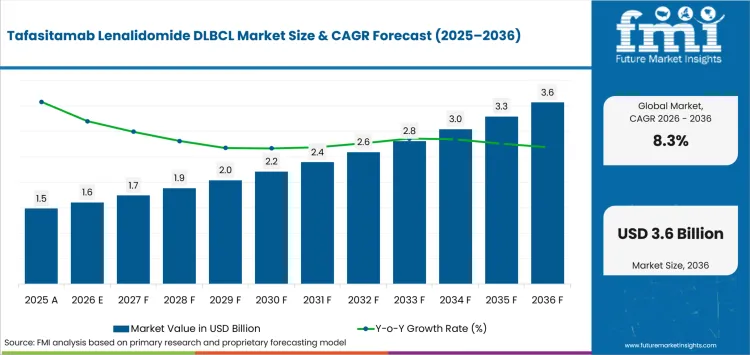
USD 1.6 billion in 2026 and USD 3.6 billion by 2036 at an 8.3% CAGR.
Sales in the tafasitamab lenalidomide DLBCL market are forecast to rise at 8.3% CAGR from 2026 to 2036, increasing valuation from USD 1.6 billion in 2026 to USD 3.6 billion by 2036. Commercial expansion depends on clinical evidence that supports eligible relapse pathways and fits established specialist care. Monoclonal antibody therapies require infusion scheduling and toxicity surveillance across hematology centers with rapid clinical response capacity. Oral immunomodulatory treatments add dispensing controls and reimbursement responsibilities across the same course of treatment. ClinicalTrials.gov posted a June 2026 phase two study evaluating tafasitamab with lenalidomide and standard immunochemotherapy before autologous stem cell transplantation in relapsed or refractory DLBCL, establishing a development signal for pathway expansion. Hospital groups gain a stronger purchasing case through one accountable pathway that aligns prescribing and patient support.
National access routes differ across the United States and Western Europe together with Japan and South Korea despite a shared clinical rationale. The United States combines accelerated approval with specialty support although payer authorization remains a separate commercial test. British adoption faces restrictive public reimbursement guidance, whereas Germany uses a completed national benefit-assessment route for the combination. Comparisons with antibody treatment platforms and next-generation immunotherapies help hospital committees assess sequencing pressure without treating adjacent therapies as regimen evidence. Market entry therefore depends on legal status and payment rules alongside accountable medicine distribution within each country.
Key Takeaways of the Tafasitamab Lenalidomide DLBCL Market
- Monoclonal antibody plus immunomodulator combination therapy is projected to hold 37.0% of therapy type demand in 2026, driven by tafasitamab's CD19-targeting action paired with oral lenalidomide's immunomodulatory contribution, with the EMA retaining authorization for the combination sequence in January 2026.
- Tafasitamab plus lenalidomide is forecast to represent 42.4% of drug regimen demand in 2026, supported by its defined twelve-cycle combination phase followed by tafasitamab monotherapy, with adoption dependent on reliable coordination across infusion and oral medicine channels.
- Second-line therapy is estimated to account for 48.9% of line-of-therapy demand in 2026, concentrated among transplant-ineligible adults with relapsed or refractory DLBCL, with ClinicalTrials.gov updating the firmMIND study in May 2026.
- Hospitals are projected to capture 44.8% of end-user demand in 2026, reflecting their combined infusion infrastructure, reimbursement coordination, and multidisciplinary safety management requirements.
- South Korea leads country growth at a 10.2% CAGR through 2036, followed by Germany at 9.7% CAGR through its national benefit-assessment pathway.
- Incyte controls tafasitamab commercialization globally, while Bristol Myers Squibb and Teva compete through branded and generic lenalidomide supply under regulated distribution channels.
Analyst Perspective
"The tafasitamab lenalidomide DLBCL market is shaped by the ability to translate combination efficacy into a practical treatment pathway for eligible patients. Clinical adoption depends on response durability, safety monitoring, treatment coordination, and funded access rather than trial results alone. Companies that strengthen evidence, streamline combination management, and address reimbursement barriers will be better positioned to sustain clinical uptake."
— Anurag Sharma, Principal Analyst at Future Market Insights
Source: FMI's proprietary forecasting model and primary research
How is the Tafasitamab Lenalidomide DLBCL Market segmented?
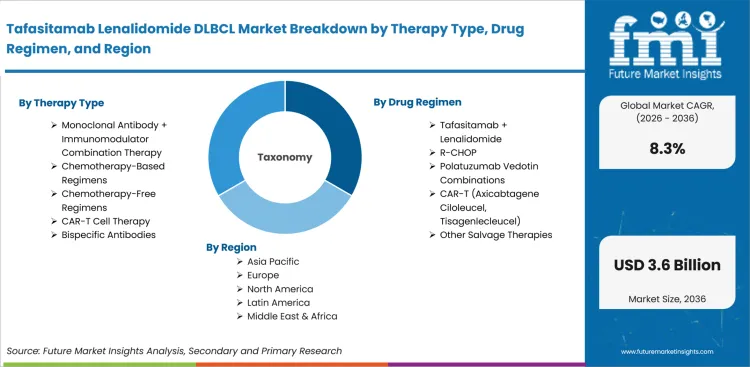
The tafasitamab lenalidomide DLBCL market is segmented by therapy type, drug regimen, line of therapy, end user, and region.
The segmentation framework separates treatment architecture from the named medicine combination and the clinical point of use. Therapy type compares combination immunotherapy with chemotherapy-based pathways and other advanced treatment architectures used in specialist care. Drug regimen analysis distinguishes tafasitamab plus lenalidomide from R-CHOP and other salvage combinations used across DLBCL care. Line-of-therapy analysis follows treatment position from second-line use through later relapse pathways and refractory disease management. End-user categories separate hospitals from specialty centers and academic cancer institutes with different infusion and monitoring responsibilities. Regional analysis compares authorization and reimbursement conditions across national systems with distinct specialist capacity and medicine distribution routes.
What supports monoclonal Antibody + Immunomodulator combination therapy within the therapy type category?
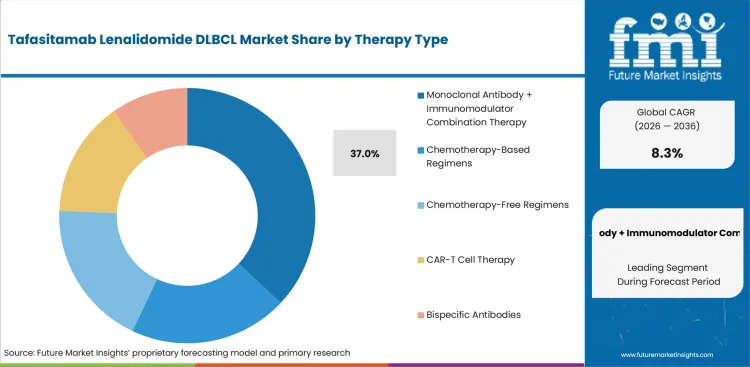
Relapsed DLBCL treatment requires a targeted antibody effect together with an oral agent that alters immune and tumor responses. The European Medicines Agency updated Minjuvi information in January 2026 and retained authorization for combination treatment followed by tafasitamab monotherapy. The treatment sequence creates a clear transition between active dual therapy and ongoing antibody control. Comparable injectable oncology drugs help hospital planners assess infusion capacity without replacing evidence for this exact regimen.
- By therapy type, monoclonal antibody + immunomodulator combination therapy is forecast to hold 37.0% share in 2026, driven by its combined CD19-targeting action and oral immunomodulatory contribution. The percentage remains a market estimate and does not represent a clinical-trial result for eligible patients.
- Adoption of this therapy type is expanding in hematology departments, supported by coordinated infusion delivery with oral dispensing and laboratory monitoring. Oncology physicians and hospital pharmacists must share responsibility for scheduling and toxicity management throughout the regimen.
How does Tafasitamab + Lenalidomide shape the drug regimen category?
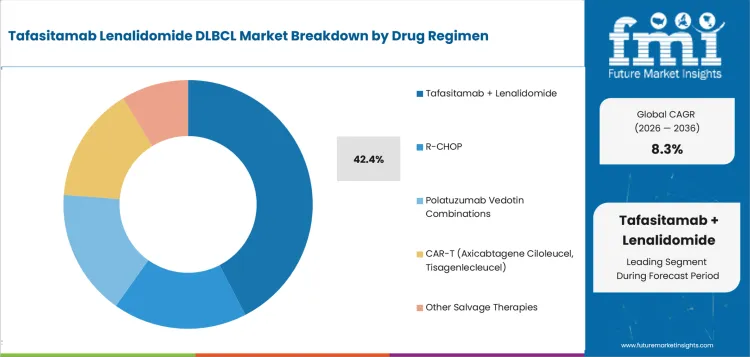
The named regimen pairs intravenous tafasitamab with oral lenalidomide during a maximum twelve-cycle combination phase. Hospitals must align infusion visits with oral dispensing and laboratory surveillance across the complete dual-treatment period. The pathway then changes to tafasitamab monotherapy for patients who continue treatment across specialist centers. The treatment sequence makes pharmacy coordination and clinical scheduling central to reliable delivery throughout the later treatment phase.
- In 2026, tafasitamab plus lenalidomide is projected to hold 42.4% share within drug regimen, the position is underpinned by its recognized treatment identity and defined continuation sequence.
- Hospital pharmacies increasingly select the regimen to address coordinated dosing instructions and clear responsibilities across infusion and oral medicine channels. Adoption weakens if lenalidomide access and risk controls fail to align with tafasitamab scheduling across treatment centers. Commercial execution therefore depends on reliable delivery across both medicines rather than the regimen name alone.
Why is Second-Line (2L) central to the line of therapy category?
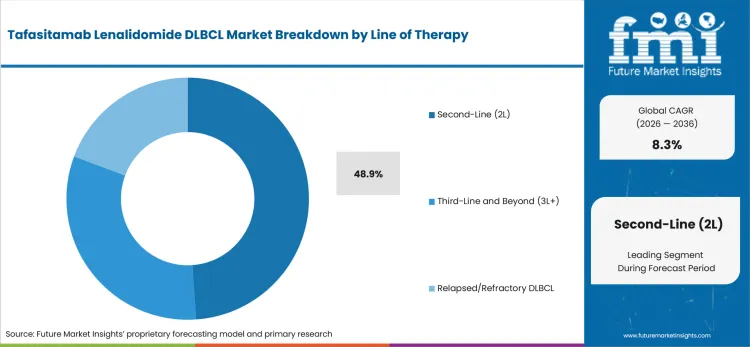
Current commercial use focuses on adults with relapsed or refractory DLBCL who cannot proceed to autologous stem cell transplantation. Specialist assessment connects prior response and transplant fitness with a practical non-transplant route for continued lymphoma treatment. Comparable lymphoproliferative treatments illustrate sequencing pressure without proving use of the named combination in DLBCL care. Referral records and prior-treatment documentation therefore determine whether the regimen enters a second-line specialist review.
- Line of therapy is forecast to be led by second-line treatment at 48.9% share in 2026, sustained by the regimen’s established relapse position. The estimate reflects concentration among eligible non-transplant patients rather than uniform use across all second-line cases. Specialist screening remains necessary to translate the authorized share into individual treatment selection across referral networks.
- Second-line treatment receives greater consideration from lymphoma specialists, owing to its role in separating transplant candidates from patients needing a non-transplant pathway. ClinicalTrials.gov updated firmMIND in May 2026 and continued evaluating tafasitamab plus lenalidomide among patients with one to three prior treatment lines. Adoption depends on timely referral and complete treatment records across specialist networks serving eligible patients.
What makes hospitals the principal End User category?
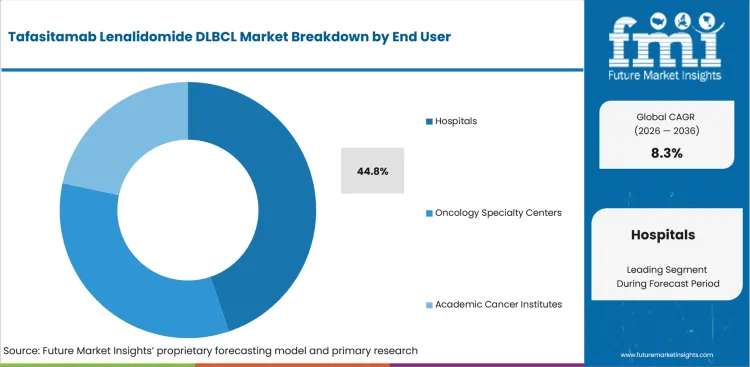
Tafasitamab delivery requires intravenous infusion capacity and rapid clinical response to infusion reactions or treatment-related cytopenias. Incyte’s patient-support page accessed in July 2026 described insurance navigation and financial assistance for eligible United States patients. Hospital teams therefore combine clinical delivery with reimbursement work and oral medicine coordination throughout treatment. The complete operating requirement exceeds the role of a standalone dispensing channel during routine combination care.
- Within end user, hospitals are projected to account for 44.8% share in 2026, the position is supported by infusion infrastructure and multidisciplinary safety management. Their position reflects coordinated physician and pharmacy oversight rather than institutional size across treatment networks. The authorized percentage remains separate from external evidence about patient-support availability in the United States.
- Regional referral networks use hospitals to address infusion and safety requirements, which concentrates complex DLBCL delivery within sites equipped for monitoring. Academic cancer institutes manage complex referrals and specialty centers provide recurring infusions closer to patients. Wider adoption requires referral coordination and reliable access to generic oncology medicines under formal distribution controls.
What are the drivers, restraints, and opportunities in the Tafasitamab Lenalidomide DLBCL Market?
Clinical evidence supports demand, treatment toxicity and reimbursement uncertainty restrict routine access, and new line-of-therapy research creates a measured development opening.
- Driver: Phase 3 evidence can expand specialist confidence and support regulatory review across newly diagnosed high-risk DLBCL populations.
- Restraint: Cytopenias and other serious adverse events require monitoring capacity that can limit use across less specialized treatment settings.
- Opportunity: Controlled research across additional relapse pathways can clarify which patient groups justify broader combination use and investment.
Clinical differentiation supports demand if the regimen improves outcomes without disrupting established lymphoma care for eligible high-risk patients. The May 2026 frontMIND publication reported a progression-free survival hazard ratio of 0.75 for the combination against R-CHOP. The result supports regulatory assessment of first-line use but does not establish commercial availability or reimbursement. Hospital committees gain a stronger evidence package without merging authorization decisions with funded-access decisions during treatment planning.
Treatment toxicity creates a material restraint for hospitals that lack frequent laboratory review and rapid management of complications. Incyte reported in May 2026 that grade three or higher adverse events occurred in 86.7% of combination recipients versus 76.1% with R-CHOP. The comparison requires treatment centers to budget monitoring capacity alongside medicine acquisition throughout the complete course. Adoption slows across facilities that cannot sustain timely cytopenia management throughout treatment during routine operations.
Research across transplant-eligible relapse pathways creates an opportunity to define new uses without assuming commercial adoption. ClinicalTrials.gov posted a phase two study in June 2026 that combines tafasitamab and lenalidomide with immunochemotherapy prior to autologous transplantation. The trial creates a verified development opening rather than a current sales route under present research conditions. Commercial teams should prepare evidence scenarios and preserve the existing authorized market boundary during investment planning.
Which country CAGRs are profiled in the Tafasitamab Lenalidomide DLBCL Market?
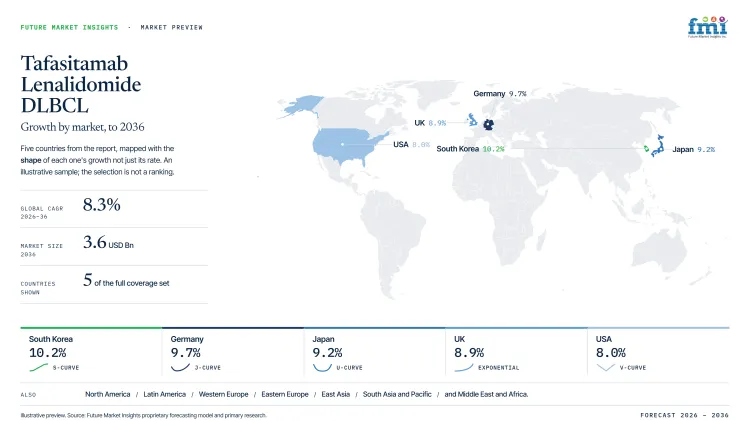
| Country | CAGR |
|---|---|
| USA | 8.0% |
| UK | 8.9% |
| Germany | 9.7% |
| Japan | 9.2% |
| South Korea | 10.2% |
How do country-level CAGRs compare in the Tafasitamab Lenalidomide DLBCL Market?
The five-country comparison spans 2.2 percentage points between the first and final displayed rates. South Korea and Germany form an upper cluster separated by one half percentage point within the authorized forecast table. Japan and the United Kingdom form a middle band despite different approval and public funding conditions. The United States remains 0.9 percentage point below the United Kingdom and 2.2 points below South Korea. Measured spacing matters, similar forecast rates can conceal materially different commercial entry requirements across current national systems.
- South Korea and Germany occupy the upper band, yet each market depends on a different combination of local authorization and reimbursement readiness.
- Japan and the United Kingdom form the middle cluster despite sharply different access conditions under national approval and public funding systems.
- The United States sits outside the main cluster and maintains the most established commercial support pathway among the five countries.
Similar CAGRs can produce different entry decisions through uneven medicine approval and payer review across national health systems. Hospital infusion capacity and oral drug distribution also mature at different speeds across the five profiled countries. Comparisons with peripheral lymphoma therapies and CNS lymphoma treatments provide broader access context without proving adoption for this combination. The measured forecast gaps support country-specific planning instead of one regional launch assumption across the five profiled systems. The full report provides country-level CAGR analysis across the Americas and Europe alongside Asia, Oceania and the Middle East and Africa.
Country-wise Analysis
- United States oncology networks already combine authorized tafasitamab access with specialty distribution across established hematology referral systems. The outlook for the tafasitamab lenalidomide DLBCL market in the United States is anticipated to advance at 8.0% CAGR over the assessment period, attributable to established commercial availability. As of July 2026, the FDA accelerated-approval list retained Monjuvi for DLBCL and linked continued authorization to confirmatory evidence. The retained authorization route enables specialist prescribing through centers with established infusion and safety-monitoring capacity. Payer authorization remains the main local friction and first-line research cannot support use outside the current label.
- United Kingdom hematology services operate through centralized public reimbursement decisions and specialist hospital commissioning across National Health Service pathways. Sales of tafasitamab plus lenalidomide in the United Kingdom are forecast to expand at 8.9% CAGR by 2036, facilitated by a transparent national appraisal route. NICE guidance published in May 2023 does not recommend the regimen for routine National Health Service use. As of July 2026, NICE scheduled its first-line appraisal decision for June 2027 under the development timetable. The appraisal process offers a clear route for new evidence, but the current nonrecommendation continues to block routine NHS funding.
- German lymphoma centers work within statutory reimbursement structures that connect European authorization with national benefit assessment. In March 2022, the Federal Joint Committee completed its tafasitamab plus lenalidomide assessment and identified Incyte Biosciences Germany as the manufacturer. The German tafasitamab lenalidomide DLBCL market sector is projected to record 9.7% CAGR during the assessment period, underpinned by established evaluation infrastructure. The completed assessment gives manufacturers and statutory insurers a defined route for commercial negotiation and national planning. Price negotiation and evidence expectations remain the material access friction for routine use across statutory purchasing channels.
- Japanese cancer centers now work through national authorization and specialist hospital distribution for tafasitamab plus lenalidomide in relapsed DLBCL. Demand for tafasitamab plus lenalidomide in Japan is forecast to rise at 9.2% CAGR over the forecast period, driven by national approval and specialist infrastructure. A study first published in January 2026 reported that J-MIND treated 24 patients across six Japanese sites during its phase 1b portion. Local clinical experience supports medical training and specialist evaluation across the newly authorized treatment pathway. Reimbursement listing and coordinated hospital supply remain material frictions for routine access across participating institutions.
- South Korean tertiary hospitals generate comparative DLBCL evidence through established academic registries and specialist hematology research teams. A March 2026 study compared 76 L-MIND participants with 39 patients from the Samsung Medical Center registry in South Korea. Adoption of tafasitamab plus lenalidomide in South Korea is estimated to expand at 10.2% CAGR through 2036, enabled by tertiary oncology capability. Local evidence expertise supports specialist evaluation and treatment planning for the named combination across tertiary centers. Research findings do not establish local authorization or reimbursement and that gap remains the material commercial friction.
Who are the notable companies in the Tafasitamab Lenalidomide DLBCL Market?
The competitive roster includes one tafasitamab rights holder and seven regulated lenalidomide suppliers supporting the combination pathway.
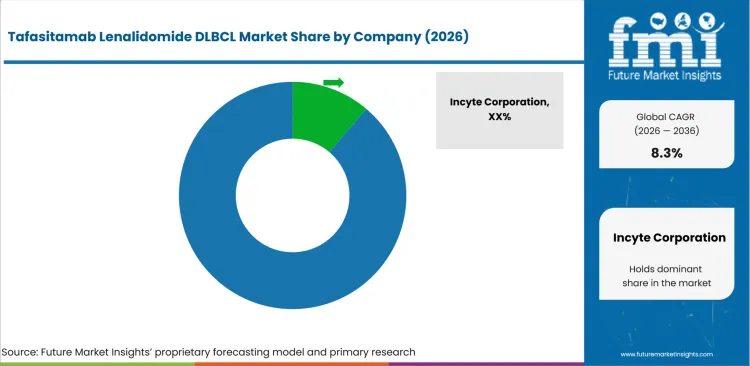
Incyte’s 2025 Form 10-K confirms exclusive global tafasitamab rights and responsibility for United States commercialization revenue and costs. Bristol Myers Squibb reports Revlimid as a current medicine, whereas Teva and Amneal maintain regulated United States lenalidomide labels. Dr. Reddy’s Laboratories and Sun Pharmaceutical Industries join Aurobindo Pharma Limited and Zydus Pharmaceuticals USA through current labeled capsules. Companies active across antibody therapeutics can offer adjacent oncology expertise but direct participation requires responsibility for tafasitamab or lenalidomide. The roster excludes DLBCL products without an exact role in the named combination pathway under current commercial conditions.
- Incyte combines exclusive tafasitamab control with dedicated patient access support and current clinical development across several DLBCL treatment settings.
- Bristol Myers Squibb maintains the branded Revlimid role with an established risk-management system and current worldwide commercial reporting.
- Regulated generic manufacturers compete through current capsule labels and formal medicine support rather than ownership of the tafasitamab antibody.
Competitive Benchmarking: Tafasitamab Lenalidomide DLBCL Market
| Company | Tafasitamab Control | Lenalidomide Supply | Access Support | Geographic Reach |
|---|---|---|---|---|
| Incyte Corporation | High | Low | High | United States, Europe, Japan |
| Bristol Myers Squibb | Low | High | High | Global |
| Teva Pharmaceuticals, Inc. | Low | High | Medium | United States |
| Amneal Pharmaceuticals NY LLC | Low | High | Medium | United States |
| Dr. Reddy’s Laboratories Inc. | Low | High | Medium | United States |
| Sun Pharmaceutical Industries, Inc. | Low | High | Medium | United States |
| Aurobindo Pharma Limited | Low | High | Medium | United States |
| Zydus Pharmaceuticals USA Inc. | Low | High | Medium | United States |
Key Developments in the Tafasitamab Lenalidomide DLBCL Market
- In June 2026, Incyte announced Japanese approval of Minjuvi with lenalidomide for adults with relapsed or refractory DLBCL. The decision established a verified legal sale route under Incyte Biosciences Japan and changed the country’s commercial availability framework. Launch execution now depends on reimbursement listing and coordinated hospital supply rather than additional proof of national authorization.
- In April 2025, Roche received European Commission approval for Columvi plus GemOx in relapsed or refractory DLBCL.
- The approval covers transplant-ineligible patients following at least one previous systemic treatment. This earlier-line bispecific regimen increases direct competition for tafasitamab plus lenalidomide among transplant-ineligible patients.
- In August 2024, Regeneron received European Union approval for Ordspono in relapsed or refractory DLBCL. The approval covers patients whose disease progressed after at least two previous systemic therapies.
Key Players in the Tafasitamab Lenalidomide DLBCL Market
Tafasitamab Rights Holder
- Incyte Corporation
Branded Lenalidomide Supplier
- Bristol Myers Squibb
Generic Lenalidomide Suppliers
- Teva Pharmaceuticals, Inc.
- Amneal Pharmaceuticals NY LLC
- Dr. Reddy’s Laboratories Inc.
- Sun Pharmaceutical Industries, Inc.
- Aurobindo Pharma Limited
- Zydus Pharmaceuticals USA Inc.
Tafasitamab Lenalidomide DLBCL Market - Report Scope
| Coverage field | Report scope |
|---|---|
| Market breakdown | Therapy type, drug regimen, line of therapy, end user, and region. |
| Quantitative Units | Revenue in USD Million, CAGR in %. |
| Market Definition | Revenue from DLBCL treatment pathways assessed across the approved therapy and regimen taxonomy, with tafasitamab + lenalidomide as the named regimen reference. |
| Regions Covered | North America, Latin America, Western Europe, Eastern Europe, East Asia, South Asia and Pacific, and Middle East and Africa. |
| Countries Covered | USA, UK, Germany, Japan, and South Korea, with additional countries assessed in the full report. |
| Key Companies Profiled | Incyte Corporation, Bristol Myers Squibb, Teva Pharmaceuticals, Inc., Amneal Pharmaceuticals NY LLC, Dr. Reddy’s Laboratories Inc., Sun Pharmaceutical Industries, Inc., Aurobindo Pharma Limited, and Zydus Pharmaceuticals USA Inc. |
| Forecast Period | 2026 to 2036. |
| Approach | Hybrid bottom-up and top-down market sizing supported by primary research and official desk research. |
Tafasitamab Lenalidomide DLBCL Market - Research Methodology
| Method | Approach |
|---|---|
| Primary Research | FMI analysts gathered input from manufacturers, service providers, technology developers, distributors, end users, sourcing teams, and subject-matter experts. Interviews examined purchasing decisions, product or service evaluation, adoption barriers, approval requirements, pricing considerations, and expectations for technical or commercial support. Respondents were also asked what evidence is required before a trial, pilot, or initial order develops into regular purchasing. |
| Desk Research | Desk research covered government statistics, regulatory publications, trade data, industry associations, technical literature, standards, company filings, product information, and official corporate announcements. Sources were reviewed for relevance, publication date, geographic coverage, and consistency with the defined market scope. Claims relating to performance, applications, approvals, capacity, investment, and commercial activity were retained only when supported by credible public evidence. |
| Market Sizing and Forecasting | The market model combined the baseline value with historical performance, segment structure, pricing and volume indicators, adoption levels, company participation, and country-level demand conditions. Forecast assumptions considered economic activity, investment trends, regulatory developments, technology adoption, purchasing cycles, supply availability, and barriers to wider market use. Segment and regional estimates were reconciled before the final market total was calculated. |
| Data Validation | Estimates were checked against multiple independent indicators, including public data, company activity, trade patterns, industry developments, and findings from primary interviews. Validation also tested whether products, services, applications, and company revenues fell within the defined market boundaries. Adjacent categories, unsupported claims, overlapping revenues, and activities without direct market relevance were excluded to reduce double counting and maintain consistency across segments and countries. |
Tafasitamab Lenalidomide DLBCL Market by Segments
Tafasitamab Lenalidomide DLBCL Market segmented by Therapy Type:
- Monoclonal Antibody + Immunomodulator Combination Therapy
- Chemotherapy-Based Regimens
- Chemotherapy-Free Regimens
- CAR-T Cell Therapy
- Bispecific Antibodies
Tafasitamab Lenalidomide DLBCL Market segmented by Drug Regimen:
- Tafasitamab + Lenalidomide
- R-CHOP
- Polatuzumab Vedotin Combinations
- CAR-T (Axicabtagene Ciloleucel, Tisagenlecleucel)
- Other Salvage Therapies
Tafasitamab Lenalidomide DLBCL Market segmented by Line of Therapy:
- Second-Line (2L)
- Third-Line and Beyond (3L+)
- Relapsed/Refractory DLBCL
Tafasitamab Lenalidomide DLBCL Market segmented by End User:
- Hospitals
- Oncology Specialty Centers
- Academic Cancer Institutes
Tafasitamab Lenalidomide DLBCL Market by Region:
- North America
- United States
- Canada
- Latin America
- Brazil
- Mexico
- Argentina
- Chile
- Western Europe
- Germany
- France
- United Kingdom
- Italy
- Spain
- Benelux
- Nordics
- Eastern Europe
- Poland
- Czech Republic
- Romania
- Hungary
- East Asia
- China
- Japan
- South Korea
- South Asia and Pacific
- India
- ASEAN
- Australia and New Zealand
- Middle East and Africa
- GCC Countries
- South Africa
- Türkiye
- Israel
Research Sources and Bibliography
- ClinicalTrials.gov. (2026, June 2). Efficacy and Safety of Sequential Autologous Hematopoietic Stem Cell Transplantation Combined With Tafasitamab, Lenalidomide, and Standard Immunochemotherapy for Relapsed/Refractory Diffuse Large B-cell Lymphoma.
- European Medicines Agency. (2026, January 27). Minjuvi.
- National Library of Medicine. (2026, February 2). DailyMed - MONJUVI- tafasitamab-cxix injection, powder, lyophilized, for solution.
- ClinicalTrials.gov. (2026, May 5). Study to Evaluate the Safety and Efficacy of Tafasitamab Plus Lenalidomide in Participants With Relapsed or Refractory Diffuse Large B-Cell Lymphoma (firmMIND).
- Lenz, G., Trněný, M., Burke, J. M., Nowakowski, G. S., Fox, C. P., Chiappella, A., Duell, J., Jeon, Y. W., Cheah, C. Y., Westin, J., Ye, J. Z., Caguioa, P. B., Belada, D., Shin, H. J., Oh, S. Y., Amorim, S., Ku, M., Mocikova, H., Jimenez, J. L., . . . frontMIND Study Investigators. (2026, May 30). Tafasitamab plus lenalidomide and R-CHOP versus R-CHOP for first-line treatment of patients with high-risk diffuse large B-cell lymphoma (frontMIND): A global, phase 3, randomised, double-blind, placebo-controlled trial.
- Incyte Corporation. (2026, May 30). Incyte’s Pivotal frontMIND Trial Showed Tafasitamab (Monjuvi®/Minjuvi®) Combination Significantly Prolonged Progression-free Survival, Reducing the Risk of Disease Progression or Death by 25% in Patients with Previously Untreated, High-risk DLBCL.
- ClinicalTrials.gov. (2026, June 2). Efficacy and Safety of Sequential Autologous Hematopoietic Stem Cell Transplantation Combined With Tafasitamab, Lenalidomide, and Standard Immunochemotherapy for Relapsed/Refractory Diffuse Large B-cell Lymphoma.
- USA Food and Drug Administration. (n.d.). Ongoing Cancer Accelerated Approvals.
- National Institute for Health and Care Excellence. (2023, May 3). Tafasitamab with lenalidomide for treating relapsed or refractory diffuse large B-cell lymphoma.
- National Institute for Health and Care Excellence. (n.d.). Tafasitamab with lenalidomide and R-CHOP for untreated high-intermediate-risk or high-risk diffuse large B-cell lymphoma [ID6568].
- Gemeinsamer Bundesausschuss. (2022, March 3). Nutzenbewertungsverfahren zum Wirkstoff Tafasitamab (Diffus großzelliges B-Zell-Lymphom, Kombination mit Lenalidomid).
- Izutsu, K., Fukuhara, N., Yuda, J., Suehiro, Y., Kusumoto, S., Casadebaig, M.-L., Suzukawa, K., & Fukushima, K. (2026, January 21). Tafasitamab as Monotherapy or in Combination in Japanese Patients With B-Cell Non-Hodgkin Lymphoma: Results From the Phase 1b J-MIND Study.
- Jung, K., Kim, J. H., Lim, H., Kim, S., Hyun, B. J., Yoo, S. H., Shin, J.-Y., & Kim, S. J. (2026, March 30). Comparative Effectiveness of Tafasitamab Plus Lenalidomide versus Ifosfamide, Carboplatin, Etoposide-Based Chemotherapy for Relapsed/Refractory Diffuse Large B-cell Lymphoma: An External Control Arm Study.
- Incyte Corporation. (2026, February 10). incy-20251231.
- Bristol-Myers Squibb Company. (2026, March 25). Annual Report 2025 - Bristol Myers Squibb.
- National Library of Medicine. (2023, March 24). DailyMed - REVLIMID- lenalidomide capsule.
- National Library of Medicine. (2026, May 27). DailyMed - LENALIDOMIDE capsule.
- National Library of Medicine. (2026, May 14). DailyMed - LENALIDOMIDE capsule.
- National Library of Medicine. (2023, April 30). DailyMed - LENALIDOMIDE capsule.
- National Library of Medicine. (2024, December 13). DailyMed - LENALIDOMIDE capsule.
- National Library of Medicine. (2023, June 29). DailyMed - LENALIDOMIDE capsule.
- National Library of Medicine. (2024, February 10). DailyMed - LENALIDOMIDE capsule.
- Roche. (2025, April 14). European Commission approves Roche’s Columvi as the first bispecific antibody for diffuse large B-cell lymphoma after initial therapy.
- Regeneron Pharmaceuticals, Inc. (2024, August 26). Ordspono™ (odronextamab) approved in the European Union for the treatment of relapsed/refractory follicular lymphoma and diffuse large B-cell lymphoma.
- Incyte Corporation. (2026, January 5). Incyte Announces Positive Topline Results from Pivotal Study of Tafasitamab (Monjuvi®/Minjuvi®) as a First-line Treatment for Diffuse Large B-Cell Lymphoma.
- Incyte Corporation. (2026, April 21). Incyte Highlights New Phase 3 Tafasitamab Data at the 2026 American Society of Clinical Oncology (ASCO) Annual Meeting.
- Incyte Corporation. (2026, June 13). Results from Incyte’s Pivotal Phase 3 frontMIND Trial of Tafasitamab (Monjuvi®/Minjuvi®) Combination Presented at the 2026 European Hematology Association (EHA) Congress Plenary Showed Prolonged Progression Free Survival.
- Incyte Corporation. (2026, June 19). Incyte Japan Announces Approval of Minjuvi® (tafasitamab) in Combination with Lenalidomide for the Treatment of Adults with Relapsed or Refractory Diffuse Large B-Cell Lymphoma (DLBCL).
This bibliography is provided for reader reference and is not exhaustive. The full report contains the complete reference list and detailed citations.
This Report Answers
- How large is the tafasitamab lenalidomide DLBCL market in 2026 and 2036?
- Which clinical and access conditions support growth in the tafasitamab lenalidomide DLBCL market?
- Why does Monoclonal Antibody + Immunomodulator Combination Therapy hold the principal therapy-type share in 2026?
- How does Tafasitamab + Lenalidomide shape drug-regimen purchasing and treatment coordination?
- Why does Second-Line (2L) hold the principal line-of-therapy share in 2026?
- How do country growth rates differ across the USA, UK, Germany, Japan, and South Korea?
- Which companies directly participate in the tafasitamab lenalidomide DLBCL market?
- What safety and reimbursement conditions restrict routine adoption across hospitals?
- How should executives evaluate regulatory expansion without confusing trial progress with authorized use?
Frequently Asked Questions
How big is the Tafasitamab Lenalidomide DLBCL Market in 2026?
The tafasitamab lenalidomide DLBCL market is valued at USD 1.6 billion in 2026 and is forecast to reach USD 3.6 billion by 2036.
What is the CAGR of the Tafasitamab Lenalidomide DLBCL Market from 2026 to 2036?
The tafasitamab lenalidomide DLBCL market is projected to grow at a CAGR of 8.3% between 2026 and 2036, supported by phase 3 evidence expanding specialist confidence and supporting regulatory review across newly diagnosed high-risk DLBCL populations.
Which line of therapy leads the Tafasitamab Lenalidomide DLBCL Market?
Second-line therapy accounts for 48.9% of the tafasitamab lenalidomide DLBCL market by line of therapy in 2026, driven by concentration among transplant-ineligible adults with relapsed or refractory DLBCL requiring a non-transplant pathway following initial regimen failure.
Which country is growing fastest in the Tafasitamab Lenalidomide DLBCL Market?
South Korea is the fastest-growing country in the tafasitamab lenalidomide DLBCL market, expanding at a 10.2% CAGR through 2036, ahead of the market average of 8.3%, enabled by tertiary oncology capability and local evidence expertise supporting specialist evaluation and treatment planning across major cancer centers.
Who are the leading companies in the Tafasitamab Lenalidomide DLBCL Market?
Leading companies in the tafasitamab lenalidomide DLBCL market include Incyte Corporation, Bristol Myers Squibb, Teva Pharmaceuticals, Amneal Pharmaceuticals, Dr. Reddy's Laboratories, Sun Pharmaceutical Industries, Aurobindo Pharma, and Zydus Pharmaceuticals, competing across tafasitamab rights ownership, branded lenalidomide supply, and regulated generic lenalidomide distribution channels.
Preview the report firsthand - request a free sample
Get SampleGet the brochure for pricing and purchase details.
Get PDFTable of Content
- Key Takeaways
- Market Size and CAGR
- Top Growth Driver
- Fastest Growing Segment
- Leading Region
- Key Companies
- Emerging Opportunities
- Executive Summary
- Global Market Outlook
- Demand-side Trends
- Supply-side Trends
- Technology Roadmap Analysis
- Analysis and Recommendations
- Analyst Perspective (What is happening? Why now? What should investors know?)
- Key Questions Answered
- How large is the market?
- What is the CAGR?
- What are key trends?
- Which region dominates?
- Who are the leaders?
- Market Overview
- Market Coverage / Taxonomy
- Market Definition / Scope / Limitations
- Research Methodology
- Chapter Orientation
- Analytical Lens and Working Hypotheses
- Market Structure, Signals, and Trend Drivers
- Benchmarking and Cross-market Comparability
- Market Sizing, Forecasting, and Opportunity Mapping
- Research Design and Evidence Framework
- Desk Research Programme (Secondary Evidence)
- Expert Input and Fieldwork (Primary Evidence)
- Tooling, Models, and Reference Databases
- Data Engineering and Model Build
- Quality Assurance and Audit Trail
- Market Background
- Market Dynamics (Drivers, Restraints, Opportunity, Trends)
- Scenario Forecast (Optimistic, Likely, Conservative)
- Impact Analysis
- AI Impact
- Sustainability Impact
- Regulatory Impact
- Technology Impact
- Consumer / Buyer Analysis
- Purchase Drivers
- Adoption Barriers
- Buyer Journey
- Opportunity Map Analysis
- Product Life Cycle Analysis
- Supply Chain Analysis
- Investment Feasibility Matrix
- Value Chain Analysis
- PESTLE and Porter's Analysis
- Regulatory Landscape
- Regional Parent Market Outlook
- Production and Consumption Statistics
- Import and Export Statistics
- Global Market Analysis and Forecast, 2021 to 2036
- Historical Market Size Value (USD Billion) Analysis, 2021 to 2025
- Current and Future Market Size Value (USD Billion) Projections, 2026 to 2036
- Y-o-Y Growth Trend Analysis
- Absolute $ Opportunity Analysis
- Global Market Pricing Analysis, 2021 to 2036
- Global Market Analysis and Forecast, By Therapy Type, 2021 to 2036
- Introduction / Key Findings
- Historical Market Size Value (USD Billion) Analysis By Therapy Type, 2021 to 2025
- Current and Future Market Size Value (USD Billion) Analysis and Forecast By Therapy Type, 2026 to 2036
- Monoclonal Antibody + Immunomodulator Combination Therapy
- Chemotherapy-Based Regimens
- Chemotherapy-Free Regimens
- CAR-T Cell Therapy
- Bispecific Antibodies
- Monoclonal Antibody + Immunomodulator Combination Therapy
- Y-o-Y Growth Trend Analysis By Therapy Type, 2021 to 2025
- Absolute $ Opportunity Analysis By Therapy Type, 2026 to 2036
- Global Market Analysis and Forecast, By Drug Regimen, 2021 to 2036
- Introduction / Key Findings
- Historical Market Size Value (USD Billion) Analysis By Drug Regimen, 2021 to 2025
- Current and Future Market Size Value (USD Billion) Analysis and Forecast By Drug Regimen, 2026 to 2036
- Tafasitamab + Lenalidomide
- R-CHOP
- Polatuzumab Vedotin Combinations
- CAR-T (Axicabtagene Ciloleucel, Tisagenlecleucel)
- Other Salvage Therapies
- Tafasitamab + Lenalidomide
- Y-o-Y Growth Trend Analysis By Drug Regimen, 2021 to 2025
- Absolute $ Opportunity Analysis By Drug Regimen, 2026 to 2036
- Global Market Analysis and Forecast, By Line of Therapy, 2021 to 2036
- Introduction / Key Findings
- Historical Market Size Value (USD Billion) Analysis By Line of Therapy, 2021 to 2025
- Current and Future Market Size Value (USD Billion) Analysis and Forecast By Line of Therapy, 2026 to 2036
- Second-Line (2L)
- Third-Line and Beyond (3L+)
- Relapsed/Refractory DLBCL
- Second-Line (2L)
- Y-o-Y Growth Trend Analysis By Line of Therapy, 2021 to 2025
- Absolute $ Opportunity Analysis By Line of Therapy, 2026 to 2036
- Global Market Analysis and Forecast, By End User, 2021 to 2036
- Introduction / Key Findings
- Historical Market Size Value (USD Billion) Analysis By End User, 2021 to 2025
- Current and Future Market Size Value (USD Billion) Analysis and Forecast By End User, 2026 to 2036
- Hospitals
- Oncology Specialty Centers
- Academic Cancer Institutes
- Hospitals
- Y-o-Y Growth Trend Analysis By End User, 2021 to 2025
- Absolute $ Opportunity Analysis By End User, 2026 to 2036
- Global Market Analysis and Forecast, By Region, 2021 to 2036
- Introduction
- Historical Market Size Value (USD Billion) Analysis By Region, 2021 to 2025
- Current Market Size Value (USD Billion) Analysis and Forecast By Region, 2026 to 2036
- North America
- Latin America
- Western Europe
- Eastern Europe
- East Asia
- South Asia and Pacific
- Middle East & Africa
- Market Attractiveness Analysis By Region
- North America Market Analysis and Forecast, By Country, 2021 to 2036
- Historical Market Size Value (USD Billion) Trend Analysis By Market Taxonomy, 2021 to 2025
- Market Size Value (USD Billion) Forecast By Market Taxonomy, 2026 to 2036
- By Country
- USA
- Canada
- By Therapy Type
- By Drug Regimen
- By Line of Therapy
- By End User
- By Country
- Market Attractiveness Analysis
- By Country
- By Therapy Type
- By Drug Regimen
- By Line of Therapy
- By End User
- Key Takeaways
- Latin America Market Analysis and Forecast, By Country
- Historical Market Size Value (USD Billion) Trend Analysis By Market Taxonomy, 2021 to 2025
- Market Size Value (USD Billion) Forecast By Market Taxonomy, 2026 to 2036
- By Country
- Brazil
- Mexico
- Chile
- Rest of Latin America
- By Therapy Type
- By Drug Regimen
- By Line of Therapy
- By End User
- By Country
- Market Attractiveness Analysis
- By Country
- By Therapy Type
- By Drug Regimen
- By Line of Therapy
- By End User
- Key Takeaways
- Western Europe Market Analysis and Forecast, By Country
- Historical Market Size Value (USD Billion) Trend Analysis By Market Taxonomy, 2021 to 2025
- Market Size Value (USD Billion) Forecast By Market Taxonomy, 2026 to 2036
- By Country
- Germany
- UK
- Italy
- Spain
- France
- Nordic
- BENELUX
- Rest of Western Europe
- By Therapy Type
- By Drug Regimen
- By Line of Therapy
- By End User
- By Country
- Market Attractiveness Analysis
- By Country
- By Therapy Type
- By Drug Regimen
- By Line of Therapy
- By End User
- Key Takeaways
- Eastern Europe Market Analysis and Forecast, By Country
- Historical Market Size Value (USD Billion) Trend Analysis By Market Taxonomy, 2021 to 2025
- Market Size Value (USD Billion) Forecast By Market Taxonomy, 2026 to 2036
- By Country
- Russia
- Poland
- Hungary
- Balkan & Baltic
- Rest of Eastern Europe
- By Therapy Type
- By Drug Regimen
- By Line of Therapy
- By End User
- By Country
- Market Attractiveness Analysis
- By Country
- By Therapy Type
- By Drug Regimen
- By Line of Therapy
- By End User
- Key Takeaways
- East Asia Market Analysis and Forecast, By Country
- Historical Market Size Value (USD Billion) Trend Analysis By Market Taxonomy, 2021 to 2025
- Market Size Value (USD Billion) Forecast By Market Taxonomy, 2026 to 2036
- By Country
- China
- Japan
- South Korea
- By Therapy Type
- By Drug Regimen
- By Line of Therapy
- By End User
- By Country
- Market Attractiveness Analysis
- By Country
- By Therapy Type
- By Drug Regimen
- By Line of Therapy
- By End User
- Key Takeaways
- South Asia and Pacific Market Analysis and Forecast, By Country
- Historical Market Size Value (USD Billion) Trend Analysis By Market Taxonomy, 2021 to 2025
- Market Size Value (USD Billion) Forecast By Market Taxonomy, 2026 to 2036
- By Country
- India
- ASEAN
- Australia & New Zealand
- Rest of South Asia and Pacific
- By Therapy Type
- By Drug Regimen
- By Line of Therapy
- By End User
- By Country
- Market Attractiveness Analysis
- By Country
- By Therapy Type
- By Drug Regimen
- By Line of Therapy
- By End User
- Key Takeaways
- Middle East & Africa Market Analysis and Forecast, By Country
- Historical Market Size Value (USD Billion) Trend Analysis By Market Taxonomy, 2021 to 2025
- Market Size Value (USD Billion) Forecast By Market Taxonomy, 2026 to 2036
- By Country
- Kingdom of Saudi Arabia
- Other GCC Countries
- Türkiye
- South Africa
- Other African Union
- Rest of Middle East & Africa
- By Therapy Type
- By Drug Regimen
- By Line of Therapy
- By End User
- By Country
- Market Attractiveness Analysis
- By Country
- By Therapy Type
- By Drug Regimen
- By Line of Therapy
- By End User
- Key Takeaways
- Key Countries Market Analysis
- USA
- Pricing Analysis
- Market Share Analysis, 2025
- By Therapy Type
- By Drug Regimen
- By Line of Therapy
- By End User
- Canada
- Pricing Analysis
- Market Share Analysis, 2025
- By Therapy Type
- By Drug Regimen
- By Line of Therapy
- By End User
- Mexico
- Pricing Analysis
- Market Share Analysis, 2025
- By Therapy Type
- By Drug Regimen
- By Line of Therapy
- By End User
- Brazil
- Pricing Analysis
- Market Share Analysis, 2025
- By Therapy Type
- By Drug Regimen
- By Line of Therapy
- By End User
- Chile
- Pricing Analysis
- Market Share Analysis, 2025
- By Therapy Type
- By Drug Regimen
- By Line of Therapy
- By End User
- Germany
- Pricing Analysis
- Market Share Analysis, 2025
- By Therapy Type
- By Drug Regimen
- By Line of Therapy
- By End User
- UK
- Pricing Analysis
- Market Share Analysis, 2025
- By Therapy Type
- By Drug Regimen
- By Line of Therapy
- By End User
- Italy
- Pricing Analysis
- Market Share Analysis, 2025
- By Therapy Type
- By Drug Regimen
- By Line of Therapy
- By End User
- Spain
- Pricing Analysis
- Market Share Analysis, 2025
- By Therapy Type
- By Drug Regimen
- By Line of Therapy
- By End User
- France
- Pricing Analysis
- Market Share Analysis, 2025
- By Therapy Type
- By Drug Regimen
- By Line of Therapy
- By End User
- India
- Pricing Analysis
- Market Share Analysis, 2025
- By Therapy Type
- By Drug Regimen
- By Line of Therapy
- By End User
- ASEAN
- Pricing Analysis
- Market Share Analysis, 2025
- By Therapy Type
- By Drug Regimen
- By Line of Therapy
- By End User
- Australia & New Zealand
- Pricing Analysis
- Market Share Analysis, 2025
- By Therapy Type
- By Drug Regimen
- By Line of Therapy
- By End User
- China
- Pricing Analysis
- Market Share Analysis, 2025
- By Therapy Type
- By Drug Regimen
- By Line of Therapy
- By End User
- Japan
- Pricing Analysis
- Market Share Analysis, 2025
- By Therapy Type
- By Drug Regimen
- By Line of Therapy
- By End User
- South Korea
- Pricing Analysis
- Market Share Analysis, 2025
- By Therapy Type
- By Drug Regimen
- By Line of Therapy
- By End User
- Russia
- Pricing Analysis
- Market Share Analysis, 2025
- By Therapy Type
- By Drug Regimen
- By Line of Therapy
- By End User
- Poland
- Pricing Analysis
- Market Share Analysis, 2025
- By Therapy Type
- By Drug Regimen
- By Line of Therapy
- By End User
- Hungary
- Pricing Analysis
- Market Share Analysis, 2025
- By Therapy Type
- By Drug Regimen
- By Line of Therapy
- By End User
- Kingdom of Saudi Arabia
- Pricing Analysis
- Market Share Analysis, 2025
- By Therapy Type
- By Drug Regimen
- By Line of Therapy
- By End User
- Türkiye
- Pricing Analysis
- Market Share Analysis, 2025
- By Therapy Type
- By Drug Regimen
- By Line of Therapy
- By End User
- South Africa
- Pricing Analysis
- Market Share Analysis, 2025
- By Therapy Type
- By Drug Regimen
- By Line of Therapy
- By End User
- USA
- Market Structure Analysis
- Competition Dashboard
- Competition Benchmarking
- Market Share Analysis of Top Players
- By Regional
- By Therapy Type
- By Drug Regimen
- By Line of Therapy
- By End User
- Emerging Startups
- Innovation Benchmarking
- Competition Analysis
- Competition Deep Dive
- Incyte Corporation
- Overview
- Product Portfolio
- Profitability by Market Segments
- Sales Footprint
- Strategy Overview
- Marketing Strategy
- Product Strategy
- Channel Strategy
- MorphoSys AG (Novartis)
- Bristol Myers Squibb
- Roche Holding AG
- Gilead Sciences, Inc.
- AbbVie Inc.
- Pfizer Inc.
- AstraZeneca PLC
- Kite Pharma (Gilead)
- Kyowa Kirin Co., Ltd.
- Incyte Corporation
- Case Studies
- Success Stories
- Recent Developments
- Competition Deep Dive
- Assumptions & Acronyms Used


