

- Market Size (2026)
- USD 850.0 Mn
- Forecast (2036)
- USD 1801.4 Mn
- CAGR (2026 to 2036)
- 7.8%
How big is the Feed Conversion Boosters Market in 2026?
USD 850.0 million in 2026 and USD 1,801.4 million by 2036 at a 7.8% CAGR.
Demand in the Feed Conversion Boosters Market is tied to the economics of animal production. Producers consider these additives when they can connect use to feed efficiency and measurable output from commercial diets.
The source base keeps the market discussion grounded in livestock and feed-input pressure. FAOSTAT and FAO Livestock Systems frame the production base, while USDA ERS Feed Grains Database helps explain why feed-cost movement affects additive evaluation.
The operating issue for buyers is validation. A product may appear useful in controlled tests, but procurement teams need evidence for feed conversion response, dosage economics, and species fit before it becomes part of routine formulation. This keeps supplier selection focused on proof, service quality, and formulation support.
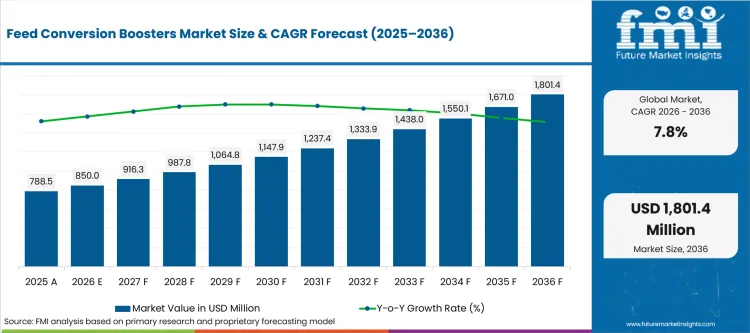
| Metric | Value |
|---|---|
| 2025 Market Size | USD 788.5 million |
| 2026 Market Size | USD 850.0 million |
| 2036 Market Size | USD 1,801.4 million |
| Forecast CAGR (2026-2036) | 7.8% |
| Form Focus | Dry |
| Dry Share (2026) | 40.6% |
| Livestock Focus | Poultry |
| Poultry Share (2026) | 34.8% |
| Source Focus | Synthetic |
| Synthetic Share (2026) | 32.4% |
Summary of the Feed Conversion Boosters Market
| Market Signal | Commercial Impact |
|---|---|
| Demand and Growth Drivers | Demand is expected to remain driven by the need to improve feed efficiency, animal performance, and production economics, with producers favoring additive programs that deliver measurable commercial outcomes.
|
| Product and Segment View | Dry formulations, Poultry, and Synthetic sources are estimated to lead their respective categories in 2026 as commercial feed manufacturers prioritize operational efficiency and consistent product quality.
|
| Geography and Growth Outlook | Regional growth is projected to depend on livestock production intensity, feed economics, technical support, and suppliers' ability to demonstrate measurable performance under commercial farming conditions.
|
| Competitive Landscape | Competition is anticipated to focus on product performance, technical documentation, application expertise, and the ability to support commercial feed manufacturers through local service networks.
|
| Analyst Perspective | Commercial adoption is expected to depend on measurable feed conversion improvement, dosage economics, and the ability of suppliers to demonstrate consistent performance under practical farm conditions.
|
How is the Feed Conversion Boosters Market segmented?
The Feed Conversion Boosters Market industry is segmented by Form, Source, Livestock, Function, and Region.
By form, the market covers Dry, Liquid, Pellet, Premix, and Encapsulated. By source, the market covers Synthetic, Microbial, Plant/Botanical, Mineral, and Yeast-based. By livestock, the market covers Poultry, Swine, Ruminants, Aquaculture, and Equine and pets. By function, the market covers Gut health, Growth performance, Immunity, Nutrient use, and Stress management. By region, the market covers North America, Europe, East Asia, South Asia, and Latin America.
Why does Dry carry weight within Form?
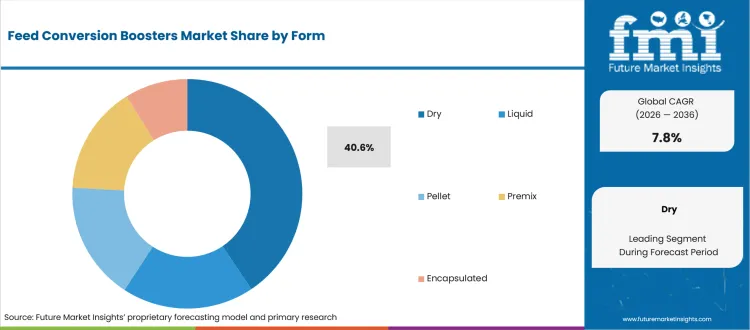
Dry demand within Form is shaped by how easily the additive can be handled in commercial feeding programs. Dry formats fit feed-mill practice because storage, dosing, premix blending, and transport are easier to manage across commercial batches.
- Dry accounts for 40.6% share within Form in 2026. The segment is valued at USD 320.1 million in 2025, USD 345.1 million in 2026, and USD 731.4 million by 2036. FAOSTAT provides the livestock and agricultural production baseline used to read demand.
- For procurement teams, the issue is handling reliability. Dry or blended formats need to move through storage, dosing, and feed-mill routines without creating extra mixing or inventory problems.
What keeps Poultry relevant in the Livestock category?
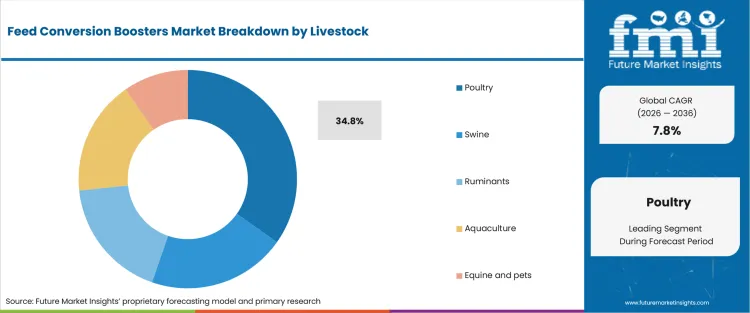
Poultry demand within Livestock is shaped by how easily the additive can be handled in commercial feeding programs. Poultry is closely watched because integrators track feed conversion, flock uniformity, gut challenge, and production-cycle economics at high frequency.
- Poultry accounts for 34.8% share within Livestock in 2026. The segment is valued at USD 274.4 million in 2025, USD 295.8 million in 2026, and USD 626.9 million by 2036. FAO Livestock Systems gives livestock-distribution and animal-production context for adoption.
- For nutrition teams, the issue is species-level proof. Poultry, swine, ruminant, or aquafeed programs need evidence that the additive response holds under normal diet and production pressure.
How do buyers evaluate Synthetic within Source?
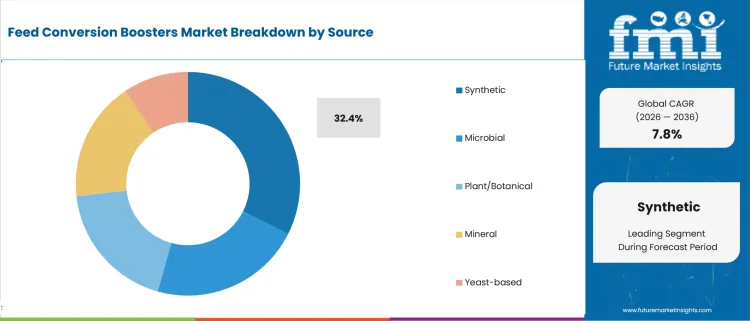
Synthetic demand within Source is shaped by how easily the additive can be handled in commercial feeding programs. Synthetic sources remain relevant where buyers need repeatable concentration, predictable availability, and tighter specification control.
- Synthetic accounts for 32.4% share within Source in 2026. The segment is valued at USD 255.5 million in 2025, USD 275.4 million in 2026, and USD 583.7 million by 2036. USDA ERS Feed Grains Database supports the feed-grain supply, use, and price context behind buyer economics.
- For buyers, the issue is supply and specification stability. Source choice affects concentration, batch consistency, pricing, and the ease of defending the additive in formulation review.
Where does Gut health fit within Function demand?
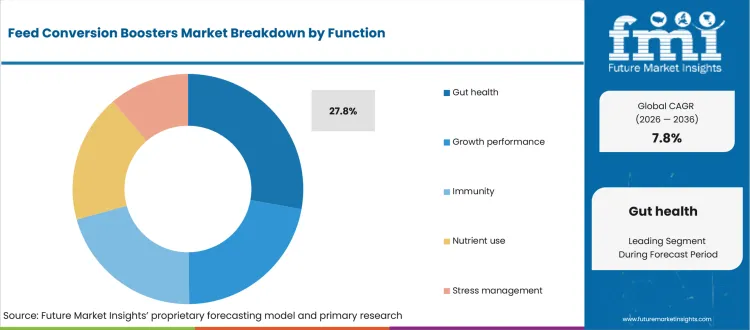
Gut health demand within Function is shaped by how easily the additive can be handled in commercial feeding programs. Gut-health use is tied to feed response, diet-change tolerance, and the need to keep animal performance stable under commercial conditions.
- Gut health accounts for 27.8% share within Function in 2026. The segment is valued at USD 219.2 million in 2025, USD 236.3 million in 2026, and USD 500.8 million by 2036. dsm-firmenich Animal Nutrition & Health provides the source context used for this demand view.
- For formulation teams, the issue is whether the claimed function can be measured. Products need trial evidence and usage guidance before they become part of repeat feed programs.
What explains the North America position within Region?
North America demand within Region is shaped by how easily the additive can be handled in commercial feeding programs. North America reflects integrated production systems, formal nutrition programs, and established technical-service expectations from suppliers.
- North America accounts for 23.8% share within Region in 2026. The segment is valued at USD 187.7 million in 2025, USD 202.3 million in 2026, and USD 428.7 million by 2036. Cargill feed additives provides the source context used for this demand view.
- For suppliers, the issue is service coverage. Regional demand becomes easier to capture when technical support, distributor reach, and local trial evidence are already in place.
What are the drivers, restraints, and opportunities in the Feed Conversion Boosters Market?
Near-term purchases are being shaped by the operating requirement, implementation constraint, and expansion route outlined below.
- The main driver is that feed efficiency, animal performance, protein demand, and input-cost discipline support demand. Buyers need a practical reason to approve spend, so demand improves where evidence can be linked to feed conversion response, dosage economics, and species fit.
- The main restraint is that budget pressure, uncertain farm economics, validation cost, and uneven technical support restrain adoption. Adoption slows when buyer teams cannot see the payback, safety boundary, service owner, or documentation path clearly enough for approval.
- The opportunity lies in precision nutrition, antibiotic-reduction programs, and species-specific additive support. Suppliers can use this route only when they bring practical evidence, local support, and a realistic implementation plan.
Demand is more defensible when the additive addresses a defined feed-program problem. FAOSTAT anchors the livestock and agricultural context, so adoption should be tied to farm economics and measurable response.
The profiled country rows reconcile to USD 850.0 million in 2026 and USD 1,801.4 million by 2036 at a 7.8% CAGR. This matters because a strong forecast still depends on whether producers can justify additive spend against feed cost and field performance.
Implementation friction comes from trial cost, formulation changes, processing stability, and responsibility for technical service after purchase. Suppliers with clear usage guidance and reliable local support are better positioned than suppliers that offer only product availability.
Which country CAGRs are profiled in the Feed Conversion Boosters Market?
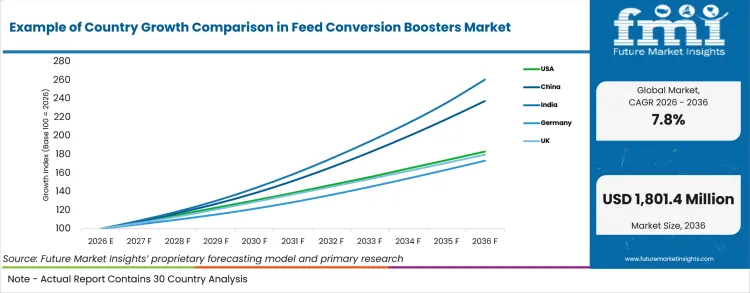
| Country | CAGR |
|---|---|
| United States | 6.24% |
| China | 9.04% |
| India | 10.04% |
| Germany | 5.64% |
| United Kingdom | 6.04% |
| Japan | 5.64% |
| South Korea | 7.24% |
| Rest of World | 8.44% |
How do country-level CAGRs compare in the Feed Conversion Boosters Market?
Country growth in the Feed Conversion Boosters Market should be read through livestock structure, feed-cost pressure, species mix, and the depth of local technical service. The same CAGR can reflect different adoption barriers, so executives should compare how each country validates product response under commercial diets.
- United States records USD 170.0 million in 2026, USD 311.5 million by 2036, and 6.24% CAGR. Integrator economics, feed-cost discipline, and formal nutrition programs make buyers strict about measurable farm response. Procurement teams therefore ask for trial data, dosage economics, and support that fits integrator decision cycles.
- China records USD 153.0 million in 2026, USD 363.5 million by 2036, and 9.04% CAGR. Large feed compounders and high-throughput production create demand for additives that can survive processing and deliver repeatable results. Suppliers need processing-stability evidence and technical support that can scale across large feed operations.
- India records USD 85.00 million in 2026, USD 221.2 million by 2036, and 10.04% CAGR. Poultry, dairy, and mixed livestock systems create demand, but price sensitivity and field support decide how quickly products move into routine use. Field support, affordability, and simple inclusion guidance will decide how quickly products move beyond trials.
- Germany records USD 68.00 million in 2026, USD 117.8 million by 2036, and 5.64% CAGR. Feed buyers weigh documentation, additive performance, and regulatory discipline before switching formulation programs. Supplier review is likely to focus on documentation, regulatory fit, and repeatable feed response.
- United Kingdom records USD 42.50 million in 2026, USD 76.42 million by 2036, and 6.04% CAGR. Demand is tied to farm economics, retail pressure around animal production practices, and the need for supplier-backed technical guidance. Buyers need technical guidance that connects additive use with farm economics and retail-chain expectations.
- Japan records USD 51.00 million in 2026, USD 88.31 million by 2036, and 5.64% CAGR. Compact and quality-conscious production systems require consistent feed response and dependable supplier documentation. Supplier confidence depends on stable quality, detailed usage guidance, and reliable distributor support.
- South Korea records USD 34.00 million in 2026, USD 68.41 million by 2036, and 7.24% CAGR. Dense livestock systems and feed-cost sensitivity make buyers look for quick evidence of response under local diet conditions. Buyers will look for local diet evidence and quick technical response when performance gaps appear.
- Rest of World records USD 246.5 million in 2026, USD 554.3 million by 2036, and 8.44% CAGR. Distributor-led adoption and mixed livestock systems make local technical service as important as product availability. Local service and distributor reach remain critical because livestock systems and feed practices vary widely.
Who are the notable companies in the Feed Conversion Boosters Market?
dsm-firmenich, Evonik Industries, Adisseo, AB Vista, IFF / Danisco Animal Nutrition & Health, BASF, Cargill, ADM, Novus International, Kemin Industries, and Alltech are the notable companies shaping this market.
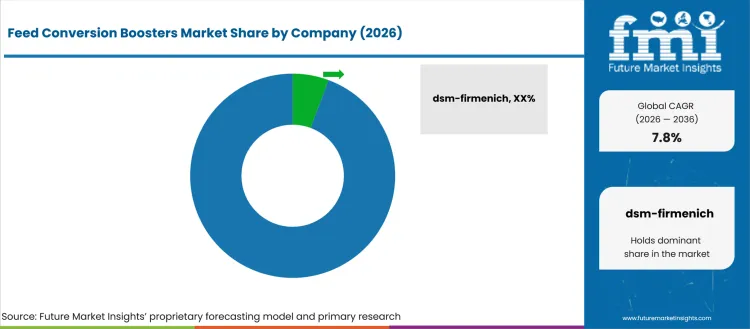
Competition is shaped by whether the buyer is solving feed efficiency through enzymes, amino acids, eubiotics, premix support, or technical service. Feed mills and integrators need suppliers that can connect product use with diet formulation, processing stability, and measurable response under commercial conditions.
- dsm-firmenich, AB Vista, IFF / Danisco Animal Nutrition & Health, BASF, and Adisseo are important where feed conversion work depends on enzymes and digestibility programs. Their buyer relevance comes from product evidence, matrix guidance, pelleting stability, and the ability to support reformulation decisions.
- Evonik Industries, Novus International, ADM, and Cargill are relevant where feed efficiency is tied to amino acids, premixes, and broader nutrition programs. These companies matter because buyers often evaluate conversion improvement as part of a full ration and procurement plan rather than as one additive line.
- Kemin Industries and Alltech support the market through specialty additives, gut-health support, and field service. Their role increases where producers need help interpreting farm response before they commit to routine inclusion.
Competitive Benchmarking: Feed Conversion Boosters Market
| Company | Feed Efficiency Portfolio Fit | Technical Validation Support | Feed-Mill or Premix Reach | Geographic Footprint |
|---|---|---|---|---|
| dsm-firmenich | High | High | High | Global |
| Evonik Industries | High | High | High | Global |
| Adisseo | High | High | Strong | Global |
| AB Vista | High | High | Strong | Global |
| IFF / Danisco Animal Nutrition & Health | High | High | Strong | Global |
| BASF | High | High | Strong | Global |
| Cargill | Strong | Medium | High | Global |
| ADM | Strong | Medium | High | Global |
| Novus International | Strong | Medium | Strong | Global |
| Kemin Industries | Medium | Strong | Strong | Global |
| Alltech | Medium | Strong | Strong | Global |
Source: Future Market Insights competitive analysis, 2026. Ratings reflect relative portfolio relevance, workflow or project fit, service capability, and geographic reach.
Key Developments in the Feed Conversion Boosters Market
- In February 2025, Novonesis agreed to acquire dsm-firmenich’s share of the Feed Enzyme Alliance and take over related sales and distribution activities. The move matters for feed conversion buyers because enzyme access, reseller arrangements, and technical support can affect procurement continuity.
- In August 2024, Adisseo and Allozymes announced a partnership focused on next-generation animal feed production using rapid microfluidics technology. The partnership is relevant because enzyme development and production efficiency influence digestibility-focused feed programs.
- In September 2025, ADM and Alltech announced a North American animal feed joint venture while ADM retained its USA premix and additive operations. The development matters because feed conversion additives are often evaluated through broader premix, formulation, and feed-service relationships.
Key Players in the Feed Conversion Boosters Market
Enzyme and Digestibility Specialists
- dsm-firmenich
- AB Vista
- IFF / Danisco Animal Nutrition & Health
- BASF
- Adisseo
Amino Acid, Premix, and Nutrition Platform Suppliers
- Evonik Industries
- Cargill
- ADM
- Novus International
Specialty Additive and Field-Support Suppliers
- Kemin Industries
- Alltech
Feed Conversion Boosters Market - Report Scope
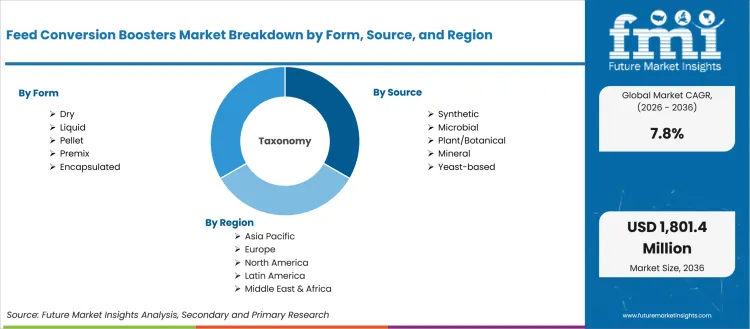
| Coverage field | Report scope |
|---|---|
| Market breakdown | Feed Conversion Boosters Market Breakdown Form, Source, Livestock, Function, Region |
| Market Definition | Commercial demand covered under Feed Conversion Boosters Market, including country demand, segment demand, and supplier-selection context |
| Regions Covered | East Asia, Europe, North America, Rest of World, South Asia |
| Countries Covered | United States, China, India, Germany, United Kingdom, Japan, South Korea, Rest of World |
| Key Companies Profiled | dsm-firmenich, Evonik Industries, Adisseo, AB Vista, IFF / Danisco Animal Nutrition & Health, BASF, Cargill, ADM, Novus International, Kemin Industries, and Alltech |
| Forecast Period | 2026 to 2036 |
| Approach | Global, country, and segment assessment using public source evidence and market context |
Feed Conversion Boosters Market - Research Methodology
| Method | Approach |
|---|---|
| Primary Research | The assessment covers buyer needs, supplier roles, country demand, and segment-level adoption patterns. |
| Desk Research | FAOSTAT; FAO Livestock Systems; USDA ERS Feed Grains Database. Official company portfolio, product, label, and press-release pages were reviewed where company names were used. |
| Market Sizing and Forecasting | Global, country, and segment values were assessed across demand pools, country adoption, segment share, and forecast-period growth. |
| Data Validation | Country totals, segment shares, and forecast values are presented on one reconciled base. |
Feed Conversion Boosters Market by Segments
Feed Conversion Boosters Market segmented by Form:
- Dry
- Liquid
- Pellet
- Premix
- Encapsulated
Feed Conversion Boosters Market segmented by Source:
- Synthetic
- Microbial
- Plant/Botanical
- Mineral
- Yeast-based
Feed Conversion Boosters Market segmented by Livestock:
- Poultry
- Swine
- Ruminants
- Aquaculture
- Equine and pets
Feed Conversion Boosters Market segmented by Function:
- Gut health
- Growth performance
- Immunity
- Nutrient use
- Stress management
Feed Conversion Boosters Market segmented by Region:
- North America
- Europe
- East Asia
- South Asia
- Latin America
Research Sources and Bibliography
- 1. FAOSTAT. Livestock, crop, food-balance, and agricultural production baseline.
- 2. FAO Livestock Systems. Livestock distribution and animal-production demand context.
- 3. USDA ERS Feed Grains Database. Feed grain supply, use, and price context for feed inputs.
- 4. dsm-firmenich Animal Nutrition & Health.
- 5. Cargill feed additives.
- 6. Evonik Animal Nutrition & Health.
- 7. ADM Animal Nutrition.
- 8. Adisseo animal nutrition.
- 9. IFF Danisco Animal Nutrition & Health.
- 10. Kemin Animal Nutrition & Health.
- 11. Alltech Mycosorb.
- 12. Novus International.
- 13. AB Vista animal nutrition products.
- 14. AB Vista Quantum Blue phytase.
- 15. BASF Natuphos E phytase.
- 16. Novonesis feed enzyme alliance announcement.
- 17. Adisseo and Allozymes partnership.
- 18. Reuters on ADM and Alltech animal feed joint venture.
This Report Answers
- What is the expected global value of the Feed Conversion Boosters Market in 2026 and 2036?
- What CAGR is forecast for the Feed Conversion Boosters Market during the 2026 to 2036 period?
- Which country value and CAGR rows are included for Feed Conversion Boosters Market?
- Which segment groups and subsegments carry the higher 2026 shares?
- How do country values reconcile with the global 2026 and 2036 totals?
- Which public sources support the market, country, and segment context?
- Which named companies shape competition in the Feed Conversion Boosters Market?
- What adoption risk, procurement risk, or supplier-selection issue should executives watch?
- How does FMI size and forecast Feed Conversion Boosters Market across countries and segments?
- Which supplier or development signals affect executive decisions?
Frequently Asked Questions
Why should executives track the Feed Conversion Boosters Market?
Executives should track this market because additive use affects feed cost, animal performance, supplier dependence, and formulation risk. The value case is easier to defend when procurement can connect product use to field response and avoid broad nutrition claims.
What business problem does the Feed Conversion Boosters Market address?
The market addresses the need to improve feed efficiency and measurable output from commercial diets while keeping additive spend under control. Buyers need proof that the product works in commercial diets, as well as in controlled demonstrations.
What should procurement leaders evaluate before selecting suppliers?
Procurement leaders should compare formulation fit, dosage economics, processing stability, species-specific evidence, distributor service, and documentation quality. Supplier selection should also check who supports trial work after the first purchase.
What can limit return on investment for buyers?
Return on investment can be limited by weak field evidence, high validation cost, inconsistent raw materials, and poor local technical support. Buyers can reduce this risk by using phased trials and measuring outcomes against feed-cost and performance targets.
How can suppliers build executive confidence?
Suppliers build confidence through field data, clear inclusion guidance, stable supply, and practical nutrition support. The buyer needs to see how the product performs in routine feeding programs before it becomes part of repeat procurement.
Preview the report firsthand - request a free sample
Get SampleGet the brochure for pricing and purchase details.
Get PDFTable of Content
- Key Takeaways
- Market Size and CAGR
- Top Growth Driver
- Fastest Growing Segment
- Leading Region
- Key Companies
- Emerging Opportunities
- Executive Summary
- Global Market Outlook
- Demand-side Trends
- Supply-side Trends
- Technology Roadmap Analysis
- Analysis and Recommendations
- Analyst Perspective (What is happening? Why now? What should investors know?)
- Key Questions Answered
- How large is the market?
- What is the CAGR?
- What are key trends?
- Which region dominates?
- Who are the leaders?
- Market Overview
- Market Coverage / Taxonomy
- Market Definition / Scope / Limitations
- Research Methodology
- Chapter Orientation
- Analytical Lens and Working Hypotheses
- Market Structure, Signals, and Trend Drivers
- Benchmarking and Cross-market Comparability
- Market Sizing, Forecasting, and Opportunity Mapping
- Research Design and Evidence Framework
- Desk Research Programme (Secondary Evidence)
- Expert Input and Fieldwork (Primary Evidence)
- Tooling, Models, and Reference Databases
- Data Engineering and Model Build
- Quality Assurance and Audit Trail
- Market Background
- Market Dynamics (Drivers, Restraints, Opportunity, Trends)
- Scenario Forecast (Optimistic, Likely, Conservative)
- Impact Analysis
- AI Impact
- Sustainability Impact
- Regulatory Impact
- Technology Impact
- Consumer / Buyer Analysis
- Purchase Drivers
- Adoption Barriers
- Buyer Journey
- Opportunity Map Analysis
- Product Life Cycle Analysis
- Supply Chain Analysis
- Investment Feasibility Matrix
- Value Chain Analysis
- PESTLE and Porter's Analysis
- Regulatory Landscape
- Regional Parent Market Outlook
- Production and Consumption Statistics
- Import and Export Statistics
- Global Market Analysis and Forecast, 2021 to 2036
- Historical Market Size Value (USD Million) Analysis, 2021 to 2025
- Current and Future Market Size Value (USD Million) Projections, 2026 to 2036
- Y-o-Y Growth Trend Analysis
- Absolute $ Opportunity Analysis
- Global Market Pricing Analysis, 2021 to 2036
- Global Market Analysis and Forecast, By Form, 2021 to 2036
- Introduction / Key Findings
- Historical Market Size Value (USD Million) Analysis By Form, 2021 to 2025
- Current and Future Market Size Value (USD Million) Analysis and Forecast By Form, 2026 to 2036
- Dry
- Liquid
- Pellet
- Premix
- Encapsulated
- Dry
- Y-o-Y Growth Trend Analysis By Form, 2021 to 2025
- Absolute $ Opportunity Analysis By Form, 2026 to 2036
- Global Market Analysis and Forecast, By Source, 2021 to 2036
- Introduction / Key Findings
- Historical Market Size Value (USD Million) Analysis By Source, 2021 to 2025
- Current and Future Market Size Value (USD Million) Analysis and Forecast By Source, 2026 to 2036
- Synthetic
- Microbial
- Plant/Botanical
- Mineral
- Yeast-based
- Synthetic
- Y-o-Y Growth Trend Analysis By Source, 2021 to 2025
- Absolute $ Opportunity Analysis By Source, 2026 to 2036
- Global Market Analysis and Forecast, By Livestock, 2021 to 2036
- Introduction / Key Findings
- Historical Market Size Value (USD Million) Analysis By Livestock, 2021 to 2025
- Current and Future Market Size Value (USD Million) Analysis and Forecast By Livestock, 2026 to 2036
- Poultry
- Swine
- Ruminants
- Aquaculture
- Equine and pets
- Poultry
- Y-o-Y Growth Trend Analysis By Livestock, 2021 to 2025
- Absolute $ Opportunity Analysis By Livestock, 2026 to 2036
- Global Market Analysis and Forecast, By Function, 2021 to 2036
- Introduction / Key Findings
- Historical Market Size Value (USD Million) Analysis By Function, 2021 to 2025
- Current and Future Market Size Value (USD Million) Analysis and Forecast By Function, 2026 to 2036
- Gut health
- Growth performance
- Immunity
- Nutrient use
- Stress management
- Gut health
- Y-o-Y Growth Trend Analysis By Function, 2021 to 2025
- Absolute $ Opportunity Analysis By Function, 2026 to 2036
- Global Market Analysis and Forecast, By Region, 2021 to 2036
- Introduction
- Historical Market Size Value (USD Million) Analysis By Region, 2021 to 2025
- Current Market Size Value (USD Million) Analysis and Forecast By Region, 2026 to 2036
- North America
- Latin America
- Western Europe
- Eastern Europe
- East Asia
- South Asia and Pacific
- Middle East & Africa
- Market Attractiveness Analysis By Region
- North America Market Analysis and Forecast, By Country, 2021 to 2036
- Historical Market Size Value (USD Million) Trend Analysis By Market Taxonomy, 2021 to 2025
- Market Size Value (USD Million) Forecast By Market Taxonomy, 2026 to 2036
- By Country
- USA
- Canada
- By Form
- By Source
- By Livestock
- By Function
- By Country
- Market Attractiveness Analysis
- By Country
- By Form
- By Source
- By Livestock
- By Function
- Key Takeaways
- Latin America Market Analysis and Forecast, By Country
- Historical Market Size Value (USD Million) Trend Analysis By Market Taxonomy, 2021 to 2025
- Market Size Value (USD Million) Forecast By Market Taxonomy, 2026 to 2036
- By Country
- Brazil
- Mexico
- Chile
- Rest of Latin America
- By Form
- By Source
- By Livestock
- By Function
- By Country
- Market Attractiveness Analysis
- By Country
- By Form
- By Source
- By Livestock
- By Function
- Key Takeaways
- Western Europe Market Analysis and Forecast, By Country
- Historical Market Size Value (USD Million) Trend Analysis By Market Taxonomy, 2021 to 2025
- Market Size Value (USD Million) Forecast By Market Taxonomy, 2026 to 2036
- By Country
- Germany
- UK
- Italy
- Spain
- France
- Nordic
- BENELUX
- Rest of Western Europe
- By Form
- By Source
- By Livestock
- By Function
- By Country
- Market Attractiveness Analysis
- By Country
- By Form
- By Source
- By Livestock
- By Function
- Key Takeaways
- Eastern Europe Market Analysis and Forecast, By Country
- Historical Market Size Value (USD Million) Trend Analysis By Market Taxonomy, 2021 to 2025
- Market Size Value (USD Million) Forecast By Market Taxonomy, 2026 to 2036
- By Country
- Russia
- Poland
- Hungary
- Balkan & Baltic
- Rest of Eastern Europe
- By Form
- By Source
- By Livestock
- By Function
- By Country
- Market Attractiveness Analysis
- By Country
- By Form
- By Source
- By Livestock
- By Function
- Key Takeaways
- East Asia Market Analysis and Forecast, By Country
- Historical Market Size Value (USD Million) Trend Analysis By Market Taxonomy, 2021 to 2025
- Market Size Value (USD Million) Forecast By Market Taxonomy, 2026 to 2036
- By Country
- China
- Japan
- South Korea
- By Form
- By Source
- By Livestock
- By Function
- By Country
- Market Attractiveness Analysis
- By Country
- By Form
- By Source
- By Livestock
- By Function
- Key Takeaways
- South Asia and Pacific Market Analysis and Forecast, By Country
- Historical Market Size Value (USD Million) Trend Analysis By Market Taxonomy, 2021 to 2025
- Market Size Value (USD Million) Forecast By Market Taxonomy, 2026 to 2036
- By Country
- India
- ASEAN
- Australia & New Zealand
- Rest of South Asia and Pacific
- By Form
- By Source
- By Livestock
- By Function
- By Country
- Market Attractiveness Analysis
- By Country
- By Form
- By Source
- By Livestock
- By Function
- Key Takeaways
- Middle East & Africa Market Analysis and Forecast, By Country
- Historical Market Size Value (USD Million) Trend Analysis By Market Taxonomy, 2021 to 2025
- Market Size Value (USD Million) Forecast By Market Taxonomy, 2026 to 2036
- By Country
- Kingdom of Saudi Arabia
- Other GCC Countries
- Türkiye
- South Africa
- Other African Union
- Rest of Middle East & Africa
- By Form
- By Source
- By Livestock
- By Function
- By Country
- Market Attractiveness Analysis
- By Country
- By Form
- By Source
- By Livestock
- By Function
- Key Takeaways
- Key Countries Market Analysis
- USA
- Pricing Analysis
- Market Share Analysis, 2025
- By Form
- By Source
- By Livestock
- By Function
- Canada
- Pricing Analysis
- Market Share Analysis, 2025
- By Form
- By Source
- By Livestock
- By Function
- Mexico
- Pricing Analysis
- Market Share Analysis, 2025
- By Form
- By Source
- By Livestock
- By Function
- Brazil
- Pricing Analysis
- Market Share Analysis, 2025
- By Form
- By Source
- By Livestock
- By Function
- Chile
- Pricing Analysis
- Market Share Analysis, 2025
- By Form
- By Source
- By Livestock
- By Function
- Germany
- Pricing Analysis
- Market Share Analysis, 2025
- By Form
- By Source
- By Livestock
- By Function
- UK
- Pricing Analysis
- Market Share Analysis, 2025
- By Form
- By Source
- By Livestock
- By Function
- Italy
- Pricing Analysis
- Market Share Analysis, 2025
- By Form
- By Source
- By Livestock
- By Function
- Spain
- Pricing Analysis
- Market Share Analysis, 2025
- By Form
- By Source
- By Livestock
- By Function
- France
- Pricing Analysis
- Market Share Analysis, 2025
- By Form
- By Source
- By Livestock
- By Function
- India
- Pricing Analysis
- Market Share Analysis, 2025
- By Form
- By Source
- By Livestock
- By Function
- ASEAN
- Pricing Analysis
- Market Share Analysis, 2025
- By Form
- By Source
- By Livestock
- By Function
- Australia & New Zealand
- Pricing Analysis
- Market Share Analysis, 2025
- By Form
- By Source
- By Livestock
- By Function
- China
- Pricing Analysis
- Market Share Analysis, 2025
- By Form
- By Source
- By Livestock
- By Function
- Japan
- Pricing Analysis
- Market Share Analysis, 2025
- By Form
- By Source
- By Livestock
- By Function
- South Korea
- Pricing Analysis
- Market Share Analysis, 2025
- By Form
- By Source
- By Livestock
- By Function
- Russia
- Pricing Analysis
- Market Share Analysis, 2025
- By Form
- By Source
- By Livestock
- By Function
- Poland
- Pricing Analysis
- Market Share Analysis, 2025
- By Form
- By Source
- By Livestock
- By Function
- Hungary
- Pricing Analysis
- Market Share Analysis, 2025
- By Form
- By Source
- By Livestock
- By Function
- Kingdom of Saudi Arabia
- Pricing Analysis
- Market Share Analysis, 2025
- By Form
- By Source
- By Livestock
- By Function
- Türkiye
- Pricing Analysis
- Market Share Analysis, 2025
- By Form
- By Source
- By Livestock
- By Function
- South Africa
- Pricing Analysis
- Market Share Analysis, 2025
- By Form
- By Source
- By Livestock
- By Function
- USA
- Market Structure Analysis
- Competition Dashboard
- Competition Benchmarking
- Market Share Analysis of Top Players
- By Regional
- By Form
- By Source
- By Livestock
- By Function
- Emerging Startups
- Innovation Benchmarking
- Competition Analysis
- Competition Deep Dive
- dsm-firmenich
- Overview
- Product Portfolio
- Profitability by Market Segments
- Sales Footprint
- Strategy Overview
- Marketing Strategy
- Product Strategy
- Channel Strategy
- Evonik Industries
- Adisseo
- AB Vista
- IFF / Danisco Animal Nutrition & Health
- BASF
- Cargill
- ADM
- Novus International
- Kemin Industries
- Alltech
- dsm-firmenich
- Case Studies
- Success Stories
- Recent Developments
- Competition Deep Dive
- Assumptions & Acronyms Used


