

- Industry Size (2025)
- USD 4.8 Bn
- Forecast (2035)
- USD 7.8 Bn
- CAGR (2025 to 2035)
- 5.1%
Fluoroscopy Market Size and Share Forecast Outlook 2025 to 2035
The Fluoroscopy Market is estimated to be valued at USD 4.8 billion in 2025 and is projected to reach USD 7.8 billion by 2035, registering a compound annual growth rate (CAGR) of 5.1% over the forecast period.
Quick Stats for Fluoroscopy Market
- Fluoroscopy Market Value (2025): USD 4.8 billion
- Fluoroscopy Market Forecast Value (2035): USD 7.8 billion
- Fluoroscopy Market Forecast CAGR: 5.1%
- Leading Segment in Fluoroscopy Market in 2025: Cardiovascular interventions (40.2%)
- Key Growth Regions in Fluoroscopy Market: North America, Asia-Pacific, Europe
- Top Key Players in Fluoroscopy Market: Canon Medical Systems Corporation., Siemens Healthineers, GE HealthCare, Koninklijke Philips NV, Hitachi Medical Systems, Shimadzu, Ziehm Imaging GmbH, Hologic Inc, Carestream Health., Orthoscan Inc.
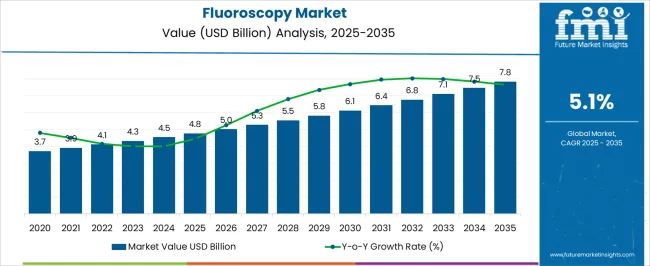
Fluoroscopy Market Key Takeaways
| Metric | Value |
|---|---|
| Fluoroscopy Market Estimated Value in (2025 E) | USD 4.8 billion |
| Fluoroscopy Market Forecast Value in (2035 F) | USD 7.8 billion |
| Forecast CAGR (2025 to 2035) | 5.1% |
Why is the Fluoroscopy Market Growing?
The fluoroscopy market is experiencing steady growth, driven by its increasing role in minimally invasive procedures and diagnostic imaging across multiple clinical areas. Rising prevalence of cardiovascular diseases, gastrointestinal disorders, and orthopedic conditions is contributing to heightened demand for real-time imaging technologies that improve precision and reduce procedural risks. The growing adoption of image-guided surgeries and interventional radiology techniques is also expanding the scope of fluoroscopy applications.
Advancements in digital imaging, dose reduction technologies, and integration with artificial intelligence are improving image quality while enhancing patient safety. Hospitals and specialty clinics are increasingly investing in fluoroscopy systems to meet the demand for high-throughput diagnostic and interventional services.
Global healthcare reforms and the expansion of insurance coverage in emerging economies are further supporting market growth by making advanced imaging more accessible As patient demand for less invasive treatments rises and clinical workflows become more dependent on imaging support, the fluoroscopy market is expected to expand consistently, with manufacturers focusing on innovation, workflow integration, and cost efficiency.
Segmental Analysis
The fluoroscopy market is segmented by type of surgery, end use type, and geographic regions. By type of surgery, fluoroscopy market is divided into Cardiovascular interventions, Biopsy, Orthopedic surgeries, and Others. In terms of end use type, fluoroscopy market is classified into Hospitals, Diagnostic centers, and Clinics. Regionally, the fluoroscopy industry is classified into North America, Latin America, Western Europe, Eastern Europe, Balkan & Baltic Countries, Russia & Belarus, Central Asia, East Asia, South Asia & Pacific, and the Middle East & Africa.
Insights into the Cardiovascular Interventions Type of Surgery Segment
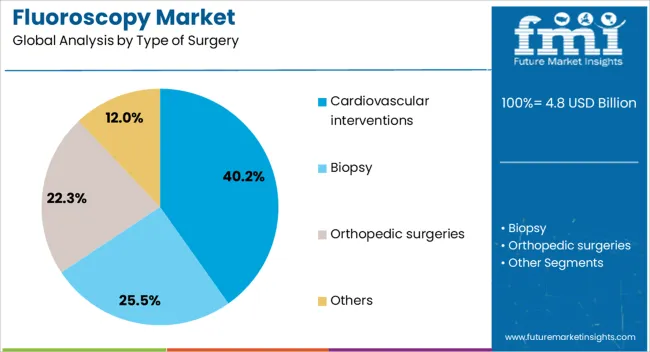
The cardiovascular interventions segment is projected to account for 40.2% of the fluoroscopy market revenue share in 2025, establishing it as the leading surgical application. Its leadership is being reinforced by the rising prevalence of cardiovascular diseases globally and the growing preference for minimally invasive interventions to reduce patient recovery times and procedural complications.
Fluoroscopy provides real-time imaging that enables accurate catheter placement, stent deployment, and assessment of vascular structures, making it a critical component in interventional cardiology. Increasing investments in specialized cardiac care facilities and the expansion of hybrid operating rooms are further accelerating demand for fluoroscopy in this segment.
Technological advancements such as digital flat-panel detectors and improved dose management systems are enhancing procedural safety and efficiency, encouraging wider adoption As healthcare systems prioritize early intervention and advanced treatment for cardiovascular conditions, the role of fluoroscopy in supporting safe, precise, and effective cardiovascular interventions is expected to sustain its leadership in the market.
Insights into the Hospitals End Use Segment
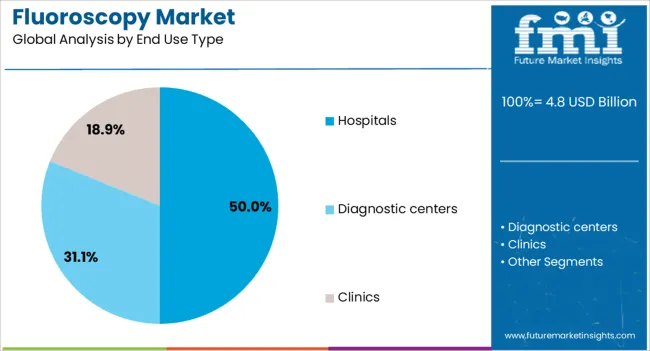
The hospitals segment is expected to hold 50.0% of the fluoroscopy market revenue share in 2025, positioning it as the dominant end-use category. Its leadership is being supported by the concentration of advanced imaging infrastructure in hospitals, where high patient volumes and complex procedures necessitate reliable and versatile imaging solutions. Hospitals serve as the primary centers for cardiovascular, orthopedic, and gastrointestinal interventions, all of which rely heavily on fluoroscopy for real-time visualization.
The availability of skilled healthcare professionals, integrated surgical suites, and comprehensive diagnostic services makes hospitals the preferred setting for fluoroscopy-based procedures. Significant investments are being made by hospitals to upgrade imaging technologies that support minimally invasive and image-guided treatments, thereby reinforcing the segment’s growth.
Additionally, government and private funding directed toward hospital modernization projects is contributing to the widespread adoption of advanced fluoroscopy systems As hospitals continue to expand service offerings to meet rising patient demand, their central role in driving the use of fluoroscopy is expected to remain strong in the coming years.
Market Overview
Fluoroscopy Market Outlook
The fluoroscopy market is primarily driven by the increase in interventional radiology procedures, which necessitate real-time imaging like fluoroscopy. The aforementioned advantage will probably lead to a greater uptake of these devices in the upcoming years.
The treatment of conditions like varicose veins, pulmonary embolism, deep vein thrombosis, abdominal aortic aneurysms, and other common medical conditions make consistent use of this equipment in a wide range of interventional radiological procedures. Future fluoroscopy market growth is anticipated to be fueled by this consistent usage.
Due to collaborations between interventionalists and producers of cutting-edge medical devices, the global fluoroscopy market is anticipated to expand significantly during the forecast period.
Other factors contributing to the market's expansion include an increase in the number of government hospitals, qualified interventionalists, and minimally invasive interventional procedures. At the same time, the need for advanced medical facilities and the radiation-related risks associated with fluoroscopy may be the main barriers to market expansion.
In the upcoming years, fluoroscopy market growth is anticipated to be further accelerated by technological developments like integration with image intensifiers like the Flat-Panel Detector (FPD), rotational angiography with CT images, and use of thallium-doped cesium iodide in conjunction with magnifying fluoroscopes.
Due to a large number of applications, the cardiovascular intervention segment is anticipated to dominate the market over the other segments. Other factors that are anticipated to support the growth of the global fluoroscopy market over the forecast period include increasing demand for orthopedic surgeries as a result of rising rates of traffic accidents in the US, technological advancements, and rising public awareness.
The largest portion of the market for fluoroscopy equipment was held by North America. A significant portion is attributable to the ongoing presence of strategic alliances intended to develop new product generations. Demand in this area is expected to increase due to the implementation of strict regulatory and reimbursement frameworks designed to ensure patient safety and high diagnostic standards.
The significant share of the market for fluoroscopy recorded by North America is attributed to the rising prevalence of obesity. The significant share is due to the rise in minimally invasive surgeries. The region's increased adoption of fluoroscopy over the past few years is a useful tool that offers improved guidance during minimally invasive surgeries.
During the forecast period, the Asia-Pacific fluoroscopy market is anticipated to grow at a profitable rate. Strong economic growth is being seen in the region's emerging economies. The need for advanced diagnostics has increased throughout this region as a result of rising disease prevalence and rising infrastructure standards.
The nature of the global market for fluoroscopy is one of intense competition. Significant businesses like GE Healthcare, Philips Healthcare, and Siemens Healthineers, which account for their commanding market share, are implementing sustainability strategies in this competition. These businesses place a lot of emphasis on different strategies like geographic expansion, new product development initiatives, and mergers and acquisitions.
Fluoroscopy Market: Drivers and Restraints
The global fluoroscopy market is expected to grow significantly over the forecast period due to tie ups between interventionalists and manufacturers of innovative medical devices.
Growing number of government hospitals and qualified interventionalists, increasing demand for minimally invasive interventional procedures are some other reasons for the growth of global fluoroscopy market. Whereas the requirement of sophisticated medical facilities and radiation related risks associated with fluoroscopy can be the major restraints for the growth of global fluoroscopy market.
Fluoroscopy Market: Overview
The cardiovascular intervention segment is expected to dominate the global fluoroscopy market over the other segments due to large number of applications. Growing number of orthopedic surgeries due to increasing incidences of road accidents in US , advances in technology and increasing awareness among the people are some other factors which are expected to support the growth of global fluoroscopy market over the forecast period.
Fluoroscopy Market: Regional Overview
Geographically, the global fluoroscopy market is classified into regions namely, North America, Latin America, Western Europe, Eastern Europe, Asia-Pacific, Japan, Middle East and Africa.
North America dominated the global market for fluoroscopy in 2025 due to innovative techniques, good investments in infrastructures and good reimbursement policies for diagnostic procedures. The fluoroscopy market in the Asia-Pacific is expected to grow further with moderate rate due to expanding aging population.
Fluoroscopy Market: Key Players
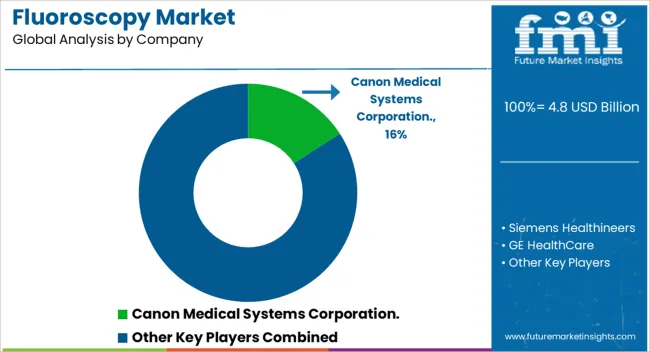
Some of the key players in global fluoroscopy market are GE Heathcare., Orthoscan Inc., Hologic Inc., Shimadzu Corporation, Siemens Medical Solutions, Philips N.V., Hitachi Ltd., Toshiba Medical Systems Corporation, Ziehm Imaging GmbH, Amico X-ray technologies, Carestream Health to name a few.
The global fluoroscopy market is highly competitive as new players are entering into the market such as Canon USA Inc. because of increasing demand for new innovative techniques in X-ray and radiology.
The report covers exhaustive analysis on
- Market Segments
- Market Dynamics
- Market Size
- Supply & Demand
- Current Trends/Issues/Challenges
- Competition & Companies involved
- Technology
- Value Chain
Regional analysis includes
- North America (USA., Canada)
- Latin America (Mexico, Brazil)
- Western Europe (Germany, Italy, UK, Spain, France, Nordic countries, BENELUX)
- Eastern Europe (Russia, Poland, Rest Of Eastern Europe)
- Asia Pacific Excluding Japan (China, India, ASEAN, Australia & New Zealand)
- Japan
- Middle East and Africa (GCC, S. Africa, N. Africa, Rest Of MEA)
The report is a compilation of first-hand information, qualitative and quantitative assessment by industry analysts, inputs from industry experts and industry participants across the value chain.
The report provides in-depth analysis of parent market trends, macro-economic indicators and governing factors along with market attractiveness as per segments. The report also maps the qualitative impact of various market factors on market segments and geographies.
Analysis of Fluoroscopy Market By Key Countries
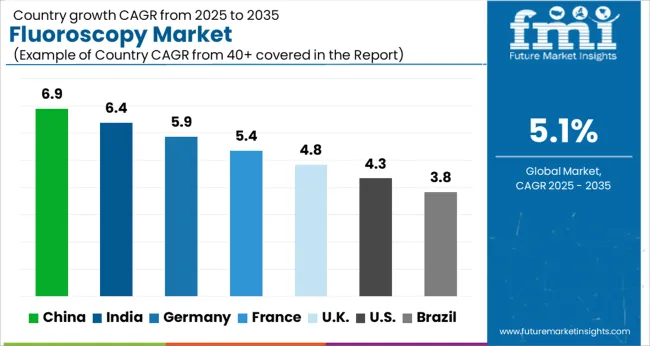
| Country | CAGR |
|---|---|
| China | 6.9% |
| India | 6.4% |
| Germany | 5.9% |
| France | 5.4% |
| UK | 4.8% |
| USA | 4.3% |
| Brazil | 3.8% |
Country-wise Analysis
The Fluoroscopy Market is expected to register a CAGR of 5.1% during the forecast period, exhibiting varied country level momentum. China leads with the highest CAGR of 6.9%, followed by India at 6.4%. Developed markets such as Germany, France, and the UK continue to expand steadily, while the USA is likely to grow at consistent rates. Brazil posts the lowest CAGR at 3.8%, yet still underscores a broadly positive trajectory for the global Fluoroscopy Market. In 2024, Germany held a dominant revenue in the Western Europe market and is expected to grow with a CAGR of 5.9%. The USA Fluoroscopy Market is estimated to be valued at USD 1.7 billion in 2025 and is anticipated to reach a valuation of USD 2.5 billion by 2035. Sales are projected to rise at a CAGR of 4.3% over the forecast period between 2025 and 2035. While Japan and South Korea markets are estimated to be valued at USD 225.2 million and USD 122.8 million respectively in 2025.
Key Players in the Fluoroscopy Market
- Canon Medical Systems Corporation.
- Siemens Healthineers
- GE HealthCare
- Koninklijke Philips NV
- Hitachi Medical Systems
- Shimadzu
- Ziehm Imaging GmbH
- Hologic Inc
- Carestream Health.
- Orthoscan Inc.
Scope of the Report
| Item | Value |
|---|---|
| Quantitative Units | USD 4.8 Billion |
| Type of Surgery | Cardiovascular interventions, Biopsy, Orthopedic surgeries, and Others |
| End Use Type | Hospitals, Diagnostic centers, and Clinics |
| Regions Covered | North America, Europe, Asia-Pacific, Latin America, Middle East & Africa |
| Country Covered | United States, Canada, Germany, France, United Kingdom, China, Japan, India, Brazil, South Africa |
| Key Companies Profiled | Canon Medical Systems Corporation., Siemens Healthineers, GE HealthCare, Koninklijke Philips NV, Hitachi Medical Systems, Shimadzu, Ziehm Imaging GmbH, Hologic Inc, Carestream Health., and Orthoscan Inc. |
Fluoroscopy Market by Segments
Type of Surgery:
- Cardiovascular interventions
- Biopsy
- Orthopedic surgeries
- Others
End Use Type:
- Hospitals
- Diagnostic centers
- Clinics
Region:
- North America
- USA
- Canada
- Mexico
- Latin America
- Brazil
- Chile
- Rest of Latin America
- Western Europe
- Germany
- UK
- Italy
- Spain
- France
- Nordic
- BENELUX
- Rest of Western Europe
- Eastern Europe
- Russia
- Poland
- Hungary
- Balkan & Baltic
- Rest of Eastern Europe
- East Asia
- China
- Japan
- South Korea
- South Asia and Pacific
- India
- ASEAN
- Australia & New Zealand
- Rest of South Asia and Pacific
- Middle East & Africa
- Kingdom of Saudi Arabia
- Other GCC Countries
- Turkiye
- South Africa
- Other African Union
- Rest of Middle East & Africa
Frequently Asked Questions
How big is the fluoroscopy market in 2025?
The global fluoroscopy market is estimated to be valued at USD 4.8 billion in 2025.
What will be the size of fluoroscopy market in 2035?
The market size for the fluoroscopy market is projected to reach USD 7.8 billion by 2035.
How much will be the fluoroscopy market growth between 2025 and 2035?
The fluoroscopy market is expected to grow at a 5.1% CAGR between 2025 and 2035.
What are the key product types in the fluoroscopy market?
The key product types in fluoroscopy market are cardiovascular interventions, biopsy, orthopedic surgeries and others.
Which end use type segment to contribute significant share in the fluoroscopy market in 2025?
In terms of end use type, hospitals segment to command 50.0% share in the fluoroscopy market in 2025.
Preview the report firsthand - request a free sample
Get SampleGet the brochure for pricing and purchase details.
Get PDFTable of Content
- Executive Summary
- Global Market Outlook
- Demand-side Trends
- Supply-side Trends
- Technology Roadmap Analysis
- Analysis and Recommendations
- Market Overview
- Market Coverage / Taxonomy
- Market Definition / Scope / Limitations
- Market Background
- Market Dynamics
- Drivers
- Restraints
- Opportunity
- Trends
- Scenario Forecast
- Demand in Optimistic Scenario
- Demand in Likely Scenario
- Demand in Conservative Scenario
- Opportunity Map Analysis
- Product Life Cycle Analysis
- Supply Chain Analysis
- Investment Feasibility Matrix
- Value Chain Analysis
- PESTLE and Porter’s Analysis
- Regulatory Landscape
- Regional Parent Market Outlook
- Production and Consumption Statistics
- Import and Export Statistics
- Market Dynamics
- Global Market Analysis 2020 to 2024 and Forecast, 2025 to 2035
- Historical Market Size Value (USD Million) Analysis, 2020 to 2024
- Current and Future Market Size Value (USD Million) Projections, 2025 to 2035
- Y-o-Y Growth Trend Analysis
- Absolute $ Opportunity Analysis
- Global Market Pricing Analysis 2020 to 2024 and Forecast 2025 to 2035
- Global Market Analysis 2020 to 2024 and Forecast 2025 to 2035, By Type of Surgery
- Introduction / Key Findings
- Historical Market Size Value (USD Million) Analysis By Type of Surgery , 2020 to 2024
- Current and Future Market Size Value (USD Million) Analysis and Forecast By Type of Surgery , 2025 to 2035
- Cardiovascular interventions
- Biopsy
- Orthopedic surgeries
- Others
- Y-o-Y Growth Trend Analysis By Type of Surgery , 2020 to 2024
- Absolute $ Opportunity Analysis By Type of Surgery , 2025 to 2035
- Global Market Analysis 2020 to 2024 and Forecast 2025 to 2035, By End Use Type
- Introduction / Key Findings
- Historical Market Size Value (USD Million) Analysis By End Use Type, 2020 to 2024
- Current and Future Market Size Value (USD Million) Analysis and Forecast By End Use Type, 2025 to 2035
- Hospitals
- Diagnostic centers
- Clinics
- Y-o-Y Growth Trend Analysis By End Use Type, 2020 to 2024
- Absolute $ Opportunity Analysis By End Use Type, 2025 to 2035
- Global Market Analysis 2020 to 2024 and Forecast 2025 to 2035, By Region
- Introduction
- Historical Market Size Value (USD Million) Analysis By Region, 2020 to 2024
- Current Market Size Value (USD Million) Analysis and Forecast By Region, 2025 to 2035
- North America
- Latin America
- Western Europe
- Eastern Europe
- East Asia
- South Asia and Pacific
- Middle East & Africa
- Market Attractiveness Analysis By Region
- North America Market Analysis 2020 to 2024 and Forecast 2025 to 2035, By Country
- Historical Market Size Value (USD Million) Trend Analysis By Market Taxonomy, 2020 to 2024
- Market Size Value (USD Million) Forecast By Market Taxonomy, 2025 to 2035
- By Country
- USA
- Canada
- Mexico
- By Type of Surgery
- By End Use Type
- By Country
- Market Attractiveness Analysis
- By Country
- By Type of Surgery
- By End Use Type
- Key Takeaways
- Latin America Market Analysis 2020 to 2024 and Forecast 2025 to 2035, By Country
- Historical Market Size Value (USD Million) Trend Analysis By Market Taxonomy, 2020 to 2024
- Market Size Value (USD Million) Forecast By Market Taxonomy, 2025 to 2035
- By Country
- Brazil
- Chile
- Rest of Latin America
- By Type of Surgery
- By End Use Type
- By Country
- Market Attractiveness Analysis
- By Country
- By Type of Surgery
- By End Use Type
- Key Takeaways
- Western Europe Market Analysis 2020 to 2024 and Forecast 2025 to 2035, By Country
- Historical Market Size Value (USD Million) Trend Analysis By Market Taxonomy, 2020 to 2024
- Market Size Value (USD Million) Forecast By Market Taxonomy, 2025 to 2035
- By Country
- Germany
- UK
- Italy
- Spain
- France
- Nordic
- BENELUX
- Rest of Western Europe
- By Type of Surgery
- By End Use Type
- By Country
- Market Attractiveness Analysis
- By Country
- By Type of Surgery
- By End Use Type
- Key Takeaways
- Eastern Europe Market Analysis 2020 to 2024 and Forecast 2025 to 2035, By Country
- Historical Market Size Value (USD Million) Trend Analysis By Market Taxonomy, 2020 to 2024
- Market Size Value (USD Million) Forecast By Market Taxonomy, 2025 to 2035
- By Country
- Russia
- Poland
- Hungary
- Balkan & Baltic
- Rest of Eastern Europe
- By Type of Surgery
- By End Use Type
- By Country
- Market Attractiveness Analysis
- By Country
- By Type of Surgery
- By End Use Type
- Key Takeaways
- East Asia Market Analysis 2020 to 2024 and Forecast 2025 to 2035, By Country
- Historical Market Size Value (USD Million) Trend Analysis By Market Taxonomy, 2020 to 2024
- Market Size Value (USD Million) Forecast By Market Taxonomy, 2025 to 2035
- By Country
- China
- Japan
- South Korea
- By Type of Surgery
- By End Use Type
- By Country
- Market Attractiveness Analysis
- By Country
- By Type of Surgery
- By End Use Type
- Key Takeaways
- South Asia and Pacific Market Analysis 2020 to 2024 and Forecast 2025 to 2035, By Country
- Historical Market Size Value (USD Million) Trend Analysis By Market Taxonomy, 2020 to 2024
- Market Size Value (USD Million) Forecast By Market Taxonomy, 2025 to 2035
- By Country
- India
- ASEAN
- Australia & New Zealand
- Rest of South Asia and Pacific
- By Type of Surgery
- By End Use Type
- By Country
- Market Attractiveness Analysis
- By Country
- By Type of Surgery
- By End Use Type
- Key Takeaways
- Middle East & Africa Market Analysis 2020 to 2024 and Forecast 2025 to 2035, By Country
- Historical Market Size Value (USD Million) Trend Analysis By Market Taxonomy, 2020 to 2024
- Market Size Value (USD Million) Forecast By Market Taxonomy, 2025 to 2035
- By Country
- Kingdom of Saudi Arabia
- Other GCC Countries
- Turkiye
- South Africa
- Other African Union
- Rest of Middle East & Africa
- By Type of Surgery
- By End Use Type
- By Country
- Market Attractiveness Analysis
- By Country
- By Type of Surgery
- By End Use Type
- Key Takeaways
- Key Countries Market Analysis
- USA
- Pricing Analysis
- Market Share Analysis, 2024
- By Type of Surgery
- By End Use Type
- Canada
- Pricing Analysis
- Market Share Analysis, 2024
- By Type of Surgery
- By End Use Type
- Mexico
- Pricing Analysis
- Market Share Analysis, 2024
- By Type of Surgery
- By End Use Type
- Brazil
- Pricing Analysis
- Market Share Analysis, 2024
- By Type of Surgery
- By End Use Type
- Chile
- Pricing Analysis
- Market Share Analysis, 2024
- By Type of Surgery
- By End Use Type
- Germany
- Pricing Analysis
- Market Share Analysis, 2024
- By Type of Surgery
- By End Use Type
- UK
- Pricing Analysis
- Market Share Analysis, 2024
- By Type of Surgery
- By End Use Type
- Italy
- Pricing Analysis
- Market Share Analysis, 2024
- By Type of Surgery
- By End Use Type
- Spain
- Pricing Analysis
- Market Share Analysis, 2024
- By Type of Surgery
- By End Use Type
- France
- Pricing Analysis
- Market Share Analysis, 2024
- By Type of Surgery
- By End Use Type
- India
- Pricing Analysis
- Market Share Analysis, 2024
- By Type of Surgery
- By End Use Type
- ASEAN
- Pricing Analysis
- Market Share Analysis, 2024
- By Type of Surgery
- By End Use Type
- Australia & New Zealand
- Pricing Analysis
- Market Share Analysis, 2024
- By Type of Surgery
- By End Use Type
- China
- Pricing Analysis
- Market Share Analysis, 2024
- By Type of Surgery
- By End Use Type
- Japan
- Pricing Analysis
- Market Share Analysis, 2024
- By Type of Surgery
- By End Use Type
- South Korea
- Pricing Analysis
- Market Share Analysis, 2024
- By Type of Surgery
- By End Use Type
- Russia
- Pricing Analysis
- Market Share Analysis, 2024
- By Type of Surgery
- By End Use Type
- Poland
- Pricing Analysis
- Market Share Analysis, 2024
- By Type of Surgery
- By End Use Type
- Hungary
- Pricing Analysis
- Market Share Analysis, 2024
- By Type of Surgery
- By End Use Type
- Kingdom of Saudi Arabia
- Pricing Analysis
- Market Share Analysis, 2024
- By Type of Surgery
- By End Use Type
- Turkiye
- Pricing Analysis
- Market Share Analysis, 2024
- By Type of Surgery
- By End Use Type
- South Africa
- Pricing Analysis
- Market Share Analysis, 2024
- By Type of Surgery
- By End Use Type
- USA
- Market Structure Analysis
- Competition Dashboard
- Competition Benchmarking
- Market Share Analysis of Top Players
- By Regional
- By Type of Surgery
- By End Use Type
- Competition Analysis
- Competition Deep Dive
- Canon Medical Systems Corporation.
- Overview
- Product Portfolio
- Profitability by Market Segments (Product/Age /Sales Channel/Region)
- Sales Footprint
- Strategy Overview
- Marketing Strategy
- Product Strategy
- Channel Strategy
- Siemens Healthineers
- GE HealthCare
- Koninklijke Philips NV
- Hitachi Medical Systems
- Shimadzu
- Ziehm Imaging GmbH
- Hologic Inc
- Carestream Health.
- Orthoscan Inc.
- Canon Medical Systems Corporation.
- Competition Deep Dive
- Assumptions & Acronyms Used
- Research Methodology


