

- Market Size (2026)
- USD 151.8 Mn
- Forecast (2036)
- USD 356.1 Mn
- CAGR (2026 to 2036)
- 8.9%
How big is Forage Freshness Additives Market in 2026?
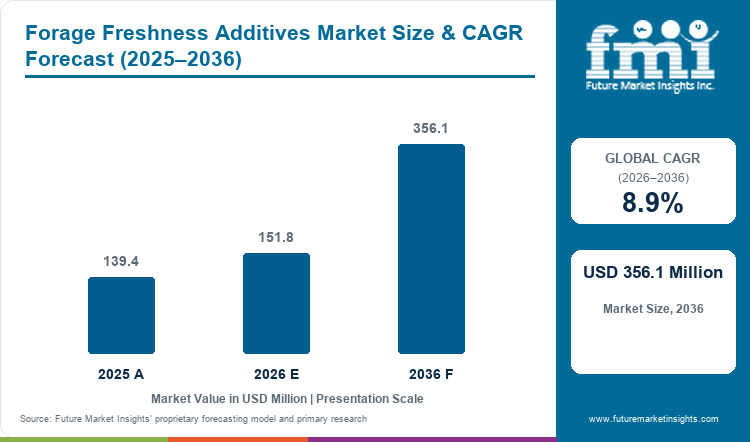
USD 151.8 million in 2026 and USD 356.1 million by 2036 at an 8.9% CAGR.
Demand for forage freshness additives is projected to rise from USD 151.8 million in 2026 to USD 356.1 million by 2036 at an 8.9% CAGR. Dairy farms pay for preservation where retained dry matter reduces replacement-feed needs after storage losses. USDA NASS documented a 2.6% increase in USA milk production during 2025 to 232 billion pounds in April 2026. Higher milk throughput raises the volume of conserved forage exposed to fermentation and feedout losses. Treatment still cannot correct poor packing or sealing.
Inventory pressure strengthens the treatment case when farms enter a feeding season with less carried forage. USDA NASS put USA hay stocks at 23.287 million tons on May 1, 2026, down 3.3% from the prior year. A smaller reserve raises the penalty from heating, mold or avoidable dry matter shrink. Product choice therefore moves toward the moisture and oxygen risk present before storage. Farms with stable inventories can apply a tighter return threshold.
Key Takeaways
- Preservation spending is strongest where forage losses would otherwise force more purchased feed or reduce ration consistency during storage and feedout.
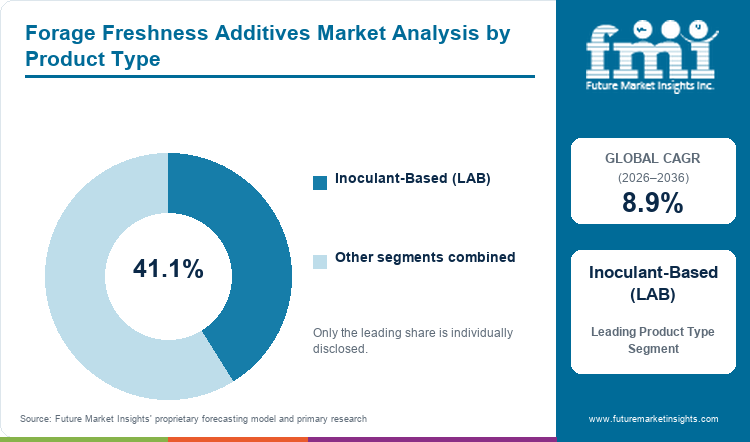
- Based on product type, inoculant-based (LAB) is projected to account for 41.1% in 2026 due to its direct role in controlled fermentation.
- By forage type, corn silage is estimated to hold 44.9% in 2026 owing to its large stored volume and exposure to feedout heating.
- In 2026, at-harvest applied is expected to lead application with 42.3% share because uniform treatment begins before undesirable fermentation develops.
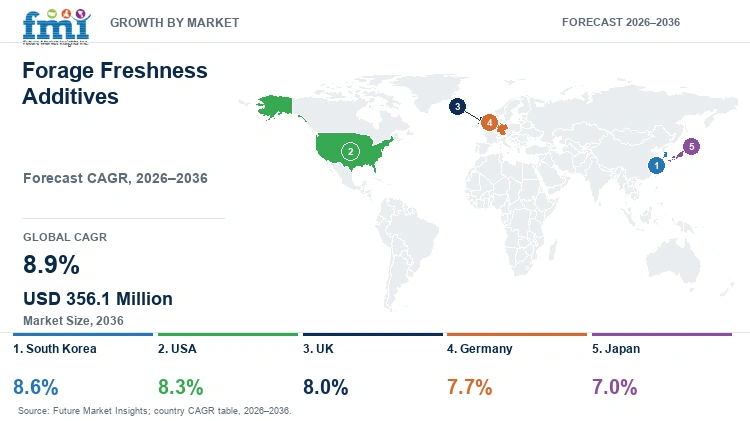
- South Korea records the fastest country CAGR at 8.6%, followed by the USA at 8.3%, while local forage systems determine the route to adoption.
- Some of the key players in this market include Volac, Schaumann, Lallemand Animal Nutrition, Pioneer Hi-Bred International (Corteva Agriscience), BASF, ADDCON EUROPE GmbH, Josera GmbH & Co. KG, and Microferm Limited.
Analyst Perspective
"Forage freshness additives earn repeat orders when treatment fits the crop entering storage and the risk expected at feedout. Commercial advantage comes from proving dry matter protection under local harvest conditions and making application repeatable during each cut."
- Nandini Roy Choudhury, Principal Consultant, Future Market Insights
How is the forage freshness additives market segmented?
The forage freshness additives market is segmented by product type, forage type, application, end user, sales channel and region.
Product type separates microbial inoculants from acid-led and enzyme-enhanced preservation routes, while forage type captures different moisture and fermentability conditions. Application distinguishes treatment at harvest, feedout or baling. End user identifies who controls storage decisions. Sales channel shows how technical guidance reaches farms. A corn-silage program can therefore require a different organism and dose from a high-moisture hay program.
What makes inoculant-based (LAB) central to the product type category?
LAB inoculants act directly on fermentation, so formulation choice can follow the crop problem. Homofermentative strains focus on rapid acidification, while heterofermentative strains address aerobic stability at feedout. Corteva's March 2025 maize update included Pioneer brand inoculants beside its current forage program and crop guidance. The publication places inoculant selection inside crop management rather than a stand-alone additive decision.
- Inoculant-based (LAB) is set to lead the product type category with 41.1% share in 2026 due to its direct role in steering silage fermentation.
- Adoption depends on matching bacterial activity to dry matter, forage type and expected silo-opening interval before routine farm use.
Why does corn silage lead the forage type category?
Corn silage concentrates substantial feed value in bunkers and piles, so modest losses become visible in ration economics. USDA NASS reported a record 136 million tons of USA corn silage production for 2025 in January 2026, up 8%. That volume expands the material exposed to fermentation loss and oxygen entry. Corn also gives formulators a clear crop target for rapid fermentation or feedout stability.
- By forage type, corn silage is forecast to represent 44.9% in 2026 driven by high storage volumes and the cost of heating during feedout.
- Adoption rises where bunk density, face management and expected feedout speed make measurable stability gains commercially useful.
How does at-harvest applied lead the application category?
Treatment at chopping or baling places the additive in forage before undesirable fermentation develops. Lallemand Animal Nutrition stated in May 2026 that unstable spring weather was compressing hay harvest windows and raising heating, mold and dry matter risk. That pressure favors treatment during harvest. Applicator calibration and moisture measurement remain decisive because uneven dosing can erase the expected benefit.
- At-harvest applied is projected to hold 42.3% share in 2026 owing to its preventive position before fermentation and storage losses become established.
- Adoption is strongest where applicators can maintain dose consistency despite changing field moisture and contractor schedules.
What supports dairy operations in the end user category?
Dairy operations use conserved forage daily, making silage consistency a ration-management issue instead of a seasonal storage issue. Defra recorded a 5.0% increase in UK milk production during 2025 to 15.8 billion litres in its July 2026 livestock release. Higher output keeps pressure on farms to protect forage value through long feeding periods. Farms still need to separate additive effects from packing and ration changes.
- The dairy operations segment is likely to capture 46.0% share in 2026 attributable to daily reliance on conserved forage and stable ration quality.
- Repeat purchasing follows where farms can compare treated forage performance against storage loss, intake response and purchased-feed use.
What drives feed & forage distributors in the sales channel category?
Forage additives need local placement advice because one product may not fit wet grass, dry hay and opened corn silage. Volac appointed a USA technical service manager in April 2026 for feed and forage additive application, customer support and commercial trials. The role shows why channel strength depends on technical access and seasonal inventory. Local advice loses value if stock arrives after the harvest window closes.
- The feed & forage distributors channel is forecast to be led by local technical networks at 43.4% share in 2026 due to time-sensitive product placement.
- Adoption depends on carrying enough seasonal stock and giving advisers application rules that can be used during fast harvest decisions.
What are the drivers, restraints and opportunities in the Forage Freshness Additives Market?
Driver: Weather and inventory pressure raise the value of retaining usable forage. Restraint: Lower replacement-feed costs can tighten the return threshold for routine treatment. Opportunity: Public support for silage production expands the treated-forage base in selected countries.
Dry Forage Risk Raises the Value of Preservation
Forage additives gain urgency when weather limits grazing or reduces feed carried into the next season. USDA ERS noted in May 2026 that 62% of the USA cattle inventory was in drought areas, compared with 29% one year earlier. Drought does not guarantee treatment. It raises the penalty from avoidable hay and silage losses where ration continuity depends on stored forage.
Lower Replacement-Feed Costs Tighten the ROI Test
A preservation treatment faces a harder commercial test if replacement feed becomes cheaper. USDA ERS projected USA feed spending to fall 6.8% in 2026 from its expected 2025 level. The figure does not measure additive demand directly. It can narrow the financial gap between preserving marginal forage and purchasing substitute feed. Additive companies therefore need farm-level evidence that treatment clears the cost threshold.
Supported Silage Infrastructure Widens the Treatment Route
Public forage programs increase treatment potential when organized production systems standardize application. South Korea's agriculture ministry set supported silage-manufacturing area at 99.6 thousand hectares in its January 2026 budget plan. The program also funds machinery and forage processing or distribution facilities. Additive companies can therefore work through contractors and cooperatives if guidance fits local crops and equipment.
Which country CAGRs are profiled in the Forage Freshness Additives Market?
| Country | CAGR |
|---|---|
| South Korea | 8.6% |
| USA | 8.3% |
| UK | 8.0% |
| Germany | 7.7% |
| Japan | 7.0% |
How do country-level CAGRs compare in the Forage Freshness Additives Market?
A 1.6 percentage-point spread separates South Korea from Japan, with the USA and UK forming the upper-middle group. South Korea and the USA exceed 8.0%, while Germany and Japan advance more slowly. Channel access and crop fit can therefore outweigh headline CAGR differences in individual accounts.
- South Korea uses cooperative and contractor structures to aggregate forage volumes for organized treatment.
- The USA brings large bunker and pile volumes that reward fast seasonal availability.
- The UK relies heavily on grass silage, which makes harvest timing a central purchase condition.
- Germany pairs fewer dairy holdings with larger operating scale and more standardized forage routines.
- Japan places domestic roughage efficiency beside persistent labor and machinery constraints.
Country growth separates by operating route rather than product chemistry alone. The full report retains North America, Latin America, Western Europe, Eastern Europe, East Asia, South Asia and Pacific, and Middle East and Africa.
Country-wise Analysis
- South Korea expands treatment opportunities through government-backed forage production, yet cattle economics keep pressure on every added input. The agriculture ministry increased forage-production-base support by 4.1% in its January 2026 budget plan. Forage freshness additive demand in South Korea is forecast to rise at 8.6% CAGR through 2036 because more supported forage moves through silage-making programs. Machinery and contractor support give brands a practical application route. The friction is uneven treatment discipline between cooperatives, contractors and individual farms. Companies that document loss reduction under local forage conditions can attach products to supported silage workflows as those programs scale further.
- Large USA dairy and beef operations store forage in volumes that make a small percentage of shrink financially visible. Forage freshness additives in the USA are projected to grow at 8.3% CAGR through 2036, tied to high corn-silage throughput and large feeding programs. USDA NASS counted 9.65 million milk cows in July 2026. That installed dairy base gives distributors a broad repeat-purchase pool for crop-specific inoculants and hay preservatives. Poor face management, variable crop moisture and rushed harvest schedules can overwhelm product performance. Companies that pair seasonal inventory with clear application limits are better placed to defend repeat orders than those selling on formulation claims alone.
- UK dairy farms depend heavily on grass silage through housed feeding periods, so wet harvest windows shape product choice more than a broad preservation claim. Local advisers and contractors give inoculant suppliers a direct route into cutting and clamping decisions. Defra recorded a 0.7% increase in the dairy herd to 1,849,459 animals in June 2025. Adoption in the UK is anticipated to advance at 8.0% CAGR over the assessment period, helped by the need to protect silage quality through variable grass conditions. The caveat is economic: plentiful purchased feed can reduce the immediate penalty from moderate forage loss, which raises the proof required for routine treatment.
- Germany is consolidating dairy production into fewer holdings, which increases the value of repeatable harvest protocols and documented forage specifications. Destatis recorded a 3.1% fall in dairy-cow holdings to roughly 47,200 by November 2025 while cow numbers stayed near 3.6 million. The German forage freshness additives sector is projected to record 7.7% CAGR during the assessment period, attributable to larger operating units and structured feed programs. Local technical advisers can standardize product use across repeated cuts. The structural constraint is that larger farms also scrutinize additive performance against storage design and ration data, so weak crop placement is exposed quickly.
- Japan treats domestic roughage as part of feed-security policy, which keeps preservation quality relevant even with a smaller livestock base than major Western markets. Forage freshness additive sales in Japan are forecast to expand at 7.0% CAGR by 2036, given the emphasis on domestic feed efficiency. MAFF reported an 80% roughage self-sufficiency rate for fiscal 2023 in its current white-paper material. Contractor and total mixed ration centers provide an organized application route. Labor, machinery capacity and fragmented forage production limit how quickly treatment practices spread. Japan therefore rewards products that fit organized feed-production groups more than broad portfolio scale alone.
Who are the notable companies in the Forage Freshness Additives Market?
Volac, Schaumann, Lallemand Animal Nutrition, Pioneer Hi-Bred International (Corteva Agriscience), BASF, ADDCON EUROPE GmbH, Josera GmbH & Co. KG, and Microferm Limited are the notable companies profiled in this market.
Competition separates by preservation route and evidence depth. Volac, Schaumann, Lallemand, Pioneer and Josera carry microbial programs. BASF and ADDCON document acid-preservation routes, while Microferm participates through authorized microbial silage additives. Current DLG and EFSA records make qualification breadth comparable without using corporate scale as a proxy.
- Microbial inoculant specialists: Volac, Schaumann, Lallemand Animal Nutrition, Pioneer Hi-Bred International (Corteva Agriscience), Josera GmbH & Co. KG, and Microferm Limited.
- Acid-led preservation providers: BASF and ADDCON EUROPE GmbH document chemical silage-preservation routes beside microbial competitors.
Competitive Benchmarking: Forage Freshness Additives Market
| Company | Qualification Depth | Preservation Route Breadth | Documented Efficacy Breadth | Geographic Reach |
|---|---|---|---|---|
| Volac | High | High | High | United Kingdom, United States and Western Europe |
| Schaumann | High | High | High | Germany and Western Europe |
| Lallemand Animal Nutrition | Medium | Medium | Low | Western Europe and North America |
| Pioneer Hi-Bred International (Corteva Agriscience) | High | High | High | Western Europe |
| BASF | High | High | High | Western Europe |
| ADDCON EUROPE GmbH | High | High | High | Western Europe |
| Josera GmbH & Co. KG | High | High | High | Western Europe |
| Microferm Limited | High | Medium | Medium | United Kingdom and European Union |
Scoring basis: High qualification depth requires multiple current third-party or regulatory qualifications. Medium identifies one broad qualification and Low one narrow route. High preservation breadth covers more than one preservation route or chemistry. High efficacy breadth requires at least three documented categories, Medium requires two, and Low one. DLG's March 2025 register supports seven company ratings, while EFSA's 2025 renewal assessments support Microferm.
Key Developments in the Forage Freshness Additives Market
- In July 2026, Lallemand Animal Nutrition launched MAGNIVA Platinum for Mexican dairy and beef producers. The launch extends a three-strain forage inoculant into a large livestock market with fermentation and feedout-stability needs.
- In January 2025, Microferm Limited received a positive EFSA renewal assessment for Pediococcus acidilactici NCIMB 30005 as a silage additive. The assessment keeps a defined microbial route inside the EU authorization process, though efficacy was not re-assessed during renewal.
- In January 2026, Volac began a planned ERP order-and-despatch upgrade covering its forage additives line. The company published order cutoffs and stock arrangements before the pause, making fulfillment continuity part of seasonal service during harvest-sensitive purchasing.
Key Players in the Forage Freshness Additives Market
Microbial Silage Preservation Specialists
- Volac
- Schaumann
- Lallemand Animal Nutrition
- Pioneer Hi-Bred International (Corteva Agriscience)
- Josera GmbH & Co. KG
- Microferm Limited
Acid Preservation Specialists
- BASF
- ADDCON EUROPE GmbH
Forage Freshness Additives Market - Report Scope
| Coverage field | Report scope |
|---|---|
| Market breakdown | By product type, forage type, application, end user, sales channel and region. |
| Quantitative Units | USD million. |
| Market Definition | Revenue from microbial inoculants, organic-acid preservatives, enzyme-enhanced blends and other additives sold to preserve harvested forage during ensiling, storage or feedout. Forage seed, harvesting equipment, complete feed rations and standalone diagnostic services are excluded. |
| Regions Covered | North America, Latin America, Western Europe, Eastern Europe, East Asia, South Asia and Pacific, Middle East and Africa. |
| Countries Covered | South Korea, USA, UK, Germany, Japan, and 25+ additional countries in the full report. |
| Key Companies Profiled | Volac, Schaumann, Lallemand Animal Nutrition, Pioneer Hi-Bred International (Corteva Agriscience), BASF, ADDCON EUROPE GmbH, Josera GmbH & Co. KG, Microferm Limited. |
| Forecast Period | 2026 to 2036. |
| Approach | Primary and secondary research with market triangulation. |
Forage Freshness Additives Market - Research Methodology
| Method | Approach |
|---|---|
| Primary Research | FMI analysts gathered input from manufacturers, service providers, technology developers, distributors, end users, procurement teams, and subject-matter experts. Interviews examined purchasing decisions, product or service evaluation, adoption barriers, approval requirements, pricing considerations, and expectations for technical or commercial support. Respondents were also asked what evidence is required before a trial, pilot, or initial order develops into regular purchasing. |
| Desk Research | Desk research covered government statistics, regulatory publications, trade data, industry associations, technical literature, standards, company filings, product information, and official corporate announcements. Sources were reviewed for relevance, publication date, geographic coverage, and consistency with the defined market scope. Claims relating to performance, applications, approvals, capacity, investment, and commercial activity were retained only when supported by credible public evidence. |
| Market Sizing and Forecasting | The market model combined the baseline value with historical performance, segment structure, pricing and volume indicators, adoption levels, company participation, and country-level demand conditions. Forecast assumptions considered economic activity, investment trends, regulatory developments, technology adoption, purchasing cycles, supply availability, and barriers to wider market use. Segment and regional estimates were reconciled before the final market total was calculated. |
| Data Validation | Estimates were checked against multiple independent indicators, including public data, company activity, trade patterns, industry developments, and findings from primary interviews. Validation also tested whether products, services, applications, and company revenues fell within the defined market boundaries. Adjacent categories, unsupported claims, overlapping revenues, and activities without direct market relevance were excluded to reduce double counting and maintain consistency across segments and countries. |
Forage Freshness Additives Market by Segments
Forage Freshness Additives Market segmented by Product Type:
- Inoculant-Based (LAB)
- Organic Acid-Based
- Enzyme-Enhanced Blends
- Others
Forage Freshness Additives Market segmented by Forage Type:
- Corn Silage
- Grass & Haylage
- Alfalfa
- High-Moisture Grains
- Others
Forage Freshness Additives Market segmented by Application:
- At-Harvest Applied
- At-Feedout
- Bale Treatment
- Others
Forage Freshness Additives Market segmented by End User:
- Dairy Operations
- Beef Operations
- Custom Harvesters
- Others
Forage Freshness Additives Market segmented by Sales Channel:
- Feed & Forage Distributors
- Cooperatives
- Direct Sales
- Online
- Others
Forage Freshness Additives Market by Region:
- North America
- United States
- Canada
- Latin America
- Brazil
- Mexico
- Argentina
- Chile
- Western Europe
- Germany
- France
- United Kingdom
- Italy
- Spain
- Benelux
- Nordics
- Eastern Europe
- Poland
- Czech Republic
- Romania
- Hungary
- East Asia
- China
- Japan
- South Korea
- South Asia and Pacific
- India
- ASEAN
- Australia and New Zealand
- Middle East and Africa
- GCC Countries
- South Africa
- Türkiye
- Israel
Research Sources and Bibliography
- USA Department of Agriculture, National Agricultural Statistics Service. (2026, April 30). Milk Production, Disposition, and Income 2025 Summary.
- USA Department of Agriculture, National Agricultural Statistics Service. (2026, May 12). May 2026 Hay Stocks [Executive briefing].
- Corteva Agriscience. (2025, March 3). Corteva's Maize Update March 2025.
- USA Department of Agriculture, National Agricultural Statistics Service. (2026, January 12). Crop Production 2025 Summary.
- Lallemand Animal Nutrition. (2026, May 7). Unpredictable Spring Weather Is Raising the Stakes for Hay Quality in 2026.
- Department for Environment, Food & Rural Affairs. (2026, July). Agriculture in the United Kingdom 2025: Chapter 8, Livestock.
- Volac. (2026, April 13). Volac announces Lucas Krueger as Technical Service Manager for the United States.
- USA Department of Agriculture, Economic Research Service. (2026, May 18). Livestock, Dairy, and Poultry Outlook: May 2026.
- USA Department of Agriculture, Economic Research Service. (2026, February 5). Selected USA farm production expenses, 2024-26F.
- Ministry of Agriculture, Food and Rural Affairs, Republic of Korea. (2026, January). 2026 Budget and Fund Management Plan Overview.
- USA Department of Agriculture, National Agricultural Statistics Service. (2026, July 24). United States Cattle Inventory Up Slightly.
- Department for Environment, Food & Rural Affairs. (2026, March 26). Livestock populations in the United Kingdom at 1 June 2025.
- Statistisches Bundesamt. (2025, December 22). Korrektur: Schweinebestand 2025 leicht gewachsen, Zahl der Betriebe weiterhin rückläufig.
- Ministry of Agriculture, Forestry and Fisheries of Japan. (2025). The status of agricultural production input supply in Japan.
- DLG e.V. (2025, March 27). DLG Quality Seal for silage additives.
- Lallemand Animal Nutrition. (2026, July 7). Lallemand Animal Nutrition Launches MAGNIVA Platinum for Mexican Producers.
- EFSA Panel on Additives and Products or Substances used in Animal Feed. (2025, January 24). Assessment of the feed additive consisting of Pediococcus acidilactici NCIMB 30005 for all animal species for the renewal of its authorisation (Microferm Ltd.).
- Volac. (2026, January 8). We’re upgrading our order and despatch system at the end of January.
- Lallemand Animal Nutrition. (2026, March 17). Lallemand Animal Nutrition Launches MAGNIVA Platinum for Canadian Producers.
- EFSA Panel on Additives and Products or Substances used in Animal Feed. (2025, February 13). Assessment of the feed additive consisting of Lactiplantibacillus plantarum DSM 16627 for all animal species for the renewal of its authorisation (Microferm Ltd.).
- BASF SE. (2025, July 21). Eurofins Agro Testing and trinamiX introduce first silage applications for on-farm nutritional analysis with handheld spectrometer.
This Report Answers
- How large is the forage freshness additives market in 2026 and how large is it forecast to be by 2036?
- Why does inoculant-based (LAB) hold 41.1% of product type demand in 2026?
- Why does corn silage account for 44.9% of forage type demand?
- How does at-harvest application shape preservation purchasing?
- Which operating conditions strengthen or weaken the return from forage treatment?
- How do country CAGRs differ between South Korea, the USA, the UK, Germany and Japan?
- Which companies have current qualification evidence for microbial or acid-led silage preservation?
- Which service and application conditions affect repeat purchasing?
Frequently Asked Questions
How big is the forage freshness additives market in 2026?
The forage freshness additives market is valued at USD 151.8 million in 2026 and is projected to reach USD 356.1 million by 2036. Growth follows greater attention to retained dry matter and feedout stability.
What is the CAGR of the forage freshness additives market from 2026 to 2036?
The forage freshness additives market is projected to grow at a CAGR of 8.9% between 2026 and 2036. Expansion is tied to crop-specific preservation, larger stored-forage volumes and tighter control of feed losses.
Which product type leads the forage freshness additives market?
The inoculant-based (LAB) segment is expected to hold 41.1% of the forage freshness additives market in 2026, driven by its direct role in controlling fermentation. Product choice depends on forage condition and feedout risk.
Which forage type leads the forage freshness additives market?
The corn silage segment is expected to hold 44.9% of the forage freshness additives market in 2026, attributable to high storage volumes and exposure to feedout heating. Large bunkers make small preservation losses financially visible.
Which application leads the forage freshness additives market?
The at-harvest applied segment is expected to hold 42.3% of the forage freshness additives market in 2026, supported by preventive treatment before storage. Correct dosing and applicator calibration determine whether the expected preservation gain is realized.
Which countries are projected to record the highest growth in the forage freshness additives market?
South Korea is projected to grow at 8.6% CAGR, followed by the USA at 8.3% and the UK at 8.0% through 2036. Growth depends on local forage programs, farm scale and technical distribution.
Which companies are active in the forage freshness additives market?
Key companies operating in the market include Volac, Schaumann, Lallemand Animal Nutrition, Pioneer Hi-Bred International, BASF, ADDCON EUROPE GmbH, Josera GmbH & Co. KG, and Microferm Limited. They compete through qualified preservation routes and application support.
Preview the report firsthand - request a free sample
Get SampleGet the brochure for pricing and purchase details.
Get PDFTable of Content
- Key Takeaways
- Market Size and CAGR
- Top Growth Driver
- Fastest Growing Segment
- Leading Region
- Key Companies
- Emerging Opportunities
- Executive Summary
- Global Market Outlook
- Demand-side Trends
- Supply-side Trends
- Technology Roadmap Analysis
- Analysis and Recommendations
- Analyst Perspective (What is happening? Why now? What should investors know?)
- Key Questions Answered
- How large is the market?
- What is the CAGR?
- What are key trends?
- Which region dominates?
- Who are the leaders?
- Market Overview
- Market Coverage / Taxonomy
- Market Definition / Scope / Limitations
- Research Methodology
- Chapter Orientation
- Analytical Lens and Working Hypotheses
- Market Structure, Signals, and Trend Drivers
- Benchmarking and Cross-market Comparability
- Market Sizing, Forecasting, and Opportunity Mapping
- Research Design and Evidence Framework
- Desk Research Programme (Secondary Evidence)
- Expert Input and Fieldwork (Primary Evidence)
- Tooling, Models, and Reference Databases
- Data Engineering and Model Build
- Quality Assurance and Audit Trail
- Market Background
- Market Dynamics (Drivers, Restraints, Opportunity, Trends)
- Scenario Forecast (Optimistic, Likely, Conservative)
- Impact Analysis
- AI Impact
- Sustainability Impact
- Regulatory Impact
- Technology Impact
- Consumer / Buyer Analysis
- Purchase Drivers
- Adoption Barriers
- Buyer Journey
- Opportunity Map Analysis
- Product Life Cycle Analysis
- Supply Chain Analysis
- Investment Feasibility Matrix
- Value Chain Analysis
- PESTLE and Porter's Analysis
- Regulatory Landscape
- Regional Parent Market Outlook
- Production and Consumption Statistics
- Import and Export Statistics
- Global Market Analysis and Forecast, 2021 to 2036
- Historical Market Size Value (USD Million) Analysis, 2021 to 2025
- Current and Future Market Size Value (USD Million) Projections, 2026 to 2036
- Y-o-Y Growth Trend Analysis
- Absolute $ Opportunity Analysis
- Global Market Pricing Analysis, 2021 to 2036
- Global Market Analysis and Forecast, By Product Type, 2021 to 2036
- Introduction / Key Findings
- Historical Market Size Value (USD Million) Analysis By Product Type, 2021 to 2025
- Current and Future Market Size Value (USD Million) Analysis and Forecast By Product Type, 2026 to 2036
- Inoculant-Based (LAB)
- Organic Acid-Based
- Enzyme-Enhanced Blends
- Others
- Y-o-Y Growth Trend Analysis By Product Type, 2021 to 2025
- Absolute $ Opportunity Analysis By Product Type, 2026 to 2036
- Global Market Analysis and Forecast, By Forage Type, 2021 to 2036
- Introduction / Key Findings
- Historical Market Size Value (USD Million) Analysis By Forage Type, 2021 to 2025
- Current and Future Market Size Value (USD Million) Analysis and Forecast By Forage Type, 2026 to 2036
- Corn Silage
- Grass & Haylage
- Alfalfa
- High-Moisture Grains
- Others
- Y-o-Y Growth Trend Analysis By Forage Type, 2021 to 2025
- Absolute $ Opportunity Analysis By Forage Type, 2026 to 2036
- Global Market Analysis and Forecast, By Application, 2021 to 2036
- Introduction / Key Findings
- Historical Market Size Value (USD Million) Analysis By Application, 2021 to 2025
- Current and Future Market Size Value (USD Million) Analysis and Forecast By Application, 2026 to 2036
- At-Harvest Applied
- At-Feedout
- Bale Treatment
- Others
- Y-o-Y Growth Trend Analysis By Application, 2021 to 2025
- Absolute $ Opportunity Analysis By Application, 2026 to 2036
- Global Market Analysis and Forecast, By End User, 2021 to 2036
- Introduction / Key Findings
- Historical Market Size Value (USD Million) Analysis By End User, 2021 to 2025
- Current and Future Market Size Value (USD Million) Analysis and Forecast By End User, 2026 to 2036
- Dairy Operations
- Beef Operations
- Custom Harvesters
- Others
- Y-o-Y Growth Trend Analysis By End User, 2021 to 2025
- Absolute $ Opportunity Analysis By End User, 2026 to 2036
- Global Market Analysis and Forecast, By Sales Channel, 2021 to 2036
- Introduction / Key Findings
- Historical Market Size Value (USD Million) Analysis By Sales Channel, 2021 to 2025
- Current and Future Market Size Value (USD Million) Analysis and Forecast By Sales Channel, 2026 to 2036
- Feed & Forage Distributors
- Cooperatives
- Direct Sales
- Online
- Others
- Y-o-Y Growth Trend Analysis By Sales Channel, 2021 to 2025
- Absolute $ Opportunity Analysis By Sales Channel, 2026 to 2036
- Global Market Analysis and Forecast, By Region, 2021 to 2036
- Introduction
- Historical Market Size Value (USD Million) Analysis By Region, 2021 to 2025
- Current Market Size Value (USD Million) Analysis and Forecast By Region, 2026 to 2036
- North America
- Latin America
- Western Europe
- Eastern Europe
- East Asia
- South Asia and Pacific
- Middle East and Africa
- Market Attractiveness Analysis By Region
- North America Market Analysis and Forecast, By Country, 2021 to 2036
- Historical Market Size Value (USD Million) Trend Analysis By Market Taxonomy, 2021 to 2025
- Market Size Value (USD Million) Forecast By Market Taxonomy, 2026 to 2036
- By Country
- United States
- Canada
- By Product Type
- By Forage Type
- By Application
- By End User
- By Sales Channel
- By Country
- Market Attractiveness Analysis
- By Country
- By Product Type
- By Forage Type
- By Application
- By End User
- By Sales Channel
- Key Takeaways
- Latin America Market Analysis and Forecast, By Country
- Historical Market Size Value (USD Million) Trend Analysis By Market Taxonomy, 2021 to 2025
- Market Size Value (USD Million) Forecast By Market Taxonomy, 2026 to 2036
- By Country
- Brazil
- Mexico
- Argentina
- Chile
- By Product Type
- By Forage Type
- By Application
- By End User
- By Sales Channel
- By Country
- Market Attractiveness Analysis
- By Country
- By Product Type
- By Forage Type
- By Application
- By End User
- By Sales Channel
- Key Takeaways
- Western Europe Market Analysis and Forecast, By Country
- Historical Market Size Value (USD Million) Trend Analysis By Market Taxonomy, 2021 to 2025
- Market Size Value (USD Million) Forecast By Market Taxonomy, 2026 to 2036
- By Country
- Germany
- France
- United Kingdom
- Italy
- Spain
- Benelux
- Nordics
- By Product Type
- By Forage Type
- By Application
- By End User
- By Sales Channel
- By Country
- Market Attractiveness Analysis
- By Country
- By Product Type
- By Forage Type
- By Application
- By End User
- By Sales Channel
- Key Takeaways
- Eastern Europe Market Analysis and Forecast, By Country
- Historical Market Size Value (USD Million) Trend Analysis By Market Taxonomy, 2021 to 2025
- Market Size Value (USD Million) Forecast By Market Taxonomy, 2026 to 2036
- By Country
- Poland
- Czech Republic
- Romania
- Hungary
- By Product Type
- By Forage Type
- By Application
- By End User
- By Sales Channel
- By Country
- Market Attractiveness Analysis
- By Country
- By Product Type
- By Forage Type
- By Application
- By End User
- By Sales Channel
- Key Takeaways
- East Asia Market Analysis and Forecast, By Country
- Historical Market Size Value (USD Million) Trend Analysis By Market Taxonomy, 2021 to 2025
- Market Size Value (USD Million) Forecast By Market Taxonomy, 2026 to 2036
- By Country
- China
- Japan
- South Korea
- By Product Type
- By Forage Type
- By Application
- By End User
- By Sales Channel
- By Country
- Market Attractiveness Analysis
- By Country
- By Product Type
- By Forage Type
- By Application
- By End User
- By Sales Channel
- Key Takeaways
- South Asia and Pacific Market Analysis and Forecast, By Country
- Historical Market Size Value (USD Million) Trend Analysis By Market Taxonomy, 2021 to 2025
- Market Size Value (USD Million) Forecast By Market Taxonomy, 2026 to 2036
- By Country
- India
- ASEAN
- Australia and New Zealand
- By Product Type
- By Forage Type
- By Application
- By End User
- By Sales Channel
- By Country
- Market Attractiveness Analysis
- By Country
- By Product Type
- By Forage Type
- By Application
- By End User
- By Sales Channel
- Key Takeaways
- Middle East and Africa Market Analysis and Forecast, By Country
- Historical Market Size Value (USD Million) Trend Analysis By Market Taxonomy, 2021 to 2025
- Market Size Value (USD Million) Forecast By Market Taxonomy, 2026 to 2036
- By Country
- GCC Countries
- South Africa
- Türkiye
- Israel
- By Product Type
- By Forage Type
- By Application
- By End User
- By Sales Channel
- By Country
- Market Attractiveness Analysis
- By Country
- By Product Type
- By Forage Type
- By Application
- By End User
- By Sales Channel
- Key Takeaways
- Key Countries Market Analysis
- United States
- Pricing Analysis
- Market Share Analysis, 2025
- By Product Type
- By Forage Type
- By Application
- By End User
- By Sales Channel
- Canada
- Pricing Analysis
- Market Share Analysis, 2025
- By Product Type
- By Forage Type
- By Application
- By End User
- By Sales Channel
- Mexico
- Pricing Analysis
- Market Share Analysis, 2025
- By Product Type
- By Forage Type
- By Application
- By End User
- By Sales Channel
- Brazil
- Pricing Analysis
- Market Share Analysis, 2025
- By Product Type
- By Forage Type
- By Application
- By End User
- By Sales Channel
- Chile
- Pricing Analysis
- Market Share Analysis, 2025
- By Product Type
- By Forage Type
- By Application
- By End User
- By Sales Channel
- Germany
- Pricing Analysis
- Market Share Analysis, 2025
- By Product Type
- By Forage Type
- By Application
- By End User
- By Sales Channel
- United Kingdom
- Pricing Analysis
- Market Share Analysis, 2025
- By Product Type
- By Forage Type
- By Application
- By End User
- By Sales Channel
- Italy
- Pricing Analysis
- Market Share Analysis, 2025
- By Product Type
- By Forage Type
- By Application
- By End User
- By Sales Channel
- Spain
- Pricing Analysis
- Market Share Analysis, 2025
- By Product Type
- By Forage Type
- By Application
- By End User
- By Sales Channel
- France
- Pricing Analysis
- Market Share Analysis, 2025
- By Product Type
- By Forage Type
- By Application
- By End User
- By Sales Channel
- India
- Pricing Analysis
- Market Share Analysis, 2025
- By Product Type
- By Forage Type
- By Application
- By End User
- By Sales Channel
- ASEAN
- Pricing Analysis
- Market Share Analysis, 2025
- By Product Type
- By Forage Type
- By Application
- By End User
- By Sales Channel
- Australia and New Zealand
- Pricing Analysis
- Market Share Analysis, 2025
- By Product Type
- By Forage Type
- By Application
- By End User
- By Sales Channel
- China
- Pricing Analysis
- Market Share Analysis, 2025
- By Product Type
- By Forage Type
- By Application
- By End User
- By Sales Channel
- Japan
- Pricing Analysis
- Market Share Analysis, 2025
- By Product Type
- By Forage Type
- By Application
- By End User
- By Sales Channel
- South Korea
- Pricing Analysis
- Market Share Analysis, 2025
- By Product Type
- By Forage Type
- By Application
- By End User
- By Sales Channel
- Poland
- Pricing Analysis
- Market Share Analysis, 2025
- By Product Type
- By Forage Type
- By Application
- By End User
- By Sales Channel
- Hungary
- Pricing Analysis
- Market Share Analysis, 2025
- By Product Type
- By Forage Type
- By Application
- By End User
- By Sales Channel
- Türkiye
- Pricing Analysis
- Market Share Analysis, 2025
- By Product Type
- By Forage Type
- By Application
- By End User
- By Sales Channel
- South Africa
- Pricing Analysis
- Market Share Analysis, 2025
- By Product Type
- By Forage Type
- By Application
- By End User
- By Sales Channel
- United States
- Market Structure Analysis
- Competition Dashboard
- Competition Benchmarking
- Market Share Analysis of Top Players
- By Regional
- By Product Type
- By Forage Type
- By Application
- By End User
- By Sales Channel
- Emerging Startups
- Innovation Benchmarking
- Competition Analysis
- Competition Deep Dive
- Volac
- Overview
- Product Portfolio
- Profitability by Market Segments
- Sales Footprint
- Strategy Overview
- Marketing Strategy
- Product Strategy
- Channel Strategy
- Schaumann
- Lallemand Animal Nutrition
- Pioneer Hi-Bred International (Corteva Agriscience)
- Josera GmbH & Co. KG
- Microferm Limited
- BASF
- ADDCON EUROPE GmbH
- Volac
- Case Studies
- Success Stories
- Recent Developments
- Competition Deep Dive
- Assumptions & Acronyms Used


