

- Industry Size (2026)
- USD 21.6 Bn
- Forecast (2036)
- USD 40.1 Bn
- CAGR (2026 to 2036)
- 6.4%
Germany Ecotourism Market Forecast and Outlook 2026 to 2036
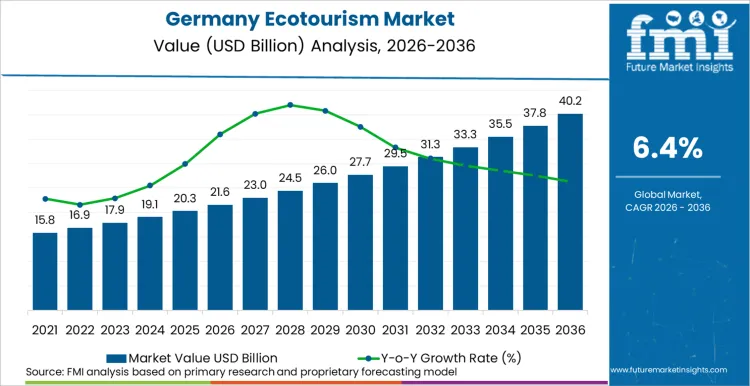
The Germany ecotourism sector is on track to achieve a valuation of USD 40.1 billion by 2036, expanding from USD 21.6 billion in 2026 at a CAGR of 6.4%. As per Future Market Insights, expansion is structurally underpinned by Germany's institutional commitment to sustainable tourism infrastructure, the growing international demand for certified eco-friendly travel experiences, and the federal government's integration of environmental sustainability into national tourism promotion strategy. The Federal Statistical Office of Germany (Destatis) confirmed that overnight stays in Germany reached 487.7 million in 2024, recovering to pre-pandemic levels, with eco-certified accommodations growing at twice the rate of conventional lodging.
This recovery compels tourism operators to invest in sustainability certification and nature-based experiences that align with the GNTB's strategic direction. Simultaneously, the regulatory environment is formalizing sustainability requirements for tourism operators through the German Sustainability Code and the EU Corporate Sustainability Reporting Directive (CSRD), which mandate transparent environmental reporting from hospitality companies above certain thresholds.
Petra Hedorfer, CEO of the German National Tourist Board (GNTB), stated: 'To credibly position Germany as a sustainable destination in the international market, we need to be as green as we can in our own day-to-day operations.' This confirms that Germany's national tourism marketing body has embedded sustainability into its own operational mandate through EMAS (Eco-Management and Audit Scheme) certification, setting an institutional standard that regional tourism boards and private operators are expected to follow. FMI opines that Germany's top-down institutional approach to ecotourism, where the national tourism agency leads by operational example, creates a credibility advantage over destinations that promote sustainability through marketing alone.
The operational landscape in 2025 and 2026 has been defined by strategic investments and infrastructure milestones. The GNTB launched its 2025 strategic tourism theme 'Embrace German Nature' in April 2025, investing EUR 2 million to promote sustainable slow travel and nature retreats to international markets, with a specific focus on Indian travelers. Deutsche Bahn achieved a milestone on January 1, 2025, switching all stations, maintenance depots, and office buildings to 100% renewable energy supply. The German Federal Ministry for Economic Affairs and Climate Action continued its National Tourism Strategy implementation through 2025, integrating climate neutrality targets into federal tourism infrastructure planning. TourCert, a German-based sustainability certification body, expanded its certified operator network across Bavaria, Baden-Wurttemberg, and North Rhine-Westphalia through 2025. As per FMI, this combination of national campaign investment, rail infrastructure decarbonization, and certification network expansion confirms that Germany's ecotourism market is being built on institutional foundations rather than voluntary private sector initiatives.
Key Takeaways
The Germany ecotourism market is shaped by a power structure where the federal government (through the GNTB and the Federal Ministry for Economic Affairs) sets the strategic direction, while state-level tourism boards (Bayern Tourismus, Baden-Wurttemberg Tourismus) execute regional programming and certification. FMI analysts observe that Germany's 16 federal states compete for ecotourism market share through differentiated nature offerings, from Bavaria's Alpine trails to Mecklenburg-Vorpommern's Baltic coast biosphere reserves.
Pricing asymmetry in Germany's ecotourism market exists between certified eco-accommodations (30 to 50% premium over conventional lodging) and standard tourism offerings. As per FMI, international travelers, particularly from the Nordic countries and North America, demonstrate strong willingness to pay this premium for verified sustainability credentials, while price-sensitive domestic travelers require value-added bundling to justify the cost differential.
Sourcing fragility is concentrated in the limited supply of certified eco-accommodations and trained sustainability guides. Germany has 16 national parks and 18 UNESCO Biosphere Reserves, but certified eco-lodging capacity within these areas is insufficient to meet peak-season demand. FMI is of the opinion that accommodation capacity expansion within protected areas will require navigating complex environmental permitting processes, creating a structural supply constraint that favors early movers.
Brand and compliance risks center on greenwashing allegations and the tightening of EU-level sustainability reporting requirements. The CSRD mandates that large tourism and hospitality companies report verified environmental impact data, exposing operators who make unsubstantiated sustainability claims. GNTB's own EMAS certification serves as a defense against such risk at the institutional level.
Geographic leverage within Germany is concentrated in Bavaria, Baden-Wurttemberg, and the northern coastal states. Bavaria leads in Alpine and forest-based ecotourism, while Mecklenburg-Vorpommern leads in coastal and wetland conservation tourism. Urban ecotourism is emerging in Berlin and Hamburg through green mobility infrastructure and sustainable culinary experiences. FMI analysts note that Deutsche Bahn's renewable energy transition directly supports ecotourism by providing a verified low-carbon transport option connecting all major nature destinations.
The executive reframing for the Germany ecotourism market is that sustainability is no longer a marketing narrative but an institutional operating requirement backed by EMAS certification, CSRD reporting mandates, and federal tourism strategy integration. FMI analysts emphasize that hospitality and tourism executives operating in Germany must invest in verifiable sustainability infrastructure as a condition of market access, not a voluntary brand enhancement.
Summary of Germany Ecotourism Market
What Is Growth Outlook for Germany Ecotourism Market as per Future Market Insights Projection?
Future Market Insights projects the Germany ecotourism market to expand at a CAGR of 6.4% from 2026 to 2036, increasing from USD 21.6 Billion in 2026 to USD 40.1 Billion by 2036.
FMI Research Approach: FMI proprietary forecasting model based on Destatis overnight stay data and eco-certified accommodation growth rates.
How Do FMI Analysts Perceive Germany Ecotourism Market to Evolve?
FMI analysts perceive the market evolving toward institutionalized sustainability where EMAS certification, CSRD reporting, and federal tourism strategy integration make eco-compliance a structural requirement rather than a voluntary initiative.
FMI Research Approach: GNTB strategic theme analysis and CSRD implementation timeline tracking.
Which Country Holds Largest Share in Global Germany Ecotourism Market?
Germany is the sole country in this market scope, with Bavaria, Baden-Wurttemberg, and Mecklenburg-Vorpommern leading by eco-certified accommodation supply and nature tourism visitor volume.
FMI Research Approach: FMI state-level revenue modeling by eco-certified lodging capacity and national park visitor data.
How Large Will Germany Ecotourism Market Be by 2036?
The Germany ecotourism market is projected to reach USD 40.1 Billion by 2036.
FMI Research Approach: FMI long-term revenue forecast derived from German tourism recovery projections and eco-certification penetration rate modeling.
What Is Definition of Germany Ecotourism Market?
The Germany ecotourism market includes revenue from nature-based, sustainability-certified, and environmentally responsible tourism experiences within Germany, covering eco-certified accommodations, national park visits, cycling and hiking tourism, sustainable rail travel, and conservation-focused tour programs.
FMI Research Approach: FMI market taxonomy and inclusion-exclusion framework.
What Are Globally Unique Trends Shaping Germany Ecotourism Market?
Globally unique trends include GNTB's institutional EMAS certification setting an operational sustainability standard, Deutsche Bahn's complete switch to renewable energy for all facilities, and the EUR 2 million 'Embrace German Nature' campaign targeting international ecotourists.
FMI Research Approach: GNTB campaign announcements and Deutsche Bahn sustainability disclosures.
Germany Ecotourism Market Key Takeaways
| Metric | Details |
|---|---|
| Industry Size (2026) | USD 21.6 Billion |
| Industry Value (2036) | USD 40.1 Billion |
| CAGR (2026 to 2036) | 6.4% |
Source: Future Market Insights (FMI) analysis, based on proprietary forecasting model and primary research
Semi-Annual Industry Update for Germany’s Ecotourism Sector
The table below outlines the expected CAGR for the Germany ecotourism market over semi-annual periods from 2025 to 2035. Growth is being driven by the adoption of eco-friendly practices and technological advancements in tourism planning.
| Period | CAGR |
|---|---|
| H1 (2024 to 2034) | 6.9% |
| H2 (2024 to 2034) | 7.2% |
| H1 (2025 to 2035) | 6.5% |
| H2 (2025 to 2035) | 6.1% |
Growth is seen during the initial years of the decade through investments in protected areas and eco-friendly accommodations. During the latter half, AI-driven trip customization and blockchain-enabled sustainability tracking are anticipated to enhance market performance.
Comparison of 2021 to 2025 Market Outlook vs Forecast for 2026 to 2036
From 2021 to 2025, the Germany ecotourism market was observed to grow at a steady CAGR of 6.4%, with revenues increasing from USD 14.5 billion in 2021 to USD 19 billion in 2025. Domestic tourism was prioritized during the COVID-19 pandemic as travelers sought nature-based destinations within the country.
From 2026 to 2036, considerable growth at a CAGR of 6.4% is expected, supported by global interest in Germany’s eco-destinations and the implementation of sustainable tourism policies. Investments in green infrastructure and eco-certification programs for tourism operators are anticipated to contribute to the market’s expansion.
Key Dynamics in the Germany Ecotourism Market
Trend: Renewable Energy-Powered Tourism Facilities Are Being Developed
In Germany's ecotourism sector, lodges that operate on renewable energy and low-impact transportation systems are under priority development. Some of the destinations are equipped with solar and wind energy solutions, such as those in the Black Forest and Saxon Switzerland National Park. Such development is enhancing sustainability in these areas and attracting the eco-conscious tourists.
Driver: Environmental Sustainability Awareness Among Travelers Is Increasing
The trend of sustainability awareness among travelers is being seen in Germany. According to a survey conducted in 2024, 70% of tourists have chosen eco-friendly practices in their travel plans, and 50% are willing to pay premiums for sustainable accommodations and experiences. Such preferences are compelling operators to become more sustainable and transparent.
Opportunity: Untapped Ecotourism Destinations Are Being Promoted
In the global context, areas like the Harz Mountains and Hunsrück-Hochwald National Park in the emerging regions are conceived as prime opportunities for sustainable tourism. Through collaborative work and exchange among conservation organizations, local government, and private operators, these destinations are being developed sustainably while protecting biodiversity and promoting heritage.
Key Dynamics in the Germany Ecotourism Market
Overcrowding is being seen at popular destinations like the Bavarian Alps and Rhine Valley. Visitor management strategies, such as capacity limits and the promotion of lesser-known destinations, are being used to alleviate pressure on these ecosystems.
Market Concentration and Competitive Landscape
| Category | Details |
|---|---|
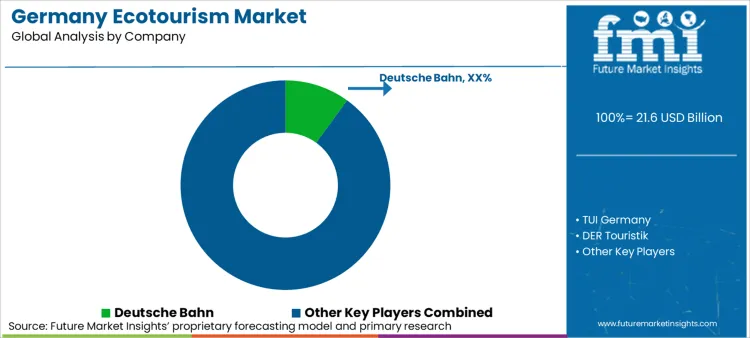
| Tier-1 Players | Dominated by leading companies like TUI Group, National Park Tours, and Nature Lovers Travel, that held between 60% and 70% of the market share in 2024, this market highlights operators that are very keen on emphasizing sustainable accommodations, cultural immersion, and nature-based experiences. |
| Tier-2 Players | Regional companies like Green Forest Adventures and Alpine Eco Trails are also targeting niche markets with niche offerings. These operators report annual revenues of between USD 20 million and USD 60 million, reflecting regional expertise and very impressive local networks. |
| Tier-3 Players | Small companies and community-based organizations, such as Eco-Rhine Travels, are emphasizing affordable and sustainable travel. These small firms play a very important role in the support of grassroots eco-tourism initiatives and promoting sustainable practices. |
Category-Wise Insights Across Adventure, Wildlife, and Sustainable Travel
By Type:
| Type | Market Share (2036) |
|---|---|
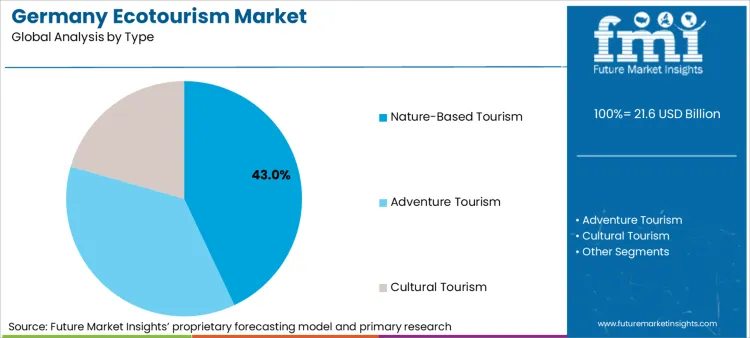
| Nature-Based Tourism | 43% |
| Adventure Tourism | 31% |
| Cultural Tourism | 26% |
Nature-based tourism is expected to continue to maintain its dominance over the years due to the different offerings such as forest hikes and birdwatching, which many places in Germany promote, just like the beautiful Black Forest area. Cultural tours are on an increase, either in historical sites or heritage routes, while adventurous tourism, consisting of rock climbing and mountain bikes, is popular.
By Tourist Type:
| Tourist Type | Market Share (2036) |
|---|---|
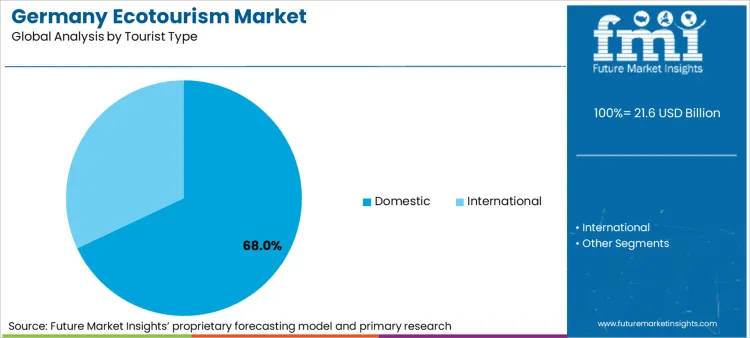
| Domestic | 68% |
| International | 32% |
Domestic travellers make up most of the demand, and they are mainly triggered by accessibility and increasing local demand for eco-tourism destinations. International travellers account for significant premiums and are driven by the attractions of natural beauty and cultural heritage in Germany.
Recent Developments in Germany’s Ecotourism Infrastructure
- In April 2025, the German National Tourist Board (GNTB) launched its 2025 strategic tourism theme 'Embrace German Nature,' investing EUR 2 million to promote sustainable slow travel and nature retreats to international markets.
- On January 1, 2025, Deutsche Bahn achieved a milestone by switching all stations, maintenance depots, and office buildings across Germany to 100% renewable energy supply.
- In May 2024, Kerry Group opened a 10,000-square-meter taste manufacturing facility in Hamm, Germany, supporting sustainable food processing for ecotourism-adjacent gastronomy experiences.
Key Players in the Germany Ecotourism Market
Prominent players in the market include:
- TUI Group
- National Park Tours
- Nature Lovers Travel
- Green Forest Adventures
- Alpine Eco Trails
- Eco-Rhine Travels
- Bavarian Eco Holidays
- Saxon Wilderness Tours
- Black Forest Eco-Lodges
- Germany Adventure Trails
Market Definition
The Germany ecotourism market represents revenue generated from nature-based, sustainability-certified, and environmentally responsible tourism experiences within Germany. The market measures the value of eco-certified accommodations, national park and biosphere reserve visits, cycling and hiking tourism, sustainable rail travel packages, and conservation-focused guided tours.
Inclusions cover eco-certified hotels, lodges, and guesthouses (TourCert, Viabono, EU Ecolabel), national park and biosphere reserve entrance fees and guided tours, cycling tourism (EuroVelo routes) and hiking tourism revenue, Deutsche Bahn green travel packages, organic and sustainable gastronomy tourism, and wildlife and conservation volunteer tourism.
Exclusions include conventional hotel revenue not eco-certified, air travel revenue to and from Germany, general urban sightseeing not marketed as eco-tourism, and business travel. Standard retail purchases at tourist destinations not related to sustainability products are outside the scope.
Scope of Report
| Items | Values |
|---|---|
| Quantitative Units (2026) | USD 21.6 Billion |
| Product Type | Eco-Certified Accommodations, National Park and Biosphere Tourism, Cycling and Hiking Tourism, Sustainable Rail Travel, Conservation and Wildlife Tourism, Organic Gastronomy Tourism |
| Material Type | TourCert Certified, Viabono Certified, EU Ecolabel, EMAS Audited, Klimahotel Certified |
| End-Use / Channel | Tour Operators, Deutsche Bahn Travel Packages, Online Travel Agencies, State Tourism Board Programs, Direct Hotel Booking |
| Regions Covered | Bavaria, Baden-Wurttemberg, Mecklenburg-Vorpommern, North Rhine-Westphalia, Lower Saxony, Schleswig-Holstein |
| Countries Covered | Germany (16 federal states) |
| Key Companies Profiled | Deutsche Bahn, TUI Germany, DER Touristik, FTI Group, Bayern Tourismus, GNTB, TourCert |
| Additional Attributes | Revenue analysis by state and experience type, eco-certification penetration tracking, Deutsche Bahn green travel correlation, CSRD compliance monitoring, and international vs. domestic ecotourist spend comparison |
Germany Ecotourism Market by Segments
By Product Type:
- Eco-Certified Accommodations
- National Park and Biosphere Reserve Tourism
- Cycling Tourism (EuroVelo, Regional Routes)
- Hiking and Trail Tourism
- Sustainable Rail Travel Packages
- Organic and Sustainable Gastronomy Tourism
By Material Type:
- TourCert Certified Operators
- Viabono Certified Accommodations
- EU Ecolabel Properties
- EMAS Audited Organizations
- Klimahotel Certified Hotels
By Region:
- Bavaria
- Baden-Wurttemberg
- Mecklenburg-Vorpommern
- North Rhine-Westphalia
- Lower Saxony
- Schleswig-Holstein
Bibliography
- German National Tourist Board (GNTB). (2025, April). Embrace German Nature 2025 campaign launch. GNTB.
- Deutsche Bahn AG. (2025, January). 100% renewable energy milestone for all facilities. Deutsche Bahn.
- Federal Statistical Office of Germany (Destatis). (2025, February). Tourism statistics 2024 overnight stays. Destatis.
- TourCert gGmbH. (2025, March). Certified operator network expansion report. TourCert.
Frequently Asked Questions
What is the current market size for Germany Ecotourism?
The market is valued at USD 21.6 Billion in 2026, driven by GNTB's institutional sustainability commitment and Deutsche Bahn's renewable energy transition.
What is the projected CAGR for the market over the next 10 years?
The market is projected to grow at a CAGR of 6.4% from 2026 to 2036.
Which states lead ecotourism in Germany?
Bavaria leads in Alpine and forest ecotourism, followed by Baden-Wurttemberg and Mecklenburg-Vorpommern for coastal and biosphere reserve tourism.
What are the primary market drivers?
GNTB institutional sustainability strategy, Deutsche Bahn green energy transition, and CSRD reporting mandates for hospitality companies are the primary drivers.
Who are the leading operators in the industry?
Deutsche Bahn, TUI Germany, DER Touristik, and TourCert-certified operators are key players, differentiating through sustainability certification and integrated green travel packages.
Preview the report firsthand - request a free sample
Get SampleGet the brochure for pricing and purchase details.
Get PDFTable of Content
- Executive Summary
- Global Market Outlook
- Demand-side Trends
- Supply-side Trends
- Technology Roadmap Analysis
- Analysis and Recommendations
- Market Overview
- Market Coverage / Taxonomy
- Market Definition / Scope / Limitations
- Research Methodology
- Chapter Orientation
- Analytical Lens and Working Hypotheses
- Market Structure, Signals, and Trend Drivers
- Benchmarking and Cross-market Comparability
- Market Sizing, Forecasting, and Opportunity Mapping
- Research Design and Evidence Framework
- Desk Research Programme (Secondary Evidence)
- Company Annual and Sustainability Reports
- Peer-reviewed Journals and Academic Literature
- Corporate Websites, Product Literature, and Technical Notes
- Earnings Decks and Investor Briefings
- Statutory Filings and Regulatory Disclosures
- Technical White Papers and Standards Notes
- Trade Journals, Industry Magazines, and Analyst Briefs
- Conference Proceedings, Webinars, and Seminar Materials
- Government Statistics Portals and Public Data Releases
- Press Releases and Reputable Media Coverage
- Specialist Newsletters and Curated Briefings
- Sector Databases and Reference Repositories
- FMI Internal Proprietary Databases and Historical Market Datasets
- Subscription Datasets and Paid Sources
- Social Channels, Communities, and Digital Listening Inputs
- Additional Desk Sources
- Expert Input and Fieldwork (Primary Evidence)
- Primary Modes
- Qualitative Interviews and Expert Elicitation
- Quantitative Surveys and Structured Data Capture
- Blended Approach
- Why Primary Evidence is Used
- Field Techniques
- Interviews
- Surveys
- Focus Groups
- Observational and In-context Research
- Social and Community Interactions
- Stakeholder Universe Engaged
- C-suite Leaders
- Board Members
- Presidents and Vice Presidents
- R&D and Innovation Heads
- Technical Specialists
- Domain Subject-matter Experts
- Scientists
- Physicians and Other Healthcare Professionals
- Governance, Ethics, and Data Stewardship
- Research Ethics
- Data Integrity and Handling
- Primary Modes
- Tooling, Models, and Reference Databases
- Desk Research Programme (Secondary Evidence)
- Data Engineering and Model Build
- Data Acquisition and Ingestion
- Cleaning, Normalisation, and Verification
- Synthesis, Triangulation, and Analysis
- Quality Assurance and Audit Trail
- Market Background
- Market Dynamics
- Drivers
- Restraints
- Opportunity
- Trends
- Scenario Forecast
- Demand in Optimistic Scenario
- Demand in Likely Scenario
- Demand in Conservative Scenario
- Opportunity Map Analysis
- Product Life Cycle Analysis
- Supply Chain Analysis
- Investment Feasibility Matrix
- Value Chain Analysis
- PESTLE and Porter’s Analysis
- Regulatory Landscape
- Regional Parent Market Outlook
- Production and Consumption Statistics
- Import and Export Statistics
- Market Dynamics
- Global Market Analysis 2021 to 2025 and Forecast, 2026 to 2036
- Historical Market Size Value (USD Million) Analysis, 2021 to 2025
- Current and Future Market Size Value (USD Million) Projections, 2026 to 2036
- Y-o-Y Growth Trend Analysis
- Absolute $ Opportunity Analysis
- Global Market Pricing Analysis 2021 to 2025 and Forecast 2026 to 2036
- Global Market Analysis 2021 to 2025 and Forecast 2026 to 2036, By Type
- Introduction / Key Findings
- Historical Market Size Value (USD Million) Analysis By Type , 2021 to 2025
- Current and Future Market Size Value (USD Million) Analysis and Forecast By Type , 2026 to 2036
- Nature-Based Tourism
- Adventure Tourism
- Cultural Tourism
- Nature-Based Tourism
- Y-o-Y Growth Trend Analysis By Type , 2021 to 2025
- Absolute $ Opportunity Analysis By Type , 2026 to 2036
- Global Market Analysis 2021 to 2025 and Forecast 2026 to 2036, By Tourist Type
- Introduction / Key Findings
- Historical Market Size Value (USD Million) Analysis By Tourist Type, 2021 to 2025
- Current and Future Market Size Value (USD Million) Analysis and Forecast By Tourist Type, 2026 to 2036
- Domestic
- International
- Domestic
- Y-o-Y Growth Trend Analysis By Tourist Type, 2021 to 2025
- Absolute $ Opportunity Analysis By Tourist Type, 2026 to 2036
- Global Market Analysis 2021 to 2025 and Forecast 2026 to 2036, By Region
- Introduction
- Historical Market Size Value (USD Million) Analysis By Region, 2021 to 2025
- Current Market Size Value (USD Million) Analysis and Forecast By Region, 2026 to 2036
- North America
- Latin America
- Western Europe
- Eastern Europe
- East Asia
- South Asia and Pacific
- Middle East & Africa
- Market Attractiveness Analysis By Region
- North America Market Analysis 2021 to 2025 and Forecast 2026 to 2036, By Country
- Historical Market Size Value (USD Million) Trend Analysis By Market Taxonomy, 2021 to 2025
- Market Size Value (USD Million) Forecast By Market Taxonomy, 2026 to 2036
- By Country
- USA
- Canada
- Mexico
- By Type
- By Tourist Type
- By Country
- Market Attractiveness Analysis
- By Country
- By Type
- By Tourist Type
- Key Takeaways
- Latin America Market Analysis 2021 to 2025 and Forecast 2026 to 2036, By Country
- Historical Market Size Value (USD Million) Trend Analysis By Market Taxonomy, 2021 to 2025
- Market Size Value (USD Million) Forecast By Market Taxonomy, 2026 to 2036
- By Country
- Brazil
- Chile
- Rest of Latin America
- By Type
- By Tourist Type
- By Country
- Market Attractiveness Analysis
- By Country
- By Type
- By Tourist Type
- Key Takeaways
- Western Europe Market Analysis 2021 to 2025 and Forecast 2026 to 2036, By Country
- Historical Market Size Value (USD Million) Trend Analysis By Market Taxonomy, 2021 to 2025
- Market Size Value (USD Million) Forecast By Market Taxonomy, 2026 to 2036
- By Country
- Germany
- UK
- Italy
- Spain
- France
- Nordic
- BENELUX
- Rest of Western Europe
- By Type
- By Tourist Type
- By Country
- Market Attractiveness Analysis
- By Country
- By Type
- By Tourist Type
- Key Takeaways
- Eastern Europe Market Analysis 2021 to 2025 and Forecast 2026 to 2036, By Country
- Historical Market Size Value (USD Million) Trend Analysis By Market Taxonomy, 2021 to 2025
- Market Size Value (USD Million) Forecast By Market Taxonomy, 2026 to 2036
- By Country
- Russia
- Poland
- Hungary
- Balkan & Baltic
- Rest of Eastern Europe
- By Type
- By Tourist Type
- By Country
- Market Attractiveness Analysis
- By Country
- By Type
- By Tourist Type
- Key Takeaways
- East Asia Market Analysis 2021 to 2025 and Forecast 2026 to 2036, By Country
- Historical Market Size Value (USD Million) Trend Analysis By Market Taxonomy, 2021 to 2025
- Market Size Value (USD Million) Forecast By Market Taxonomy, 2026 to 2036
- By Country
- China
- Japan
- South Korea
- By Type
- By Tourist Type
- By Country
- Market Attractiveness Analysis
- By Country
- By Type
- By Tourist Type
- Key Takeaways
- South Asia and Pacific Market Analysis 2021 to 2025 and Forecast 2026 to 2036, By Country
- Historical Market Size Value (USD Million) Trend Analysis By Market Taxonomy, 2021 to 2025
- Market Size Value (USD Million) Forecast By Market Taxonomy, 2026 to 2036
- By Country
- India
- ASEAN
- Australia & New Zealand
- Rest of South Asia and Pacific
- By Type
- By Tourist Type
- By Country
- Market Attractiveness Analysis
- By Country
- By Type
- By Tourist Type
- Key Takeaways
- Middle East & Africa Market Analysis 2021 to 2025 and Forecast 2026 to 2036, By Country
- Historical Market Size Value (USD Million) Trend Analysis By Market Taxonomy, 2021 to 2025
- Market Size Value (USD Million) Forecast By Market Taxonomy, 2026 to 2036
- By Country
- Kingdom of Saudi Arabia
- Other GCC Countries
- Turkiye
- South Africa
- Other African Union
- Rest of Middle East & Africa
- By Type
- By Tourist Type
- By Country
- Market Attractiveness Analysis
- By Country
- By Type
- By Tourist Type
- Key Takeaways
- Key Countries Market Analysis
- USA
- Pricing Analysis
- Market Share Analysis, 2025
- By Type
- By Tourist Type
- Canada
- Pricing Analysis
- Market Share Analysis, 2025
- By Type
- By Tourist Type
- Mexico
- Pricing Analysis
- Market Share Analysis, 2025
- By Type
- By Tourist Type
- Brazil
- Pricing Analysis
- Market Share Analysis, 2025
- By Type
- By Tourist Type
- Chile
- Pricing Analysis
- Market Share Analysis, 2025
- By Type
- By Tourist Type
- Germany
- Pricing Analysis
- Market Share Analysis, 2025
- By Type
- By Tourist Type
- UK
- Pricing Analysis
- Market Share Analysis, 2025
- By Type
- By Tourist Type
- Italy
- Pricing Analysis
- Market Share Analysis, 2025
- By Type
- By Tourist Type
- Spain
- Pricing Analysis
- Market Share Analysis, 2025
- By Type
- By Tourist Type
- France
- Pricing Analysis
- Market Share Analysis, 2025
- By Type
- By Tourist Type
- India
- Pricing Analysis
- Market Share Analysis, 2025
- By Type
- By Tourist Type
- ASEAN
- Pricing Analysis
- Market Share Analysis, 2025
- By Type
- By Tourist Type
- Australia & New Zealand
- Pricing Analysis
- Market Share Analysis, 2025
- By Type
- By Tourist Type
- China
- Pricing Analysis
- Market Share Analysis, 2025
- By Type
- By Tourist Type
- Japan
- Pricing Analysis
- Market Share Analysis, 2025
- By Type
- By Tourist Type
- South Korea
- Pricing Analysis
- Market Share Analysis, 2025
- By Type
- By Tourist Type
- Russia
- Pricing Analysis
- Market Share Analysis, 2025
- By Type
- By Tourist Type
- Poland
- Pricing Analysis
- Market Share Analysis, 2025
- By Type
- By Tourist Type
- Hungary
- Pricing Analysis
- Market Share Analysis, 2025
- By Type
- By Tourist Type
- Kingdom of Saudi Arabia
- Pricing Analysis
- Market Share Analysis, 2025
- By Type
- By Tourist Type
- Turkiye
- Pricing Analysis
- Market Share Analysis, 2025
- By Type
- By Tourist Type
- South Africa
- Pricing Analysis
- Market Share Analysis, 2025
- By Type
- By Tourist Type
- USA
- Market Structure Analysis
- Competition Dashboard
- Competition Benchmarking
- Market Share Analysis of Top Players
- By Regional
- By Type
- By Tourist Type
- Competition Analysis
- Competition Deep Dive
- Deutsche Bahn
- Overview
- Product Portfolio
- Profitability by Market Segments (Product/Age /Sales Channel/Region)
- Sales Footprint
- Strategy Overview
- Marketing Strategy
- Product Strategy
- Channel Strategy
- TUI Germany
- DER Touristik
- GNTB
- FTI Group
- Deutsche Bahn
- Competition Deep Dive
- Assumptions & Acronyms Used


