

- Market Size (2026)
- USD 11.88 Bn
- Forecast (2036)
- USD 19.72 Bn
- CAGR (2026 to 2036)
- 5.2%
Spinal Fusion Market Size, Market Forecast and Outlook By FMI
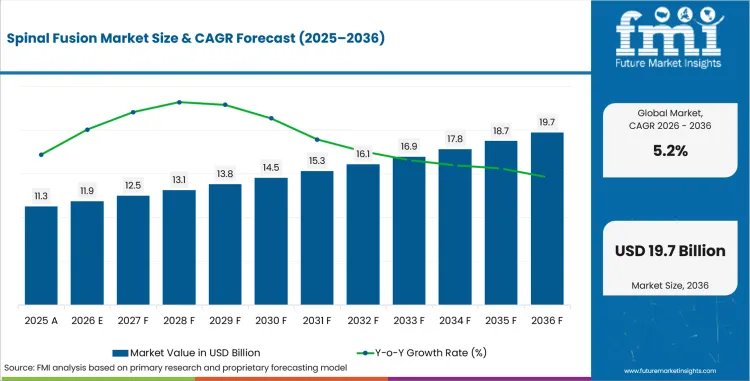
The spinal fusion market was valued at USD 11.3 billion in 2025. The market is set to reach USD 11.9 billion by 2026-end and grow at a CAGR of 5.2% between 2026-2036 to reach USD 19.7 billion by 2036. Interbody Cages will dominate with a 42.0% share, while Posterolateral Fusion will lead with a 48.0% share.
Key Takeaways, Market Size, and Forecast
- 2026 Market Size: USD 11.88 billion
- 2036 Market Size: USD 19.72 billion
- Forecast CAGR: 5.2% from 2026 to 2036
- Absolute $ Opportunity: USD 7.84 billion between 2026 and 2036
- Leading Product Segment: Interbody Cages
- Interbody Cages Share in 2026: 42.0%
- Fastest-growing Country: India
- India CAGR: 8.3% through 2036
| Parameter | Details |
|---|---|
| Market Size in 2026 (Value) | USD 11.88 billion |
| Market Forecast in 2036 (Value) | USD 19.72 billion |
| CAGR (2026 to 2036) | 5.2% |
| Years Considered | 2021 to 2036 |
| Base Year | 2025 |
| Forecast Period | 2026 to 2036 |
| Units Considered | Value (USD Billion) |
| Leading Sub-Region | India |
Summary of the Spinal Fusion Market
- Demand and Growth Drivers
- Rising prevalence of degenerative spinal conditions across aging populations is expected to sustain demand for spinal fusion implants and biologics through the forecast period.
- Adoption of minimally invasive spinal fusion techniques is increasing due to reduced blood loss, shorter hospital stays, and faster recovery compared to open surgical approaches.
- Expansion of spine surgery capability in South Asia and East Asia is broadening the addressable market as healthcare systems invest in neurosurgery and orthopedic spine departments.
- Product and Segment View
- Interbody cages account for 42.0% of the product segment, reflecting clinical preference for titanium and PEEK cage designs that provide structural support and facilitate bony fusion across lumbar, cervical, and thoracic spine levels.
- Posterolateral fusion holds 48.0% of the procedure segment, sustained by high procedural volumes in lumbar degenerative disc disease and spondylolisthesis treatment.
- Hospitals represent the dominant end-user, with procurement concentrated in neurosurgery and orthopedic spine departments of tertiary care and specialty spine centers.
- Geography and Competitive Outlook
- India is expected to lead growth at 8.3% CAGR through 2036, driven by expanding spine surgery capability, growing private hospital investment, and increasing patient access to surgical treatment for degenerative spinal conditions.
- North America accounts for the largest share of market value, supported by high per-capita procedure rates, established insurance coverage, and comprehensive spine implant portfolios from major device manufacturers.
- Medtronic Plc holds an estimated 28.0% market share, supported by the broadest spine implant portfolio in the market, established surgeon relationships, and integrated surgical navigation and robotics platforms.
- Analyst Opinion
- Sabyasachi Ghosh, Principal Consultant at FMI says, 'Companies that can deliver integrated spine surgery ecosystems combining implants, navigation technology, and intraoperative imaging are positioned to capture share as hospitals invest in technology-enabled spine programs. The expansion of minimally invasive techniques and the growing adoption of 3D-printed patient-specific implants are creating differentiation opportunities for manufacturers with advanced manufacturing and digital surgery capability.'
- Growth reflects aging population demographics, expanding minimally invasive surgical technique adoption, and increasing global access to spine surgery.
- Demand is supported by degenerative disc disease prevalence, scoliosis correction requirements, and trauma-related spinal stabilization needs across all age groups.
- Adoption of premium implant technologies is constrained by procedure cost, reimbursement limitations in price-sensitive markets, and surgeon training requirements for advanced techniques.
Spinal Fusion Market Definition
The spinal fusion market includes interbody cages, pedicle screw systems, plates, rods, bone grafts, bone graft substitutes, and biologics used to stabilize and fuse spinal segments in the treatment of degenerative disc disease, spondylolisthesis, spinal stenosis, scoliosis, and spinal trauma.
Spinal Fusion Market Inclusions
Market scope covers all commercially traded spinal fusion products segmented by product (interbody cages, pedicle screws and rods, plates, bone grafts, bone graft substitutes, biologics), procedure (posterolateral fusion, anterior lumbar interbody fusion, posterior lumbar interbody fusion, transforaminal interbody fusion, cervical fusion), end user (hospitals, ambulatory surgical centers, specialty spine centers), technology (minimally invasive surgery, navigation-guided, robotic-assisted, 3D-printed implants), and distribution channel (direct sales, distributor network). Revenue estimates span 2026 to 2036.
Spinal Fusion Market Exclusions
The scope excludes spinal motion preservation devices (disc replacement and dynamic stabilization), standalone spinal imaging systems, and pain management devices used without fusion procedures.
Spinal Fusion Market Research Methodology
- Primary Research: FMI analysts conducted interviews with spine surgeons, hospital neurosurgery department directors, and spinal implant procurement managers across key markets in North America, Europe, and Asia Pacific.
- Desk Research: Combined data from spine surgery registries, hospital procedure volume databases, and implant manufacturer revenue disclosures.
- Market Sizing and Forecasting: Bottom-up aggregation of spine fusion procedure volumes across indications and technique types, calibrated against implant utilization rates and average selling prices.
- Data Validation: Cross-checked quarterly against spine procedure registries, implant manufacturer earnings, and hospital claims data.
Why is the Spinal Fusion Market Growing?
- Aging population demographics are driving increasing prevalence of degenerative disc disease, spinal stenosis, and spondylolisthesis that require surgical intervention, expanding procedural volumes in spine surgery departments globally.
- Minimally invasive spine fusion techniques using tubular retractors and specialized instruments are displacing open surgical approaches, reducing patient morbidity and creating demand for MIS-optimized implant designs.
- 3D-printed titanium interbody cages with porous surface structures that promote bone ingrowth represent the emerging technology trend, with clinical adoption accelerating as clinical evidence matures and manufacturing costs decrease.
The spinal fusion market is expanding as degenerative spinal conditions become more prevalent across aging global populations and surgical treatment options become more accessible. Lumbar degenerative disc disease represents the largest indication, with posterolateral fusion and interbody fusion techniques providing spinal stabilization that addresses pain, instability, and neurological compression. Cervical fusion for disc herniation and degenerative conditions represents the second-largest indication category.
Interbody cage technology is evolving from standard PEEK and titanium designs toward 3D-printed porous structures that improve bone-implant integration. Additively manufactured titanium cages with controlled porosity mimic cancellous bone architecture, creating surface environments that promote bony fusion. These premium implants command higher pricing than standard cages, with adoption concentrated in spine specialty centers and academic medical institutions.
Minimally invasive surgical technique adoption is creating demand for specialized instrumentation and MIS-optimized implant designs. Navigation-guided and robotic-assisted spine surgery is gaining adoption as technologies from Medtronic Mazor, Globus Medical ExcelsiusGPS, and Stryker Mako enable more precise pedicle screw placement and reduced radiation exposure. These technologies create capital equipment revenue alongside recurring implant and disposable instrument sales.
Market Segmentation Analysis
- Interbody cages hold 42.0% of the product segment, reflecting widespread clinical adoption of PEEK and titanium cage designs for structural support and bony fusion facilitation across lumbar, cervical, and thoracic procedures.
- Posterolateral fusion accounts for 48.0% of the procedure segment, sustained by high procedural volumes in lumbar degenerative disc disease treatment using pedicle screw fixation with bone grafting.
- Hospitals represent the largest end-user segment, with spine implant procurement concentrated in neurosurgery and orthopedic spine departments of tertiary and specialty medical centers.
The spinal fusion market is segmented by product, procedure, end user, technology, and distribution channel. Products include interbody cages, pedicle screws/rods, plates, bone grafts, substitutes, and biologics. Procedures span posterolateral, ALIF, PLIF, TLIF, and cervical fusion. Technologies include MIS, navigation, robotics, and 3D printing.
Insights into the Interbody Cage Product Segment
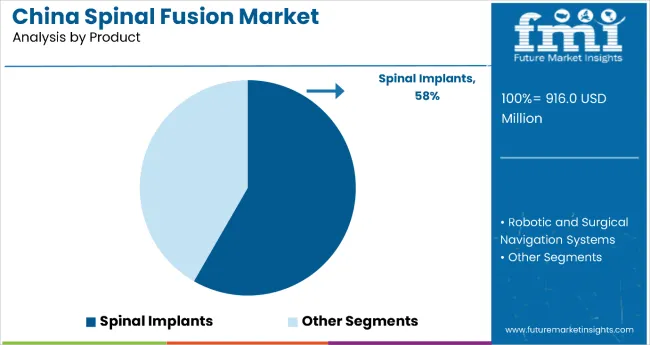
In 2026, interbody cages are expected to account for 42.0% of the product segment. PEEK interbody cages provide radiolucent imaging advantages and modulus of elasticity closer to bone, while titanium cages offer superior bony integration. 3D-printed titanium cages with porous surface architecture represent the premium technology tier.
Procurement is driven by surgeon preference for specific cage designs, approach-specific configurations (anterior, lateral, posterior), and manufacturer implant system compatibility. Spine surgeons develop familiarity with specific cage insertion instruments and techniques, creating product loyalty patterns.
Insights into the Biologics and Bone Graft Product Segment
Bone grafts and biologics including demineralized bone matrix, bone morphogenetic proteins, and synthetic bone graft substitutes complement structural implants by providing biological environments that promote bony fusion. BMP-2 remains a significant biologic despite safety profile scrutiny, with usage concentrated in specific indications. Cellular allograft products represent emerging alternatives.
Spinal Fusion Market Drivers, Restraints, and Opportunities
- Aging demographics and degenerative spinal condition prevalence create structural demand growth for spinal fusion implants across hospital and ambulatory surgical settings globally.
- Procedure cost and reimbursement limitations in price-sensitive markets constrain adoption of premium implant technologies, concentrating advanced product demand in well-reimbursed healthcare systems.
- Minimally invasive techniques, navigation, and robotic-assisted surgery create technology-driven procurement cycles and capital equipment revenue alongside implant sales.
The spinal fusion market benefits from aging demographics, MIS adoption, and technology-driven implant evolution. Restraints include procedure cost, reimbursement constraints, and surgeon training barriers. Opportunities exist in 3D-printed implants, robotic-assisted surgery, and emerging market spine infrastructure.
Degenerative Disease Prevalence
Demand is shaped by increasing prevalence of degenerative disc disease, spinal stenosis, and spondylolisthesis in aging populations. Population aging accelerates the growth of surgical candidates, with patients seeking intervention when conservative treatment fails to provide adequate symptom relief.
MIS Technology Adoption
Growth reflects expanding minimally invasive spine fusion technique adoption that reduces patient morbidity and enables outpatient and short-stay surgical delivery. MIS approaches create demand for specialized instruments, optimized implant designs, and navigation technology.
3D-Printed Implant Technology
Adoption of 3D-printed porous titanium interbody cages is accelerating as clinical evidence demonstrates improved fusion rates and bone integration. Manufacturing cost reduction through additive manufacturing optimization is improving commercial viability for broader clinical adoption.
Analysis of Spinal Fusion Market By Key Countries
.webp "Top Country Growth Comparison Spinal Fusion Market Cagr (2026 2036)")
| Country | CAGR |
|---|---|
| India | 8.3% |
| China | 8.0% |
| Germany | 4.5% |
| USA | 4.2% |
| Brazil | 3.6% |
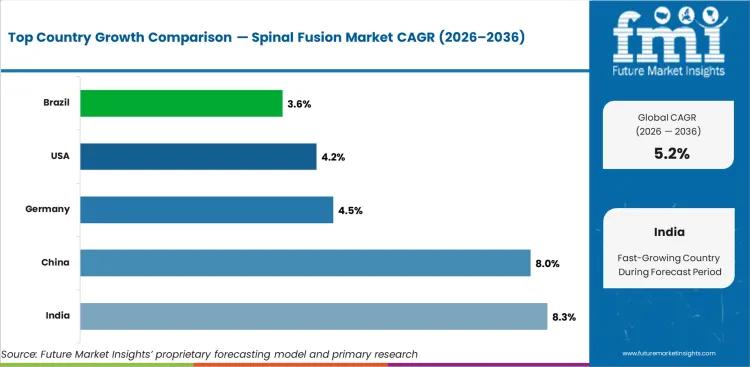
- India leads growth at 8.3% CAGR, driven by expanding private hospital spine surgery capability, growing patient access to surgical treatment, and increasing availability of trained spine surgeons.
- China at 8.0% reflects healthcare modernization, government hospital investment in neurosurgery departments, and growing adoption of minimally invasive spine fusion techniques.
- Germany (4.5%) and the USA (4.2%) sustain demand through established spine surgery infrastructure, technology-driven product upgrades, and expanding ambulatory surgical center procedure volumes.
The global spinal fusion market is projected to grow at 5.2% CAGR from 2026 to 2036. The analysis covers more than 30 countries, with the following key markets discussed below.
Demand Outlook for Spinal Fusion Market in India
Private hospital investment in spine surgery departments and growing patient access to surgical treatment are generating rapid demand growth. India is projected to grow at 8.3% through 2036, supported by expanding medical tourism for spine procedures and increasing availability of spine-trained orthopedic and neurosurgery specialists.
- Private hospital chains including Apollo, Fortis, and Max Healthcare are investing in spine centers of excellence that create high-volume procurement pipelines for interbody cages, pedicle screw systems, and biologics.
- Medical tourism for spine surgery at cost-effective pricing compared to US and European alternatives generates international patient volumes that sustain premium implant utilization in Indian specialty hospitals.
- Growing availability of spine fellowship-trained surgeons in tier-1 and tier-2 cities is expanding procedural capability beyond traditional concentration in metropolitan academic medical centers.
Sales Analysis of Spinal Fusion Market in China
Government hospital modernization and expanding neurosurgery department capacity are driving spinal fusion implant procurement. Growth at 8.0% through 2036 reflects domestic implant manufacturer advancement, MIS technique adoption, and growing surgical volumes for degenerative spinal conditions.
- Government hospital equipment upgrade programs include neurosurgery and spine surgery department modernization that generates procurement demand for fusion implants and surgical navigation systems.
- Domestic spine implant manufacturers are developing competitive interbody cage and pedicle screw systems at lower price points than international brands, creating volume growth in provincial hospital networks.
- MIS technique training programs supported by international and domestic surgical societies are expanding minimally invasive spine fusion capability across Chinese hospital spine departments.
Opportunity Analysis of Spinal Fusion Market in Germany
EU MDR compliance requirements, DIN standards, and advanced spine surgery infrastructure shape implant procurement in the German market. Growth at 4.5% through 2036 reflects technology-driven product upgrades and ambulatory spine surgery expansion.
- EU MDR certification requirements for Class III spinal implants create structured procurement cycles that favor established manufacturers with comprehensive regulatory documentation and clinical evidence.
- DIN standards for spinal implant testing and performance create specification requirements that support German manufacturer positioning and quality certification.
- Ambulatory spine surgery expansion in German healthcare enables outpatient fusion procedures that create demand for MIS-optimized implant systems designed for short-stay surgical pathways.
In-depth Analysis of Spinal Fusion Market in the United States
The installed surgical infrastructure is mature, with demand sustained by high procedure volumes, technology-driven upgrades, and ambulatory surgical center expansion. Growth at 4.2% through 2036 reflects 3D-printed implant adoption, robotic-assisted surgery growth, and expanding outpatient spine fusion.
- FDA 510(k) and PMA clearance pathways for next-generation interbody cages, 3D-printed implants, and robotic surgery platforms support technology-driven product replacement cycles.
- Medicare and commercial insurance coverage for spine fusion procedures sustains per-capita procedure volumes, with reimbursement policies influencing technique and implant utilization patterns.
- Ambulatory surgical center expansion for single and two-level lumbar fusion is shifting procedure volumes from hospital inpatient to outpatient settings, driving demand for MIS-optimized implant systems.
Future Outlook for Spinal Fusion Market in Brazil
Expanding private healthcare investment and growing spine surgery capability support demand growth. Brazil is projected to grow at 3.6% through 2036, with procurement concentrated in spine surgery centers in Sao Paulo and secondary cities.
- SUS public health system spine surgery programs provide access to fusion procedures for the broader population, creating institutional procurement demand for standard interbody cage and pedicle screw systems.
- Import dependency for premium spine implants and navigation technology creates exchange rate sensitivity in procurement, with domestic manufacturers gaining share in commodity product categories.
- Growing spine surgery fellowship training programs in Brazilian medical centers are expanding surgical capability that sustains long-term procedural volume growth.
Competitive Landscape and Strategic Positioning
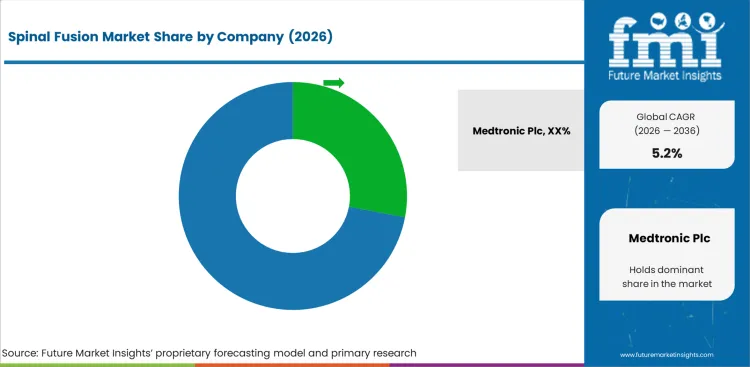
- Medtronic Plc holds an estimated 28.0% market share, supported by the broadest spine implant portfolio, Mazor robotic surgery platform, and established surgeon relationships across global markets.
- Johnson and Johnson (DePuy Synthes) and Stryker Corporation maintain positions through comprehensive spine portfolios, surgical navigation technology, and hospital-level procurement relationships.
- Globus Medical, Inc. and NuVasive, Inc. compete through technology-focused spine implant platforms, with robotic-assisted surgery and MIS-optimized product lines creating differentiation in the spine specialty market.
Medtronic leads with an estimated 28.0% share, benefiting from the broadest spine portfolio spanning cervical to lumbar implants, biologics, navigation, and robotic-assisted surgery through the Mazor platform. The company's established surgeon training infrastructure and hospital relationships sustain procurement loyalty.
Johnson and Johnson through DePuy Synthes and Stryker Corporation compete with comprehensive spine portfolios that integrate implants with surgical technology platforms. Both companies invest in surgeon education and robotic-assisted spine surgery capability.
Globus Medical has built a strong position through technology differentiation, with its ExcelsiusGPS robotic navigation platform and expandable interbody cage technology creating surgeon adoption. NuVasive competes through lateral approach spine surgery leadership and specialized MIS implant systems.
Barriers include surgeon preference patterns requiring extensive clinical education investment, long product development and regulatory clearance cycles, capital equipment requirements for navigation and robotics, and the engineering capability required for 3D-printed implant manufacturing.
Key Companies in the Spinal Fusion Market
Key global companies leading the spinal fusion market include:
- Medtronic Plc (Ireland), Johnson and Johnson/DePuy Synthes (USA), and Stryker Corporation (USA) lead with comprehensive spine portfolios, robotic-assisted surgery platforms, and established surgeon relationships across global markets.
- Zimmer Biomet Holdings (USA), Globus Medical (USA), and NuVasive (USA) maintain positions through technology-focused spine implant platforms, surgical navigation, and MIS-optimized product lines.
- Orthofix Medical (USA), ATEC Spine (USA), B. Braun Melsungen AG (Germany), and SeaSpine Holdings (USA) serve focused segments including biologics, motion preservation, and specialty interbody cage technology.
Competitive Benchmarking: Spinal Fusion Market
| Company | Product Breadth | Technology | Surgeon Relationships | Geographic Footprint |
|---|---|---|---|---|
| Medtronic Plc | High | High | Strong | Global |
| J&J DePuy Synthes | High | High | Strong | Global |
| Stryker Corporation | High | High | Strong | Global |
| Zimmer Biomet | High | Medium | Strong | Global |
| Globus Medical | High | High | Strong | N. America, Global |
| NuVasive | Medium | High | Strong | N. America, Global |
| Orthofix Medical | Medium | Medium | Moderate | N. America, Europe |
| ATEC Spine | Medium | High | Moderate | N. America |
| B. Braun Melsungen | Medium | Medium | Moderate | Europe, Global |
| SeaSpine | Medium | Medium | Moderate | N. America |
Source: Future Market Insights competitive analysis, 2026.
Key Developments in Spinal Fusion Market
- In 2025, Medtronic Plc launched an updated Mazor robotic navigation platform with enhanced planning software and expanded implant compatibility for minimally invasive lumbar fusion procedures.
- In 2025, Globus Medical introduced a 3D-printed titanium interbody cage with optimized porous architecture for enhanced bone integration in lateral lumbar interbody fusion applications.
Key Players in the Spinal Fusion Market
Major Global Players
- Medtronic Plc
- Johnson and Johnson (DePuy Synthes)
- Stryker Corporation
- Zimmer Biomet Holdings, Inc.
- Globus Medical, Inc.
- NuVasive, Inc.
Emerging Players/Startups
- Orthofix Medical, Inc.
- ATEC Spine, Inc.
- B. Braun Melsungen AG
- SeaSpine Holdings Corporation
Report Scope and Coverage
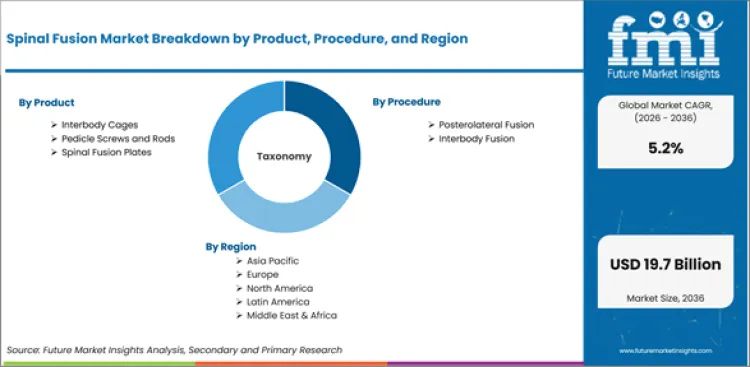
| Parameter | Details |
|---|---|
| Market size by 2036 | USD 19.72 billion |
| Growth rate | 5.2% CAGR (2026 to 2036) |
| Forecast period | 2026 to 2036 |
| Base year value (2026) | USD 11.88 billion |
| By Product | Interbody Cages, Pedicle Screws and Rods, Spinal Fusion Plates |
| By Procedure | Posterolateral Fusion, Interbody Fusion |
| By End User | Hospitals, Specialty Clinics, Ambulatory Surgical Centers |
| By Technology | Minimally Invasive Surgery, Open Surgery Technology, Biologic Fusion Technology |
| By Distribution Channel | Direct Sales, Distributor Network, Online Sales |
| Regions covered | North America, Latin America, Europe, East Asia, South Asia and Pacific, Middle East and Africa |
| Countries covered | USA, UK, Germany, France, Japan, China, India, Brazil, 30 plus countries |
| Key companies profiled | Medtronic, DePuy Synthes, Stryker, Zimmer Biomet, Globus Medical, NuVasive, Orthofix, ATEC Spine, B. Braun, SeaSpine |
| Approach | Hybrid bottom-up and top-down methodology starting with procedure volume data and implant utilization rates, projecting adoption across products and regions. |
Segmentation
Spinal Fusion Market Segmented by Product:
- Interbody Cages
- Spinal Implant Systems
- Titanium Interbody Cages
- PEEK Interbody Cages
- Spinal Implant Systems
- Pedicle Screws and Rods
- Fixation Systems
- Screw Based Stabilization Systems
- Rod Fixation Systems
- Fixation Systems
- Spinal Fusion Plates
- Anterior Stabilization Systems
- Cervical Plates
- Thoracolumbar Plates
- Anterior Stabilization Systems
Spinal Fusion Market Segmented by Procedure:
- Posterolateral Fusion
- Open Fusion Techniques
- Bone Grafting Procedures
- Posterior Stabilization
- Open Fusion Techniques
- Interbody Fusion
- Minimally Invasive Fusion
- Anterior Lumbar Interbody Fusion
- Posterior Lumbar Interbody Fusion
- Minimally Invasive Fusion
Spinal Fusion Market Segmented by End User:
- Hospitals
- Large Healthcare Facilities
- Multi Specialty Hospitals
- Orthopedic Centers
- Large Healthcare Facilities
- Specialty Clinics
- Spine Care Centers
- Orthopedic Clinics
- Neurosurgery Clinics
- Spine Care Centers
- Ambulatory Surgical Centers
- Day Care Surgical Units
- Minimally Invasive Surgery Centers
- Day Care Surgical Units
Spinal Fusion Market Segmented by Technology:
- Minimally Invasive Surgery
- Advanced Surgical Techniques
- Navigation Guided Surgery
- Endoscopic Fusion Systems
- Advanced Surgical Techniques
- Open Surgery Technology
- Traditional Surgical Methods
- Manual Instrumentation
- Standard Fusion Techniques
- Traditional Surgical Methods
- Biologic Fusion Technology
- Bone Growth Enhancement
- Bone Morphogenetic Proteins
- Stem Cell Based Fusion
- Bone Growth Enhancement
Spinal Fusion Market Segmented by Distribution Channel:
- Direct Sales
- Manufacturer Supply
- Hospital Procurement
- Manufacturer Supply
- Distributor Network
- Medical Device Distributors
- Regional Suppliers
- Medical Device Distributors
- Online Sales
- Digital Procurement
- B2B Medical Platforms
- Digital Procurement
Spinal Fusion Market by Region:
- North America
- USA
- Canada
- Mexico
- Latin America
- Brazil
- Chile
- Rest of Latin America
- Western Europe
- Germany
- UK
- Italy
- Spain
- France
- Nordic
- BENELUX
- Rest of Western Europe
- Eastern Europe
- Russia
- Poland
- Hungary
- Balkan & Baltic
- Rest of Eastern Europe
- East Asia
- China
- Japan
- South Korea
- South Asia and Pacific
- India
- ASEAN
- Australia & New Zealand
- Rest of South Asia and Pacific
- Middle East & Africa
- Kingdom of Saudi Arabia
- Other GCC Countries
- Turkiye
- South Africa
- Other African Union
- Rest of Middle East & Africa
Research Sources and Bibliography
- 1. North American Spine Society. (2025). NASS Evidence-Based Clinical Guidelines for Spinal Fusion. NASS.
- 2. Scoliosis Research Society. (2024). SRS Annual Meeting and Research Report. SRS.
- 3. World Health Organization. (2025). WHO Musculoskeletal Health and Spinal Condition Report. WHO.
- 4. USA Food and Drug Administration. (2024). FDA Medical Device Approvals: Spinal Implants. FDA.
- 5. AO Spine. (2025). AO Spine Global Spine Surgery Education and Research Report. AO Spine.
This bibliography is provided for reader reference. The full Future Market Insights report contains the complete reference list with publication dates, URLs, and supporting data for all cited works.
This Report Answers
- Estimating the market size and revenue potential from 2026 to 2036.
- Segmentation by product, procedure, end user, technology, and distribution channel.
- Regional insights across more than 30 markets.
- Technology analysis covering MIS, navigation, robotics, and 3D-printed implants.
- Competitive landscape assessment.
- Identifying investment opportunities in robotic-assisted surgery and 3D-printed implant technology.
- Supply chain and distribution analysis.
- Delivery of data in PDF and Excel formats.
Frequently Asked Questions
How big is the spinal fusion market in 2026?
The global spinal fusion market is estimated to be valued at USD 11.9 billion in 2026.
What will be the size of spinal fusion market in 2036?
The market size for the spinal fusion market is projected to reach USD 19.7 billion by 2036.
How much will be the spinal fusion market growth between 2026 and 2036?
The spinal fusion market is expected to grow at a 5.2% CAGR between 2026 and 2036.
What are the key product types in the spinal fusion market?
The key product types in spinal fusion market are Interbody Cages, Pedicle Screws and Rods and Spinal Fusion Plates.
Which procedure segment is expected to contribute significant share in the spinal fusion market in 2026?
In terms of procedure, posterolateral fusion segment is expected to command 48.0% share in the spinal fusion market in 2026.
Preview the report firsthand - request a free sample
Get SampleGet the brochure for pricing and purchase details.
Get PDFTable of Content
- Executive Summary
- Global Market Outlook
- Demand-side Trends
- Supply-side Trends
- Technology Roadmap Analysis
- Analysis and Recommendations
- Market Overview
- Market Coverage / Taxonomy
- Market Definition / Scope / Limitations
- Research Methodology
- Chapter Orientation
- Analytical Lens and Working Hypotheses
- Market Structure, Signals, and Trend Drivers
- Benchmarking and Cross-market Comparability
- Market Sizing, Forecasting, and Opportunity Mapping
- Research Design and Evidence Framework
- Desk Research Programme (Secondary Evidence)
- Company Annual and Sustainability Reports
- Peer-reviewed Journals and Academic Literature
- Corporate Websites, Product Literature, and Technical Notes
- Earnings Decks and Investor Briefings
- Statutory Filings and Regulatory Disclosures
- Technical White Papers and Standards Notes
- Trade Journals, Industry Magazines, and Analyst Briefs
- Conference Proceedings, Webinars, and Seminar Materials
- Government Statistics Portals and Public Data Releases
- Press Releases and Reputable Media Coverage
- Specialist Newsletters and Curated Briefings
- Sector Databases and Reference Repositories
- FMI Internal Proprietary Databases and Historical Market Datasets
- Subscription Datasets and Paid Sources
- Social Channels, Communities, and Digital Listening Inputs
- Additional Desk Sources
- Expert Input and Fieldwork (Primary Evidence)
- Primary Modes
- Qualitative Interviews and Expert Elicitation
- Quantitative Surveys and Structured Data Capture
- Blended Approach
- Why Primary Evidence is Used
- Field Techniques
- Interviews
- Surveys
- Focus Groups
- Observational and In-context Research
- Social and Community Interactions
- Stakeholder Universe Engaged
- C-suite Leaders
- Board Members
- Presidents and Vice Presidents
- R&D and Innovation Heads
- Technical Specialists
- Domain Subject-matter Experts
- Scientists
- Physicians and Other Healthcare Professionals
- Governance, Ethics, and Data Stewardship
- Research Ethics
- Data Integrity and Handling
- Primary Modes
- Tooling, Models, and Reference Databases
- Desk Research Programme (Secondary Evidence)
- Data Engineering and Model Build
- Data Acquisition and Ingestion
- Cleaning, Normalisation, and Verification
- Synthesis, Triangulation, and Analysis
- Quality Assurance and Audit Trail
- Market Background
- Market Dynamics
- Drivers
- Restraints
- Opportunity
- Trends
- Scenario Forecast
- Demand in Optimistic Scenario
- Demand in Likely Scenario
- Demand in Conservative Scenario
- Opportunity Map Analysis
- Product Life Cycle Analysis
- Supply Chain Analysis
- Investment Feasibility Matrix
- Value Chain Analysis
- PESTLE and Porter’s Analysis
- Regulatory Landscape
- Regional Parent Market Outlook
- Production and Consumption Statistics
- Import and Export Statistics
- Interbody Cages
- Spinal Implant Systems
- Titanium Interbody Cages
- PEEK Interbody Cages
- Spinal Implant Systems
- Pedicle Screws and Rods
- Fixation Systems
- Screw Based Stabilization Systems
- Rod Fixation Systems
- Fixation Systems
- Spinal Fusion Plates
- Anterior Stabilization Systems
- Cervical Plates
- Thoracolumbar Plates
- Anterior Stabilization Systems
- Market Dynamics
- Y-o-Y Growth Trend Analysis By Product , 2021 to 2025
- Absolute $ Opportunity Analysis By Product , 2026 to 2036
- Global Market Analysis 2021 to 2025 and Forecast 2026 to 2036, By Procedure
- Introduction / Key Findings
- Historical Market Size Value (USD Million) Analysis By Procedure, 2021 to 2025
- Current and Future Market Size Value (USD Million) Analysis and Forecast By Procedure, 2026 to 2036
- Posterolateral Fusion
- Open Fusion Techniques
- Bone Grafting Procedures
- Posterior Stabilization
- Open Fusion Techniques
- Interbody Fusion
- Minimally Invasive Fusion
- Anterior Lumbar Interbody Fusion
- Posterior Lumbar Interbody Fusion
- Minimally Invasive Fusion
- Posterolateral Fusion
- Y-o-Y Growth Trend Analysis By Procedure, 2021 to 2025
- Absolute $ Opportunity Analysis By Procedure, 2026 to 2036
- Global Market Analysis 2021 to 2025 and Forecast 2026 to 2036, By End User
- Introduction / Key Findings
- Historical Market Size Value (USD Million) Analysis By End User, 2021 to 2025
- Current and Future Market Size Value (USD Million) Analysis and Forecast By End User, 2026 to 2036
- Hospitals
- Large Healthcare Facilities
- Multi Specialty Hospitals
- Orthopedic Centers
- Large Healthcare Facilities
- Specialty Clinics
- Spine Care Centers
- Orthopedic Clinics
- Neurosurgery Clinics
- Spine Care Centers
- Ambulatory Surgical Centers
- Day Care Surgical Value (USD Million)s
- Minimally Invasive Surgery Centers
- Day Care Surgical Value (USD Million)s
- Hospitals
- Y-o-Y Growth Trend Analysis By End User, 2021 to 2025
- Absolute $ Opportunity Analysis By End User, 2026 to 2036
- Global Market Analysis 2021 to 2025 and Forecast 2026 to 2036, By Technology
- Introduction / Key Findings
- Historical Market Size Value (USD Million) Analysis By Technology, 2021 to 2025
- Current and Future Market Size Value (USD Million) Analysis and Forecast By Technology, 2026 to 2036
- Minimally Invasive Surgery
- Advanced Surgical Techniques
- Navigation Guided Surgery
- Endoscopic Fusion Systems
- Advanced Surgical Techniques
- Open Surgery Technology
- Traditional Surgical Methods
- Manual Instrumentation
- Standard Fusion Techniques
- Traditional Surgical Methods
- Biologic Fusion Technology
- Bone Growth Enhancement
- Bone Morphogenetic Proteins
- Stem Cell Based Fusion
- Bone Growth Enhancement
- Minimally Invasive Surgery
- Y-o-Y Growth Trend Analysis By Technology, 2021 to 2025
- Absolute $ Opportunity Analysis By Technology, 2026 to 2036
- Global Market Analysis 2021 to 2025 and Forecast 2026 to 2036, By Distribution Channel
- Introduction / Key Findings
- Historical Market Size Value (USD Million) Analysis By Distribution Channel, 2021 to 2025
- Current and Future Market Size Value (USD Million) Analysis and Forecast By Distribution Channel, 2026 to 2036
- Direct Sales
- Manufacturer Supply
- Hospital Procurement
- Manufacturer Supply
- Distributor Network
- Medical Device Distributors
- Regional Suppliers
- Medical Device Distributors
- Online Sales
- Digital Procurement
- B2B Medical Platforms
- Digital Procurement
- Direct Sales
- Y-o-Y Growth Trend Analysis By Distribution Channel, 2021 to 2025
- Absolute $ Opportunity Analysis By Distribution Channel, 2026 to 2036
- Global Market Analysis 2021 to 2025 and Forecast 2026 to 2036, By Region
- Introduction
- Historical Market Size Value (USD Million) Analysis By Region, 2021 to 2025
- Current Market Size Value (USD Million) Analysis and Forecast By Region, 2026 to 2036
- North America
- Latin America
- Western Europe
- Eastern Europe
- East Asia
- South Asia and Pacific
- Middle East & Africa
- Market Attractiveness Analysis By Region
- North America Market Analysis 2021 to 2025 and Forecast 2026 to 2036, By Country
- Historical Market Size Value (USD Million) Trend Analysis By Market Taxonomy, 2021 to 2025
- Market Size Value (USD Million) Forecast By Market Taxonomy, 2026 to 2036
- By Country
- USA
- Canada
- Mexico
- By Product
- By Procedure
- By End User
- By Technology
- By Distribution Channel
- By Country
- Market Attractiveness Analysis
- By Country
- By Product
- By Procedure
- By End User
- By Technology
- By Distribution Channel
- Key Takeaways
- Latin America Market Analysis 2021 to 2025 and Forecast 2026 to 2036, By Country
- Historical Market Size Value (USD Million) Trend Analysis By Market Taxonomy, 2021 to 2025
- Market Size Value (USD Million) Forecast By Market Taxonomy, 2026 to 2036
- By Country
- Brazil
- Chile
- Rest of Latin America
- By Product
- By Procedure
- By End User
- By Technology
- By Distribution Channel
- By Country
- Market Attractiveness Analysis
- By Country
- By Product
- By Procedure
- By End User
- By Technology
- By Distribution Channel
- Key Takeaways
- Western Europe Market Analysis 2021 to 2025 and Forecast 2026 to 2036, By Country
- Historical Market Size Value (USD Million) Trend Analysis By Market Taxonomy, 2021 to 2025
- Market Size Value (USD Million) Forecast By Market Taxonomy, 2026 to 2036
- By Country
- Germany
- UK
- Italy
- Spain
- France
- Nordic
- BENELUX
- Rest of Western Europe
- By Product
- By Procedure
- By End User
- By Technology
- By Distribution Channel
- By Country
- Market Attractiveness Analysis
- By Country
- By Product
- By Procedure
- By End User
- By Technology
- By Distribution Channel
- Key Takeaways
- Eastern Europe Market Analysis 2021 to 2025 and Forecast 2026 to 2036, By Country
- Historical Market Size Value (USD Million) Trend Analysis By Market Taxonomy, 2021 to 2025
- Market Size Value (USD Million) Forecast By Market Taxonomy, 2026 to 2036
- By Country
- Russia
- Poland
- Hungary
- Balkan & Baltic
- Rest of Eastern Europe
- By Product
- By Procedure
- By End User
- By Technology
- By Distribution Channel
- By Country
- Market Attractiveness Analysis
- By Country
- By Product
- By Procedure
- By End User
- By Technology
- By Distribution Channel
- Key Takeaways
- East Asia Market Analysis 2021 to 2025 and Forecast 2026 to 2036, By Country
- Historical Market Size Value (USD Million) Trend Analysis By Market Taxonomy, 2021 to 2025
- Market Size Value (USD Million) Forecast By Market Taxonomy, 2026 to 2036
- By Country
- China
- Japan
- South Korea
- By Product
- By Procedure
- By End User
- By Technology
- By Distribution Channel
- By Country
- Market Attractiveness Analysis
- By Country
- By Product
- By Procedure
- By End User
- By Technology
- By Distribution Channel
- Key Takeaways
- South Asia and Pacific Market Analysis 2021 to 2025 and Forecast 2026 to 2036, By Country
- Historical Market Size Value (USD Million) Trend Analysis By Market Taxonomy, 2021 to 2025
- Market Size Value (USD Million) Forecast By Market Taxonomy, 2026 to 2036
- By Country
- India
- ASEAN
- Australia & New Zealand
- Rest of South Asia and Pacific
- By Product
- By Procedure
- By End User
- By Technology
- By Distribution Channel
- By Country
- Market Attractiveness Analysis
- By Country
- By Product
- By Procedure
- By End User
- By Technology
- By Distribution Channel
- Key Takeaways
- Middle East & Africa Market Analysis 2021 to 2025 and Forecast 2026 to 2036, By Country
- Historical Market Size Value (USD Million) Trend Analysis By Market Taxonomy, 2021 to 2025
- Market Size Value (USD Million) Forecast By Market Taxonomy, 2026 to 2036
- By Country
- Kingdom of Saudi Arabia
- Other GCC Countries
- Turkiye
- South Africa
- Other African Union
- Rest of Middle East & Africa
- By Product
- By Procedure
- By End User
- By Technology
- By Distribution Channel
- By Country
- Market Attractiveness Analysis
- By Country
- By Product
- By Procedure
- By End User
- By Technology
- By Distribution Channel
- Key Takeaways
- Key Countries Market Analysis
- USA
- Pricing Analysis
- Market Share Analysis, 2025
- By Product
- By Procedure
- By End User
- By Technology
- By Distribution Channel
- Canada
- Pricing Analysis
- Market Share Analysis, 2025
- By Product
- By Procedure
- By End User
- By Technology
- By Distribution Channel
- Mexico
- Pricing Analysis
- Market Share Analysis, 2025
- By Product
- By Procedure
- By End User
- By Technology
- By Distribution Channel
- Brazil
- Pricing Analysis
- Market Share Analysis, 2025
- By Product
- By Procedure
- By End User
- By Technology
- By Distribution Channel
- Chile
- Pricing Analysis
- Market Share Analysis, 2025
- By Product
- By Procedure
- By End User
- By Technology
- By Distribution Channel
- Germany
- Pricing Analysis
- Market Share Analysis, 2025
- By Product
- By Procedure
- By End User
- By Technology
- By Distribution Channel
- UK
- Pricing Analysis
- Market Share Analysis, 2025
- By Product
- By Procedure
- By End User
- By Technology
- By Distribution Channel
- Italy
- Pricing Analysis
- Market Share Analysis, 2025
- By Product
- By Procedure
- By End User
- By Technology
- By Distribution Channel
- Spain
- Pricing Analysis
- Market Share Analysis, 2025
- By Product
- By Procedure
- By End User
- By Technology
- By Distribution Channel
- France
- Pricing Analysis
- Market Share Analysis, 2025
- By Product
- By Procedure
- By End User
- By Technology
- By Distribution Channel
- India
- Pricing Analysis
- Market Share Analysis, 2025
- By Product
- By Procedure
- By End User
- By Technology
- By Distribution Channel
- ASEAN
- Pricing Analysis
- Market Share Analysis, 2025
- By Product
- By Procedure
- By End User
- By Technology
- By Distribution Channel
- Australia & New Zealand
- Pricing Analysis
- Market Share Analysis, 2025
- By Product
- By Procedure
- By End User
- By Technology
- By Distribution Channel
- China
- Pricing Analysis
- Market Share Analysis, 2025
- By Product
- By Procedure
- By End User
- By Technology
- By Distribution Channel
- Japan
- Pricing Analysis
- Market Share Analysis, 2025
- By Product
- By Procedure
- By End User
- By Technology
- By Distribution Channel
- South Korea
- Pricing Analysis
- Market Share Analysis, 2025
- By Product
- By Procedure
- By End User
- By Technology
- By Distribution Channel
- Russia
- Pricing Analysis
- Market Share Analysis, 2025
- By Product
- By Procedure
- By End User
- By Technology
- By Distribution Channel
- Poland
- Pricing Analysis
- Market Share Analysis, 2025
- By Product
- By Procedure
- By End User
- By Technology
- By Distribution Channel
- Hungary
- Pricing Analysis
- Market Share Analysis, 2025
- By Product
- By Procedure
- By End User
- By Technology
- By Distribution Channel
- Kingdom of Saudi Arabia
- Pricing Analysis
- Market Share Analysis, 2025
- By Product
- By Procedure
- By End User
- By Technology
- By Distribution Channel
- Turkiye
- Pricing Analysis
- Market Share Analysis, 2025
- By Product
- By Procedure
- By End User
- By Technology
- By Distribution Channel
- South Africa
- Pricing Analysis
- Market Share Analysis, 2025
- By Product
- By Procedure
- By End User
- By Technology
- By Distribution Channel
- USA
- Market Structure Analysis
- Competition Dashboard
- Competition Benchmarking
- Market Share Analysis of Top Players
- By Regional
- By Product
- By Procedure
- By End User
- By Technology
- By Distribution Channel
- Competition Analysis
- Competition Deep Dive
- Medtronic Plc
- Overview
- Product Portfolio
- Profitability by Market Segments (Product/Age /Sales Channel/Region)
- Sales Footprint
- Strategy Overview
- Marketing Strategy
- Product Strategy
- Channel Strategy
- Johnson and Johnson (DePuy Synthes)
- Stryker Corporation
- Zimmer Biomet Holdings, Inc.
- Globus Medical, Inc.
- NuVasive, Inc.
- Orthofix Medical, Inc.
- ATEC Spine, Inc.
- B. Braun Melsungen AG
- SeaSpine Holdings Corporation
- Xtant Medical Holdings, Inc.
- Spineology Inc.
- Captiva Spine, Inc.
- Medtronic Plc
- Competition Deep Dive
- Assumptions & Acronyms Used


