

- Market Size (2026)
- USD 251.3 Mn
- Forecast (2036)
- USD 584.1 Mn
- CAGR (2026 to 2036)
- 8.8%
How big is the green ammonia fertilizer additives market in 2026?
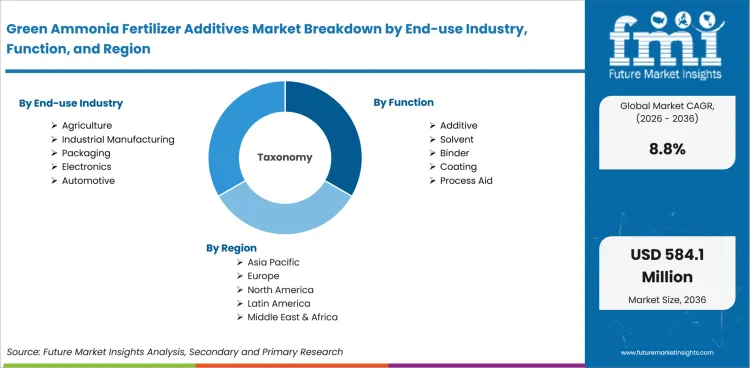
USD 251.3 million in 2026 and USD 584.1 million by 2036 at an 8.8% CAGR.
The green ammonia fertilizer additives industry value is forecast to grow from USD 231.0 million in 2025 to USD 584.1 million by 2036 at 8.8% CAGR as fertilizer producers qualify stabilizers, binders, coatings, and process aids for low-carbon ammonia-based fertilizer lines. Agriculture is forecast to represent 52.0% share in 2026 because crop nutrition buyers remain the main users of ammonia-derived fertilizer additives. Additive function is expected to secure 41.5% share in 2026, led by urease and nitrification control across urea and ammonia-linked products.
The green ammonia fertilizer additives market is expected to witness steady growth through 2036, driven by low-carbon ammonia offtake, nitrogen-loss control, and fertilizer plant qualification work. Market expansion is further supported by demand for additive systems that preserve fertilizer performance while helping producers document cleaner input chains.
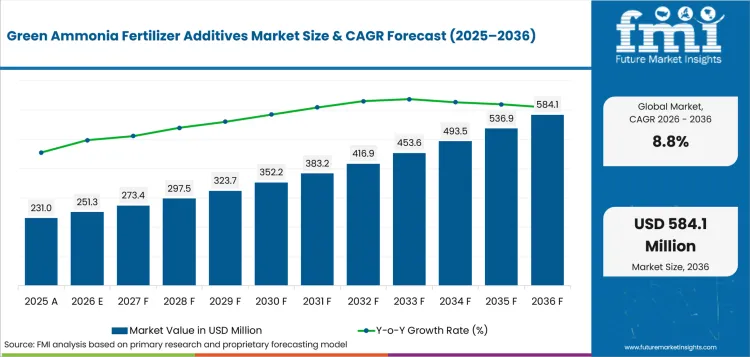
Green Ammonia Fertilizer Additives Market Overview: Size and Forecast
- 2026 Market Size: USD 251.3 million
- 2036 Market Size: USD 584.1 million
- Forecast CAGR: 8.8% from 2026 to 2036
- Leading End-use Industry: Agriculture
- Agriculture Share in 2026: 52.0%
- Leading Function: Additive
- Additive Function Share in 2026: 41.5%
- Fastest-growing Country: India
- India CAGR: 10.4% by 2036
Summary of the Green Ammonia Fertilizer Additives Market
- Demand and Growth Drivers
- Fertilizer producers are qualifying additives that protect product performance across low-carbon ammonia production routes.
- Farm channels are giving more attention to nitrogen stabilizers that reduce volatilization and leaching risk.
- Public procurement and industrial offtake programs are creating earlier trials for binders, coatings, and process aids.
- Product and Segment View
- Agriculture is projected to account for 52.0% share in 2026, led by crop nutrition programs where nitrogen efficiency decides repeat purchase.
- Additive function is expected to hold 41.5% share in 2026, influenced by stabilizer demand across urea, ammonia, and nitrate fertilizer systems.
- Bio-based chemistry is anticipated to secure 34.0% share in 2026, supported by buyers seeking lower-residue carriers and stronger sustainability fit.
- Geography and Competitive Outlook
- India is projected to record 10.4% CAGR by 2036, backed by tender-linked green ammonia supply for fertilizer plants.
- China is expected to expand at 9.1% CAGR by 2036 through fertilizer manufacturing scale and stabilizer field trials.
- Yara Clean Ammonia and CF Industries compete through low-carbon ammonia routes that can support fertilizer supply chains.
- BASF and Koch Agronomic Services focus on nitrogen stabilizer chemistry, field evidence, and farm-channel education.
- Analyst Opinion
- Nikhil Kaitwade, Principal Consultan at FMI, observes, “Green ammonia fertilizer additives are moving from sustainability language into plant qualification and agronomic proof. Suppliers will gain stronger commercial footing when they can prove compatibility with urea, ammonium nitrate, liquid fertilizers, and low-carbon ammonia production routes. The market will reward companies combining chemistry evidence, fertilizer plant access, and country-specific channel execution.”
Market outlook is being shaped by low-carbon hydrogen availability, fertilizer nutrient demand, and public green ammonia procurement. The International Energy Agency stated in September 2025 that low-emissions hydrogen output increased 10% in 2024 and is on track to reach 1.0 million tonnes in 2025. The International Fertilizer Association reported in July 2025 that ammonia capability is projected to rise from 166.6 Mt N in 2024 to 184.9 Mt N by 2029. India’s Press Information Bureau stated in June 2025 that SECI’s green ammonia tender covers 724,000 tonnes per year for 13 fertilizer plants. These signals create a stronger setting for additives that help low-carbon ammonia-derived fertilizers remain stable, usable, and commercially defensible.
Which factors support expansion in the green ammonia fertilizer additives market?
Low-carbon ammonia offtake, nitrogen-loss control, and fertilizer plant qualification support market value across regulated crop nutrition channels.
- Market value is supported by additive revenue linked to stabilizers, binders, coatings, solvents, and carrier systems used with low-carbon ammonia-derived fertilizers.
- Supplier pricing reflects field performance, formulation stability, and plant compatibility before sustainability claims influence premium positioning.
- Revenue improves as fertilizer producers qualify green ammonia-based products for specialty blends, public tenders, and crop nutrition programs.
- Retail trust rises as additives provide clearer handling, storage, and nutrient-efficiency advantages across treated fertilizer products.
Why is the green ammonia fertilizer additives market growing?
Fertilizer producers are moving toward low-carbon ammonia routes while farmers and retailers seek additives that protect nitrogen value.
Market expansion has become more practical as fertilizer production remains closely linked to hydrogen and ammonia economics. The USA Energy Information Administration stated in April 2024 that nitrogenous fertilizer industries used 21% of USA hydrogen production. This shows why changes in hydrogen sourcing can influence ammonia-derived fertilizer costs and additive selection. Green ammonia-based fertilizers carry higher qualification needs than conventional products because producers must protect granule stability, nitrogen behavior, and field performance. Additive suppliers therefore gain opportunities where stabilizers, binders, and coatings help buyers defend premium fertilizer claims through measurable use benefits.
How is the green ammonia fertilizer additives market segmented?
The green ammonia fertilizer additives industry is segmented by end-use industry, function, chemistry type, application, and region.
- Agriculture is projected to account for 52.0% share in 2026, led by crop nutrition buyers comparing additive cost with nitrogen loss, crop response, and application reliability.
- Additive function is anticipated to hold 41.5% share in 2026 since urease and nitrification control provide a direct performance case for producers and farm retailers.
- Bio-based chemistry is expected to capture 34.0% share in 2026 as procurement teams screen additives for lower-residue carriers and stronger sustainability alignment.
- Europe is forecast to represent 31.5% share in 2026, guided by low-carbon fertilizer assets, nitrogen policy scrutiny, and emissions disclosure pressure.
- Water treatment is projected to secure 28.0% share in 2026, reflected by fertilizer plants managing ammonia-bearing streams and nitrogen-effluent scrutiny.
Why does agriculture dominate the green ammonia fertilizer additives market?
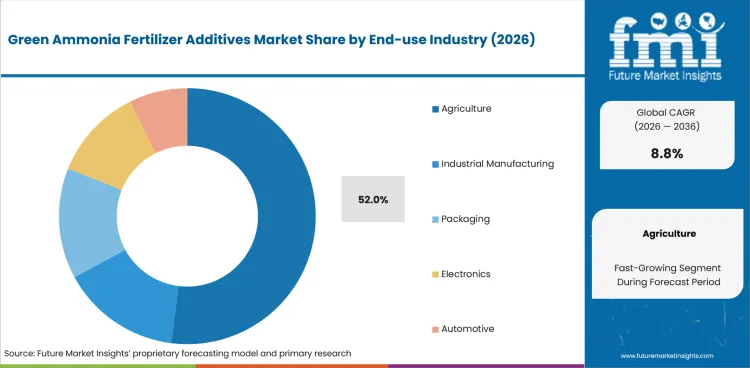
- Agriculture is projected to account for 52.0% share in 2026, influenced by fertilizer buyers comparing additive cost against nitrogen loss, crop response, and product handling reliability.
- Industrial manufacturing gains interest where ammonia-derived intermediates need process aids, although crop nutrition remains the clearest source of repeat demand.
Which function leads the green ammonia fertilizer additives market?
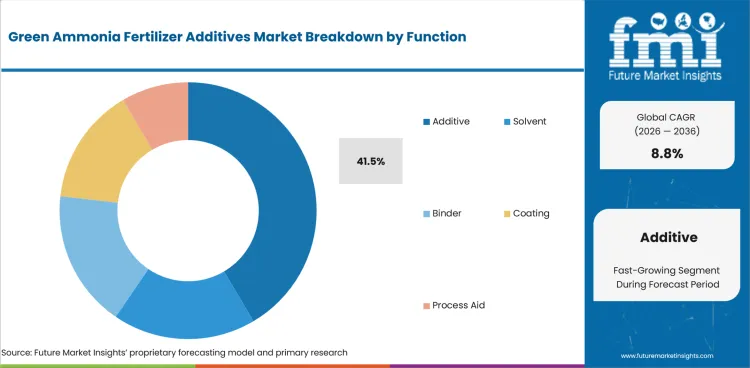
- Additive function is expected to hold 41.5% share in 2026, supported by urease inhibitors, nitrification inhibitors, and carrier systems that address measurable nitrogen-loss costs.
- Binder and coating functions gain value when low-carbon fertilizer producers require granule strength, controlled release, and lower dusting through storage and transport.
Which chemistry type leads the green ammonia fertilizer additives market?
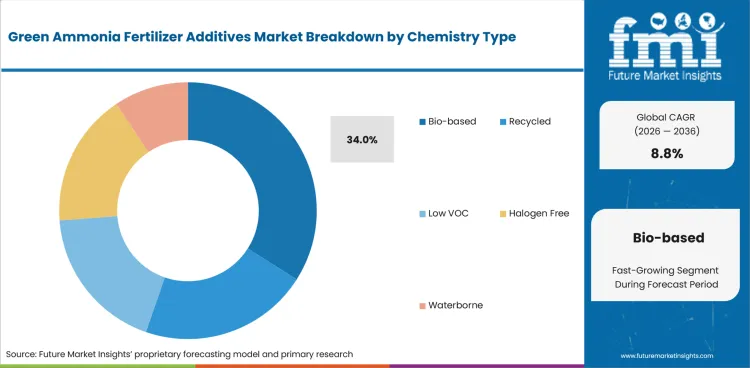
- Bio-based chemistry is forecast to secure 34.0% share in 2026, reflected by residue concerns and procurement teams seeking additive systems aligned with cleaner fertilizer labels.
- Low VOC and waterborne chemistries gain trial interest where plants prioritize safer handling, easier formulation control, and lower solvent exposure during additive blending.
Which region leads the green ammonia fertilizer additives market?
- Europe is expected to represent 31.5% share in 2026, shaped by low-carbon fertilizer assets and stronger pressure to document ammonia and nitrogen-loss performance.
- South Asia gains faster momentum as green ammonia procurement moves into fertilizer plant offtake and technical qualification programs.
Which application leads the green ammonia fertilizer additives market?
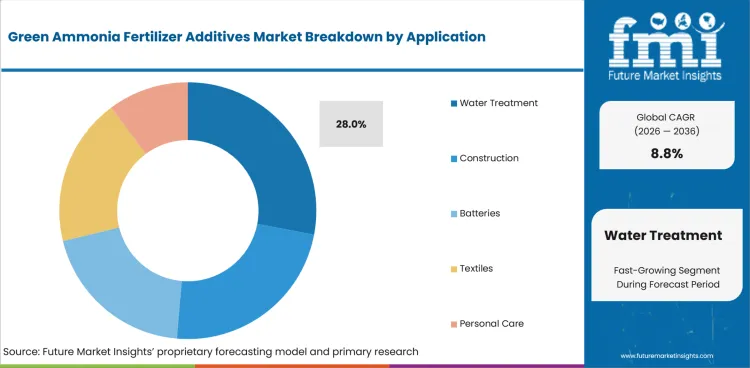
- Water treatment is projected to account for 28.0% share in 2026, led by fertilizer plants addressing nitrogen-bearing process streams and ammonia-handling requirements.
- Construction, battery, textile, and personal care applications remain secondary in the scope and are assessed only where fertilizer-linked additive chemistry overlaps with industrial formulations.
What are the drivers, restraints, and opportunities in the green ammonia fertilizer additives market?
Low-carbon fertilizer qualification supports demand while feedstock cost and field proof requirements limit faster adoption.
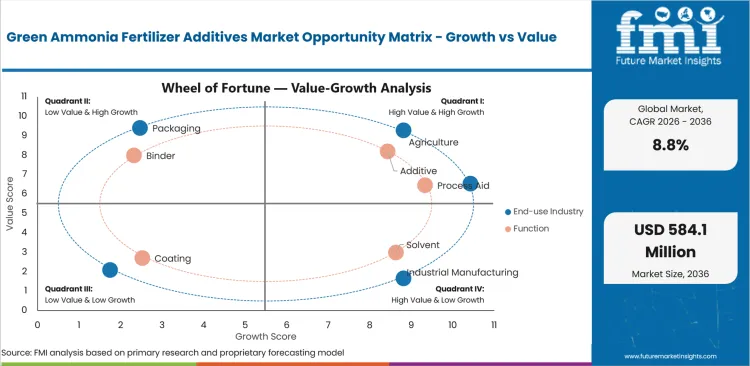
- Driver: Green ammonia offtake gives fertilizer producers a reason to qualify stabilizers, binders, and process aids before full product rollout.
- Restraint: Green ammonia costs remain exposed to electricity pricing, electrolyzer utilization, and ammonia storage economics.
- Opportunity: Specialty fertilizer blends can use additives to position low-carbon nitrogen products around efficiency, handling quality, and reduced loss.
Green Ammonia Offtake and Fertilizer Plant Qualification
Low-carbon ammonia offtake is creating a structured testing environment for additive suppliers. The International Fertilizer Association reported in February 2025 that ammonia capacity is forecast to increase 4% between 2023 and 2025, reaching 200.7 Mt N. This added ammonia capability gives producers more space to test low-carbon input routes and related additive systems. Suppliers that can provide plant trial data, granulation compatibility, and storage stability should gain earlier access to fertilizer plant qualification programs.
Power Cost Exposure and Commercial Restraint
Green ammonia-linked additives depend on a feedstock route that has not yet reached broad cost stability. The International Energy Agency stated in September 2025 that hydrogen production reached almost 100 Mt in 2024, while low-emissions hydrogen represented less than 1% of total production. This limited share keeps green ammonia supply constrained and makes additive adoption more likely in premium blends before commodity fertilizers. Producers without firm power contracts and offtake certainty may delay broad qualification spending.
Specialty Fertilizer and Tender-linked Opportunity
Tender-linked procurement is creating a stronger opportunity for additive suppliers serving fertilizer plants. India’s Press Information Bureau stated in August 2025 that SECI’s first green ammonia auction discovered a price of ₹55.75 per kg compared with ₹100.28 per kg in 2024. Lower price discovery improves the case for plant-level trials and product specifications. Additive suppliers can use this window to support stabilizers, binders, and process aids that help fertilizer producers commercialize cleaner ammonia-derived products.
Which countries are growing fastest in the green ammonia fertilizer additives market?
India 10.4% CAGR, China 9.1% CAGR, United States 8.5% CAGR, France 8.4% CAGR, Germany 8.2% CAGR, South Korea 8.0% CAGR, Japan 7.9% CAGR, and United Kingdom 7.6% CAGR through 2036.
.webp "Top Country Growth Comparison Green Ammonia Fertilizer Additives Market Cagr (2026 2036)")
| Country | CAGR |
|---|---|
| India | 10.4% |
| China | 9.1% |
| United States | 8.5% |
| France | 8.4% |
| Germany | 8.2% |
| South Korea | 8.0% |
| Japan | 7.9% |
| United Kingdom | 7.6% |
Source: Future Market Insights, 2026.
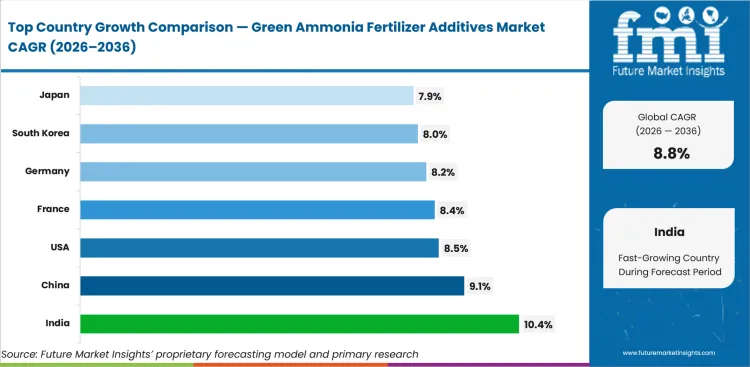
How do country-level CAGRs compare in the green ammonia fertilizer additives market?
India leads country expansion while the United Kingdom records the most cautious pace among profiled markets.
- India is forecast to record 10.4% CAGR by 2036 as green ammonia procurement links directly with fertilizer plants.
- China is expected to expand at 9.1% CAGR from 2026 to 2036 due to fertilizer manufacturing scale and local stabilizer trials.
- The United States is projected to grow at 8.5% CAGR through 2036 as ammonia production and farm retail channels support additive testing.
- France is estimated to rise at 8.4% CAGR by 2036 with low-carbon fertilizer projects supporting early qualification work.
- Germany is expected to advance at 8.2% CAGR over the forecast period as ammonia emissions scrutiny supports stabilizer demand.
- South Korea is forecast to grow at 8.0% CAGR through 2036 as ammonia import channels mature before fertilizer conversion scales.
- Japan is projected to post 7.9% CAGR by 2036 as sustainable nitrogen policy and ammonia handling experience support measured adoption.
- The United Kingdom is anticipated to rise at 7.6% CAGR by 2036 as agronomy-led nitrogen efficiency guides additive uptake.
How fast is the green ammonia fertilizer additives market growing in India?
A 10.4% CAGR through 2036 reflects tender-backed green ammonia supply and fertilizer plant qualification across domestic production hubs.
Country Market Snapshot Table
| Parameter | Value |
|---|---|
| Market Size in 2025 (Value) | USD 31.4 million |
| Market Size in 2026 (Value) | USD 34.7 million |
| Market Forecast in 2036 (Value) | USD 93.5 million |
| CAGR (2026 to 2036) | 10.4% |
| Years Considered | 2021 to 2036 |
| Base Year | 2025 |
| Forecast Period | 2026 to 2036 |
| Units Considered | Value (USD million) |
| Leading Sub-Region | Gujarat, Odisha, and fertilizer plant corridors |
India Green Ammonia Fertilizer Additives Market Outlook
- India green ammonia fertilizer additive demand is shaped by public procurement and fertilizer plant qualification. Producers can evaluate stabilizers, binders, and process aids through defined plant routes before wider farmer-facing products scale.
- Early adoption is expected to begin with fertilizer producers and project developers rather than open retail channels. Suppliers with plant compatibility data and tender-linked access should gain stronger commercial confidence.
Key Growth Drivers
- Public procurement gives additive suppliers a clearer entry point into fertilizer plant trials. India’s Press Information Bureau stated in March 2026 that green ammonia agreements are expected to save about USD 2.5 billion in foreign exchange over 10 years.
- Subsidy support keeps fertilizer availability central to farm policy. Press Information Bureau reported in August 2025 that the Department of Fertilizers budget for 2024 to 2025 was revised to ₹1,91,836.29 crore.
- Domestic fertilizer producers can qualify additives across urea, DAP, and complex fertilizer routes before wider farm-channel promotion begins.
- Renewable ammonia developers can partner with fertilizer plants where technical sales teams support compatibility testing and storage assessments.
Key Restraints
- Domestic production pressure can slow premium additive acceptance. A 2025 parliamentary committee report noted urea output moved from 314 LMT in 2023 to 2024 to 307 LMT in 2024 to 2025.
- Delivered green ammonia prices can remain difficult for commodity fertilizer producers if power contracts and transport costs move upward.
- Tender timelines can delay additive specification work when plant procurement teams wait for final offtake and supply terms.
What makes India unique
India is unique due to policy-backed green ammonia procurement that directly links clean ammonia supply with fertilizer plant demand.
Key Companies
- AM Green
- ACME Group
- Indian Farmers Fertiliser Cooperative Limited
- Paradeep Phosphates Limited
- Reliance Industries Limited
- Coromandel International Limited
- Rashtriya Chemicals and Fertilizers Limited
Sales & Marketing Channels
- Public tender qualification
- Fertilizer plant technical sales
- Cooperative farm input networks
- Regional distributor channels
- Project developer partnerships
- Agronomy advisory routes
Country Segment Breakdown Table
| Segment | Sub-Segments |
|---|---|
| By End-use Industry | Agriculture · Industrial Manufacturing · Packaging · Electronics · Automotive |
| By Function | Additive · Solvent · Binder · Coating · Process Aid |
| By Chemistry Type | Bio-based · Recycled · Low VOC · Halogen Free · Waterborne |
| By Region | Europe · North America · East Asia · South Asia · Latin America |
| By Application | Water Treatment · Construction · Batteries · Textiles · Personal Care |
| Key Sub-Regions Covered, Fertilizer Plant Corridors | Gujarat · Odisha · Andhra Pradesh · Rajasthan · Uttar Pradesh · Maharashtra |
Frequently Asked Questions
How fast is India green ammonia fertilizer additives market growing?
Sales in India are ready to scale at 10.4% CAGR from 2026 to 2036, guided by green ammonia procurement and fertilizer plant qualification.
Who leads India green ammonia fertilizer additives market?
AM Green, ACME, IFFCO, Paradeep Phosphates, and Coromandel International compete through ammonia projects, fertilizer production, and plant channels.
What is driving adoption in India green ammonia fertilizer additives market?
Public tenders and fertilizer plant offtake programs are moving low-carbon ammonia additives into structured qualification routes.
What is the green ammonia fertilizer additives market outlook in China?
A 9.1% CAGR through 2036 is supported by fertilizer manufacturing scale, stabilizer field trials, and producer partnerships.
Country Market Snapshot Table
| Parameter | Value |
|---|---|
| Market Size in 2025 (Value) | USD 27.5 million |
| Market Size in 2026 (Value) | USD 30.0 million |
| Market Forecast in 2036 (Value) | USD 71.5 million |
| CAGR (2026 to 2036) | 9.1% |
| Years Considered | 2021 to 2036 |
| Base Year | 2025 |
| Forecast Period | 2026 to 2036 |
| Units Considered | Value (USD million) |
| Leading Sub-Region | Yunnan and eastern fertilizer production clusters |
China Green Ammonia Fertilizer Additives Market Outlook
- China demand is shaped by large fertilizer manufacturing capacity and stronger interest in stabilized nitrogen products. Local producer partnerships are important because farmers and distributors need proof across crop zones.
- Additive suppliers are expected to focus on trial evidence and distributor training. Companies with localized field data should gain faster acceptance than suppliers relying only on global product claims.
Key Growth Drivers
- Local field programs strengthen confidence in stabilizer performance. BASF stated in February 2026 that Yuntianhua organized 31 field trials and demonstrations in 2025 for nitrogen fertilizers containing Limus urease inhibitor.
- Nitrogen fertilizer remains central to crop output. Frontiers of Agricultural Science and Engineering reported in 2025 that nitrogen fertilizer accounts for about 45% of the increase in China’s grain production.
- Provincial fertilizer distributors can shorten the path from plant qualification to farmer adoption when product evidence is available.
- Domestic fertilizer scale allows suppliers to test additive systems across many soil, crop, and application conditions.
Key Restraints
- Import and price controls can complicate premium product positioning. OECD reported in October 2025 that China’s 2025 in-quota fertilizer tariff applied to imports up to 3.3 million tonnes of urea.
- Commodity fertilizer price pressure can limit uptake when farms do not see clear value from treated nitrogen products.
- Regional crop differences require localized proof before suppliers can expand beyond selected demonstration provinces.
What makes China unique
China is unique because large fertilizer manufacturing scale can turn validated additive chemistry into high-volume procurement faster than smaller markets.
Key Companies
- BASF China
- Yunnan Yuntianhua Co., Ltd.
- Sinofert Holdings Limited
- China BlueChemical Ltd.
- Kingenta Ecological Engineering Group
- Hubei Xinyangfeng Fertilizer Co., Ltd.
- Luxi Chemical Group
Sales & Marketing Channels
-
Provincial distributor networks
- Fertilizer producer partnerships
- Demonstration farm programs
- Agricultural input retail chains
- Local agronomy service platforms
- Technical training events
Country Segment Breakdown Table
| Segment | Sub-Segments |
|---|---|
| By End-use Industry | Agriculture · Industrial Manufacturing · Packaging · Electronics · Automotive |
| By Function | Additive · Solvent · Binder · Coating · Process Aid |
| By Chemistry Type | Bio-based · Recycled · Low VOC · Halogen Free · Waterborne |
| By Region | Europe · North America · East Asia · South Asia · Latin America |
| By Application | Water Treatment · Construction · Batteries · Textiles · Personal Care |
| Key Sub-Regions Covered, Fertilizer Manufacturing Clusters | Yunnan · Shandong · Hubei · Henan · Jiangsu · Inner Mongolia |
Frequently Asked Questions
How fast is China green ammonia fertilizer additives market growing?
Demand in China is ready to rise at 9.1% CAGR from 2026 to 2036 with fertilizer scale and stabilizer trials supporting adoption.
Who leads China green ammonia fertilizer additives market?
BASF, Yuntianhua, Sinofert, Kingenta, and China BlueChemical compete through stabilizer chemistry, production scale, and distributor networks.
What is driving adoption in China green ammonia fertilizer additives market?
Field-trial evidence and fertilizer producer partnerships are moving stabilized nitrogen additives toward larger commercial use.
What is driving green ammonia fertilizer additives growth in the United States?
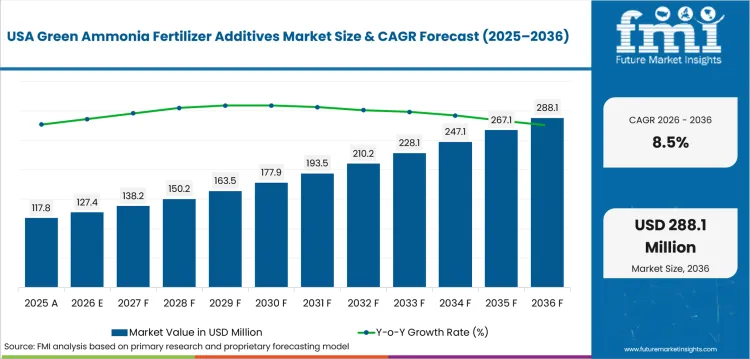
An 8.5% CAGR through 2036 is supported by ammonia production scale, farm retail depth, and low-carbon fertilizer trials.
Country Market Snapshot Table
| Parameter | Value |
|---|---|
| Market Size in 2025 (Value) | USD 41.7 million |
| Market Size in 2026 (Value) | USD 45.2 million |
| Market Forecast in 2036 (Value) | USD 102.2 million |
| CAGR (2026 to 2036) | 8.5% |
| Years Considered | 2021 to 2036 |
| Base Year | 2025 |
| Forecast Period | 2026 to 2036 |
| Units Considered | Value (USD million) |
| Leading Sub-Region | Corn Belt and Gulf Coast ammonia corridors |
United States Green Ammonia Fertilizer Additives Market Outlook
- United States demand is shaped by ammonia production capacity and a mature farm retail channel. Additive adoption is strongest where growers use stabilizers to protect nitrogen value during uncertain application windows.
- Low-carbon ammonia projects can extend additive demand into premium corn and ethanol-linked programs. Suppliers with agronomic proof and cooperative distribution access should gain better acceptance.
Key Growth Drivers
- Domestic ammonia output keeps fertilizer additives tied to large production assets. USGS stated in January 2026 that USA ammonia plants operated at about 80% of rated capacity in 2025.
- Nitrogen fertilizer exposure creates a clear efficiency case. RMI stated in March 2025 that the United States consumes 11% of global synthetic nitrogen.
- Farm retailers and cooperatives can bundle stabilizers with fertilizer service programs during spring and fall application seasons.
- Low-carbon ammonia pilots can support premium fertilizer programs where corn buyers evaluate supply-chain carbon intensity.
Key Restraints
- Fertilizer price volatility can limit discretionary additive spending. USDA Agricultural Marketing Service reported in June 2026 that urea ask prices ranged from USD 875.00 to USD 1,259.42 per ton.
- Growers require yield and nitrogen-retention proof across variable rainfall, soil type, and timing conditions before paying premiums.
- Commodity fertilizer buyers may delay treated products when untreated ammonia and urea remain cheaper and readily available.
What makes the United States unique
The United States is unique because ammonia production, corn demand, and ag-retail channels are closely connected to nitrogen stabilizer decisions.
Key Companies
- CF Industries
- Koch Agronomic Services
- Corteva Agriscience
- BASF Corporation
- Nutrien Ltd.
- Yara North America
- WinField United
Sales & Marketing Channels
- Direct fertilizer producer sales
- Ag-retail dealer programs
- Cooperative purchasing routes
- Crop consultant recommendations
- Distributor-backed stabilizer bundles
- Ethanol supply-chain trials
Country Segment Breakdown Table
| Segment | Sub-Segments |
|---|---|
| By End-use Industry | Agriculture · Industrial Manufacturing · Packaging · Electronics · Automotive |
| By Function | Additive · Solvent · Binder · Coating · Process Aid |
| By Chemistry Type | Bio-based · Recycled · Low VOC · Halogen Free · Waterborne |
| By Region | Europe · North America · East Asia · South Asia · Latin America |
| By Application | Water Treatment · Construction · Batteries · Textiles · Personal Care |
| Key Sub-Regions Covered, Ammonia and Crop Nutrition Corridors | Iowa · Illinois · Nebraska · Kansas · Louisiana · Texas |
Frequently Asked Questions
How fast is United States green ammonia fertilizer additives market growing?
Industry in the United States is projected to increase at 8.5% CAGR from 2026 to 2036 through ammonia scale and farm retail channels.
Who leads United States green ammonia fertilizer additives market?
CF Industries, Koch Agronomic Services, Corteva Agriscience, BASF, Nutrien, and Yara compete through ammonia supply and stabilizer portfolios.
What is driving adoption in United States green ammonia fertilizer additives market?
Low-carbon ammonia trials and ag-retail stabilizer programs are moving treated nitrogen products toward wider farm evaluation.
How is the green ammonia fertilizer additives market performing in France?
An 8.4% CAGR through 2036 reflects low-carbon fertilizer projects and cooperative-led qualification routes.
Country Market Snapshot Table
| Parameter | Value |
|---|---|
| Market Size in 2025 (Value) | USD 16.4 million |
| Market Size in 2026 (Value) | USD 17.8 million |
| Market Forecast in 2036 (Value) | USD 39.9 million |
| CAGR (2026 to 2036) | 8.4% |
| Years Considered | 2021 to 2036 |
| Base Year | 2025 |
| Forecast Period | 2026 to 2036 |
| Units Considered | Value (USD million) |
| Leading Sub-Region | Hauts-de-France and national cooperative corridors |
France Green Ammonia Fertilizer Additives Market Outlook
- France demand is influenced by low-carbon fertilizer plant planning and cooperative purchasing routes. Additive suppliers can gain from early qualification work around nitrate and ammonia-derived fertilizers.
- The country’s route is project-led rather than fully commodity-led. Suppliers with documentation for process aids, binders, and stabilizers should gain stronger interest from fertilizer producers.
Key Growth Drivers
- Low-carbon fertilizer manufacturing creates an entry route for additive qualification. Stamicarbon stated in July 2024 that FertigHy’s planned French plant will produce 500,000 tonnes per year of low-carbon nitrogen-based fertilizers.
- French climate reporting shows a clear crop-nutrition context. The Ministry for Ecological Transition reported that crops accounted for 27% of French agricultural emissions in 2024.
- Cooperatives can aggregate early demand for premium fertilizer products when technical proof and farm economics are clear.
- Regional crop systems give producers a defined base for testing treated nitrogen fertilizers in grain and industrial crop areas.
Key Restraints
- EU nitrogen fertilizer prices remain a risk for premium products. The European Commission stated in April 2026 that overall nitrogen fertilizer prices were 71% higher than the 2024 average.
- Project commissioning timelines can delay additive revenue if plants postpone process design and product qualification decisions.
- Farmers may prioritize lower-cost conventional fertilizers when input prices rise faster than crop returns.
What makes France unique
France is unique due to a project-based low-carbon fertilizer route supported by cooperative influence and regional crop nutrition demand.
Key Companies
- FertigHy
- Stamicarbon
- Yara France
- BASF France
- Timac Agro
- Borealis L.A.T France
- InVivo Group
Sales & Marketing Channels
- Cooperative purchasing networks
- Direct fertilizer producer sales
- Project developer qualification
- Agronomy distributor channels
- Regional crop advisor programs
- Plant engineering partnerships
Country Segment Breakdown Table
| Segment | Sub-Segments |
|---|---|
| By End-use Industry | Agriculture · Industrial Manufacturing · Packaging · Electronics · Automotive |
| By Function | Additive · Solvent · Binder · Coating · Process Aid |
| By Chemistry Type | Bio-based · Recycled · Low VOC · Halogen Free · Waterborne |
| By Region | Europe · North America · East Asia · South Asia · Latin America |
| By Application | Water Treatment · Construction · Batteries · Textiles · Personal Care |
| Key Sub-Regions Covered, Low-carbon Fertilizer and Crop Corridors | Hauts-de-France · Normandy · Grand Est · Brittany · Nouvelle-Aquitaine · Occitanie |
Frequently Asked Questions
How fast is France green ammonia fertilizer additives market growing?
France demand is projected to rise at 8.4% CAGR from 2026 to 2036, supported by low-carbon fertilizer projects and cooperative channels.
Who leads France green ammonia fertilizer additives market?
FertigHy, Stamicarbon, Yara, BASF, Timac Agro, and InVivo compete through project development, fertilizer production, and agronomy channels.
What is driving adoption in France green ammonia fertilizer additives market?
Low-carbon fertilizer plant planning and nitrogen-efficiency requirements are moving additive suppliers into early qualification programs.
What is the green ammonia fertilizer additives market forecast for Germany?
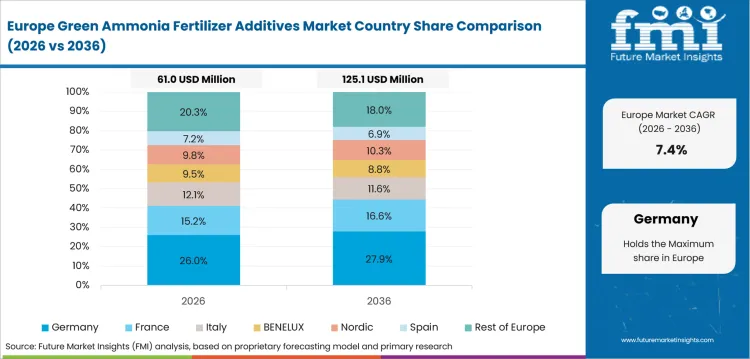
An 8.2% CAGR through 2036 reflects ammonia emissions scrutiny and technical demand for documented stabilizer performance.
Country Market Snapshot Table
| Parameter | Value |
|---|---|
| Market Size in 2025 (Value) | USD 15.9 million |
| Market Size in 2026 (Value) | USD 17.2 million |
| Market Forecast in 2036 (Value) | USD 37.9 million |
| CAGR (2026 to 2036) | 8.2% |
| Years Considered | 2021 to 2036 |
| Base Year | 2025 |
| Forecast Period | 2026 to 2036 |
| Units Considered | Value (USD million) |
| Leading Sub-Region | North Rhine-Westphalia and port-linked chemical corridors |
Germany Green Ammonia Fertilizer Additives Market Outlook
- Germany demand is shaped by ammonia emissions control and chemical industry depth. Buyers are expected to ask for documentation, field data, and compliance support before accepting premium fertilizer additives.
- Low-carbon ammonia imports can strengthen future fertilizer decarbonization once delivery terms become predictable. Additive suppliers should position products as nitrogen-loss control tools rather than simple sustainability inputs.
Key Growth Drivers
- Ammonia emissions pressure supports stabilizer adoption. The Thünen Institute reported in March 2026 that German agriculture emitted around 484 kilotonnes of ammonia in 2024.
- Green ammonia import planning supports future low-carbon fertilizer inputs. Germany’s economy ministry stated in July 2024 that imported ammonia from Egypt will use 273 MW of renewable energy production capacity.
- Chemical clusters support additive formulation, testing, and technical service for fertilizer producers.
- Port-linked ammonia routes can help producers evaluate low-carbon feedstock compatibility with existing fertilizer assets.
Key Restraints
- Emission compliance remains demanding. The European Commission stated in July 2025 that Germany’s national ammonia reduction target is 29% by 2030 against 2005 levels.
- Power and gas price exposure can slow green ammonia offtake when low-carbon supply costs remain uncertain.
- Farmers need evidence that additives fit German soil conditions, manure practices, and crop-specific nitrogen programs.
What makes Germany unique
Germany is unique due to strict ammonia emissions scrutiny and chemical manufacturing depth that supports formulation testing.
Key Companies
- BASF SE
- Yara Germany
- SKW Piesteritz
- K+S AG
- Helm AG
- Fertiglobe-linked import channels
- BayWa AG
Sales & Marketing Channels
- Chemical distributor networks
- Fertilizer producer qualification programs
- Agricultural cooperative channels
- Technical agronomy advisory routes
- Port-linked ammonia supply routes
- Crop input retail networks
Country Segment Breakdown Table
| Segment | Sub-Segments |
|---|---|
| By End-use Industry | Agriculture · Industrial Manufacturing · Packaging · Electronics · Automotive |
| By Function | Additive · Solvent · Binder · Coating · Process Aid |
| By Chemistry Type | Bio-based · Recycled · Low VOC · Halogen Free · Waterborne |
| By Region | Europe · North America · East Asia · South Asia · Latin America |
| By Application | Water Treatment · Construction · Batteries · Textiles · Personal Care |
| Key Sub-Regions Covered, Chemical and Agricultural Corridors | North Rhine-Westphalia · Lower Saxony · Bavaria · Baden-Württemberg · Saxony-Anhalt · Hamburg |
Frequently Asked Questions
How fast is Germany green ammonia fertilizer additives market growing?
Germany demand is forecast to grow at 8.2% CAGR from 2026 to 2036, guided by emissions pressure and chemical-sector capability.
Who leads Germany green ammonia fertilizer additives market?
BASF, Yara Germany, SKW Piesteritz, K+S, Helm, and BayWa compete through chemistry, fertilizer production, and distribution strength.
What is driving adoption in Germany green ammonia fertilizer additives market?
Ammonia emissions rules and fertilizer efficiency needs are moving producers toward documented stabilizer and additive systems.
What is the green ammonia fertilizer additives market outlook in South Korea?
An 8.0% CAGR through 2036 is supported by ammonia import readiness and future low-carbon feedstock partnerships.
Country Market Snapshot Table
| Parameter | Value |
|---|---|
| Market Size in 2025 (Value) | USD 8.6 million |
| Market Size in 2026 (Value) | USD 9.3 million |
| Market Forecast in 2036 (Value) | USD 20.1 million |
| CAGR (2026 to 2036) | 8.0% |
| Years Considered | 2021 to 2036 |
| Base Year | 2025 |
| Forecast Period | 2026 to 2036 |
| Units Considered | Value (USD million) |
| Leading Sub-Region | Ulsan, Incheon, and importer-linked fertilizer corridors |
South Korea Green Ammonia Fertilizer Additives Market Outlook
- South Korea demand is more indirect than India or China, but ammonia import learning can support future fertilizer compatibility work. The market is expected to develop through importers, trading houses, and agricultural cooperatives.
- Additive suppliers should treat the country as a qualification and distribution market before large fertilizer-linked volumes appear. Early relationships with importers and farm input channels will be important.
Key Growth Drivers
- Long-term ammonia sourcing creates future feedstock visibility. Reliance Industries stated in March 2026 that its green ammonia agreement with Samsung C&T is valued at more than US$ 3 billion over 15 years.
- Clean hydrogen planning can support ammonia import infrastructure. GH2 reported in 2025 that South Korea targets 3.9 million tonnes of hydrogen production by 2030.
- Agricultural cooperatives can support adoption once fertilizer additives are proven under local crop and distribution conditions.
- Industrial ammonia logistics can lower later qualification barriers for fertilizer-grade supply and additive blending.
Key Restraints
- Import dependence can increase landed cost exposure. GH2 reported that South Korea’s 2030 hydrogen plan includes 1.96 million tonnes of green hydrogen imports.
- Direct public evidence for green ammonia fertilizer additive projects remains limited compared with India, China, and France.
- Farmers may resist premiums unless distributors can translate ammonia sourcing benefits into practical nitrogen efficiency claims.
What makes South Korea unique
South Korea is unique as an import-channel readiness market where fertilizer additive demand is expected to follow ammonia logistics maturity.
Key Companies
- Samsung C&T Corporation
- Reliance Industries-linked supply channels
- Namhae Chemical Corporation
- FarmHannong
- Korea Fertilizer Co., Ltd.
- Lotte Chemical
- Hyundai Corporation
Sales & Marketing Channels
- Agricultural cooperative channels
- Importer-led distribution
- Trading company sourcing routes
- Fertilizer wholesaler networks
- Industrial ammonia logistics partners
- Technical product demonstrations
Country Segment Breakdown Table
| Segment | Sub-Segments |
|---|---|
| By End-use Industry | Agriculture · Industrial Manufacturing · Packaging · Electronics · Automotive |
| By Function | Additive · Solvent · Binder · Coating · Process Aid |
| By Chemistry Type | Bio-based · Recycled · Low VOC · Halogen Free · Waterborne |
| By Region | Europe · North America · East Asia · South Asia · Latin America |
| By Application | Water Treatment · Construction · Batteries · Textiles · Personal Care |
| Key Sub-Regions Covered, Import and Fertilizer Distribution Corridors | Ulsan · Incheon · Busan · Jeolla · Chungcheong · Gyeonggi |
Frequently Asked Questions
How fast is South Korea green ammonia fertilizer additives market growing?
South Korea demand is anticipated to rise at 8.0% CAGR from 2026 to 2036, supported by ammonia import readiness and cooperative channels.
Who leads South Korea green ammonia fertilizer additives market?
Samsung C&T, Namhae Chemical, FarmHannong, Korea Fertilizer, Lotte Chemical, and Hyundai Corporation are relevant across import and fertilizer routes.
What is driving adoption in South Korea green ammonia fertilizer additives market?
Ammonia sourcing agreements and agricultural cooperative access are preparing the market for later fertilizer additive qualification.
How is the green ammonia fertilizer additives market progressing in Japan?
A 7.9% CAGR through 2036 reflects sustainable nitrogen planning and measured qualification through cooperative and research channels.
Country Market Snapshot Table
| Parameter | Value |
|---|---|
| Market Size in 2025 (Value) | USD 9.0 million |
| Market Size in 2026 (Value) | USD 9.7 million |
| Market Forecast in 2036 (Value) | USD 20.8 million |
| CAGR (2026 to 2036) | 7.9% |
| Years Considered | 2021 to 2036 |
| Base Year | 2025 |
| Forecast Period | 2026 to 2036 |
| Units Considered | Value (USD million) |
| Leading Sub-Region | Hokkaido, Tohoku, and cooperative fertilizer corridors |
Japan Green Ammonia Fertilizer Additives Market Outlook
- Japan demand is expected to build through sustainable nitrogen management and ammonia-handling experience. Current activity is cautious because much ammonia planning remains tied to energy and industrial use.
- Fertilizer additive adoption will depend on research routes, cooperative acceptance, and proof that low-carbon ammonia-based fertilizers can work under local crop systems. Suppliers should expect measured qualification rather than immediate volume expansion.
Key Growth Drivers
- Sustainable nitrogen policy gives fertilizer additives a clearer environmental context. Japan’s Ministry of the Environment reported in April 2026 that FY2024 greenhouse gas emissions and removals were 994 Mt CO2e, falling below the 1 billion tonne level.
- Ammonia use targets strengthen national handling capability. ICEF material stated in October 2024 that Japan targets 3.0 million tonnes of fuel ammonia use in 2030 and 30.0 million tonnes in 2050.
- Agricultural cooperatives can scale approved additive products once technical proof and safety documentation are available.
- Research institutes can support early fertilizer trials before products move into wider farm channels.
Key Restraints
- Import reliance can slow premium fertilizer additive acceptance. World Bank WITS recorded Japan’s mineral or chemical fertilizer imports with nitrogen at 29,501,800 kg in 2024.
- Energy-sector ammonia use may receive priority before fertilizer-grade low-carbon ammonia supply becomes affordable for crop nutrition.
- Farm input costs can restrict premium additive adoption when growers need direct evidence of yield or efficiency returns.
What makes Japan unique
Japan is unique because ammonia-handling policy and cooperative agriculture can support cautious but structured fertilizer additive adoption.
Key Companies
- Mitsubishi Chemical Group
- Mitsui Chemicals
- JERA-linked ammonia channels
- Zen-Noh
- Sumitomo Chemical
- Japan Fertilizer and Feed Inspection Association-linked channels
- Marubeni Corporation
Sales & Marketing Channels
- Agricultural cooperative networks
- Research institute pilot routes
- Fertilizer distributor qualification
- Trading company sourcing channels
- Industrial ammonia import routes
- Regional crop advisor networks
Country Segment Breakdown Table
| Segment | Sub-Segments |
|---|---|
| By End-use Industry | Agriculture · Industrial Manufacturing · Packaging · Electronics · Automotive |
| By Function | Additive · Solvent · Binder · Coating · Process Aid |
| By Chemistry Type | Bio-based · Recycled · Low VOC · Halogen Free · Waterborne |
| By Region | Europe · North America · East Asia · South Asia · Latin America |
| By Application | Water Treatment · Construction · Batteries · Textiles · Personal Care |
| Key Sub-Regions Covered, Cooperative and Industrial Corridors | Hokkaido · Tohoku · Kanto · Chubu · Kansai · Kyushu |
Frequently Asked Questions
How fast is Japan green ammonia fertilizer additives market growing?
Japan demand is expected to grow at 7.9% CAGR from 2026 to 2036, supported by nitrogen policy and ammonia-handling capability.
Who leads Japan green ammonia fertilizer additives market?
Mitsubishi Chemical, Mitsui Chemicals, JERA-linked channels, Zen-Noh, Sumitomo Chemical, and Marubeni are relevant across technology and distribution routes.
What is driving adoption in Japan green ammonia fertilizer additives market?
Sustainable nitrogen planning and research-led green ammonia trials are supporting cautious additive evaluation.
What is the green ammonia fertilizer additives market outlook in the United Kingdom?
A 7.6% CAGR through 2036 is supported by nitrogen efficiency needs and agronomy-led purchasing behavior.
Country Market Snapshot Table
| Parameter | Value |
|---|---|
| Market Size in 2025 (Value) | USD 11.1 million |
| Market Size in 2026 (Value) | USD 11.9 million |
| Market Forecast in 2036 (Value) | USD 24.8 million |
| CAGR (2026 to 2036) | 7.6% |
| Years Considered | 2021 to 2036 |
| Base Year | 2025 |
| Forecast Period | 2026 to 2036 |
| Units Considered | Value (USD million) |
| Leading Sub-Region | East Anglia and cereal production corridors |
United Kingdom Green Ammonia Fertilizer Additives Market Outlook
- United Kingdom demand is shaped by agronomy advice, fertilizer import exposure, and nitrogen management pressure. Additive suppliers must prove field value before premium products gain consistent adoption.
- The market is expected to move through agricultural merchants and crop advisors. Buyers will favor products that fit existing application programs and reduce nitrogen loss without adding complexity.
Key Growth Drivers
- Crop nutrient management supports additive evaluation. Defra’s 2025 British Survey of Fertiliser Practice stated that the 2024 overall nitrogen rate on grassland was 34 kg per hectare.
- Environmental pressure strengthens the role of nitrogen-efficiency tools. GOV.UK stated in July 2025 that agriculture accounted for 87% of UK ammonia emissions in 2023.
- Agronomy advisers can shape stabilizer adoption faster than producer branding when they see reliable trial results.
- Imported fertilizer exposure makes supply documentation and product consistency important for growers and merchants.
Key Restraints
- Ammonia emissions keep fertilizer products under scrutiny. GOV.UK stated in February 2026 that agriculture contributed 89% of total UK ammonia emissions in 2024.
- Smaller farm budgets can slow uptake of premium additive blends after periods of high fertilizer prices.
- Limited direct green ammonia fertilizer evidence can delay retailer confidence outside selected demonstration programs.
What makes United Kingdom unique
The United Kingdom is unique as an advisory-led market where agronomists and agricultural merchants strongly influence additive acceptance.
Key Companies
- Yara UK
- CF Fertilisers UK-linked channels
- Origin Fertilisers
- ICL UK
- Omex Agriculture
- Hutchinsons
- Agrii
Sales & Marketing Channels
- Independent agronomy consultants
- Agricultural merchant networks
- Cooperative buying groups
- Fertilizer distributor programs
- Farm assurance-linked advisory routes
- Crop trial demonstration programs
Country Segment Breakdown Table
| Segment | Sub-Segments |
|---|---|
| By End-use Industry | Agriculture · Industrial Manufacturing · Packaging · Electronics · Automotive |
| By Function | Additive · Solvent · Binder · Coating · Process Aid |
| By Chemistry Type | Bio-based · Recycled · Low VOC · Halogen Free · Waterborne |
| By Region | Europe · North America · East Asia · South Asia · Latin America |
| By Application | Water Treatment · Construction · Batteries · Textiles · Personal Care |
| Key Sub-Regions Covered, Cereal and Agronomy Corridors | East Anglia · Yorkshire · Lincolnshire · Scotland · Wales · South West England |
Frequently Asked Questions
How fast is United Kingdom green ammonia fertilizer additives market growing?
Industry in the United Kingdom is projected to rise at 7.6% CAGR from 2026 to 2036, guided by nitrogen efficiency and agronomy channels.
Who leads United Kingdom green ammonia fertilizer additives market?
Yara UK, Origin Fertilisers, ICL UK, Omex Agriculture, Hutchinsons, and Agrii compete through fertilizer products and advisory access.
What is driving adoption in United Kingdom green ammonia fertilizer additives market?
Nitrogen management pressure and merchant-led agronomy advice are moving growers toward evaluated stabilizer and additive systems.
Who are the leading companies in the green ammonia fertilizer additives market?
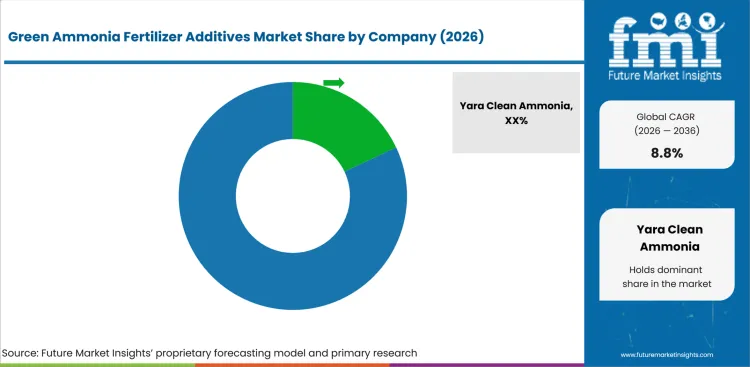
Yara Clean Ammonia, CF Industries, BASF, Koch Agronomic Services, Corteva Agriscience, AM Green, FertigHy and Stamicarbon.
- Established ammonia suppliers hold an advantage through offtake access, project development, and links to fertilizer producers.
- Nitrogen stabilizer suppliers gain stronger market positions through field evidence and farm-channel education.
- Plant technology firms support additive demand by shaping process routes that define formulation compatibility.
- Specialist formulators can win trials when bio-based carriers, binders, and coatings meet plant handling requirements.
Competition is developing across two connected layers. Low-carbon ammonia suppliers compete by proving dependable feedstock availability for fertilizer plants. Additive formulators compete by proving that their stabilizers, binders, coatings, and carriers perform under specific fertilizer production and field-use conditions.
Technical evidence is becoming more important than broad sustainability messaging. Buyers want compatibility with urea, ammonium nitrate, liquid fertilizers, and calcium ammonium nitrate before they approve additive packages. Companies with plant access, agronomic trial support, and documentation discipline should gain stronger procurement positions.
Project developers and plant technology companies can influence demand before the additive sale occurs. Their process choices help determine which solvents, process aids, and coating systems are qualified. Suppliers that work early with ammonia producers and fertilizer plants are best positioned to win long-term specifications.
How do top green ammonia fertilizer additives companies compare?
Yara Clean Ammonia and CF Industries score strongest on ammonia linkage while BASF and Koch Agronomic Services lead stabilized nitrogen portfolio relevance.
| Company | Relevance to Market Title | Low-Carbon Ammonia Linkage | Stabilized Nitrogen Portfolio | Fertilizer Plant Integration | Channel Reach | Geographic Footprint |
|---|---|---|---|---|---|---|
| Yara Clean Ammonia | Very High | Very Strong | Moderate | Strong | Strong | Global |
| CF Industries | Very High | Very Strong | Moderate | Very Strong | Strong | North America and global |
| BASF | Very High | Moderate | Very Strong | Moderate | Very Strong | Global |
| Koch Agronomic Services | High | Low | Very Strong | Moderate | Strong | North America and selected global |
| Corteva Agriscience | High | Low | Strong | Moderate | Strong | North America and selected global |
| AM Green | High | Very Strong | Low | Strong | Moderate | India and export markets |
| FertigHy | High | Very Strong | Low | Strong | Moderate | Europe |
| Stamicarbon | Moderate to High | Moderate | Low | Very Strong | Moderate | Global |
Source: Future Market Insights competitive analysis, 2026.
Who are the key players in the green ammonia fertilizer additives market?
Yara Clean Ammonia, CF Industries, BASF, Koch Agronomic Services and Corteva Agriscience are listed with AM Green, FertigHy and Stamicarbon among other suppliers.
Key global companies leading the green ammonia fertilizer additives market include:
- Yara Clean Ammonia
- CF Industries
- BASF
- Koch Agronomic Services
- Corteva Agriscience
- AM Green
- FertigHy
- Stamicarbon
- Nutrien
- Coromandel International
Key Developments in Green Ammonia Fertilizer Additives Market
- In May 2024, Yara Clean Ammonia and AM Green signed a term sheet for renewable ammonia supply from India to Yara’s global market.
- In July 2024, CF Industries and POET announced a demonstration using low-carbon ammonia fertilizer for corn production, with CF stating that ethanol carbon intensity can be reduced by up to 10%.
- In April 2026, Koch Agronomic Services launched CENTURO A-PRO nitrogen stabilizer for fall applications in anhydrous ammonia and UAN systems.
Key Players in the Green Ammonia Fertilizer Additives Market
Low-carbon Ammonia Suppliers
- Yara Clean Ammonia
- CF Industries
- AM Green
- FertigHy
- Reliance Industries
Nitrogen Stabilizer Formulators
- BASF
- Koch Agronomic Services
- Corteva Agriscience
- Nutrien
- Coromandel International
Fertilizer Technology and Plant Integration Companies
- Stamicarbon
- Rely
- John Cockerill
- Topsoe
- Thyssenkrupp Uhde
Green Ammonia Fertilizer Additives Market - Scope & Definition
| Attribute | Detail |
|---|---|
| Market Definition | Additive systems used with fertilizers made from low-carbon or renewable ammonia, including stabilizers, binders, coatings, solvents, process aids, and carrier systems used to improve nutrient efficiency, handling, and product stability |
| Functions Covered | Nitrogen stabilization, solvent support, binding, coating, process aid performance, carrier compatibility, and product handling improvement |
| Applications Covered | Water treatment, construction, batteries, textiles, and personal care where fertilizer-linked additive chemistry overlaps with industrial formulation needs |
| End-use Industries | Agriculture, industrial manufacturing, packaging, electronics, and automotive |
| Chemistry Types Covered | Bio-based, recycled, low VOC, halogen free, and waterborne additive systems |
| Inclusions | Commercially traded additive systems used with green ammonia-derived fertilizers, including urease inhibitors, nitrification inhibitors, coating aids, binders, solvents, and process aids |
| Exclusions | Bulk grey ammonia, commodity urea without additive differentiation, pesticides, standalone crop protection chemicals, ammonia used only for marine fuel, and microbial products tracked only under biofertilizers |
Green Ammonia Fertilizer Additives Market - Research Methodology
| Method | Description |
|---|---|
| Primary Research | FMI analyst interviews with fertilizer producers, ammonia buyers, additive formulators, farm retailers, distributors, and plant engineering specialists across key markets |
| Desk Research | Review of fertilizer nutrient statistics, ammonia production data, hydrogen project evidence, official tender records, company product documentation, and regulatory material related to nitrogen management |
| Market Sizing and Forecasting | Hybrid bottom-up and top-down approach using additive use rates, fertilizer output pathways, ammonia offtake evidence, country policy signals, and average additive pricing |
| Data Validation | Cross-verification using fertilizer nutrient demand, low-carbon ammonia projects, plant utilization evidence, company portfolio checks, and regional channel readiness |
Green Ammonia Fertilizer Additives Market - Report Scope
| Item | Value |
|---|---|
| Market size by 2036 | USD 584.1 million |
| Growth rate | 8.8% CAGR from 2026 to 2036 |
| Forecast period | 2026 to 2036 |
| Base year value (2025) | USD 231.0 million |
| By end-use industry | Agriculture, industrial manufacturing, packaging, electronics, automotive |
| By function | Additive, solvent, binder, coating, process aid |
| By chemistry type | Bio-based, recycled, low VOC, halogen free, waterborne |
| By region | Europe, North America, East Asia, South Asia, Latin America |
| By application | Water treatment, construction, batteries, textiles, personal care |
| Regions covered | North America, Latin America, Europe, East Asia, South Asia |
| Countries covered | India, China, United States, France, Germany, South Korea, Japan, United Kingdom |
| Key companies profiled | Yara Clean Ammonia, CF Industries, BASF, Koch Agronomic Services, Corteva Agriscience, AM Green, FertigHy, Stamicarbon |
| Approach | Hybrid bottom-up and top-down methodology using additive use rates, fertilizer output pathways, ammonia offtake evidence, and country-level policy signals |
Source: Future Market Insights, 2026.
Green Ammonia Fertilizer Additives Market Breakdown by End-use Industry, Function, Chemistry Type, Application, and Region
Green Ammonia Fertilizer Additives Market Segmented by End-use Industry
- Agriculture
- Industrial Manufacturing
- Packaging
- Electronics
- Automotive
Green Ammonia Fertilizer Additives Market Segmented by Function
- Additive
- Solvent
- Binder
- Coating
- Process Aid
Green Ammonia Fertilizer Additives Market Segmented by Chemistry Type
- Bio-based
- Recycled
- Low VOC
- Halogen Free
- Waterborne
Green Ammonia Fertilizer Additives Market Segmented by Region
- Europe
- North America
- East Asia
- South Asia
- Latin America
Green Ammonia Fertilizer Additives Market Segmented by Application
- Water Treatment
- Construction
- Batteries
- Textiles
- Personal Care
Green Ammonia Fertilizer Additives Market by Region
- North America
- Latin America
- Europe
- East Asia
- South Asia
Research Sources and Bibliography
- BASF. (2025, June 3). BASF and Yuntianhua successfully verify and register emissions reductions from stabilized urea fertilizer.
- BASF. (2026, February 4). BASF and Yuntianhua extend Limus partnership through 2030.
- CF Industries. (2024, July 15). CF Industries and POET to demonstrate the use of low-carbon ammonia fertilizer to reduce the carbon intensity of corn production and ethanol.
- Department for Environment, Food and Rural Affairs. (2025, July). The British Survey of Fertiliser Practice 2024.
- Department for Environment, Food and Rural Affairs. (2025, July 10). Agriculture in the United Kingdom 2024: Chapter 11 Agri-environment.
- Department for Environment, Food and Rural Affairs. (2026, February 12). Emissions of air pollutants in the UK: Ammonia.
- European Commission. (2025, July 3). Study shows how successful new regulations on German agricultural ammonia emissions are helping achieve targets.
- European Commission. (2026, April). Ensuring availability and affordability of fertilisers.
- Federal Ministry for Economic Affairs and Climate Action. (2024, July 11). Germany will work with H2Global to import green hydrogen products.
- Global Green Hydrogen Organisation. (2025). South Korea country profile.
- International Energy Agency. (2025, September 12). Global Hydrogen Review 2025.
- International Fertilizer Association. (2025, February). Public summary: Short-term fertilizer outlook 2024-2025.
- International Fertilizer Association. (2025, July). Public summary: Medium-term fertilizer outlook 2025-2029.
- Japan International Research Center for Agricultural Sciences. (2025, October 9). The potential of low-carbon ammonia fertilizer.
- Koch Agronomic Services. (2026, April 15). Koch Agronomic Services launches CENTURO A-PRO nitrogen stabilizer.
- Lok Sabha Secretariat. (2025). Standing Committee on Chemicals and Fertilizers report.
- Ministry of the Environment, Japan. (2024, November 18). Formulation of Japan’s National Action Plan on Sustainable Nitrogen Management.
- Organisation for Economic Co-operation and Development. (2025, October 30). Agricultural Policy Monitoring and Evaluation 2025: China.
- Press Information Bureau. (2025, June 23). SECI’s landmark green ammonia tender set to revolutionise India’s fertiliser sector.
- Press Information Bureau. (2025, August 3). Empowering India’s farmers through strategic fertilizer policy.
- Press Information Bureau. (2025, August 6). India achieves green ammonia price breakthrough.
- Press Information Bureau. (2026, March 31). Decarbonizing India’s fertilizer sector and strengthening green ammonia supply.
- Reliance Industries Limited. (2026, March 16). Reliance Industries signs landmark green ammonia binding long-term offtake agreement with Samsung C&T.
- RMI. (2025, March). Decarbonizing nitrogen fertilizer production in the United States.
- Stamicarbon. (2024, July 2). Stamicarbon to provide NX Stami Green Ammonia and NX Stami Nitric Acid technologies to FertigHy.
- Thünen Institute. (2026, March 14). Emissions of ammonia from agriculture.
- USA Department of Agriculture, Agricultural Marketing Service. (2026, June). Farm production cost report.
- USA Energy Information Administration. (2024, April 8). USA refiners and chemical manufacturers lead hydrogen production and consumption.
- USA Geological Survey. (2026, January). Nitrogen fixed ammonia.
- Yara. (2024, May 13). Yara Clean Ammonia and AM Green sign term sheet for renewable ammonia supply from India.
- World Bank. (2026, June 18). Japan mineral or chemical fertilizers with nitrogen imports by country in 2024.
- Ministry of the Environment, Japan. (2026, April 14). Japan’s national greenhouse gas emissions and removals for FY2024.
- Frontiers of Agricultural Science and Engineering. (2025). Nitrogen fertilizer use and grain production evidence in China.
This bibliography is provided for reader reference and is not exhaustive. The full report contains the complete reference list and detailed citations.
This Report Answers
- Market size estimates for 2026 and forecasts through 2036 for the green ammonia fertilizer additives market.
- Insights across regional and country-level markets with country CAGR comparison.
- Analysis of demand drivers, low-carbon ammonia procurement, nitrogen-loss control, and additive qualification.
- Evaluation of end-use industry, function, chemistry type, region, and application segments.
- Assessment of fertilizer plant qualification routes and tender-backed adoption pathways.
- Identification of opportunities across nitrogen stabilizers, binders, coatings, solvents, and process aids.
- Evaluation of supply chain dynamics, product innovation, and fertilizer distribution structures.
- Country-level analysis covering India, China, the United States, France, Germany, South Korea, Japan, and the United Kingdom.
- Assessment of the competitive landscape, including low-carbon ammonia suppliers and nitrogen stabilizer chemistry firms.
- Analysis of research methodology, market definition, inclusions, exclusions, and report scope.
Frequently Asked Questions
What is the green ammonia fertilizer additives market size in 2026?
The green ammonia fertilizer additives market size is anticipated to cross USD 251.3 million in 2026.
What is the green ammonia fertilizer additives market forecast for 2036?
The green ammonia fertilizer additives industry revenue is predicted to reach USD 584.1 million by 2036 as low-carbon ammonia enters fertilizer supply chains.
What is the green ammonia fertilizer additives market CAGR?
The green ammonia fertilizer additives sector is projected to expand at 8.8% CAGR from 2026 to 2036.
What segment leads the green ammonia fertilizer additives market?
Agriculture is likely to capture 52.0% share in 2026 due to crop nutrition demand and nitrogen-efficiency requirements.
Which function leads the green ammonia fertilizer additives market?
Additive function is expected to lead with 41.5% share in 2026 as stabilizers address measurable nitrogen-loss costs.
Which chemistry type is expected to lead in 2026?
Bio-based chemistry is projected to lead with 34.0% share in 2026 due to residue concerns and sustainability screening.
Which country grows fastest in the green ammonia fertilizer additives market?
India is set to record 10.4% CAGR by 2036, driven by tender-backed green ammonia supply for fertilizer plants.
What does this market include?
This market includes stabilizers, binders, coatings, solvents, carrier systems, and process aids used with fertilizers made from low-carbon or renewable ammonia.
How is the forecast built?
The forecast combines additive use rates, fertilizer output routes, ammonia offtake evidence, country policy signals, company portfolio checks, and channel readiness.
What are the main disadvantages of green ammonia fertilizer additives?
The main disadvantages are added cost, variable field response, registration needs, feedstock price exposure, and the need to prove compatibility with each fertilizer format before wide use.
Preview the report firsthand - request a free sample
Get SampleGet the brochure for pricing and purchase details.
Get PDFTable of Content
- Executive Summary
- Global Market Outlook
- Demand-side Trends
- Supply-side Trends
- Technology Roadmap Analysis
- Analysis and Recommendations
- Market Overview
- Market Coverage / Taxonomy
- Market Definition / Scope / Limitations
- Research Methodology
- Chapter Orientation
- Analytical Lens and Working Hypotheses
- Market Structure, Signals, and Trend Drivers
- Benchmarking and Cross-market Comparability
- Research Design and Evidence Framework
- Desk Research Programme (Secondary Evidence)
- Company Annual and Sustainability Reports
- Peer-reviewed Journals and Academic Literature
- Corporate Websites, Product Literature, and Technical Notes
- Earnings Decks and Investor Briefings
- Statutory Filings and Regulatory Disclosures
- Technical White Papers and Standards Notes
- Trade Journals, Industry Magazines, and Analyst Briefs
- Conference Proceedings, Webinars, and Seminar Materials
- Government Statistics Portals and Public Data Releases
- Press Releases and Reputable Media Coverage
- Specialist Newsletters and Curated Briefings
- Sector Databases and Reference Repositories
- FMI Internal Proprietary Databases and Historical Market Datasets
- Subscription Datasets and Paid Sources
- Social Channels, Communities, and Digital Listening Inputs
- Additional Desk Sources
- Expert Input and Fieldwork (Primary Evidence)
- Primary Modes
- Qualitative Interviews and Expert Elicitation
- Quantitative Surveys and Structured Data Capture
- Blended Approach
- Why Primary Evidence is Used
- Field Techniques
- Interviews
- Surveys
- Board Members
- Presidents and Vice Presidents
- R&D and Innovation Heads
- Technical Specialists
- Domain Subject-matter Experts
- Scientists
- Agronomists and Other Agricultural Professionals
- Governance, Ethics, and Data Stewardship
- Research Ethics
- Data Integrity and Handling
- Primary Modes
- Tooling, Models, and Reference Databases
- Desk Research Programme (Secondary Evidence)
- Data Engineering and Model Build
- Data Acquisition and Ingestion
- Cleaning, Normalisation, and Verification
- Synthesis, Triangulation, and Analysis
- Quality Assurance and Audit Trail
- Market Background
- Market Dynamics
- Drivers
- Restraints
- Opportunity
- Trends
- Scenario Forecast
- Demand in Optimistic Scenario
- Demand in Likely Scenario
- Demand in Conservative Scenario
- Opportunity Map Analysis
- Product Life Cycle Analysis
- Supply Chain Analysis
- Investment Feasibility Matrix
- Value Chain Analysis
- PESTLE and Porter’s Analysis
- Regulatory Landscape
- Regional Parent Market Outlook
- Production and Consumption Statistics
- Import and Export Statistics
- Market Dynamics
- Global Market Analysis 2021 to 2025 and Forecast, 2026 to 2036
- Historical Market Size Value (USD Million) Analysis, 2021 to 2025
- Current and Future Market Size Value (USD Million) Projections, 2026 to 2036
- Y-o-Y Growth Trend Analysis
- Absolute $ Opportunity Analysis
- Global Market Pricing Analysis 2021 to 2025 and Forecast 2026 to 2036
- Global Market Analysis 2021 to 2025 and Forecast 2026 to 2036, By End-use Industry
- Introduction / Key Findings
- Historical Market Size Value (USD Million) Analysis By End-use Industry, 2021 to 2025
- Current and Future Market Size Value (USD Million) Analysis and Forecast By End-use Industry, 2026 to 2036
- Agriculture
- Industrial Manufacturing
- Packaging
- Electronics
- Automotive
- Agriculture
- Y-o-Y Growth Trend Analysis By End-use Industry, 2021 to 2025
- Absolute $ Opportunity Analysis By End-use Industry, 2026 to 2036
- Global Market Analysis 2021 to 2025 and Forecast 2026 to 2036, By Function
- Introduction / Key Findings
- Historical Market Size Value (USD Million) Analysis By Function, 2021 to 2025
- Current and Future Market Size Value (USD Million) Analysis and Forecast By Function, 2026 to 2036
- Additive
- Solvent
- Binder
- Coating
- Process Aid
- Additive
- Y-o-Y Growth Trend Analysis By Function, 2021 to 2025
- Absolute $ Opportunity Analysis By Function, 2026 to 2036
- Global Market Analysis 2021 to 2025 and Forecast 2026 to 2036, By Chemistry Type
- Introduction / Key Findings
- Historical Market Size Value (USD Million) Analysis By Chemistry Type, 2021 to 2025
- Current and Future Market Size Value (USD Million) Analysis and Forecast By Chemistry Type, 2026 to 2036
- Bio-based
- Recycled
- Low VOC
- Halogen Free
- Waterborne
- Bio-based
- Y-o-Y Growth Trend Analysis By Chemistry Type, 2021 to 2025
- Absolute $ Opportunity Analysis By Chemistry Type, 2026 to 2036
- Global Market Analysis 2021 to 2025 and Forecast 2026 to 2036, By Application
- Introduction / Key Findings
- Historical Market Size Value (USD Million) Analysis By Application, 2021 to 2025
- Current and Future Market Size Value (USD Million) Analysis and Forecast By Application, 2026 to 2036
- Water Treatment
- Construction
- Batteries
- Textiles
- Personal Care
- Water Treatment
- Y-o-Y Growth Trend Analysis By Application, 2021 to 2025
- Absolute $ Opportunity Analysis By Application, 2026 to 2036
- Global Market Analysis 2021 to 2025 and Forecast 2026 to 2036, By Region
- Introduction
- Historical Market Size Value (USD Million) Analysis By Region, 2021 to 2025
- Current Market Size Value (USD Million) Analysis and Forecast By Region, 2026 to 2036
- North America
- Latin America
- Western Europe
- Eastern Europe
- East Asia
- South Asia and Pacific
- Middle East & Africa
- Market Attractiveness Analysis By Region
- North America Market Analysis 2021 to 2025 and Forecast 2026 to 2036, By Country
- Historical Market Size Value (USD Million) Trend Analysis By Market Taxonomy, 2021 to 2025
- Market Size Value (USD Million) Forecast By Market Taxonomy, 2026 to 2036
- By Country
- USA
- Canada
- Mexico
- By End-use Industry
- By Function
- By Chemistry Type
- By Application
- By Country
- Market Attractiveness Analysis
- By Country
- By End-use Industry
- By Function
- By Chemistry Type
- By Application
- Key Takeaways
- Latin America Market Analysis 2021 to 2025 and Forecast 2026 to 2036, By Country
- Historical Market Size Value (USD Million) Trend Analysis By Market Taxonomy, 2021 to 2025
- Market Size Value (USD Million) Forecast By Market Taxonomy, 2026 to 2036
- By Country
- Brazil
- Chile
- Rest of Latin America
- By End-use Industry
- By Function
- By Chemistry Type
- By Application
- By Country
- Market Attractiveness Analysis
- By Country
- By End-use Industry
- By Function
- By Chemistry Type
- By Application
- Key Takeaways
- Western Europe Market Analysis 2021 to 2025 and Forecast 2026 to 2036, By Country
- Historical Market Size Value (USD Million) Trend Analysis By Market Taxonomy, 2021 to 2025
- Market Size Value (USD Million) Forecast By Market Taxonomy, 2026 to 2036
- By Country
- Germany
- UK
- Italy
- Spain
- France
- Nordic
- BENELUX
- Rest of Western Europe
- By End-use Industry
- By Function
- By Chemistry Type
- By Application
- By Country
- Market Attractiveness Analysis
- By Country
- By End-use Industry
- By Function
- By Chemistry Type
- By Application
- Key Takeaways
- Eastern Europe Market Analysis 2021 to 2025 and Forecast 2026 to 2036, By Country
- Historical Market Size Value (USD Million) Trend Analysis By Market Taxonomy, 2021 to 2025
- Market Size Value (USD Million) Forecast By Market Taxonomy, 2026 to 2036
- By Country
- Russia
- Poland
- Hungary
- Balkan & Baltic
- Rest of Eastern Europe
- By End-use Industry
- By Function
- By Chemistry Type
- By Application
- By Country
- Market Attractiveness Analysis
- By Country
- By End-use Industry
- By Function
- By Chemistry Type
- By Application
- Key Takeaways
- East Asia Market Analysis 2021 to 2025 and Forecast 2026 to 2036, By Country
- Historical Market Size Value (USD Million) Trend Analysis By Market Taxonomy, 2021 to 2025
- Market Size Value (USD Million) Forecast By Market Taxonomy, 2026 to 2036
- By Country
- China
- Japan
- South Korea
- By End-use Industry
- By Function
- By Chemistry Type
- By Application
- By Country
- Market Attractiveness Analysis
- By Country
- By End-use Industry
- By Function
- By Chemistry Type
- By Application
- Key Takeaways
- South Asia and Pacific Market Analysis 2021 to 2025 and Forecast 2026 to 2036, By Country
- Historical Market Size Value (USD Million) Trend Analysis By Market Taxonomy, 2021 to 2025
- Market Size Value (USD Million) Forecast By Market Taxonomy, 2026 to 2036
- By Country
- India
- ASEAN
- Australia & New Zealand
- Rest of South Asia and Pacific
- By End-use Industry
- By Function
- By Chemistry Type
- By Application
- By Country
- Market Attractiveness Analysis
- By Country
- By End-use Industry
- By Function
- By Chemistry Type
- By Application
- Key Takeaways
- Middle East & Africa Market Analysis 2021 to 2025 and Forecast 2026 to 2036, By Country
- Historical Market Size Value (USD Million) Trend Analysis By Market Taxonomy, 2021 to 2025
- Market Size Value (USD Million) Forecast By Market Taxonomy, 2026 to 2036
- By Country
- Kingdom of Saudi Arabia
- Other GCC Countries
- Turkiye
- South Africa
- Other African Union
- Rest of Middle East & Africa
- By End-use Industry
- By Function
- By Chemistry Type
- By Application
- By Country
- Market Attractiveness Analysis
- By Country
- By End-use Industry
- By Function
- By Chemistry Type
- By Application
- Key Takeaways
- Key Countries Market Analysis
- USA
- Pricing Analysis
- Market Share Analysis, 2025
- By End-use Industry
- By Function
- By Chemistry Type
- By Application
- Canada
- Pricing Analysis
- Market Share Analysis, 2025
- By End-use Industry
- By Function
- By Chemistry Type
- By Application
- Mexico
- Pricing Analysis
- Market Share Analysis, 2025
- By End-use Industry
- By Function
- By Chemistry Type
- By Application
- Brazil
- Pricing Analysis
- Market Share Analysis, 2025
- By End-use Industry
- By Function
- By Chemistry Type
- By Application
- Chile
- Pricing Analysis
- Market Share Analysis, 2025
- By End-use Industry
- By Function
- By Chemistry Type
- By Application
- Germany
- Pricing Analysis
- Market Share Analysis, 2025
- By End-use Industry
- By Function
- By Chemistry Type
- By Application
- UK
- Pricing Analysis
- Market Share Analysis, 2025
- By End-use Industry
- By Function
- By Chemistry Type
- By Application
- Italy
- Pricing Analysis
- Market Share Analysis, 2025
- By End-use Industry
- By Function
- By Chemistry Type
- By Application
- Spain
- Pricing Analysis
- Market Share Analysis, 2025
- By End-use Industry
- By Function
- By Chemistry Type
- By Application
- France
- Pricing Analysis
- Market Share Analysis, 2025
- By End-use Industry
- By Function
- By Chemistry Type
- By Application
- India
- Pricing Analysis
- Market Share Analysis, 2025
- By End-use Industry
- By Function
- By Chemistry Type
- By Application
- ASEAN
- Pricing Analysis
- Market Share Analysis, 2025
- By End-use Industry
- By Function
- By Chemistry Type
- By Application
- Australia & New Zealand
- Pricing Analysis
- Market Share Analysis, 2025
- By End-use Industry
- By Function
- By Chemistry Type
- By Application
- China
- Pricing Analysis
- Market Share Analysis, 2025
- By End-use Industry
- By Function
- By Chemistry Type
- By Application
- Japan
- Pricing Analysis
- Market Share Analysis, 2025
- By End-use Industry
- By Function
- By Chemistry Type
- By Application
- South Korea
- Pricing Analysis
- Market Share Analysis, 2025
- By End-use Industry
- By Function
- By Chemistry Type
- By Application
- Russia
- Pricing Analysis
- Market Share Analysis, 2025
- By End-use Industry
- By Function
- By Chemistry Type
- By Application
- Poland
- Pricing Analysis
- Market Share Analysis, 2025
- By End-use Industry
- By Function
- By Chemistry Type
- By Application
- Hungary
- Pricing Analysis
- Market Share Analysis, 2025
- By End-use Industry
- By Function
- By Chemistry Type
- By Application
- Kingdom of Saudi Arabia
- Pricing Analysis
- Market Share Analysis, 2025
- By End-use Industry
- By Function
- By Chemistry Type
- By Application
- Turkiye
- Pricing Analysis
- Market Share Analysis, 2025
- By End-use Industry
- By Function
- By Chemistry Type
- By Application
- South Africa
- Pricing Analysis
- Market Share Analysis, 2025
- By End-use Industry
- By Function
- By Chemistry Type
- By Application
- USA
- Market Structure Analysis
- Competition Dashboard
- Competition Benchmarking
- Market Share Analysis of Top Players
- By Region
- By End-use Industry
- By Function
- By Chemistry Type
- By Application
- Competition Analysis
- Competition Deep Dive
- Yara Clean Ammonia
- Overview
- Product Portfolio
- Profitability by Market Segments (End-use Industry/Function/Chemistry Type/Application/Region)
- Sales Footprint
- Strategy Overview
- Marketing Strategy
- Product Strategy
- Channel Strategy
- CF Industries
- BASF
- Koch Agronomic Services
- Corteva Agriscience
- AM Green
- FertigHy
- Stamicarbon
- Yara Clean Ammonia
- Competition Deep Dive
- Assumptions & Acronyms Used


