

- Industry Size (2026)
- USD 2281.5 Mn
- Forecast (2036)
- USD 4124.5 Mn
- CAGR (2026 to 2036)
- 6.1%
Hanger Market Forecast and Outlook 2026 to 2036
The global hanger sector is on track to achieve a valuation of USD 4.4 billion by 2036, accelerating from USD 2.4 billion in 2026 at a CAGR of 6.1%. As per Future Market Insights, expansion is structurally underpinned by the global fashion retail recovery and the regulatory pressure on single-use plastic accessories that is forcing retailers to mandate sustainable hanger specifications from their supply chains. The European Commission's revised Packaging and Packaging Waste Regulation (PPWR), adopted in April 2024, has introduced binding recycled content and recyclability targets that directly affect plastic hangers used in garment retail.
The Ellen MacArthur Foundation reported in its 2024 Circular Economy Update that the fashion industry generates approximately 92 million tonnes of textile waste annually, validating the urgency of circularity interventions across all touchpoints including garment presentation accessories. This environmental pressure compels hanger manufacturers to invest in paper-based, recycled-plastic, and ocean-bound plastic alternatives. Simultaneously the retail landscape is shifting from disposable hanger procurement to managed reuse programmes which forces suppliers to build reverse logistics capabilities.
Jeffrey Hsu, Global Head of Hangers at Mainetti, stated: 'In 1961, Mainetti introduced plastic hangers as alternatives to traditional wooden hangers. We are proud to be offering this next breakthrough in design and function.' This statement, made in December 2025 during the launch of the Paperform Hanger range, a patented plastic-free solution made from 100% recycled paper and steel, confirms that the industry's founding innovator is now pivoting away from its original product category toward fibre-based alternatives. FMI opines that paper-based hangers will capture 15 to 20% of the total hanger market by volume within five years as major fashion retailers adopt plastic-free garment presentation policies.
The competitive landscape in 2025 and 2026 is defined by material innovation and reuse programme scaling. Braiform (Tam Hangers) reached a milestone in January 2026, saving over 300 million hangers annually from landfills through its Hanger Re-Use Programme, which integrates advanced soft mechanical recycling to reprocess damaged units with 70% less manufacturing pollution than virgin plastic. In February 2026, Nexgen Packaging collaborated with Kidkanai, a children's concept store launched by French retailer Kiabi, to produce the Ditto sustainable hanger, a 100% plastic-free product made from recycled FSC paper fibreboard designed for the preloved clothing segment.
In May 2025, eco-startup (re)x launched a reinforced circular hanger made from 100% ocean-bound plastic with a 50% thicker hook and reinforced bridge, targeting the luxury and heavy-outerwear segments. As per FMI, this convergence of paper-based innovation, industrial-scale reuse programmes, and ocean-plastic recycling confirms that the hanger sector is undergoing a material transition comparable in scale to the shift that originally displaced wooden hangers six decades ago.
Summary of Hanger Market
What Is Growth Outlook for Hanger Market as per Future Market Insights Projection?
Future Market Insights projects the hanger industry to expand at a CAGR of 6.1% from 2026 to 2036, increasing from USD 2.4 Billion in 2026 to USD 4.4 Billion by 2036.
FMI Research Approach: FMI proprietary forecasting model based on global garment retail unit volumes and hanger-per-unit procurement ratios.
How Do FMI Analysts Perceive Hanger Market to Evolve?
FMI analysts perceive the market evolving toward closed-loop circular systems where managed reuse programmes and paper-based alternatives replace single-use plastic hangers, driven by retailer sustainability mandates and regulatory pressure on plastic accessories.
FMI Research Approach: European Commission PPWR recyclability and recycled content target analysis for plastic accessories.
Which Country Holds Largest Share in Global Hanger Market?
The United States holds a significant share of the global hanger market by value which is supported by the scale of its fashion retail sector and the concentration of major apparel brand headquarters that set global hanger procurement specifications.
FMI Research Approach: FMI country-level revenue modeling by garment retail unit sales and hanger procurement data from major retailers.
How Large Will Hanger Market Be by 2036?
The global hanger market is projected to reach USD 4.4 Billion by 2036.
FMI Research Approach: FMI long-term revenue forecast derived from fashion retail growth projections and material substitution trend analysis.
What Is Definition of Hanger Market?
The hanger market includes garment hangers manufactured from plastic, wood, metal, paper, and composite materials used for retail display, consumer wardrobe storage, and garment logistics across fashion, apparel, and textile industries.
FMI Research Approach: FMI market taxonomy and inclusion-exclusion framework.
What Are Globally Unique Trends Shaping Hanger Market?
Globally unique trends include the transition to plastic-free paper hangers pioneered by Mainetti, industrial-scale reuse programmes saving over 300 million units annually, and the emergence of ocean-bound plastic as a premium hanger substrate for luxury retail.
FMI Research Approach: Ellen MacArthur Foundation circular economy reports and retailer sustainability policy tracking.
Hanger Market Key Takeaways
| Metric | Details |
|---|---|
| Industry Size (2026) | USD 2.4 Billion |
| Industry Value (2036) | USD 4.4 Billion |
| CAGR (2026 to 2036) | 6.1% |
Source: Future Market Insights (FMI) analysis, based on proprietary forecasting model and primary research
Key Points Covered in the Hanger Market Survey
- Market Estimates and Forecast 2020 to 2035
- Key Drivers and Restraints Impacting Market Growth
- Regional Analysis, Segment-wise, and Country-wise Analysis
- Competition Mapping and Benchmarking
- Brand share and Market Share Analysis
- Key Product Innovations and Regulatory Climate
- Recommendation on Key Winning Strategies
2021 to 2025 Global Hanger Market Outlook Compared to 2026 to 2036 Forecast
From 2021 to 2025, sales witnessed significant growth, registering a CAGR of 3.8%. Hangers, also called clothes hangers or coat hangers, can be made from various materials such as plastic, steel (sometimes referred to as wire hangers), and wood; they are often made with a combination of these materials.
Certain hangers also have padding made of other materials like satin, nylon, wool, velvet, or cotton to give them a more luxurious feel. Hangers are mainly used in homes and are classified under the residential or domestic segment. They are also used commercially by the retail sector in clothes shops and by the hospitality sector in hotels, hostels, and dormitories.
As a result, the global demand for hangers is projected to increase at a CAGR of 6.1% during the forecast period between 2026 and 2036, reaching a total of USD 4,124.5 million in 2036.
Key Dynamics in the Hanger Market Worldwide
Urbanization and the Growing Fashion Industry Are Driving the Expansion
People are purchasing more garments due to the rise of quick fashion and online shopping. The need for hangers grows along with the number of individuals purchasing clothing.
In addition, as more people move into cities, hangers and other space-saving devices are in greater demand. People are searching for more effective ways to organize their clothing as living spaces get smaller, and hangers offer a quick and easy fix which is leading to a surge in the sales of the target product.
The demand for hangers in the hospitality sector is rising as more people travel and stay in hotels. Hotels and other lodging establishments require a consistent supply of hangers for their visitors, which has opened up a new market for hanger producers and in turn is leading to increased revenue generation for these producers.
Increasing Environmental Consciousness is Contributing to the Increased Demand
Customers are seeking sustainable solutions like eco-friendly hangers as they become more conscious of how their purchases affect the environment. Due to this, the market for hangers made of recyclable materials or biodegradable plastics is expanding.
Moreover, hanger producers are continually developing fresh, cutting-edge designs that provide more utility and convenience. For instance, hangers that can hold many items, hangers with built-in accessory hooks, and hangers made expressly for a particular type of clothes are gaining significant traction subsequently contributing to the growth of the industry.
Competition from Alternative Storage Solutions Is Hampering the Growth of the Market
Although using hangers is a common method of storing clothing, there are other options, including shelving, drawers, and storage boxes. As a result, these storage choices are a threat to hanger producers as the increase in the use of these products hampers the target market expansion.
Furthermore, even while environmentally friendly hangers are becoming more and more popular, the hangers sector as a whole continues to produce a sizable amount of plastic waste. Those who are particularly concerned about the environment avoid using hangers altogether or choose more ecologically friendly storage options which in turn hampers the growth of the market.
Unstable Market Conditions Likely to Affect the Demand for Hangers
Plastic, wood, and metal are just a few of the materials that are used to make hangers. The cost of producing hangers and the pricing at which they are sold may change depending on the supply and demand of these raw materials.
Furthermore, the demand for hangers is frequently cyclical, reaching its apex during the back-to-school and holiday shopping seasons. Manufacturers of hangers may find it challenging to maintain sales and profitability during a market stagnancy period.
In addition, the hangers sector is governed by several laws and standards regarding labelling, product safety, and environmental effects. Manufacturers may find it expensive and time-consuming to comply with these laws, which may hurt their ability to compete.
Country-wise Insights
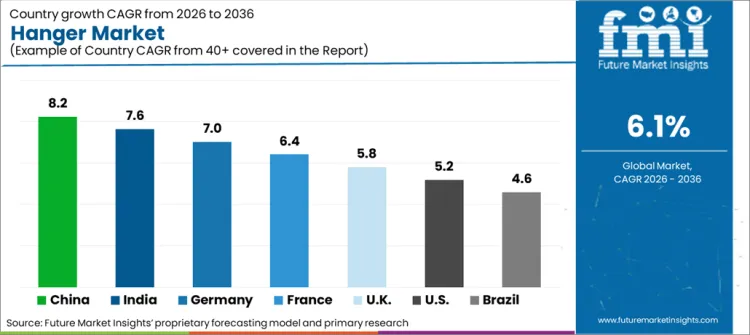
Will the USA Continue Dominance in the Global Market?
Residential Sector to Favor the Sales in the Country
The USA market is expected to accumulate a market share of close to 18% in 2026. On a geographic basis, the USA is anticipated to be the largest hangers market due to profound interest from the commercial sector. Continued sales in the residential segment are likely to help manufacturers gain a competitive edge over others due to hangers being a basic necessity in the region.
Further, the presence of top manufacturers and brands in the country is another factor leading to increased product adoption and growing sales. Besides, the brands in the region are focused on developing innovative solutions in the target market leading to the grasping of a new and enthusiastic consumer base that is interested in the unique products.
What is the Market Scenario in the German market?
Digital Technologies to Reaffirm Growth in Germany
Germany is expected to accumulate a market share value of 5-6% in 2026 in the global market. The country also offers potential growth opportunities in the market due to the rise in the retail and hospitality sectors. The innovation of smart and multi-functional hangers is also expected to drive the growth of the market. In addition, growth in the commercial segment and easy availability of the product will create ample opportunities for the producers.
Market Definition
The hanger market represents revenue generated from the manufacture and sale of garment hangers used in retail display, consumer wardrobe storage, dry cleaning, and garment logistics. The market measures the value of plastic hangers, wooden hangers, metal hangers, paper/fibreboard hangers, and velvet-coated hangers sold through B2B retail procurement, consumer retail, and e-commerce channels.
Inclusions cover standard retail display hangers, branded custom hangers, clip hangers for trousers and skirts, padded hangers for delicate garments, children's hangers, and specialty hangers for heavy outerwear. It includes materials such as polystyrene, polypropylene, recycled plastic, FSC-certified paper fibreboard, bamboo, and ocean-bound plastic. Managed reuse and recycling programme services are also included.
Exclusions include industrial metal hooks for warehouse racking, curtain hooks and rails, display mannequins, and garment bags. Non-garment hanging solutions such as tool hangers and kitchen utensil racks are outside the scope.
Category-wise Insights
Which Product Type is the Most Popular in the Market?
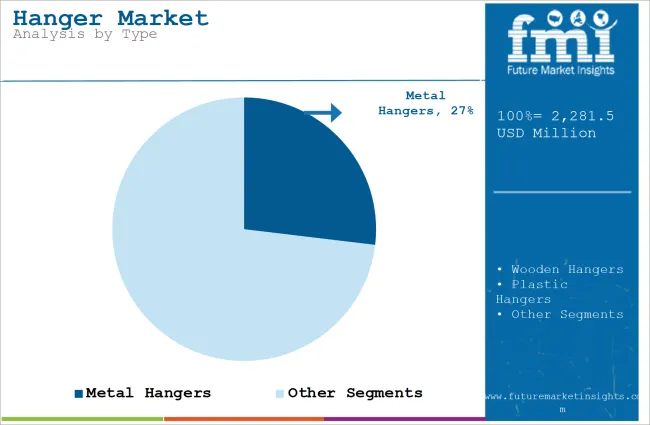
A Large Portion of Consumer Base Prefer Hardwood, Metal, and Plastic Hangers
According to market trends, hardwood hangers, metal hangers, and plastic hangers are in order of popularity. Although there are other hanger types like velvet, cushioned, and wire hangers, they are less common than the three main varieties.
Due to their accessibility, dependability, and lightweight construction, which makes them simple to handle and store, plastic hangers are widely used. They come in a range of colours and designs and are frequently used for storing ordinary clothing.
Because of its attractive appearance and strength, wooden hangers are preferred by high-end and luxury retailers. They are frequently used to show off expensive attire, like suits, jackets, and gowns. Furthermore, eco-friendly, wooden hangers appeal to customers that place a high value on sustainability.
In addition, metal hangers are well-liked for their robustness and endurance. Because of their durability and long-lasting design, they are frequently used for heavy apparel, such as coats and suits, and are well-liked in the hospitality sector.
Which Sales Channel Is Preferred by the Consumers?
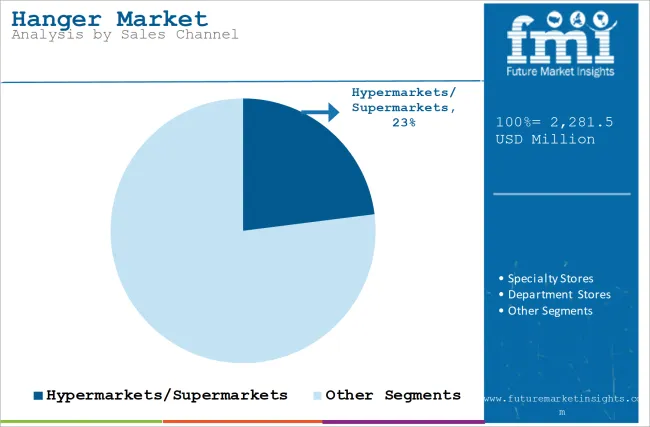
Physical Stores Dominate the Target Market
As customers can see and touch the products before making a purchase, traditional retail establishments including department stores, home goods stores, and specialized retailers are still preferred channels to buy hangers.
Because of their ease and extensive product range, online marketplaces like Amazon and Alibaba are becoming more and more popular for buying hangers. Many brands and manufacturers have their own websites where customers may make purchases straight from them. This allows customers to learn more about the firm and its products, and it may also be a convenient way to buy authentic and reliable products.
Competitive Landscape
Manufacturers are adopting various marketing strategies such as new product launches, geographical expansion, mergers and acquisitions, partnerships and collaboration to identify the interest of potential buyers and create a larger customer base. Some of the prominent players in the market include M & B Hangers, Weatherford, Guilin Iango Home Collection, Whitmor, MAWA, and Mainetti among others.
Recent Developments
- In February 2026, Mainetti expanded its Paperform Hanger range, a plastic-free solution made from 100% recycled paper, following the opening of a new Design and Innovation Centre in the UK to accelerate circular product development.
- In January 2026, Braiform (Tam Hangers) reached a milestone in its Hanger Re-Use Programme, saving over 300 million hangers annually from landfills through advanced soft mechanical recycling with 70% less manufacturing pollution than virgin plastic.
- In May 2025, eco-startup (re)x launched a reinforced circular hanger made from 100% ocean-bound plastic, featuring a 50% thicker hook and reinforced bridge to target the luxury and heavy-outerwear retail segments.
Scope of Report
| Attribute | Details |
|---|---|
| Forecast Period | 2025 to 2035 |
| Historical Data Available for | 2020 to 2024 |
| Market Analysis | USD Million for Value |
| Report Coverage | Revenue Forecast, Volume Forecast, Company Ranking, Competitive Landscape, Growth Factors, and Trends, Pricing Analysis |
| Key Segments Covered | Type, Application, Sales Channel, Region |
| Key Regions Covered | North America; Latin America; Europe; South Asia; East Asia; Oceania; MEA |
| Key Companies Profiled | M & B Hangers; Guilin Iango Home Collection; Whitmor; MAWA and Mainetti; Bend and Hook; Henry Hanger; Hangers Direct; Others (as per request) |
| Customization & Pricing | Available upon Request |
| Pricing and Purchase Options | Avail Customized Purchase Options to Meet Your Exact Research Needs |
Scope of Report
| Items | Values |
|---|---|
| Quantitative Units (2026) | USD 2.4 Billion |
| Product Type | Plastic Hangers, Wooden Hangers, Metal Hangers, Paper/Fibreboard Hangers, Velvet-Coated Hangers |
| Material Type | Polystyrene, Polypropylene, Recycled Plastic, Ocean-Bound Plastic, FSC Paper, Bamboo, Metal |
| End-Use Channel | Fashion Retail, Dry Cleaning, Consumer Wardrobe, E-commerce Fulfilment, Garment Logistics |
| Regions Covered | North America, Europe, Asia Pacific, Latin America, Middle East and Africa |
| Countries Covered | USA, UK, Germany, China, India, Bangladesh, France, and 40+ countries |
| Key Companies Profiled | Mainetti, Braiform (Tam Hangers), Nexgen Packaging, MAWA, Hangerworld, Ditto |
Key Segments Profiled in the Market
By Type:
- Metal Hangers
- Wooden Hangers
- Plastic Hangers
- Other Hanger Types
By Application:
- Personal Use
- Commercial Use
By Sales Channel:
- Hypermarkets/Supermarkets
- Specialty Stores
- Department Stores
- Convenience Stores
- Online Retailers
- Other Sales Channels
By Region:
- North America
- Latin America
- Europe
- South Asia
- East Asia
- Oceania
- Middle East and Africa
Bibliography
- European Parliament. (2024, April). Packaging and Packaging Waste Regulation (PPWR). Official Journal of the European Union.
- Mainetti Group. (2025, December). Mainetti launches Paperform Hanger range. Home of Direct Commerce.
- Ellen MacArthur Foundation. (2024). Circular Economy in Fashion: 2024 Update. Ellen MacArthur Foundation.
- Nexgen Packaging. (2026, February). Sustainable hanger launched by Nexgen Packaging and Kidkanai. Transportation Today News.
Frequently Asked Questions
What is the current global market size for Hangers?
The global market is valued at USD 2.4 Billion in 2026, driven by fashion retail recovery and the regulatory shift toward plastic-free garment presentation accessories.
What is the projected Compound Annual Growth Rate (CAGR) for the market over the next 10 years?
The market is projected to grow at a CAGR of 6.1% from 2026 to 2036.
Which regions are experiencing the fastest expansion?
Asia Pacific leads by volume driven by garment manufacturing concentration in China, Bangladesh, and India, while Europe leads the sustainability-driven value shift toward paper and recycled-plastic hangers.
What are the primary market drivers?
Retailer sustainability mandates, the EU PPWR regulatory pressure on single-use plastic accessories, and the scaling of industrial reuse programmes are the primary growth catalysts.
Who are the leading suppliers in the industry?
Mainetti, Braiform (Tam Hangers), and Nexgen Packaging are key players, differentiating through circular material innovation, managed reuse programmes, and retailer-specific custom hanger design capabilities.
Preview the report firsthand - request a free sample
Get SampleGet the brochure for pricing and purchase details.
Get PDFTable of Content
- Executive Summary
- Global Market Outlook
- Demand-side Trends
- Supply-side Trends
- Technology Roadmap Analysis
- Analysis and Recommendations
- Market Overview
- Market Coverage / Taxonomy
- Market Definition / Scope / Limitations
- Research Methodology
- Chapter Orientation
- Analytical Lens and Working Hypotheses
- Market Structure, Signals, and Trend Drivers
- Benchmarking and Cross-market Comparability
- Market Sizing, Forecasting, and Opportunity Mapping
- Research Design and Evidence Framework
- Desk Research Programme (Secondary Evidence)
- Company Annual and Sustainability Reports
- Peer-reviewed Journals and Academic Literature
- Corporate Websites, Product Literature, and Technical Notes
- Earnings Decks and Investor Briefings
- Statutory Filings and Regulatory Disclosures
- Technical White Papers and Standards Notes
- Trade Journals, Industry Magazines, and Analyst Briefs
- Conference Proceedings, Webinars, and Seminar Materials
- Government Statistics Portals and Public Data Releases
- Press Releases and Reputable Media Coverage
- Specialist Newsletters and Curated Briefings
- Sector Databases and Reference Repositories
- FMI Internal Proprietary Databases and Historical Market Datasets
- Subscription Datasets and Paid Sources
- Social Channels, Communities, and Digital Listening Inputs
- Additional Desk Sources
- Expert Input and Fieldwork (Primary Evidence)
- Primary Modes
- Qualitative Interviews and Expert Elicitation
- Quantitative Surveys and Structured Data Capture
- Blended Approach
- Why Primary Evidence is Used
- Field Techniques
- Interviews
- Surveys
- Focus Groups
- Observational and In-context Research
- Social and Community Interactions
- Stakeholder Universe Engaged
- C-suite Leaders
- Board Members
- Presidents and Vice Presidents
- R&D and Innovation Heads
- Technical Specialists
- Domain Subject-matter Experts
- Scientists
- Physicians and Other Healthcare Professionals
- Governance, Ethics, and Data Stewardship
- Research Ethics
- Data Integrity and Handling
- Primary Modes
- Tooling, Models, and Reference Databases
- Desk Research Programme (Secondary Evidence)
- Data Engineering and Model Build
- Data Acquisition and Ingestion
- Cleaning, Normalisation, and Verification
- Synthesis, Triangulation, and Analysis
- Quality Assurance and Audit Trail
- Market Background
- Market Dynamics
- Drivers
- Restraints
- Opportunity
- Trends
- Scenario Forecast
- Demand in Optimistic Scenario
- Demand in Likely Scenario
- Demand in Conservative Scenario
- Opportunity Map Analysis
- Product Life Cycle Analysis
- Supply Chain Analysis
- Investment Feasibility Matrix
- Value Chain Analysis
- PESTLE and Porter’s Analysis
- Regulatory Landscape
- Regional Parent Market Outlook
- Production and Consumption Statistics
- Import and Export Statistics
- Market Dynamics
- Global Market Analysis 2021 to 2025 and Forecast, 2026 to 2036
- Historical Market Size Value (USD Million) Analysis, 2021 to 2025
- Current and Future Market Size Value (USD Million) Projections, 2026 to 2036
- Y-o-Y Growth Trend Analysis
- Absolute $ Opportunity Analysis
- Global Market Pricing Analysis 2021 to 2025 and Forecast 2026 to 2036
- Global Market Analysis 2021 to 2025 and Forecast 2026 to 2036, By Type
- Introduction / Key Findings
- Historical Market Size Value (USD Million) Analysis By Type , 2021 to 2025
- Current and Future Market Size Value (USD Million) Analysis and Forecast By Type , 2026 to 2036
- Metal Hangers
- Wooden Hangers
- Plastic Hangers
- Metal Hangers
- Y-o-Y Growth Trend Analysis By Type , 2021 to 2025
- Absolute $ Opportunity Analysis By Type , 2026 to 2036
- Global Market Analysis 2021 to 2025 and Forecast 2026 to 2036, By Sales Channel
- Introduction / Key Findings
- Historical Market Size Value (USD Million) Analysis By Sales Channel, 2021 to 2025
- Current and Future Market Size Value (USD Million) Analysis and Forecast By Sales Channel, 2026 to 2036
- Hypermarkets/Supermarkets
- Specialty Stores
- Department Stores
- Convenience Stores
- Hypermarkets/Supermarkets
- Y-o-Y Growth Trend Analysis By Sales Channel, 2021 to 2025
- Absolute $ Opportunity Analysis By Sales Channel, 2026 to 2036
- Global Market Analysis 2021 to 2025 and Forecast 2026 to 2036, By Region
- Introduction
- Historical Market Size Value (USD Million) Analysis By Region, 2021 to 2025
- Current Market Size Value (USD Million) Analysis and Forecast By Region, 2026 to 2036
- North America
- Latin America
- Western Europe
- Eastern Europe
- East Asia
- South Asia and Pacific
- Middle East & Africa
- Market Attractiveness Analysis By Region
- North America Market Analysis 2021 to 2025 and Forecast 2026 to 2036, By Country
- Historical Market Size Value (USD Million) Trend Analysis By Market Taxonomy, 2021 to 2025
- Market Size Value (USD Million) Forecast By Market Taxonomy, 2026 to 2036
- By Country
- USA
- Canada
- Mexico
- By Type
- By Sales Channel
- By Country
- Market Attractiveness Analysis
- By Country
- By Type
- By Sales Channel
- Key Takeaways
- Latin America Market Analysis 2021 to 2025 and Forecast 2026 to 2036, By Country
- Historical Market Size Value (USD Million) Trend Analysis By Market Taxonomy, 2021 to 2025
- Market Size Value (USD Million) Forecast By Market Taxonomy, 2026 to 2036
- By Country
- Brazil
- Chile
- Rest of Latin America
- By Type
- By Sales Channel
- By Country
- Market Attractiveness Analysis
- By Country
- By Type
- By Sales Channel
- Key Takeaways
- Western Europe Market Analysis 2021 to 2025 and Forecast 2026 to 2036, By Country
- Historical Market Size Value (USD Million) Trend Analysis By Market Taxonomy, 2021 to 2025
- Market Size Value (USD Million) Forecast By Market Taxonomy, 2026 to 2036
- By Country
- Germany
- UK
- Italy
- Spain
- France
- Nordic
- BENELUX
- Rest of Western Europe
- By Type
- By Sales Channel
- By Country
- Market Attractiveness Analysis
- By Country
- By Type
- By Sales Channel
- Key Takeaways
- Eastern Europe Market Analysis 2021 to 2025 and Forecast 2026 to 2036, By Country
- Historical Market Size Value (USD Million) Trend Analysis By Market Taxonomy, 2021 to 2025
- Market Size Value (USD Million) Forecast By Market Taxonomy, 2026 to 2036
- By Country
- Russia
- Poland
- Hungary
- Balkan & Baltic
- Rest of Eastern Europe
- By Type
- By Sales Channel
- By Country
- Market Attractiveness Analysis
- By Country
- By Type
- By Sales Channel
- Key Takeaways
- East Asia Market Analysis 2021 to 2025 and Forecast 2026 to 2036, By Country
- Historical Market Size Value (USD Million) Trend Analysis By Market Taxonomy, 2021 to 2025
- Market Size Value (USD Million) Forecast By Market Taxonomy, 2026 to 2036
- By Country
- China
- Japan
- South Korea
- By Type
- By Sales Channel
- By Country
- Market Attractiveness Analysis
- By Country
- By Type
- By Sales Channel
- Key Takeaways
- South Asia and Pacific Market Analysis 2021 to 2025 and Forecast 2026 to 2036, By Country
- Historical Market Size Value (USD Million) Trend Analysis By Market Taxonomy, 2021 to 2025
- Market Size Value (USD Million) Forecast By Market Taxonomy, 2026 to 2036
- By Country
- India
- ASEAN
- Australia & New Zealand
- Rest of South Asia and Pacific
- By Type
- By Sales Channel
- By Country
- Market Attractiveness Analysis
- By Country
- By Type
- By Sales Channel
- Key Takeaways
- Middle East & Africa Market Analysis 2021 to 2025 and Forecast 2026 to 2036, By Country
- Historical Market Size Value (USD Million) Trend Analysis By Market Taxonomy, 2021 to 2025
- Market Size Value (USD Million) Forecast By Market Taxonomy, 2026 to 2036
- By Country
- Kingdom of Saudi Arabia
- Other GCC Countries
- Turkiye
- South Africa
- Other African Union
- Rest of Middle East & Africa
- By Type
- By Sales Channel
- By Country
- Market Attractiveness Analysis
- By Country
- By Type
- By Sales Channel
- Key Takeaways
- Key Countries Market Analysis
- USA
- Pricing Analysis
- Market Share Analysis, 2025
- By Type
- By Sales Channel
- Canada
- Pricing Analysis
- Market Share Analysis, 2025
- By Type
- By Sales Channel
- Mexico
- Pricing Analysis
- Market Share Analysis, 2025
- By Type
- By Sales Channel
- Brazil
- Pricing Analysis
- Market Share Analysis, 2025
- By Type
- By Sales Channel
- Chile
- Pricing Analysis
- Market Share Analysis, 2025
- By Type
- By Sales Channel
- Germany
- Pricing Analysis
- Market Share Analysis, 2025
- By Type
- By Sales Channel
- UK
- Pricing Analysis
- Market Share Analysis, 2025
- By Type
- By Sales Channel
- Italy
- Pricing Analysis
- Market Share Analysis, 2025
- By Type
- By Sales Channel
- Spain
- Pricing Analysis
- Market Share Analysis, 2025
- By Type
- By Sales Channel
- France
- Pricing Analysis
- Market Share Analysis, 2025
- By Type
- By Sales Channel
- India
- Pricing Analysis
- Market Share Analysis, 2025
- By Type
- By Sales Channel
- ASEAN
- Pricing Analysis
- Market Share Analysis, 2025
- By Type
- By Sales Channel
- Australia & New Zealand
- Pricing Analysis
- Market Share Analysis, 2025
- By Type
- By Sales Channel
- China
- Pricing Analysis
- Market Share Analysis, 2025
- By Type
- By Sales Channel
- Japan
- Pricing Analysis
- Market Share Analysis, 2025
- By Type
- By Sales Channel
- South Korea
- Pricing Analysis
- Market Share Analysis, 2025
- By Type
- By Sales Channel
- Russia
- Pricing Analysis
- Market Share Analysis, 2025
- By Type
- By Sales Channel
- Poland
- Pricing Analysis
- Market Share Analysis, 2025
- By Type
- By Sales Channel
- Hungary
- Pricing Analysis
- Market Share Analysis, 2025
- By Type
- By Sales Channel
- Kingdom of Saudi Arabia
- Pricing Analysis
- Market Share Analysis, 2025
- By Type
- By Sales Channel
- Turkiye
- Pricing Analysis
- Market Share Analysis, 2025
- By Type
- By Sales Channel
- South Africa
- Pricing Analysis
- Market Share Analysis, 2025
- By Type
- By Sales Channel
- USA
- Market Structure Analysis
- Competition Dashboard
- Competition Benchmarking
- Market Share Analysis of Top Players
- By Regional
- By Type
- By Sales Channel
- Competition Analysis
- Competition Deep Dive
- M & B Hangers
- Overview
- Product Portfolio
- Profitability by Market Segments (Product/Age /Sales Channel/Region)
- Sales Footprint
- Strategy Overview
- Marketing Strategy
- Product Strategy
- Channel Strategy
- Guilin Iango Home Collection
- Whitmor
- MAWA and Mainetti
- M & B Hangers
- Competition Deep Dive
- Assumptions & Acronyms Used


