

- Industry Size (2026)
- USD 607 Mn
- Forecast (2036)
- USD 1359.8 Mn
- CAGR (2026 to 2036)
- 8.40%
Heavy Truck EV Chassis Steel Plates Market Forecast and Outlook 2026 to 2036
The heavy truck EV chassis steel plates market is likely to be valued at USD 607 million in 2026 and is projected to reach USD 1,359.8 million by 2036, expanding at a CAGR of 8.40% over the forecast period. Competitive power in this market is concentrated among a small group of global steel producers that control advanced metallurgical capabilities, large-scale plate production, and long-standing relationships with truck OEMs. Pricing power is defended through proprietary high-strength and advanced high-strength steel grades that are difficult to replicate without significant capital investment and process know-how.
Entry barriers remain high due to the need for consistent quality in thick-gauge plates, proven fatigue performance, and certified compliance with automotive safety standards. Long qualification cycles with OEMs further limit rapid supplier substitution. While regional steel producers participate, fragmentation is gradually narrowing as EV-specific chassis requirements favor suppliers with global footprints, stable raw material access, and the ability to co-develop materials with manufacturers, reinforcing the dominance of established players.
Quick Stats for Heavy Truck EV Chassis Steel Plates Market
- Heavy Truck EV Chassis Steel Plates Market Value (2026): USD 607 Million
- Heavy Truck EV Chassis Steel Plates Market Forecast Value (2036): USD 1,359.8 Million
- Heavy Truck EV Chassis Steel Plates Market Forecast CAGR 2026 to 2036: 8.40%
- Leading Steel Type in Heavy Truck EV Chassis Steel Plates Market: High-Strength Steel
- Leading Truck Class in Heavy Truck EV Chassis Steel Plates Market: Heavy-Duty Trucks
- Key Growth Regions in Heavy Truck EV Chassis Steel Plates Market: Asia Pacific, North America
- Top Key Players in Heavy Truck EV Chassis Steel Plates Market: SSAB, ArcelorMittal, POSCO, Nippon Steel, Baosteel, Tata Steel
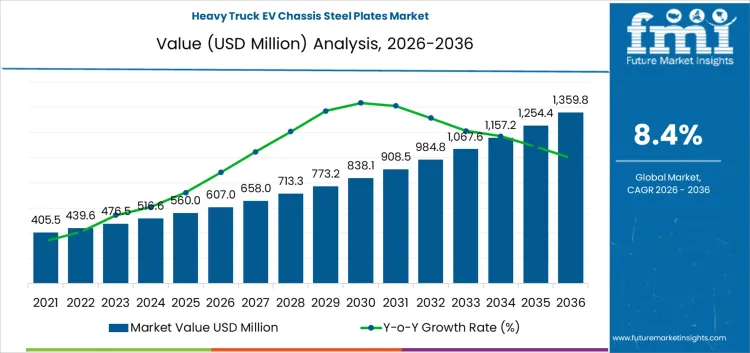
Heavy Truck EV Chassis Steel Plates Market Key Takeaways
| Metric | Value |
|---|---|
| Industry Value (2026) | USD 607 Million |
| Forecast Value (2036) | USD 1,359.8 Million |
| Forecast CAGR 2026 to 2036 | 8.40% |
How Is the Global Heavy Truck EV Chassis Steel Plates Market Advancing?
The global heavy truck EV chassis steel plates market is advancing steadily, driven by the increasing production of electric heavy-duty trucks for logistics, construction, and long-haul transportation. Chassis steel plates play a critical role in providing structural strength, load-bearing capacity, and crash resistance in electric trucks, while supporting the integration of battery packs and powertrain components within the vehicle frame.
A key factor supporting market growth is the shift by fleet operators and manufacturers toward electrification of heavy-duty vehicles to meet evolving emissions regulations and operating cost targets. Electric heavy trucks require reinforced chassis structures to accommodate battery weight without compromising durability or vehicle performance. High-strength and advanced-grade steel plates are therefore increasingly adopted to balance structural integrity with weight optimization.
Ongoing advancements in steel metallurgy and forming technologies are further contributing to market expansion. Improvements in high-strength steel grades, improved weldability, and enhanced corrosion resistance are enabling chassis designs that support higher payloads and longer service life. As electric heavy truck adoption continues to expand across commercial transport applications, the EV chassis steel plates market is expected to experience consistent growth over the forecast period.
What Is the Segment-Wise Analysis for the Heavy Truck EV Chassis Steel Plates Market?
The heavy truck EV chassis steel plates market is segmented by steel type and truck class, reflecting evolving structural and load-bearing requirements of electric commercial vehicles. By steel type, high-strength steel leads with a 32% share, driven by its superior load capacity, fatigue resistance, and ability to reduce chassis weight without compromising durability. Advanced high-strength steel, structural mild steel, hybrid steel laminates, and custom-formed plates follow, supporting diverse design and performance needs. By truck class, heavy-duty trucks dominate with a 59% share, supported by rising electrification of long-haul and high-payload vehicles. The need for reinforced chassis structures to accommodate heavy battery systems and powertrain components is accelerating demand for specialized steel plates across this segment.
Why Does High-Strength Steel Lead the Heavy Truck EV Chassis Steel Plates Market?
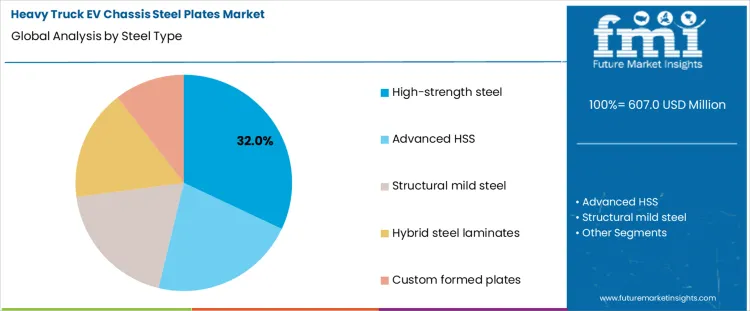
High-strength steel accounts for 32% of the steel type segment in the Heavy Truck EV Chassis Steel Plates Market due to its optimal balance of mechanical strength, durability, and weight efficiency. Electric heavy trucks require chassis structures capable of supporting large battery packs, electric drivetrains, and higher gross vehicle weights while maintaining structural integrity. High-strength steel enables thinner plate designs without sacrificing load-bearing performance, helping manufacturers manage overall vehicle weight and improve efficiency. Its excellent fatigue resistance and crash performance also make it suitable for demanding operating conditions such as long-haul transport and construction logistics. High-strength steel integrates well with existing forming and welding processes, reducing production complexity and cost, which reinforces its leading position in EV chassis applications.
How Do Heavy-Duty Trucks Drive Demand for EV Chassis Steel Plates?
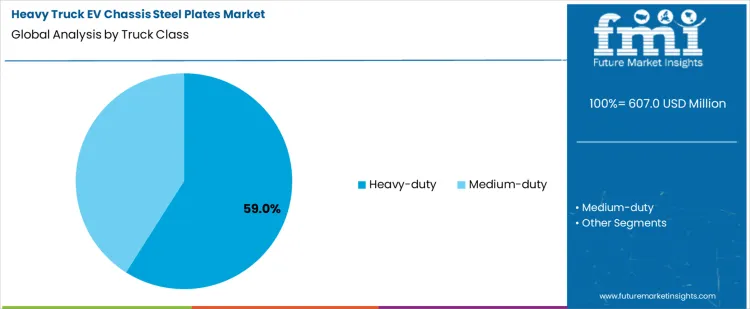
Heavy-duty trucks represent 59% of total truck class demand, making them the dominant segment in the Heavy Truck EV Chassis Steel Plates Market. The electrification of heavy-duty trucks places significant structural demands on chassis systems due to higher payload capacities and the added weight of battery assemblies. Steel plates used in this segment must deliver high stiffness, torsional strength, and long-term durability under continuous load cycles. Heavy-duty EVs used in logistics, freight transport, and industrial applications increasingly rely on reinforced chassis designs to maintain performance and safety standards. As fleet operators adopt electric trucks for high-mileage and high-payload use cases, demand for advanced steel plate solutions continues to grow, positioning the heavy-duty segment as the primary driver of market expansion.a
What Are the Key Dynamics for the Heavy Truck EV Chassis Steel Plates Market?
The heavy truck EV chassis steel plates market is driven by the increasing adoption of electric heavy-duty trucks as part of global efforts to reduce emissions and improve fleet efficiency. Steel plates used in EV chassis provide critical structural strength, impact resistance, and durability required for the heavy loads carried by electric trucks. Key market dynamics include the shift to electrification in commercial transport, stringent regulatory emissions norms, and the need for materials that ensure safety and performance in EV platforms. Demand is further shaped by OEM focus on optimizing vehicle weight without compromising structural integrity, where advanced high-strength steel grades play a central role.
How Are the Key Drivers Shaping the Heavy Truck EV Chassis Steel Plates Market?
Key drivers shaping the market include tightening emissions regulations that encourage commercial electrification, which in turn increases production of EV chassis steel plates. Growth in e-commerce and freight transport volumes is boosting demand for heavy electric trucks capable of reliable long-haul operations. Advances in high-strength and ultra-high-strength steel formulations are enabling lighter but stronger chassis designs, improving range and load efficiency. OEM collaborations with steel manufacturers to develop tailored steel grades optimized for EV applications are helping to meet performance and manufacturing requirements.
What Are the Challenges Impacting the Heavy Truck EV Chassis Steel Plates Market?
Challenges include competition from alternative lightweight materials such as aluminum alloys and composite reinforcements, which are also being explored to reduce vehicle mass and extend EV range. Volatility in raw material prices and supply chain disruptions can influence production costs and lead times for steel plates. The need to balance material strength with weight reduction presents engineering challenges, requiring significant R&D investment. Transitioning existing manufacturing facilities to support advanced steel processing for EV applications may involve capital expenditure that some component suppliers find difficult to justify in the short term.
What Is the Growth Outlook for the Heavy Truck EV Chassis Steel Plates Market by Country?
| Country | CAGR (%) |
|---|---|
| China | 8.5% |
| USA | 8.0% |
| Germany | 7.8% |
| India | 7.5% |
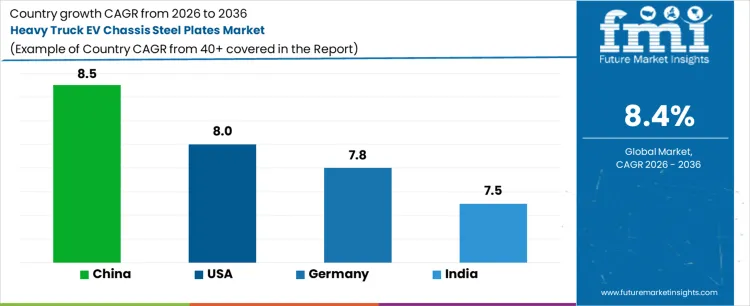
The heavy truck EV chassis steel plates market is expanding steadily as electrification of commercial vehicles accelerates worldwide. China leads with an 8.5% CAGR, driven by large-scale electric truck production and strong policy support. The USA follows at 8.0%, supported by fleet electrification initiatives and growing domestic EV manufacturing. Germany grows at 7.8%, benefiting from advanced automotive engineering and stringent emission regulations. India expands at 7.5%, supported by early-stage adoption of electric heavy trucks and rising investment in EV manufacturing. As electric trucks gain traction globally, demand for high-strength chassis steel plates is expected to continue rising across these regions.
What Is Driving the Growth of the Heavy Truck EV Chassis Steel Plates Market in China?
The heavy truck EV chassis steel plates market in China is growing at a CAGR of 8.5%, driven by rapid electrification of heavy-duty commercial vehicles across logistics, construction, and mining applications. China’s strong EV manufacturing ecosystem and large-scale production of electric trucks are significantly increasing demand for high-strength steel plates used in chassis structures. These plates are essential for supporting heavy battery packs while ensuring load-bearing capacity, torsional rigidity, and long-term durability. Government policies promoting zero-emission freight transport, electrified public fleets, and carbon reduction targets are accelerating adoption of electric heavy trucks. In parallel, domestic steel manufacturers are investing in advanced high-strength and wear-resistant steel grades optimized for EV chassis designs. Close collaboration between truck OEMs and steel suppliers is further improving material performance and cost efficiency. As charging infrastructure expands and electric truck deployment scales nationwide, demand for specialized EV chassis steel plates in China is expected to grow steadily.
How Is the Heavy Truck EV Chassis Steel Plates Market Expanding in the USA?
The heavy truck EV chassis steel plates market in the USA is expanding at a CAGR of 8.0%, supported by increasing adoption of electric trucks in freight transport, port operations, municipal services, and last-mile logistics. USA manufacturers are redesigning heavy truck platforms to integrate large battery systems, driving demand for high-performance steel plates that balance strength, fatigue resistance, and manufacturability. Federal and state-level emission regulations and incentive programs are encouraging fleet operators to transition toward electric heavy-duty vehicles. In addition, rising fuel costs and sustainability targets among logistics companies are supporting electrification initiatives. Domestic investments in EV manufacturing, battery plants, and advanced steel production are strengthening the supply chain for EV chassis materials. Steel producers are also developing lightweight, high-strength grades to improve vehicle range without compromising safety. As electric heavy truck adoption accelerates, demand for chassis steel plates is expected to increase consistently.
What Is Supporting Growth of the Heavy Truck EV Chassis Steel Plates Market in Germany?
The heavy truck EV chassis steel plates market in Germany is growing at a CAGR of 7.8%, driven by the country’s strong automotive engineering capabilities and increasing focus on electric commercial vehicle development. German truck manufacturers are actively introducing electric and hybrid heavy-duty platforms, increasing demand for advanced steel plates capable of supporting battery integration and high structural loads. Stringent emission standards and urban transport regulations are encouraging logistics operators to adopt electric trucks, particularly for regional and city-based operations. Germany’s advanced steel industry plays a key role, offering high-strength, corrosion-resistant, and formable steel grades tailored for EV chassis applications. Close cooperation between OEMs, steel producers, and research institutions supports continuous material innovation. Additionally, emphasis on vehicle safety and performance consistency favors steel-intensive chassis designs. As electrification of heavy trucks progresses, demand for EV chassis steel plates in Germany is expected to grow steadily.
How Is the Heavy Truck EV Chassis Steel Plates Market Developing in India?
The heavy truck EV chassis steel plates market in India is expanding at a CAGR of 7.5%, supported by early-stage electrification of commercial vehicles and increasing focus on reducing emissions in freight transport. While electric heavy trucks are still in pilot and demonstration phases, growing interest from logistics operators, mining companies, and public sector fleets is creating initial demand for EV-compatible chassis materials. Indian manufacturers are exploring high-strength steel plates to maintain durability under heavy loads while accommodating battery weight and thermal requirements. Government initiatives promoting electric mobility, domestic manufacturing, and cleaner transportation are encouraging investment in electric commercial vehicle platforms. India’s expanding steel production capacity also supports localized sourcing of chassis materials. As charging infrastructure improves and electric heavy truck adoption gains momentum, demand for specialized chassis steel plates is expected to rise progressively across the country.
How Are SSAB, ArcelorMittal, POSCO, Nippon Steel, Baosteel, and Tata Steel Competing in the Heavy Truck EV Chassis Steel Plates Market?
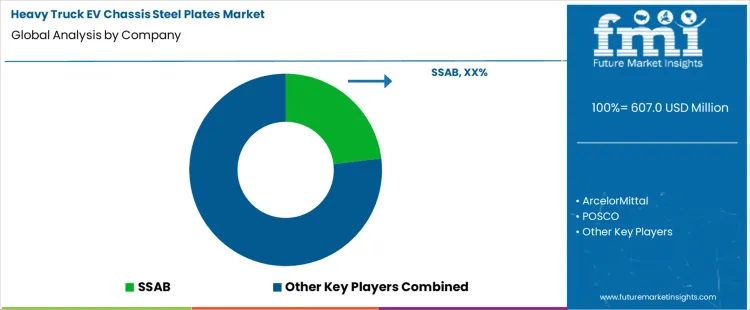
Competition in the heavy truck EV chassis steel plates market is shaped by the need to offset battery-related weight while preserving structural durability, fatigue resistance, and manufacturability. As electric heavy trucks place higher static and dynamic loads on frames and cross members, OEMs increasingly demand high-yield-strength steel plates that deliver lightweighting benefits without compromising stiffness or long-term fatigue life. Consistent weldability, predictable forming behavior in thick gauges, and reliable quality across large production volumes have become core differentiators among steel producers serving EV truck platforms.
SSAB and ArcelorMittal compete strongly on advanced high-strength steel positioning and engineering support for lightweight chassis design. SSAB emphasizes stronger-yet-lighter structural steel grades that enable thinner sections and reduced vehicle mass, supporting payload optimization and driving range improvement. ArcelorMittal leverages a broad portfolio of high-strength and high-yield steel plates, coupled with design and material selection support, helping truck OEMs balance strength, formability, and durability across modular EV chassis architectures.
POSCO, Nippon Steel, Baosteel, and Tata Steel compete through metallurgical capability, grade breadth, and regional supply strength. POSCO focuses on high-performance hot-rolled and plate steels engineered for heavy-duty structural applications, with attention to weldability and toughness. Nippon Steel differentiates through advanced plate processing and tight control of microstructure to support fatigue-critical chassis components. Baosteel leverages large-scale production and automotive-grade structural steels tailored for commercial vehicle frames, while Tata Steel competes with chassis-oriented high-strength grades and strong localization near major truck manufacturing hubs. Across the market, competitive advantage increasingly depends on delivering high-strength plate solutions that integrate smoothly into EV chassis manufacturing while meeting durability, weight, and cost targets.
Key Players in Heavy Truck EV Chassis Steel Plates Market
- SSAB
- ArcelorMittal
- POSCO
- Nippon Steel
- Baosteel
- Tata Steel
Scope of Report
| Attributes | Description |
|---|---|
| Quantitative Unit (2026) | USD Million |
| Steel Type | High-Strength Steel, Advanced HSS, Structural Mild Steel, Hybrid Steel Laminates, Custom Formed Plates |
| Truck Class | Heavy-Duty, Medium-Duty |
| Regions Covered | Asia Pacific, Europe, North America, Latin America, Middle East & Africa |
| Countries Covered | China, Japan, South Korea, India, Australia & New Zealand, ASEAN, Rest of Asia Pacific, Germany, United Kingdom, France, Italy, Spain, Nordic, BENELUX, Rest of Europe, United States, Canada, Mexico, Brazil, Chile, Rest of Latin America, Kingdom of Saudi Arabia, Other GCC Countries, Turkey, South Africa, Other African Union, Rest of Middle East & Africa |
| Key Companies Profiled | SSAB, ArcelorMittal, POSCO, Nippon Steel, Baosteel, Tata Steel |
| Additional Attributes | Dollar sales by steel type and truck class; regional market size and forecast analysis; growth outlook across major regions; demand trends for lightweight and high-strength chassis materials in electric heavy and medium-duty trucks; assessment of material performance requirements, forming complexity, and adoption patterns across OEM and supplier value chains. |
Heavy Truck EV Chassis Steel Plates Market by Key Segments
Steel Type
- High-strength steel
- Advanced HSS
- Structural mild steel
- Hybrid steel laminates
- Custom formed plates
Truck Class
- Heavy-duty
- Medium-duty
Region
- Asia Pacific
- China
- Japan
- South Korea
- India
- Australia & New Zealand
- ASEAN
- Rest of Asia Pacific
- Europe
- Germany
- United Kingdom
- France
- Italy
- Spain
- Nordic
- BENELUX
- Rest of Europe
- North America
- United States
- Canada
- Mexico
- Latin America
- Brazil
- Chile
- Rest of Latin America
- Middle East & Africa
- Kingdom of Saudi Arabia
- Other GCC Countries
- Turkey
- South Africa
- Other African Union
- Rest of Middle East & Africa
Bibliography
European Parliament and Council of the European Union. (2024, May 14). Regulation (EU) 2024/1610 amending Regulation (EU) 2019/1242 as regards strengthening the CO2 emission performance standards for new heavy-duty vehicles and integrating reporting obligations, amending Regulation (EU) 2018/858 and repealing Regulation (EU) 2018/956 (Text with EEA relevance). Official Journal of the European Union. EUR-Lex.
ArcelorMittal. (2023, May 25). Unveiling ArcelorMittal Multi Part Integration™, battery enclosures solutions and multi-phase steel grades at Great Designs in Steel in North America. ArcelorMittal Automotive.
Honda Motor Co., Ltd. (2023, April 11). POSCO and Honda begin exploring comprehensive partnership toward the realization of carbon neutrality. Honda Global Corporate Website (News Release).
Nippon Steel Corporation. (2024). Integrated report 2024. Nippon Steel Corporation.
Baoshan Iron & Steel Co., Ltd. (2024, June 7). Baosteel sustainability report 2023. Baoshan Iron & Steel Co., Ltd.
Frequently Asked Questions
How big is the heavy truck ev chassis steel plates market in 2026?
The global heavy truck ev chassis steel plates market is estimated to be valued at USD 607.0 million in 2026.
What will be the size of heavy truck ev chassis steel plates market in 2036?
The market size for the heavy truck ev chassis steel plates market is projected to reach USD 1,359.8 million by 2036.
How much will be the heavy truck ev chassis steel plates market growth between 2026 and 2036?
The heavy truck ev chassis steel plates market is expected to grow at a 8.4% CAGR between 2026 and 2036.
What are the key product types in the heavy truck ev chassis steel plates market?
The key product types in heavy truck ev chassis steel plates market are high-strength steel, advanced hss, structural mild steel, hybrid steel laminates and custom formed plates.
Which truck class segment to contribute significant share in the heavy truck ev chassis steel plates market in 2026?
In terms of truck class, heavy-duty segment to command 59.0% share in the heavy truck ev chassis steel plates market in 2026.
Preview the report firsthand - request a free sample
Get SampleGet the brochure for pricing and purchase details.
Get PDFTable of Content
- Executive Summary
- Global Market Outlook
- Demand-side Trends
- Supply-side Trends
- Technology Roadmap Analysis
- Analysis and Recommendations
- Market Overview
- Market Coverage / Taxonomy
- Market Definition / Scope / Limitations
- Market Background
- Market Dynamics
- Drivers
- Restraints
- Opportunity
- Trends
- Scenario Forecast
- Demand in Optimistic Scenario
- Demand in Likely Scenario
- Demand in Conservative Scenario
- Opportunity Map Analysis
- Product Life Cycle Analysis
- Supply Chain Analysis
- Investment Feasibility Matrix
- Value Chain Analysis
- PESTLE and Porter’s Analysis
- Regulatory Landscape
- Regional Parent Market Outlook
- Production and Consumption Statistics
- Import and Export Statistics
- Market Dynamics
- Global Market Analysis 2021 to 2025 and Forecast, 2026 to 2036
- Historical Market Size Value (USD Million) Analysis, 2021 to 2025
- Current and Future Market Size Value (USD Million) Projections, 2026 to 2036
- Y-o-Y Growth Trend Analysis
- Absolute $ Opportunity Analysis
- Global Market Pricing Analysis 2021 to 2025 and Forecast 2026 to 2036
- Global Market Analysis 2021 to 2025 and Forecast 2026 to 2036, By Steel Type
- Introduction / Key Findings
- Historical Market Size Value (USD Million) Analysis By Steel Type , 2021 to 2025
- Current and Future Market Size Value (USD Million) Analysis and Forecast By Steel Type , 2026 to 2036
- High-strength steel
- Advanced HSS
- Structural mild steel
- Hybrid steel laminates
- Custom formed plates
- High-strength steel
- Y-o-Y Growth Trend Analysis By Steel Type , 2021 to 2025
- Absolute $ Opportunity Analysis By Steel Type , 2026 to 2036
- Global Market Analysis 2021 to 2025 and Forecast 2026 to 2036, By Truck Class
- Introduction / Key Findings
- Historical Market Size Value (USD Million) Analysis By Truck Class, 2021 to 2025
- Current and Future Market Size Value (USD Million) Analysis and Forecast By Truck Class, 2026 to 2036
- Heavy-duty
- Medium-duty
- Heavy-duty
- Y-o-Y Growth Trend Analysis By Truck Class, 2021 to 2025
- Absolute $ Opportunity Analysis By Truck Class, 2026 to 2036
- Global Market Analysis 2021 to 2025 and Forecast 2026 to 2036, By Region
- Introduction
- Historical Market Size Value (USD Million) Analysis By Region, 2021 to 2025
- Current Market Size Value (USD Million) Analysis and Forecast By Region, 2026 to 2036
- North America
- Latin America
- Western Europe
- Eastern Europe
- East Asia
- South Asia and Pacific
- Middle East & Africa
- Market Attractiveness Analysis By Region
- North America Market Analysis 2021 to 2025 and Forecast 2026 to 2036, By Country
- Historical Market Size Value (USD Million) Trend Analysis By Market Taxonomy, 2021 to 2025
- Market Size Value (USD Million) Forecast By Market Taxonomy, 2026 to 2036
- By Country
- USA
- Canada
- Mexico
- By Steel Type
- By Truck Class
- By Country
- Market Attractiveness Analysis
- By Country
- By Steel Type
- By Truck Class
- Key Takeaways
- Latin America Market Analysis 2021 to 2025 and Forecast 2026 to 2036, By Country
- Historical Market Size Value (USD Million) Trend Analysis By Market Taxonomy, 2021 to 2025
- Market Size Value (USD Million) Forecast By Market Taxonomy, 2026 to 2036
- By Country
- Brazil
- Chile
- Rest of Latin America
- By Steel Type
- By Truck Class
- By Country
- Market Attractiveness Analysis
- By Country
- By Steel Type
- By Truck Class
- Key Takeaways
- Western Europe Market Analysis 2021 to 2025 and Forecast 2026 to 2036, By Country
- Historical Market Size Value (USD Million) Trend Analysis By Market Taxonomy, 2021 to 2025
- Market Size Value (USD Million) Forecast By Market Taxonomy, 2026 to 2036
- By Country
- Germany
- UK
- Italy
- Spain
- France
- Nordic
- BENELUX
- Rest of Western Europe
- By Steel Type
- By Truck Class
- By Country
- Market Attractiveness Analysis
- By Country
- By Steel Type
- By Truck Class
- Key Takeaways
- Eastern Europe Market Analysis 2021 to 2025 and Forecast 2026 to 2036, By Country
- Historical Market Size Value (USD Million) Trend Analysis By Market Taxonomy, 2021 to 2025
- Market Size Value (USD Million) Forecast By Market Taxonomy, 2026 to 2036
- By Country
- Russia
- Poland
- Hungary
- Balkan & Baltic
- Rest of Eastern Europe
- By Steel Type
- By Truck Class
- By Country
- Market Attractiveness Analysis
- By Country
- By Steel Type
- By Truck Class
- Key Takeaways
- East Asia Market Analysis 2021 to 2025 and Forecast 2026 to 2036, By Country
- Historical Market Size Value (USD Million) Trend Analysis By Market Taxonomy, 2021 to 2025
- Market Size Value (USD Million) Forecast By Market Taxonomy, 2026 to 2036
- By Country
- China
- Japan
- South Korea
- By Steel Type
- By Truck Class
- By Country
- Market Attractiveness Analysis
- By Country
- By Steel Type
- By Truck Class
- Key Takeaways
- South Asia and Pacific Market Analysis 2021 to 2025 and Forecast 2026 to 2036, By Country
- Historical Market Size Value (USD Million) Trend Analysis By Market Taxonomy, 2021 to 2025
- Market Size Value (USD Million) Forecast By Market Taxonomy, 2026 to 2036
- By Country
- India
- ASEAN
- Australia & New Zealand
- Rest of South Asia and Pacific
- By Steel Type
- By Truck Class
- By Country
- Market Attractiveness Analysis
- By Country
- By Steel Type
- By Truck Class
- Key Takeaways
- Middle East & Africa Market Analysis 2021 to 2025 and Forecast 2026 to 2036, By Country
- Historical Market Size Value (USD Million) Trend Analysis By Market Taxonomy, 2021 to 2025
- Market Size Value (USD Million) Forecast By Market Taxonomy, 2026 to 2036
- By Country
- Kingdom of Saudi Arabia
- Other GCC Countries
- Turkiye
- South Africa
- Other African Union
- Rest of Middle East & Africa
- By Steel Type
- By Truck Class
- By Country
- Market Attractiveness Analysis
- By Country
- By Steel Type
- By Truck Class
- Key Takeaways
- Key Countries Market Analysis
- USA
- Pricing Analysis
- Market Share Analysis, 2025
- By Steel Type
- By Truck Class
- Canada
- Pricing Analysis
- Market Share Analysis, 2025
- By Steel Type
- By Truck Class
- Mexico
- Pricing Analysis
- Market Share Analysis, 2025
- By Steel Type
- By Truck Class
- Brazil
- Pricing Analysis
- Market Share Analysis, 2025
- By Steel Type
- By Truck Class
- Chile
- Pricing Analysis
- Market Share Analysis, 2025
- By Steel Type
- By Truck Class
- Germany
- Pricing Analysis
- Market Share Analysis, 2025
- By Steel Type
- By Truck Class
- UK
- Pricing Analysis
- Market Share Analysis, 2025
- By Steel Type
- By Truck Class
- Italy
- Pricing Analysis
- Market Share Analysis, 2025
- By Steel Type
- By Truck Class
- Spain
- Pricing Analysis
- Market Share Analysis, 2025
- By Steel Type
- By Truck Class
- France
- Pricing Analysis
- Market Share Analysis, 2025
- By Steel Type
- By Truck Class
- India
- Pricing Analysis
- Market Share Analysis, 2025
- By Steel Type
- By Truck Class
- ASEAN
- Pricing Analysis
- Market Share Analysis, 2025
- By Steel Type
- By Truck Class
- Australia & New Zealand
- Pricing Analysis
- Market Share Analysis, 2025
- By Steel Type
- By Truck Class
- China
- Pricing Analysis
- Market Share Analysis, 2025
- By Steel Type
- By Truck Class
- Japan
- Pricing Analysis
- Market Share Analysis, 2025
- By Steel Type
- By Truck Class
- South Korea
- Pricing Analysis
- Market Share Analysis, 2025
- By Steel Type
- By Truck Class
- Russia
- Pricing Analysis
- Market Share Analysis, 2025
- By Steel Type
- By Truck Class
- Poland
- Pricing Analysis
- Market Share Analysis, 2025
- By Steel Type
- By Truck Class
- Hungary
- Pricing Analysis
- Market Share Analysis, 2025
- By Steel Type
- By Truck Class
- Kingdom of Saudi Arabia
- Pricing Analysis
- Market Share Analysis, 2025
- By Steel Type
- By Truck Class
- Turkiye
- Pricing Analysis
- Market Share Analysis, 2025
- By Steel Type
- By Truck Class
- South Africa
- Pricing Analysis
- Market Share Analysis, 2025
- By Steel Type
- By Truck Class
- USA
- Market Structure Analysis
- Competition Dashboard
- Competition Benchmarking
- Market Share Analysis of Top Players
- By Regional
- By Steel Type
- By Truck Class
- Competition Analysis
- Competition Deep Dive
- SSAB
- Overview
- Product Portfolio
- Profitability by Market Segments (Product/Age /Sales Channel/Region)
- Sales Footprint
- Strategy Overview
- Marketing Strategy
- Product Strategy
- Channel Strategy
- ArcelorMittal
- POSCO
- Nippon Steel
- Baosteel
- Tata Steel
- SSAB
- Competition Deep Dive
- Assumptions & Acronyms Used
- Research Methodology


