

- Industry Size (2026)
- USD 1061.3 Mn
- Forecast (2036)
- USD 2355.7 Mn
- CAGR (2026 to 2036)
- 8.3%
High-Energy Laser Test Equipment Market Forecast and Outlook 2026 to 2036
Demand for high-energy laser test equipment market is valued at USD 1,061.3 million in 2026 and is projected to reach USD 2,355.7 million by 2036, expanding at a CAGR of 8.3%. Demand growth is driven by increasing deployment of high-power laser systems across defense, industrial processing, scientific research, and directed energy applications.
Quick Stats for High-Energy Laser Test Equipment Market
- High-Energy Laser Test Equipment Market Value (2026): USD 1,061.3 million
- High-Energy Laser Test Equipment Market Forecast Value (2036): USD 2,355.7 million
- High-Energy Laser Test Equipment Market Forecast CAGR (2026 to 2036): 8.3%
- Leading Measurement Type in Global Demand: Power Meters and Beam Profiling & Diagnostics
- Fastest-Growing Countries: China, Brazil, South Korea, USA, United Kingdom
- Top Players in Global Demand: Ophir (MKS Instruments), Coherent, Gentec-EO, Thorlabs, Newport (MKS/Newport), Edmund Optics, Keysight Technologies, Tektronix, Teledyne FLIR, Laser Components

Power meters and beam profiling and diagnostics represent leading measurement types in global demand due to requirement for precise output power verification, beam quality assessment, spatial intensity distribution analysis, and thermal stability monitoring under high-energy operating conditions. Test adoption emphasizes safety compliance, performance repeatability, and calibration accuracy for continuous and pulsed laser systems.
China, Brazil, South Korea, USA, and United Kingdom emerge as fastest-growing countries, supported by expanding laser manufacturing capacity, defense research programs, and advanced materials processing investments. Ophir (MKS Instruments), Coherent, Gentec-EO, Thorlabs, Newport (MKS/Newport), Edmund Optics, Keysight Technologies, Tektronix, Teledyne FLIR, and Laser Components maintain strong positions through high-precision optical diagnostics, ruggedized measurement platforms, and application-specific test solutions.
High-Energy Laser Test Equipment Market Key Takeaways
| Metric | Value |
|---|---|
| Market Value (2026) | USD 1,061.3 million |
| Market Forecast Value (2036) | USD 2,355.7 million |
| Forecast CAGR (2026 to 2036) | 8.3% |
Why is the Demand for High-Energy Laser Test Equipment Market Growing Globally?
Demand for high-energy laser test equipment is growing globally due to expanding research, development, and deployment of directed energy systems across defense, industrial manufacturing, and scientific research sectors. Defense agencies in multiple countries invest in high-energy laser technologies for applications such as target tracking, threat neutralization, and platform integration, which requires accurate testing of beam quality, power stability, and thermal effects. Industrial users adopt high-energy lasers for cutting, welding, additive manufacturing, and material processing, which increases need for test systems that verify performance, reliability, and safety under production conditions.
Scientific institutions expand research into high intensity laser interactions with matter, particle acceleration, and fusion energy experiments, which drives procurement of specialized diagnostic tools and measurement equipment. Standardization of test protocols strengthens cross border collaboration and product certification in areas requiring precise beam characterization. Manufacturers of high-energy lasers require test benches, sensors, and calibration systems to support quality assurance and iterative design improvements. Growth in commercial aerospace and automotive applications further stimulates demand for test solutions capable of coping with higher power densities and complex operational environments. Test equipment suppliers develop modular systems that integrate real time data acquisition, control, and environmental simulation to support broader usage across markets worldwide.
How Are the Segments Classified in the High-Energy Laser Test Equipment Market?
Demand for high-energy laser test equipment globally is shaped by rising laser power levels, safety compliance requirements, and precision control needs across industrial and defense applications. Stakeholders assess measurement accuracy, thermal handling capability, diagnostics resolution, and operational safety assurance. Adoption patterns reflect expanded testing intensity for continuous-wave and pulsed laser systems used in manufacturing, research facilities, and directed-energy development programs.
Which Measurement Type Represents the Largest Share of Global Demand?
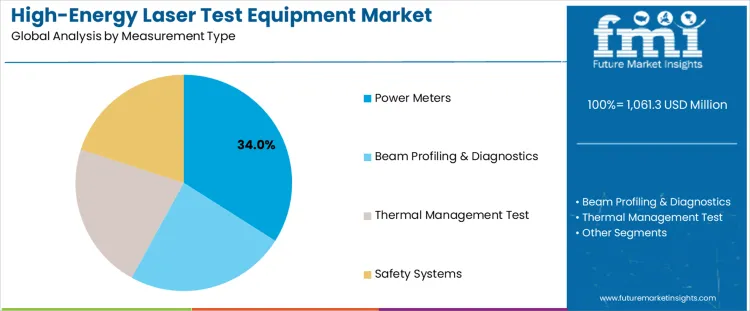
Power meters hold 34.0%, representing the largest measurement-type share globally. Power meters enable accurate quantification of laser output across wide power ranges, supporting calibration, performance verification, and compliance monitoring. Beam profiling and diagnostics hold 24.0%, supporting spatial intensity analysis and beam quality assessment. Thermal management testing accounts for 22.0%, addressing heat dissipation and component stability under sustained operation. Safety systems hold 20.0%, supporting interlocks, exposure control, and operational risk mitigation. Measurement-type distribution reflects priority for accurate power verification in high-energy laser operation.
Key Points
- Power meters dominate due to critical output verification needs.
- Beam diagnostics support spatial and quality assessment.
- Thermal and safety testing address operational stability.
Which Laser Application Drives the Highest Demand for Test Equipment Globally?
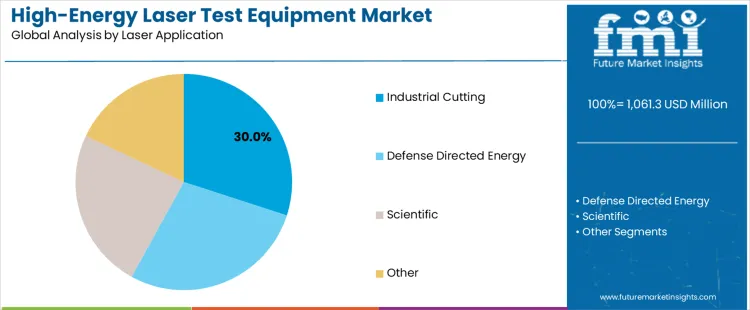
Industrial cutting holds 30.0%, driving the highest demand globally. High-power lasers used in metal processing require consistent output validation and beam quality control. Defense directed-energy applications hold 28.0%, requiring rigorous testing under extreme power and duty-cycle conditions. Scientific applications account for 24.0%, supporting experimental research and precision measurement. Other applications hold 18.0%, covering medical and specialty laser uses. Application distribution reflects strong demand from industrial manufacturing and defense development programs.
Key Points
- Industrial cutting leads due to widespread manufacturing adoption.
- Defense applications require stringent high-power validation.
- Scientific use supports experimental and research activities.
Which Power Class Accounts for the Largest Share of Global Testing Activity?
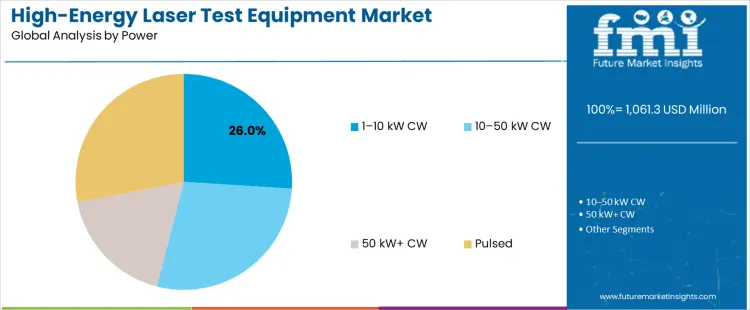
Continuous-wave lasers in the 10-50 kW range hold 28.0%, accounting for the largest share of global testing activity. These systems balance high output with industrial scalability, driving extensive validation needs. Pulsed lasers also hold 28.0%, supporting applications requiring peak power characterization and temporal profiling. Continuous-wave lasers in the 1–10 kW range hold 26.0%, serving mainstream industrial and research applications. Systems above 50 kW hold 18.0%, requiring specialized testing infrastructure. Power-class distribution reflects emphasis on mid-range and pulsed high-energy laser systems.
Key Points
- 10–50 kW CW systems dominate due to industrial scalability.
- Pulsed lasers require temporal and peak power validation.
- Ultra-high-power systems remain specialized and limited.
What are the Key Dynamics in the High-Energy Laser Test Equipment Market?
Global demand rises as defense agencies, research institutions, and aerospace manufacturers advance development and qualification of high-energy laser systems for range, power scaling, beam quality, and operational resilience. Test equipment enables measurement of optical output, thermal loading, pointing accuracy, and component durability under integrated scenarios. Adoption aligns with strategic investments in directed energy technologies across North America, Europe, Middle East, and Asia-Pacific defense programs. Usage spans development labs, weapons integration facilities, and industrial research centers focusing on high-power photonics and laser applications.
How do defense modernization objectives and high-energy laser deployment strategies shape global demand?
Defense programs invest in directed energy systems for counter-UAV, shipboard defense, and precision engagement roles, requiring rigorous test protocols to validate system performance before field deployment. Test equipment characterizes laser beam quality, power efficiency, cooling system efficacy, and alignment stability under simulated operational conditions. Research institutions explore scaling of fiber, solid-state, and chemical laser architectures, generating demand for versatile measurement platforms. Aerospace firms integrate high-energy lasers into flight demonstrators, adding emphasis on vibration, thermal, and environmental compatibility. Collaborative international programs and joint exercises promote cross-border data comparability and shared test standards, increasing requirement for interoperable test infrastructure.
How do capital intensity, safety regulations, and infrastructure challenges influence market scalability?
High-energy laser test systems involve significant capital expenditure for specialized optical benches, high-speed sensors, thermal management, and controlled environments to handle high-power beams safely. Facility design must accommodate eye- and skin-safety protocols, beam dumps, and interlock systems to mitigate radiation hazards. Regulatory frameworks governing export controls and dual-use technology influence equipment distribution and access, particularly for international buyers. Skilled personnel are required to operate and interpret complex measurement data. Maintenance and calibration of high-power optical components demand specialized expertise. Geographic concentration of advanced test facilities in major defense industrial hubs limits access for smaller developers, while collaborative test service models and modular equipment aim to broaden participation in high-energy laser development globally.
How Is Demand for High-Energy Laser Test Equipment Evolving?
Demand for high-energy laser test equipment is increasing globally due to expansion of directed energy research, industrial laser deployment, and defense modernization programs. China leads with a 9.8% CAGR, supported by sustained investment in high-power laser development and domestic testing capacity. Brazil follows at 9.2%, driven by research-led programs and industrial laser applications. South Korea records an 8.4% CAGR, shaped by precision manufacturing and defense electronics integration. USA posts 8.2%, reflecting defense testing requirements and advanced industrial laser usage. UK records 7.9%, supported by collaborative research facilities and materials testing programs. Growth reflects rising power levels, safety validation needs, and reliability qualification requirements worldwide.
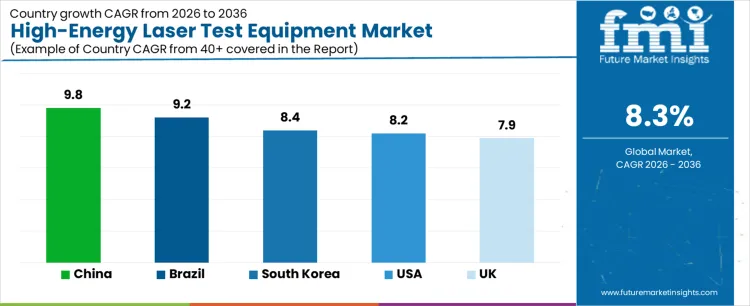
| Country | CAGR (%) |
|---|---|
| China | 9.8 |
| Brazil | 9.2 |
| South Korea | 8.4 |
| USA | 8.2 |
| UK | 7.9 |
What factors are supporting expansion of high-energy laser test equipment demand in China?
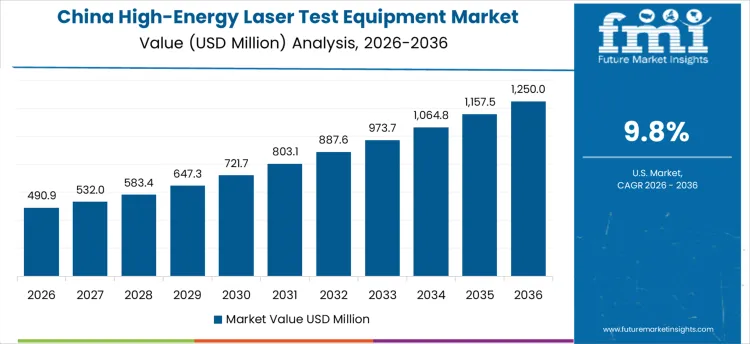
China drives demand through large-scale directed energy research, industrial laser manufacturing, and government-backed testing infrastructure. Country’s CAGR of 9.8% reflects rising need for beam diagnostics, thermal load measurement, and damage threshold testing. Facilities validate laser performance under continuous and pulsed high-power operation. Emphasis remains on in-house testing to accelerate development cycles and protect proprietary designs. Academic institutes expand laboratory capabilities for materials interaction studies. Test equipment prioritizes scalability, automation, and high-duty-cycle operation. Growth remains policy-supported and volume-driven, aligned with national programs targeting high-power laser system maturity.
- Directed energy and industrial laser development programs
- Expansion of in-house high-power test facilities
- Focus on beam quality and thermal performance validation
- Government-supported research infrastructure
Why is Brazil emerging as a growing market for high-energy laser test equipment?
Brazil demand is shaped by expansion of applied research, industrial processing lasers, and academic collaboration. Country’s CAGR of 9.2% reflects increasing adoption of test equipment for power stability, optics durability, and safety verification. Universities and public laboratories invest in shared test setups to support multiple users. Industrial sectors apply high-power lasers for cutting, welding, and surface treatment, increasing validation needs. Demand favors modular and mid-scale systems suitable for laboratory environments. Growth remains research-led and capability-focused, aligned with gradual scaling of domestic laser technology applications.
- Research and industrial laser application growth
- Shared academic and public testing facilities
- Power stability and optics durability testing
- Modular laboratory-scale equipment preference
How does South Korea’s manufacturing ecosystem influence laser test equipment demand?
South Korea demand reflects precision manufacturing, semiconductor processing, and defense electronics development. Country’s CAGR of 8.4% is supported by need for accurate beam characterization, pulse control testing, and thermal stress analysis. Manufacturers emphasize repeatability and measurement accuracy to support quality standards. Government-backed programs encourage domestic testing capability development. Facilities prioritize compact, high-precision test systems compatible with space-constrained laboratories. Growth remains technology-driven, aligned with integration of high-energy lasers into advanced manufacturing and defense applications.
- Precision manufacturing and semiconductor usage
- High-accuracy beam and pulse measurement needs
- Standardized testing and quality assurance focus
- Compact and precise test system adoption
What dynamics sustain steady growth of high-energy laser test equipment demand in the USA?
USA demand is driven by defense research, aerospace applications, and advanced industrial laser deployment. Country’s CAGR of 8.2% reflects ongoing investment in test equipment for power scaling, safety validation, and system reliability. Defense laboratories validate laser weapon components and countermeasure technologies. Industrial users require testing for continuous operation and materials interaction. Demand emphasizes data accuracy, safety compliance, and long-term performance assessment. Growth remains program-driven, aligned with national security priorities and industrial modernization efforts.
- Defense and aerospace laser testing programs
- Industrial high-power laser validation needs
- Emphasis on safety and reliability compliance
- Long-duration performance assessment
How is the UK positioned within the global high-energy laser test equipment landscape?
UK demand reflects collaborative research models, materials science expertise, and defense-linked laser development. Country’s CAGR of 7.9% is supported by investment in shared laser test facilities serving academia and industry. Test equipment enables beam diagnostics, materials damage testing, and thermal response evaluation. Public funding supports infrastructure upgrades and cross-sector collaboration. Demand favors versatile systems adaptable to research and applied testing. Growth remains ecosystem-driven, aligned with UK’s role in laser research, validation, and export-oriented technology development.
- Shared laser test facilities across academia and industry
- Materials interaction and damage threshold testing
- Government-funded infrastructure development
- Research and export-oriented validation focus
What is the competitive landscape of demand for high-energy laser test equipment globally?
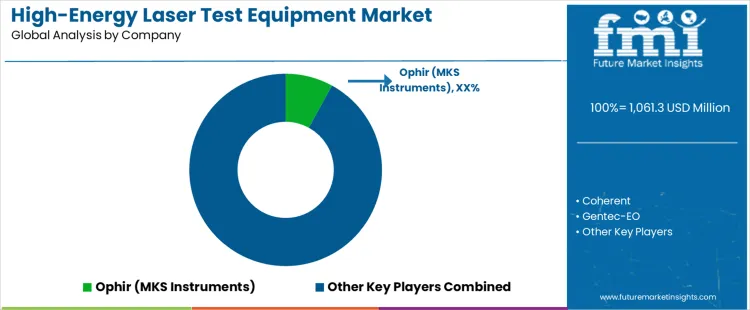
Demand for high-energy laser test equipment is driven by defense programs, industrial laser processing, scientific research, and directed energy development. Testing requirements include accurate measurement of laser power, pulse energy, beam profile, temporal stability, and thermal loading effects. Buyers prioritize high damage-threshold sensors, calibration traceability, fast response times, and compatibility with continuous-wave and pulsed lasers. Procurement teams evaluate system robustness, measurement repeatability, integration with laboratory automation, and safety compliance. Reliability under high power densities and long test durations strongly influences equipment selection. Trend in the global market reflects rising laser power levels, tighter beam quality tolerances, and expansion of directed energy research.
Ophir, part of MKS Instruments, holds strong positioning through widely adopted laser power and energy measurement systems used across defense and industrial laboratories. Coherent supplies beam diagnostics and measurement solutions aligned with its broader laser technology ecosystem. Gentec-EO supports laser testing with calibrated power and energy meters used in research and manufacturing environments. Thorlabs and Newport, operating within the MKS and Newport portfolio, provide beam profiling, optomechanical integration, and diagnostic platforms. Edmund Optics contributes optical components and measurement tools supporting laser characterization workflows. Keysight Technologies and Tektronix provide high-speed electronics and signal analysis used in pulsed laser diagnostics. Teledyne FLIR supplies thermal imaging systems for monitoring laser-induced heating and system safety. Laser Components supports specialty detectors and optoelectronic measurement devices. Competitive differentiation depends on measurement accuracy, damage resistance, calibration credibility, and system integration capability.
Key Players in the High-Energy Laser Test Equipment Market
- Ophir (MKS Instruments)
- Coherent
- Gentec-EO
- Thorlabs
- Newport (MKS/Newport)
- Edmund Optics
- Keysight Technologies
- Tektronix
- Teledyne FLIR
- Laser Components
Scope of the Report
| Items | Values |
|---|---|
| Quantitative Units | USD million |
| Measurement Type | Power Meters; Beam Profiling and Diagnostics; Thermal Management Test Systems; Laser Safety and Protection Systems |
| Laser Application | Industrial Cutting and Welding; Defense Directed-Energy Systems; Scientific and Research Lasers; Other High-Power Laser Applications |
| Power Class | 1–10 kW Continuous Wave (CW); 10–50 kW CW; Above 50 kW CW; Pulsed High-Energy Lasers |
| End User | Industrial Laser OEMs; Defense Laboratories and Agencies; Universities and Research Institutes; Service, Calibration, and Maintenance Firms |
| Regions Covered | Asia Pacific; Europe; North America; Latin America; Middle East & Africa |
| Countries Covered | China; USA; Brazil; South Korea; UK; and 40+ countries |
| Key Companies Profiled | Ophir (MKS Instruments); Coherent; Gentec-EO; Thorlabs; Newport (MKS/Newport); Edmund Optics; Keysight Technologies; Tektronix; Teledyne FLIR; Laser Components |
| Additional Attributes | Dollar sales by measurement type and laser power class; rising adoption in industrial and defense directed-energy programs; demand linked to multi-kilowatt laser deployment; emphasis on beam diagnostics and thermal testing; integration with safety compliance systems; technology upgrades supporting higher power densities and pulsed laser validation. |
High-Energy Laser Test Equipment Market by Segment
Measurement Type:
- Power Meters
- Beam Profiling & Diagnostics
- Thermal Management Test
- Safety Systems
Laser Application:
- Industrial Cutting
- Defense Directed Energy
- Scientific
- Other
Power:
- 1–10 kW CW
- 10–50 kW CW
- 50 kW+ CW
- Pulsed
End User:
- Industrial OEMs
- Defense Labs
- Universities
- Service & Maintenance Firms
Region:
- Asia Pacific
- China
- Japan
- South Korea
- India
- Australia & New Zealand
- ASEAN
- Rest of Asia Pacific
- Europe
- Germany
- United Kingdom
- France
- Italy
- Spain
- Nordic
- BENELUX
- Rest of Europe
- North America
- United States
- Canada
- Mexico
- Latin America
- Brazil
- Chile
- Rest of Latin America
- Middle East & Africa
- Kingdom of Saudi Arabia
- Other GCC Countries
- Turkey
- South Africa
- Other African Union
- Rest of Middle East & Africa
Frequently Asked Questions
How big is the high-energy laser test equipment market in 2026?
The global high-energy laser test equipment market is estimated to be valued at USD 1,061.3 million in 2026.
What will be the size of high-energy laser test equipment market in 2036?
The market size for the high-energy laser test equipment market is projected to reach USD 2,355.7 million by 2036.
How much will be the high-energy laser test equipment market growth between 2026 and 2036?
The high-energy laser test equipment market is expected to grow at a 8.3% CAGR between 2026 and 2036.
What are the key product types in the high-energy laser test equipment market?
The key product types in high-energy laser test equipment market are power meters, beam profiling & diagnostics, thermal management test and safety systems.
Which laser application segment to contribute significant share in the high-energy laser test equipment market in 2026?
In terms of laser application, industrial cutting segment to command 30.0% share in the high-energy laser test equipment market in 2026.
Preview the report firsthand - request a free sample
Get SampleGet the brochure for pricing and purchase details.
Get PDFTable of Content
- Executive Summary
- Global Market Outlook
- Demand-side Trends
- Supply-side Trends
- Technology Roadmap Analysis
- Analysis and Recommendations
- Market Overview
- Market Coverage / Taxonomy
- Market Definition / Scope / Limitations
- Market Background
- Market Dynamics
- Drivers
- Restraints
- Opportunity
- Trends
- Scenario Forecast
- Demand in Optimistic Scenario
- Demand in Likely Scenario
- Demand in Conservative Scenario
- Opportunity Map Analysis
- Product Life Cycle Analysis
- Supply Chain Analysis
- Investment Feasibility Matrix
- Value Chain Analysis
- PESTLE and Porter’s Analysis
- Regulatory Landscape
- Regional Parent Market Outlook
- Production and Consumption Statistics
- Import and Export Statistics
- Market Dynamics
- Global Market Analysis 2021 to 2025 and Forecast, 2026 to 2036
- Historical Market Size Value (USD Million) Analysis, 2021 to 2025
- Current and Future Market Size Value (USD Million) Projections, 2026 to 2036
- Y-o-Y Growth Trend Analysis
- Absolute $ Opportunity Analysis
- Global Market Pricing Analysis 2021 to 2025 and Forecast 2026 to 2036
- Global Market Analysis 2021 to 2025 and Forecast 2026 to 2036, By Measurement Type
- Introduction / Key Findings
- Historical Market Size Value (USD Million) Analysis By Measurement Type , 2021 to 2025
- Current and Future Market Size Value (USD Million) Analysis and Forecast By Measurement Type , 2026 to 2036
- Power Meters
- Beam Profiling & Diagnostics
- Thermal Management Test
- Safety Systems
- Power Meters
- Y-o-Y Growth Trend Analysis By Measurement Type , 2021 to 2025
- Absolute $ Opportunity Analysis By Measurement Type , 2026 to 2036
- Global Market Analysis 2021 to 2025 and Forecast 2026 to 2036, By Laser Application
- Introduction / Key Findings
- Historical Market Size Value (USD Million) Analysis By Laser Application, 2021 to 2025
- Current and Future Market Size Value (USD Million) Analysis and Forecast By Laser Application, 2026 to 2036
- Industrial Cutting
- Defense Directed Energy
- Scientific
- Other
- Industrial Cutting
- Y-o-Y Growth Trend Analysis By Laser Application, 2021 to 2025
- Absolute $ Opportunity Analysis By Laser Application, 2026 to 2036
- Global Market Analysis 2021 to 2025 and Forecast 2026 to 2036, By Power
- Introduction / Key Findings
- Historical Market Size Value (USD Million) Analysis By Power, 2021 to 2025
- Current and Future Market Size Value (USD Million) Analysis and Forecast By Power, 2026 to 2036
- 1–10 kW CW
- 10–50 kW CW
- 50 kW+ CW
- Pulsed
- 1–10 kW CW
- Y-o-Y Growth Trend Analysis By Power, 2021 to 2025
- Absolute $ Opportunity Analysis By Power, 2026 to 2036
- Global Market Analysis 2021 to 2025 and Forecast 2026 to 2036, By End User
- Introduction / Key Findings
- Historical Market Size Value (USD Million) Analysis By End User, 2021 to 2025
- Current and Future Market Size Value (USD Million) Analysis and Forecast By End User, 2026 to 2036
- Industrial OEMs
- Defense Labs
- Universities
- Service & Maintenance Firms
- Industrial OEMs
- Y-o-Y Growth Trend Analysis By End User, 2021 to 2025
- Absolute $ Opportunity Analysis By End User, 2026 to 2036
- Global Market Analysis 2021 to 2025 and Forecast 2026 to 2036, By Region
- Introduction
- Historical Market Size Value (USD Million) Analysis By Region, 2021 to 2025
- Current Market Size Value (USD Million) Analysis and Forecast By Region, 2026 to 2036
- North America
- Latin America
- Western Europe
- Eastern Europe
- East Asia
- South Asia and Pacific
- Middle East & Africa
- Market Attractiveness Analysis By Region
- North America Market Analysis 2021 to 2025 and Forecast 2026 to 2036, By Country
- Historical Market Size Value (USD Million) Trend Analysis By Market Taxonomy, 2021 to 2025
- Market Size Value (USD Million) Forecast By Market Taxonomy, 2026 to 2036
- By Country
- USA
- Canada
- Mexico
- By Measurement Type
- By Laser Application
- By Power
- By End User
- By Country
- Market Attractiveness Analysis
- By Country
- By Measurement Type
- By Laser Application
- By Power
- By End User
- Key Takeaways
- Latin America Market Analysis 2021 to 2025 and Forecast 2026 to 2036, By Country
- Historical Market Size Value (USD Million) Trend Analysis By Market Taxonomy, 2021 to 2025
- Market Size Value (USD Million) Forecast By Market Taxonomy, 2026 to 2036
- By Country
- Brazil
- Chile
- Rest of Latin America
- By Measurement Type
- By Laser Application
- By Power
- By End User
- By Country
- Market Attractiveness Analysis
- By Country
- By Measurement Type
- By Laser Application
- By Power
- By End User
- Key Takeaways
- Western Europe Market Analysis 2021 to 2025 and Forecast 2026 to 2036, By Country
- Historical Market Size Value (USD Million) Trend Analysis By Market Taxonomy, 2021 to 2025
- Market Size Value (USD Million) Forecast By Market Taxonomy, 2026 to 2036
- By Country
- Germany
- UK
- Italy
- Spain
- France
- Nordic
- BENELUX
- Rest of Western Europe
- By Measurement Type
- By Laser Application
- By Power
- By End User
- By Country
- Market Attractiveness Analysis
- By Country
- By Measurement Type
- By Laser Application
- By Power
- By End User
- Key Takeaways
- Eastern Europe Market Analysis 2021 to 2025 and Forecast 2026 to 2036, By Country
- Historical Market Size Value (USD Million) Trend Analysis By Market Taxonomy, 2021 to 2025
- Market Size Value (USD Million) Forecast By Market Taxonomy, 2026 to 2036
- By Country
- Russia
- Poland
- Hungary
- Balkan & Baltic
- Rest of Eastern Europe
- By Measurement Type
- By Laser Application
- By Power
- By End User
- By Country
- Market Attractiveness Analysis
- By Country
- By Measurement Type
- By Laser Application
- By Power
- By End User
- Key Takeaways
- East Asia Market Analysis 2021 to 2025 and Forecast 2026 to 2036, By Country
- Historical Market Size Value (USD Million) Trend Analysis By Market Taxonomy, 2021 to 2025
- Market Size Value (USD Million) Forecast By Market Taxonomy, 2026 to 2036
- By Country
- China
- Japan
- South Korea
- By Measurement Type
- By Laser Application
- By Power
- By End User
- By Country
- Market Attractiveness Analysis
- By Country
- By Measurement Type
- By Laser Application
- By Power
- By End User
- Key Takeaways
- South Asia and Pacific Market Analysis 2021 to 2025 and Forecast 2026 to 2036, By Country
- Historical Market Size Value (USD Million) Trend Analysis By Market Taxonomy, 2021 to 2025
- Market Size Value (USD Million) Forecast By Market Taxonomy, 2026 to 2036
- By Country
- India
- ASEAN
- Australia & New Zealand
- Rest of South Asia and Pacific
- By Measurement Type
- By Laser Application
- By Power
- By End User
- By Country
- Market Attractiveness Analysis
- By Country
- By Measurement Type
- By Laser Application
- By Power
- By End User
- Key Takeaways
- Middle East & Africa Market Analysis 2021 to 2025 and Forecast 2026 to 2036, By Country
- Historical Market Size Value (USD Million) Trend Analysis By Market Taxonomy, 2021 to 2025
- Market Size Value (USD Million) Forecast By Market Taxonomy, 2026 to 2036
- By Country
- Kingdom of Saudi Arabia
- Other GCC Countries
- Turkiye
- South Africa
- Other African Union
- Rest of Middle East & Africa
- By Measurement Type
- By Laser Application
- By Power
- By End User
- By Country
- Market Attractiveness Analysis
- By Country
- By Measurement Type
- By Laser Application
- By Power
- By End User
- Key Takeaways
- Key Countries Market Analysis
- USA
- Pricing Analysis
- Market Share Analysis, 2025
- By Measurement Type
- By Laser Application
- By Power
- By End User
- Canada
- Pricing Analysis
- Market Share Analysis, 2025
- By Measurement Type
- By Laser Application
- By Power
- By End User
- Mexico
- Pricing Analysis
- Market Share Analysis, 2025
- By Measurement Type
- By Laser Application
- By Power
- By End User
- Brazil
- Pricing Analysis
- Market Share Analysis, 2025
- By Measurement Type
- By Laser Application
- By Power
- By End User
- Chile
- Pricing Analysis
- Market Share Analysis, 2025
- By Measurement Type
- By Laser Application
- By Power
- By End User
- Germany
- Pricing Analysis
- Market Share Analysis, 2025
- By Measurement Type
- By Laser Application
- By Power
- By End User
- UK
- Pricing Analysis
- Market Share Analysis, 2025
- By Measurement Type
- By Laser Application
- By Power
- By End User
- Italy
- Pricing Analysis
- Market Share Analysis, 2025
- By Measurement Type
- By Laser Application
- By Power
- By End User
- Spain
- Pricing Analysis
- Market Share Analysis, 2025
- By Measurement Type
- By Laser Application
- By Power
- By End User
- France
- Pricing Analysis
- Market Share Analysis, 2025
- By Measurement Type
- By Laser Application
- By Power
- By End User
- India
- Pricing Analysis
- Market Share Analysis, 2025
- By Measurement Type
- By Laser Application
- By Power
- By End User
- ASEAN
- Pricing Analysis
- Market Share Analysis, 2025
- By Measurement Type
- By Laser Application
- By Power
- By End User
- Australia & New Zealand
- Pricing Analysis
- Market Share Analysis, 2025
- By Measurement Type
- By Laser Application
- By Power
- By End User
- China
- Pricing Analysis
- Market Share Analysis, 2025
- By Measurement Type
- By Laser Application
- By Power
- By End User
- Japan
- Pricing Analysis
- Market Share Analysis, 2025
- By Measurement Type
- By Laser Application
- By Power
- By End User
- South Korea
- Pricing Analysis
- Market Share Analysis, 2025
- By Measurement Type
- By Laser Application
- By Power
- By End User
- Russia
- Pricing Analysis
- Market Share Analysis, 2025
- By Measurement Type
- By Laser Application
- By Power
- By End User
- Poland
- Pricing Analysis
- Market Share Analysis, 2025
- By Measurement Type
- By Laser Application
- By Power
- By End User
- Hungary
- Pricing Analysis
- Market Share Analysis, 2025
- By Measurement Type
- By Laser Application
- By Power
- By End User
- Kingdom of Saudi Arabia
- Pricing Analysis
- Market Share Analysis, 2025
- By Measurement Type
- By Laser Application
- By Power
- By End User
- Turkiye
- Pricing Analysis
- Market Share Analysis, 2025
- By Measurement Type
- By Laser Application
- By Power
- By End User
- South Africa
- Pricing Analysis
- Market Share Analysis, 2025
- By Measurement Type
- By Laser Application
- By Power
- By End User
- USA
- Market Structure Analysis
- Competition Dashboard
- Competition Benchmarking
- Market Share Analysis of Top Players
- By Regional
- By Measurement Type
- By Laser Application
- By Power
- By End User
- Competition Analysis
- Competition Deep Dive
- Ophir (MKS Instruments)
- Overview
- Product Portfolio
- Profitability by Market Segments (Product/Age /Sales Channel/Region)
- Sales Footprint
- Strategy Overview
- Marketing Strategy
- Product Strategy
- Channel Strategy
- Coherent
- Gentec-EO
- Thorlabs
- Newport (MKS/Newport)
- Edmund Optics
- Keysight Technologies
- Tektronix
- Teledyne FLIR
- Laser Components
- Ophir (MKS Instruments)
- Competition Deep Dive
- Assumptions & Acronyms Used
- Research Methodology


