

- Industry Size (2026)
- USD 70 Mn
- Forecast (2036)
- USD 119.6 Mn
- CAGR (2026 to 2036)
- 5.5%
High-Solids Waterborne Can Coatings for Aseptic Lines Market Forecast and Outlook 2026 to 2036
The high-solids waterborne can coatings for aseptic lines market is valued at USD 70 million in 2026 and is projected to reach USD 119.6 million by 2036, reflecting a CAGR of 5.5%. Adoption during this period is governed by sterilization tolerance, film integrity under thermal shock, and line speed compatibility. Procurement emphasis is placed on coatings that maintain barrier performance during retort and aseptic processing. Cost structures are shaped by solids loading, cure efficiency, and defect avoidance during high throughput runs. Preference is given to suppliers demonstrating stable application windows. As a result, qualification reliability is prioritized over incremental material cost savings.
Between 2026 and 2036, buyer behavior is influenced by contamination risk management and production continuity requirements. Vendor lock-in is reinforced through line calibration, validation protocols, and regulatory documentation tied to food contact compliance. Switching costs are elevated due to requalification expense and downtime exposure. Procurement flexibility is constrained once coatings are embedded within approved aseptic workflows. Fragmentation persists across can formats and filling technologies, limiting full standardization. At the same time, supplier concentration increases within large beverage programs where repeat validation supports scale efficiency. Market outcomes are shaped by operational risk tolerance rather than competitive pricing pressure.
Quick Stats for High Solids Waterborne Can Coatings for Aseptic Lines Market
- High Solids Waterborne Can Coatings for Aseptic Lines Market Value (2026): USD 70 million
- High Solids Waterborne Can Coatings for Aseptic Lines Market Forecast Value (2036): USD 119.6 million
- High Solids Waterborne Can Coatings for Aseptic Lines Market Forecast CAGR (2026 to 2036): 5.5%
- Leading Can Type in High Solids Waterborne Can Coatings for Aseptic Lines Market: Aluminium beverage aseptic cans
- Key Growth Regions in High Solids Waterborne Can Coatings for Aseptic Lines Market: Asia Pacific, North America, Europe
- Top Players in High Solids Waterborne Can Coatings for Aseptic Lines Market: PPG Industries, AkzoNobel, Actega (ALTANA), Michelman, Henkel, The Sherwin-Williams Company
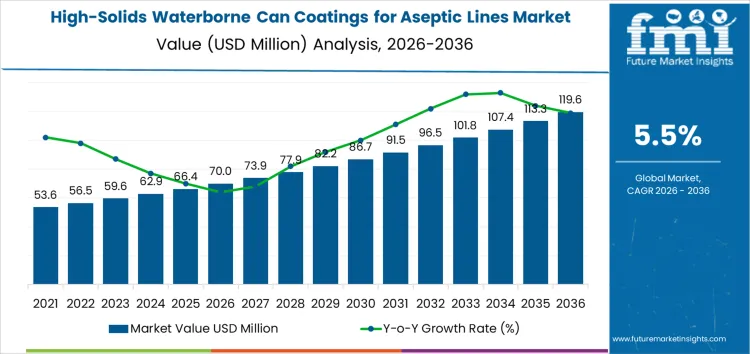
What Is the Growth Forecast for High Solids Waterborne Can Coatings for Aseptic Lines Market through 2036?
Filling line hygiene requirements and coating cure consistency define the early growth phase of the high solids waterborne can coatings for aseptic lines market between 2026 and 2031. During this period, the market expands from USD 70 million to USD 85 million, adding USD 15 million in value. Annual progression from USD 53 million to USD 70 million reflects steady adoption across beverage and liquid food aseptic packaging operations. Historical growth was limited by narrow process windows and reliance on solvent based can coatings. Forward expansion in this phase is supported by improved film build at lower water content, reliable sterilization resistance, and increasing deployment on high speed aseptic filling lines.
Line modernization and packaging format diversification drive growth from 2031 to 2036. Over this period, the market increases from USD 85 million to USD 126 million, adding USD 41 million and representing the stronger expansion window. Annual values rise from USD 90 million to USD 126 million, indicating consistent year over year momentum. Earlier demand focused on selective dairy and juice applications, while future growth reflects broader use across shelf stable beverages and nutritional products. Higher line throughput, reduced coating defects, and stable barrier performance support sustained expansion as high solids waterborne can coatings become established solutions for aseptic packaging lines.
High Solids Waterborne Can Coatings for Aseptic Lines Market Key Takeaways
| Metric | Value |
|---|---|
| Market Value (2026) | USD 70 million |
| Forecast Value (2036) | USD 119.6 million |
| Forecast CAGR (2026 to 2036) | 5.5% |
What Is Driving Demand in the High-Solids Waterborne Can Coatings for Aseptic Lines Market?
Growth in the high-solids waterborne can coatings market for aseptic packaging lines reflects specific production and regulatory challenges rather than general coating demand alone. Aseptic canning environments require coatings that cure quickly at moderate temperatures, maintain food contact compliance, and deliver corrosion resistance under high humidity and sanitation cycles. Traditional solvent-borne coatings posed regulatory restrictions due to volatile organic compound emissions and required lengthy drying that constrained line throughput. Early adoption of high-solids waterborne systems occurred in facilities where VOC limits, worker exposure policies, and productivity targets made solvent-based alternatives untenable. Demand was driven by measurable impacts on air quality compliance, line speed, and coating performance rather than by aesthetic surface requirements.
Future growth will be shaped by tightening environmental standards, sustainable manufacturing expectations, and performance integration in automated aseptic lines rather than incremental coating improvements alone. Regulatory frameworks increasingly restrict VOC emissions in food and beverage packaging plants, prompting canners to specify waterborne high-solids coatings that balance low emissions with robust barrier properties. Aseptic processing protocols now include documented surface performance metrics, requiring coatings that resist frequent washdowns, maintain adhesion in sterile environments, and support long equipment life. Advances in polymer technology are improving film formation, chemical resistance, and cure efficiency at lower energy input.
What Factors Are Affecting the Demand for High Solids Waterborne Can Coatings for Aseptic Lines Market in Terms of Can Type and Functional Coating Role?
The high solids waterborne can coatings market for aseptic lines is driven by food safety regulation, solvent emission limits, and rising use of shelf stable packaged foods. Demand centers on coating systems that withstand sterilization while maintaining barrier integrity and sensory neutrality. Adoption depends on can substrate, thermal exposure, and compatibility with high speed aseptic filling lines. Market leadership reflects regulatory compliance, corrosion protection reliability, and process stability rather than decorative performance alone.
What Is Driving Leadership by Can Type in the High Solids Waterborne Can Coatings Market?
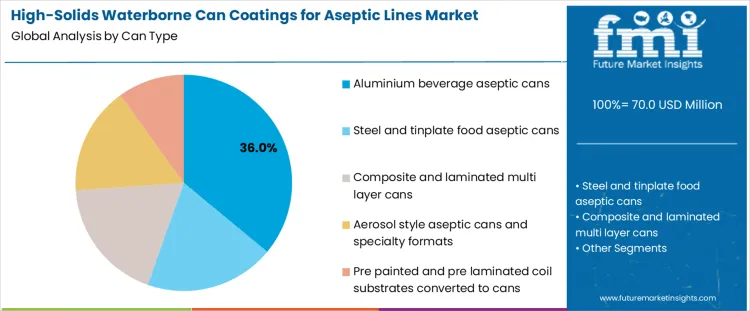
Aluminium beverage aseptic cans account for about 36% of demand because they combine lightweight structure, corrosion resistance, and compatibility with high speed aseptic filling operations. These cans are widely used for ready to drink beverages, dairy alternatives, and nutritional products requiring extended shelf life. High solids waterborne coatings are applied internally to protect aluminium from acidic or protein rich contents while maintaining food contact compliance. Manufacturers favor aluminium cans due to uniform surface quality and predictable coating adhesion, which reduces defect risk during sterilization. Large production volumes and standardized dimensions reinforce consistent coating consumption. As aseptic beverage formats expand beyond cartons, aluminium cans increasingly adopt waterborne systems that meet emission regulations without sacrificing throughput.
Steel and tinplate cans, composite multilayer cans, and specialty formats contribute secondary demand. Steel cans require stronger corrosion protection but operate at lower volumes. Composite and laminated cans introduce adhesion complexity across layers. Aerosol style aseptic formats remain niche. Pre painted coil substrates support upstream coating but do not dominate finished can demand. Can type leadership therefore reflects beverage volume growth, substrate uniformity, and line efficiency rather than total diversity of aseptic container formats.
What Is Driving Leadership by Functional Coating Role in the High Solids Waterborne Can Coatings Market?
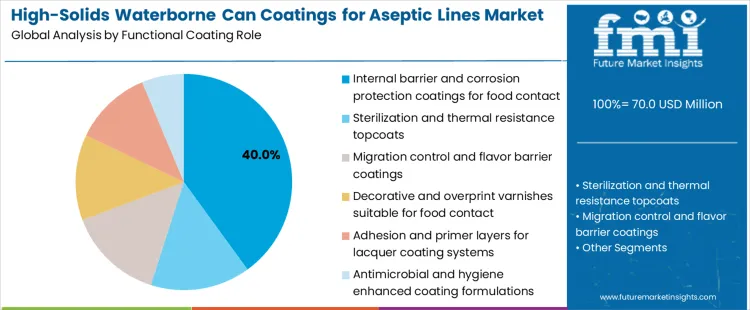
Internal barrier and corrosion protection coatings represent about 40% of demand because direct food contact protection is the primary function in aseptic packaging. These coatings prevent metal interaction with contents, control migration, and preserve flavor integrity during long storage periods. Aseptic processing subjects cans to high temperature sterilization, placing stress on coating films. Manufacturers prioritize waterborne systems with proven thermal stability and adhesion retention. Large internal surface area coverage drives higher material usage compared with external coatings. Regulatory scrutiny further concentrates investment in barrier performance validation.
Sterilization resistant topcoats, migration control layers, decorative varnishes, primers, and antimicrobial coatings play supporting roles. External coatings protect graphics and appearance but involve thinner films. Antimicrobial systems remain selective due to regulatory complexity. Adhesion primers are applied in smaller quantities. Functional role leadership therefore reflects safety critical performance, surface area coverage, and regulatory priority rather than number of coating layers applied in aseptic can systems.
How Are High-Solids Waterborne Can Coatings Being Applied Across Aseptic Food and Beverage Lines?
Use appears in beverage and liquid food production facilities where aluminum and steel cans require corrosion resistance, food safety compliance, and minimal VOC emissions. Manufacturers adopt high-solids waterborne coatings to protect can interiors on aseptic lines, ensuring chemical inertness, adhesion, and barrier performance during sterilization and filling. Canning operators integrate these coatings to maintain product quality, extend shelf life, and meet environmental regulations. These applications reflect operational and regulatory priorities rather than purely aesthetic objectives, with adoption driven by coating performance, food safety, and environmental compliance.
What Operational and Material Conditions Support Adoption of High-Solids Waterborne Can Coatings?
Selection aligns with can production lines capable of precise coating thickness, curing, and surface preparation. Formulations are optimized for chemical resistance, thermal stability, and adhesion to prevent leaching and corrosion. Process engineers monitor coating application, drying conditions, and line speed to maintain uniformity and quality. Quality control evaluates film integrity, barrier performance, and regulatory compliance with food-contact standards such as FDA or EFSA. These conditions emerge from operational efficiency, material performance, and regulatory adherence priorities in structured aseptic packaging workflows.
Which Practical Considerations Limit Wider Use of High-Solids Waterborne Can Coatings?
Higher material and processing costs may influence adoption in low-margin beverage segments. Compatibility with sterilization, filling, and sealing operations must be validated. Variability in can metal substrates or surface treatment can affect adhesion. Regulatory approvals and testing for food safety differ by region. These factors lead to selective deployment where coating durability, product safety, and environmental compliance justify incremental cost and process control.
What is the Demand for High Solids Waterborne Can Coatings for Aseptic Lines by Country?
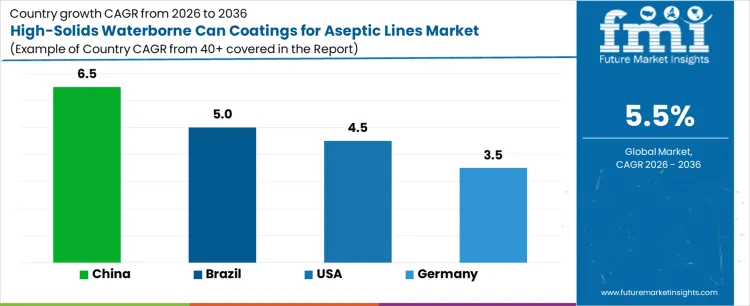
| Country | CAGR (%) |
|---|---|
| USA | 4.5% |
| China | 6.5% |
| Germany | 3.5% |
| Brazil | 5.0% |
The demand for high solids waterborne can coatings for aseptic lines varies across countries, driven by food and beverage packaging, environmental regulations, and adoption of low VOC coatings. China leads with a 6.5% CAGR, supported by rapid growth in beverage production, expansion of aseptic packaging lines, and regulatory focus on environmentally friendly coatings. Brazil follows at 5.0%, driven by increasing beverage and food processing operations. The USA grows at 4.5%, reflecting steady adoption in commercial and industrial packaging. Germany records 3.5%, shaped by mature packaging markets and strict environmental compliance. These coatings improve can durability, reduce emissions, and support sustainable packaging practices.
How are high-solids waterborne can coatings expanding aseptic line applications in China?
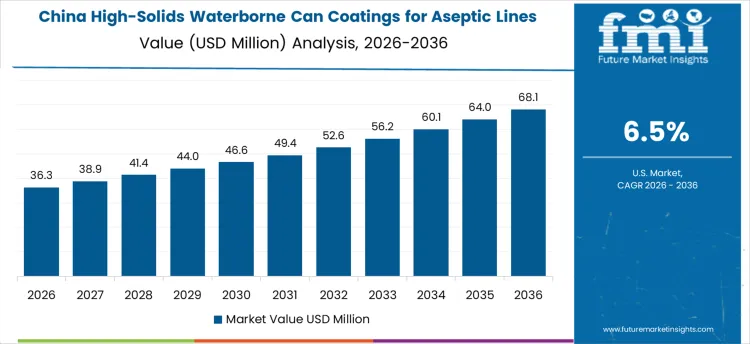
In China, the high-solids waterborne can coatings for aseptic lines market is growing at a CAGR of 6.5% through 2036, driven by rapid expansion of beverage, dairy, and canned food production. Manufacturers are adopting waterborne coatings to improve corrosion resistance, maintain product hygiene, and comply with environmental regulations. Demand is concentrated in beverage production hubs, aseptic packaging facilities, and industrial coating suppliers. Compared to the USA, China emphasizes large-scale industrial integration and high-volume adoption. Domestic suppliers provide high-performance, low-VOC coatings suitable for recurring can line application and maintenance cycles.
- Beverage production hubs, aseptic packaging facilities, and industrial coating suppliers drive adoption
- Coatings improve corrosion resistance and maintain hygiene standards
- Domestic suppliers provide high-performance, low-VOC solutions
- Recurring can line application and maintenance cycles sustain adoption
How are regulatory compliance and industrial growth driving adoption in the United States?
In the United States, revenue is growing at a CAGR of 4.5% through 2036, supported by expansion of canned beverages and aseptic food production lines, alongside strict FDA and environmental standards. Manufacturers are integrating high-solids waterborne coatings to enhance can durability, reduce VOC emissions, and maintain food safety. Demand is concentrated in industrial beverage hubs, aseptic packaging lines, and coating application facilities. Compared to China, adoption emphasizes regulatory compliance and quality control over large-volume deployment. Domestic suppliers provide chemically compatible coatings suitable for recurring can production and finishing cycles.
- Industrial beverage hubs, aseptic packaging lines, and coating facilities drive adoption
- Coatings enhance durability and reduce VOC emissions
- Domestic suppliers provide chemically compatible, compliant solutions
- Recurring can production and finishing cycles sustain adoption
How are environmental regulations and coating performance driving adoption in Germany?
In Germany, the market is expanding at a CAGR of 3.5% through 2036, fueled by environmental regulations, sustainable packaging initiatives, and growth in beverage and food industries. Manufacturers are adopting high-solids waterborne coatings to improve corrosion resistance, reduce emissions, and comply with EU environmental standards. Demand is concentrated in industrial beverage hubs, aseptic production lines, and coating suppliers. Compared to China, adoption emphasizes regulatory compliance and precise formulation rather than volume. Domestic suppliers provide EU-certified, high-performance coatings suitable for recurring can line application and quality inspections.
- Industrial beverage hubs, aseptic production lines, and coating suppliers drive adoption
- Coatings improve corrosion resistance and reduce emissions
- Domestic suppliers provide EU-certified, high-performance solutions
- Recurring can line application and quality inspections sustain adoption
How are beverage industry growth and sustainability goals driving market growth in Brazil?
In Brazil, revenue is growing at a CAGR of 5% through 2036, supported by expansion of canned beverage production, food safety requirements, and environmental sustainability initiatives. Manufacturers are using high-solids waterborne coatings to enhance can durability, maintain aseptic quality, and reduce VOC emissions. Demand is concentrated in beverage production hubs, industrial coating facilities, and packaging lines. Compared to the USA, adoption emphasizes cost-effective solutions and compliance with local environmental standards. Domestic suppliers provide high-performance, low-emission coatings suitable for recurring can production and maintenance cycles.
- Beverage production hubs, industrial coating facilities, and packaging lines drive adoption
- Coatings enhance durability and maintain aseptic quality
- Domestic suppliers provide high-performance, low-emission solutions
- Recurring can production and maintenance cycles sustain adoption
Which Strategic Approaches Define Competition in the High Solids Waterborne Can Coatings Market for Aseptic Filling Lines?
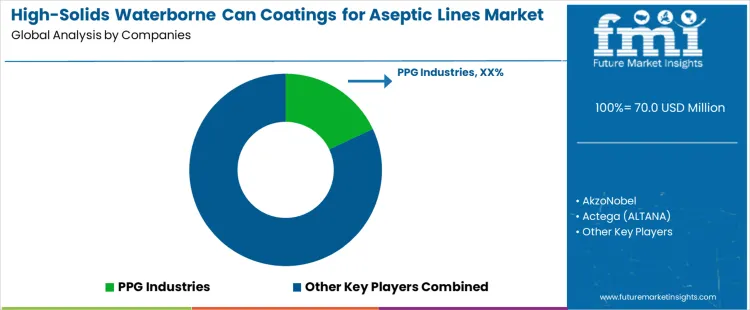
Competition in high solids waterborne can coatings for aseptic lines is shaped by sterilization compatibility and line stability rather than by coating chemistry alone. PPG Industries and AkzoNobel anchor their strategies in proven aseptic performance, focusing on resistance to hydrogen peroxide, thermal shock, and rapid pressure changes during filling. Their formulations emphasize film integrity at reduced bake windows, uniform coverage at high line speeds, and consistent wetting on aluminum and steel substrates. Actega positions solutions around regulatory assurance and migration control, aligning coating performance with food contact compliance and global audit expectations. Qualification is driven by sterilant tolerance, adhesion after repeated exposure, and predictable curing under constrained energy profiles.
Process integration and service depth differentiate secondary competitors. Michelman focuses on surface control and slip management to stabilize can handling through aseptic equipment, reducing scuffing and jams. Henkel competes through materials that support adhesion and protection functions within broader packaging systems, emphasizing compatibility with existing application hardware. The Sherwin-Williams Company prioritizes retrofit friendliness and global supply consistency for brand owners operating mixed aseptic platforms. Across the market, advantage accrues to suppliers that deliver repeatable performance under sterilization stress, provide rapid line trial support, and maintain conservative formulation evolution to protect approvals.
Key Players in the High Solids Waterborne Can Coatings Market
- PPG Industries
- AkzoNobel
- Actega (ALTANA)
- Michelman
- Henkel
- The Sherwin-Williams Company
Scope of the Report
| Items | Values |
|---|---|
| Quantitative Units | USD million |
| Type | High-solids waterborne coating systems, Solvent-borne can lacquer systems used in legacy lines, UV-cured and electron beam-cured decorative coatings, Hybrid two-component epoxy coating systems for specialty aseptic applications |
| Application | Internal coating of aluminium beverage aseptic cans, Steel and tinplate food aseptic cans, Composite and laminated multi-layer cans, Specialty and aerosol-style aseptic cans, Pre-painted or pre-laminated coil substrates converted into cans |
| End Users | Beverage manufacturers operating aseptic filling lines, Shelf-stable food processors, Dairy and UHT product manufacturers, Infant and specialty nutrition producers, Contract can coaters and packaging converters |
| Regions Covered | Asia Pacific, Europe, North America, Latin America, Middle East and Africa |
| Countries Covered | China, United States, Germany, Brazil, Japan, India, South Korea, United Kingdom, France, Italy, Canada, Mexico, ASEAN countries, GCC countries, and other aseptic packaging markets |
| Key Companies Profiled | PPG Industries, AkzoNobel, Actega (ALTANA), Michelman, Henkel, The Sherwin-Williams Company |
| Additional Attributes | Dollar by sales across can type functional coating role and end use, sterilization and thermal shock resistance benchmarks, food contact and migration compliance documentation, line speed compatibility and defect avoidance metrics, validation and requalification requirements for aseptic filling lines, operational lock-in effects driven by regulatory approvals and line calibration |
High Solids Waterborne Can Coatings Market Segmentation
By Can Type:
- Aluminium beverage aseptic cans
- Steel and tinplate food aseptic cans
- Composite and laminated multi-layer cans
- Aerosol style aseptic cans and specialty formats
- Pre painted and pre laminated coil substrates converted to cans
By Functional Coating Role:
- Internal barrier and corrosion protection coatings for food contact
- Sterilization and thermal resistance topcoats
- Migration control and flavor barrier coatings
- Decorative and overprint varnishes suitable for food contact
- Adhesion and primer layers for lacquer coating systems
- Antimicrobial and hygiene enhanced coating formulations
By System:
- High solids waterborne coating systems
- Solvent borne can lacquer systems used in legacy and regulated markets
- UV cured and electron beam cured coatings for decorative layers
- Hybrid two component epoxy coating systems for specialty applications
By End-Use:
- Ready to drink beverages including juices, teas, and ready to drink coffees
- Shelf stable food products including soups and prepared meals
- Dairy and UHT products packaged in can formats
- Infant and specialty nutrition cans
- Specialty industrial and pharmaceutical aseptic cans
By Region:
- Asia Pacific
- China
- Japan
- South Korea
- India
- Australia & New Zealand
- ASEAN
- Rest of Asia Pacific
- Europe
- Germany
- United Kingdom
- France
- Italy
- Spain
- Nordic
- BENELUX
- Rest of Europe
- North America
- United States
- Canada
- Mexico
- Latin America
- Brazil
- Chile
- Rest of Latin America
- Middle East & Africa
- Kingdom of Saudi Arabia
- Other GCC Countries
- Turkey
- South Africa
- Other African Union
- Rest of Middle East & Africa
Frequently Asked Questions
How big is the high-solids waterborne can coatings for aseptic lines market in 2026?
The global high-solids waterborne can coatings for aseptic lines market is estimated to be valued at USD 70.0 million in 2026.
What will be the size of high-solids waterborne can coatings for aseptic lines market in 2036?
The market size for the high-solids waterborne can coatings for aseptic lines market is projected to reach USD 119.6 million by 2036.
How much will be the high-solids waterborne can coatings for aseptic lines market growth between 2026 and 2036?
The high-solids waterborne can coatings for aseptic lines market is expected to grow at a 5.5% CAGR between 2026 and 2036.
What are the key product types in the high-solids waterborne can coatings for aseptic lines market?
The key product types in high-solids waterborne can coatings for aseptic lines market are aluminium beverage aseptic cans, steel and tinplate food aseptic cans, composite and laminated multi layer cans, aerosol style aseptic cans and specialty formats and pre painted and pre laminated coil substrates converted to cans.
Which functional coating role segment to contribute significant share in the high-solids waterborne can coatings for aseptic lines market in 2026?
In terms of functional coating role, internal barrier and corrosion protection coatings for food contact segment to command 40.0% share in the high-solids waterborne can coatings for aseptic lines market in 2026.
Preview the report firsthand - request a free sample
Get SampleGet the brochure for pricing and purchase details.
Get PDFTable of Content
- Executive Summary
- Global Market Outlook
- Demand-side Trends
- Supply-side Trends
- Technology Roadmap Analysis
- Analysis and Recommendations
- Market Overview
- Market Coverage / Taxonomy
- Market Definition / Scope / Limitations
- Market Background
- Market Dynamics
- Drivers
- Restraints
- Opportunity
- Trends
- Scenario Forecast
- Demand in Optimistic Scenario
- Demand in Likely Scenario
- Demand in Conservative Scenario
- Opportunity Map Analysis
- Product Life Cycle Analysis
- Supply Chain Analysis
- Investment Feasibility Matrix
- Value Chain Analysis
- PESTLE and Porter’s Analysis
- Regulatory Landscape
- Regional Parent Market Outlook
- Production and Consumption Statistics
- Import and Export Statistics
- Market Dynamics
- Global Market Analysis 2021 to 2025 and Forecast, 2026 to 2036
- Historical Market Size Value (USD Million) Analysis, 2021 to 2025
- Current and Future Market Size Value (USD Million) Projections, 2026 to 2036
- Y-o-Y Growth Trend Analysis
- Absolute $ Opportunity Analysis
- Global Market Pricing Analysis 2021 to 2025 and Forecast 2026 to 2036
- Global Market Analysis 2021 to 2025 and Forecast 2026 to 2036, By Can Type
- Introduction / Key Findings
- Historical Market Size Value (USD Million) Analysis By Can Type , 2021 to 2025
- Current and Future Market Size Value (USD Million) Analysis and Forecast By Can Type , 2026 to 2036
- Aluminium beverage aseptic cans
- Steel and tinplate food aseptic cans
- Composite and laminated multi layer cans
- Aerosol style aseptic cans and specialty formats
- Pre painted and pre laminated coil substrates converted to cans
- Aluminium beverage aseptic cans
- Y-o-Y Growth Trend Analysis By Can Type , 2021 to 2025
- Absolute $ Opportunity Analysis By Can Type , 2026 to 2036
- Global Market Analysis 2021 to 2025 and Forecast 2026 to 2036, By Functional Coating Role
- Introduction / Key Findings
- Historical Market Size Value (USD Million) Analysis By Functional Coating Role, 2021 to 2025
- Current and Future Market Size Value (USD Million) Analysis and Forecast By Functional Coating Role, 2026 to 2036
- Internal barrier and corrosion protection coatings for food contact
- Sterilization and thermal resistance topcoats
- Migration control and flavor barrier coatings
- Decorative and overprint varnishes suitable for food contact
- Adhesion and primer layers for lacquer coating systems
- Antimicrobial and hygiene enhanced coating formulations
- Internal barrier and corrosion protection coatings for food contact
- Y-o-Y Growth Trend Analysis By Functional Coating Role, 2021 to 2025
- Absolute $ Opportunity Analysis By Functional Coating Role, 2026 to 2036
- Global Market Analysis 2021 to 2025 and Forecast 2026 to 2036, By System
- Introduction / Key Findings
- Historical Market Size Value (USD Million) Analysis By System, 2021 to 2025
- Current and Future Market Size Value (USD Million) Analysis and Forecast By System, 2026 to 2036
- High solids waterborne coating systems
- Solvent borne can lacquer systems used in legacy and regulated markets
- UV cured and electron beam cured coatings for decorative layers
- Hybrid two component epoxy coating systems for specialty applications
- High solids waterborne coating systems
- Y-o-Y Growth Trend Analysis By System, 2021 to 2025
- Absolute $ Opportunity Analysis By System, 2026 to 2036
- Global Market Analysis 2021 to 2025 and Forecast 2026 to 2036, By End-Use
- Introduction / Key Findings
- Historical Market Size Value (USD Million) Analysis By End-Use, 2021 to 2025
- Current and Future Market Size Value (USD Million) Analysis and Forecast By End-Use, 2026 to 2036
- Ready to drink beverages including juices, teas, and ready to drink coffees
- Shelf stable food products including soups and prepared meals
- Dairy and UHT products packaged in can formats
- Infant and specialty nutrition cans
- Specialty industrial and pharmaceutical aseptic cans
- Ready to drink beverages including juices, teas, and ready to drink coffees
- Y-o-Y Growth Trend Analysis By End-Use, 2021 to 2025
- Absolute $ Opportunity Analysis By End-Use, 2026 to 2036
- Global Market Analysis 2021 to 2025 and Forecast 2026 to 2036, By Region
- Introduction
- Historical Market Size Value (USD Million) Analysis By Region, 2021 to 2025
- Current Market Size Value (USD Million) Analysis and Forecast By Region, 2026 to 2036
- North America
- Latin America
- Western Europe
- Eastern Europe
- East Asia
- South Asia and Pacific
- Middle East & Africa
- Market Attractiveness Analysis By Region
- North America Market Analysis 2021 to 2025 and Forecast 2026 to 2036, By Country
- Historical Market Size Value (USD Million) Trend Analysis By Market Taxonomy, 2021 to 2025
- Market Size Value (USD Million) Forecast By Market Taxonomy, 2026 to 2036
- By Country
- USA
- Canada
- Mexico
- By Can Type
- By Functional Coating Role
- By System
- By End-Use
- By Country
- Market Attractiveness Analysis
- By Country
- By Can Type
- By Functional Coating Role
- By System
- By End-Use
- Key Takeaways
- Latin America Market Analysis 2021 to 2025 and Forecast 2026 to 2036, By Country
- Historical Market Size Value (USD Million) Trend Analysis By Market Taxonomy, 2021 to 2025
- Market Size Value (USD Million) Forecast By Market Taxonomy, 2026 to 2036
- By Country
- Brazil
- Chile
- Rest of Latin America
- By Can Type
- By Functional Coating Role
- By System
- By End-Use
- By Country
- Market Attractiveness Analysis
- By Country
- By Can Type
- By Functional Coating Role
- By System
- By End-Use
- Key Takeaways
- Western Europe Market Analysis 2021 to 2025 and Forecast 2026 to 2036, By Country
- Historical Market Size Value (USD Million) Trend Analysis By Market Taxonomy, 2021 to 2025
- Market Size Value (USD Million) Forecast By Market Taxonomy, 2026 to 2036
- By Country
- Germany
- UK
- Italy
- Spain
- France
- Nordic
- BENELUX
- Rest of Western Europe
- By Can Type
- By Functional Coating Role
- By System
- By End-Use
- By Country
- Market Attractiveness Analysis
- By Country
- By Can Type
- By Functional Coating Role
- By System
- By End-Use
- Key Takeaways
- Eastern Europe Market Analysis 2021 to 2025 and Forecast 2026 to 2036, By Country
- Historical Market Size Value (USD Million) Trend Analysis By Market Taxonomy, 2021 to 2025
- Market Size Value (USD Million) Forecast By Market Taxonomy, 2026 to 2036
- By Country
- Russia
- Poland
- Hungary
- Balkan & Baltic
- Rest of Eastern Europe
- By Can Type
- By Functional Coating Role
- By System
- By End-Use
- By Country
- Market Attractiveness Analysis
- By Country
- By Can Type
- By Functional Coating Role
- By System
- By End-Use
- Key Takeaways
- East Asia Market Analysis 2021 to 2025 and Forecast 2026 to 2036, By Country
- Historical Market Size Value (USD Million) Trend Analysis By Market Taxonomy, 2021 to 2025
- Market Size Value (USD Million) Forecast By Market Taxonomy, 2026 to 2036
- By Country
- China
- Japan
- South Korea
- By Can Type
- By Functional Coating Role
- By System
- By End-Use
- By Country
- Market Attractiveness Analysis
- By Country
- By Can Type
- By Functional Coating Role
- By System
- By End-Use
- Key Takeaways
- South Asia and Pacific Market Analysis 2021 to 2025 and Forecast 2026 to 2036, By Country
- Historical Market Size Value (USD Million) Trend Analysis By Market Taxonomy, 2021 to 2025
- Market Size Value (USD Million) Forecast By Market Taxonomy, 2026 to 2036
- By Country
- India
- ASEAN
- Australia & New Zealand
- Rest of South Asia and Pacific
- By Can Type
- By Functional Coating Role
- By System
- By End-Use
- By Country
- Market Attractiveness Analysis
- By Country
- By Can Type
- By Functional Coating Role
- By System
- By End-Use
- Key Takeaways
- Middle East & Africa Market Analysis 2021 to 2025 and Forecast 2026 to 2036, By Country
- Historical Market Size Value (USD Million) Trend Analysis By Market Taxonomy, 2021 to 2025
- Market Size Value (USD Million) Forecast By Market Taxonomy, 2026 to 2036
- By Country
- Kingdom of Saudi Arabia
- Other GCC Countries
- Turkiye
- South Africa
- Other African Union
- Rest of Middle East & Africa
- By Can Type
- By Functional Coating Role
- By System
- By End-Use
- By Country
- Market Attractiveness Analysis
- By Country
- By Can Type
- By Functional Coating Role
- By System
- By End-Use
- Key Takeaways
- Key Countries Market Analysis
- USA
- Pricing Analysis
- Market Share Analysis, 2025
- By Can Type
- By Functional Coating Role
- By System
- By End-Use
- Canada
- Pricing Analysis
- Market Share Analysis, 2025
- By Can Type
- By Functional Coating Role
- By System
- By End-Use
- Mexico
- Pricing Analysis
- Market Share Analysis, 2025
- By Can Type
- By Functional Coating Role
- By System
- By End-Use
- Brazil
- Pricing Analysis
- Market Share Analysis, 2025
- By Can Type
- By Functional Coating Role
- By System
- By End-Use
- Chile
- Pricing Analysis
- Market Share Analysis, 2025
- By Can Type
- By Functional Coating Role
- By System
- By End-Use
- Germany
- Pricing Analysis
- Market Share Analysis, 2025
- By Can Type
- By Functional Coating Role
- By System
- By End-Use
- UK
- Pricing Analysis
- Market Share Analysis, 2025
- By Can Type
- By Functional Coating Role
- By System
- By End-Use
- Italy
- Pricing Analysis
- Market Share Analysis, 2025
- By Can Type
- By Functional Coating Role
- By System
- By End-Use
- Spain
- Pricing Analysis
- Market Share Analysis, 2025
- By Can Type
- By Functional Coating Role
- By System
- By End-Use
- France
- Pricing Analysis
- Market Share Analysis, 2025
- By Can Type
- By Functional Coating Role
- By System
- By End-Use
- India
- Pricing Analysis
- Market Share Analysis, 2025
- By Can Type
- By Functional Coating Role
- By System
- By End-Use
- ASEAN
- Pricing Analysis
- Market Share Analysis, 2025
- By Can Type
- By Functional Coating Role
- By System
- By End-Use
- Australia & New Zealand
- Pricing Analysis
- Market Share Analysis, 2025
- By Can Type
- By Functional Coating Role
- By System
- By End-Use
- China
- Pricing Analysis
- Market Share Analysis, 2025
- By Can Type
- By Functional Coating Role
- By System
- By End-Use
- Japan
- Pricing Analysis
- Market Share Analysis, 2025
- By Can Type
- By Functional Coating Role
- By System
- By End-Use
- South Korea
- Pricing Analysis
- Market Share Analysis, 2025
- By Can Type
- By Functional Coating Role
- By System
- By End-Use
- Russia
- Pricing Analysis
- Market Share Analysis, 2025
- By Can Type
- By Functional Coating Role
- By System
- By End-Use
- Poland
- Pricing Analysis
- Market Share Analysis, 2025
- By Can Type
- By Functional Coating Role
- By System
- By End-Use
- Hungary
- Pricing Analysis
- Market Share Analysis, 2025
- By Can Type
- By Functional Coating Role
- By System
- By End-Use
- Kingdom of Saudi Arabia
- Pricing Analysis
- Market Share Analysis, 2025
- By Can Type
- By Functional Coating Role
- By System
- By End-Use
- Turkiye
- Pricing Analysis
- Market Share Analysis, 2025
- By Can Type
- By Functional Coating Role
- By System
- By End-Use
- South Africa
- Pricing Analysis
- Market Share Analysis, 2025
- By Can Type
- By Functional Coating Role
- By System
- By End-Use
- USA
- Market Structure Analysis
- Competition Dashboard
- Competition Benchmarking
- Market Share Analysis of Top Players
- By Regional
- By Can Type
- By Functional Coating Role
- By System
- By End-Use
- Competition Analysis
- Competition Deep Dive
- PPG Industries
- Overview
- Product Portfolio
- Profitability by Market Segments (Product/Age /Sales Channel/Region)
- Sales Footprint
- Strategy Overview
- Marketing Strategy
- Product Strategy
- Channel Strategy
- AkzoNobel
- Actega (ALTANA)
- Michelman
- Henkel
- The Sherwin-Williams Company
- PPG Industries
- Competition Deep Dive
- Assumptions & Acronyms Used
- Research Methodology


