

- Market Size (2026)
- USD 258.1 Bn
- Forecast (2036)
- USD 502.8 Bn
- CAGR (2026 to 2036)
- 6.9%
How big is Home Decor Market in 2026?
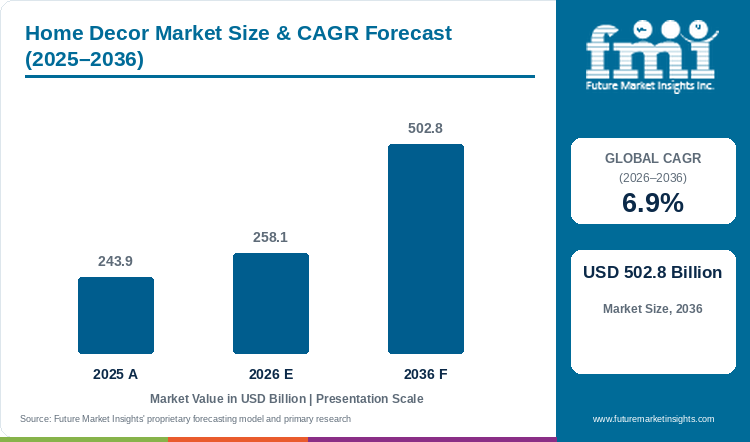
The home decor market is estimated at USD 243.9 billion in 2025 and is forecast to reach USD 258.1 billion in 2026. Home decor sales are expected to grow at a 6.9% CAGR from 2026 to 2036 and reach USD 502.8 billion by 2036.
Demand for home decor, from sofas and rugs to lamps and wall art, is estimated at USD 243.9 billion in 2025. Room-by-room buying is likely to take the home decor market to USD 258.1 billion in 2026, and a 6.9% CAGR through 2036 is projected to bring sales to USD 502.8 billion. An adoption review shows shoppers buying whole rooms online once a phone can place a sofa or rug in a photo of the living room. Active customers at Wayfair numbered 21.7 million in the June 2026 quarter, 3.3% more than in 2025, and each order averaged USD 332.[1] A larger base of repeat buyers keeps online retail near an estimated 38% share of 2026 channel sales.
Price and store reach now decide which retailers gain. Comparable brand sales at Williams-Sonoma rose 6.2% for the period ended 2 August 2026, and tariff costs cut non-GAAP gross margin by 160 basis points.[2] Wayfair grew U.S. sales 8.7%, and the Perigold luxury brand grew more than 35%.[1] Large retailers with sourcing scale are absorbing tariffs and widening ranges, so independent furniture stores and small importers face the hardest squeeze.
Furniture holds 42% of 2026 product type sales in FMI's estimate, as sofas, beds and dining sets are the biggest ticket in a room refresh. Rugs, cushions and wall pieces follow that purchase, so a sofa sale usually pulls rug, cushion and lamp orders to the same retailer.
Key Market Trends & Insights
- Furniture leads product type with an expected 42% in 2026, and home textiles follow on an estimated 23.4%.
- Phone and web orders give online retail a likely 38% channel share in 2026, with furniture retailers near 22.7%. Wayfair served 21.7 million active customers in Q2 2026.[1]
- Households buy an estimated 78.6% of home decor in 2026, with hotels, offices and shops buying the remaining 21.4%.
Regional Highlights
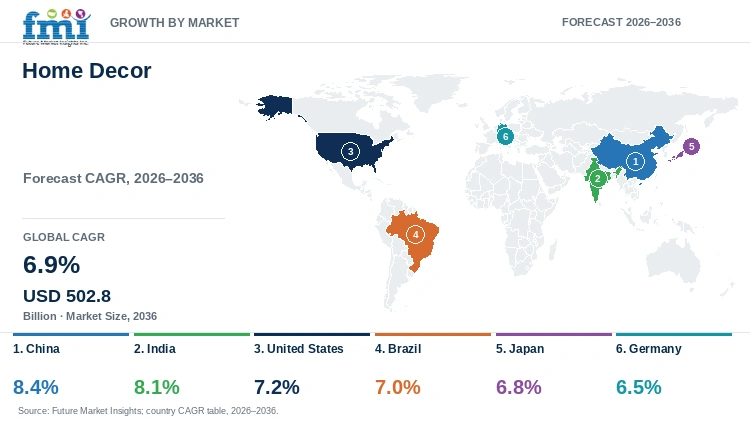
- Urban furniture replacement and new homes give China and India the two highest rates in FMI's country figures, led by China on 8.4% with India on 8.1%, against a 6.9% global home decor market CAGR.
- American online and gallery buying supports a 7.2% rate, and Brazil follows on 7%. Japan and Germany fall under the global rate, on 6.8% and 6.5%.
- German furniture makers reported H1 2026 sales of about EUR 7.7 billion, 2.7% lower, and expect a full-year decline of about 3%, the VDM said.[3]
Market Size & Forecast
Table 1: Market Size and Forecast for the Home Decor Market (USD billion and percentage), 2025 to 2036
| Metric | Value |
|---|---|
| 2025 Market Size | USD 243.9 billion |
| Estimated Market Size in 2026 | USD 258.1 billion |
| Projected Market Size by 2036 | USD 502.8 billion |
| CAGR, 2026 to 2036 | 6.9% |
| Added Revenue, 2026 to 2036 | USD 244.7 billion |
| Market Expansion Multiple | 1.9x |
Moves, new homes and room refreshes drive home decor orders, and sales peak from March to May and before the holiday season. Home Depot said customers kept taking on smaller projects in the June 2026 quarter, when sales grew 5.7% to USD 47.9 billion.[4] Fiscal 2026 net sales at Ethan Allen fell 5.7% to USD 579.5 million, with retail written orders down 6.1%.[5] Hotels and offices buy furniture and decor in fit-out cycles, and those cycles give the contract furniture market a forecast 6.1% CAGR, a little below home decor. FMI estimates close to USD 244.7 billion of growth in the home decor market from 2026 to 2036, nearly doubling the 2026 size. Tariff changes on imported furniture are the main near-term risk, since retailers reprice within a season.
Tariffs, Online Channels and Room-Level Selling
US tariffs changed furniture sourcing decisions through 2026. Ethan Allen said Section 301 tariffs of 10% to 12.5% replaced expired Section 122 global tariffs on 24 July 2026, and about 75% of Ethan Allen custom furniture is made in North American plants.[5] Williams-Sonoma reported USD 167.8 million of refunds of earlier IEEPA tariffs in Q2 2026 and set aside USD 47.5 million to repay vendors.[2] Retailers with domestic plants or flexible sourcing will hold prices better than importers.
Retailers are also opening new channels. IKEA opened a Douyin flagship store on 11 October 2026 with more than 6,500 products across 179 categories, delivering to 301 cities in China.[6] RH unveiled the first freestanding RH Estates gallery on Greenwich Avenue in September 2026 and plans a second on Melrose Avenue in 2027.[7] The Inspired Home Show in Chicago drew more than 1,000 exhibitors and buyers from about 100 countries in March 2026.[8] Video commerce and design galleries both sell full rooms, which raises the value of each order.
Table 2: Retailer, Channel and Housing Indicators for the Home Decor Market (sales, customers, tariffs and housing), 2026
| Indicator | Data Point | Relevance | Source |
|---|---|---|---|
| Wayfair active customers, Q2 2026 | 21.7 million; up 3.3% | Online buying is widening. | [1] |
| Williams-Sonoma comparable brand revenue, Q2 2026 | Up 6.2% | Premium room sets are selling. | [2] |
| Ethan Allen net sales, fiscal 2026 | USD 579.5 million; down 5.7% | Custom furniture demand is soft. | [5] |
| Home Depot sales, Q2 fiscal 2026 | USD 47.9 billion; up 5.7% | Small home projects continue. | [4] |
| German furniture industry sales, H1 2026 | About EUR 7.7 billion; down 2.7% | European demand is weak. | [3] |
| China furniture retail sales, January to August 2026 | CNY 114.9 billion; down 4.9% | Near-term weakness in China. | [9] |
| PMAY-Urban houses sanctioned, August 2026 | Over 1.25 crore | New homes need furnishing in India. | [10] |
| IKEA Douyin flagship store, October 2026 | 6,500 products; 301 cities | Video commerce adds reach. | [6] |
Analyst Perspective
“Shoppers in 2026 are choosing home decor retailers that can show and sell a whole room, online or in a gallery, and price still decides the final click. I expect large omnichannel retailers with flexible sourcing to gain share through 2036, opening a wider door for whole-room sellers, as tariffs and freight costs fall hardest on small importers.”
- Rahul Pandita, Principal Consultant, Future Market Insights.
How is the home decor market segmented?
The market is segmented into product type, distribution channel, application, and region. Furniture is expected to lead product type with 42% in 2026, online retail leads distribution channel with 38%, and residential use leads application with 78.6%.
By product type: furniture, floor coverings, wall decor, and home textiles.
By distribution channel: online retail, home improvement stores, furniture retailers, department stores, and others.
By application: residential and commercial.
By region: households, retailers, hotels and offices across North America, Latin America, Western Europe, Eastern Europe, East Asia, South Asia and Pacific, and Middle East and Africa.
Why does furniture lead home decor sales by product type?
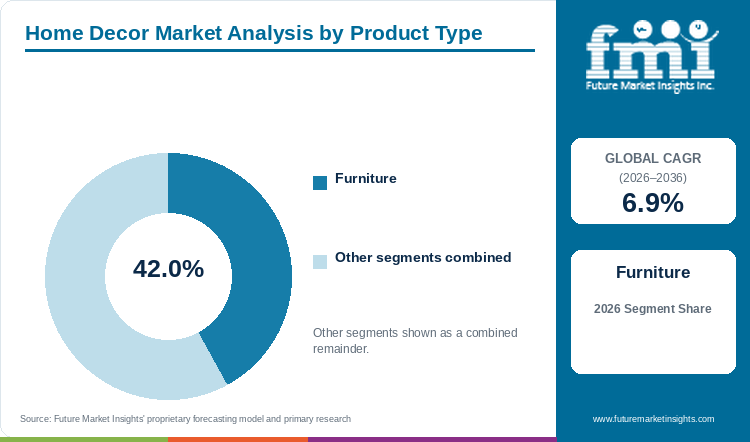
Furniture is expected to lead product type sales with 42% share in 2026, ahead of home textiles at about 23.4% and floor coverings near 20.1%.
Table 3: Product Type Share for the Home Decor Market (percentage share), 2026
| Product Type | Estimated Share (2026) |
|---|---|
| Furniture | 42% |
| Home Textiles | 23.4% |
| Floor Coverings | 20.1% |
| Wall Decor | 14.5% |
| Total | 100.0% |
Table 4: Product Type Leadership and Market Growth for the Home Decor Market (segment and CAGR percentage), 2026 to 2036
| Metric | Value |
|---|---|
| Global CAGR (2026 to 2036) | 6.9% |
| Leading Segment | Furniture |
A sofa, bed or dining set costs many times a cushion or a print and is the first purchase in a new home, so furniture is expected to lead with 42% share in 2026. Home textiles, an estimated 23.4%, cover curtains, bedding and cushions, and buyers replace them often at low prices. Floor coverings, about 20.1%, include rugs and carpets bought once per room and kept for years. Wall decor, near 14.5%, sells mirrors, art and clocks at small tickets, with a 4.5% CAGR expected for the wall decor market. Pottery Barn, the largest Williams-Sonoma brand, had Q2 2026 net revenues of USD 770.8 million and a 5.1% comparable gain.[2] A household with a fixed budget spends first on the sofa and the bed, which keeps furniture ahead of every soft item.
- Sofas, sectionals, beds, dining sets and storage pieces make up most furniture sales.
- Upholstered furniture from German factories came to EUR 423 million over January to June 2026, a 10% fall, VDM data show.[3]
Why does online retail lead home decor sales by distribution channel?
Online retail is likely to carry 38% of distribution channel sales in 2026, against about 22.7% for furniture retailers and 18.4% for home improvement stores.
Table 5: Distribution Channel Share for the Home Decor Market (percentage share), 2026
| Distribution Channel | Estimated Share (2026) |
|---|---|
| Online Retail | 38% |
| Furniture Retailers | 22.7% |
| Home Improvement Stores | 18.4% |
| Department Stores | 11.6% |
| Others | 9.3% |
| Total | 100.0% |
Online retail will lead with 38% share in 2026. Shoppers compare thousands of sofas, rugs and lamps on a phone and receive heavy items at the door. Furniture retailers, about 22.7%, keep buyers who want to try a sofa or feel a fabric, and Ethan Allen ran 171 design centres in North America at the end of fiscal 2026.[5] Home improvement stores, near 18.4%, sell flooring, paint, lighting and storage for home improvement projects, with Home Depot running 2,364 stores.[4] Department stores, an estimated 11.6%, sell bedding and small decor at seasonal prices, and other channels such as design studios and contract sales take 9.3%. A shopper furnishing a second bedroom will order online, which keeps online retail in front.
- Marketplaces, retailer websites and apps make up most online decor sales.
- IKEA began selling more than 6,500 products through a Douyin flagship store on 11 October 2026.[6]
Why does residential use lead home decor sales by application?
Residential use is estimated at 78.6% of application sales in 2026, with commercial buyers at 21.4%.
Table 6: Application Share for the Home Decor Market (percentage share), 2026
| Application | Estimated Share (2026) |
|---|---|
| Residential | 78.6% |
| Commercial | 21.4% |
| Total | 100.0% |
Households buy decor at every move, marriage, renovation or room change, and residential use is estimated to lead with 78.6% share in 2026 on that steady churn. Commercial buyers, an estimated 21.4%, include hotels, offices, restaurants and shops buying in fit-out cycles. Both groups order custom pieces, and the personalized home decor market carries a 7.2% CAGR forecast. Over 1.25 crore homes have been sanctioned under PMAY-Urban in India, and more than 1 crore have been handed over.[10] A new home needs a full set of furniture and textiles, which keeps residential buyers far ahead.
- Living rooms, bedrooms and dining rooms set most residential decor spend.
- Kitchen furniture was the steadiest German segment in H1 2026, with sales of about EUR 2.9 billion, 1% higher.[3]
What are the drivers, restraints, and opportunities in the home decor market?
Moves, new homes and room refreshes keep households buying furniture and decor. Tariffs and weak housing in some countries raise prices and delay purchases, and online video commerce and design galleries open new routes to whole-room sales.
- Driver: Households moving into new homes or refreshing a room buy furniture, rugs and textiles together, which raises the value of each order.
- Restraint: Import tariffs and freight costs push up shelf prices, and buyers in weak housing markets delay large furniture purchases.
- Opportunity: Video commerce, room visualisation and design galleries let retailers sell complete rooms instead of single items.
Room Refreshes Raise Order Values
Households now treat a room refresh as one project, buying sofa, rug and lighting together. Williams-Sonoma now guides fiscal 2026 net revenue growth between 4.7% and 7.2%.[2] West Elm comparable brand sales grew 6.4% in Q2 2026.[2] Retailers selling coordinated room sets will keep average order values rising.
Tariffs and Weak Housing Delay Purchases
Prices and weak housing are holding back home decor sales in two large markets. Retail furniture sales in China were 4.9% lower for January to August 2026, and building and decoration material sales were 9.8% lower.[9] German makers expect 2026 sales to fall about 3%.[3] FMI expects tariff and housing pressure to weigh most on importers, and retailers without flexible sourcing will lose margin first.
Video Commerce and Galleries Open Whole-Room Sales
Channels that show a whole room are opening new home decor sales. IKEA delivers to 301 cities in China from the Douyin store.[6] RH plans a second RH Estates gallery in Los Angeles in 2027.[7] Blankets and throws sell with sofas, and a 4.2% CAGR is forecast for the blanket market. Retailers pairing video selling with delivery and assembly will gain the largest baskets.
Which country CAGRs are profiled in the home decor market?
Table 7: Country CAGR Comparison for the Home Decor Market (CAGR percentage), 2026 to 2036
| Country | CAGR (2026 to 2036) |
|---|---|
| China | 8.4% |
| India | 8.1% |
| United States | 7.2% |
| Brazil | 7% |
| Japan | 6.8% |
| Germany | 6.5% |
How do country-level CAGRs compare in the home decor market?
Handover of more than 1 crore PMAY-Urban homes in India means new households need furniture and textiles, so India grows at 8.1% in FMI's estimate.[10] Over the decade, China grows at 8.4%, although furniture retail sales fell 4.9% in the first eight months of 2026.[9] The United States grows at 7.2% on online and gallery selling, and Brazil at 7% on urban apartment building. Germany is lowest at 6.5% after a 2.7% fall in German furniture industry sales in H1 2026, and Japan is at 6.8%.[3]
- Chinese shoppers are buying furniture through new video commerce stores.
- New homes under PMAY-Urban need full furniture sets in India.
- Online and gallery retailers in the United States sell complete rooms.
- Apartment buyers in Brazil furnish compact homes.
- Japanese households buy smaller, space-saving pieces.
- German furniture makers face weak domestic orders and import pressure.
Full report country CAGRs cover: From 8.4% in China down to 7% in Brazil, the faster group beats the 6.9% home decor market figure. India and the United States lie in between, and Japan and Germany are the two markets below that figure.
Country-wise Analysis
China Home Decor Market Outlook (2026 to 2036)
Urban households in China are replacing furniture and buying online, and the long-run China rate is an 8.4% CAGR. The National Bureau of Statistics counted CNY 114.9 billion of furniture retail sales for the first eight months of 2026, 4.9% below 2025.[9] IKEA opened a Douyin flagship store on 11 October 2026 to reach shoppers in 301 cities.[6] Video commerce will carry the recovery once housing sales improve.
Key takeaway: Online and video selling support the long-term outlook in China after a weak 2026.
India Home Decor Market Outlook (2026 to 2036)
Over 1.25 crore houses have been sanctioned under PMAY-Urban and PMAY-U 2.0, the Ministry of Housing and Urban Affairs said in August 2026.[10] An 8.1% CAGR is projected for India. Families moving into these homes buy beds, storage, curtains and floor coverings, and online marketplaces bring those items to smaller cities.
Key takeaway: New homes and online reach keep India close behind China.
United States Home Decor Market Outlook (2026 to 2036)
American shoppers keep home decor sales growing at a likely 7.2% CAGR. In Q2 2026, U.S. net revenue at Wayfair rose 8.7%, to USD 3.1 billion.[1] RH opened the first freestanding RH Estates gallery on Greenwich Avenue in September 2026.[7] Retailers will sell more full rooms through apps and galleries.
Key takeaway: Online scale and design galleries support American demand.
Brazil Home Decor Market Outlook (2026 to 2036)
Apartment buyers in São Paulo and Rio de Janeiro furnish compact homes with modular furniture, rugs and textiles, supporting a 7% CAGR for Brazil. Bento Gonçalves and São Bento do Sul are major furniture-making clusters for domestic buyers. Online marketplaces will widen access to decor in smaller cities, and FMI expects Brazil to grow faster than Japan and Germany.
Key takeaway: Apartment building and domestic furniture clusters support Brazil.
Japan Home Decor Market Outlook (2026 to 2036)
Japanese demand grows at a 6.8% CAGR in FMI's view, just under the global home decor market rate. Japanese households in small urban apartments buy compact, multi-use furniture and storage, and retailers such as Nitori and IKEA sell low-priced coordinated ranges. Ageing homeowners renovate for comfort and accessibility, which adds steady orders.
Key takeaway: Compact homes and renovation hold Japan just under 6.9%.
Germany Home Decor Market Outlook (2026 to 2036)
At a projected 6.5% CAGR, Germany is the slowest of the six. In H1 2026, German furniture makers sold about EUR 7.7 billion, 2.7% below H1 2025, with domestic sales down 4.1%, and about 60% of furniture sold in Germany came from abroad, the VDM reported.[3] Kitchen furniture grew 1%, and upholstered furniture fell 10%. Importers and large chains will gain share from domestic makers.
Key takeaway: Weak domestic orders and import pressure keep Germany below the global rate.
Who are the notable companies in the home decor market?
IKEA, Ashley Furniture, Wayfair, Williams-Sonoma, La-Z-Boy, MillerKnoll, Ethan Allen, Crate and Barrel, Haworth and RH are the profiled companies.
Global furniture retailers, online sellers, premium brands and office furniture makers form FMI's profiled group. Q2 2026 net revenue at Wayfair rose 7.5% to USD 3.5 billion.[1] Williams-Sonoma added 6.7% to quarterly net revenues, reaching USD 1.96 billion.[2] Ethan Allen opened four design centres in fiscal 2026.[5] IKEA, Ashley Furniture, La-Z-Boy, MillerKnoll, Crate and Barrel, Haworth and RH complete the group.
- Global furniture retailers: IKEA and Ashley Furniture.
- Online and multichannel sellers: Wayfair, Williams-Sonoma and Crate and Barrel.
- Premium home brands: RH, Ethan Allen and La-Z-Boy.
- Office and contract furniture makers: MillerKnoll and Haworth.
Competitive Benchmarking: Home Decor Market
Table 8: Competitive Benchmarking for the Home Decor Market (qualitative documentation ratings), 2026
| Company | Furniture Range | Decor and Textiles | Online Reach | Recency |
|---|---|---|---|---|
| Wayfair | High | High | High | High |
| Williams-Sonoma | High | High | High | High |
| IKEA | High | High | High | High |
| Ethan Allen | High | Medium | Medium | High |
| RH | High | Medium | Medium | Medium |
A company scores higher when more dated 2026 releases and results back the rating, and the ratings say nothing about share.
Key Developments in the Home Decor Market
- On 12 October 2026, Ingka Group announced the IKEA Douyin flagship store for shoppers in China.[6]
- On 18 September 2026, RH unveiled the first freestanding RH Estates gallery, on Greenwich Avenue.[7]
- On 16 September 2026, the National Bureau of Statistics of China published January to August retail data showing furniture sales down 4.9%.[9]
- On 1 September 2026, the VDM published H1 2026 figures showing German furniture industry sales down 2.7%.[3]
- On 26 August 2026, Pottery Barn owner Williams-Sonoma said comparable brand revenue for the June quarter grew 6.2%.[2]
- On 18 August 2026, Home Depot reaffirmed fiscal 2026 guidance with Q2 results.[4]
- On 9 August 2026, News On AIR reported over 1.25 crore houses sanctioned under PMAY-Urban, citing the housing ministry.[10]
- On 4 August 2026, the Wayfair active customer count reached 21.7 million in the quarter to June, 3.3% higher, at USD 332 per order.[1]
- On 29 July 2026, Ethan Allen closed fiscal 2026 with 171 design centres after opening four.[5]
- From 10 to 12 March 2026, the Inspired Home Show in Chicago hosted more than 1,000 exhibitors.[8]
Key Players in the Home Decor Market
Global Furniture Retailers
- IKEA
- Ashley Furniture
Online and Multichannel Sellers
- Wayfair
- Williams-Sonoma
- Crate and Barrel
Premium Home Brands
- RH
- Ethan Allen
- La-Z-Boy
Office and Contract Furniture Makers
- MillerKnoll
- Haworth
Home Decor Market - Report Scope
Table 9: Report Scope for the Home Decor Market (coverage fields and definitions), 2026 to 2036
| Coverage field | Report scope |
|---|---|
| Market breakdown | Product type; distribution channel; application; region |
| Quantitative units | USD billion |
| Market definition | Furniture, floor coverings, wall decor and home textiles bought to furnish and decorate homes and commercial interiors, sold online, through home improvement stores, furniture retailers, department stores and other channels. |
| Regions covered | North America; Latin America; Western Europe; Eastern Europe; East Asia; South Asia and Pacific; Middle East and Africa |
| Countries covered | United States; Canada; Brazil; Mexico; Argentina; Chile; Germany; France; United Kingdom; Italy; Spain; Benelux; Nordics; Poland; Czech Republic; Romania; Hungary; China; Japan; South Korea; India; ASEAN; Australia and New Zealand; GCC Countries; South Africa; Türkiye; Israel |
| Key companies profiled | IKEA, Ashley Furniture, Wayfair, Williams-Sonoma, La-Z-Boy, MillerKnoll, Ethan Allen, Crate and Barrel, Haworth, RH |
| Forecast period | 2026 to 2036 |
Home Decor Market - Research Methodology
Table 10: Research Methodology for the Home Decor Market (research methods and approach), 2026 edition
| Method | Approach |
|---|---|
| Data Sources | Retailer results, furniture industry association releases, national statistics, housing ministry releases, trade show reports and company newsrooms from May 2025 onward. |
| Desk Research | Desk research covers retail channels, tariffs, housing programmes and furniture output. |
| Market Sizing and Forecasting | Sizing starts from the 2026 base of USD 258.1 billion and the 6.9% CAGR for 2026 to 2036. |
| Data Validation | Sales, customer, tariff and housing figures were matched to the company, agency or association that reported them. |
Home Decor Market by Segments
Home Decor Market segmented by Product Type:
- Furniture
- Floor Coverings
- Wall Decor
- Home Textiles
Home Decor Market segmented by Distribution Channel:
- Online Retail
- Home Improvement Stores
- Furniture Retailers
- Department Stores
- Others
Home Decor Market segmented by Application:
- Residential
- Commercial
Home Decor Market by Region
- North America
- United States
- Canada
- Latin America
- Brazil
- Mexico
- Argentina
- Chile
- Western Europe
- Germany
- France
- United Kingdom
- Italy
- Spain
- Benelux
- Nordics
- Eastern Europe
- Poland
- Czech Republic
- Romania
- Hungary
- East Asia
- China
- Japan
- South Korea
- South Asia and Pacific
- India
- ASEAN
- Australia and New Zealand
- Middle East and Africa
- GCC Countries
- South Africa
- Türkiye
- Israel
Research Sources and Bibliography
- [1] Wayfair Inc. (2026, August 4). Wayfair announces second quarter 2026 results, reports strongest free cash flow since 2020. https://investor.wayfair.com/news/news-details/2026/Wayfair-Announces-Second-Quarter-2026-Results-Reports-Strongest-Free-Cash-Flow-Since-2020/default.aspx
- [2] Williams-Sonoma, Inc. (2026, August 26). Williams-Sonoma, Inc. announces strong second quarter 2026 results. https://ir.williams-sonomainc.com/investor-information/news-releases/news-release-details/2026/Williams-Sonoma-Inc--announces-strong-second-quarter-2026-results/default.aspx
- [3] Verband der Deutschen Möbelindustrie. (2026, September 1). Deutsche Möbelindustrie verzeichnet im ersten Halbjahr 2026 ein Umsatzminus von 2,7 Prozent. http://www.moebelindustrie.de/presse/4905/deutsche-moebelindustrie-verzeichnet-im-ersten-halbjahr-2026-ein-umsatzminus-von-2-7-prozent.html
- [4] The Home Depot. (2026, August 18). The Home Depot announces second quarter fiscal 2026 results. https://ir.homedepot.com/news-releases/2026/08-18-2026-110040463
- [5] Ethan Allen Interiors Inc. (2026, July 29). Ethan Allen reports fiscal 2026 full year and fourth quarter results. https://ir.ethanallen.com/news-events/press-releases/detail/318/ethan-allen-reports-fiscal-2026-full-year-and-fourth/
- [6] Ingka Group. (2026, October 12). IKEA brings more than 6,500 home furnishing products to Douyin e-commerce shoppers across China. https://www.ingka.com/newsroom/ikea-brings-more-than-6500-home-furnishing-products-to-douyin-e-commerce-shoppers-across-china/
- [7] RH. (2026, September 18). RH unveils RH Estates, The Gallery on Greenwich Avenue. https://ir.rh.com/news-events/detail/293/rh-unveils-rh-estates-the-gallery-on-greenwich-avenue-the-first-freestanding-rh-estates-gallery-in-the-world
- [8] The Shelby Report. (2026, March 23). Inspired Home Show 2026 draws buyers from more than 100 countries. https://theshelbyreport.com/2026/03/23/inspired-home-show-2026-draws-buyers-from-more-than-100-countries
- [9] National Bureau of Statistics of China. (2026, September 16). Total retail sales of consumer goods from January to August 2026. https://www.stats.gov.cn/english/PressRelease/202609/t20260916_1965341.html
- [10] News On AIR. (2026, August 9). Over 1.25 crore houses sanctioned under PMAY-Urban so far: Govt. https://newsonair.gov.in/over-1-25-crore-houses-sanctioned-under-pmay-urban-so-far-govt/
This bibliography is provided for reader reference. The full report contains the complete reference list and detailed citations.
This Report Answers
- How big is the home decor market during 2026?
- What market size is projected by 2036?
- Which product type holds notable share?
- Which distribution channel holds notable share?
- Which countries have notable growth?
- Which companies are notable in the market?
Frequently Asked Questions
How large is the home decor market expected in 2026?
Expected 2026 home decor sales of USD 258.1 billion follow USD 243.9 billion in 2025, on FMI figures. The home decor market is projected to reach USD 502.8 billion by 2036.
What CAGR is projected for the home decor market through 2036?
A 6.9% CAGR from 2026 to 2036 is projected for home decor sales. New homes, room refreshes and online buying carry that growth.
Which product type holds a notable market share in 2026?
In 2026, furniture is expected to lead with 42% share. Home textiles follow at an estimated 23.4%.
Which distribution channel holds a notable market share in 2026?
With 38% share likely in 2026, online retail leads distribution. Furniture retailers follow at about 22.7%.
Which country has a notable expansion outlook through 2036?
Urban furniture replacement gives China an 8.4% CAGR in FMI's outlook, the top profiled rate. India follows at 8.1%.
Who are the key companies in the home decor market?
The profiled group is led by IKEA and Ashley Furniture among global furniture retailers, with Wayfair, Williams-Sonoma and Crate and Barrel among the online and multichannel sellers. RH, Ethan Allen, La-Z-Boy, MillerKnoll and Haworth complete the profiled group.
Preview the report firsthand - request a free sample
Get SampleGet the brochure for pricing and purchase details.
Get PDFTable of Content
- Key Takeaways
- Market Size and CAGR
- Top Growth Driver
- Fastest Growing Segment
- Leading Region
- Key Companies
- Emerging Opportunities
- Executive Summary
- Global Market Outlook
- Demand-side Trends
- Supply-side Trends
- Technology Roadmap Analysis
- Analysis and Recommendations
- Analyst Perspective (What is happening? Why now? What should investors know?)
- Key Questions Answered
- How large is the market?
- What is the CAGR?
- What are key trends?
- Which region dominates?
- Who are the leaders?
- Market Overview
- Market Coverage / Taxonomy
- Market Definition / Scope / Limitations
- Research Methodology
- Chapter Orientation
- Analytical Lens and Working Hypotheses
- Market Structure, Signals, and Trend Drivers
- Benchmarking and Cross-market Comparability
- Market Sizing, Forecasting, and Opportunity Mapping
- Research Design and Evidence Framework
- Desk Research Programme (Secondary Evidence)
- Expert Input and Fieldwork (Primary Evidence)
- Tooling, Models, and Reference Databases
- Data Engineering and Model Build
- Quality Assurance and Audit Trail
- Market Background
- Market Dynamics (Drivers, Restraints, Opportunity, Trends)
- Scenario Forecast (Optimistic, Likely, Conservative)
- Impact Analysis
- AI Impact
- Sustainability Impact
- Regulatory Impact
- Technology Impact
- Consumer / Buyer Analysis
- Purchase Drivers
- Adoption Barriers
- Buyer Journey
- Opportunity Map Analysis
- Product Life Cycle Analysis
- Supply Chain Analysis
- Investment Feasibility Matrix
- Value Chain Analysis
- PESTLE and Porter's Analysis
- Regulatory Landscape
- Regional Parent Market Outlook
- Production and Consumption Statistics
- Import and Export Statistics
- Global Market Analysis and Forecast, 2021 to 2036
- Historical Market Size Value (USD Billion) Analysis, 2021 to 2025
- Current and Future Market Size Value (USD Billion) Projections, 2026 to 2036
- Y-o-Y Growth Trend Analysis
- Absolute $ Opportunity Analysis
- Global Market Pricing Analysis, 2021 to 2036
- Global Market Analysis and Forecast, By Product Type, 2021 to 2036
- Introduction / Key Findings
- Historical Market Size Value (USD Billion) Analysis By Product Type, 2021 to 2025
- Current and Future Market Size Value (USD Billion) Analysis and Forecast By Product Type, 2026 to 2036
- Furniture
- Floor Coverings
- Wall Decor
- Home Textiles
- Y-o-Y Growth Trend Analysis By Product Type, 2021 to 2025
- Absolute $ Opportunity Analysis By Product Type, 2026 to 2036
- Global Market Analysis and Forecast, By Distribution Channel, 2021 to 2036
- Introduction / Key Findings
- Historical Market Size Value (USD Billion) Analysis By Distribution Channel, 2021 to 2025
- Current and Future Market Size Value (USD Billion) Analysis and Forecast By Distribution Channel, 2026 to 2036
- Online Retail
- Home Improvement Stores
- Furniture Retailers
- Department Stores
- Others
- Y-o-Y Growth Trend Analysis By Distribution Channel, 2021 to 2025
- Absolute $ Opportunity Analysis By Distribution Channel, 2026 to 2036
- Global Market Analysis and Forecast, By Application, 2021 to 2036
- Introduction / Key Findings
- Historical Market Size Value (USD Billion) Analysis By Application, 2021 to 2025
- Current and Future Market Size Value (USD Billion) Analysis and Forecast By Application, 2026 to 2036
- Residential
- Commercial
- Y-o-Y Growth Trend Analysis By Application, 2021 to 2025
- Absolute $ Opportunity Analysis By Application, 2026 to 2036
- Global Market Analysis and Forecast, By Region, 2021 to 2036
- Introduction
- Historical Market Size Value (USD Billion) Analysis By Region, 2021 to 2025
- Current Market Size Value (USD Billion) Analysis and Forecast By Region, 2026 to 2036
- North America
- Latin America
- Western Europe
- Eastern Europe
- East Asia
- South Asia and Pacific
- Middle East and Africa
- Market Attractiveness Analysis By Region
- North America Market Analysis and Forecast, By Country, 2021 to 2036
- Historical Market Size Value (USD Billion) Trend Analysis By Market Taxonomy, 2021 to 2025
- Market Size Value (USD Billion) Forecast By Market Taxonomy, 2026 to 2036
- By Country
- United States
- Canada
- By Product Type
- By Distribution Channel
- By Application
- By Country
- Market Attractiveness Analysis
- By Country
- By Product Type
- By Distribution Channel
- By Application
- Key Takeaways
- Latin America Market Analysis and Forecast, By Country
- Historical Market Size Value (USD Billion) Trend Analysis By Market Taxonomy, 2021 to 2025
- Market Size Value (USD Billion) Forecast By Market Taxonomy, 2026 to 2036
- By Country
- Brazil
- Mexico
- Argentina
- Chile
- By Product Type
- By Distribution Channel
- By Application
- By Country
- Market Attractiveness Analysis
- By Country
- By Product Type
- By Distribution Channel
- By Application
- Key Takeaways
- Western Europe Market Analysis and Forecast, By Country
- Historical Market Size Value (USD Billion) Trend Analysis By Market Taxonomy, 2021 to 2025
- Market Size Value (USD Billion) Forecast By Market Taxonomy, 2026 to 2036
- By Country
- Germany
- France
- United Kingdom
- Italy
- Spain
- Benelux
- Nordics
- By Product Type
- By Distribution Channel
- By Application
- By Country
- Market Attractiveness Analysis
- By Country
- By Product Type
- By Distribution Channel
- By Application
- Key Takeaways
- Eastern Europe Market Analysis and Forecast, By Country
- Historical Market Size Value (USD Billion) Trend Analysis By Market Taxonomy, 2021 to 2025
- Market Size Value (USD Billion) Forecast By Market Taxonomy, 2026 to 2036
- By Country
- Poland
- Czech Republic
- Romania
- Hungary
- By Product Type
- By Distribution Channel
- By Application
- By Country
- Market Attractiveness Analysis
- By Country
- By Product Type
- By Distribution Channel
- By Application
- Key Takeaways
- East Asia Market Analysis and Forecast, By Country
- Historical Market Size Value (USD Billion) Trend Analysis By Market Taxonomy, 2021 to 2025
- Market Size Value (USD Billion) Forecast By Market Taxonomy, 2026 to 2036
- By Country
- China
- Japan
- South Korea
- By Product Type
- By Distribution Channel
- By Application
- By Country
- Market Attractiveness Analysis
- By Country
- By Product Type
- By Distribution Channel
- By Application
- Key Takeaways
- South Asia and Pacific Market Analysis and Forecast, By Country
- Historical Market Size Value (USD Billion) Trend Analysis By Market Taxonomy, 2021 to 2025
- Market Size Value (USD Billion) Forecast By Market Taxonomy, 2026 to 2036
- By Country
- India
- ASEAN
- Australia and New Zealand
- By Product Type
- By Distribution Channel
- By Application
- By Country
- Market Attractiveness Analysis
- By Country
- By Product Type
- By Distribution Channel
- By Application
- Key Takeaways
- Middle East and Africa Market Analysis and Forecast, By Country
- Historical Market Size Value (USD Billion) Trend Analysis By Market Taxonomy, 2021 to 2025
- Market Size Value (USD Billion) Forecast By Market Taxonomy, 2026 to 2036
- By Country
- GCC Countries
- South Africa
- Türkiye
- Israel
- By Product Type
- By Distribution Channel
- By Application
- By Country
- Market Attractiveness Analysis
- By Country
- By Product Type
- By Distribution Channel
- By Application
- Key Takeaways
- Key Countries Market Analysis
- United States
- Pricing Analysis
- Market Share Analysis, 2025
- By Product Type
- By Distribution Channel
- By Application
- Canada
- Pricing Analysis
- Market Share Analysis, 2025
- By Product Type
- By Distribution Channel
- By Application
- Mexico
- Pricing Analysis
- Market Share Analysis, 2025
- By Product Type
- By Distribution Channel
- By Application
- Brazil
- Pricing Analysis
- Market Share Analysis, 2025
- By Product Type
- By Distribution Channel
- By Application
- Chile
- Pricing Analysis
- Market Share Analysis, 2025
- By Product Type
- By Distribution Channel
- By Application
- Germany
- Pricing Analysis
- Market Share Analysis, 2025
- By Product Type
- By Distribution Channel
- By Application
- United Kingdom
- Pricing Analysis
- Market Share Analysis, 2025
- By Product Type
- By Distribution Channel
- By Application
- Italy
- Pricing Analysis
- Market Share Analysis, 2025
- By Product Type
- By Distribution Channel
- By Application
- Spain
- Pricing Analysis
- Market Share Analysis, 2025
- By Product Type
- By Distribution Channel
- By Application
- France
- Pricing Analysis
- Market Share Analysis, 2025
- By Product Type
- By Distribution Channel
- By Application
- India
- Pricing Analysis
- Market Share Analysis, 2025
- By Product Type
- By Distribution Channel
- By Application
- ASEAN
- Pricing Analysis
- Market Share Analysis, 2025
- By Product Type
- By Distribution Channel
- By Application
- Australia and New Zealand
- Pricing Analysis
- Market Share Analysis, 2025
- By Product Type
- By Distribution Channel
- By Application
- China
- Pricing Analysis
- Market Share Analysis, 2025
- By Product Type
- By Distribution Channel
- By Application
- Japan
- Pricing Analysis
- Market Share Analysis, 2025
- By Product Type
- By Distribution Channel
- By Application
- South Korea
- Pricing Analysis
- Market Share Analysis, 2025
- By Product Type
- By Distribution Channel
- By Application
- Poland
- Pricing Analysis
- Market Share Analysis, 2025
- By Product Type
- By Distribution Channel
- By Application
- Hungary
- Pricing Analysis
- Market Share Analysis, 2025
- By Product Type
- By Distribution Channel
- By Application
- Türkiye
- Pricing Analysis
- Market Share Analysis, 2025
- By Product Type
- By Distribution Channel
- By Application
- South Africa
- Pricing Analysis
- Market Share Analysis, 2025
- By Product Type
- By Distribution Channel
- By Application
- United States
- Market Structure Analysis
- Competition Dashboard
- Competition Benchmarking
- Market Share Analysis of Top Players
- By Regional
- By Product Type
- By Distribution Channel
- By Application
- Emerging Startups
- Innovation Benchmarking
- Competition Analysis
- Competition Deep Dive
- Wayfair
- Overview
- Product Portfolio
- Profitability by Market Segments
- Sales Footprint
- Strategy Overview
- Marketing Strategy
- Product Strategy
- Channel Strategy
- Williams-Sonoma
- IKEA
- Ethan Allen
- RH
- Ashley Furniture
- Crate and Barrel
- La-Z-Boy
- MillerKnoll
- Haworth
- Wayfair
- Case Studies
- Success Stories
- Recent Developments
- Competition Deep Dive
- Assumptions & Acronyms Used


