

- Industry Size (2025)
- USD 1.85 Bn
- Forecast (2035)
- USD 3.8 Bn
- CAGR (2025 to 2035)
- 7.5%
Power Tools Industry Analysis in India Size and Share Forecast Outlook 2025 to 2035
The India power tools market has been valued at USD 1.85 billion in 2025 and is projected to reach USD 3.8 billion by 2035 at a CAGR of 7.5% during the forecast period. This growth is expected to be driven primarily by expanding infrastructure development, rapid industrialization, and increasing mechanization across key end-use sectors such as construction, automotive, and manufacturing. Power tools are being adopted across both public and private projects as demand grows for productivity-enhancing, durable, and cost-efficient equipment.
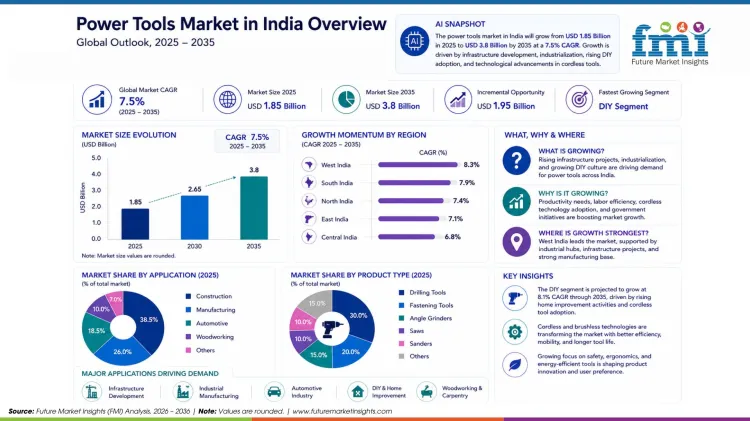
The construction sector remains the largest revenue generator, while manufacturing demand supports steady industrial tool procurement. Accelerated urbanization, rising housing demand, and a strong pipeline of infrastructure projects are supporting increased tool adoption across small, mid-scale, and large-scale construction sites. Major government initiatives such as the Smart Cities Mission, Pradhan Mantri Awas Yojana (PMAY), and Gati Shakti National Master Plan are actively contributing to construction activity in both urban and semi-urban regions. As a result, construction contractors and civil engineering firms are increasingly relying on power tools for drilling, grinding, cutting, fastening, and finishing operations that require both speed and accuracy.
Power tools are being preferred for their ability to reduce manual labor, improve safety, and ensure operational consistency in demanding site conditions. Electric-powered tools, in particular, are being deployed widely due to their compatibility with emerging technologies and low operational costs. The shift from manual tools to powered systems is being accelerated by increasing project complexity and the growing focus on worker productivity, especially in real estate development, public infrastructure, and industrial construction zones.
Apart from construction, growth in the automotive and manufacturing sectors is contributing significantly to market expansion. The automotive sector is utilizing power tools for assembly lines, vehicle component fabrication, and body repair tasks that require high precision and process reliability. Power tool use is also being scaled across ancillary manufacturing units, tier suppliers, and heavy engineering operations. In these industries, tools equipped with brushless motors, speed controls, and ergonomic designs are being favored for their reliability and performance under continuous-use conditions. Adoption in small and medium enterprises (SMEs) is also increasing, particularly in fabrication, assembly, and light manufacturing activities. With greater access to affordable tools and rising awareness of their cost-saving potential, SMEs across industrial hubs such as Pune, Ahmedabad, Coimbatore, and Ludhiana are actively modernizing their tool sets. The increasing electrification of power tools and growth in battery-operated models is supporting this trend, particularly in mobile or semi-automated setups.
Technological upgrades are reshaping the market as well. Features such as smart sensors, energy-efficient brushless motors, and integrated safety mechanisms are becoming standard in newer models. These innovations are improving tool lifespan, user comfort, and real-time operational control. Manufacturers are increasingly integrating digital diagnostics and modular configurations to support maintenance and minimize unplanned downtime, which is especially valued in construction and manufacturing environments.
Distribution and accessibility have also improved, supported by growth in organized retail networks and e-commerce platforms. Professional procurement teams, site engineers, and institutional buyers now have better access to a wide range of power tools tailored to different project needs and price tiers. While international brands continue to compete on quality and innovation, domestic manufacturers are gaining ground through competitive pricing, localization, and expanding after-sales support.
Analyzing India Power Tools Market Analysis by Top Investment Segments
The market is segmented based on product type, application, and region. By product type, the market is divided into drilling tool, fastening tool, heat gun, angle grinder, chain saw, orbital sander, jigsaw, impact wrench, and circular saw. Based on application, the market is categorized into manufacturing, MRO services, DIY, and construction. Regionally, the market is classified into Northern India, Western India, Southern India, and Eastern India.
By Product Type, Impact Wrench Segment to Grow with Surge in Industrial Applications
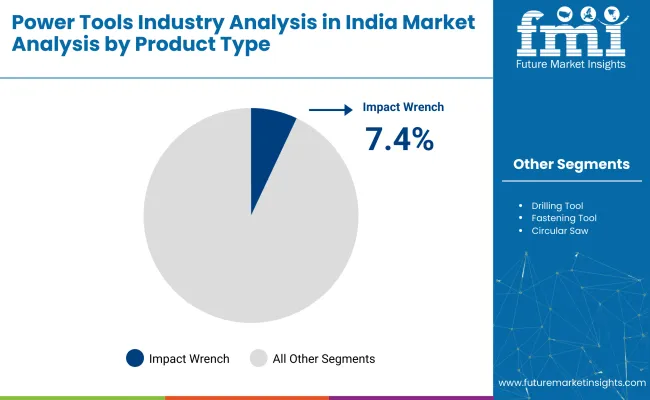
| Product Type | CAGR (2025 to 2035) |
|---|---|
| Impact Wrench | 7.4% |
The impact wrench segment is projected to grow at the highest CAGR of 7.4% between 2025 and 2035. Rising demand for high-torque, precision fastening in industries such as automotive manufacturing, aerospace, and heavy equipment assembly is driving adoption. The growing shift toward cordless impact wrenches, offering mobility and ergonomic advantages, is further boosting market penetration.
Manufacturers are introducing advanced brushless motor technologies, longer battery life, and smart torque control features to cater to professional users. As a result, impact wrenches are gaining popularity in both industrial MRO and new production environments.
Meanwhile, drilling tools maintain the largest volume share due to their ubiquitous use across construction, woodworking, and home improvement applications. Continuous product innovation, such as multi-material drill bits and compact drill/drivers, supports sustained demand. Angle grinders and circular saws remain staples in metal fabrication and construction industries, benefiting from trends in urban infrastructure development.
Heat guns and orbital sanders serve niche segments in automotive refinishing, furniture manufacturing, and electrical work. Fastening tools, jigsaws, and chain saws see steady uptake across woodworking and DIY markets, with cordless variants driving incremental sales.
By Application, DIY Segment to Witness Fastest Growth Driven by Rising Consumer Adoption
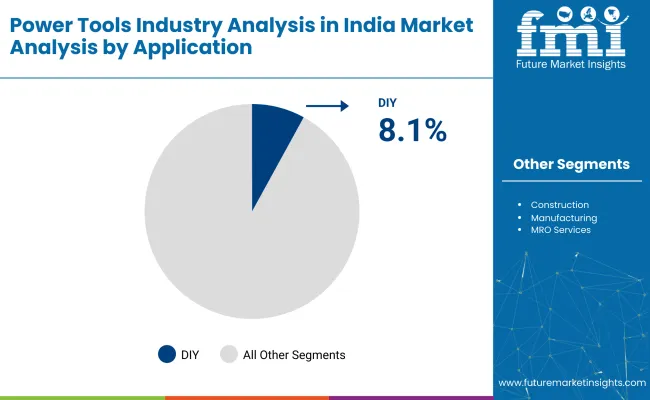
| Application | CAGR (2025 to 2035) |
|---|---|
| DIY | 8.1% |
The DIY (Do It Yourself) segment is projected to register the highest CAGR of 8.1% from 2025 to 2035. Increasing urbanization, rising disposable incomes, and greater consumer interest in home improvement are driving demand for user-friendly power tools across India. The COVID-19 pandemic catalyzed DIY trends, and this momentum continues as younger consumers embrace home-based woodworking, repair, and customization projects.
E-commerce platforms and organized retail channels are expanding access to affordable, feature-rich cordless power tools, which further fuels DIY segment growth. Leading manufacturers are focusing on compact, ergonomic designs with integrated safety features to meet rising demand from non-professional users.
The MRO services segment contributes steady demand, driven by the need for maintenance and repair across industries such as oil & gas, railways, and heavy equipment. Power tools used here emphasize durability, portability, and serviceability. The construction segment sees robust growth, particularly in urban infrastructure and residential housing projects, where cordless tools offer speed and flexibility on dynamic job sites.
Challenges
High Initial Costs
One of the major challenges in the Indian power tool market is the high initial investment required for advanced power tools, particularly cordless and industrial-grade variants. Power tools remain expensive, and higher pricing can limit adoption among small contractors and price-sensitive users. The cost of using lithium-ion batteries for cordless tools is also added on top of this. Although financing options and leasing models are introductory, affordability is still a major hurdle, particularly for price-sensitive consumers, which is the most common one. Manufacturers are working on launching affordable models and payment solutions, but massive adoption will require more awareness of financing options and wider access to them.
Skill Gap and Limited Workforce Training
Despite the increasing demand for power tools, a significant challenge lies in the shortage of skilled workers trained to handle advanced equipment. Many industries, especially particularly in small towns and rural areas, are still dependent on manual work because they do not know how to operate the power tools properly. These tools, if used improperly, can pose a safety risk, can result in accidents, and/or result in equipment damage, further leading to their hesitance to adopt it. Although a number of larger companies spend significantly on training their employees, there are no widely accepted efforts for skills development across the sector. To further this cause, there is a need for increased collaboration between manufacturers, vocational training institutes, and government programs to improve workforce competency and help ensure safer, more efficient use of power tools in all industries.
Opportunities
Technological Advancements in Power Tools
The rapid advancement of technology is creating significant growth opportunities in India's power tool market. The incorporation of brushless motors into cordless tools has enhanced working life with better efficiency, less maintenance, and longer running times with enhanced battery longevity, updated across multiple industries. Smart power tools with IoT functionality are also gaining traction; these tools can support wireless connectivity to facilitate real-time monitoring, predictive maintenance, and enhanced safety features. As precision does matter in industrial or construction tasks, such innovation is more effective in these domains. In addition, advances in lithium-ion battery technology are increasing the power and reliability of cordless power tools. As R&D is continuously being invested in by manufacturers, the advent of even more energy-saving, automated, and AI-integrated tools will aid in the further expansion and adoption of the market.
Government Initiatives and Local Manufacturing Growth
The "Make in India" initiative by the Indian government has helped power tools to be manufactured locally, making imports unnecessary and encouraging local production of power tools. The initiatives like industrialization, infrastructure, and MSME (Micro, Small & Medium Enterprises) development are encouraging in providing a conducive business environment for the power tool manufacturers. Other power tools initiatives by the government, such as Smart Cities Mission, Bharatmala Pariyojana, and Housing for All, are fuelling demand for power tools in construction and infrastructure development. Local manufacturing hubs in Gujarat, Maharashtra, and Tamil Nadu are facilitating supply chain efficiencies and lowering costs, too. The availability of favorable policies, tax incentives, and industrial automation investments to experience growth are anticipated to sustain the power tool market in India for the next decade.
State-wise Analysis
Uttar Pradesh
Uttar Pradesh's power tool sector is gradually expanding due to extensive infrastructure projects and increasing industrialization. The state witnessing a fast-paced urbanization backed by several smart city initiatives by various governments is also driving the demand for advanced power tools. In addition, the increase in real estate and road construction projects also drives the growth of the market.
An increase in MSMEs and local manufacturing hubs is driving cost-effective and efficient tools. With India pushing for green energy, the use of electric and battery-powered tools is also seeing a rapid rise. Given these factors, Uttar Pradesh’s power tool market is expected to witness a CAGR of 8.2% from 2025 to 2035, slightly outperforming the national average.
- Infrastructure Boom: Urbanization and construction boom driven demand for advanced power tools.
- Industrial Growth: The growth of MSMEs and local manufacturing hubs increases the need for efficient and economical power tools.
- Government Policies: Infrastructure investments and industrial incentives push various sectors to adopt the tool.
- Renewable Energy Projects: With increasing installations of solar and wind energy, the need for specialized tools is driving the demand in the market.
- Shift to Cordless Tools: Increasing the shift to battery-operated tools improves productivity by minimizing reliance on the electrical power grid.
| Country | CAGR (2025 to 2035) |
|---|---|
| Uttar Pradesh | 8.2% |
Maharashtra
Maharashtra, as an industrial and financial hub, remains a key driver in India’s power tool market. With the state's leading manufacturing clusters, such as Mumbai, Pune, and Nashik, the demand for precision power tools is strong. The increasing automotive and construction industries and the growing infrastructure projects drive market growth.
Moreover, the drive for industrial automation and smart manufacturing is driving high-tech cordless and pneumatic tool demand in Maharashtra. The growing focus on sustainability along with energy-efficient equipment is contributing for the market to grow even faster.With these favourable conditions, the power tool market in Maharashtra is anticipated to grow at a CAGR of 8.5% from 2025 to 2035.
- Manufacturing Hub: High demand for precision power tools due to strong industrial base in Mumbai, Pune, and Nashik.
- Automotive Sector Growth: The region's automotive sector induces the growing adoption of advanced electric and pneumatic tools in Maharashtra.
- Smart Manufacturing: The rise of automation and robotics increases demand for tech-heavy power tools.
- Sustainability Focus: Increasing use of energy-efficient, eco-friendly tools owing to regulations surrounding the environment.
- Infrastructure Expansion: Growth of metro rail, highways, and all the real estate projects increase the demand for power tools in the construction industry.
| Country | CAGR (2025 to 2035) |
|---|---|
| Maharashtra | 8.5% |
Karnataka
Karnataka has a fast-growing power tool market because of its huge amount of IT and manufacturing industries. The state’s technology hub, Bengaluru, is witnessing the rising adoption of automated and smart devices in the precision engineering and electronics sector. The urban construction sector in places like Mysore and Hubballi is also growing vigorously, pushing demand for power tools. Government-sponsored industrial efforts make no mistake in accelerating the market, which involves consolidating MSME and industrial corridors.
The electric and battery-driven machine sectors are projected to thrive due to increased interest in workplace effectiveness and equipment usage. With these developments, Karnataka’s power tool market is forecasted to grow at a CAGR of 8.0% from 2025 to 2035.
- IT and Tech Influence: The booming IT engineering sector in Bengaluru propels a rise in advanced and automated tools preferred by power tools.
- Growing Construction Industry: Rising real estate developments in Mysore and Hubballi are anticipated to boost the market.
- Industrial Corridors: Government-funded MSME support schemes add to local power tools manufacturing and consumption.
- Battery-Powered Tools: The growing popularity of cordless equipment is in line with Karnataka's goals for sustainable development.
- Workforce Productivity Focus: As labour costs rise, industrialists are expected to use high-efficiency power tools.
| Country | CAGR (2025 to 2035) |
|---|---|
| Karnataka | 8.0% |
West Bengal
West Bengal’s power tool market is expanding steadily, driven by increasing industrialization and urban development. Real estate and infrastructure projects are booming in Kolkata, the commercial capital of the state, leading to demand for high-end equipment. The growing logistics and warehousing industry, buoyed by the government's infrastructure-building projects, is also accelerating growth in the market.
Furthermore, the increase in small-scale industries as well as local manufacturing units is generating a consistent demand for economical and long-lasting power tools. However, market growth is slightly moderated by price sensitivity among end users. Despite this, West Bengal’s power tool market is projected to grow at a CAGR of 7.6% from 2025 to 2035.
- Urbanization Growth: Demand of Power tools is driven by real estate and commercial developments in Kolkata.
- Infrastructure Development: Government investment in roads, bridges, and ports enhances tool adoption.
- Warehousing Expansion: The growth of logistics and storage facilities leads to the growth of power tools for construction and maintenance.
- MSME Sector Growth: Small-scale manufacturing boosts demand for affordable power tools.
- Price Sensitivity Challenge: Higher price consciousness moderates premium tool adoption but sustains demand for affordable alternatives.
| Country | CAGR (2025 to 2035) |
|---|---|
| West Bengal | 7.6% |
Madhya Pradesh
In Madhya Pradesh, the demand for power tools is driven by rapid urbanization, increasing infrastructural developments, and government-driven industrial initiatives. The growth of smart cities and growing investments in roadways, railways, and real estate is further propelling the demand for power tools. The state has two solid manufacturing centres of Bhopal and Indore, and it's evolving manufacturing industry is additionally bolstering the requirement of efficient and superior tools. In addition, increasing focus on skills development and labour productivity in the state is leading to increasing adoption of modern power tools .With these factors contributing to a positive market outlook, Madhya Pradesh’s power tool market is expected to grow at a CAGR of 7.9% from 2025 to 2035.
- Smart City Projects: Urban development initiatives are driving demand for advanced construction tools.
- Transport Infrastructure Growth: Expansion of roadways, railways, and airports leads to the adoption of power tools.
- Manufacturing Expansion: Growing industrialization in both Bhopal and Indore increases market demand.
- Skilled Workforce Development: Government programs increase the adoption of power tools designed for efficiency and productivity.
- Agricultural Mechanization: Increased mechanized farming trends are creating a demand for specialized power tools.
| Country | CAGR (2025 to 2035) |
|---|---|
| Madhya Pradesh | 7.9% |
Competitive Outlook
India’s power tools market includes Bosch, Stanley Black & Decker, Makita, Hilti, Techtronic Industries, Hitachi Metabo, Festool, Husqvarna, Snap-on Tools, and RIDGID across professional, industrial, and retail channels. An established group of multinational corporations dominates the market alongside growing players working on innovation and sustainability. The landscape of ITW (Innovative Technology Week) includes key players like Bosch, Stanley Black & Decker, Makita, Hilti, and Techtronic Industries , providing diversified offerings in the construction, automotive, and industrial applications.
Key Company Insights
Bosch
Bosch is a leader in the power tools market and offers state-of-the-art innovations and environmentally friendly solutions. The company focuses on embedding IoT-enabled solutions that enable real-time diagnostics and predictive maintenance. AI-powered technology plays a key role in Bosch's vast and ambitious portfolio focused on the efficiency and precision of industrial and construction efforts.
Bosch is positioned around professional cordless tools, drilling systems, fastening tools, grinding tools, and construction-site power tool applications. Through acquisition and strategic partnerships, companies can position themselves in professional and consumer markets that give a competitive advantage and global reach.
Stanley Black & Decker
Stanley Black & Decker is a diversified global supplier of tools and storage as well as industrial and security products for both DIY and professional users. The company is redefining lithium-ion battery efficiency and longevity. Its sustainability agenda is both bold and ambitious, with a commitment to carbon neutrality and sustainable resources in the products it makes.
Stanley Black & Decker targets contracts with financial institutions that finance developments and diversifying its product lines and acquisitions. It continues to be a hallmark of growth strategy with an eye on emerging markets and bolstering its distribution network. The company’s DeWalt brand is a leader in the high-performance segment, emphasizing durability and ergonomic design.
Makita
Makita is known for its lightweight, ergonomic designs and first-to-market brushless motor technology that increases power efficiency and durability. Recognized for leading the charge on cordless tools, all while still improving battery life and performance over time. Makita puts a lot of emphasis on product durability, so its tools work well for professional and industrial applications.
With its expanding operations throughout Asia-Pacific and North America, the company has devoted resources to research and development to improve efficiency. Makita's focus on sustainability is evident in its commitment to energy-efficient battery technologies and reduced carbon footprints.
Hilti
Hilti makes high-performance power tools for commercial and industrial construction. Offer high-end solutions for demanding needs, guaranteeing functionality and lasting endurance. Hilti is accelerating digital solutions for tool fleet management, enabling customers to more efficiently track, manage, and maintain their equipment. Full-fledged global presence and extending its footprint in major markets via direct sales and rental models. With significant investments in research and development, Hilti focuses on making construction work more productive, safer, and more automated and has become a popular choice among construction professionals.
Techtronic Industries
Techtronic Industries is a significant player in the power tool market and is recognized for its Milwaukee and Ryobi brands. It has a significant share of the North American and Asia-Pacific markets and develops high-power, brushless motor-powered cordless tools under its brand. Techtronic features cutting-edge technology in battery technology, giving you a long run and quick charging. The company caters to both pro contractors and DIY users with its extensive product range. Techtronic is also focused on smart tools and automation to improve both user experience and productivity.
Key Players
- Bosch,
- Stanley Black & Decker
- Makita
- Hilti
- Techtronic Industries
- Hitachi Metabo
- Festool
- Husqvarna
- Snap-on Tools
- RIDGID
Key Segmentation
By Product Type:
In terms of products, the industry is divided into drilling tool, fastening tool, heat gun, angle grinder, chain saw, orbital sander, jigsaw, impact wrench, and circular saw.
By Application:
In terms of application, the industry is segregated into manufacturing, MRO services, DIY, and construction.
By Region:
The report covers key regions, including Northern India, Western India, southern India, Eastern India, North Eastern India.
Frequently Asked Questions
What is the projected size of the India power tool market by 2035?
The India market is expected to reach USD 3.8 billion by 2035, growing from USD 1.85 billion in 2025, at a CAGR of 7.8% during the forecast period.
Which product segment is growing the fastest in the India power tool market?
The impact wrench segment is projected to grow at the fastest pace, driven by high demand across construction, woodworking, and DIY applications, owing to its versatility, precision, and efficiency for both professionals and home users.
Which application segment contributes most to the growth of the India power tool market?
The construction sector is the leading application segment, supported by rapid urbanization, large-scale infrastructure projects, and increasing adoption of advanced power tools to improve productivity and quality.
What are the major factors driving demand for power tools in India?
Key drivers include booming construction and manufacturing sectors, rising DIY culture, government focus on infrastructure development, and technological advancements such as cordless tools and brushless motors.
Who are the leading players in the India power tool market?
Top companies include Hitachi (Metabo), Festool, Husqvarna, Snap-on Tools, and RIDGID, known for innovative product offerings, durability, and expansive distribution networks across India’s growing power tools landscape.
Preview the report firsthand - request a free sample
Get SampleGet the brochure for pricing and purchase details.
Get PDFTable of Content
- Key Takeaways
- Market Size and CAGR
- Top Growth Driver
- Fastest Growing Segment
- Leading Region
- Key Companies
- Emerging Opportunities
- Executive Summary
- India Market Outlook
- Demand-side Trends
- Supply-side Trends
- Technology Roadmap Analysis
- Analysis and Recommendations
- Analyst Perspective (What is happening? Why now? What should investors know?)
- Key Questions Answered
- How large is the market?
- What is the CAGR?
- What are key trends?
- Which region dominates?
- Who are the leaders?
- Market Overview
- Market Coverage / Taxonomy
- Market Definition / Scope / Limitations
- Research Methodology
- Chapter Orientation
- Analytical Lens and Working Hypotheses
- Market Structure, Signals, and Trend Drivers
- Benchmarking and Cross-market Comparability
- Market Sizing, Forecasting, and Opportunity Mapping
- Research Design and Evidence Framework
- Desk Research Programme (Secondary Evidence)
- Expert Input and Fieldwork (Primary Evidence)
- Tooling, Models, and Reference Databases
- Data Engineering and Model Build
- Quality Assurance and Audit Trail
- Market Background
- Market Dynamics (Drivers, Restraints, Opportunity, Trends)
- Scenario Forecast (Optimistic, Likely, Conservative)
- Impact Analysis
- AI Impact
- Sustainability Impact
- Regulatory Impact
- Technology Impact
- Consumer / Buyer Analysis
- Purchase Drivers
- Adoption Barriers
- Buyer Journey
- Opportunity Map Analysis
- Product Life Cycle Analysis
- Supply Chain Analysis
- Investment Feasibility Matrix
- Value Chain Analysis
- PESTLE and Porter's Analysis
- Regulatory Landscape
- Regional Parent Market Outlook
- Production and Consumption Statistics
- Import and Export Statistics
- India Market Analysis and Forecast, 2020 to 2035
- Historical Market Size Value (USD Billion) Analysis, 2021 to 2025
- Current and Future Market Size Value (USD Billion) Projections, 2025 to 2035
- Y-o-Y Growth Trend Analysis
- Absolute $ Opportunity Analysis
- India Market Pricing Analysis, 2020 to 2035
- India Market Analysis and Forecast, By Product Type, 2021 to 2035
- Introduction / Key Findings
- Historical Market Size Value (USD Billion) Analysis By Product Type, 2021 to 2025
- Current and Future Market Size Value (USD Billion) Analysis and Forecast By Product Type, 2025 to 2035
- Drilling Tool
- Fastening Tool
- Heat Gun
- Angle Grinder
- Chain Saw
- Orbital Sander
- Jigsaw
- Impact Wrench
- Circular Saw
- Y-o-Y Growth Trend Analysis By Product Type, 2021 to 2025
- Absolute $ Opportunity Analysis By Product Type, 2025 to 2035
- India Market Analysis and Forecast, By Application, 2021 to 2035
- Introduction / Key Findings
- Historical Market Size Value (USD Billion) Analysis By Application, 2021 to 2025
- Current and Future Market Size Value (USD Billion) Analysis and Forecast By Application, 2025 to 2035
- Manufacturing
- MRO Services
- DIY
- Construction
- Y-o-Y Growth Trend Analysis By Application, 2021 to 2025
- Absolute $ Opportunity Analysis By Application, 2025 to 2035
- India Market Analysis and Forecast, By Sub-region, 2021 to 2035
- Introduction
- Historical Market Size Value (USD Billion) Analysis By Sub-region, 2021 to 2025
- Current Market Size Value (USD Billion) Analysis and Forecast By Sub-region, 2025 to 2035
- Northern India
- Western India
- Southern India
- Eastern India
- Market Attractiveness Analysis By Sub-region
- Northern India Market Analysis and Forecast, By Sub-region, 2021 to 2035
- Historical Market Size Value (USD Billion) Trend Analysis By Market Taxonomy, 2021 to 2025
- Market Size Value (USD Billion) Forecast By Market Taxonomy, 2025 to 2035
- By Product Type
- By Application
- Market Attractiveness Analysis
- By Product Type
- By Application
- Key Takeaways
- Western India Market Analysis and Forecast, By Sub-region
- Historical Market Size Value (USD Billion) Trend Analysis By Market Taxonomy, 2021 to 2025
- Market Size Value (USD Billion) Forecast By Market Taxonomy, 2025 to 2035
- By Product Type
- By Application
- Market Attractiveness Analysis
- By Product Type
- By Application
- Key Takeaways
- Southern India Market Analysis and Forecast, By Sub-region
- Historical Market Size Value (USD Billion) Trend Analysis By Market Taxonomy, 2021 to 2025
- Market Size Value (USD Billion) Forecast By Market Taxonomy, 2025 to 2035
- By Product Type
- By Application
- Market Attractiveness Analysis
- By Product Type
- By Application
- Key Takeaways
- Eastern India Market Analysis and Forecast, By Sub-region
- Historical Market Size Value (USD Billion) Trend Analysis By Market Taxonomy, 2021 to 2025
- Market Size Value (USD Billion) Forecast By Market Taxonomy, 2025 to 2035
- By Product Type
- By Application
- Market Attractiveness Analysis
- By Product Type
- By Application
- Key Takeaways
- Market Structure Analysis
- Competition Dashboard
- Competition Benchmarking
- Market Share Analysis of Top Players
- By Sub-regional
- By Product Type
- By Application
- Emerging Startups
- Innovation Benchmarking
- Case Studies
- Success Stories
- Recent Developments
- Competition Analysis
- Competition Deep Dive
- Hitachi (Metabo)
- Overview
- Product Portfolio
- Profitability by Market Segments
- Sales Footprint
- Strategy Overview
- Marketing Strategy
- Product Strategy
- Channel Strategy
- Festool
- Husqvarna
- Snap-on Tools
- RIDGID
- Einhell
- CRAFTSMAN
- Kobalt
- WORX
- Chicago Pneumatic
- Hitachi (Metabo)
- Competition Deep Dive
- Assumptions & Acronyms Used


