

- Industry Size (2026)
- USD 1.19 Mn
- Forecast (2036)
- USD 1.92 Mn
- CAGR (2026 to 2036)
- 4.9%
Inulinase Market Size, Market Forecast and Outlook By FMI
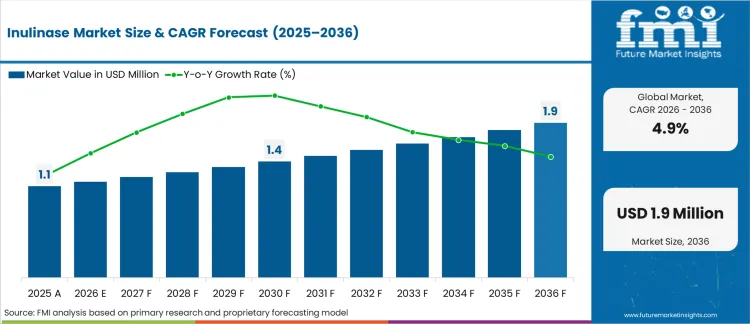
In 2025, the inulinase market was valued at USD 1.14 million. Based on Future Market Insights' analysis, demand for inulinase is estimated to grow to USD 1.19 million in 2026 and USD 1.92 million by 2036. FMI projects a CAGR of 4.9% during the forecast period.
Absolute growth of USD 0.73 million over the decade reflects a nascent but structurally expanding specialty enzyme category driven by three distinct application vectors: high fructose syrup production from inulin-rich crops, second-generation bioethanol production from chicory and Jerusalem artichoke feedstocks, and the emerging inulo-oligosaccharides prebiotics market that requires inulinase for controlled partial hydrolysis. Kerry Group's February 2026 announcement of a next-generation fermentation-derived enzyme system within its Proactive Health portfolio, utilizing enzymes including inulinase to modify fibers for digestive health, signals the expansion of inulinase into functional food and beverage formulation beyond industrial processing applications. [3]
As Ester Baiget, President and CEO of Novonesis, noted regarding the company's post-merger commercial performance, 'In 2025, we continued to deliver strong organic sales growth... As a pure biosolutions player, Novonesis uniquely combines deep understanding of customers and innovation leadership.' [2]
Summary of Inulinase Market
- Inulinase Market Definition
- The market covers globally traded microbial and plant-derived inulinase enzymes for inulin polyfructan hydrolysis in high fructose syrup production, bioethanol fermentation, inulo-oligosaccharides prebiotic manufacturing, and emerging bakery fermentation enhancement applications.
- Demand Drivers in the Market
- Health Canada's November 2025 formal proposal to permit exo-inulinase derived from Trichoderma reesei strain AR-577 in bread, flour, and bakery products, opening the North American bakery industry to a new inulinase application that improves yeast fermentation and dough softness through increased fermentable sugar availability. [1]
- Novonesis's June 2025 completion of the DSM-Firmenich feed enzyme alliance acquisition for EUR 1.5 billion, centralizing industrial enzyme leadership and enabling scaled-up production of specialty enzymes including inulinase used in animal nutrition and food processing. [2]
- Kerry Group's February 2026 next-generation enzyme system launch within the Proactive Health portfolio, utilizing inulinase to modify fibers for digestive health applications in functional beverages and snacks, expanding inulinase's commercial reach into the consumer health nutrition segment. [3]
- Key Segments Analyzed in the FMI Report
- Product Type: Microbial Inulinase holds 63.2% of product type share in 2026, reflecting the commercial preference for Aspergillus niger and Kluyveromyces marxianus fermentation-derived enzyme for industrial-scale high fructose syrup and bioethanol applications.
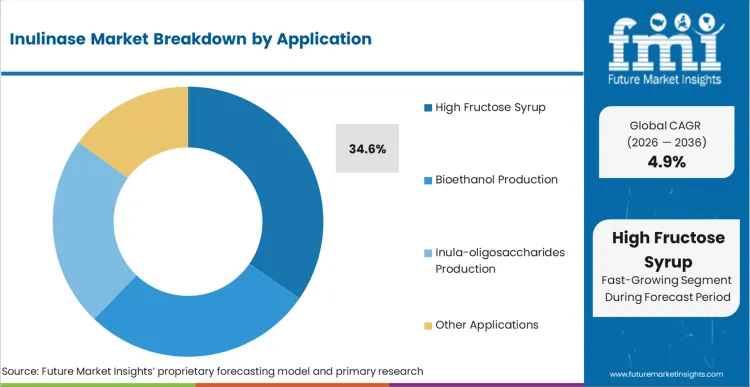
- Application: High Fructose Syrup accounts for 34.6% of application value in 2026, anchored by established industrial processing of chicory and Jerusalem artichoke inulin into high-fructose sweetener products.
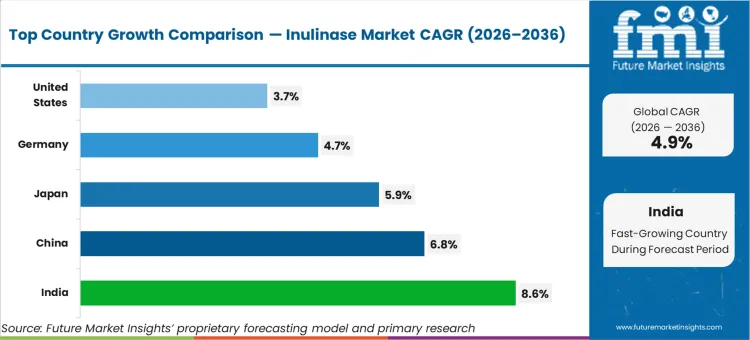
- Geography: India leads at 8.6% CAGR, China at 6.8%, Japan at 5.9%; the United States represents USD 0.44 million in 2026 with growth contingent on Health Canada and FDA bakery application approvals.
- Analyst Opinion at FMI
- Nandini Roy Choudhury, Principal Consultant for Food & Beverage at Future Market Insights, opines, "In the updated version of the Inulinase Market Report for 2026 to 2036, CXOs will find that Health Canada's November 2025 proposal to permit exo-inulinase in North American bread and bakery products, if finalized and mirrored by FDA guidance, could expand the addressable bakery application market by an order of magnitude beyond the current industrial processing base. My findings indicate that the transition from inulinase's current identity as an industrial fructose syrup and bioethanol enzyme toward prebiotic ingredient manufacturing and functional food fiber modification represents a value-per-kilogram upgrade opportunity that specialty enzyme producers should position for ahead of the regulatory approval timeline, as the prebiotic and digestive health segments command substantially higher pricing than commodity industrial enzyme supply."
- Strategic Implications / Executive Takeaways
- Monitor Health Canada's exo-inulinase bakery approval finalization timeline and prepare FDA regulatory submission documentation in parallel to capture first-mover North American bakery application supply contracts ahead of broad market awareness.
- Develop inulo-oligosaccharides prebiotic application technical support capabilities, as the controlled partial hydrolysis specification requirements for prebiotic production represent a differentiated, premium-priced inulinase application that commodity industrial enzyme producers cannot serve without specialized process knowledge.
- Pursue strategic alignment with Kerry Group's Proactive Health enzyme platform to access the functional food and beverage channel for inulinase-based fiber modification applications, where bundled formulation solutions command higher contract values than standalone enzyme ingredient supply.
- Methodology
- Validated through primary interviews with microbial inulinase producers and chicory processing facility operators, supported by Health Canada enzyme proposal documentation and EU food enzyme register data.
- Grounded in chicory crop production statistics from European agricultural bodies, Jerusalem artichoke cultivation data, and bioethanol production capacity benchmarks.
- Zero reliance on speculative third-party market research; all forecasts reflect verifiable regulatory approval timelines, production capacity data, and confirmed commercial developments.
India leads growth at 8.6% CAGR through 2036, driven by expanding chicory root processing capacity and growing domestic demand for inulo-oligosaccharides as prebiotic ingredients in functional food formulations. China follows at 6.8%, supported by the country's established high fructose syrup manufacturing infrastructure and regulatory expansion of inulin-derived sweetener applications. Japan grows at 5.9%, anchored by advanced functional food and prebiotic ingredient market development. Germany grows at 4.7% with established chicory processing and pharmaceutical-grade inulinase demand. The United States grows at 3.7%, where Health Canada's bakery application proposal and Kerry's functional enzyme platform signal North American application expansion. Microbial inulinase holds 63.2% of product type share; High Fructose Syrup application accounts for 34.6% of application value.
Inulinase Market Definition
The inulinase market encompasses the global production, trade, and industrial application of inulinase enzymes (EC 3.2.1.7 exo-inulinase and EC 3.2.1.80 endo-inulinase) that catalyze the hydrolysis of inulin polyfructans into fructose monomers, fructooligosaccharides, or inulo-oligosaccharides depending on enzyme type and reaction conditions. The market covers microbial inulinase derived primarily from Aspergillus niger, Kluyveromyces marxianus, and Trichoderma reesei fermentation, as well as plant-derived inulinase from chicory and other inulin-accumulating plant sources. Primary applications include high fructose syrup production from chicory and Jerusalem artichoke inulin, second-generation bioethanol production from inulin-rich agricultural residues, inulo-oligosaccharides prebiotic ingredient production, and bakery fermentation enhancement.
Inulinase Market Inclusions
The report includes comprehensive global and regional market sizing by volume and value with a 10-year forecast from 2026 to 2036. Segmental analysis covers product type (Microbial Inulinase, Plant Inulinase) and application (High Fructose Syrup, Bioethanol Production, Inula-oligosaccharides Production). Country-level CAGR analysis includes the United States, Germany, Japan, China, and India. Health Canada bakery application approval timeline modeling, inulin-rich crop production capacity by region, bioethanol feedstock economics, and prebiotic market growth integration are incorporated.
Inulinase Market Exclusions
The scope excludes inulase used in clinical diagnostic and analytical chemistry laboratory applications unless commercially scaled enzyme supply is quantified. Inulin polysaccharide as a prebiotic ingredient and finished inulo-oligosaccharide products are outside scope unless the inulinase enzyme component is separately valued. Fructooligosaccharide extraction by non-enzymatic chemical hydrolysis methods and synthetic fructan processing are excluded from market sizing.
Inulinase Market Research Methodology
Primary Research:
Interviews were conducted with microbial inulinase producers, chicory processing and inulin extraction facility operators, bioethanol production plant managers specifying inulinase in second-generation fermentation, prebiotic ingredient formulators, and regulatory affairs specialists tracking Health Canada and EU inulinase application approval frameworks.
Desk Research:
Health Canada List of Permitted Food Enzymes proposal documentation for exo-inulinase from Trichoderma reesei, EU food enzyme register data, chicory crop production statistics from European agricultural bodies, Jerusalem artichoke cultivation area data from national agricultural ministries, and bioethanol production capacity benchmarks supported the quantitative framework.
Market-Sizing and Forecasting:
A hybrid bottom-up and top-down model reconstructed inulinase demand from high fructose syrup production volumes using inulin-based feedstocks, bioethanol inulinase usage benchmarks by production capacity, inulo-oligosaccharides prebiotic market volume projections, and bakery application demand based on Health Canada regulatory approval timeline modeling, validated against microbial enzyme producer shipment data.
Data Validation and Update Cycle:
Outputs underwent cross-validation against chicory inulin production capacity data, bioethanol feedstock economics, prebiotic market demand trajectory benchmarks, anomaly screening, and expert review by food enzyme chemists and fermentation technology specialists prior to release.
Key Industry Highlights
Rising demand in the Meat and Dairy Industry to facilitate the growth of inulinase as feed enzymes
As the requirement for meat is growing all over the world, the overseas market for meat is expanding, and therefore inulinase is a feed enzyme. Of all the animal categories, pigs and poultry were the most frequently reported to use feed enzymes.
As feed enzymes promote faster growth rate and make the immune system of pigs and poultry stronger there is demand for it all over the world. The market has shot up in terms of the number of farm animals brought into the market due to the improvement in demand for animal proteins.
One of the major cost categories in the dairy operations is feed. Livestock farmers especially those specializing in dairy benefit from the efficiency gain in the conversion of feed to milk. Market players are therefore working towards formulating feed enzymes that can enhance feed intake and improve ruminants and milk yields which in the process reduce feed costs among dairy farmers. Such feed enzymes are expected to achieve preference among dairy sector stakeholders.
Increasing demand for bakery products such as ready-to-eat products drives the market for inulinase.
In the bakery products inulinase is included in any type of baking starting from cake to biscuits. They gelatinize the products of flour starch, such as sugars that are utilized in the yeast. Using baking enzymes then enhances the softness of the bread and also the shelf life of the developed bread. Since more and more people consume ready-to-eat and packed foods, Bakery Enzymes’ market share has gone up.
Higher uptake of Bakery Enzymes is attributed to sales of bakery enzymes since these can reduce the flour mixing time, enhance oxidation, and machinability, provide high fermentation rates, and great dough firmness. This has had the following effect on the Bakery and Processed food market. Consumers are demanding clean labels and certified products, and governments as well as Multinational companies are investing in the research and development of diverse products and processing products.
Rising crop quality and resistance to growing the sale of inulinase as an agriculture
Agricultural inulinase enzymes have been widely used in the improvement of the quality of oilseeds, pulses, cereals, grains, fruits, and vegetables. The enzymes decompose plant matter and organic matter thereby releasing micronutrients that are indispensably important for the growth of plants.
Such enzymatic activity is more crucial at some specified stage in germination such as sprouting or rooting of a seed. One way, through enzymes, these crops have improved water stress tolerance, while nutrient assimilation, anotherparameter that has been ascertained as influential in plant growth.
They act as biological catalysts that increase the rate of chemical reactions within the soils as well as enhance nutrient uptake for use by plant roots. As a result, this results in enhanced quality of the crops produced as well as the ability to withstand conditions unfavorable as occasioned by climate change or uncompromising soil standards. The duller value is gotten at an improved crop quality hence leading to a boost of food security through the production of crops that endure stressful conditions in the environment.
2021 to 2026 Global Inulinase Sales Analysis Compared to Demand Forecasts for 2026 to 2036
Global Inulinase increased at a CAGR of 4.6% from 2021to 2026. For the next ten years (2026 to 2036), projections are that expenditure on Inulinase will rise at 4.9% CAGR
The trade of inulinase itself is a dynamic one and has transitioned in the past decade on the global market. Historical outlook and future projections are key factors that need to be analyzed in relation to the Inulinase market. Both are important to know the current changes for they use historical data to make current trend analysis while projections can help prepare for future changes when subjection analysis is done.
From 2024 to 2034, the growth in the global market of the food industry, diet supplements, and feed industry brought the growth in inulinase enzyme use in all the industries also. As more people rush towards convenient sources of processed foods and comfort food, the market of food enzymes is a large opportunity for industry players.
An urgent demand for planned and predictable secondary additional chemicals, plus the gradually increasing consumption of clean-name products promotes development and market expansion in this sphere.
Market Concentration
The prominent marketing strategies of the big Global Inulinase players such as Jarrow Formulas Sensus, BENEO, Cosucra, Orafti, Kikkoman Corporation, and others. These business leaders are, therefore, a very large value share. They have good manufacturing practices and gain a competitive advantage over rivals through a striking distribution channel and market and also the capability to introduce new products.
Products are viewed and used throughout each country in the world. It has voluminous product line-affiliated packages. It demands more legal targets to gain more customers’ loyalty to their brands and hence improve the personality of brands.
The key enterprises in the local area are Triveni Formulations Limited, Nutrients India Private Limited Bioven Ingredients, Alfa Chemistry is that they can know about the demands and preferences of their local consumers and also cater to them.
On a research and development aspect for instance the regional players are ever slightly edged out whenever they are up against the national brands, but what will probably surprise most people is the fact that the regional players are as informed as can be with regards to their targeted consumers and market niches. Regional brands follow the changes in the market more closely because there are many of them, and all are small and located close to the regional market.
Country-wise Insights
The table below highlights revenue from product sales in key countries. The United States and China are predicted to remain top consumers, with estimated valuations of USD 361.3 Million and USD 283.4 Million, respectively, by 2036.
.webp "Top Country Growth Comparison Inulinase Market Cagr (2026 2036)")
| Countries | Value (2036) |
|---|---|
| United States | USD 361.3 Million |
| Germany | USD 258.4 Million |
| Japan | USD 98.1 Million |
| China | USD 283.4 Million |
| India | USD 160.6 Million |
The following table shows the estimated growth rates of the top three industries. China and India are set to exhibit insulinase consumption, recording CAGRs of 6.8% and 8.6%, respectively, through 2034.
| Countries | CAGR 2026 to 2036 |
|---|---|
| United States | 3.7% |
| Germany | 4.7% |
| Japan | 5.9% |
| China | 6.8% |
| India | 8.6% |
Application of Inulinase in different industries in the United States
The sale of Inulinase in the United States is projected to exhibit a CAGR of 3.7% during the assessment period by 2036, and revenue from the sales of Inulinase in the country is expected to reach USD 361.3 Million.
This market for inulinase enzymes as bakery enzymes has been highly spurred by the advantages of Enzymes and the altered consumer trend of consuming more convenient and healthy foods. This indicates that even though the prices of some of the baking products are on the rise continuously in the years ahead. Therefore, the market for lnulinse Enzymes mostly catering the household consumers market.
Increased demand for animal products in the United Kingdom is driving demand for Inulinase in Germany.
Inulinase demand in Germany is expected to rise at a value CAGR of 4.7% during the forecast period 2026 to 2036. By 2036, Germany is expected value share to account for 258.4 of Inulinase sales in Europe.
Growing demand for animal products in Germany is huge and is largely establishing improvements on the supply side to improve the yields from livestock. Many of the newer technologies require capital to be installed to replace traditional fixed capital investment practices and methods for industrial production, already adopted for chickens and pigs, even in regions where space is limited.
To enhance output per unit of inputs, enhance feed conversion ratios, and increase animal muscling and protein yield, industrial-scale livestock production sources high-quality feed enzymes.
It would be important to enhance the current inulinase feed enzyme manufacturing to increase the number of farmers engaged in industrial-scale livestock production for a high-quality compound feed from this large production base to be produced. However, enabling policies that many governments have put in place are expected to largely help in maintaining or enhancing supply to meet the demand. This is believed to further enhance the growth of the global inulinase market across the projected period.
Demand for feed enzymes in India growing the inulinase industry
Consumption of Inulinase in India is expected to increase at a value CAGR of 10.6% over the next ten years. By 2036, the sale size is forecasted to reach USD 6.5 Million, with India expected to account for a market share of 27.5% in South Asia.
The market for feed enzymes in India will rise significantly during the projected period due to the growing application of enzymes in fermenting milk preparation products such as curd, yogurt, cheese, and so on. India’s fast-growing dairy industry is likely to exert a positive influence on inulinase enzymes.
The feed enzymes industry keeps the world market leaving India is its higher population. India has been featured by a growth in the number of households in the middle class and the income level, thus, affecting the population’s food choice and leading to higher consumption per capita of dairy and meats. With a better knowledge of the need of people to take foods that are rich in proteins among the population. The market for enzymes in animal feed has shown growth in the coming years in India due to the enhanced usage of enzymes in feed.
Category-Wise Insights
Food application is expected to continue dominating the Inulinase industry
| Segment | Food (Application) |
|---|---|
| Value Share (2026) | 41.5% |
Sales of food application end-use applications of Inulinase are projected to register a CAGR of 6.2% from 2026 to 2036
Inulinase may be applied in the process of producing foods that are sweet but are not rich in calories or sugars. That is why it is useful to lessen bitterness in some culinary products, including coffee and cocoa-containing dishes. The other uses are creating low-fat milk products such as yogurt, and cheese amongst others, having a better texture, taste, and mouthfeel. Also, in their processing, it can act as a stabilizer by lowering the viscosity of the foods and thus giving the process more predictable and standard stability of shelf life.
Plant Inulinase is more popular among all application
| Segment | Plant Inulinase (Application) |
|---|---|
| Value Share (2026) | 34.6% |
The rapidly growing popularity of the Plant Inulinase segment is anticipated to advance at 7.5% CAGR during the projection period.
Inulinase is a naturally occurring plant enzyme that can cleave a certain type of carbohydrate called inulin. Inulin is a polysaccharide sweetener of natural origin that is not hydrolyzed in the human small intestine and is therefore classified as a FROND. This enzyme enables the inulin to be split into individual sugars that the plant is in a position to provide energy to both humans and animals.
Competition Outlook
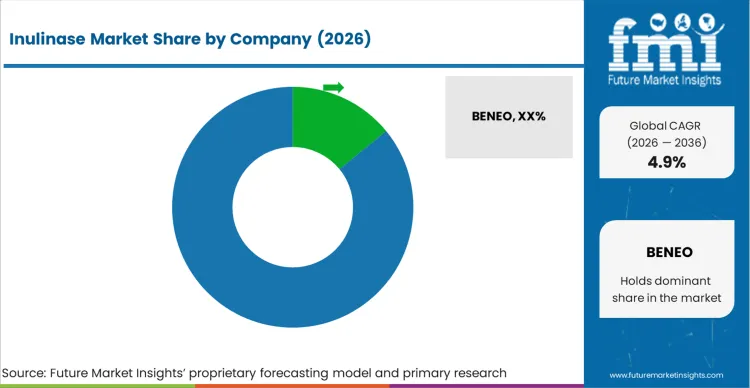
The inulinase market is a small but specialized category within the broader industrial enzyme sector, with a limited number of dedicated commercial producers. BENEO holds an estimated 14.1% share in 2026, with Sensus, Cosucra, Orafti, Kikkoman Corporation, Triveni Formulations, Nutrients India, Bioven Ingredients, and Alfa Chemistry as regional competitors. The market's small absolute value relative to broader enzyme categories means that strategic positioning is primarily defined by application expertise and substrate-specific technical support rather than volume-based competitive pricing.
Health Canada's November 2025 proposal to add exo-inulinase from Trichoderma reesei strain AR-577 to the List of Permitted Food Enzymes for use in bread, flour, and bakery products is the most significant regulatory development in the North American inulinase market in recent years. [1] If finalized, this approval creates a commercial pathway for inulinase suppliers with Trichoderma reesei production capability to enter the North American bakery ingredient market at volumes substantially larger than current industrial processing applications. Novonesis's June 2025 acquisition of dsm-firmenich's feed enzyme alliance stake centralizes specialty enzyme supply chain infrastructure that includes inulinase production capabilities, providing improved economies of scale for commercial production. [2]
Buyer concentration in the current market is high, with a limited number of high fructose syrup producers and bioethanol manufacturers accounting for the dominant share of industrial inulinase demand. Kerry Group's entry into the inulinase-adjacent prebiotic fiber modification market through its Proactive Health enzyme platform in February 2026 represents the most commercially significant demand diversification signal in the market's near-term trajectory. [3]
Recent Developments
- November 2025: Health Canada officially announced its intention to modify the List of Permitted Food Enzymes to include exo-inulinase derived from Trichoderma reesei strain AR-577. The proposal seeks to allow the enzyme's use in bread, flour, and bakery products to increase fermentable sugars in dough, thereby improving yeast fermentation and dough softness, facilitating the expansion of inulinase applications in the North American bakery industry. [1]
- June 2025: Novonesis completed the acquisition of dsm-firmenich's feed enzymes business for EUR 1.5 billion as part of broader market consolidation. This transaction includes specialized enzyme activities used for improving nutrient digestibility and centralizes industrial enzyme leadership under the Novonesis banner, allowing for scaled-up production of enzymes used in animal nutrition and food processing including inulinase. [2]
- February 2026: Kerry Group reported the launch of a next-generation breakthrough enzyme system within its 2025/2026 Proactive Health innovation cycle. The fermentation-derived enzyme technology utilizes enzymes including inulinase to modify fibers for digestive health, delivering more effective natural sweetness while enhancing the nutritional profile of functional beverages and snacks. [3]
Leading Inulinase Brands
- BENEO
- Jarrow Formulas
- Sensus
- Cosucra
- Orafti
- Kikkoman Corporation
- Triveni Formulations Limited
- Nutrients India Private Limited
- Bioven Ingredients
- Alfa Chemistry
Scope of the Repor
| Metric | Value |
|---|---|
| Quantitative Units | USD 1.19 million (2026) to USD 1.92 million (2036), at a CAGR of 4.9% |
| Market Definition | The inulinase market covers global production and trade of microbial and plant-derived inulinase enzymes for inulin hydrolysis in high fructose syrup production, bioethanol fermentation, inulo-oligosaccharides prebiotic manufacturing, and bakery fermentation enhancement applications. |
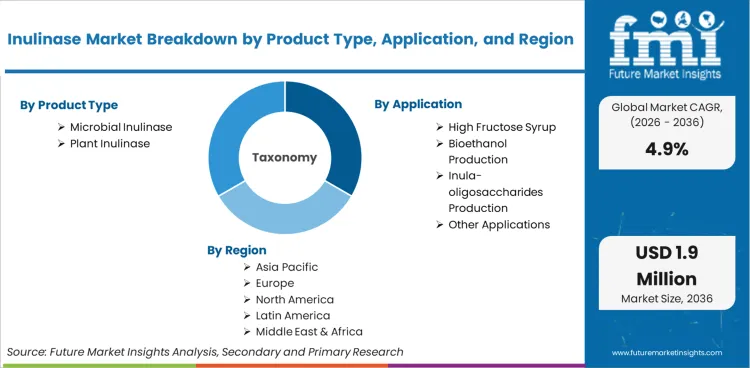
| Product Type Segmentation | Microbial Inulinase, Plant Inulinase |
| Application Segmentation | High Fructose Syrup, Bioethanol Production, Inula-oligosaccharides Production |
| Regions Covered | North America, Latin America, Europe, East Asia, South Asia, Oceania, Middle East and Africa |
| Countries Covered | United States, Germany, Japan, China, India, France, United Kingdom, Brazil, South Korea, Australia and 40 plus countries |
| Key Companies Profiled | BENEO, Jarrow Formulas, Sensus, Cosucra, Orafti, Kikkoman Corporation, Triveni Formulations Limited, Nutrients India Private Limited, Bioven Ingredients, Alfa Chemistry |
| Forecast Period | 2026 to 2036 |
| Approach | Hybrid bottom-up and top-down market modeling validated through primary interviews with microbial inulinase producers and chicory processing operators, supported by Health Canada enzyme proposal documentation, EU food enzyme register data, and chicory crop production statistics |
Key Segments of Market Report
Product Type
- Microbial Inulinase (63.2% share, 2026)
- Plant Inulinase
Application
- High Fructose Syrup (34.6% share, 2026)
- Bioethanol Production
- Inula-oligosaccharides Production
Region
- North America: United States (USD 0.44M, 2026), Canada, Mexico
- Latin America: Brazil, Argentina, Chile, Rest of Latin America
- Europe: Germany, France, United Kingdom, Italy, Spain, Benelux, Nordics, Rest of Europe
- East Asia: China, Japan (USD 0.89M projected, 2036), South Korea
- South Asia: India, Indonesia, Malaysia, Thailand, Rest of South Asia
- Oceania: Australia, New Zealand
- Middle East & Africa: Saudi Arabia, UAE, South Africa, Rest of Middle East & Africa
Bibliography
- [1] Health Canada. (2025). Notice of Proposal to Modify the List of Permitted Food Enzymes to Authorize Exo-Inulinase Derived from Trichoderma reesei Strain AR-577. Government of Canada, November 2025. https://www.canada.ca/en/health-canada/services/food-nutrition/legislation-guidelines/acts-regulations/notices-proposal-notices-modification/permitted-food-enzymes-authorize-exo-inulinase.html
- [2] Novonesis. (2025). Novonesis Completes Acquisition of DSM-Firmenich Feed Enzymes Business. Corporate Press Release, June 2025. https://www.novonesis.com/en
- [3] Food Ingredients First. (2026). Kerry Group Launches Next-Generation Enzyme System in Proactive Health Portfolio. Industry Report, February 2026. https://www.foodingredientsfirst.com/news/kerry-taste-innovation-fy2025-margin.html
- [4] Novonesis. (2026). Novonesis Delivered Strong Organic Sales Growth of 7% in 2025. Annual Results, February 2026. https://backend.novonesis.com/sites/default/files/document/2026-02/2026_01_12M%202025__Highlights.pdf
- [5] Nutraceuticals World. (2025). Inulinase Enzymes May Benefit Gut Symptoms of FODMAP Digestion. Industry Research Report, 2025. https://www.nutraceuticalsworld.com/breaking-news/inulinase-enzymes-may-benefit-gut-symptoms-of-fodmap-digestion/
This Report Addresses
- Market intelligence to enable inulinase sourcing strategy and new application development decisions across high fructose syrup, bioethanol, prebiotic ingredient, and bakery fermentation segments
- Market size estimation and 10-year revenue forecasts from 2026 to 2036, incorporating Health Canada bakery application approval timeline and prebiotic market growth projections
- Growth opportunity mapping across microbial and plant inulinase source categories with emphasis on inulo-oligosaccharides prebiotic production and North American bakery application regulatory expansion
- Segment and regional revenue forecasts covering product type and application dimensions with country-level CAGR analysis for the United States, Germany, Japan, China, and India
- Competition strategy assessment including Novonesis consolidation impact, Kerry Proactive Health enzyme platform implications, and BENEO and Sensus competitive positioning in inulin and inulinase supply chain integration
- Regulatory impact analysis covering Health Canada exo-inulinase bakery approval process, EU food enzyme register status, and FDA parallel regulatory pathway assessment for North American bakery market access
- Supply chain analysis covering Trichoderma reesei and Aspergillus niger fermentation capacity for exo-inulinase production, chicory crop processing substrate availability, and plant inulinase certification requirements
- Market report delivery in PDF, Excel, PPT, and interactive dashboard formats for executive and operational use
Frequently Asked Questions
How large is the demand for Inulinase in the global market in 2026?
Demand for Inulinase in the global market is estimated to be valued at USD 1.19 million in 2026.
What will be the market size of Inulinase by 2036?
Market size for Inulinase is projected to reach USD 1.92 million by 2036.
What is the expected CAGR for the Inulinase market between 2026 and 2036?
Demand for Inulinase is expected to grow at a CAGR of 4.9% between 2026 and 2036.
Which product type dominates the Inulinase market in 2026?
Microbial Inulinase holds 63.2% of product type share in 2026, reflecting the commercial preference for Aspergillus niger and Kluyveromyces marxianus fermentation-derived enzyme for industrial-scale high fructose syrup and bioethanol processing applications.
Which application leads the Inulinase market in 2026?
High Fructose Syrup accounts for 34.6% of application value in 2026, anchored by established industrial processing of chicory root and Jerusalem artichoke inulin feedstocks into high-fructose sweetener products for the food and beverage industry.
What is the significance of the Health Canada November 2025 proposal for Inulinase?
Health Canada's proposal to permit exo-inulinase from Trichoderma reesei strain AR-577 in bread and bakery products opens a North American bakery application that would increase fermentable sugars in dough, improving yeast fermentation efficiency and dough softness, representing a new commercial pathway substantially larger than current North American industrial enzyme volumes.
Which country leads Inulinase growth through 2036?
India leads at 8.6% CAGR through 2036, driven by expanding chicory root processing capacity, growing domestic functional food and prebiotic ingredient demand, and increasing inulo-oligosaccharides production for the South Asian health nutrition market.
What drives Inulinase demand in China?
China grows at 6.8% CAGR, driven by established high fructose syrup manufacturing infrastructure utilizing inulin-based feedstocks and regulatory expansion of inulin-derived sweetener applications in the country's packaged food and beverage processing industry.
How is Kerry Group's enzyme platform relevant to the Inulinase market?
Kerry Group's February 2026 Proactive Health enzyme system launch utilizes inulinase to modify fibers for digestive health applications in functional beverages and snacks, expanding inulinase demand into the consumer health nutrition segment where prebiotic fiber modification commands premium pricing above industrial processing applications.
How does FMI validate its Inulinase forecast?
Forecast is developed using hybrid bottom-up and top-down modeling validated through primary interviews with microbial inulinase producers and chicory processing operators, Health Canada enzyme proposal documentation, EU food enzyme register data, and chicory crop production statistics from European agricultural bodies.
Preview the report firsthand - request a free sample
Get SampleGet the brochure for pricing and purchase details.
Get PDFTable of Content
- Executive Summary
- Global Market Outlook
- Demand-side Trends
- Supply-side Trends
- Technology Roadmap Analysis
- Analysis and Recommendations
- Market Overview
- Market Coverage / Taxonomy
- Market Definition / Scope / Limitations
- Research Methodology
- Chapter Orientation
- Analytical Lens and Working Hypotheses
- Market Structure, Signals, and Trend Drivers
- Company Annual and Sustainability Reports
- Peer-reviewed Journals and Academic Literature
- Corporate Websites, Product Literature, and Technical Notes
- Earnings Decks and Investor Briefings
- Statutory Filings and Regulatory Disclosures
- Technical White Papers and Standards Notes
- Trade Journals, Industry Magazines, and Analyst Briefs
- Conference Proceedings, Webinars, and Seminar Materials
- Government Statistics Portals and Public Data Releases
- Press Releases and Reputable Media Coverage
- Specialist Newsletters and Curated Briefings
- Sector Databases and Reference Repositories
- FMI Internal Proprietary Databases and Historical Market Datasets
- Subscription Datasets and Paid Sources
- Social Channels, Communities, and Digital Listening Inputs
- Additional Desk Sources
- Expert Input and Fieldwork (Primary Evidence)
- Primary Modes
- Qualitative Interviews and Expert Elicitation
- Quantitative Surveys and Structured Data Capture
- Blended Approach
- Why Primary Evidence is Used
- Field Techniques
- Interviews
- Surveys
- Focus Groups
- Observational and In-context Research
- Social and Community Interactions
- Stakeholder Universe Engaged
- C-suite Leaders
- Board Members
- Presidents and Vice Presidents
- R&D and Innovation Heads
- Technical Specialists
- Domain Subject-matter Experts
- Scientists
- Physicians and Other Healthcare Professionals
- Governance, Ethics, and Data Stewardship
- Research Ethics
- Data Integrity and Handling
- Primary Modes
- Tooling, Models, and Reference Databases
- Data Engineering and Model Build
- Data Acquisition and Ingestion
- Cleaning, Normalisation, and Verification
- Synthesis, Triangulation, and Analysis
- Quality Assurance and Audit Trail
- Market Background
- Market Dynamics
- Drivers
- Restraints
- Opportunity
- Trends
- Scenario Forecast
- Demand in Optimistic Scenario
- Demand in Likely Scenario
- Demand in Conservative Scenario
- Opportunity Map Analysis
- Product Life Cycle Analysis
- Supply Chain Analysis
- Investment Feasibility Matrix
- Value Chain Analysis
- PESTLE and Porter’s Analysis
- Regulatory Landscape
- Regional Parent Market Outlook
- Production and Consumption Statistics
- Import and Export Statistics
- Market Dynamics
- Global Market Analysis 2021 to 2025 and Forecast, 2026 to 2036
- Historical Market Size Value (USD Million) Analysis, 2021 to 2025
- Current and Future Market Size Value (USD Million) Projections, 2026 to 2036
- Y-o-Y Growth Trend Analysis
- Absolute $ Opportunity Analysis
- Global Market Pricing Analysis 2021 to 2025 and Forecast 2026 to 2036
- Global Market Analysis 2021 to 2025 and Forecast 2026 to 2036, By Product Type
- Introduction / Key Findings
- Historical Market Size Value (USD Million) Analysis By Product Type , 2021 to 2025
- Current and Future Market Size Value (USD Million) Analysis and Forecast By Product Type , 2026 to 2036
- Microbial Inulinase
- Plant Inulinase
- Microbial Inulinase
- Y-o-Y Growth Trend Analysis By Product Type , 2021 to 2025
- Absolute $ Opportunity Analysis By Product Type , 2026 to 2036
- Global Market Analysis 2021 to 2025 and Forecast 2026 to 2036, By Application
- Introduction / Key Findings
- Historical Market Size Value (USD Million) Analysis By Application, 2021 to 2025
- Current and Future Market Size Value (USD Million) Analysis and Forecast By Application, 2026 to 2036
- High Fructose Syrup
- Bioethanol Production
- Inula-oligosaccharides Production
- Other Applications
- High Fructose Syrup
- Y-o-Y Growth Trend Analysis By Application, 2021 to 2025
- Absolute $ Opportunity Analysis By Application, 2026 to 2036
- Global Market Analysis 2021 to 2025 and Forecast 2026 to 2036, By Region
- Introduction
- Historical Market Size Value (USD Million) Analysis By Region, 2021 to 2025
- Current Market Size Value (USD Million) Analysis and Forecast By Region, 2026 to 2036
- North America
- Latin America
- Western Europe
- Eastern Europe
- East Asia
- South Asia and Pacific
- Middle East & Africa
- Market Attractiveness Analysis By Region
- North America Market Analysis 2021 to 2025 and Forecast 2026 to 2036, By Country
- Historical Market Size Value (USD Million) Trend Analysis By Market Taxonomy, 2021 to 2025
- Market Size Value (USD Million) Forecast By Market Taxonomy, 2026 to 2036
- By Country
- USA
- Canada
- Mexico
- By Product Type
- By Application
- By Country
- Market Attractiveness Analysis
- By Country
- By Product Type
- By Application
- Key Takeaways
- Latin America Market Analysis 2021 to 2025 and Forecast 2026 to 2036, By Country
- Historical Market Size Value (USD Million) Trend Analysis By Market Taxonomy, 2021 to 2025
- Market Size Value (USD Million) Forecast By Market Taxonomy, 2026 to 2036
- By Country
- Brazil
- Chile
- Rest of Latin America
- By Product Type
- By Application
- By Country
- Market Attractiveness Analysis
- By Country
- By Product Type
- By Application
- Key Takeaways
- Western Europe Market Analysis 2021 to 2025 and Forecast 2026 to 2036, By Country
- Historical Market Size Value (USD Million) Trend Analysis By Market Taxonomy, 2021 to 2025
- Market Size Value (USD Million) Forecast By Market Taxonomy, 2026 to 2036
- By Country
- Germany
- UK
- Italy
- Spain
- France
- Nordic
- BENELUX
- Rest of Western Europe
- By Product Type
- By Application
- By Country
- Market Attractiveness Analysis
- By Country
- By Product Type
- By Application
- Key Takeaways
- Eastern Europe Market Analysis 2021 to 2025 and Forecast 2026 to 2036, By Country
- Historical Market Size Value (USD Million) Trend Analysis By Market Taxonomy, 2021 to 2025
- Market Size Value (USD Million) Forecast By Market Taxonomy, 2026 to 2036
- By Country
- Russia
- Poland
- Hungary
- Balkan & Baltic
- Rest of Eastern Europe
- By Product Type
- By Application
- By Country
- Market Attractiveness Analysis
- By Country
- By Product Type
- By Application
- Key Takeaways
- East Asia Market Analysis 2021 to 2025 and Forecast 2026 to 2036, By Country
- Historical Market Size Value (USD Million) Trend Analysis By Market Taxonomy, 2021 to 2025
- Market Size Value (USD Million) Forecast By Market Taxonomy, 2026 to 2036
- By Country
- China
- Japan
- South Korea
- By Product Type
- By Application
- By Country
- Market Attractiveness Analysis
- By Country
- By Product Type
- By Application
- Key Takeaways
- South Asia and Pacific Market Analysis 2021 to 2025 and Forecast 2026 to 2036, By Country
- Historical Market Size Value (USD Million) Trend Analysis By Market Taxonomy, 2021 to 2025
- Market Size Value (USD Million) Forecast By Market Taxonomy, 2026 to 2036
- By Country
- India
- ASEAN
- Australia & New Zealand
- Rest of South Asia and Pacific
- By Product Type
- By Application
- By Country
- Market Attractiveness Analysis
- By Country
- By Product Type
- By Application
- Key Takeaways
- Middle East & Africa Market Analysis 2021 to 2025 and Forecast 2026 to 2036, By Country
- Historical Market Size Value (USD Million) Trend Analysis By Market Taxonomy, 2021 to 2025
- Market Size Value (USD Million) Forecast By Market Taxonomy, 2026 to 2036
- By Country
- Kingdom of Saudi Arabia
- Other GCC Countries
- Turkiye
- South Africa
- Other African Union
- Rest of Middle East & Africa
- By Product Type
- By Application
- By Country
- Market Attractiveness Analysis
- By Country
- By Product Type
- By Application
- Key Takeaways
- Key Countries Market Analysis
- USA
- Pricing Analysis
- Market Share Analysis, 2025
- By Product Type
- By Application
- Canada
- Pricing Analysis
- Market Share Analysis, 2025
- By Product Type
- By Application
- Mexico
- Pricing Analysis
- Market Share Analysis, 2025
- By Product Type
- By Application
- Brazil
- Pricing Analysis
- Market Share Analysis, 2025
- By Product Type
- By Application
- Chile
- Pricing Analysis
- Market Share Analysis, 2025
- By Product Type
- By Application
- Germany
- Pricing Analysis
- Market Share Analysis, 2025
- By Product Type
- By Application
- UK
- Pricing Analysis
- Market Share Analysis, 2025
- By Product Type
- By Application
- Italy
- Pricing Analysis
- Market Share Analysis, 2025
- By Product Type
- By Application
- Spain
- Pricing Analysis
- Market Share Analysis, 2025
- By Product Type
- By Application
- France
- Pricing Analysis
- Market Share Analysis, 2025
- By Product Type
- By Application
- India
- Pricing Analysis
- Market Share Analysis, 2025
- By Product Type
- By Application
- ASEAN
- Pricing Analysis
- Market Share Analysis, 2025
- By Product Type
- By Application
- Australia & New Zealand
- Pricing Analysis
- Market Share Analysis, 2025
- By Product Type
- By Application
- China
- Pricing Analysis
- Market Share Analysis, 2025
- By Product Type
- By Application
- Japan
- Pricing Analysis
- Market Share Analysis, 2025
- By Product Type
- By Application
- South Korea
- Pricing Analysis
- Market Share Analysis, 2025
- By Product Type
- By Application
- Russia
- Pricing Analysis
- Market Share Analysis, 2025
- By Product Type
- By Application
- Poland
- Pricing Analysis
- Market Share Analysis, 2025
- By Product Type
- By Application
- Hungary
- Pricing Analysis
- Market Share Analysis, 2025
- By Product Type
- By Application
- Kingdom of Saudi Arabia
- Pricing Analysis
- Market Share Analysis, 2025
- By Product Type
- By Application
- Turkiye
- Pricing Analysis
- Market Share Analysis, 2025
- By Product Type
- By Application
- South Africa
- Pricing Analysis
- Market Share Analysis, 2025
- By Product Type
- By Application
- USA
- Market Structure Analysis
- Competition Dashboard
- Competition Benchmarking
- Market Share Analysis of Top Players
- By Regional
- By Product Type
- By Application
- Competition Analysis
- Competition Deep Dive
- BENEO
- Overview
- Product Portfolio
- Profitability by Market Segments (Product/Age /Sales Channel/Region)
- Sales Footprint
- Strategy Overview
- Marketing Strategy
- Product Strategy
- Channel Strategy
- Jarrow Formulas
- Sensus
- Cosucra
- Orafti
- Kikkoman Corporation
- Triveni Formulations Limited
- Nutrients India Private Limited
- Bioven Ingredients
- Alfa Chemistry
- BENEO
- Competition Deep Dive
- Assumptions & Acronyms Used


