

- Industry Size (2026)
- USD 3.2 Mn
- Forecast (2036)
- USD 5.3 Mn
- CAGR (2026 to 2036)
- 5.3%
Demand for Autocollimators in Japan 2026 to 2036
Demand for autocollimators in Japan is valued at USD 3.2 million in 2026 and is anticipated to reach USD 5.3 million by 2036, reflecting a CAGR of 5.3%. Demand advances through precision manufacturing requirements across optics, semiconductors, aerospace components, and metrology applications. Emphasis on micron-level alignment accuracy, quality control, and process validation supports steady adoption within high-precision industrial environments.
Electronic and digital autocollimators lead product-type usage because these systems deliver higher measurement accuracy, faster data acquisition, and seamless integration with digital inspection workflows. Manufacturers prefer digital autocollimators for automated alignment, real-time angle measurement, and data logging compatibility with quality management systems. Improved sensor resolution, software analytics, and ease of calibration strengthen operational efficiency.
Quick Stats for Demand for Autocollimators in Japan
- Japan Autocollimators Sales Value (2026): USD 3.2 million
- Japan Autocollimators Forecast Value (2036): USD 5.3 million
- Japan Autocollimators Forecast CAGR (2026 to 2036): 5.3%
- Leading Product Type in Japan: Electronic and Digital Autocollimators
- Key Growth Regions in Japan: Kyushu & Okinawa, Kanto, Kansai, Chubu, Tohoku
- Top Players in Japan: Mitutoyo Corporation, Nikon Corporation, Keyence Japan, Tokyo Seimitsu, Shimadzu Corporation
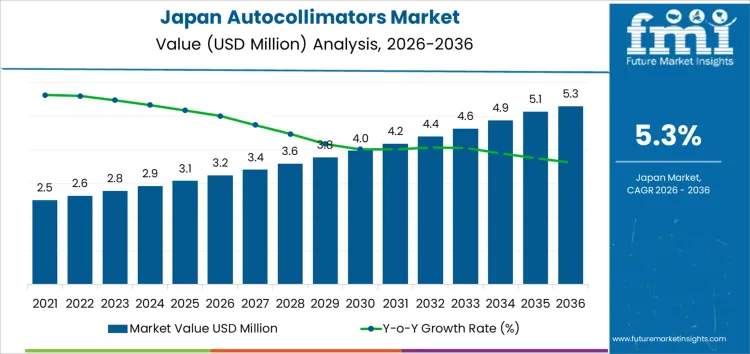
Kyushu & Okinawa, Kanto, Kansai, Chubu, and Tohoku represent key growth regions due to concentration of precision engineering clusters, semiconductor fabrication, and advanced research facilities. Mitutoyo Corporation, Nikon Corporation, Keyence Japan, Tokyo Seimitsu, and Shimadzu Corporation anchor competitive activity through precision instrumentation expertise, strong domestic distribution, and products aligned with Japan’s stringent accuracy and manufacturing reliability standards.
Japan Autocollimators Key Takeaways
| Metric | Value |
|---|---|
| Japan Autocollimators Sales Value (2026) | USD 3.2 million |
| Japan Autocollimators Forecast Value (2036) | USD 5.3 million |
| Japan Autocollimators Forecast CAGR (2026-2036) | 5.3% |
Why is the Demand for Autocollimators in Japan Growing?
Demand for autocollimators in Japan grows due to sustained emphasis on precision measurement across manufacturing, optics, and advanced engineering activities. Semiconductor fabrication, optical component production, and precision machining rely on angular measurement accuracy at arc second and sub arc second levels. Japanese manufacturers maintain strict tolerance standards in machine tools, stages, and alignment systems, which increases reliance on non-contact optical instruments. Expansion of semiconductor equipment production supports use during assembly, calibration, and quality assurance stages. Aerospace, automotive, and robotics sectors apply autocollimators to align shafts, bearings, mirrors, and motion platforms during installation and maintenance.
Research laboratories and metrology institutes expand procurement to support optical testing, surface evaluation, and instrument calibration programs. Growth in automation encourages use of digital autocollimators compatible with data logging and closed loop control. Replacement of legacy analog systems strengthens demand for compact, high resolution devices with improved stability. Export oriented manufacturing prioritizes measurement traceability, reinforcing adoption of certified optical alignment tools. Domestic focus on productivity and defect reduction aligns with instruments that support rapid setup, repeatability, and reduced rework across high precision production environments in Japan.
How Are the Segments Classified in the Demand for Autocollimators in Japan?
Demand for autocollimators in Japan is shaped by precision metrology requirements, alignment accuracy standards, and adoption of digital measurement systems. Buyers assess angular resolution, repeatability, data capture capability, and integration with automated inspection workflows. Adoption patterns reflect strong use in research, automotive manufacturing, and aerospace applications, aligned with Japan’s emphasis on dimensional accuracy, process control, and high-reliability measurement environments.
Which Product Type Accounts for the Largest Share in Japan?
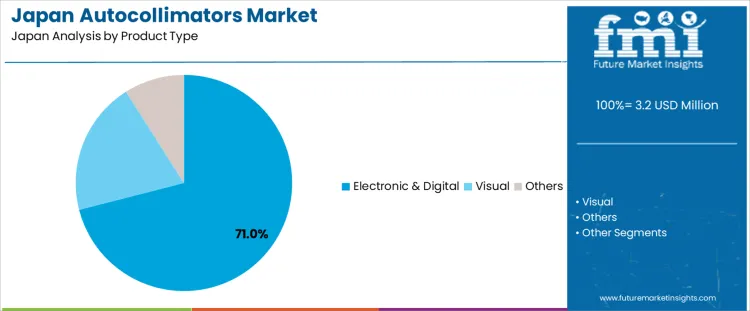
Electronic and digital autocollimators hold 71.0%, making them the leading product-type segment in Japan. These systems provide high-resolution angle measurement, digital output, and compatibility with automated data acquisition platforms. Usage supports alignment tasks in precision machining, optics testing, and calibration laboratories. Visual autocollimators hold 20.0%, serving applications requiring simple optical alignment and manual verification. Other product types hold 9.0%, addressing specialized or legacy measurement needs. Product-type distribution reflects preference for digital systems due to measurement repeatability, data traceability, and integration with Japan’s automated quality-control processes.
Key Points:
- Electronic and digital systems dominate due to measurement precision.
- Digital output supports automated inspection and traceability.
- Visual systems serve limited manual alignment needs.
Which Application Represents the Largest Share in Japan?
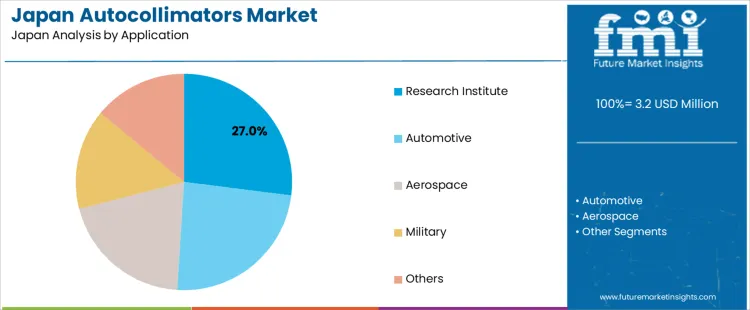
Research institutes hold 27.0%, making them the leading application segment in Japan. Universities and national laboratories use autocollimators for optical alignment, materials research, and instrument calibration. Automotive applications hold 24.0%, supporting component alignment, tooling setup, and quality inspection. Aerospace accounts for 20.0%, applying autocollimators to structural alignment and assembly verification. Military applications hold 15.0%, supporting precision equipment calibration. Other applications hold 14.0%, covering industrial and educational use cases. Application distribution reflects strong research-driven adoption supporting Japan’s technology development ecosystem.
Key Points:
- Research institutes lead due to intensive precision measurement needs.
- Automotive manufacturing relies on alignment and inspection accuracy.
- Aerospace and defense support high-reliability calibration tasks.
What are the Key Dynamics in the Autocollimators Industry in Japan?
Demand remains strong as Japan sustains precision manufacturing across optics, semiconductors, machine tools, and metrology. Autocollimators support angular measurement, alignment, and calibration with sub-arcsecond accuracy. Adoption aligns with tight tolerance requirements, long equipment lifecycles, and rigorous quality control practices. Usage concentrates in OEM production lines, calibration laboratories, and research institutes within established industrial clusters.
How do precision manufacturing standards and metrology practices drive demand in Japan?
Japan’s machine tool, optics, and semiconductor sectors require accurate angular alignment for spindles, stages, mirrors, and lithography components. Autocollimators enable non-contact measurement suited to cleanroom and vibration-controlled environments. Semiconductor fabs use these instruments during tool setup and maintenance to maintain overlay and focus accuracy. Optical component manufacturers apply autocollimators for lens and mirror alignment during assembly and inspection. National metrology institutes and accredited labs rely on traceable measurements to support calibration services. Preference for proven instruments with long-term stability supports repeat procurement from established suppliers serving Japan’s quality-driven manufacturing base.
How do capital cost, integration needs, and workforce factors influence demand stability?
High-precision autocollimators involve significant capital investment, limiting purchases to users with clear accuracy requirements. Integration with existing fixtures, stages, and data systems requires customization and engineering time. Skilled technicians are needed to operate, interpret results, and maintain calibration integrity. Production environments with space constraints demand compact instrument designs. Long replacement cycles in Japanese factories slow volume growth. Import dependence for certain high-end models affects lead times and pricing. Demand remains stable in core precision applications, while expansion depends on continued investment in advanced manufacturing and sustained emphasis on measurement accuracy across Japan’s industrial sectors.
How Is Demand for Autocollimators in Japan Evolving by Region?
Demand for autocollimators in Japan is increasing due to precision manufacturing requirements, optical metrology adoption, and quality control needs across electronics, automotive, and machinery sectors. Kyushu and Okinawa lead with a 6.6% CAGR, supported by semiconductor and electronics assembly activity. Kanto follows at 6.0%, driven by research institutions, optics development, and advanced manufacturing. Kansai records a 5.3% CAGR, shaped by machinery production and precision engineering. Chubu posts 4.7%, reflecting automotive manufacturing quality standards. Tohoku shows 4.1%, supported by regional manufacturing and inspection needs. Rest of Japan records 3.9%, reflecting stable replacement-led demand. Regional variation reflects manufacturing intensity, metrology sophistication, and inspection requirements across Japan.
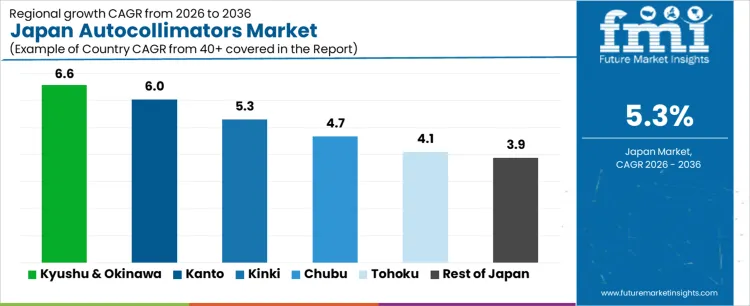
| Region | CAGR (2026-2036) |
|---|---|
| Kyushu & Okinawa | 6.6% |
| Kanto | 6.0% |
| Kansai | 5.3% |
| Chubu | 4.7% |
| Tohoku | 4.1% |
| Rest of Japan | 3.9% |
How is Kyushu and Okinawa driving demand for Autocollimators in Japan?
Kyushu and Okinawa drive demand through semiconductor fabrication, electronics assembly, and precision component manufacturing. Region’s CAGR of 6.6% reflects use of autocollimators for alignment, flatness measurement, and angular verification in cleanroom and production environments. Manufacturers require high-accuracy optical measurement to support miniaturized components and tight tolerances. Autocollimators are applied during equipment setup, maintenance, and quality audits. Facilities prioritize digital autocollimators offering fast measurement, data logging, and integration with inspection workflows. Demand favors robust instruments capable of stable performance under continuous operation. Growth remains quality-driven, aligned with yield improvement and process control requirements.
- Semiconductor and electronics precision inspection
- Alignment and angular measurement applications
- Digital measurement and data integration demand
- Quality and yield-driven instrument adoption
How is Kanto driving demand for Autocollimators in Japan?
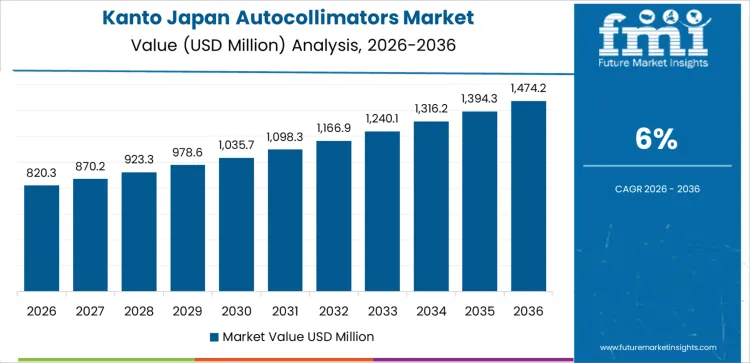
Kanto demand is shaped by concentration of research laboratories, optics developers, and advanced manufacturing facilities. Region’s CAGR of 6.0% reflects extensive use of autocollimators in optical system calibration, metrology research, and precision equipment development. Universities and corporate laboratories rely on high-resolution instruments for prototype validation and experimental setups. Manufacturers prioritize flexibility, measurement accuracy, and compatibility with automated inspection systems. Demand favors advanced autocollimators supporting software-based analysis and traceability. Growth aligns with research funding cycles, technology development, and precision engineering expansion rather than volume manufacturing alone.
- Research and laboratory-based metrology usage
- Optical system calibration requirements
- High-resolution and software-enabled instruments
- Research and development-driven demand
How is Kansai driving demand for Autocollimators in Japan?
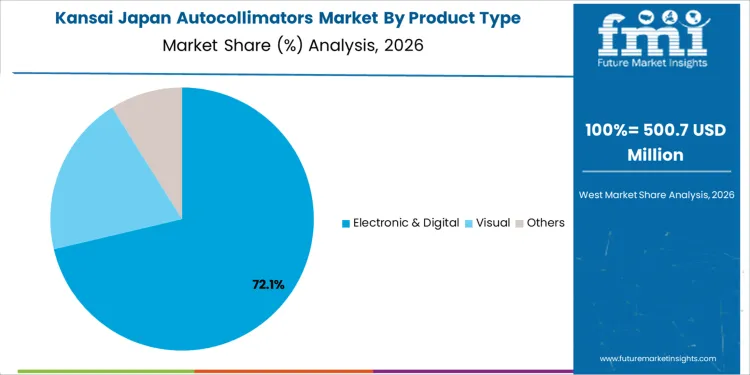
Kansai demand reflects machinery manufacturing, industrial equipment production, and precision engineering activity. Region’s CAGR of 5.3% is supported by autocollimator use in machine tool alignment, spindle calibration, and assembly verification. Manufacturers emphasize reliable measurement, ease of operation, and compatibility with workshop environments. Instruments support routine maintenance and quality assurance programs. Procurement decisions prioritize durability, supplier support, and cost efficiency. Demand growth remains steady, aligned with incremental modernization of inspection practices and replacement of legacy optical tools.
- Machine tool and equipment alignment usage
- Workshop-compatible precision measurement
- Maintenance and quality assurance applications
- Replacement-driven procurement behavior
How is Chubu driving demand for Autocollimators in Japan?
Chubu demand is anchored in automotive manufacturing and component production requiring strict dimensional accuracy. Region’s CAGR of 4.7% reflects use of autocollimators for alignment of assembly fixtures, inspection of rotating components, and quality verification. Manufacturers prioritize measurement repeatability, robustness, and ease of integration into inspection routines. Adoption supports continuous improvement and defect reduction initiatives. Demand aligns with production line upgrades and inspection standardization rather than expansion of capacity. Growth remains moderate and process-focused.
- Automotive assembly and component inspection
- Alignment and rotational accuracy verification
- Focus on repeatability and robustness
- Process improvement-driven adoption
How is Tohoku driving demand for Autocollimators in Japan?
Tohoku demand is influenced by regional manufacturing facilities and quality inspection requirements. Region’s CAGR of 4.1% reflects use of autocollimators in general machinery production, equipment maintenance, and technical training environments. Facilities prioritize simple operation, reliability, and consistent measurement performance. Instruments support skill development and standardized inspection practices. Demand growth remains cautious and efficiency-driven, aligned with maintaining production quality rather than adopting advanced metrology systems.
- General manufacturing inspection usage
- Equipment maintenance and calibration needs
- Training and skill development applications
- Efficiency-focused adoption patterns
How is Rest of Japan driving demand for Autocollimators in Japan?
Rest of Japan shows stable demand driven by routine equipment maintenance, calibration needs, and replacement of aging instruments. Region’s CAGR of 3.9% reflects continued use of autocollimators in small and mid-sized manufacturing facilities. Buyers prioritize affordability, availability, and service support. Adoption remains maintenance-oriented, with limited demand for advanced digital features. Growth aligns with sustaining operational accuracy rather than expanding measurement capability.
- Routine calibration and maintenance usage
- Small and mid-sized manufacturing facilities
- Cost-sensitive instrument procurement
- Stable replacement-driven demand
What is the competitive landscape of demand for autocollimators in Japan?
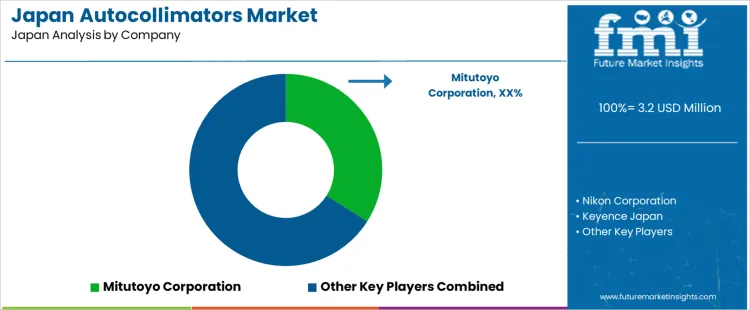
Demand for autocollimators in Japan is driven by precision measurement needs in optics manufacturing, semiconductor equipment calibration, aerospace alignment, and quality control in high-precision engineering. Usage spans angular measurement, optical alignment, surface flatness checks, and machine tool calibration where sub-arcsecond resolution and high repeatability are required. Buyers evaluate instrument accuracy, measurement range, environmental stability, and compatibility with automated metrology systems. Procurement teams prioritize suppliers with Japan-based technical support, calibration services, and integration capability with existing inspection workflows. Trend in the Japan market reflects sustained activity in semiconductor and precision optical sectors, ongoing automation of metrology processes, and strong demand for traceable measurement standards.
Mitutoyo Corporation holds a leading position through domestically engineered autocollimators and broad precision measurement portfolios tailored to Japanese manufacturing. Nikon Corporation participates with optical and precision instrumentation including high-accuracy autocollimators used in R&D and production environments. Keyence Japan operates with compact autocollimator solutions integrated into automated inspection and alignment applications. Tokyo Seimitsu contributes high-precision optical measurement systems, including autocollimators, used in advanced engineering and semiconductor equipment calibration. Shimadzu Corporation maintains visibility with optical metrology and alignment instruments supported by domestic service networks and calibration traceability. Competitive positioning in Japan reflects measurement accuracy, instrument stability, service and calibration support, and ability to meet stringent quality standards within precision-manufacturing sectors.
Key Players in Japan Autocollimators Demand
- Mitutoyo Corporation
- Nikon Corporation
- Keyence Japan
- Tokyo Seimitsu
- Shimadzu Corporation
Scope of the Report
| Items | Values |
|---|---|
| Quantitative Units | USD million |
| Product Type | Electronic & Digital; Visual; Others |
| Application | Research Institute; Automotive; Aerospace; Military; Others |
| Regions Covered | Kanto; Kansai; Chubu; Kyushu & Okinawa; Tohoku; Rest of Japan |
| Key Companies Profiled | Mitutoyo Corporation; Nikon Corporation; Keyence Japan; Tokyo Seimitsu; Shimadzu Corporation |
| Additional Attributes | Demand driven by precision metrology requirements in semiconductor tooling, automotive alignment, and aerospace calibration. Electronic and digital autocollimators gain preference due to higher accuracy and automation compatibility. Adoption supported by Japan’s advanced manufacturing base, quality-control standards, and ongoing investment in research laboratories and defense-grade optical instrumentation. |
Japan Autocollimators Demand by Segments
Product Type:
- Electronic & Digital
- Visual
- Others
Application:
- Research Institute
- Automotive
- Aerospace
- Military
- Others
Region:
- Kyushu & Okinawa
- Kanto
- Kansai
- Chubu
- Tohoku
- Rest of Japan
Frequently Asked Questions
How big is the demand for autocollimators in Japan in 2026?
The demand for autocollimators in Japan is estimated to be valued at USD 3.2 million in 2026.
What will be the size of autocollimators in Japan in 2036?
The market size for the autocollimators in Japan is projected to reach USD 5.3 million by 2036.
How much will be the demand for autocollimators in Japan growth between 2026 and 2036?
The demand for autocollimators in Japan is expected to grow at a 5.3% CAGR between 2026 and 2036.
What are the key product types in the autocollimators in Japan?
The key product types in autocollimators in Japan are electronic & digital, visual and others.
Which application segment is expected to contribute significant share in the autocollimators in Japan in 2026?
In terms of application, research institute segment is expected to command 27.0% share in the autocollimators in Japan in 2026.
Preview the report firsthand - request a free sample
Get SampleGet the brochure for pricing and purchase details.
Get PDFTable of Content
- Executive Summary
- Japan Market Outlook
- Demand-side Trends
- Supply-side Trends
- Technology Roadmap Analysis
- Analysis and Recommendations
- Market Overview
- Market Coverage / Taxonomy
- Market Definition / Scope / Limitations
- Market Background
- Market Dynamics
- Drivers
- Restraints
- Opportunity
- Trends
- Scenario Forecast
- Demand in Optimistic Scenario
- Demand in Likely Scenario
- Demand in Conservative Scenario
- Opportunity Map Analysis
- Product Life Cycle Analysis
- Supply Chain Analysis
- Investment Feasibility Matrix
- Value Chain Analysis
- PESTLE and Porter’s Analysis
- Regulatory Landscape
- Regional Parent Market Outlook
- Production and Consumption Statistics
- Import and Export Statistics
- Market Dynamics
- Japan Market Analysis 2021 to 2025 and Forecast, 2026 to 2036
- Historical Market Size Value (USD Million) Analysis, 2021 to 2025
- Current and Future Market Size Value (USD Million) Projections, 2026 to 2036
- Y-o-Y Growth Trend Analysis
- Absolute $ Opportunity Analysis
- Japan Market Pricing Analysis 2021 to 2025 and Forecast 2026 to 2036
- Japan Market Analysis 2021 to 2025 and Forecast 2026 to 2036, By Product Type
- Introduction / Key Findings
- Historical Market Size Value (USD Million) Analysis By Product Type , 2021 to 2025
- Current and Future Market Size Value (USD Million) Analysis and Forecast By Product Type , 2026 to 2036
- Electronic & Digital
- Visual
- Others
- Electronic & Digital
- Y-o-Y Growth Trend Analysis By Product Type , 2021 to 2025
- Absolute $ Opportunity Analysis By Product Type , 2026 to 2036
- Japan Market Analysis 2021 to 2025 and Forecast 2026 to 2036, By Application
- Introduction / Key Findings
- Historical Market Size Value (USD Million) Analysis By Application, 2021 to 2025
- Current and Future Market Size Value (USD Million) Analysis and Forecast By Application, 2026 to 2036
- Research Institute
- Automotive
- Aerospace
- Military
- Others
- Research Institute
- Y-o-Y Growth Trend Analysis By Application, 2021 to 2025
- Absolute $ Opportunity Analysis By Application, 2026 to 2036
- Market Structure Analysis
- Competition Dashboard
- Competition Benchmarking
- Market Share Analysis of Top Players
- By Regional
- By Product Type
- By Application
- Competition Analysis
- Competition Deep Dive
- Mitutoyo Corporation
- Overview
- Product Portfolio
- Profitability by Market Segments (Product/Age /Sales Channel/Region)
- Sales Footprint
- Strategy Overview
- Marketing Strategy
- Product Strategy
- Channel Strategy
- Nikon Corporation
- Keyence Japan
- Tokyo Seimitsu
- Shimadzu Corporation
- Mitutoyo Corporation
- Competition Deep Dive
- Assumptions & Acronyms Used
- Research Methodology


