

Demand for Ear Health in Japan Forecast and Outlook 2026 to 2036
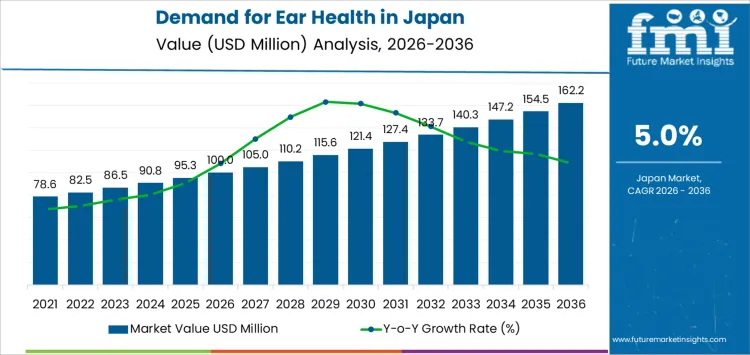
The demand for ear health in Japan is valued at USD 100.0 million in 2026 and is projected to reach USD 162.2 million by 2036, reflecting a CAGR of 5.0%. The increase from USD 78.6 million in 2020 to USD 100.0 million in 2026 is supported by steady use of diagnostic devices, treatment medication, and supplements across audiology centers, ENT clinics, and hospitals. Devices and diagnostic equipment anchor early demand as age related hearing conditions and routine screening volumes grow within clinical settings.
From 2027 onward, values rise from USD 105.0 million to USD 133.7 million by 2031, then advance to USD 162.2 million by 2036 through consistent yearly additions. Hospitals and ENT clinics maintain predictable intake as testing requirements and treatment follow-ups increase. Audiology centers continue to expand device related services, while e commerce contributes moderate growth in supplements and over the counter products. Long term demand reflects demographic trends, structured screening practices, and regular replacement cycles across Japan’s ear care ecosystem.
Quick Stats of the Demand for Ear Health in Japan
- Ear Health Demand in Japan Value (2026): USD 100.0 million
- Ear Health Demand in Japan Forecast Value (2036): USD 162.2 million
- Ear Health Demand in Japan Forecast CAGR (2026-2036): 5.0%
- Ear Health Leading Product: Devices (35%)
- Ear Health Key Growth Regions: Kyushu & Okinawa, Kanto, Kinki
- Ear Health Top Players: Starkey Hearing Technologies, MED-EL, Amplifon, Sivantos Group, Widex A/S
What is the Growth Forecast for Ear Health in Japan through 2036?
Between 2026 and 2031, demand for ear health services and related products in Japan rises from USD 100.0 million to USD 127.4 million, reflecting a steady increase shaped by gradual shifts in outpatient screening patterns and expanded awareness of age-related hearing concerns. Earlier uptake was driven mainly by routine ENT consultations, while the near-term period sees higher utilization of diagnostic devices, more frequent workplace screenings, and incremental adoption of early-stage management tools. Growing recognition of mild hearing impairment and broader clinical outreach programs add momentum within this phase.
From 2031 to 2036, demand increases from USD 127.4 million to USD 162.2 million, marking a more pronounced rise as patient volumes expand across audiology clinics and integrated care centers. This stage benefits from stronger follow-up engagement, broader device upgrade cycles, and rising interest in preventive hearing assessments among older adults. Earlier growth reflected basic service provisioning, while later expansion is shaped by diversified intervention pathways, improved access to specialized testing, and tighter incorporation of hearing evaluations into chronic care management routines. The result is a more consistent and structurally supported growth pattern through 2036.
Ear Health Industry in Japan Key Takeaways
| Metric | Value |
|---|---|
| Industry Value (2026) | USD 100.0 million |
| Forecast Value (2036) | USD 162.2 million |
| Forecast CAGR (2026-2036) | 5.0% |
What Is Driving the Demand for Ear Health Solutions in Japan from 2026 to 2036?
Demand for ear health solutions in Japan has grown alongside demographic shifts and healthcare utilisation patterns that raise prevalence of hearing-related concerns. An ageing population increases incidence of presbycusis and related balance issues, prompting more frequent audiological assessments and intervention. Clinics and hospitals expanded services for tinnitus management, cerumen impaction removal, and screening for sensorineural loss as part of routine check-ups for older adults. Consumer interest in preventive hearing care rose with greater awareness of noise-induced hearing issues and use of personal audio devices among younger adults. Providers emphasised diagnostic accuracy, evidence-based intervention options, and devices that integrate with broader hearing rehabilitation services.
From 2026 to 2036 demand for ear health is expected to strengthen with wider adoption of advanced diagnostic technologies, personalised treatment pathways, and integrated care models. Expansion of reimbursement coverage for hearing tests and assistive devices supports service uptake. Clinics invest in objective measurement tools and comprehensive patient tracking systems to tailor interventions and monitor progression. Growth in tele-audiology services, home-based screening, and remote follow-ups improves accessibility across urban and regional areas. Buyers prioritise solutions that demonstrate clinical reliability, ease of use for practitioners, and seamless data integration with electronic health records. Demand reflects sustained emphasis on quality of life, early detection, and coordinated management of hearing and balance disorders nationwide.
What Is the Demand for Ear Health Products in Japan by Product and Distribution Channel for 2026 to 2036?
The demand for ear health products in Japan from 2026 to 2036 is shaped by rising screening activity, increased awareness of age-related hearing issues, and broader home-care adoption. Devices hold the largest share due to consistent use in hearing assessment and routine monitoring. Audiology centers lead among distribution channels as they serve as structured access points for evaluation, fitting support, and device-related follow-up across urban and regional healthcare networks.
Why do devices account for 35% of the demand for ear health products in Japan by product type from 2026 to 2036?
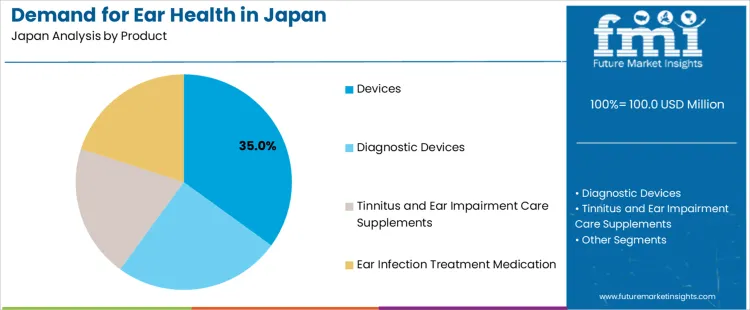
Devices account for 35% of the demand in Japan because screening, early detection, and hearing support rely on tools that provide measurable outputs and stable performance. Consumption increases across older adults, workplace health programs, and school assessments where standardized device-based evaluation remains central. Usage stays steady since devices support repeat measurement and long-term tracking of auditory thresholds. Procurement is driven by buyers seeking calibrated units with reliable signal processing and straightforward maintenance cycles. Price sensitivity stays moderate because device accuracy and durability carry long-term value for users and clinical facilities. Specification control focuses on acoustic stability, ergonomic form, and compatibility with digital record systems. Demand extends through 2026 to 2036 as population aging and structured hearing assessment programs sustain continuous device deployment.
Why do audiology centers represent 30.0% of the demand for ear health products in Japan by distribution channel?
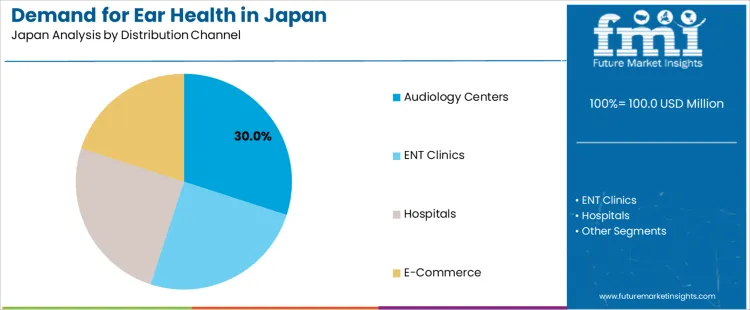
Audiology centers represent 30.0% of the demand because they function as primary points of evaluation and follow-up for hearing concerns across different age groups. Consumption rises as individuals seek detailed assessments supported by calibrated equipment and trained professionals. Usage remains steady since audiology centers provide consistent guidance on device selection, adjustment, and maintenance, which strengthens long-term engagement. Procurement is shaped by facilities selecting products that align with diagnostic protocols and fitting workflows. Price sensitivity stays moderate because centers prioritize reliability and compatibility with clinical procedures. Specification control highlights acoustic accuracy, calibration support, and integration with patient management records. Demand persists from 2026 to 2036 as audiology services maintain structured screening pathways and support continued management of hearing impairment across Japan.
How Is Demand for Ear Health Services in Japan Developing Across Local Clinical and Community Settings?
Demand grows through Japan’s hospitals, clinics, schools, and elder care programs that address hearing concerns linked to aging and daily noise exposure. ENT clinics in Osaka see rising visits for balance and hearing checks among older residents. Community centers in Chiba host screening days that identify early issues among working adults. School nurses in Fukuoka request evaluations for children with recurring infections. Elder care homes in Kanagawa coordinate assessments for residents with communication difficulties. These activities reflect practical needs shaped by Japan’s local care routines.
Which Local Healthcare Patterns Are Driving Demand for Ear Health Services in Japan?
Drivers emerge from clinical routines shaped by Japan’s demographic structure and community programs. Hospitals in Sapporo request hearing evaluations during geriatric assessments for older patients. Clinics in Kyoto see increased visits related to ear discomfort linked to seasonal allergies. School health units in Nagoya request screenings for children with lingering middle ear infections. Elder care centers in Shizuoka coordinate checks for residents with reduced speech recognition during daily interactions. These needs come from everyday care patterns that focus on communication, balance, and infection management within Japan’s diverse local settings.
What Local Constraints Are Limiting Wider Use of Ear Health Services in Japan?
Barriers relate to staffing limits, service access, and established routines. Clinics in rural prefectures lack dedicated ENT specialists, which restricts regular screening. Hospitals in older buildings face room shortages that limit expanded audiology units. School health programs in smaller towns work with tight budgets, which narrows screening frequency. Elder care homes with limited nursing staff rely on external providers, creating scheduling delays. Community centers in remote areas report long travel times to urban hospitals for advanced evaluations. These conditions lead to uneven access across regions with varied resources and facility capacities.
What is the Demand for Ear Health Solutions in Japan by Region?
| Region | CAGR (%) |
|---|---|
| Kyushu & Okinawa | 6.2% |
| Kanto | 5.7% |
| Kinki | 5.0% |
| Chubu | 4.4% |
| Tohoku | 3.9% |
| Rest of Japan | 3.7% |
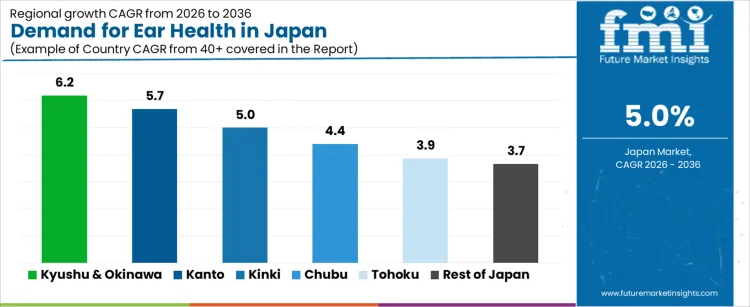
The demand for ear health solutions in Japan is increasing gradually as awareness of hearing care, diagnostic accessibility, and preventive ENT services expands. Kyushu and Okinawa lead at a 6.2% CAGR, supported by regional screening programs, rising adoption of hearing aids, and wider ENT clinic availability. Kanto follows at 5.7%, driven by urban healthcare infrastructure, higher patient volumes, and strong presence of audiology centers. Kinki records 5.0% growth, reflecting steady use of diagnostic and assistive hearing technologies across hospitals and private clinics. Chubu at 4.4% shows moderate uptake shaped by aging populations and growing ENT service networks. Tohoku and the Rest of Japan, at 3.9% and 3.7%, reflect slower growth influenced by fewer specialized clinics and more limited access to advanced hearing care devices.
How Is Medical Activity Shaping Ear Health Demand Across Kyushu and Okinawa?
Demand for ear health services and products in Kyushu and Okinawa is rising at a CAGR of 6.2% from 2026 to 2036 as clinics, hospitals, and community health programs address age related hearing concerns and diagnostic needs. Clinics provide routine evaluations for patients with early stage issues. Hospitals conduct structured assessments for complex cases that require specialist input. Community health programs engage residents through screening events that identify untreated conditions. Growth reflects steady participation across medical settings that manage hearing care with practical clinical workflows.
- Clinics conduct routine evaluations
- Hospitals manage complex assessments
- Community programs run screening activity
What Drives Ear Health Requirements Across Kanto?
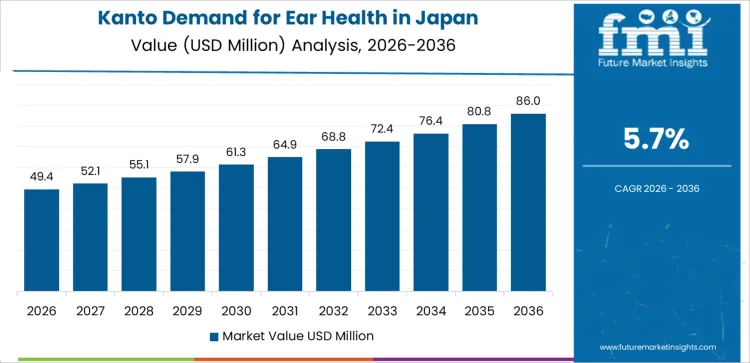
Demand for ear health services in Kanto is advancing at a CAGR of 5.7% from 2026 to 2036 as urban clinics, hospital networks, and research linked centers expand hearing related evaluations. Urban clinics treat diverse patient groups with regular diagnostic checks. Hospital networks manage structured care plans that support long term hearing management. Research linked centers run targeted studies that involve specialized assessments. Growth aligns with a large regional population that seeks accessible diagnostic and treatment pathways.
- Clinics manage routine checks
- Hospitals maintain long term care plans
- Research centers run targeted studies
How Are Clinical Practices Shaping Ear Health Demand in Kinki?
Demand for ear health services in Kinki is rising at a CAGR of 5.0% from 2026 to 2036 as outpatient centers, university hospitals, and rehabilitation units integrate structured hearing evaluations into patient care. Outpatient centers offer screening tests for early conditions. University hospitals support multidisciplinary diagnostics for complex auditory disorders. Rehabilitation units provide follow up programs that support hearing aid adaptation. Growth reflects collaborative participation across institutions that manage a wide range of hearing needs.
- Outpatient centers run screening tests
- University hospitals manage advanced diagnostics
- Rehabilitation units support adaptation programs
Which Factors Influence Ear Health Demand Across Chubu?
Demand for ear health services in Chubu is progressing at a CAGR of 4.4% from 2026 to 2036 as hospitals, clinics, and health outreach groups coordinate evaluations for regional populations. Hospitals examine patients who require structured diagnostic review. Clinics provide follow up care for age related hearing decline. Outreach groups support community based engagement for underserved residents. Growth reflects methodical clinical activity across locations that rely on established medical processes.
- Hospitals conduct structured diagnostics
- Clinics manage follow up care
- Outreach groups engage communities
How Do Regional Care Patterns Shape Ear Health Demand in Tohoku?
Demand for ear health services in Tohoku is increasing at a CAGR of 3.9% from 2026 to 2036 as clinics, hospitals, and local health units respond to growing screening needs. Clinics perform assessments for patients presenting with early symptoms. Hospitals evaluate cases requiring specialist involvement. Local health units organize screening tasks for remote communities. Growth reflects consistent reliance on clinical pathways across regions with dispersed populations.
- Clinics perform early assessments
- Hospitals support specialist review
- Health units organize screening tasks
What Supports Ear Health Service Use Across Rest of Japan?
Demand for ear health services in Rest of Japan is expanding at a CAGR of 3.7% from 2026 to 2036 as small clinics, regional hospitals, and wellness programs manage hearing related evaluations. Small clinics assess patients with routine checks. Regional hospitals address intermediate and complex cases. Wellness programs conduct community focused hearing activities. Growth reflects practical medical engagement across diverse localities.
- Clinics handle routine checks
- Hospitals address complex cases
- Wellness programs run community activities
What Is Driving the Demand for Ear Health in Japan and Which Companies Shape Clinical and Retail Access?
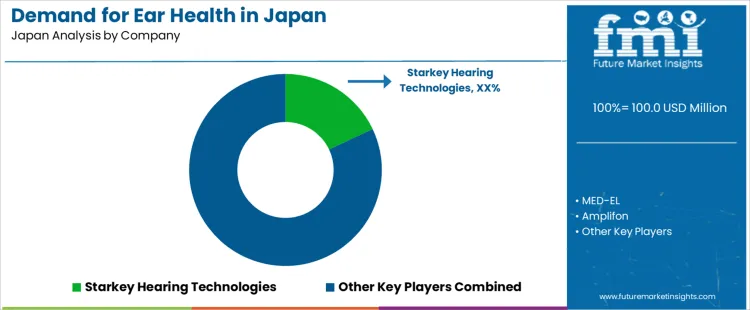
The demand for ear health in Japan is shaped by an aging population, expanded screening in community clinics, and strong uptake of digital hearing devices among adults seeking conversational clarity in daily life. Domestic audiology centers handle most fittings and follow up care, linking patients to devices suited to crowded urban sound environments. Starkey Hearing Technologies participates through advanced hearing aids adopted in private clinics that emphasize comfort and discreet form factors. MED EL supports cochlear implant programs in university hospitals treating severe hearing loss across pediatric and adult cases. Amplifon influences consumer pathways through nationwide retail centers that guide device selection and long term adjustment. Sivantos Group contributes through widely used digital platforms fitted by audiologists in regional clinics. Widex A S supports premium devices known for sound naturalness across speech heavy environments.
Care selection in Japan is governed by fitting precision, battery life, streaming stability, and comfort for long daily use. Clinics emphasize clear speech reproduction in rail stations, shops, and offices with constant background noise. Patients favor devices that pair easily with smartphones and offer reliable maintenance support. Cochlear implant programs focus on surgical coordination, rehabilitation planning, and predictable outcomes supported by detailed patient counseling. Retail centers highlight trial periods and consistent aftercare. Demand visibility tracks growth in routine hearing checks, awareness campaigns conducted by public health groups, and steady increase in device adoption among adults who seek improved communication at work and home. Use expands through medical centers, audiology chains, and home visit services in suburban and rural areas.
Key Players in Ear Health Industry in Japan
- Starkey Hearing Technologies
- MED-EL
- Amplifon
- Sivantos Group
- Widex A/S
Scope of the Report
| Items | Values |
|---|---|
| Quantitative Units (2026) | USD million |
| Product | Devices; Diagnostic Devices; Tinnitus and Ear Impairment Care Supplements; Ear Infection Treatment Medication |
| Distribution Channel | Audiology Centers; ENT Clinics; Hospitals; E Commerce |
| Regions Covered | Kyushu & Okinawa; Kanto; Kansai; Chubu; Tohoku; Rest of Japan |
| Countries Covered | Japan |
| Key Companies Profiled | Starkey Hearing Technologies; MED EL; Amplifon; Sivantos Group; Widex A/S |
| Additional Attributes | Dollar by sales across product categories and distribution channels; diagnostic usage patterns; device fitting and replacement cycles; screening program participation; clinical workflow integration; community outreach screening metrics; patient follow-up patterns; retail and clinical service utilization; tele-audiology adoption levels; regional access variations. |
Ear Health Industry in Japan Segmentation
Product:
- Devices
- Diagnostic Devices
- Tinnitus and Ear Impairment Care Supplements
- Ear Infection Treatment Medication
Distribution Channel:
- Audiology Centers
- ENT Clinics
- Hospitals
- E-Commerce
Region:
- Kyushu & Okinawa
- Kanto
- Kansai
- Chubu
- Tohoku
- Rest of Japan
Frequently Asked Questions
How big is the demand for ear health in Japan in 2026?
The demand for ear health in Japan is estimated to be valued at USD 100.0 million in 2026.
What will be the size of ear health in Japan in 2036?
The market size for the ear health in Japan is projected to reach USD 162.2 million by 2036.
How much will be the demand for ear health in Japan growth between 2026 and 2036?
The demand for ear health in Japan is expected to grow at a 5.0% CAGR between 2026 and 2036.
What are the key product types in the ear health in Japan?
The key product types in ear health in Japan are devices, diagnostic devices, tinnitus and ear impairment care supplements and ear infection treatment medication.
Which distribution channel segment is expected to contribute significant share in the ear health in Japan in 2026?
In terms of distribution channel, audiology centers segment is expected to command 30.0% share in the ear health in Japan in 2026.
Preview the report firsthand - request a free sample
Get SampleGet the brochure for pricing and purchase details.
Get PDFTable of Content
- Executive Summary
- Japan Market Outlook
- Demand-side Trends
- Supply-side Trends
- Technology Roadmap Analysis
- Analysis and Recommendations
- Market Overview
- Market Coverage / Taxonomy
- Market Definition / Scope / Limitations
- Market Background
- Market Dynamics
- Drivers
- Restraints
- Opportunity
- Trends
- Scenario Forecast
- Demand in Optimistic Scenario
- Demand in Likely Scenario
- Demand in Conservative Scenario
- Opportunity Map Analysis
- Product Life Cycle Analysis
- Supply Chain Analysis
- Investment Feasibility Matrix
- Value Chain Analysis
- PESTLE and Porter’s Analysis
- Regulatory Landscape
- Regional Parent Market Outlook
- Production and Consumption Statistics
- Import and Export Statistics
- Market Dynamics
- Japan Market Analysis 2020 to 2024 and Forecast, 2025 to 2035
- Historical Market Size Value (USD Million) Analysis, 2020 to 2024
- Current and Future Market Size Value (USD Million) Projections, 2025 to 2035
- Y-o-Y Growth Trend Analysis
- Absolute $ Opportunity Analysis
- Japan Market Pricing Analysis 2020 to 2024 and Forecast 2025 to 2035
- Japan Market Analysis 2020 to 2024 and Forecast 2025 to 2035, By Product
- Introduction / Key Findings
- Historical Market Size Value (USD Million) Analysis By Product , 2020 to 2024
- Current and Future Market Size Value (USD Million) Analysis and Forecast By Product , 2025 to 2035
- Devices
- Diagnostic Devices
- Tinnitus and Ear Impairment Care Supplements
- Ear Infection Treatment Medication
- Y-o-Y Growth Trend Analysis By Product , 2020 to 2024
- Absolute $ Opportunity Analysis By Product , 2025 to 2035
- Japan Market Analysis 2020 to 2024 and Forecast 2025 to 2035, By Distribution Channel
- Introduction / Key Findings
- Historical Market Size Value (USD Million) Analysis By Distribution Channel, 2020 to 2024
- Current and Future Market Size Value (USD Million) Analysis and Forecast By Distribution Channel, 2025 to 2035
- Audiology Centers
- ENT Clinics
- Hospitals
- E-Commerce
- Y-o-Y Growth Trend Analysis By Distribution Channel, 2020 to 2024
- Absolute $ Opportunity Analysis By Distribution Channel, 2025 to 2035
- Market Structure Analysis
- Competition Dashboard
- Competition Benchmarking
- Market Share Analysis of Top Players
- By Regional
- By Product
- By Distribution Channel
- Competition Analysis
- Competition Deep Dive
- Starkey Hearing Technologies
- Overview
- Product Portfolio
- Profitability by Market Segments (Product/Age /Sales Channel/Region)
- Sales Footprint
- Strategy Overview
- Marketing Strategy
- Product Strategy
- Channel Strategy
- MED-EL
- Amplifon
- Sivantos Group
- Widex A/S
- Starkey Hearing Technologies
- Competition Deep Dive
- Assumptions & Acronyms Used
- Research Methodology


