

- Industry Size (2026)
- USD 690.9 Mn
- Forecast (2036)
- USD 1269.2 Mn
- CAGR (2026 to 2036)
- 6.3%
Demand for Ear Health in USA 2026 to 2036
The USA ear health demand is valued at USD 690.9 million in 2026 and is forecasted to reach USD 1,269.2 million by 2036, reflecting a CAGR of 6.3%. Growth is driven by rising prevalence of age-related hearing loss, broader adoption of hearing assistance technologies, and increased screening in primary care settings. Expanded consumer awareness of early intervention and wider insurance support strengthen uptake across clinical and retail channels.
Devices lead the product segment because advanced hearing aids, cochlear implants, and diagnostic instruments deliver improved sound processing, noise reduction, and user comfort. Miniaturization, Bluetooth connectivity, and rechargeable power systems enhance daily usability. Continuous innovation in digital signal processing supports clearer speech recognition and better performance in challenging acoustic environments.
The West, South, and Northeast regions show strong demand due to large aging populations, extensive audiology networks, and high adoption of hearing wellness programs. Key suppliers include Starkey Hearing Technologies, MED-EL, Amplifon, Sivantos Group, and Widex A/S. Their strategies focus on AI-driven sound personalization, integrated remote care platforms, and expanded device portfolios that support early detection and long-term hearing management.
Quick Stats for USA Ear Health Demand
- USA Ear Health Sales Value (2026): USD 690.9 million
- USA Ear Health Forecast Value (2036): USD 1,269.2 million
- USA Ear Health Forecast CAGR (2026-2036): 6.3%
- Leading Product Segment in USA Ear Health Demand: Devices
- Key Growth Regions in USA Ear Health Demand: West USA, South USA, Northeast USA
- Top Players in USA Ear Health Demand: Starkey Hearing Technologies, MED-EL, Amplifon, Sivantos Group, Widex A/S
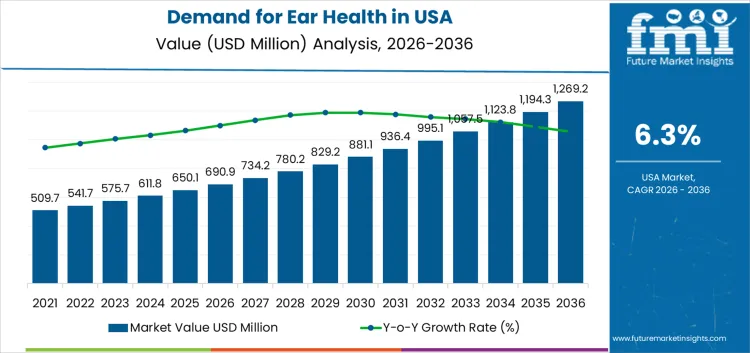
What is the Growth Forecast for Ear Health Industry in USA through 2036?
The growth rate volatility index for ear health demand in the United States reflects variation shaped by seasonal illness patterns, diagnostic utilization, and insurance-linked care behavior. Volatility remains moderate because routine audiology assessments, hearing aid fittings, and chronic condition monitoring follow stable annual cycles across primary care and specialty clinics. These services create a baseline that limits extreme fluctuations. Short-term volatility appears when respiratory infection rates shift, since otitis-related visits increase during higher viral circulation. These cycles introduce identifiable peaks that elevate the index during specific months.
Variation also emerges from discretionary care, especially in segments where patients delay hearing evaluations or device upgrades during periods of economic uncertainty. This behavior produces intermittent softening in growth that contributes to trough periods within the index. Expanded adoption of screening programs in schools and senior care environments increases ordering consistency, although implementation varies by region, creating uneven contributions to volatility.
Technological updates in diagnostic equipment and hearing devices introduce procurement shifts among providers, generating irregular growth spurts during upgrade cycles. These spurts increase short-term index movement. The pattern shows a mix of stable routine demand with identifiable seasonal and economic fluctuations that shape moderate volatility across ear health services in the domestic environment.
USA Ear Health Key Takeaways
| Metric | Value |
|---|---|
| USA Ear Health Sales Value (2026) | USD 690.9 million |
| USA Ear Health Forecast Value (2036) | USD 1,269.2 million |
| USA Ear Health Forecast CAGR (2026-2036) | 6.3% |
Why is the Demand for Ear Health in USA Growing?
Demand for ear health services and related interventions in the United States increases due to rising prevalence of hearing impairment, tinnitus, and age related auditory decline. An aging population drives steady utilization of diagnostic evaluations, hearing aids, and therapeutic procedures. Broader exposure to high noise environments contributes to early onset hearing challenges among younger adults, which increases screening volumes across primary care and audiology clinics. Growth in chronic conditions that influence auditory function, including diabetes and cardiovascular disorders, increases referrals for comprehensive ear assessments.
Occupational health programs maintain regular testing for workers in manufacturing, construction, aviation, and transportation. Pediatric hearing evaluations expand due to strengthened guidelines for early detection of congenital and developmental auditory issues. Wider public awareness of the impact of untreated hearing loss supports consistent engagement with audiologists and otolaryngologists. Advancements in digital hearing technologies encourage adoption among individuals seeking improved communication in remote and hybrid work settings. Teleaudiology platforms extend access to hearing consultations across rural regions. Insurance coverage improvements for diagnostic services reinforce routine evaluation patterns within clinical networks.
Which Product and Distribution Channel Segments Lead Demand for Ear Health in USA?
Demand for ear health solutions in the USA is shaped by rising awareness of hearing impairment, aging demographics, and increased screening across clinical and retail settings. Buyers evaluate device accuracy, treatment accessibility, and diagnostic depth. Adoption patterns reflect the prevalence of tinnitus, infection cases, and chronic auditory conditions requiring continuous monitoring. Distribution aligns with specialized clinical capacity, retail accessibility, and patient preferences.
By Product, Devices Account for the Largest Share of Demand
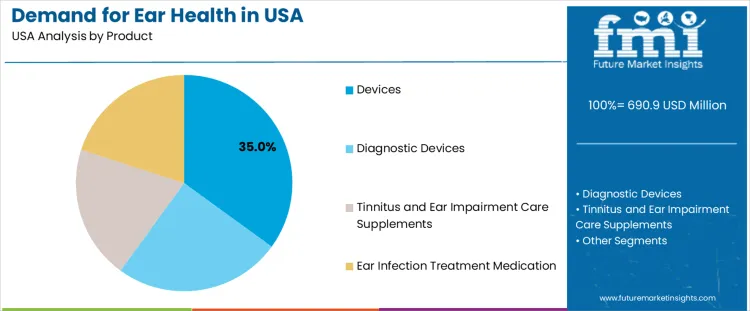
Devices hold 35.0%, making them the leading product segment in USA ear health demand. This category includes hearing devices and related tools that support amplification, monitoring, and sound-quality correction for individuals with mild to severe impairment. Diagnostic devices hold 25.0%, driven by screening needs in audiology and ENT practices that rely on tympanometry, audiometry, and objective testing technologies. Tinnitus and ear impairment care supplements hold 20.0%, supporting symptom management and nutritional support strategies. Ear infection treatment medication holds 20.0%, reflecting prescription and over-the-counter use across acute and recurrent infections. Distribution reflects clinical reliance on devices and structured diagnostic workflows.
Key Points:
- Devices address hearing loss and monitoring needs.
- Diagnostic tools support structured auditory evaluation.
- Supplements and medications address symptomatic and infection-related needs.
- Product use aligns with impairment severity and clinical protocols.
By Distribution Channel, Audiology Centers Represent the Largest Segment
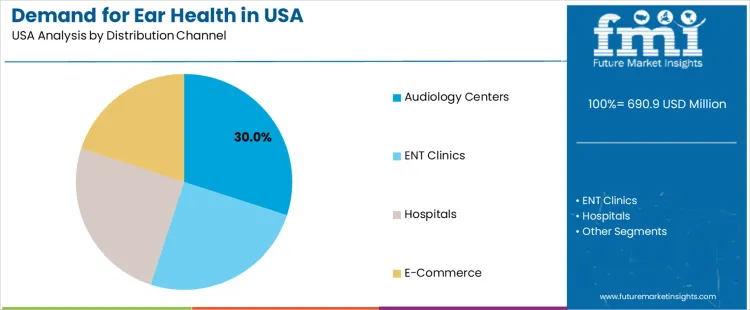
Audiology centers hold 30.0%, making them the leading distribution channel in USA ear health. These centers provide specialized assessments, device fitting, and long-term management for auditory conditions. ENT clinics and hospitals each hold 25.0%, supporting diagnostic evaluations, medical interventions, and infection treatment under physician-led care. E-commerce holds 20.0%, reflecting increased availability of supplements, basic devices, and over-the-counter treatment options. Distribution reflects the balance between specialized diagnostic capacity, clinical expertise, and consumer-driven purchasing.
Key Points:
- Audiology centers lead due to specialized testing and fitting services.
- ENT clinics and hospitals support medical diagnosis and treatment.
- E-commerce expands access for supplements and basic devices.
- Channel selection depends on condition severity and required expertise.
What are the Key Dynamics in the Ear Health Industry?
Aging demographics, preventive care adoption, and increased diagnostic activity are driving demand.
Demand increases as the US population experiences higher prevalence of age-related hearing loss, which raises utilization of screening and treatment services across audiology clinics. Primary care practices expand routine ear examinations to manage conditions such as cerumen impaction, otitis media, and tinnitus. Employers in manufacturing and logistics implement occupational hearing conservation programs that require regular audiometric testing. Paediatric practices maintain high volumes of visits for ear infections that require evaluation and follow-up. Hearing aid providers support expanded fitting services driven by rising awareness of early intervention benefits. Retail health clinics adopt point-of-care otoscopy tools that improve access in community settings.
Cost barriers, service access gaps, and device maintenance needs restrain broader utilization.
Patients encounter out-of-pocket expenses for hearing aids and diagnostic evaluations when insurance coverage varies across states and payer categories. Rural regions report limited availability of audiologists and otolaryngologists, which increases travel requirements for appointments. Clinics experience workflow pressure when scheduling follow-ups for chronic ear conditions. Device users face recurring costs for batteries, repairs, and calibration. Paediatric populations require specialized assessment environments that smaller practices cannot consistently support. Public programs maintain eligibility rules that restrict timely access to advanced hearing devices. Several facilities report equipment replacement delays that affect testing throughput.
Over-the-counter devices, tele-audiology expansion, and data-driven diagnostics shape current trends.
US consumers adopt over-the-counter hearing devices following regulatory approval frameworks that permit direct-to-consumer availability. Tele-audiology platforms support remote hearing assessments, counselling, and device adjustments for patients with mobility or geographic constraints. Clinics invest in digital otoscopy systems that enable image documentation and collaborative review. Hearing care providers evaluate rechargeable and smartphone-integrated devices that improve usability. Occupational health programs implement electronic tracking of audiometric data to support compliance reporting. Paediatric centres explore automated screening tools that standardize early detection workflows. Retail health networks expand hearing service offerings aligned with increasing consumer demand for convenient access.
Analysis of the Demand for Ear Health Services and Products in the USA by Region
Demand for ear health services and products in the USA is rising due to growing awareness of hearing care, expanding aging populations, and broader adoption of diagnostic and preventive solutions. West USA records a CAGR of 7.2% supported by extensive clinical networks and strong uptake of hearing-related evaluations. South USA shows a 6.5% CAGR driven by expanding healthcare access and higher screening volumes. Northeast USA posts a 5.8% CAGR due to dense specialty-care facilities and regulated diagnostic practices. Midwest USA holds a 5.0% CAGR supported by stable clinical infrastructure and consistent demand for hearing assessments and treatment pathways.
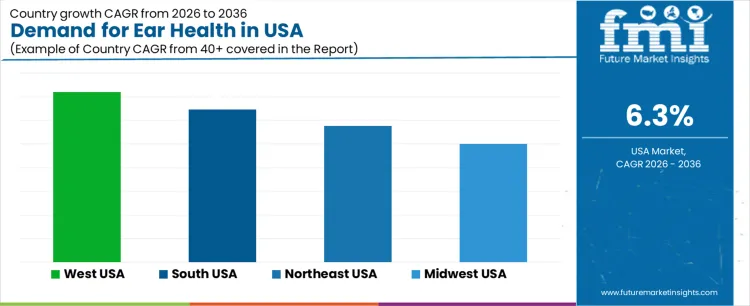
| Region | CAGR (2026-2036) |
|---|---|
| West USA | 7.2% |
| South USA | 6.5% |
| Northeast USA | 5.8% |
| Midwest USA | 5.0% |
How is the West USA driving demand for Ear Health?
West USA drives demand through its extensive healthcare ecosystem, which supports routine hearing assessments, diagnostic imaging, and treatment services. The region’s CAGR of 7.2% reflects high utilization of audiology clinics, ENT practices, and community health programs addressing age-related hearing decline and noise exposure. Large outpatient networks conduct frequent screenings linked to preventive-care initiatives. Technology-driven clinics support adoption of hearing devices and digital diagnostic platforms. Regional public-health programs promote early detection of hearing difficulties, sustaining consistent clinical volumes. Strong participation in wellness programs ensures ongoing engagement with ear health services.
- High availability of audiology and ENT facilities
- Frequent preventive screenings across outpatient networks
- Adoption of digital diagnostic and hearing-support tools
- Strong public-health engagement promoting early detection
How is the South USA driving demand for Ear Health?
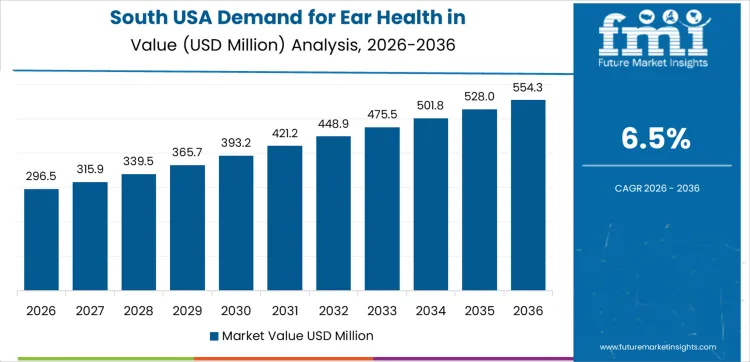
South USA supports rising demand due to expanding healthcare coverage, population growth, and increased screening for conditions affecting ear function. The region’s CAGR of 6.5% reflects steady use of diagnostic evaluations for hearing loss, middle-ear disorders, and chronic infections. Outpatient centers conduct regular assessments for pediatric and adult populations. Growth in senior demographics increases utilization of hearing-aid services and follow-up care. Primary-care practices integrate structured hearing checks into routine health visits. ENT specialists maintain strong procedure volumes tied to clinical management of persistent ear-related conditions.
- Expanding outpatient and primary-care screening
- Growing senior population requiring ongoing hearing care
- Stable utilization of ENT services for chronic conditions
- Routine hearing evaluations across community clinics
How is the Northeast USA driving demand for Ear Health?
Northeast USA drives demand due to its dense clinical networks, high diagnostic capacity, and regulated care pathways addressing hearing and balance-related conditions. The region’s CAGR of 5.8% reflects continuous use of audiology assessments, advanced imaging, and specialist-led evaluations. Hospitals and academic medical centers support large patient volumes requiring comprehensive diagnostic work. Pediatric screening programs maintain structured protocols for early detection. Strong adoption of clinical guidelines ensures consistent management of otologic conditions. Steady reliance on hearing devices and rehabilitative services contributes to ongoing demand.
- Dense hospital and specialty-care infrastructure
- High diagnostic throughput for hearing and balance disorders
- Established pediatric screening requirements
- Consistent adoption of rehabilitative hearing solutions
How is the Midwest USA driving demand for Ear Health?
Midwest USA maintains stable demand due to its broad network of hospitals, community clinics, and hearing-care providers supporting routine ear health evaluations. The region’s CAGR of 5.0% reflects consistent utilization of screening services for age-related hearing decline, infection management, and noise-related disorders. Outpatient facilities maintain predictable volumes of audiology appointments. Workplace screenings contribute to additional testing activity where occupational noise exposure is present. Hearing-aid centers support steady adoption of assistive devices. Regional healthcare systems rely on structured diagnostic pathways to support long-term hearing management.
- Broad community and hospital-based screening access
- Routine audiology visits across adult and senior populations
- Workplace screening supporting detection of noise-related issues
- Consistent adoption of hearing-support devices
What is the competitive landscape of the demand for ear health solutions in the USA?
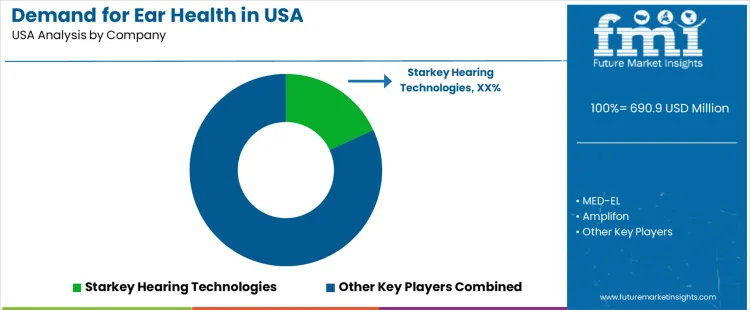
Demand for ear health solutions in the USA is shaped by rising diagnostic activity, increased use of hearing devices, and broader screening initiatives across clinical and retail environments. Buyers evaluate device reliability, fitting precision, acoustic performance, and compatibility with digital signal processing platforms. Procurement teams consider customer support structures, audiology service networks, and software tools used for individualized hearing assessments. Adoption patterns reflect growing demand among older adults, expanded insurance coverage, and heightened awareness of early hearing intervention supported by clinical guidelines.
Starkey Hearing Technologies holds a leading position driven by advanced acoustic algorithms, custom earmold manufacturing, and strong partnerships with audiology clinics across the United States. MED-EL participates with implantable hearing systems designed for patients with severe or complex auditory conditions requiring advanced stimulation solutions. Amplifon maintains visibility through a broad retail network offering assessments, fitting, and follow-up services. Sivantos Group contributes digital hearing aid platforms used by independent audiology practices and clinical providers. Widex supports demand with sophisticated signal processing, tinnitus management features, and wireless connectivity. Competitive positioning reflects engineering expertise, service accessibility, fitting software capabilities, and broad distribution across clinical and consumer channels.
Key Players in USA Ear Health Demand
- Starkey Hearing Technologies
- MED-EL
- Amplifon
- Sivantos Group
- Widex A/S
Scope of the Report
| Items | Values |
|---|---|
| Quantitative Units | USD million |
| Classification | Devices, Diagnostic Devices, Tinnitus and Ear Impairment Care Supplements, Ear Infection Treatment Medication |
| Application | Audiology Centers, ENT Clinics, Hospitals, E-Commerce |
| Regions Covered | West USA, South USA, Northeast USA, Midwest USA |
| Countries Covered | USA (primary), plus applicability across comparable global benchmarks such as India, China, Germany, South Korea, Japan, Italy, and 40+ countries |
| Key Companies Profiled | Starkey Hearing Technologies, MED-EL, Amplifon, Sivantos Group, Widex A/S |
| Additional Attributes | Dollar sales by product category and distribution channels; regional adoption differences in West, South, Northeast, and Midwest USA; competitive landscape of hearing devices, supplements, and infection-care medications; growth in ENT clinical diagnostics and tele-audiology solutions; integration of digital hearing devices, Bluetooth-enabled systems, and remote hearing assessment platforms. |
USA Ear Health Demand by Segments
Product:
- Devices
- Diagnostic Devices
- Tinnitus and Ear Impairment Care Supplements
- Ear Infection Treatment Medication
Distribution Channel:
- Audiology Centers
- ENT Clinics
- Hospitals
- E-Commerce
Region:
- West USA
- South USA
- Northeast USA
- Midwest USA
Frequently Asked Questions
How big is the demand for ear health in USA in 2026?
The demand for ear health in USA is estimated to be valued at USD 690.9 million in 2026.
What will be the size of ear health in USA in 2036?
The market size for the ear health in USA is projected to reach USD 1,269.2 million by 2036.
How much will be the demand for ear health in USA growth between 2026 and 2036?
The demand for ear health in USA is expected to grow at a 6.3% CAGR between 2026 and 2036.
What are the key product types in the ear health in USA?
The key product types in ear health in USA are devices, diagnostic devices, tinnitus and ear impairment care supplements and ear infection treatment medication.
Which distribution channel segment is expected to contribute significant share in the ear health in USA in 2026?
In terms of distribution channel, audiology centers segment is expected to command 30.0% share in the ear health in USA in 2026.
Preview the report firsthand - request a free sample
Get SampleGet the brochure for pricing and purchase details.
Get PDFTable of Content
- Executive Summary
- USA Market Outlook
- Demand-side Trends
- Supply-side Trends
- Technology Roadmap Analysis
- Analysis and Recommendations
- Market Overview
- Market Coverage / Taxonomy
- Market Definition / Scope / Limitations
- Market Background
- Market Dynamics
- Drivers
- Restraints
- Opportunity
- Trends
- Scenario Forecast
- Demand in Optimistic Scenario
- Demand in Likely Scenario
- Demand in Conservative Scenario
- Opportunity Map Analysis
- Product Life Cycle Analysis
- Supply Chain Analysis
- Investment Feasibility Matrix
- Value Chain Analysis
- PESTLE and Porter’s Analysis
- Regulatory Landscape
- Regional Parent Market Outlook
- Production and Consumption Statistics
- Import and Export Statistics
- Market Dynamics
- USA Market Analysis 2020 to 2024 and Forecast, 2025 to 2035
- Historical Market Size Value (USD Million) Analysis, 2020 to 2024
- Current and Future Market Size Value (USD Million) Projections, 2025 to 2035
- Y-o-Y Growth Trend Analysis
- Absolute $ Opportunity Analysis
- USA Market Pricing Analysis 2020 to 2024 and Forecast 2025 to 2035
- USA Market Analysis 2020 to 2024 and Forecast 2025 to 2035, By Product
- Introduction / Key Findings
- Historical Market Size Value (USD Million) Analysis By Product , 2020 to 2024
- Current and Future Market Size Value (USD Million) Analysis and Forecast By Product , 2025 to 2035
- Devices
- Diagnostic Devices
- Tinnitus and Ear Impairment Care Supplements
- Ear Infection Treatment Medication
- Y-o-Y Growth Trend Analysis By Product , 2020 to 2024
- Absolute $ Opportunity Analysis By Product , 2025 to 2035
- USA Market Analysis 2020 to 2024 and Forecast 2025 to 2035, By Distribution Channel
- Introduction / Key Findings
- Historical Market Size Value (USD Million) Analysis By Distribution Channel, 2020 to 2024
- Current and Future Market Size Value (USD Million) Analysis and Forecast By Distribution Channel, 2025 to 2035
- Audiology Centers
- ENT Clinics
- Hospitals
- E-Commerce
- Y-o-Y Growth Trend Analysis By Distribution Channel, 2020 to 2024
- Absolute $ Opportunity Analysis By Distribution Channel, 2025 to 2035
- Market Structure Analysis
- Competition Dashboard
- Competition Benchmarking
- Market Share Analysis of Top Players
- By Regional
- By Product
- By Distribution Channel
- Competition Analysis
- Competition Deep Dive
- Starkey Hearing Technologies
- Overview
- Product Portfolio
- Profitability by Market Segments (Product/Age /Sales Channel/Region)
- Sales Footprint
- Strategy Overview
- Marketing Strategy
- Product Strategy
- Channel Strategy
- MED-EL
- Amplifon
- Sivantos Group
- Widex A/S
- Starkey Hearing Technologies
- Competition Deep Dive
- Assumptions & Acronyms Used
- Research Methodology


