

- Industry Size (2026):
- USD 9.8 Mn
- Forecast (2036)
- USD 37.6 Mn
- CAGR (2026 to 2036)
- 13.0%
Demand for Egg Substitute in Japan Forecast and Outlook 2026 to 2036
The demand for egg substitute in Japan is valued at USD 9.8 million in 2026 and is projected to reach USD 37.6 million by 2036, reflecting a CAGR of 13.0%. The increase from USD 4.7 million in 2020 to USD 9.8 million in 2026 is supported by gradual adoption across bakery, household cooking, and packaged food applications. Dry formats lead early use due to longer shelf life. Plant based sources dominate as dairy proteins, starches, algal flour, and soy ingredients meet varied formulation needs.
From 2027 onward, values rise from USD 9.8 million to USD 18.0 million by 2031, then reach USD 37.6 million by 2036 through widening yearly gains. Hypermarkets and departmental stores anchor distribution as product ranges broaden, while convenience stores support small pack rotations. Liquid variants gain measured traction in commercial kitchens. Growth reflects increased recipe substitution, broader diet preferences, and consistent reformulation activity across Japan’s food industry. Annual value movement remains strong across the forecast horizon.
Quick Stats of the Demand for Egg Substitute in Japan:
- Egg Substitute Demand in Japan Value (2026): USD 9.8 million
- Egg Substitute Demand in Japan Forecast Value (2036): USD 37.6 million
- Egg Substitute Demand in Japan Forecast CAGR (2026–2036): 13.0%
- Egg Substitute Leading Form: Dry (60%)
- Egg Substitute Key Growth Regions: Kyushu & Okinawa, Kanto, Kinki
- Egg Substitute Top Players: Tate and Lyle and Ingredion Inc., Corbion Puratos, Danone Nutricia, Florida Food Products LLC, Fiberstar Inc.
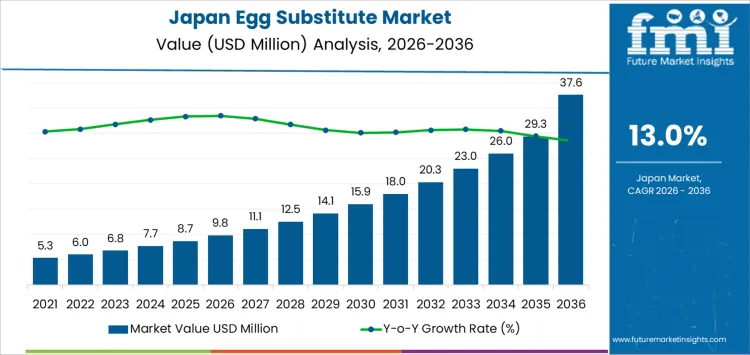
What is the Growth Forecast for Egg Substitute in Japan through 2036?
Between 2026 and 2031, demand for egg substitutes in Japan rises from USD 9.8 million to USD 15.9 million, reflecting a sharp early-stage climb driven by experimentation in bakery, confectionery, and ready-meal formulations. Earlier demand was shaped by niche health-driven consumers, but the near-term phase shows broader traction as manufacturers test allergen-free, shelf-stable, and plant-derived binding options. Expansion during this interval is propelled by pilot integrations in foodservice chains, gradual reformulation of baked goods, and increasing interest in alternative ingredients for portion-controlled packaged foods.
From 2031 to 2036, demand increases from USD 15.9 million to USD 37.6 million, indicating a markedly steeper trajectory as usage shifts from trial to routine incorporation. This period sees wider acceptance across industrial food processors, rising adoption in home-cooking categories, and greater product consistency that allows for more reliable substitution in large-scale production. Earlier growth reflected category testing, while later expansion is shaped by structured product line redesign, extended distribution in supermarkets, and stronger procurement by manufacturers seeking predictable emulsification and texture performance. The category develops from a specialty option into a recognized functional ingredient across Japan’s processed food landscape.
Egg Substitute Industry in Japan Key Takeaways
| Metric | Value |
|---|---|
| Industry Value (2026) | USD 9.8 million |
| Forecast Value (2036) | USD 37.6 million |
| Forecast CAGR (2026–2036) | 13.0% |
What Is Driving the Demand for Egg Substitutes in Japan from 2026 to 2036?
Demand for egg substitutes in Japan has grown with rising interest in plant-based diets, food allergies, and ingredient versatility among home cooks and food manufacturers. Consumers seeking alternatives to conventional eggs selected products made from pulses, starches, and formulated proteins to replicate binding and emulsifying functions in baked goods, dressings, and prepared foods. Retailers expanded shelf space for egg substitutes in chilled and ambient categories, and convenience store menus incorporated plant-based versions of traditional items where egg replacers supported texture and stability. Foodservice operators valued consistency and reduced risk of allergen exposure when preparing high-volume recipes that traditionally relied on eggs.
From 2026 to 2036 demand is expected to strengthen with broader adoption of flexitarian and health-oriented eating patterns, growth of ready-to-eat offerings that avoid common allergens, and innovation in ingredient performance. Product developers focus on replicating sensory properties of eggs while enhancing protein content and lowering saturated fat. Manufacturers prioritise egg substitutes that perform reliably under heat and moisture stress in industrial baking and formulation processes. Expanded use in plant-based meat, dairy alternatives, and frozen meals further supports uptake. Buyers evaluate functionality, clean ingredient lists, and supply chain stability when selecting egg substitute materials. Demand also reflects clearer allergen labelling and growing consumer confidence in alternative proteins across food categories nationwide.
What Is the Demand for Egg Substitutes in Japan by Form and Source for 2026 to 2036?
The demand for egg substitutes in Japan from 2026 to 2036 is supported by steady interest in allergen-safe ingredients, bakery reformulation, and plant-forward product development. Dry formats lead due to longer shelf life and efficient storage. Plant-derived substitutes dominate sourcing as food manufacturers adopt stable, neutral-flavor ingredients that integrate smoothly into baked goods, snacks, and prepared meals.
Why do dry formats account for 60% of the demand for egg substitutes in Japan by form from 2026 to 2036?
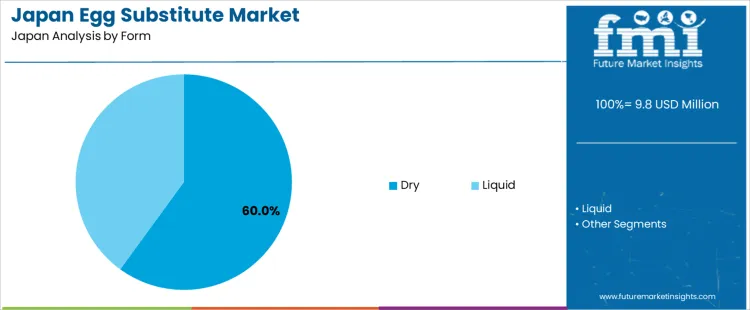
Dry formats account for 60% of the demand in Japan because food processors value stable ingredients that integrate smoothly into controlled batching systems. Consumption grows in bakeries, snack producers, and powdered mix manufacturers where predictable hydration and uniform dispersion support consistent texture. Usage remains steady since dry formats reduce transport weight and simplify long-term inventory management. Procurement is guided by buyers choosing flowable powders that withstand variable humidity while preserving binding strength. Price sensitivity stays moderate because dry substitutes extend shelf life and reduce spoilage costs when compared with refrigerated inputs. Specification control focuses on solubility, protein quality, and batch uniformity. Demand stays consistent from 2026 to 2036 as packaged food manufacturers prefer ingredient formats that align with automated dosing systems and predictable production cycles.
Why do plant-based sources represent 75.0% of the demand for egg substitutes in Japan by source?
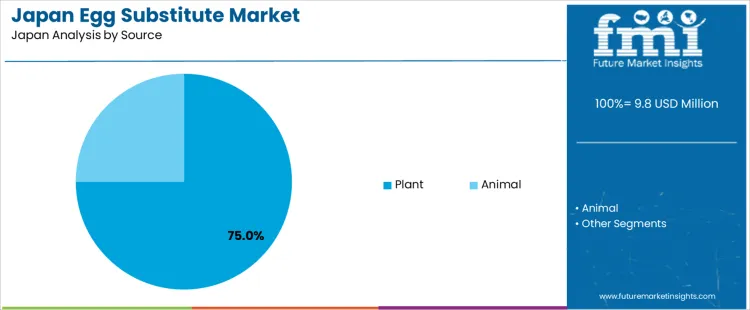
Plant-based sources represent 75.0% of the demand in Japan because manufacturers rely on ingredients that provide stable functional properties without allergen concerns linked to animal-derived alternatives. Consumption increases across processed foods where neutral taste, consistent viscosity, and predictable binding strength support wide formulation use. Usage remains steady since plant-based inputs integrate well with existing equipment and require minimal adjustment to mixing operations. Procurement is shaped by companies selecting sources with clear traceability, steady supply, and standardized quality metrics. Price sensitivity stays moderate as plant-based raw materials offer balanced cost while supporting versatile applications. Specification control focuses on protein behavior, color stability, and compatibility with heat steps. Demand progresses through 2026 to 2036 as Japan’s food sector continues adopting plant-forward formulation strategies while meeting consumer expectations around allergen-friendly ingredients.
How Is Demand for Egg Substitutes in Japan Taking Shape Across Local Food Production and Retail Settings?
Demand grows through Japan’s bakeries, confectionery plants, and ready-meal producers that adjust recipes to manage cost, supply, and texture needs. Bakeries in Osaka use substitutes during seasonal shortages that affect shell egg availability. Confectionery makers in Saitama adopt plant based ingredients to maintain batch consistency during peak production. Convenience stores in Tokyo request formulations that support chilled desserts with stable structure. School lunch programs in Fukuoka choose alternatives for students with documented allergies. These patterns reflect local production routines shaped by supply stability, dietary considerations, and Japan’s diversified food service network.Demand grows through Japan’s bakeries, confectionery plants, and ready-meal producers that adjust recipes to manage cost, supply, and texture needs. Bakeries in Osaka use substitutes during seasonal shortages that affect shell egg availability. Confectionery makers in Saitama adopt plant based ingredients to maintain batch consistency during peak production. Convenience stores in Tokyo request formulations that support chilled desserts with stable structure. School lunch programs in Fukuoka choose alternatives for students with documented allergies. These patterns reflect local production routines shaped by supply stability, dietary considerations, and Japan’s diversified food service network.
Which Local Food Production Needs Are Driving Demand for Egg Substitutes in Japan?
Drivers arise from recipe requirements across Japan’s manufacturing clusters. Bakeries in Kobe use substitutes to maintain moisture control in sweet breads produced at high volume. Confectionery plants in Hokkaido adopt powder formats that help stabilize whipped textures during transport. Ready meal producers in Kanagawa rely on substitutes to support consistent binding in chilled items sold through convenience stores. Public kitchens in Aichi request allergen friendly alternatives for rotating menus. These needs come from local production schedules, distribution patterns, and dietary management practices that shape ingredient selection across Japan.
What Local Constraints Are Limiting Wider Use of Egg Substitutes in Japan?
Barriers link to cost, flavor expectations, and equipment routines. Smaller bakeries in rural prefectures avoid substitutes because prices vary more than standard shell eggs. Confectionery makers in Niigata report differences in browning and aroma that require recipe adjustments many prefer to avoid. Ready meal lines in older facilities maintain mixers calibrated for traditional blends, which restricts formulation changes. School kitchens with limited budgets choose familiar ingredients to simplify procurement. These constraints lead to uneven adoption across regions where cost control, flavor consistency, and equipment setups guide operational choices.
What is the Demand for Egg Substitute in Japan by Region?
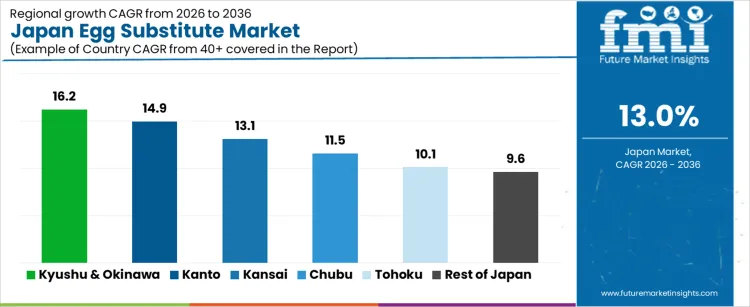
| Region | CAGR (%) |
|---|---|
| Kyushu & Okinawa | 16.2% |
| Kanto | 14.9% |
| Kinki | 13.1% |
| Chubu | 11.5% |
| Tohoku | 10.1% |
| Rest of Japan | 9.6% |
The demand for egg substitutes in Japan is rising rapidly as food manufacturers, bakeries, and consumers pursue allergen friendly, cost stable, and plant based formulation options. Kyushu and Okinawa lead at a 16.2% CAGR, supported by strong adoption among regional food processors, increasing product diversification, and supply chain interest in reducing reliance on shell eggs. Kanto follows at 14.9%, driven by dense urban consumption, bakery chains, and packaged food companies expanding egg free SKUs. Kinki shows 13.1% growth, reflecting broad uptake across culinary businesses and confectionery producers. Chubu at 11.5% records steady integration into industrial and artisanal food applications. Tohoku and the Rest of Japan, at 10.1% and 9.6%, demonstrate comparatively slower yet strong growth linked to rising interest in plant based ingredients and greater price stability relative to conventional egg inputs.
How Is Product Development Influencing Egg Substitute Demand Across Kyushu and Okinawa?
Demand for egg substitute products in Kyushu and Okinawa is rising at a CAGR of 16.2% from 2026 to 2036 as food processors, bakeries, and retail suppliers expand plant based formulations. Food processors integrate alternative ingredients into prepared meals to support consistent texture needs. Bakeries use substitute blends to maintain product stability during production cycles. Retail suppliers stock varied options that align with shifting household preferences. Growth reflects broad participation across sectors that incorporate plant based ingredients into routine food preparation.
- Processors integrate plant based blends
- Bakeries maintain stability in products
- Retail suppliers expand available options
What Drives Egg Substitute Adoption Across Kanto?
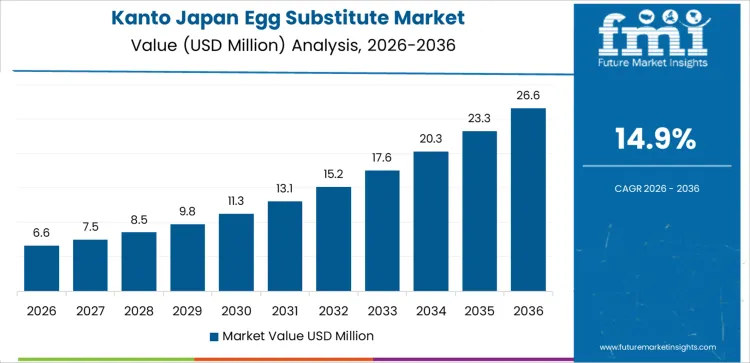
Demand for egg substitute products in Kanto is increasing at a CAGR of 14.9% from 2026 to 2036 as manufacturers, commercial kitchens, and packaged food brands adjust formulations for varied applications. Manufacturers adopt substitute ingredients for consistent batch performance. Commercial kitchens use blends to support menu flexibility. Packaged food brands revise formulations to align with evolving consumer preferences. Growth reflects coordinated activity across dense urban food networks that rely on stable ingredient systems.
- Manufacturers pursue consistent batches
- Kitchens use blends for menu flexibility
- Brands revise formulations for varied needs
How Are Production Patterns Shaping Egg Substitute Demand in Kinki?
Demand for egg substitute products in Kinki is progressing at a CAGR of 13.1% from 2026 to 2036 as bakeries, processors, and catering providers integrate plant based ingredients into routine operations. Bakeries use substitutes for controlled dough performance. Processors apply blends to maintain uniform texture. Catering providers incorporate alternatives to support diverse dietary requirements. Growth reflects structured adoption within a region known for organized food production activity.
- Bakeries maintain controlled dough performance
- Processors apply blends for texture consistency
- Caterers support varied dietary needs
Which Factors Influence Egg Substitute Use Across Chubu?
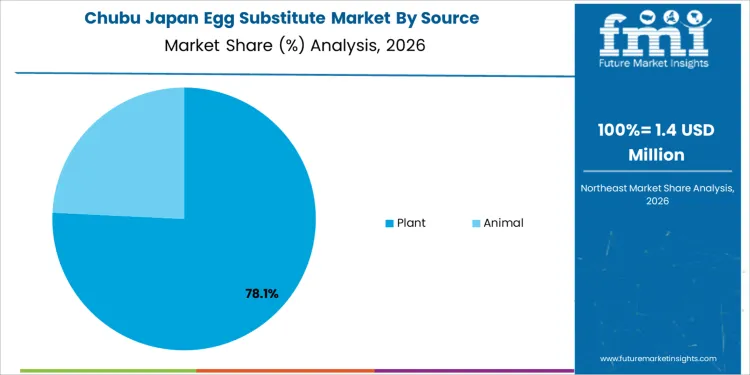
Demand for egg substitute products in Chubu is rising at a CAGR of 11.5% from 2026 to 2036 as food manufacturers, ready meal producers, and local bakeries evaluate plant based options. Food manufacturers integrate substitutes into standardized recipes. Ready meal producers rely on stable blends for portion control. Local bakeries select alternatives to support shelf stability. Growth reflects steady operational adjustments across diverse food segments.
- Manufacturers integrate substitutes into recipes
- Ready meal producers manage portion stability
- Bakeries select alternatives for shelf support
How Do Regional Food Trends Shape Egg Substitute Demand in Tohoku?
Demand for egg substitute products in Tohoku is expanding at a CAGR of 10.1% from 2026 to 2036 as processors, bakeries, and meal services depend on consistent ingredient systems. Processors use substitutes for controlled formulation work. Bakeries incorporate blends to ensure predictable outcomes. Meal services rely on plant based ingredients to support menu design. Growth reflects careful ingredient management across a dispersed region.
- Processors maintain formulation control
- Bakeries use blends for predictable output
- Meal services support menu design needs
What Supports Egg Substitute Growth Across Rest of Japan?
Demand for egg substitute products in Rest of Japan is advancing at a CAGR of 9.6% from 2026 to 2036 as small manufacturers, bakeries, and local retailers adopt plant based blends. Small manufacturers use substitutes to stabilize recipes. Bakeries implement blends to support consistent production. Local retailers expand offerings to meet household needs. Growth reflects practical ingredient adoption across smaller food networks.
- Manufacturers stabilize recipes
- Bakeries support consistent production
- Retailers expand household options
What Is Driving the Demand for Egg Substitute in Japan and Which Companies Shape Food Manufacturing Access?
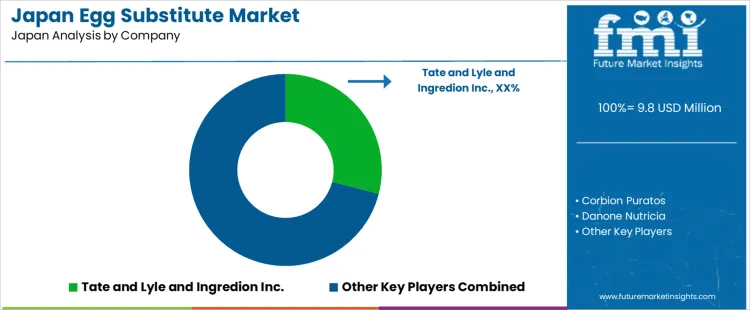
The demand for egg substitute in Japan is shaped by allergen free product development, stable formulation needs in large scale food manufacturing, and interest in plant based ingredients for bakery, confectionery, and ready meals. Domestic processors rely on starches, fibers, and fermentation based ingredients that support moisture control and aeration in cakes, bread, and sauces. Tate and Lyle and Ingredion Inc participate through functional starches and hydrocolloids used to achieve viscosity and binding in industrial bakeries. Corbion Puratos supports demand through fermentation driven systems that assist dough strength and batter stability. Danone Nutricia influences specialized nutrition products where egg free formats meet strict dietary specifications. Florida Food Products LLC and Fiberstar Inc supply plant derived ingredients used in texture improvement and water retention for heat processed foods across national brands.
Formulator selection in Japan is governed by emulsification strength, heat stability, flavor neutrality, and compatibility with automated mixing lines. Food manufacturers emphasize clean taste, predictable performance across seasonal temperature shifts, and steady supply for high volume bakeries. Buyers favor ingredients that align with allergen control programs and maintain consistent color and texture in retail products. Usage spans packaged desserts, bread mixes, savory sauces, and school meal items requiring allergen safe preparation. Research teams test egg substitute blends for aeration, crumb structure, and freeze thaw tolerance.
Key Players in Egg Substitute Industry in Japan
- Tate and Lyle and Ingredion Inc.
- Corbion Puratos
- Danone Nutricia
- Florida Food Products LLC
- Fiberstar Inc.
Scope of the Report
| Items | Values |
|---|---|
| Quantitative Units (2026) | USD million |
| Form | Dry; Liquid |
| Source | Plant; Animal |
| Ingredient | Dairy Proteins; Starch; Algal Flour; Soy based Products |
| Distribution Channel | Convenience Stores; Hypermarkets; Departmental Stores |
| Regions Covered | Kyushu & Okinawa; Kanto; Kansai; Chubu; Tohoku; Rest of Japan |
| Countries Covered | Japan |
| Key Companies Profiled | Tate and Lyle; Ingredion Inc; Corbion Puratos; Danone Nutricia; Florida Food Products LLC; Fiberstar Inc |
| Additional Attributes | Dollar by sales across forms, sources, and ingredient categories; functional performance characteristics in baking and ready meal applications; allergen management requirements; formulation stability metrics; hydration behavior and viscosity control; integration compatibility with automated food processing lines; product development trends; regional adoption differences; recipe reformulation patterns; supply chain reliability factors. |
Egg Substitute Industry in Japan Segmentation
Form:
- Dry
- Liquid
Source:
- Plant
- Animal
Ingredient:
- Dairy Proteins
- Starch
- Algal Flour
- Soy-based Products
Distribution Channel:
- Convenience Stores
- Hypermarkets
- Departmental Stores
Region
- Kyushu & Okinawa
- Kanto
- Kansai
- Chubu
- Tohoku
- Rest of Japan
Frequently Asked Questions
How big is the demand for egg substitute in Japan in 2026?
The demand for egg substitute in Japan is estimated to be valued at USD 9.8 million in 2026.
What will be the size of egg substitute in Japan in 2036?
The market size for the egg substitute in Japan is projected to reach USD 37.6 million by 2036.
How much will be the demand for egg substitute in Japan growth between 2026 and 2036?
The demand for egg substitute in Japan is expected to grow at a 13.0% CAGR between 2026 and 2036.
What are the key product types in the egg substitute in Japan?
The key product types in egg substitute in Japan are dry and liquid.
Which source segment is expected to contribute significant share in the egg substitute in Japan in 2026?
In terms of source, plant segment is expected to command 75.0% share in the egg substitute in Japan in 2026.
Preview the report firsthand - request a free sample
Get SampleGet the brochure for pricing and purchase details.
Get PDFTable of Content
- Executive Summary
- Japan Market Outlook
- Demand-side Trends
- Supply-side Trends
- Technology Roadmap Analysis
- Analysis and Recommendations
- Market Overview
- Market Coverage / Taxonomy
- Market Definition / Scope / Limitations
- Market Background
- Market Dynamics
- Drivers
- Restraints
- Opportunity
- Trends
- Scenario Forecast
- Demand in Optimistic Scenario
- Demand in Likely Scenario
- Demand in Conservative Scenario
- Opportunity Map Analysis
- Product Life Cycle Analysis
- Supply Chain Analysis
- Investment Feasibility Matrix
- Value Chain Analysis
- PESTLE and Porter’s Analysis
- Regulatory Landscape
- Regional Parent Market Outlook
- Production and Consumption Statistics
- Import and Export Statistics
- Market Dynamics
- Japan Market Analysis 2021 to 2026 and Forecast, 2026 to 2036
- Historical Market Size Value (USD Million) Analysis, 2021 to 2026
- Current and Future Market Size Value (USD Million) Projections, 2026 to 2036
- Y-o-Y Growth Trend Analysis
- Absolute $ Opportunity Analysis
- Japan Market Pricing Analysis 2021 to 2026 and Forecast 2026 to 2036
- Japan Market Analysis 2021 to 2026 and Forecast 2026 to 2036, By Form
- Introduction / Key Findings
- Historical Market Size Value (USD Million) Analysis By Form , 2021 to 2026
- Current and Future Market Size Value (USD Million) Analysis and Forecast By Form , 2026 to 2036
- Dry
- Liquid
- Y-o-Y Growth Trend Analysis By Form , 2021 to 2026
- Absolute $ Opportunity Analysis By Form , 2026 to 2036
- Japan Market Analysis 2021 to 2026 and Forecast 2026 to 2036, By Source
- Introduction / Key Findings
- Historical Market Size Value (USD Million) Analysis By Source, 2021 to 2026
- Current and Future Market Size Value (USD Million) Analysis and Forecast By Source, 2026 to 2036
- Plant
- Animal
- Y-o-Y Growth Trend Analysis By Source, 2021 to 2026
- Absolute $ Opportunity Analysis By Source, 2026 to 2036
- Japan Market Analysis 2021 to 2026 and Forecast 2026 to 2036, By Ingredient
- Introduction / Key Findings
- Historical Market Size Value (USD Million) Analysis By Ingredient, 2021 to 2026
- Current and Future Market Size Value (USD Million) Analysis and Forecast By Ingredient, 2026 to 2036
- Dairy Proteins
- Starch
- Algal Flour
- Soy-based Products
- Y-o-Y Growth Trend Analysis By Ingredient, 2021 to 2026
- Absolute $ Opportunity Analysis By Ingredient, 2026 to 2036
- Japan Market Analysis 2021 to 2026 and Forecast 2026 to 2036, By Distribution Channel
- Introduction / Key Findings
- Historical Market Size Value (USD Million) Analysis By Distribution Channel, 2021 to 2026
- Current and Future Market Size Value (USD Million) Analysis and Forecast By Distribution Channel, 2026 to 2036
- Convenience Stores
- Hypermarkets
- Departmental Stores
- Y-o-Y Growth Trend Analysis By Distribution Channel, 2021 to 2026
- Absolute $ Opportunity Analysis By Distribution Channel, 2026 to 2036
- Market Structure Analysis
- Competition Dashboard
- Competition Benchmarking
- Market Share Analysis of Top Players
- By Regional
- By Form
- By Source
- By Ingredient
- By Distribution Channel
- Competition Analysis
- Competition Deep Dive
- Tate and Lyle and Ingredion Inc.
- Overview
- Product Portfolio
- Profitability by Market Segments (Product/Age /Sales Channel/Region)
- Sales Footprint
- Strategy Overview
- Marketing Strategy
- Product Strategy
- Channel Strategy
- Corbion Puratos
- Danone Nutricia
- Florida Food Products LLC
- Fiberstar Inc.
- Tate and Lyle and Ingredion Inc.
- Competition Deep Dive
- Assumptions & Acronyms Used
- Research Methodology


