

- Industry Size (2025)
- USD 149.3 Mn
- Forecast (2035)
- USD 200.6 Mn
- CAGR (2025 to 2035)
- 3.0%
Demand for IR Emitters and Receivers in Japan Forecast and Outlook 2025 to 2035
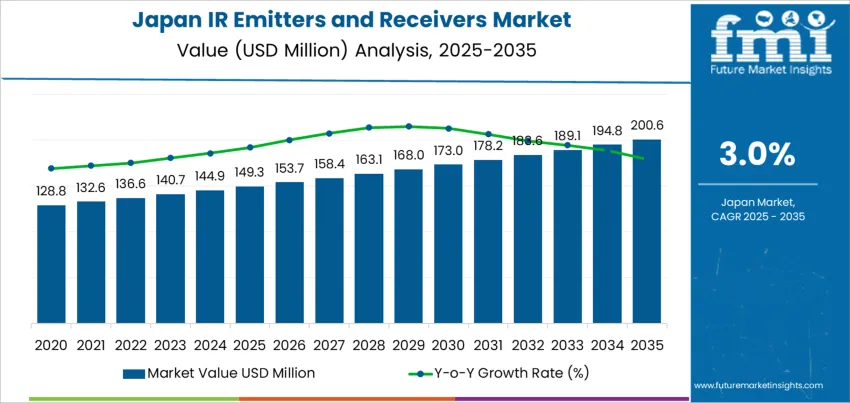
The demand for IR (infrared) emitters and receivers in Japan is projected to grow from USD 149.3 million in 2025 to USD 200.6 million by 2035, driven by a compound annual growth rate (CAGR) of 3.0%. IR emitters and receivers are widely used across automotive, consumer electronics, healthcare, and industrial automation industries for wireless communication, sensing, and data transmission. As demand for advanced sensing technologies and IoT (Internet of Things) devices continues to grow, the adoption of IR emitters and receivers will expand across applications such as remote controls, security systems, and smart home devices.
The rise of automation and smart technologies, especially in the automotive and consumer electronics sectors, will play a key role in the growth of the IR emitter and receiver industry. In the automotive industry, IR-based sensors are increasingly being integrated into vehicles for features like gesture recognition, driver monitoring, and collision avoidance. The growing use of smart home devices, such as smart thermostats, lighting systems, and security cameras, will also contribute to the demand for IR emitters and receivers. Technological advancements, including the development of more compact, efficient, and cost-effective IR sensors, will further support industry growth.
Quick Stats of the Demand for IR Emitters and Receivers in Japan
- Demand for IR Emitters and Receivers in Japan Value (2025): USD 149.3 million
- Demand for IR Emitters and Receivers in Japan Forecast Value (2035): USD 200.6 million
- Demand for IR Emitters and Receivers in Japan Forecast CAGR (2025-2035): 3.0%
- Demand for IR Emitters and Receivers in Japan Leading Product Type: Diode
- Demand for IR Emitters and Receivers in Japan Key Growth Regions: Kyushu & Okinawa, Kanto, Kansai, Chubu, Tohoku, Rest of Japan
- Demand for IR Emitters and Receivers in Japan Top Players: Vishay Intertechnology, Osram Opto Semiconductors, Everlight Electronics, Rohm Semiconductor, Lite-On Technology
What is the Growth Forecast for the Demand for IR Emitters and Receivers in Japan through 2035?
From 2025 to 2030, demand for IR emitters and receivers is expected to grow from USD 149.3 million to USD 173.0 million, adding USD 23.7 million in value. This growth will be driven by the increasing demand for smart devices, automation, and sensor technologies across various sectors, including automotive, healthcare, and consumer electronics. As more industries adopt IR-based solutions for wireless communication, sensing, and data transmission, the need for efficient IR emitters and receivers will continue to rise. The growing use of smart home technologies, such as intelligent lighting, security systems, and HVAC control, will also contribute to the industry's expansion, further increasing the demand for these devices.
From 2030 to 2035, demand for IR emitters and receivers will continue to rise from USD 173.0 million to USD 200.6 million, contributing USD 27.6 million in value. This period will see steady growth, supported by technological advancements that make IR systems more compact, energy-efficient, and cost-effective. The integration of IR emitters and receivers with emerging technologies such as AI, machine learning, and advanced automation will open up new applications in industries like automotive (e.g., gesture recognition, driver monitoring) and healthcare (e.g., patient monitoring, non-invasive diagnostics).
Demand for IR Emitters and Receivers in Japan Key Takeaways
| Metric | Value |
|---|---|
| Demand for IR Emitters and Receivers in Japan Value (2025) | USD 149.3 million |
| Demand for IR Emitters and Receivers in Japan Forecast Value (2035) | USD 200.6 million |
| Demand for IR Emitters and Receivers in Japan Forecast CAGR (2025-2035) | 3.0% |
Why is the Demand for IR Emitters and Receivers in Japan Growing?
The demand for IR (infrared) emitters and receivers in Japan is growing due to their increasing use in a wide range of applications, including consumer electronics, automotive systems, industrial automation, and healthcare devices. IR emitters and receivers are integral components in technologies such as remote sensing, motion detection, and object tracking. As the demand for smart devices and automation systems rises, the need for IR technology is expanding across various industries in Japan.
A key driver of this growth is the rapid adoption of smart home devices, consumer electronics, and automotive technologies that rely on IR sensors for features like gesture recognition, proximity detection, and communication between devices. In the automotive sector, IR sensors are used for advanced driver-assistance systems (ADAS) such as collision avoidance, adaptive cruise control, and night vision. As Japan’s automotive industry continues to innovate and integrate more advanced technologies, the demand for IR emitters and receivers is expected to rise.
The increasing use of IR technology in industrial automation and healthcare applications is contributing to industry growth. IR sensors are used for temperature monitoring, precision measurement, and diagnostics in industries such as manufacturing and healthcare. As Japan continues to invest in automation and digital healthcare solutions, the demand for IR emitters and receivers is expected to grow steadily through 2035, supported by technological advancements and the expanding role of infrared technology in modern systems.
What is the Segment-Wise Analysis of Demand for IR Emitters and Receivers in Japan?
Demand for IR (infrared) emitters and receivers in Japan is segmented by type and end-use sector. By type, demand is divided into diode, vapor chamber, and variable conductance, with diodes leading at 70%. The demand is also segmented by end-use sector, including automotive, construction, transportation & logistics, chemical, and aerospace, with automotive accounting for 30% of the demand. Regionally, demand is divided into Kanto, Kinki, Chubu, Kyushu & Okinawa, Tohoku, and the Rest of Japan.
Why Do Diodes Lead the Demand for IR Emitters and Receivers in Japan?
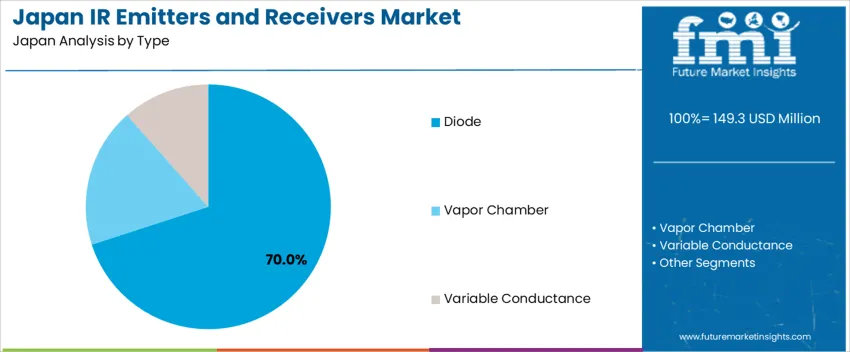
Diodes account for 70% of the demand for IR emitters and receivers in Japan, driven by their widespread use in a variety of applications that require efficient, reliable infrared emission and reception. Diodes are integral components in devices such as remote controls, sensors, communication systems, and security equipment. The high efficiency, low cost, and compact size of diode-based IR emitters and receivers make them ideal for consumer electronics, industrial applications, and automation systems. As Japan continues to lead in consumer electronics, automotive technologies, and industrial automation, the demand for diode-based IR components remains strong. The increasing use of infrared technology in emerging sectors, such as autonomous vehicles and smart devices, ensures that diodes will continue to dominate the IR emitter and receiver industry in Japan.
Why Does the Automotive Sector Lead the Demand for IR Emitters and Receivers in Japan?
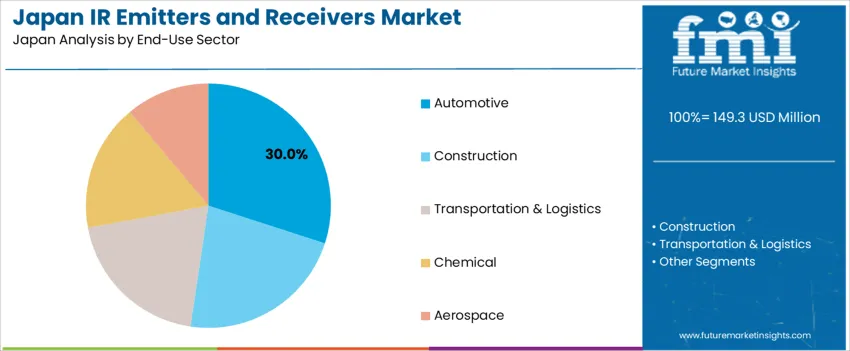
The automotive sector accounts for 30% of the demand for IR emitters and receivers in Japan, driven by the growing use of infrared technology in advanced driver-assistance systems (ADAS) and autonomous vehicles. IR emitters and receivers are used for applications such as night vision systems, collision avoidance sensors, and in-vehicle communication systems, all of which are crucial for enhancing vehicle safety and driving experience. As Japan’s automotive industry continues to invest in innovative technologies like autonomous driving and smart cars, the demand for IR components will continue to grow. The push for eco-friendlier and intelligent transportation solutions further increases the reliance on IR technology in the automotive sector. As the industry for connected and autonomous vehicles expands, the automotive sector will remain a key driver of IR emitter and receiver demand in Japan.
What are the Key Trends, Drivers, and Restraints in Demand for IR Emitters and Receivers in Japan?
Demand for IR emitters and receivers in Japan is rising as infrared (IR) technology continues to spread across multiple industries from consumer electronics and smart‑home devices to automotive safety, industrial automation, security, and healthcare. IR components are essential for remote controls, motion and proximity sensors, gesture detection, thermal imaging, surveillance, and non‑contact sensing. The growing focus on automation, IoT, energy efficiency, and miniaturization supports their adoption. Limitations such as range restrictions (line‑of‑sight requirement), competition from alternate technologies (e.g., Bluetooth, RF, cameras), and performance constraints under certain conditions (ambient light interference, need for calibration) may restrain growth.
Why is Demand for IR Emitters and Receivers Growing in Japan?
IR emitters and receivers are seeing growing demand because they enable convenience, automation, and safety across many applications. In households, IR-based remote controls, smart‑home appliances, and gesture‑ or motion‑sensing devices make everyday tasks easier and support lifestyle trends toward smart living. In industrial and commercial settings, IR sensors support automation, quality control, and contactless detection valuable in manufacturing, logistics, and facility management. In automotive sectors, IR components support driver‑assistance, occupant detection, and night‑vision features, aligning with rising safety and technology standards. Further, as electronics and IoT devices become more compact and energy‑efficient, small & low‑power IR components fit well, making them appealing for both consumers and manufacturers.
How are Technological & Industry Innovations Driving IR Emitter and Receiver Demand in Japan?
Technological advances are significantly expanding the capability and usefulness of IR components, which is driving demand in Japan. Innovations in miniaturization have made IR emitters and receivers smaller, more energy‑efficient, and better suited for compact electronics, wearables, and portable devices. Improved sensitivity, accuracy, and reliability in newer IR sensor modules enhance performance for a variety of applications, including motion detection, proximity sensing, gesture recognition, thermal imaging, and biometric sensing. The integration of IR technology into IoT/smart‑home ecosystems and automotive systems has also expanded demand, as more devices feature IR sensors for appliances, security systems, HVAC controls, lighting, and automotive safety features.
What are the Key Challenges and Risks That Could Limit IR Emitter and Receiver Demand in Japan?
Despite the strong growth drivers, several challenges could limit the demand for IR emitters and receivers in Japan. A key limitation is the technical constraint that IR communication or sensing typically requires line‑of‑sight; obstacles, ambient light, or interference can impair performance, making IR less flexible compared to other technologies like RF, Wi‑Fi, or camera‑based solutions. Furthermore, competition from alternative technologies such as audio‑visual systems, Bluetooth, Wi‑Fi, and camera‑based sensors, which often offer greater range, more data richness, and no line‑of‑sight limitations, may reduce reliance on IR in certain applications. High‑performance IR technologies, such as those used for thermal imaging and night vision, can also be expensive, which may deter cost‑sensitive buyers or smaller businesses from adoption.
What is the Regional Demand Outlook for IR Emitters and Receivers in Japan?
| Region | CAGR (%) |
|---|---|
| Kyushu & Okinawa | 3.8% |
| Kanto | 3.5% |
| Kansai | 3.0% |
| Chubu | 2.7% |
| Tohoku | 2.3% |
| Rest of Japan | 2.2% |
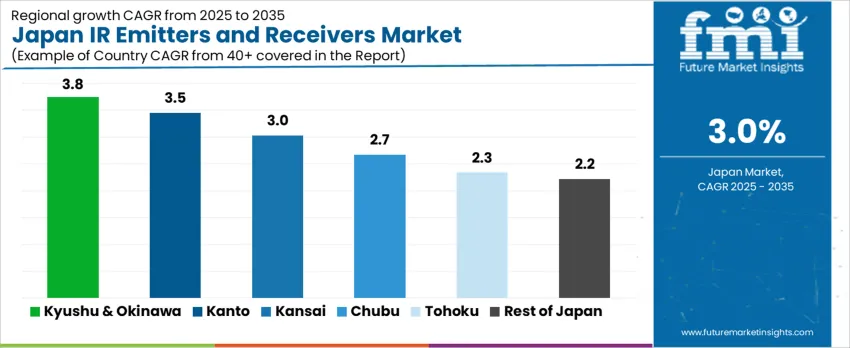
Demand for IR emitters and receivers in Japan is growing steadily, with Kyushu & Okinawa leading at a 3.8% CAGR, driven by industrial expansion and consumer electronics adoption. Kanto follows with a 3.5% CAGR, supported by its advanced technology infrastructure and consumer electronics industry. Kansai shows a 3.0% CAGR, fueled by its focus on smart technologies, automation, and consumer electronics. Chubu experiences a 2.7% CAGR, with steady demand from the manufacturing and consumer electronics sectors. Tohoku and the Rest of Japan show moderate growth at 2.3% and 2.2%, respectively, reflecting gradual adoption in rural and suburban areas. As more industries integrate smart technologies and automation, the demand for IR emitters and receivers will continue to rise across Japan.
How is Demand for IR Emitters and Receivers Growing in Kyushu & Okinawa?
Kyushu & Okinawa leads in the demand for IR emitters and receivers, growing at a 3.8% CAGR. The region’s expanding industrial sectors, particularly in electronics and telecommunications, are contributing to this rise. Kyushu & Okinawa’s growing emphasis on smart technology and automation in both residential and commercial sectors is fueling the need for IR emitters and receivers for applications such as remote sensing, security systems, and automation. The region’s focus on improving manufacturing processes, along with increasing demand for innovative devices, further supports growth. The tourism sector in Okinawa contributes to the adoption of IR devices in hospitality, particularly in systems for contactless services and guest management. As more businesses and households incorporate smart technologies, the demand for IR emitters and receivers in Kyushu & Okinawa is expected to continue growing steadily, driven by both industry and consumer applications.
Why is Demand for IR Emitters and Receivers Rising in Kanto?
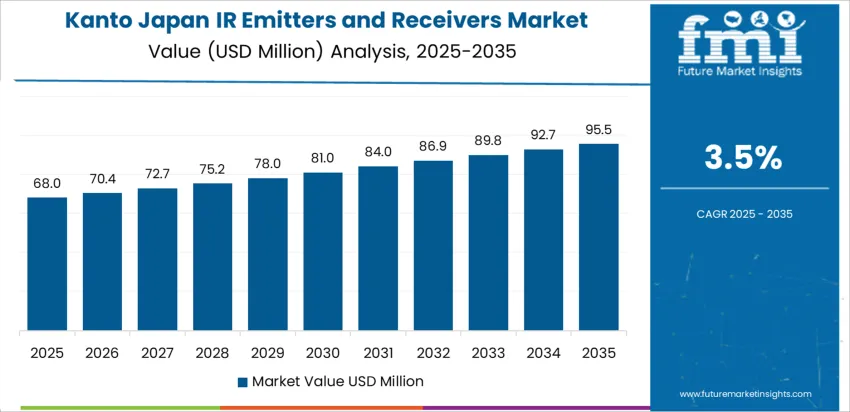
Kanto is experiencing steady demand for IR emitters and receivers, with a 3.5% CAGR. The region’s large population and high density of tech companies, particularly in Tokyo, drive the demand for IR devices used in various applications such as remote control, security, and automation systems. As the need for smart home technology, IoT (Internet of Things) devices, and other connected systems grows, Kanto’s demand for IR emitters and receivers increases. The region’s focus on technological advancements in automation and robotics across sectors like automotive, healthcare, and electronics further boosts the adoption of IR technologies. The widespread use of IR emitters and receivers in consumer electronics, including TVs, gaming consoles, and home appliances, also supports this trend. As more industries in Kanto rely on smart technology solutions, demand for IR emitters and receivers will continue to grow at a steady pace.
How is Demand for IR Emitters and Receivers Expanding in Kansai?
Kansai is seeing steady demand for IR emitters and receivers, with a 3.0% CAGR. The region’s strong industrial and technological sectors, particularly in cities like Osaka and Kyoto, are fueling the demand for IR devices. Kansai’s growing adoption of smart technologies, including automation, energy management, and security systems, drives the use of IR emitters and receivers in a wide range of applications. The region’s strong consumer electronics industry also contributes to growth, as IR technologies are widely used in products like remote controls and smart appliances. Kansai’s focus on advanced manufacturing, robotics, and medical technology has led to an increased need for precision sensors and IR communication systems. As the region continues to innovate and embrace automation and IoT solutions, the demand for IR emitters and receivers is expected to grow steadily, supporting its industrial and consumer sectors.
Why is Demand for IR Emitters and Receivers Growing in Chubu?
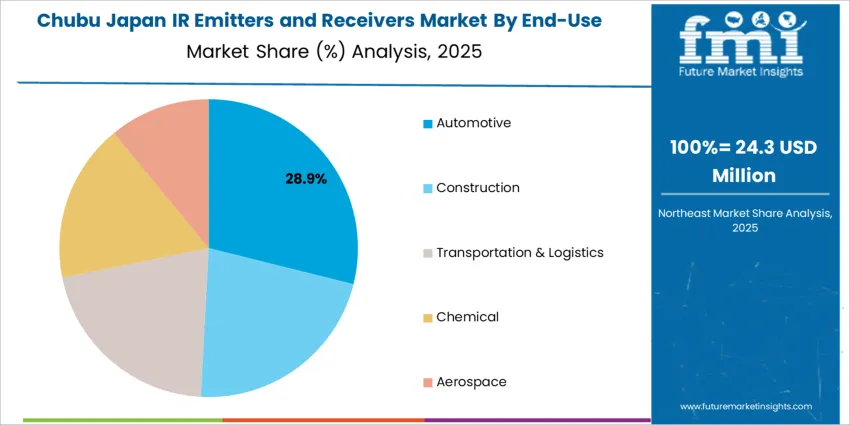
Chubu is experiencing steady demand for IR emitters and receivers, growing at a 2.7% CAGR. The region’s strong manufacturing base, particularly in automotive and electronics, contributes to the rise in demand for IR devices used in applications such as proximity sensors, automation, and remote control systems. Chubu’s increasing focus on smart factory solutions, robotics, and industrial automation is driving the need for precise IR sensing technologies. The region’s growing interest in consumer electronics, such as home automation systems and personal devices, further supports the demand for IR emitters and receivers. As Chubu’s industrial and consumer electronics sectors continue to innovate and integrate advanced technologies, the need for IR devices will continue to grow. With a steady focus on improving manufacturing processes and technology infrastructure, demand for IR emitters and receivers in Chubu is expected to expand consistently.
How is Demand for IR Emitters and Receivers Expanding in Tohoku?
Tohoku is seeing moderate demand for IR emitters and receivers, with a 2.3% CAGR. Although the industry is smaller compared to more urbanized regions, the adoption of IR technology is steadily increasing as industries in Tohoku adopt automation and remote sensing solutions. With the region’s strong focus on developing its manufacturing capabilities, particularly in robotics and sensor technology, the need for IR emitters and receivers in these applications is growing. The increasing use of IR devices in consumer electronics, particularly in remote control systems and security applications, is contributing to this rise. As Tohoku’s infrastructure and technological capabilities continue to improve, more industries and consumers are incorporating IR technology into their daily operations and products. Although growth is slower than in major urban areas, Tohoku’s demand for IR emitters and receivers is expected to increase gradually.
Why is Demand for IR Emitters and Receivers Steady in the Rest of Japan?
The Rest of Japan is experiencing steady demand for IR emitters and receivers, growing at a 2.2% CAGR. While demand is lower compared to urbanized areas, there is steady growth as more rural and suburban regions adopt advanced technologies. Local industries, including agriculture, manufacturing, and logistics, are increasingly incorporating IR devices for automation, sensing, and communication. The adoption of smart home technologies and IoT solutions in rural areas also drives demand for IR emitters and receivers. As more businesses and households in the Rest of Japan invest in automation, energy-efficient systems, and connected devices, the need for IR technology will continue to rise slowly but consistently. With increased access to technology and better infrastructure, the demand for IR emitters and receivers in rural and less-populated areas is expected to grow steadily, supporting the overall demand across Japan.
What is the Competitive Landscape of IR Emitters & Receivers Demand in Japan?
Demand for IR (infrared) emitters and receivers in Japan is growing steadily, driven by a broad shift toward smart electronics, automation, and safety systems. Infrared components are widely used in consumer electronics (remote controls, motion-sensing devices, smart home gadgets), automotive systems (safety sensors, driver assistance, in-cabin monitoring), security/surveillance (IR-based cameras and detection), industrial automation, and emerging IoT applications. As more devices incorporate non-contact sensing, gesture/proximity detection, and smart functionality, the need for reliable IR emitters and receivers has surged.
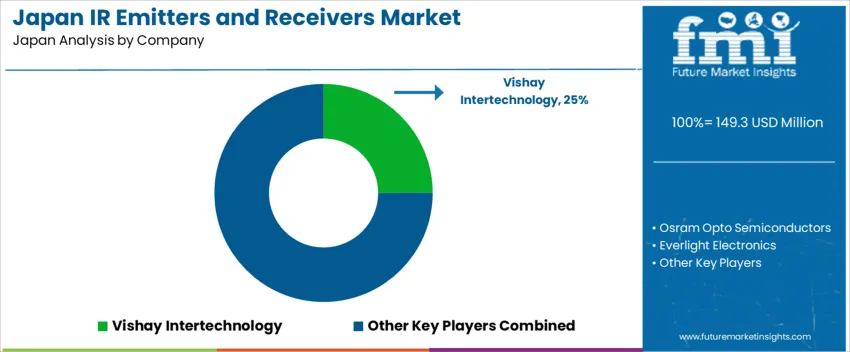
Major players in the Japanese IR emitter/receiver industry include Vishay Intertechnology, Osram Opto Semiconductors, Everlight Electronics, Rohm Semiconductor, and Lite-On Technology. Vishay Intertechnology is estimated to hold approximately 25.0% share of the industry, supplying a broad portfolio of infrared LEDs, photodiodes and receiver modules for applications across consumer electronics, automotive, industrial, and security sectors. The other firms compete by offering a mix of IR components optimized for different applications: from high-sensitivity photodiodes for industrial detection, to compact IR emitters for consumer devices and automobile sensors. Their offerings support a variety of use-cases remote controls, presence detection, thermal sensing, automated systems tailored to Japan’s diversified demand landscape.
Growth is fueled by key trends: increasing adoption of smart home appliances and IoT devices; rising demand for automotive safety and driver-assist systems; expansion of security and surveillance installations; and growth in industrial automation and environmental monitoring. IR technology is valued for its non-contact sensing, energy efficiency, compactness, and versatility. Competition among suppliers centers on miniaturization, sensitivity and reliability of components, power efficiency, breadth of product portfolio, and ability to meet sector-specific standards (e.g. automotive or medical).
Key Players in Japan IR Emitters and Receivers Demand
- Vishay Intertechnology
- Osram Opto Semiconductors
- Everlight Electronics
- Rohm Semiconductor
- Lite-On Technology
Scope of Report
| Items | Values |
|---|---|
| Quantitative Units (2025) | USD million |
| Product Type | Diode, Vapor Chamber, Variable Conductance |
| End Use Sector | Automotive, Construction, Transportation & Logistics, Chemical, Aerospace |
| Region | Kyushu & Okinawa, Kanto, Kansai, Chubu, Tohoku, Rest of Japan |
| Countries Covered | Japan |
| Key Companies Profiled | Vishay Intertechnology, Osram Opto Semiconductors, Everlight Electronics, Rohm Semiconductor, Lite-On Technology |
| Additional Attributes | Dollar sales by product type and end-use sector; regional CAGR and adoption trends; innovations in IR emitter and receiver technology; increasing demand from automotive and aerospace sectors for advanced sensing capabilities |
Japan IR Emitters and Receivers Demand by Key Segments
Type
- Diode
- Vapor Chamber
- Variable Conductance
End-Use Sector
- Automotive
- Construction
- Transportation & Logistics
- Chemical
- Aerospace
Region
- Kyushu & Okinawa
- Kanto
- Kansai
- Chubu
- Tohoku
- Rest of Japan
Bibliography
- Japan Electronics and Information Technology Industries Association. (2023). Infrared sensor components and optoelectronic device applications in consumer and industrial electronics. JEITA Technology and Industry Reports.
- Rohm Semiconductor. (2023). Infrared LEDs and photodiodes for automotive, consumer, and industrial sensing applications. Rohm Semiconductor Technical Documentation.
- Osram Opto Semiconductors. (2023). IR emitters and receivers for automotive safety, smart devices, and industrial automation. Osram Opto Semiconductors Application Notes.
- Vishay Intertechnology. (2023). Infrared emitter and receiver solutions for sensing, communication, and automation systems. Vishay Intertechnology Product and Engineering Publications.
Frequently Asked Questions
How big is the demand for ir emitters and receivers in Japan in 2025?
The demand for ir emitters and receivers in Japan is estimated to be valued at USD 149.3 million in 2025.
What will be the size of ir emitters and receivers in Japan in 2035?
The market size for the ir emitters and receivers in Japan is projected to reach USD 200.6 million by 2035.
How much will be the demand for ir emitters and receivers in Japan growth between 2025 and 2035?
The demand for ir emitters and receivers in Japan is expected to grow at a 3.0% CAGR between 2025 and 2035.
What are the key product types in the ir emitters and receivers in Japan?
The key product types in ir emitters and receivers in Japan are diode, vapor chamber and variable conductance.
Which end-use sector segment is expected to contribute significant share in the ir emitters and receivers in Japan in 2025?
In terms of end-use sector, automotive segment is expected to command 30.0% share in the ir emitters and receivers in Japan in 2025.
Preview the report firsthand - request a free sample
Get SampleGet the brochure for pricing and purchase details.
Get PDFTable of Content
- Executive Summary
- Japan Market Outlook
- Demand-side Trends
- Supply-side Trends
- Technology Roadmap Analysis
- Analysis and Recommendations
- Market Overview
- Market Coverage / Taxonomy
- Market Definition / Scope / Limitations
- Market Background
- Market Dynamics
- Drivers
- Restraints
- Opportunity
- Trends
- Scenario Forecast
- Demand in Optimistic Scenario
- Demand in Likely Scenario
- Demand in Conservative Scenario
- Opportunity Map Analysis
- Product Life Cycle Analysis
- Supply Chain Analysis
- Investment Feasibility Matrix
- Value Chain Analysis
- PESTLE and Porter’s Analysis
- Regulatory Landscape
- Regional Parent Market Outlook
- Production and Consumption Statistics
- Import and Export Statistics
- Market Dynamics
- Japan Market Analysis 2020 to 2024 and Forecast, 2025 to 2035
- Historical Market Size Value (USD Million) Analysis, 2020 to 2024
- Current and Future Market Size Value (USD Million) Projections, 2025 to 2035
- Y-o-Y Growth Trend Analysis
- Absolute $ Opportunity Analysis
- Japan Market Pricing Analysis 2020 to 2024 and Forecast 2025 to 2035
- Japan Market Analysis 2020 to 2024 and Forecast 2025 to 2035, By Type
- Introduction / Key Findings
- Historical Market Size Value (USD Million) Analysis By Type , 2020 to 2024
- Current and Future Market Size Value (USD Million) Analysis and Forecast By Type , 2025 to 2035
- Diode
- Vapor Chamber
- Variable Conductance
- Y-o-Y Growth Trend Analysis By Type , 2020 to 2024
- Absolute $ Opportunity Analysis By Type , 2025 to 2035
- Japan Market Analysis 2020 to 2024 and Forecast 2025 to 2035, By End-Use Sector
- Introduction / Key Findings
- Historical Market Size Value (USD Million) Analysis By End-Use Sector, 2020 to 2024
- Current and Future Market Size Value (USD Million) Analysis and Forecast By End-Use Sector, 2025 to 2035
- Automotive
- Construction
- Transportation & Logistics
- Chemical
- Aerospace
- Y-o-Y Growth Trend Analysis By End-Use Sector, 2020 to 2024
- Absolute $ Opportunity Analysis By End-Use Sector, 2025 to 2035
- Market Structure Analysis
- Competition Dashboard
- Competition Benchmarking
- Market Share Analysis of Top Players
- By Regional
- By Type
- By End-Use Sector
- Competition Analysis
- Competition Deep Dive
- Vishay Intertechnology
- Overview
- Product Portfolio
- Profitability by Market Segments (Product/Age /Sales Channel/Region)
- Sales Footprint
- Strategy Overview
- Marketing Strategy
- Product Strategy
- Channel Strategy
- Osram Opto Semiconductors
- Everlight Electronics
- Rohm Semiconductor
- Lite-On Technology
- Vishay Intertechnology
- Competition Deep Dive
- Assumptions & Acronyms Used
- Research Methodology


