

- Industry Size (2025)
- USD 1.0 Bn
- Forecast (2035)
- USD 1.5 Bn
- CAGR (2025 to 2035)
- 3.8%
Demand for IR Emitters and Receivers in USA (2025-2035)
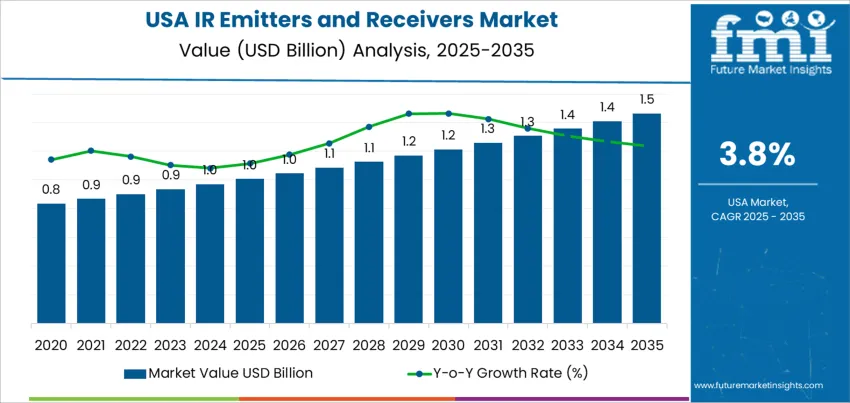
The USA IR emitters and receivers demand is valued at USD 1.0 billion in 2025 and is forecasted to reach USD 1.5 billion by 2035, indicating a CAGR of 3.8%. Demand is shaped by sustained adoption of infrared components in consumer electronics, industrial automation, automotive safety systems, and smart-home interfaces. The increased deployment of proximity-sensing, gesture-recognition, and object-detection systems across connected devices reinforces utilization. Manufacturers focus on improving power efficiency, signal sensitivity, and miniaturization to support integration into space-constrained applications.
Diodes account for the leading category due to high suitability in surveillance systems, mobile devices, and advanced driver-assistance features. Their ability to deliver consistent transmission and reception performance in short- and mid-range applications supports broad industrial use. Technical improvements in wavelength precision, thermal stability, and response accuracy enhance component reliability.
Quick Stats for USA IR Emitters and Receivers Demand
- USA IR Emitters and Receivers Sales Value (2025): USD 1.0 billion
- USA IR Emitters and Receivers Forecast Value (2035): USD 1.5 billion
- USA IR Emitters and Receivers Forecast CAGR (2025-2035): 3.8%
- Leading Category in USA IR Emitters and Receivers Demand: Diodes
- Key Growth Regions in USA IR Emitters and Receivers Demand: West USA, South USA, Northeast USA
- Top Players in USA IR Emitters and Receivers Demand: Vishay Intertechnology; Osram Opto Semiconductors; Everlight Electronics; Rohm Semiconductor; Lite-On Technology
The West, South, and Northeast record the strongest requirement because of large consumer electronics production facilities, logistics hubs deploying automated scanners, and growing automotive technology ecosystems. Key suppliers include Vishay Intertechnology, Osram Opto Semiconductors, Everlight Electronics, Rohm Semiconductor, and Lite-On Technology. Their product strategies prioritize optical efficiency, compatibility with high-speed communication protocols, and scalable solutions for industrial and consumer device manufacturers.
What is the Growth Forecast for IR Emitters and Receivers Industry in USA through 2035?
Peak periods in demand for IR emitters and receivers in the United States align with higher procurement cycles in consumer electronics, security devices, and industrial automation. Growth uplifts occur when manufacturers introduce new device generations, such as remote-controlled equipment, proximity sensing features, and infrared communication modules. Increased construction and smart home adoption also strengthen orders from thermostat, appliance, and access-control system suppliers. These factors create observable upward swings at the beginning and midpoint of the forecast window.
Troughs tend to reflect saturation in consumer categories where alternative wireless technologies reduce reliance on infrared components. Bluetooth connectivity, RF modules, and optical sensors with broader functionality introduce competitive substitution, especially in mobile and entertainment devices. Industrial purchasing remains steady, which limits the depth of decline, but unit growth may slow when automation spending moderates or replacement demand stabilizes. Procurement timing and inventory corrections can temporarily reduce shipments, even with stable end-use activity. The pattern shows peaks driven by product refresh cycles and troughs moderated by the durability of industrial and commercial applications. Stable use in medical devices, machine presence detection, and building systems prevents sharp downturns, keeping movement within a narrow fluctuation range.
USA IR Emitters and Receivers Key Takeaways
| Metric | Value |
|---|---|
| USA IR Emitters and Receivers Sales Value (2025) | USD 1.0 billion |
| USA IR Emitters and Receivers Forecast Value (2035) | USD 1.5 billion |
| USA IR Emitters and Receivers Forecast CAGR (2025-2035) | 3.8% |
Why is the Demand for IR Emitters and Receivers in the USA Growing?
Demand for IR emitters and receivers in the USA is increasing because consumer electronics, security systems and industrial automation rely on non-visible light communication and sensing functions that support convenience and safety. Remote controls for televisions, set top boxes and household devices still use IR components due to low cost, mature designs and reliable one-way data transmission. Security and surveillance equipment incorporate IR illumination for night vision, which strengthens adoption in residential and commercial properties with 24-hour monitoring needs.
Industrial facilities use IR sensors for proximity detection, motion recognition and machine safety in warehouses and automated production lines. Automotive manufacturers include IR systems in climate control panels and driver monitoring functions that track head position and alertness. Retail and healthcare environments apply IR based touchless controls to reduce contact with shared surfaces. Constraints include competition from radio frequency and optical technologies that support longer range or higher data throughput. Integration challenges may arise in compact devices that require careful heat management. Cost sensitivity in basic consumer electronics can delay specification upgrades when existing IR designs already meet performance requirements.
Which Types and End-Use Sectors Lead Demand for IR Emitters and Receivers in the USA?
Demand for IR emitters and receivers in the United States is driven by automation upgrades, smart consumer devices, and safety monitoring adoption across transportation and manufacturing. U.S. buyers prioritize components offering durability, compact integration, and precise wavelength control suitable for sensing, communication, and security systems. Growth is reinforced by infrastructure digitalization and sustained semiconductor development supporting high-volume production for connected consumer and automotive applications.
By Type, Diodes Hold the Dominant Share
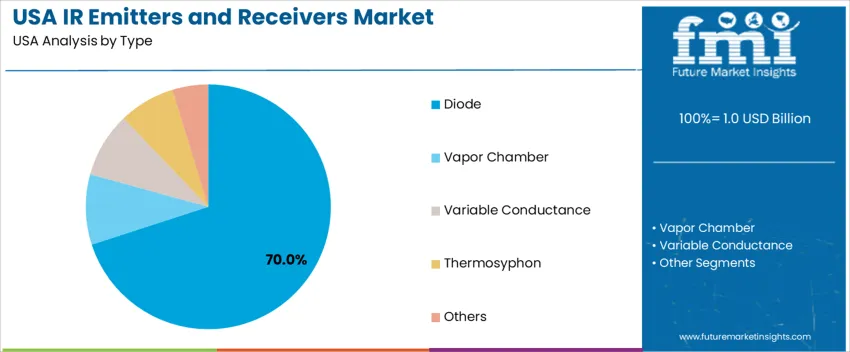
Diodes account for 70.0%, making them the primary component in USA infrared sensing and transmission applications. Their dominance reflects strong compatibility with embedded electronics such as proximity sensors, remote controls, biometric identifiers, and gesture-detection modules in consumer devices. Diode-based IR components deliver reliable emission intensity and fast response rates while maintaining power efficiency and low manufacturing costs, supporting wide deployment across regulated and consumer environments. The remaining share is distributed across vapor chamber, variable conductance, thermosyphon, and other IR component formats without individually reported segmentation. Their adoption is more niche, addressing thermal control, long-range communication, or specialized operational constraints where higher cost and engineering complexity limit broader use. USA demand structure reflects a clear priority for scalable, standardized infrared diode solutions aligned with industrial automation and IoT integration.
Key Points:
- Diodes support cost-efficient integration across electronics and sensing
- High responsiveness enables reliable motion and proximity detection
- Other component types remain niche for specialized environments
By End-Use Sector, Automotive Holds the Largest Share
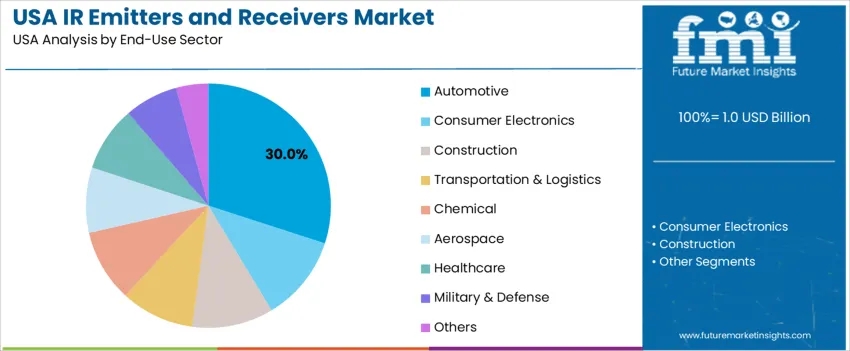
Automotive represents 30.0%, supported by increasing installations of ADAS, night-vision sensors, in-cabin safety monitoring, and driver-assistance alerts requiring infrared-based communication and detection. IR components enable vehicle automation functions and enhanced pedestrian recognition performance under low-light conditions. The remaining share spans consumer electronics, construction, transport & logistics, chemical, aerospace, healthcare, military & defense, and other industries without specified percentages. These sectors apply IR technology for quality control, security, equipment diagnostics, and human-machine interaction. USA adoption patterns reflect expanding industrial digitization, where IR sensing upgrades safety and operational reliability. Devices integrated into medical imaging and defense surveillance further reinforce product relevance as use cases broaden across connected ecosystems.
Key Points:
- Automotive leads demand through expanding ADAS and safety applications
- Diverse industries adopt IR components for sensing and monitoring
- Infrared supports automation across both civilian and defense operations
What are the Drivers, Restraints, and Key Trends of the Demand for IR Emitters and Receivers in the USA?
Growth of factory automation, continued use in consumer remote controls and rising deployment in security and sensing devices are driving demand.
In the United States, IR emitters and receivers maintain steady USAge in entertainment systems including televisions and streaming device remotes that continue to use infrared for reliable short-range control. Industrial plants adopt IR sensors for presence detection, robotics safety and conveyor automation as manufacturing facilities modernize in states such as Texas, Michigan and Ohio. Building security and smart-home systems employ IR modules for motion detection, occupancy sensing and perimeter monitoring in commercial and residential properties. Medical device manufacturers integrate IR sensing into patient monitoring equipment used in hospitals and rehabilitation centers. Automotive producers rely on IR components for cabin monitoring and climate-control interfaces in mainstream and premium vehicles sold domestically. These diverse applications sustain ongoing procurement from electronics distributors serving multiple industry segments.
Price competition, advancing alternatives such as RF and digital imaging, and slower upgrades in legacy systems restrain demand.
IR components are readily available at low cost, which results in strong price pressure across large-volume purchases. Many home-automation devices shift to Bluetooth and Wi-Fi control, reducing new remote-based deployments. Some commercial security systems transition to camera analytics and radar sensing that offer broader data insights than basic IR detection. Facilities with older hardware continue using long-life IR modules without frequent replacement, reducing rapid product turnover. These technology and replacement-cycle limitations create moderate rather than accelerated growth.
Shift toward energy-efficient surface-mount designs, increased adoption in hands-free user interfaces and rising use in industrial quality inspection define key trends.
Manufacturers supply compact, low-power IR components supporting portable consumer devices and battery-operated sensors. Touchless control interfaces in public kiosks, hospital rooms and automotive interiors use IR proximity detection for hygiene and convenience. High-precision IR receivers are gaining importance in assembly-line inspection where automated equipment verifies alignment and detects minor defects. System-level integration with microcontrollers and IoT platforms improves data connectivity and remote configuration in industrial and commercial monitoring. These developments indicate stable, multi-sector demand for IR emitters and receivers across the United States as automation and sensing capabilities expand.
Analysis of the Demand for IR Emitters and Receivers in the USA by Region
Demand for IR emitters and receivers in the United States is guided by automation uptake, consumer-electronics production, security-system upgrades, and digital-health device adoption. System integrators evaluate signal accuracy, durability, wavelength stability, and component heat-resistance in indoor and outdoor environments. Industrial procurement is influenced by design cycles in robotics, HVAC sensors, and automotive driver-monitoring functions. Consumer brands deploy IR components in remote controls, gaming accessories, and wearables to maintain gesture-tracking and communication functions. The West USA leads with 4.4% CAGR, followed by South USA at 3.9%, Northeast USA at 3.5%, and Midwest USA at 3.0%, reflecting differences in electronics manufacturing concentration and infrastructure maturity.
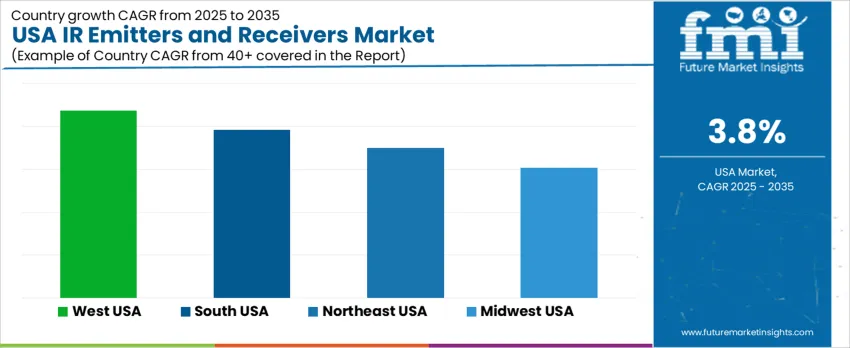
| Region | CAGR (2025-2035) |
|---|---|
| West USA | 4.4% |
| South USA | 3.9% |
| Northeast USA | 3.5% |
| Midwest USA | 3.0% |
How is West USA driving demand for IR emitters and receivers?
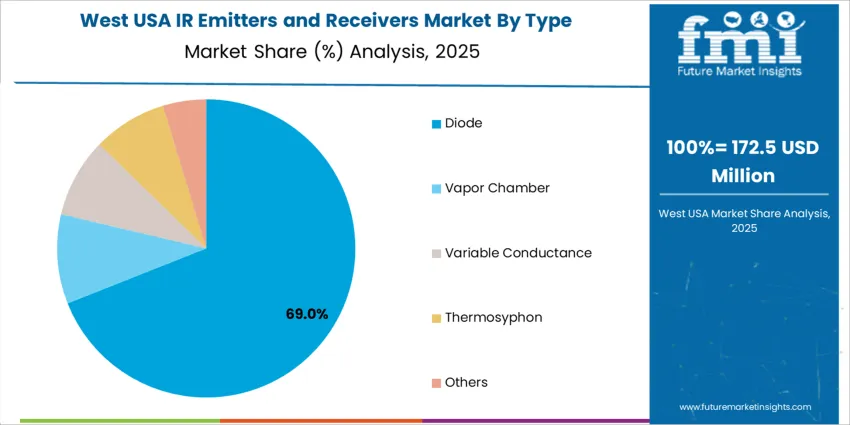
West USA shows the highest growth at 4.4% CAGR, shaped by electronics innovation clusters across California and Washington. Consumer-electronics developers integrate IR sensors into connected-home appliances, enabling device-to-device communication and gesture-controlled interfaces. Robotics startups located near automation-focused hubs adopt IR proximity sensors for navigation and collision-avoidance functions. Semiconductor R&D teams evaluate power-efficiency and long-range optical performance in designs applied to VR and AR headsets. Healthcare-device companies rely on IR communication modules in wearable technologies for data transfer that avoids radio-frequency interference. Procurement emphasizes reliable wavelength filtering and compatibility with compact embedded systems.
- Consumer-electronics brands deploying advanced sensor integration
- Robotics innovation shaping proximity-sensing component needs
- VR/AR device ecosystem requiring precise IR communication
- Medical wearables reducing RF interference with IR modules
How is South USA shaping demand for IR emitters and receivers?
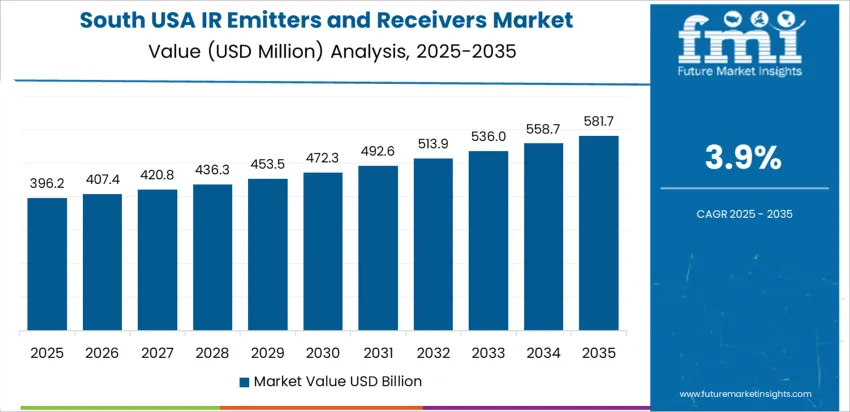
South USA expands at 3.9% CAGR, driven by industrial-automation deployment, warehouse-digitization projects, and automotive-electronics assembly in Texas, Tennessee, Georgia, and Alabama. Automated storage systems rely on IR distance-measurement technology to support material-handling equipment. Car manufacturers integrate IR sensing into seat-occupancy detection, in-cabin monitoring, and remote-key functions. Residential-security system USAge increases IR motion-detection components installed across suburban areas. Manufacturing plants incorporate IR-based inspection tools to detect product alignment and reject defects. Procurement teams assess operating-temperature tolerance, maintenance simplicity, and high repeatability across large production batches.
- Automotive-electronics adoption expanding in-cabin sensing use
- Warehousing systems depending on obstacle-avoidance sensors
- Residential-security installations increasing IR module volume
- Industrial inspection supporting consistent product-quality control
How is Northeast USA supporting component Usage growth?
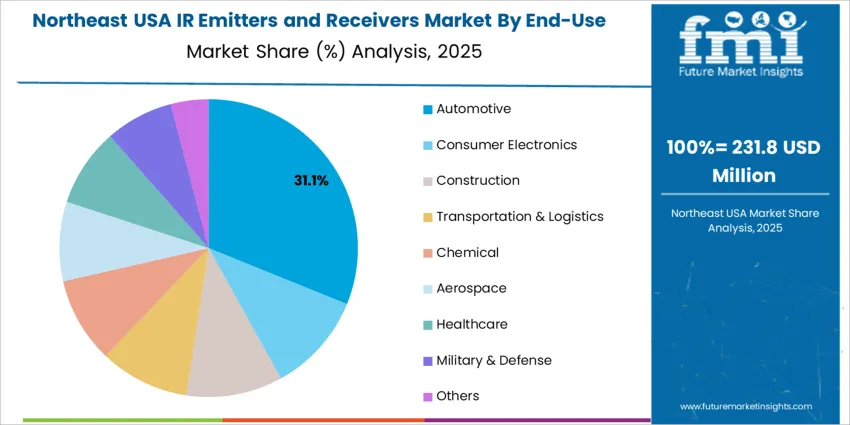
Northeast USA records around 3.5% CAGR, supported by smart-building retrofits, healthcare-system upgrades, and R&D projects across New York, Massachusetts, and New Jersey. Hospitals deploy IR-based communication modules in clinical equipment that must maintain sterile wireless interaction. Motion-activated lighting and HVAC solutions use IR sensors to manage energy efficiency in older commercial buildings. Defense-technology contractors test IR receivers for secure short-distance information transfer in controlled environments. Procurement emphasizes product certification compliance and consistent optical performance in variable indoor lighting.
- Healthcare devices using IR for controlled data transfer
- Smart-building retrofits sustaining motion-sensor integration
- Defense-contract projects evaluating compact optical modules
- Product-compliance requirements influencing purchasing decisions
How is Midwest USA contributing to overall demand?
Midwest USA grows steadily at 3.0% CAGR, driven by automation in manufacturing facilities across Michigan, Ohio, and Illinois. IR-based machine-safety devices are integrated into conveyor and assembly-line workflows to ensure operator protection. Precision-equipment makers test IR emitters in alignment sensors for metalworking and robotic welding processes. Appliance manufacturers incorporate IR components into user-control interfaces for microwaves and entertainment devices. Specifiers focus on component durability, contamination resistance, and compatibility with legacy control systems common in mature industrial plants.
- Machine-safety equipment sustaining baseline installation volumes
- Industrial automation supporting proximity-sensor requirements
- Appliance manufacturing integrating IR-enabled interfaces
- Legacy-system compatibility guiding procurement decisions
What does the competitive landscape for IR emitter and receiver demand in the United States look like?
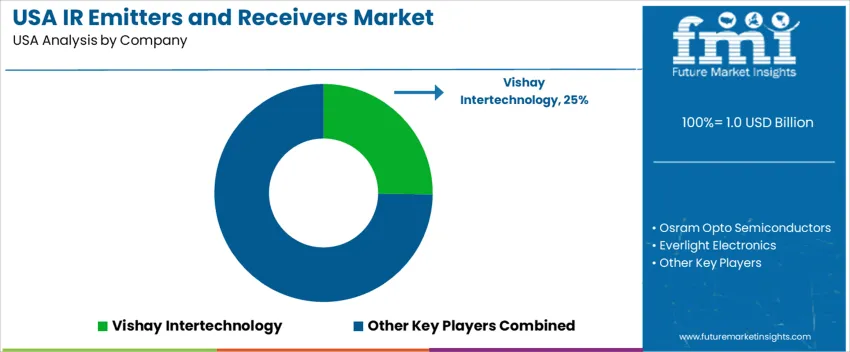
Infrared emitters and receivers in the United States support sensing in industrial automation, appliances, security systems, medical monitoring, and remote-control interfaces. Domestic demand reflects integration into occupancy sensors, optical encoders, and safety interlocks across manufacturing and building-automation environments. Component buyers prioritize signal stability, long-term supply continuity, and compliance with durability standards suitable for continuous operation. Engineering teams also evaluate package size, power efficiency, wavelength accuracy, and compatibility with automated assembly lines used in USA electronics production. Vishay Intertechnology holds an estimated 25% share. Its established photodiode and LED portfolio serves high-reliability applications in industrial and consumer electronics. Strength in USA distribution reinforces design-win retention across OEM programs.
OSRAM Opto Semiconductors supplies IR solutions for security and gesture-sensing deployments in commercial and residential systems. ROHM Semiconductor supports industrial customers with components suited to demanding environments, including material-handling equipment and automotive assemblies produced in the United States. Lite-On Technology contributes to remote-control devices, motion sensors, and optical interrupters used in consumer goods and office equipment. Everlight Electronics remains active in lighting and compact sensing elements selected for cost-sensitive applications where dependable performance remains essential. Competitive positioning in the United States depends on high-volume manufacturing readiness, component lifecycle transparency, and ongoing collaboration with integrators deploying automation and sensing functions across facilities, vehicles, and connected-device installations.
Key Players in USA IR Emitters and Receivers Demand
- Vishay Intertechnology
- Osram Opto Semiconductors
- Everlight Electronics
- Rohm Semiconductor
- Lite-On Technology
Scope of the Report
| Items | Values |
|---|---|
| Quantitative Units | USD billion |
| Type | Diode, Vapor Chamber, Variable Conductance, Thermosyphon, Others |
| End-Use Sector | Automotive, Consumer Electronics, Construction, Transportation & Logistics, Chemical, Aerospace, Healthcare, Military & Defense, Others |
| Regions Covered | West USA, South USA, Northeast USA, Midwest USA |
| Key Companies Profiled | Vishay Intertechnology, Osram Opto Semiconductors, Everlight Electronics, Rohm Semiconductor, Lite-On Technology |
| Additional Attributes | Dollar sales by type and end-use sectors; regional adoption in autonomous driving systems, LiDAR, surveillance, and gesture recognition technologies; growth supported by consumer electronics miniaturization and smart-home devices; integration trends in healthcare monitoring and industrial automation; expansion within U.S. aerospace and military defense procurement; competition focused on wavelength efficiency, heat dissipation, and optoelectronic performance improvements. |
USA IR Emitters and Receivers Demand by Segments
Type:
- Diode
- Vapor Chamber
- Variable Conductance
- Thermosyphon
- Others
End-Use Sector:
- Automotive
- Consumer Electronics
- Construction
- Transportation & Logistics
- Chemical
- Aerospace
- Healthcare
- Military & Defense
- Others
Region:
- West USA
- South USA
- Northeast USA
- Midwest USA
Frequently Asked Questions
How big is the demand for ir emitters and receivers in USA in 2025?
The demand for ir emitters and receivers in USA is estimated to be valued at USD 1.0 billion in 2025.
What will be the size of ir emitters and receivers in USA in 2035?
The market size for the ir emitters and receivers in USA is projected to reach USD 1.5 billion by 2035.
How much will be the demand for ir emitters and receivers in USA growth between 2025 and 2035?
The demand for ir emitters and receivers in USA is expected to grow at a 3.8% CAGR between 2025 and 2035.
What are the key product types in the ir emitters and receivers in USA?
The key product types in ir emitters and receivers in USA are diode, vapor chamber, variable conductance, thermosyphon and others.
Which end-use sector segment is expected to contribute significant share in the ir emitters and receivers in USA in 2025?
In terms of end-use sector, automotive segment is expected to command 30.0% share in the ir emitters and receivers in USA in 2025.
Preview the report firsthand - request a free sample
Get SampleGet the brochure for pricing and purchase details.
Get PDFTable of Content
- Executive Summary
- USA Market Outlook
- Demand-side Trends
- Supply-side Trends
- Technology Roadmap Analysis
- Analysis and Recommendations
- Market Overview
- Market Coverage / Taxonomy
- Market Definition / Scope / Limitations
- Market Background
- Market Dynamics
- Drivers
- Restraints
- Opportunity
- Trends
- Scenario Forecast
- Demand in Optimistic Scenario
- Demand in Likely Scenario
- Demand in Conservative Scenario
- Opportunity Map Analysis
- Product Life Cycle Analysis
- Supply Chain Analysis
- Investment Feasibility Matrix
- Value Chain Analysis
- PESTLE and Porter’s Analysis
- Regulatory Landscape
- Regional Parent Market Outlook
- Production and Consumption Statistics
- Import and Export Statistics
- Market Dynamics
- USA Market Analysis 2020 to 2024 and Forecast, 2025 to 2035
- Historical Market Size Value (USD Million) Analysis, 2020 to 2024
- Current and Future Market Size Value (USD Million) Projections, 2025 to 2035
- Y-o-Y Growth Trend Analysis
- Absolute $ Opportunity Analysis
- USA Market Pricing Analysis 2020 to 2024 and Forecast 2025 to 2035
- USA Market Analysis 2020 to 2024 and Forecast 2025 to 2035, By Type
- Introduction / Key Findings
- Historical Market Size Value (USD Million) Analysis By Type , 2020 to 2024
- Current and Future Market Size Value (USD Million) Analysis and Forecast By Type , 2025 to 2035
- Diode
- Vapor Chamber
- Variable Conductance
- Thermosyphon
- Others
- Y-o-Y Growth Trend Analysis By Type , 2020 to 2024
- Absolute $ Opportunity Analysis By Type , 2025 to 2035
- USA Market Analysis 2020 to 2024 and Forecast 2025 to 2035, By End-Use Sector
- Introduction / Key Findings
- Historical Market Size Value (USD Million) Analysis By End-Use Sector, 2020 to 2024
- Current and Future Market Size Value (USD Million) Analysis and Forecast By End-Use Sector, 2025 to 2035
- Automotive
- Consumer Electronics
- Construction
- Transportation & Logistics
- Chemical
- Aerospace
- Healthcare
- Military & Defense
- Others
- Y-o-Y Growth Trend Analysis By End-Use Sector, 2020 to 2024
- Absolute $ Opportunity Analysis By End-Use Sector, 2025 to 2035
- Market Structure Analysis
- Competition Dashboard
- Competition Benchmarking
- Market Share Analysis of Top Players
- By Regional
- By Type
- By End-Use Sector
- Competition Analysis
- Competition Deep Dive
- Vishay Intertechnology
- Overview
- Product Portfolio
- Profitability by Market Segments (Product/Age /Sales Channel/Region)
- Sales Footprint
- Strategy Overview
- Marketing Strategy
- Product Strategy
- Channel Strategy
- Osram Opto Semiconductors
- Everlight Electronics
- Rohm Semiconductor
- Lite-On Technology
- Vishay Intertechnology
- Competition Deep Dive
- Assumptions & Acronyms Used
- Research Methodology


