

- Industry Size (2025)
- USD 867.0 Mn
- Forecast (2035)
- USD 1298.9 Mn
- CAGR (2025 to 2035)
- 4.1%
Demand for Level Switches in Japan Forecast and Outlook 2025 to 2035
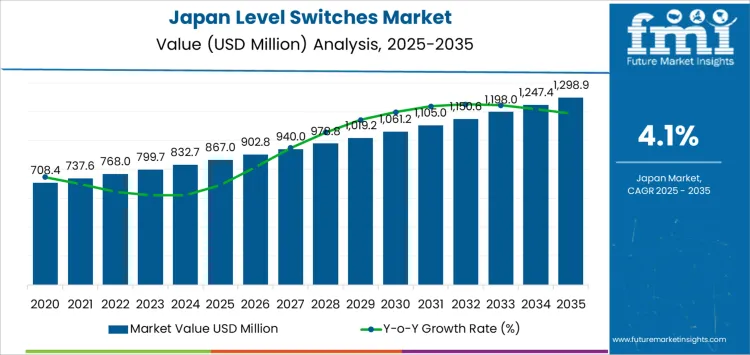
The demand for level switches in Japan is valued at USD 867.0 million in 2025 and is projected to reach USD 1,298.9 million by 2035, reflecting a CAGR of 4.1%. The value path from USD 708.4 million in 2020 to USD 867.0 million in 2025 reflects steady intake across liquid handling and bulk material monitoring systems. Float level switches hold the largest share due to broad use in liquid holding tanks and general purpose vessel control. Capacitive and conductivity formats support closed vessels and reservoir monitoring where contact based detection is required. Chemical processing, food manufacturing, and water treatment facilities form the core early demand base. Procurement during this phase reflects plant maintenance cycles, safety interlock needs, and regulated process control requirements rather than capacity driven expansion.
From 2026 onward, demand advances from USD 902.8 million to USD 1,105.0 million by 2031, then rises to USD 1,298.9 million by 2035 through steady annual increments. Grain silos and hopper applications contribute consistent incremental volumes as material handling automation expands within storage and logistics facilities. Tuning fork and optical switches gain gradual share in dusty and abrasive environments where contact wear limits float performance. Closed vessel monitoring maintains steady growth as batch processing remains central across manufacturing sectors. After 2030, replacement demand and incremental sensor density per vessel become the main drivers rather than new plant construction. Annual value movement remains controlled, indicating low volatility. The long range pattern reflects disciplined capital planning, safety compliance, and routine process automation upgrades across Japanese industrial operations.
Quick Stats of the Demand for Level Switches in Japan:
- Demand for Level Switches in Japan Value (2025): USD 867.0 million
- Demand for Level Switches in Japan Forecast Value (2035): USD 1,298.9 million
- Demand for Level Switches in Japan Forecast CAGR (2025 to 2035): 4.1%
- Demand for Level Switches in Japan Leading Switch Type: Float Level Switches (40%)
- Demand for Level Switches in Japan Key Growth Regions: Kyushu & Okinawa, Kanto, Kansai
- Demand for Level Switches in Japan Top Players: Dwyer Instruments, AMETEK Inc., SICK AG, Gems Sensors & Controls, FineTek Co. Ltd.
What is the Growth Forecast for Level Switches in Japan through 2035?
Between 2025 and 2030, demand for level switches in Japan increases from USD 867.0 million to USD 1,061.2 million, reflecting an absolute expansion of USD 194.2 million over five years. Average annual value addition during this phase stands close to USD 38.8 million. Growth is shaped by steady capital expenditure across chemical processing, water treatment, food manufacturing, and power generation facilities. New project commissioning supports consistent device installation volumes. Earlier demand was driven by basic tank monitoring needs. Near term expansion reflects higher instrumentation density, stricter process safety controls, and wider deployment across automated liquid and bulk material handling systems.
From 2030 to 2035, demand rises from USD 1,061.2 million to USD 1,298.9 million, adding USD 237.7 million over the latter half of the forecast period. Average yearly value addition moves closer to USD 47.5 million, indicating a faster scale up than the earlier phase. Growth is supported by rising investment in hydrogen, wastewater reuse, and advanced materials processing facilities. Standardization of smart plant architectures strengthens multi point sensor deployment. Earlier growth relied on incremental industrial expansion, while later demand reflects larger integrated plant build outs, higher redundancy requirements, and tighter compliance with operational safety and process reliability frameworks.
Level Switches Industry in Japan Key Takeaways
| Metric | Value |
|---|---|
| Industry Value (2025) | USD 867.0 million |
| Forecast Value (2035) | USD 1,298.9 million |
| Forecast CAGR (2025 to 2035) | 4.1% |
What Is Driving the Demand for Level Switches in Japan Across Historical and Future Growth Cycles?
Demand for level switches in Japan developed through steady expansion of chemical processing, water treatment, power generation, and food manufacturing. Facilities relied on simple float, electrode, and mechanical switches to prevent overflow, dry running, and tank imbalance. Growth followed construction of municipal utilities, refinery upgrades, and factory automation during long industrial expansion phases. Procurement focused on mechanical reliability, resistance to corrosion, and stable operation in confined plant layouts. Domestic instrumentation suppliers built durable product lines suited to liquids, slurries, and bulk solids. Replacement demand formed a stable base as switches followed predictable wear and inspection cycles. Historical growth depended on physical process control rather than digital integration. Safety compliance, operator familiarity, and low lifecycle cost shaped purchasing behavior across public utilities and high volume manufacturing sites nationwide.
Future demand for level switches in Japan is expected to align with deeper automation, remote monitoring, and stricter plant safety control. Digital output models, vibration based designs, and non-contact sensing methods support use in corrosive, hygienic, and high temperature environments. Water infrastructure renewal, semiconductor fabrication, and battery material production raise demand for precise level detection. Historical growth depended on mechanical switching and periodic inspection. Future growth centers on real time status reporting, predictive maintenance integration, and system wide fault diagnostics. Energy management, emission control, and process stability influence selection criteria. Investment decisions reflect data compatibility with control platforms, workforce skill availability, and regulatory inspection standards. Demand growth will track industrial reinvestment cycles, infrastructure renewal programs, and continuous upgrading of plant level control systems across core production regions.
What Is the Demand for Level Switches in Japan by Switch Type and Application?
The demand for level switches in Japan is shaped by automated liquid handling, compact industrial layouts, and strict process safety control across manufacturing and utilities. Float level switches lead by switch type due to their mechanical simplicity and stable operation in varied liquid conditions. Liquid holding tanks lead by application as storage, batching, and treatment operations rely on continuous level monitoring. Procurement is driven by plant engineering firms, water treatment operators, and OEM equipment builders. Import reliance remains present for specialty sensing elements and industrial connectors. Substitution pressure exists from non-contact ultrasonic sensing in corrosive settings. Demand stability is supported by steady investment in process automation and municipal infrastructure maintenance.
Why do float level switches account for 40% of the demand for level switches in Japan by switch type?
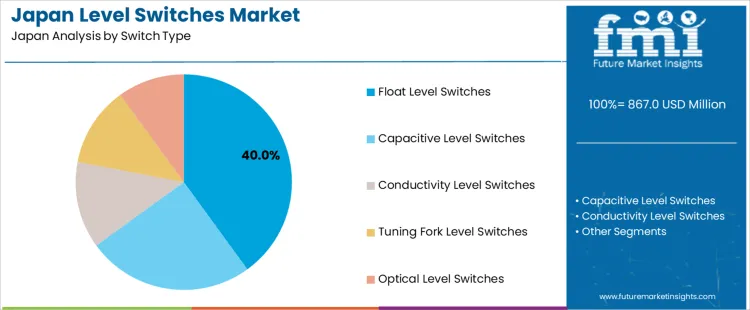
Float level switches account for 40% of the demand for level switches in Japan by switch type, reflecting their suitability for simple point level detection in industrial liquids. Consumption intensity is driven by chemical processing, food manufacturing, water treatment, and boiler feed systems. Usage remains stable because float mechanisms operate without complex electronics in temperature and pressure variable environments. Procurement is led by equipment OEMs and plant maintenance contractors focused on low failure rate components. Price sensitivity remains moderate because downtime risk guides purchasing decisions. Specification control emphasizes buoyancy stability, corrosion resistance, switch actuation reliability, and long mechanical cycle life.
Float level switches also generate steady repeat demand through scheduled maintenance and replacement cycles across continuous process industries. Repeat utilization remains predictable due to wear of mechanical linkages in high duty systems. Buyers favor standardized thread sizes and mounting formats to simplify field replacement. Margin structure remains controlled under competition among domestic instrumentation suppliers. Regulatory exposure centers on industrial safety certification and hazardous area compliance. Import reliance persists for magnetic reed switches and specialty polymers. Substitution pressure from capacitive designs remains present in viscous and high temperature liquids.
Why do liquid holding tanks represent 44.0% of the demand for level switches in Japan by application?
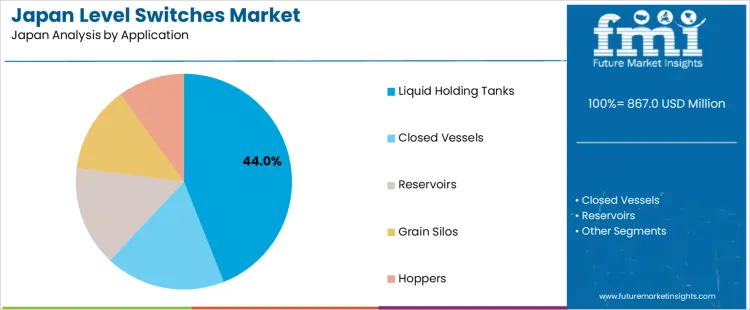
Liquid holding tanks represent 44.0% of the demand for level switches in Japan by application, reflecting their central role in storage, mixing, and treatment operations. Consumption intensity is driven by municipal water systems, chemical storage farms, food ingredient holding, and wastewater processing units. Usage remains stable because level control governs overflow prevention, pump protection, and batch measurement accuracy. Procurement is dominated by treatment plant operators, industrial utilities, and EPC contractors. Price sensitivity remains moderate because switch failure leads to spillage risk and process interruption. Specification control emphasizes ingress protection rating, chemical compatibility, response repeatability, and safe actuation under surge conditions.
Liquid tank applications also generate consistent repeat demand through inspection driven replacement and system upgrades. Repeat utilization remains predictable as tanks remain long life assets with periodic instrumentation renewal. Buyers favor redundant level switch installation to support safety interlocks and alarm signaling. Margin structure remains controlled under project based procurement. Regulatory exposure remains elevated due to environmental discharge control and workplace safety enforcement. Import reliance persists for explosion proof housings and signal isolation modules. Substitution pressure from continuous level transmitters remains limited to high precision dosing systems.
What Is Driving the Demand for Level Switches in Japan Industrial Process Control and Safety Management?
Demand for level switches in Japan reflects dense chemical processing, food production, and water treatment operations that require reliable point level detection. Tanks, silos, and pipelines across compact factory layouts depend on fast overflow prevention and dry run protection. Earthquake risk heightens value of automatic shutoff during abnormal liquid movement. Aging infrastructure renewal also raises replacement demand for mechanical float, tuning fork, and capacitive types. Buyers favor stable operation under temperature variation and vibration. Compliance with fire prevention law and plant safety audits shapes specification. Demand follows plant maintenance cycles, safety upgrades, and automation reinforcement across urban industrial zones nationwide.
How Are Chemical, Water, and Food Plants Structuring Daily Level Switch Usage in Japan?
Japan chemical plants use level switches for batch reactors, solvent tanks, and neutralization basins where overflow control protects both process stability and worker safety. Water utilities rely on switches for pump protection in lift stations and reservoir management under fluctuating inflow. Food and beverage processors monitor ingredient tanks, CIP systems, and waste lines with hygienic level sensing. Each sector applies different material and hygiene standards that shape product selection. Daily switching frequency remains high in continuous operations. Demand links to uptime protection and process repeatability rather than to metering accuracy alone in these volume driven industries clusters nationwide today operations.
Why Are Power Generation, Waste Plants, and Bulk Handling Raising Specification Rigor in Japan?
Power stations apply level switches to boiler feedwater, condensate recovery, and fuel storage where false triggering risks turbine damage. Waste treatment plants monitor sludge, chemicals, and leachate under corrosive conditions that test sensor durability. Cement, grain, and resin bulk handling sites track silo fill status to avoid overloading and blocked discharge. These environments demand vibration resistance, dust immunity, and long mechanical life. Engineering teams require clear fail safe behavior under signal loss. Demand follows tightening safety documentation and lifecycle reliability expectations within heavy industry and utility operations across regional industrial corridors nationwide support modern plant expansion and system renewal programs.
How Do Cost Control, Certification Cycles, and Process Diversity Limit Adoption in Japan?
Level switch adoption in Japan faces limits from plant certification cycles, procurement discipline, and wide fluid property variation. New devices require validation under pressure, temperature, and chemical exposure relevant to each process line. Public infrastructure projects follow multiyear bidding schedules that restrict fast substitution. Low margin sectors delay upgrades until failure events occur. Multiproduct factories hesitate to standardize due to mixed media needs across acids, oils, powders, and slurries. Spare part stocking and technician training also shape selection. These factors slow uniform adoption and favor conservative replacement within established supplier relationships across industrial operations nationwide under long term planning.
What is the Demand for Level Switches in Japan by Region?
| Region | CAGR (%) |
|---|---|
| Kyushu & Okinawa | 5.2% |
| Kanto | 4.7% |
| Kansai | 4.2% |
| Chubu | 3.7% |
| Tohoku | 3.2% |
| Rest of Japan | 3.1% |
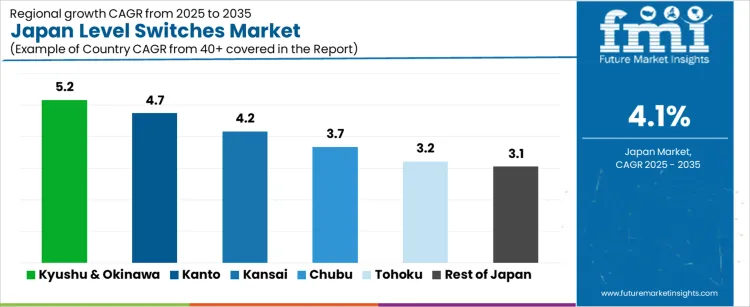
The demand for level switches in Japan is increasing steadily across industrial automation and process control regions, led by Kyushu and Okinawa at a 5.2% CAGR. Growth in this region is supported by chemical processing, water treatment projects, and expanding food and beverage manufacturing that requires continuous liquid and solid level monitoring. Kanto follows at 4.7%, driven by dense manufacturing clusters, pharmaceutical production, and smart factory upgrades that rely on precise sensing devices. Kansai records 4.2% growth, reflecting stable use in industrial equipment, utilities, and material handling systems. Chubu at 3.7% shows moderate uptake linked to automotive manufacturing and industrial fluid management. Tohoku and the Rest of Japan, at 3.2% and 3.1%, reflect slower growth shaped by lower industrial density and longer automation investment cycles.
How Are Process Industries Supporting Level Switch Adoption in Kyushu and Okinawa?
Demand for level switches in Kyushu and Okinawa is advancing at a CAGR of 5.2% through 2035, supported by chemical processing plants, water treatment facilities, and expanding food processing operations. Storage tanks, silos, and fluid transfer systems depend on level monitoring for operational safety and efficiency. Port based fuel storage terminals also apply level switches for inventory tracking. Growth reflects steady industrial output, rising compliance with safety monitoring standards, and ongoing upgrades of manual level measurement systems with automated control solutions.
- Chemical storage tanks require continuous level detection
- Water treatment plants rely on automated fluid monitoring
- Food processing lines apply hygienic level sensing systems
- Fuel terminals support bulk liquid inventory control
Why Is Dense Industrial Infrastructure Driving Level Switch Demand in Kanto?
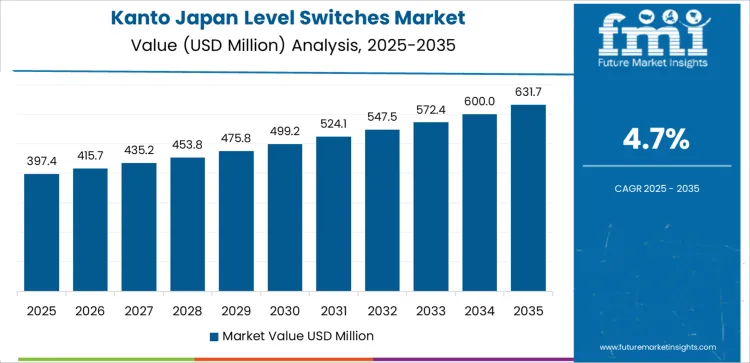
Demand for level switches in Kanto is rising at a CAGR of 4.7% through 2035, driven by high concentration of pharmaceutical plants, electronics manufacturing units, and large scale wastewater management facilities. Automated level control supports precision dosing, reactor safety, and contamination prevention. Commercial building utilities also apply level switches in HVAC and firefighting water storage. Growth reflects strong industrial automation spending, strict regulatory inspection regimes, and continuous retrofitting of legacy measurement systems with digital level sensing equipment.
- Pharmaceutical reactors depend on precise level control
- Electronics fabrication relies on clean fluid monitoring
- Commercial utilities apply level sensing for safety systems
- Retrofit programs sustain steady equipment replacement
What Is Supporting Balanced Level Switch Adoption Across Kansai Industry?
Demand for level switches in Kansai is progressing at a CAGR of 4.2% through 2035, supported by machinery manufacturing, beverage production facilities, and petrochemical material handling. Kansai plants apply level switches in blending tanks, storage silos, and lubricant reservoirs. Adoption remains balanced across float based and capacitive technologies. Growth reflects stable industrial investment, ongoing modernization of process control systems, and steady production planning across diversified manufacturing clusters.
- Beverage production lines require accurate tank level feedback
- Machinery plants rely on lubricant reservoir monitoring
- Petrochemical handling depends on safe bulk storage control
- Multi technology adoption supports balanced system use
How Is Manufacturing Equipment Modernization Shaping Level Switch Demand in Chubu?
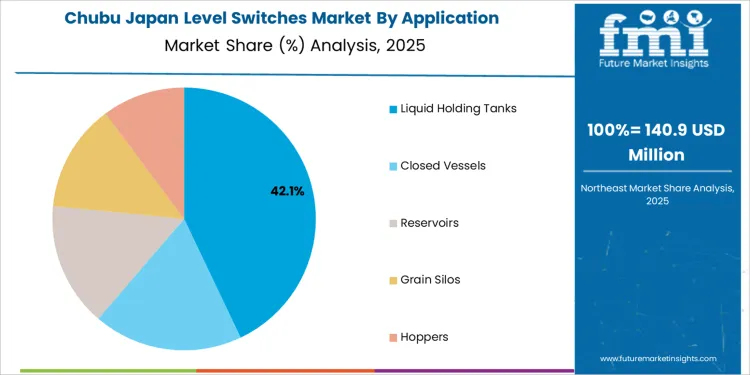
Demand for level switches in Chubu is advancing at a CAGR of 3.7% through 2035, supported by automotive manufacturing plants, metalworking facilities, and coolant management systems. Assembly plants apply level switches for hydraulic oil control, coolant circulation, and chemical bath monitoring. Machine tool workshops depend on level sensors for operational reliability. Growth reflects stable vehicle production output, phased automation of fluid management systems, and steady investment in predictive maintenance across industrial production lines.
- Automotive plants use level sensing for coolant management
- Hydraulic systems rely on oil reservoir level control
- Machine tools apply sensors for safe fluid operation
- Predictive maintenance supports steady sensor replacement
Why Is Public Utility Infrastructure Supporting Level Switch Growth in Tohoku?
Demand for level switches in Tohoku is advancing at a CAGR of 3.2% through 2035, supported by municipal water supply systems, regional wastewater treatment plants, and controlled expansion of food processing facilities. Level switches guide pump operation, overflow prevention, and storage tank safety. Industrial adoption remains selective. Growth reflects public infrastructure maintenance programs, steady compliance with environmental monitoring rules, and gradual automation of legacy water management equipment.
- Municipal pumping stations rely on level based control
- Overflow prevention systems support public safety goals
- Food processing plants apply basic tank monitoring
- Environmental compliance sustains long term demand stability
How Is Small Scale Industrial Activity Guiding Level Switch Demand in Rest of Japan?
Demand for level switches in Rest of Japan is advancing at a CAGR of 3.1% through 2035, supported by small manufacturing units, agricultural liquid storage, and community level water management systems. Independent workshops apply basic level sensing for fuel tanks, coolant reservoirs, and chemical storage. Advanced automation remains limited. Growth remains steady and guided by routine equipment replacement, safety inspection requirements, and gradual awareness of automated level protection benefits across local industrial operations.
- Small workshops rely on basic reservoir level monitoring
- Agricultural storage systems apply liquid level safety control
- Routine inspections drive replacement demand
- Safety awareness supports gradual automation uptake
What Is Driving the Demand for Level Switches in Japan and Which Companies Shape Industrial Instrumentation Adoption?
The demand for level switches in Japan is shaped by steady output in chemicals, water treatment, food processing, pharmaceuticals, and semiconductor production. Azbil holds a central domestic position through level detection and process control instruments used across factories, utilities, and clean production environments. Yokogawa Electric supports demand through integrated level measurement and safety instrumentation used in refineries, chemical plants, and power facilities. SICK AG maintains strong adoption through non-contact and optical level detection used in logistics, materials handling, and packaging automation. FineTek supports demand through capacitance and vibration based level switches supplied to food, plastics, and bulk material processors. These suppliers anchor qualification through long approval cycles and close coordination with plant engineering teams.
Dwyer Instruments participates through imported mechanical and digital level switches used in HVAC water systems, industrial tanks, and building services equipment. AMETEK supports demand through precision sensing platforms used in specialty industrial and laboratory environments. Gems Sensors and Controls supplies compact level switches used in hydraulic systems, medical equipment, and small process vessels. System selection in Japan is governed by reliability under continuous operation, resistance to corrosion and high temperature, and compatibility with domestic control systems. Buyer preference favors suppliers with domestic calibration services, Japanese language technical documentation, and rapid maintenance response. Demand visibility tracks water infrastructure renewal, semiconductor fab expansion, food safety automation, and continuous investment in process plant reliability across industrial regions.
Key Players in the Level Switches Industry in Japan
- Dwyer Instruments
- AMETEK Inc.
- SICK AG
- Gems Sensors & Controls
- FineTek Co. Ltd.
Scope of the Report
| Items | Values |
|---|---|
| Quantitative Units (2025) | USD million |
| Type | Float Level Switches, Capacitive Level Switches, Conductivity Level Switches, Tuning Fork Level Switches, Optical Level Switches |
| Application | Liquid Holding Tanks, Closed Vessels, Reservoirs, Grain Silos, Hoppers |
| End User | Chemical Processing Plants, Water Treatment Facilities, Food and Beverage Manufacturing, Power Generation, Pharmaceutical Plants, Semiconductor Fabrication, Bulk Material Handling Facilities |
| Regions Covered | Kyushu and Okinawa, Kanto, Kansai, Chubu, Tohoku, Rest of Japan |
| Countries Covered | Japan |
| Key Companies Profiled | Dwyer Instruments, AMETEK Inc., SICK AG, Gems Sensors and Controls, FineTek Co. Ltd. |
| Additional Attributes | Dollar by sales by switch type and application category, replacement versus new plant installation share, sensor density per vessel trends, safety interlock deployment patterns, use in liquid storage versus bulk solids handling, calibration and certification cycle influence on procurement, integration with smart plant control systems, and regional variation in automation intensity across Japanese industrial zones |
Level Switches Industry in Japan Segmentation
Switch Type:
- Float Level Switches
- Capacitive Level Switches
- Conductivity Level Switches
- Tuning Fork Level Switches
- Optical Level Switches
Application:
- Liquid Holding Tanks
- Closed Vessels
- Reservoirs
- Grain Silos
- Hoppers
Region
- Kyushu & Okinawa
- Kanto
- Kansai
- Chubu
- Tohoku
- Rest of Japan
Frequently Asked Questions
How big is the demand for level switches in Japan in 2025?
The demand for level switches in Japan is estimated to be valued at USD 867.0 million in 2025.
What will be the size of level switches in Japan in 2035?
The market size for the level switches in Japan is projected to reach USD 1,298.9 million by 2035.
How much will be the demand for level switches in Japan growth between 2025 and 2035?
The demand for level switches in Japan is expected to grow at a 4.1% CAGR between 2025 and 2035.
What are the key product types in the level switches in Japan?
The key product types in level switches in Japan are float level switches, capacitive level switches, conductivity level switches, tuning fork level switches and optical level switches.
Which application segment is expected to contribute significant share in the level switches in Japan in 2025?
In terms of application, liquid holding tanks segment is expected to command 44.0% share in the level switches in Japan in 2025.
Preview the report firsthand - request a free sample
Get SampleGet the brochure for pricing and purchase details.
Get PDFTable of Content
- Executive Summary
- Japan Market Outlook
- Demand-side Trends
- Supply-side Trends
- Technology Roadmap Analysis
- Analysis and Recommendations
- Market Overview
- Market Coverage / Taxonomy
- Market Definition / Scope / Limitations
- Market Background
- Market Dynamics
- Drivers
- Restraints
- Opportunity
- Trends
- Scenario Forecast
- Demand in Optimistic Scenario
- Demand in Likely Scenario
- Demand in Conservative Scenario
- Opportunity Map Analysis
- Product Life Cycle Analysis
- Supply Chain Analysis
- Investment Feasibility Matrix
- Value Chain Analysis
- PESTLE and Porter’s Analysis
- Regulatory Landscape
- Regional Parent Market Outlook
- Production and Consumption Statistics
- Import and Export Statistics
- Market Dynamics
- Japan Market Analysis 2020 to 2024 and Forecast, 2025 to 2035
- Historical Market Size Value (USD Million) Analysis, 2020 to 2024
- Current and Future Market Size Value (USD Million) Projections, 2025 to 2035
- Y-o-Y Growth Trend Analysis
- Absolute $ Opportunity Analysis
- Japan Market Pricing Analysis 2020 to 2024 and Forecast 2025 to 2035
- Japan Market Analysis 2020 to 2024 and Forecast 2025 to 2035, By Switch Type
- Introduction / Key Findings
- Historical Market Size Value (USD Million) Analysis By Switch Type , 2020 to 2024
- Current and Future Market Size Value (USD Million) Analysis and Forecast By Switch Type , 2025 to 2035
- Float Level Switches
- Capacitive Level Switches
- Conductivity Level Switches
- Tuning Fork Level Switches
- Optical Level Switches
- Y-o-Y Growth Trend Analysis By Switch Type , 2020 to 2024
- Absolute $ Opportunity Analysis By Switch Type , 2025 to 2035
- Japan Market Analysis 2020 to 2024 and Forecast 2025 to 2035, By Application
- Introduction / Key Findings
- Historical Market Size Value (USD Million) Analysis By Application, 2020 to 2024
- Current and Future Market Size Value (USD Million) Analysis and Forecast By Application, 2025 to 2035
- Liquid Holding Tanks
- Closed Vessels
- Reservoirs
- Grain Silos
- Hoppers
- Y-o-Y Growth Trend Analysis By Application, 2020 to 2024
- Absolute $ Opportunity Analysis By Application, 2025 to 2035
- Market Structure Analysis
- Competition Dashboard
- Competition Benchmarking
- Market Share Analysis of Top Players
- By Regional
- By Switch Type
- By Application
- Competition Analysis
- Competition Deep Dive
- Dwyer Instruments
- Overview
- Product Portfolio
- Profitability by Market Segments (Product/Age /Sales Channel/Region)
- Sales Footprint
- Strategy Overview
- Marketing Strategy
- Product Strategy
- Channel Strategy
- AMETEK Inc.
- SICK AG
- Gems Sensors & Controls
- FineTek Co. Ltd.
- Dwyer Instruments
- Competition Deep Dive
- Assumptions & Acronyms Used
- Research Methodology


