

- Industry Size (2025)
- USD 221.9 Mn
- Forecast (2035)
- USD 302.6 Mn
- CAGR (2025 to 2035)
- 3.2%
Demand for MRSA Testing in Japan Forecast and Outlook 2025 to 2035
Demand for MRSA testing in Japan shows a consistent upward trend from USD 221.9 million in 2025 to USD 302.6 million in 2035, reflecting a CAGR of 3.2%. Initially, the demand experiences a gradual increase from USD 33.6 million in 2025, reaching USD 190.0 million by 2030, marking a steady rise of 3.2% annually. This period is characterized by a moderate but consistent growth curve, with each year seeing incremental increases. By 2030, demand has surpassed the USD 200 million mark, highlighting a growing awareness and need for MRSA testing due to increasing healthcare concerns regarding hospital-acquired infections. The years between 2025 and 2030 demonstrate a smooth, linear growth, reflecting the adoption of more advanced and widespread testing protocols.
Quick Stats of the Demand for MRSA Testing in Japan
- Demand for MRSA Testing in Japan Value (2025): USD 221.9 million
- Demand for MRSA Testing in Japan Forecast Value (2035): USD 302.6 million
- Demand for MRSA Testing in Japan Forecast CAGR (2025-2035): 3.2%
- Demand for MRSA Testing in Japan Leading Type of MRSA: Healthcare Acquired MRSA
- Demand for MRSA Testing in Japan Key Growth Regions: Kyushu & Okinawa, Kanto, Kansai, Chubu, Tohoku, Rest of Japan
- Demand for MRSA Testing in Japan Top Players: Thermo Fisher Scientific, bioMérieux, BD, Abbott Laboratories, Cepheid
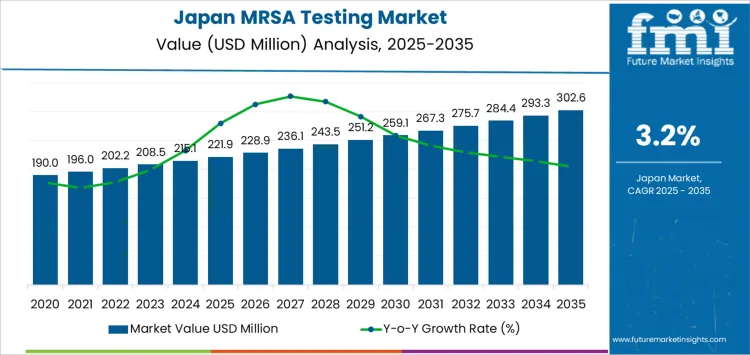
Between 2030 and 2035, the demand for MRSA testing continues to rise steadily, moving from USD 215.1 million in 2030 to USD 302.6 million by 2035. This represents an acceleration in growth, as healthcare infrastructure and awareness of antimicrobial resistance continue to improve. While the curve remains relatively linear, the rate of growth increases noticeably in the final years of the forecast period, particularly between 2031 and 2035. By 2034, the demand will surpass USD 275 million, suggesting stronger public health initiatives and regulatory focus on controlling infections. As demand for MRSA testing continues to rise, driven by advances in medical diagnostics and heightened focus on infection control, the growth curve shows both consistency and slight acceleration, ensuring steady industry expansion over the next decade.
Demand for MRSA Testing in Japan Key Takeaways
| Metric | Value |
|---|---|
| Industry Value (2025) | USD 221.9 million |
| Industry Forecast Value (2035) | USD 302.6 million |
| Forecast CAGR (2025-2035) | 3.2% |
Why is the Demand for MRSA Testing in Japan Growing?
Demand for MRSA testing in Japan is increasing due to the rising prevalence of Methicillin-resistant Staphylococcus aureus (MRSA) infections, which are notoriously difficult to treat because they are resistant to many standard antibiotics. MRSA infections pose a significant challenge, especially in healthcare settings such as hospitals and nursing homes, where patients are more vulnerable to infections. The growing threat of these infections is driving a need for more effective diagnostic tools to detect MRSA early and ensure timely, appropriate treatment. Early detection helps in managing infections before they spread, reducing the risk of complications and the need for more intensive treatments.
Advancements in diagnostic technologies have also fueled the demand for MRSA testing. New molecular diagnostics, particularly real-time PCR and rapid molecular assays, have made it possible to detect MRSA more quickly and accurately. These technologies offer faster turnaround times, which are critical in ensuring that patients receive the right antibiotic therapy without delay. The Japanese healthcare system has been investing in improving infection control and prevention measures, and accurate MRSA testing is seen as a crucial component of these efforts. The rising awareness of antimicrobial resistance (AMR) and its potential to lead to treatment failures is prompting both healthcare professionals and the public to recognize the importance of early detection.
Challenges such as the high costs of advanced diagnostic systems and the need for specialized training to interpret results may hinder broader adoption in some healthcare settings. Despite these obstacles, the growing emphasis on infection control and the increasing accessibility of diagnostic technologies are expected to drive sustained growth in the demand for MRSA testing across Japan.
What is the Segment-Wise Analysis of Demand for MRSA Testing in Japan?
Demand for MRSA testing in Japan is segmented by type, distribution channel, drug class, indication, route of administration, and region. Healthcare-acquired MRSA leads at 60%, followed by community-acquired and hospital-acquired MRSA. Hospital pharmacies dominate distribution channels with 62.4%, while retail and online pharmacies also contribute. MRSA treatments include glycopeptides, oxazolidinones, and other drug classes. Common indications include skin and soft tissue infections, pneumonia, bloodstream infections, and surgical infections. Treatments are administered intravenously, orally, topically, and more. Regionally, demand varies across Kyushu & Okinawa, Kanto, Kansai, Chubu, Tohoku, and the rest of Japan based on healthcare needs.
How Does Healthcare Acquired MRSA Lead the Demand for MRSA Testing in Japan?
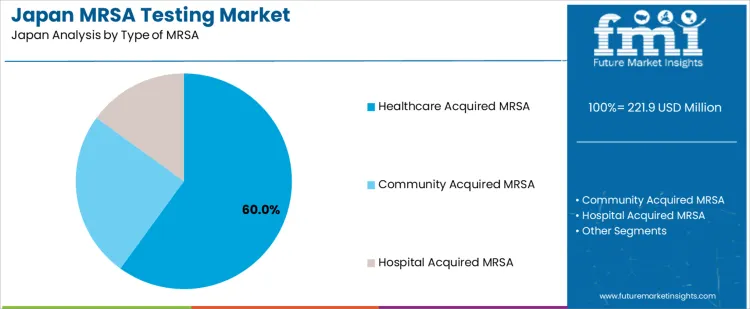
Healthcare-acquired MRSA (HA-MRSA) accounts for 60% of the demand for MRSA testing in Japan, driven by its high prevalence in hospital and healthcare settings. HA-MRSA is typically associated with invasive medical procedures, making it a major concern in hospitals and healthcare institutions. The demand for MRSA testing is particularly high in regions like Kanto and Kansai, where large medical facilities and high patient volumes contribute to the spread of MRSA. Testing for HA-MRSA is critical for preventing outbreaks in hospitals and ensuring the correct treatment is administered. With the increasing emphasis on infection control in healthcare environments, the demand for MRSA testing for healthcare-acquired infections remains a top priority. The rising number of patients with compromised immune systems and the growing complexity of medical procedures further drive the need for effective MRSA detection and treatment, ensuring HA-MRSA remains a dominant factor in the industry.
Why Do Hospital Pharmacies Lead the Demand for MRSA Testing in Japan?
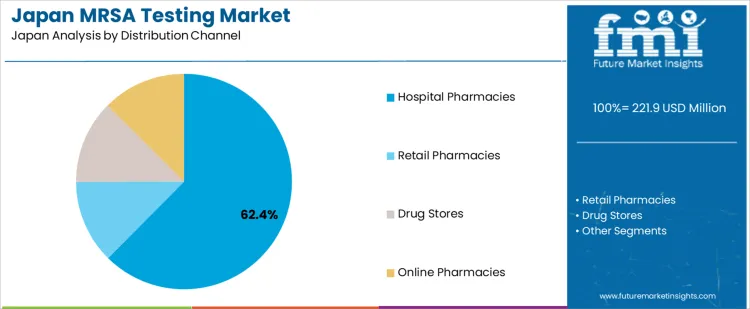
Hospital pharmacies account for 62.4% of the demand for MRSA testing in Japan, reflecting their central role in managing and treating infections within healthcare settings. Hospitals are the primary locations for patients to acquire MRSA, and hospital pharmacies are essential for providing the necessary medications and testing for these infections. The demand for MRSA testing is driven by the need to identify and manage healthcare-acquired infections quickly, preventing the spread of MRSA within hospital environments. In regions with dense populations and advanced healthcare infrastructure, such as Kanto and Kansai, hospital pharmacies see higher demand for MRSA testing, as they are critical in delivering the necessary care. Hospital pharmacies also ensure the correct administration of treatments, such as glycopeptides or oxazolidinones, based on test results. As the fight against antibiotic-resistant infections intensifies, hospital pharmacies remain the leading channel for MRSA testing and treatment in Japan.
What are the Key Trends, Drivers, and Restraints in Demand for MRSA Testing in Japan?
Demand for MRSA testing in Japan remains strong due to the ongoing prevalence of MRSA in healthcare settings. MRSA continues to be a major cause of hospital-acquired infections, despite a decline in rates over the years. As antimicrobial resistance (AMR) becomes a greater concern, healthcare facilities are increasing their reliance on MRSA testing to ensure proper treatment, prevent transmission, and improve infection control. However, the widespread adoption of MRSA testing faces barriers such as the need for proper laboratory infrastructure, skilled personnel, and funding. Smaller healthcare institutions may struggle with implementing routine or rapid testing, limiting the overall reach of MRSA screening across the country.
Why is Demand for MRSA Testing Growing in Japan?
The demand for MRSA testing in Japan is growing due to the ongoing health burden of MRSA infections, particularly in hospital settings. With Japan’s aging population, more invasive medical procedures, and higher susceptibility to infections, there is an increased need for effective diagnostic tools to prevent and control MRSA. The Japanese government’s national efforts to monitor and combat AMR, including surveillance programs and infection control measures, are also driving more widespread MRSA testing, especially in high-risk areas such as ICUs and surgical wards. As these initiatives expand, MRSA testing is becoming more routine in healthcare facilities, contributing to the growing demand for accurate and timely diagnostics.
How are Technological & Industry Innovations Driving MRSA Testing Demand in Japan?
Advances in diagnostic technologies are significantly driving demand for MRSA testing in Japan. Innovations in molecular diagnostics, such as PCR-based tests and rapid antigen detection systems, have improved the speed and accuracy of MRSA detection. These technologies allow healthcare providers to obtain test results more quickly, which is crucial for effective infection control and treatment. The growing use of automated lab platforms has streamlined testing procedures, making them more efficient and accessible for larger institutions. As diagnostic tools become more reliable and cost-effective, they are likely to expand the reach of MRSA testing to a broader range of healthcare providers, boosting demand across the country.
What are the Key Challenges and Risks That Could Limit MRSA Testing Demand in Japan?
Despite the growing demand for MRSA testing in Japan, several challenges could limit its adoption. First, smaller hospitals and rural clinics may lack the necessary resources, including lab infrastructure, skilled technicians, and funding, to implement regular or rapid MRSA testing. Second, although testing methods have improved, turnaround times for some tests can still be too long for immediate clinical decisions, particularly in emergency or outpatient settings. Third, variability in testing standards across institutions may lead to inconsistent results, impacting the reliability of diagnostics. Finally, if empirical antibiotic prescribing remains common, physicians may be less likely to prioritize MRSA testing, limiting its use in certain healthcare settings.
What is the Regional Demand Outlook for MRSA Testing in Japan?
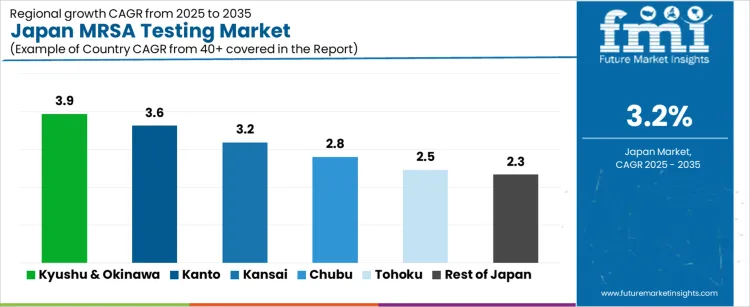
| Region | CAGR (%) |
|---|---|
| Kyushu & Okinawa | 3.9% |
| Kanto | 3.6% |
| Kansai | 3.2% |
| Chubu | 2.8% |
| Tohoku | 2.5% |
| Rest of Japan | 2.3% |
Demand for MRSA testing in Japan is growing steadily across all regions, with Kyushu & Okinawa leading at a 3.9% CAGR, driven by the region’s emphasis on improving healthcare access and addressing infections in remote areas. Kanto follows closely with a 3.6% CAGR, supported by its large urban population and advanced healthcare infrastructure. Kansai shows a 3.2% CAGR, with its well-established healthcare system and a focus on combatting healthcare-associated infections (HAIs). Chubu experiences a 2.8% CAGR, reflecting a gradual increase in MRSA testing adoption as healthcare providers modernize diagnostic services. Tohoku and the Rest of Japan see more moderate growth at 2.5% and 2.3%, respectively, as MRSA awareness and testing continue to expand in these regions.
How is Demand for MRSA Testing Growing in Kyushu & Okinawa?
Kyushu & Okinawa leads the demand for MRSA testing, growing at a 3.9% CAGR. The region’s emphasis on enhancing healthcare accessibility, especially in Okinawa, has led to the increased adoption of MRSA testing. With an aging population and a rising incidence of healthcare-associated infections (HAIs), local hospitals and clinics are adopting advanced diagnostic methods, including MRSA testing, to improve patient care. Okinawa’s growing medical tourism sector is also contributing to the demand for rapid and accurate diagnostics, as both locals and tourists require reliable testing. As the region continues to modernize its healthcare facilities and focus on infection control, the use of MRSA testing is expected to remain strong. Public health initiatives aimed at improving awareness of antimicrobial resistance (AMR) and its management further support the rise in MRSA testing demand. With these factors in play, the demand for MRSA testing in Kyushu & Okinawa is expected to continue its growth trajectory.
Why is Demand for MRSA Testing Rising in Kanto?
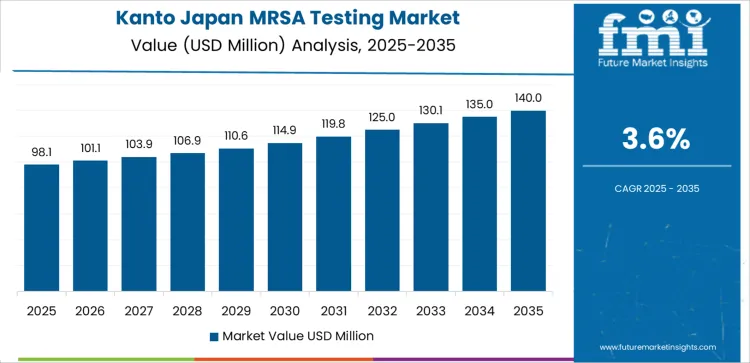
In Kanto, demand for MRSA testing is rising at a 3.6% CAGR. The region’s large urban population, particularly in Tokyo, has fueled the demand for MRSA testing. Kanto’s advanced healthcare infrastructure and a network of hospitals and diagnostic labs have increasingly incorporated MRSA testing to manage healthcare-associated infections (HAIs) more effectively. As antimicrobial resistance (AMR) becomes a significant public health concern, Kanto’s healthcare providers have turned to precise and reliable diagnostic methods like MRSA testing to guide antibiotic therapy and minimize resistance. The region’s medical research community is driving innovation, further improving the efficiency and accessibility of MRSA testing. The high rate of clinical infections in Kanto’s densely populated areas makes rapid and accurate diagnostics essential, further reinforcing the demand for MRSA testing. As Kanto focuses on enhancing healthcare delivery and tackling AMR, the demand for MRSA testing is expected to continue to grow steadily in the coming years.
How is Demand for MRSA Testing Expanding in Kansai?
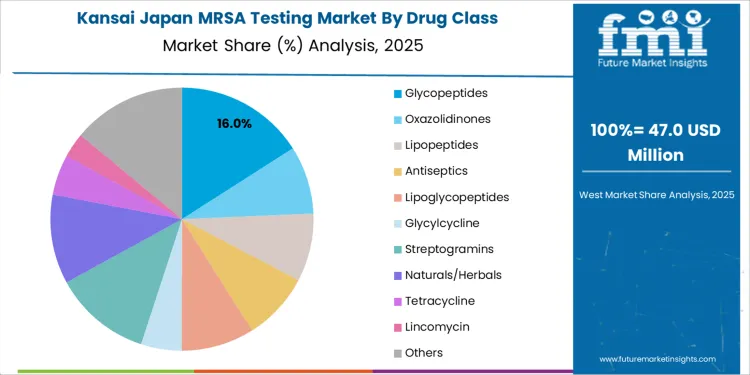
Kansai shows steady demand for MRSA testing, growing at a 3.2% CAGR. The region’s well-established healthcare system, particularly in Osaka and Kyoto, has contributed to the widespread adoption of MRSA testing in both hospitals and diagnostic centers. With an aging population and increasing cases of healthcare-associated infections (HAIs), the demand for MRSA testing in Kansai is on the rise. The region’s healthcare providers are prioritizing infection prevention and control, which has led to the adoption of advanced diagnostic tools like MRSA testing. Kansai’s growing awareness of antimicrobial resistance (AMR) further supports the demand for MRSA testing, as more healthcare facilities seek ways to manage infections effectively. The region’s strong commitment to high-quality healthcare and improving patient outcomes ensures that the demand for MRSA testing will remain steady. As Kansai’s healthcare system continues to adapt to evolving healthcare challenges, MRSA testing will remain a critical part of the solution.
Why is Demand for MRSA Testing Growing in Chubu?
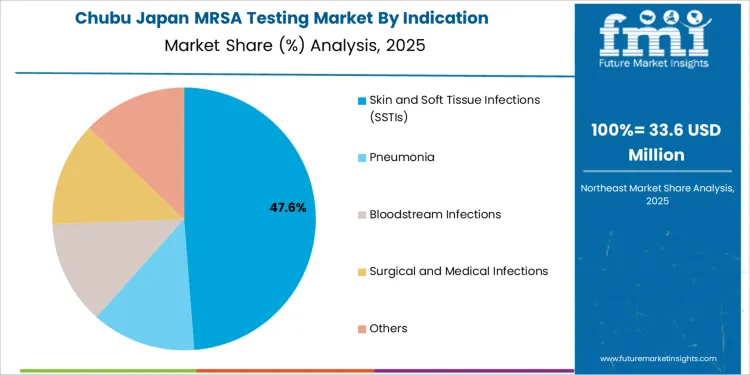
Chubu is experiencing steady demand for MRSA testing, growing at a 2.8% CAGR. The region’s expanding healthcare infrastructure, especially in urban centers like Nagoya, is driving the adoption of MRSA testing solutions. As the prevalence of healthcare-associated infections (HAIs) rises, Chubu’s healthcare providers are increasingly recognizing the importance of MRSA testing to improve infection management. Hospitals and clinics in the region are incorporating MRSA testing into their diagnostic practices to ensure more effective treatment options and reduce the spread of resistant infections. The region’s growing focus on healthcare modernization, including better diagnostic technologies, supports the demand for MRSA testing. As the healthcare landscape in Chubu evolves to meet rising demands for faster and more accurate diagnostics, MRSA testing is becoming more integrated into clinical care. With continued investments in healthcare and advancements in infection control, the demand for MRSA testing in Chubu is expected to increase steadily over time.
How is Demand for MRSA Testing Expanding in Tohoku?
Tohoku is seeing moderate growth in MRSA testing demand, with a 2.5% CAGR. While adoption is slower compared to major urban areas, there is growing interest in adopting MRSA testing technologies as part of efforts to improve infectious disease management. Tohoku’s aging population, combined with an increased incidence of healthcare-associated infections, has prompted a shift towards more accurate and effective diagnostics. As hospitals and clinics in Tohoku modernize their healthcare infrastructure, the use of MRSA testing is expected to rise gradually. The region is also benefiting from a broader national focus on combating antimicrobial resistance (AMR) and improving infection control practices. With Tohoku’s healthcare providers increasingly investing in advanced diagnostic tools, MRSA testing will become a more integral part of treatment protocols. While growth is slower than in larger urban regions, Tohoku’s healthcare system is expected to see steady demand for MRSA testing as healthcare access and awareness of AMR improve.
Why is Demand for MRSA Testing Steady in the Rest of Japan?
The Rest of Japan is experiencing steady demand for MRSA testing, with a 2.3% CAGR. Although adoption is slower compared to major urban regions, there is growing awareness of healthcare-associated infections (HAIs) and the importance of accurate MRSA testing. As healthcare providers in rural and semi-urban areas modernize their diagnostic capabilities, the adoption of MRSA testing is gradually increasing. Public health initiatives, alongside national efforts to combat antimicrobial resistance (AMR), are contributing to the adoption of MRSA testing in these regions. As healthcare access improves and hospitals and clinics in smaller cities expand their diagnostic services, the use of MRSA testing is expected to grow steadily. The Rest of Japan’s focus on improving healthcare infrastructure and public health will continue to drive demand for MRSA testing. While growth may be slower than in more urbanized regions, the Rest of Japan’s demand for MRSA testing will steadily increase as healthcare modernization continues.
What is Driving the Demand for MRSA Testing in Japan and Who Are the Key Providers?
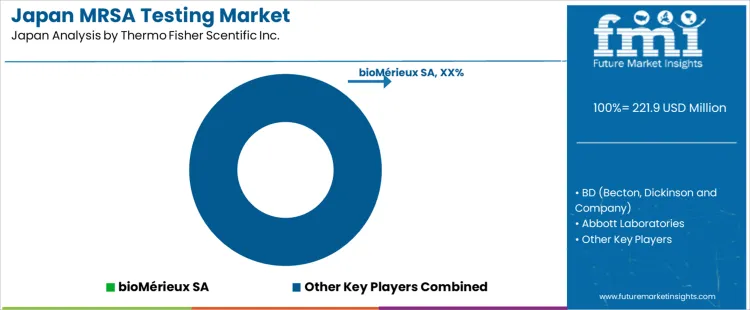
Demand for testing of Methicillin‑Resistant Staphylococcus aureus (MRSA) in Japan is increasing due to persistent challenges posed by antibiotic‑resistant infections, particularly in healthcare settings. MRSA continues to contribute significantly to hospital‑acquired infections and complications in patients who are immune‑compromised or undergoing surgery. Early and accurate detection is vital to guide antibiotic therapy, prevent outbreaks, and reduce mortality, longer hospital stays, and higher treatment costs associated with resistant infections. As a result, hospitals and diagnostic laboratories increasingly rely on MRSA screening and diagnostic tests to manage infection risk and ensure patient safety.
Key providers supplying MRSA testing solutions in Japan include Thermo Fisher Scientific, bioMérieux, BD (Becton, Dickinson and Company), Abbott Laboratories, and Cepheid. Their products span culture‑based assays, molecular diagnostics (like PCR), reagents, and test kits enabling rapid, reliable detection and resistance profiling. These providers help hospitals ensure timely diagnosis, appropriate therapy, and effective infection‑control protocols.
Advances in diagnostic technologies are further accelerating adoption of MRSA testing in Japan. Newer molecular and automated testing platforms have improved speed, sensitivity, and throughput, allowing for faster decision‑making in clinical settings. As awareness of antimicrobial resistance (AMR) grows both among medical institutions and regulatory bodies MRSA testing is increasingly seen as a core component of infection control and antimicrobial stewardship strategies. With antibiotic resistance remaining a major concern, demand for MRSA diagnostics in Japan is likely to remain high, supporting safer patient care and better public health outcomes.
Key Players in Japan MRSA Testing Demand
- Thermo Fisher Scentific Inc.
- bioMérieux SA
- BD (Becton, Dickinson and Company)
- Abbott Laboratories
- Cepheid (a Danaher Company)
Scope of Report
| Items | Values |
|---|---|
| Quantitative Units (2025) | USD million |
| Drug Class | Glycopeptides, Oxazolidinones, Lipopeptides, Antiseptics, Lipoglycopeptides, Glycylcycline, Streptogramins, Naturals/Herbals, Tetracycline, Lincomycin, Others |
| Route of Administration | Intravenous, Oral, Topical, Nasal, Cutaneous, Intramuscular |
| Type of MRSA | Healthcare Acquired MRSA, Community Acquired MRSA, Hospital Acquired MRSA |
| Distribution Channel | Hospital Pharmacies, Retail Pharmacies, Drug Stores, Online Pharmacies |
| Region | Kyushu & Okinawa, Kanto, Kansai, Chubu, Tohoku, Rest of Japan |
| Countries Covered | Japan |
| Key Companies Profiled | Thermo Fisher Scientific Inc., bioMérieux SA, BD (Becton, Dickinson and Company), Abbott Laboratories, Cepheid (a Danaher Company) |
| Additional Attributes | Dollar sales by drug class and administration route; regional CAGR and growth trends; rising focus on community-acquired MRSA; technological advancements in MRSA testing methods |
Japan MRSA Testing Demand by Key Segments
Drug Class:
- Glycopeptides
- Oxazolidinones
- Lipopeptides
- Antiseptics
- Lipoglycopeptides
- Glycylcycline
- Streptogramins
- Naturals/Herbals
- Tetracycline
- Lincomycin
- Others
Route of Administration:
- Intravenous
- Oral
- Topical
- Nasal
- Cutaneous
- Intramuscular
Type of MRSA:
- Healthcare Acquired MRSA
- Community Acquired MRSA
- Hospital Acquired MRSA
Distribution Channel:
- Hospital Pharmacies
- Retail Pharmacies
- Drug Stores
- Online Pharmacies
Region:
- Kyushu & Okinawa
- Kanto
- Kansai
- Chubu
- Tohoku
- Rest of Japan
Frequently Asked Questions
How big is the demand for MRSA testing in Japan in 2025?
The demand for MRSA testing in Japan is estimated to be valued at USD 221.9 million in 2025.
What will be the size of MRSA testing in Japan in 2035?
The market size for the MRSA testing in Japan is projected to reach USD 302.6 million by 2035.
How much will be the demand for MRSA testing in Japan growth between 2025 and 2035?
The demand for MRSA testing in Japan is expected to grow at a 3.2% CAGR between 2025 and 2035.
What are the key product types in the MRSA testing in Japan?
The key product types in MRSA testing in Japan are glycopeptides, oxazolidinones, lipopeptides, antiseptics, lipoglycopeptides, glycylcycline, streptogramins, naturals/herbals, tetracycline, lincomycin and others.
Which indication segment is expected to contribute significant share in the MRSA testing in Japan in 2025?
In terms of indication, skin and soft tissue infections (sstis) segment is expected to command 50.0% share in the MRSA testing in Japan in 2025.
Preview the report firsthand - request a free sample
Get SampleGet the brochure for pricing and purchase details.
Get PDFTable of Content
- Executive Summary
- Japan Market Outlook
- Demand-side Trends
- Supply-side Trends
- Technology Roadmap Analysis
- Analysis and Recommendations
- Market Overview
- Market Coverage / Taxonomy
- Market Definition / Scope / Limitations
- Market Background
- Market Dynamics
- Drivers
- Restraints
- Opportunity
- Trends
- Scenario Forecast
- Demand in Optimistic Scenario
- Demand in Likely Scenario
- Demand in Conservative Scenario
- Opportunity Map Analysis
- Product Life Cycle Analysis
- Supply Chain Analysis
- Investment Feasibility Matrix
- Value Chain Analysis
- PESTLE and Porter’s Analysis
- Regulatory Landscape
- Regional Parent Market Outlook
- Production and Consumption Statistics
- Import and Export Statistics
- Market Dynamics
- Japan Market Analysis 2020 to 2024 and Forecast, 2025 to 2035
- Historical Market Size Value (USD Million) Analysis, 2020 to 2024
- Current and Future Market Size Value (USD Million) Projections, 2025 to 2035
- Y-o-Y Growth Trend Analysis
- Absolute $ Opportunity Analysis
- Japan Market Pricing Analysis 2020 to 2024 and Forecast 2025 to 2035
- Japan Market Analysis 2020 to 2024 and Forecast 2025 to 2035, By Drug Class
- Introduction / Key Findings
- Historical Market Size Value (USD Million) Analysis By Drug Class , 2020 to 2024
- Current and Future Market Size Value (USD Million) Analysis and Forecast By Drug Class , 2025 to 2035
- Glycopeptides
- Oxazolidinones
- Lipopeptides
- Antiseptics
- Lipoglycopeptides
- Glycylcycline
- Streptogramins
- Naturals/Herbals
- Tetracycline
- Lincomycin
- Others
- Y-o-Y Growth Trend Analysis By Drug Class , 2020 to 2024
- Absolute $ Opportunity Analysis By Drug Class , 2025 to 2035
- Japan Market Analysis 2020 to 2024 and Forecast 2025 to 2035, By Indication
- Introduction / Key Findings
- Historical Market Size Value (USD Million) Analysis By Indication, 2020 to 2024
- Current and Future Market Size Value (USD Million) Analysis and Forecast By Indication, 2025 to 2035
- Skin and Soft Tissue Infections (SSTIs)
- Pneumonia
- Bloodstream Infections
- Surgical and Medical Infections
- Others
- Y-o-Y Growth Trend Analysis By Indication, 2020 to 2024
- Absolute $ Opportunity Analysis By Indication, 2025 to 2035
- Japan Market Analysis 2020 to 2024 and Forecast 2025 to 2035, By Route of Administration
- Introduction / Key Findings
- Historical Market Size Value (USD Million) Analysis By Route of Administration, 2020 to 2024
- Current and Future Market Size Value (USD Million) Analysis and Forecast By Route of Administration, 2025 to 2035
- Intravenous
- Oral
- Topical
- Nasal
- Cutaneous
- Intramuscular
- Y-o-Y Growth Trend Analysis By Route of Administration, 2020 to 2024
- Absolute $ Opportunity Analysis By Route of Administration, 2025 to 2035
- Japan Market Analysis 2020 to 2024 and Forecast 2025 to 2035, By Type of MRSA
- Introduction / Key Findings
- Historical Market Size Value (USD Million) Analysis By Type of MRSA, 2020 to 2024
- Current and Future Market Size Value (USD Million) Analysis and Forecast By Type of MRSA, 2025 to 2035
- Healthcare Acquired MRSA
- Community Acquired MRSA
- Hospital Acquired MRSA
- Y-o-Y Growth Trend Analysis By Type of MRSA, 2020 to 2024
- Absolute $ Opportunity Analysis By Type of MRSA, 2025 to 2035
- Japan Market Analysis 2020 to 2024 and Forecast 2025 to 2035, By Distribution Channel
- Introduction / Key Findings
- Historical Market Size Value (USD Million) Analysis By Distribution Channel, 2020 to 2024
- Current and Future Market Size Value (USD Million) Analysis and Forecast By Distribution Channel, 2025 to 2035
- Hospital Pharmacies
- Retail Pharmacies
- Drug Stores
- Online Pharmacies
- Y-o-Y Growth Trend Analysis By Distribution Channel, 2020 to 2024
- Absolute $ Opportunity Analysis By Distribution Channel, 2025 to 2035
- Market Structure Analysis
- Competition Dashboard
- Competition Benchmarking
- Market Share Analysis of Top Players
- By Regional
- By Drug Class
- By Indication
- By Route of Administration
- By Type of MRSA
- By Distribution Channel
- Competition Analysis
- Competition Deep Dive
- bioMérieux SA
- Overview
- Product Portfolio
- Profitability by Market Segments (Product/Age /Sales Channel/Region)
- Sales Footprint
- Strategy Overview
- Marketing Strategy
- Product Strategy
- Channel Strategy
- BD (Becton, Dickinson and Company)
- Abbott Laboratories
- Cepheid (a Danaher Company)
- bioMérieux SA
- Competition Deep Dive
- Assumptions & Acronyms Used
- Research Methodology


