

- CAGR (2025 to 2035)
- 5.4%
Japan Polymer Emulsion Market Size and Share Forecast Outlook From 2025 to 2035
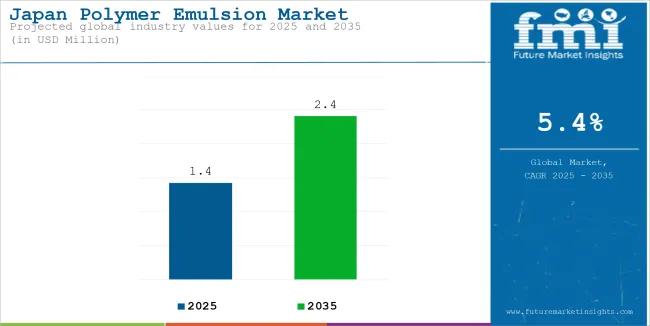
Japan polymer emulsion market will grow steadily in the future with an estimated value of USD 2.4 billion by 2035 at a compound annual growth rate of 5.4% between 2025 and 2035. Key drivers include sustainability focus, technological innovations, and rigorous environmental regulations, leading to the widespread adoption of polymer emulsions across various industries like construction, automotive, packaging, and textiles.
Growth will be spurred on by further increase in demand for eco-friendly, high-performance solutions, keeping up with global demand for sustainable materials and practices.
| Attributes | Details |
|---|---|
| Japan Polymer Emulsion Market Size 2035 | USD 2.4 billion |
| Japan Polymer Emulsion Value CAGR (2025 to 2035) | 5.4% |
The net-zero carbon target by 2050 set by Japan fuels the increasing interest in green solutions such as polymer emulsions, particularly with low VOC content and water-based formulations. Both of these factors are in line with the country's sustainability goals and environmental regulations. Additionally, a rise in the demand for lightweight high-performance materials is also driving polymer emulsion consumption in advanced applications such as EVs and electronics.
As Japanese industries find more sustainable and efficient materials, polymer emulsions are seen to play a key role in the satisfaction of both environmental and technological requirements, thereby propelling steady growth in the market.
Top Japan Polymer Emulsion Market Dynamics and Industry Trends
Eco-Friendly and Low-VOC Products
The commitment to emissions reduction and air quality improvement, as is stipulated in Japan's Basic Environmental Law, has evoked the demand for low-VOC polymer emulsions and water-based emulsions in paints, coatings, and adhesives industries. Environmentally friendly formulations are essential to cut harmful emissions from their activities while meeting local and international regulatory standards.
This has led manufacturers to increasingly use these environmentally friendly solutions to comply with environmental regulations and contribute to the broader sustainability goals of Japan. Low-VOC and water-based products are expected to continue to be in demand, which will help to drive the transition towards greener and more responsible manufacturing practices across sectors.
Sustainability in Construction
Polymer emulsions have increasingly been embraced in the Japanese construction sector, especially when there is the need to be very energy-efficient and sustainable both in retrofitting projects and new buildings. These are the materials used due to their durability, versatility, and thermal insulation properties. In the architectural coating, adhesives, and sealants sectors, polymer emulsions help offer long-term performance while aiding in the consumption of less energy.
These environmentally friendly solutions support the enhancement of building energy efficiency, the green building standards to which Japan has committed, and the demand for high-performance materials in the construction sector.
Growth in Electric Vehicles (EVs)
Japan is leading the world in automotive innovation and moving towards electric mobility, which is fueling the demand for polymer emulsions in electric vehicle applications. These materials are increasingly used in EV battery insulation, lightweight coatings, and adhesives, playing a critical role in enhancing vehicle performance, energy efficiency, and safety.
The overall weight of vehicles can be reduced, and thermal insulation can be improved through polymer emulsions. Better energy storage and safety features are ensured in EVs. In fact, as Japan continues to advance green technologies, polymer emulsions have become a vital part of developing sustainable, high-performance electric vehicles.
Advanced Applications in Packaging
Japan's packaging industry is now increasingly shifting to polymer emulsions in developing recyclable and biodegradable packaging solutions. Such materials provide excellent printability, gloss, and durability, and they are highly suited for developing premium quality, eco-friendly packaging. Polymer emulsions help the manufacturer meet its sustainability goals with a reduction in environmental impact and encouragement of recyclable materials.
This would place polymer emulsions in a position as a major facilitator of a new trend towards a greener kind of packaging for the Japanese vibrant packaging industry to improve the packaging performance and its aesthetic value as well.
Top Segments Studied in the Japan Polymer Emulsion Market Report
By Type
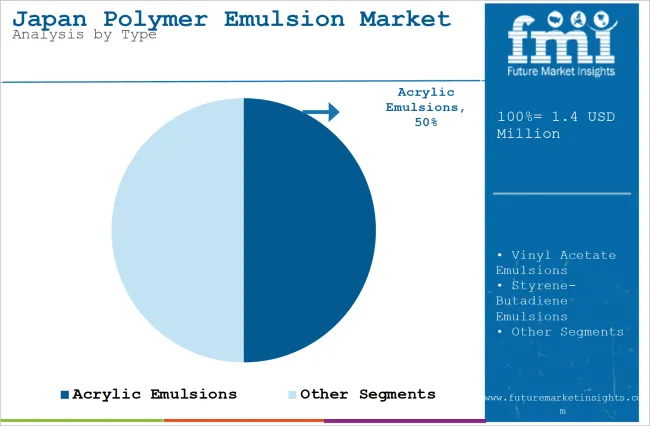
- Acrylic Emulsions: Dominating the market with over 50% share in 2023, acrylic emulsions are widely used in paints, coatings, and adhesives due to their superior durability, UV resistance, and adhesion properties.
- Vinyl Acetate Emulsions: Gaining traction in packaging and construction for their cost-effective and strong bonding properties.
- Styrene-Butadiene Emulsions: Favored in industrial coatings and paper applications for their elasticity, water resistance, and abrasion resistance.
By Application
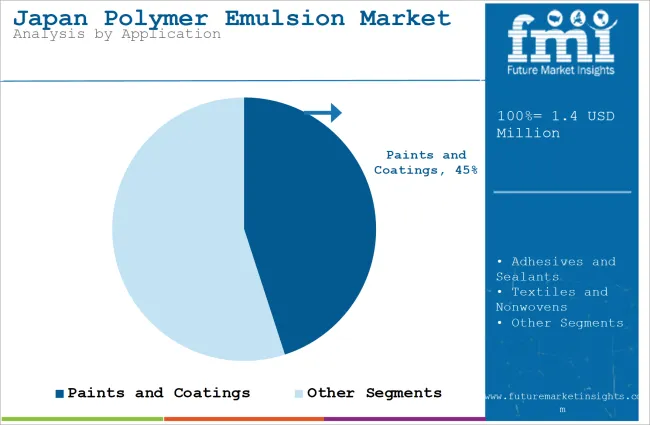
- Paints and Coatings: Accounting for 45% of the market, polymer emulsions are integral to water-based and low-VOC formulations for architectural and industrial coatings.
- Adhesives and Sealants: Representing 25% of the market, these emulsions are widely used in construction, automotive, and packaging applications.
- Textiles and Nonwovens: Holding 15% market share, emulsions improve the performance, water resistance, and flexibility of fabrics in apparel and industrial applications.
- Others: Includes applications in paper coatings, laminates, and specialty products.
Industry-Wide Growth and Trends in Japan Polymer Emulsion Market
| Segment | Paints and Coatings |
|---|---|
| CAGR (2025 to 2035) | 5.0% |
| Key Trends | Rising adoption of low-VOC and water-based coatings for green construction. |
| Segment | Adhesives & Sealants |
|---|---|
| CAGR (2025 to 2035) | 4.8% |
| Key Trends | Growth in sustainable packaging and construction materials. |
| Segment | Textiles & Nonwovens |
|---|---|
| CAGR (2025 to 2035) | 4.5% |
| Key Trends | Increasing demand for durable and water-resistant fabrics. |
Key Japan Polymer Emulsion Market Players and Concentration
The Japan polymer emulsion market is moderately consolidated, with global and domestic players competing to deliver advanced and sustainable solutions.
Leading Players
Major global companies like BASF SE, Arkema S.A., Dow Inc., and Celanese Corporation dominate the market, holding approximately 60% of the share. These firms focus on R&D and partnerships with local distributors to meet Japan’s demand for high-performance materials.
Domestic Manufacturers
Japanese manufacturers such as Asahi Kasei Corporation and Mitsui Chemicals play a critical role in supplying customized polymer emulsions for construction, automotive, and specialty applications. These companies account for about 30% of the market, emphasizing compliance with local environmental standards.
Emerging Innovators
Startups and niche players are exploring bio-based polymer emulsions and hybrid formulations for specialty applications, particularly in packaging and electronics. These innovators contribute approximately 10% of the market share.
Industry Updates in Japan Polymer Emulsion Market
| Date | Key Development |
|---|---|
| February 2025 | BASF introduced a new water-based acrylic emulsion for architectural coatings in Japan. |
| May 2025 | Mitsui Chemicals launched a bio-based polymer emulsion targeting sustainable packaging applications. |
| July 2025 | Arkema expanded its production capacity in Asia-Pacific, including Japan, to cater to the rising demand for eco-friendly emulsions. |
Future Outlook for Japan Polymer Emulsion Market
The Japan polymer emulsion market is poised for steady growth, supported by sustainability initiatives, technological advancements, and expanding applications across industries. Key factors shaping the market include:
- Sustainability and Green Manufacturing: The shift toward eco-friendly products will continue to drive the adoption of low-VOC and bio-based polymer emulsions in paints, coatings, and adhesives.
- Infrastructure and Green Building Growth: Investments in energy-efficient construction and retrofitting projects will sustain demand for polymer emulsions in the construction sector.
- Expansion of EV and Packaging Industries: The growth of electric vehicles and recyclable packaging will open new opportunities for advanced polymer emulsions in automotive and packaging applications.
Advancements in Specialty Applications: Innovations in hybrid formulations and bio-based emulsions will expand their use in high-tech industries, including electronics and renewable energy.
Japan Polymer Emulsion Market Share Analysis Segmentation
By Type:
- Acrylic Emulsions
- Vinyl Acetate Emulsions
- Styrene-Butadiene Emulsions
By Application:
- Paints and Coatings
- Adhesives and Sealants
- Textiles and Nonwovens
- Others
Frequently Asked Questions
What is the projected size of the Japan Polymer Emulsion Market by 2035?
The market is expected to reach USD 2.4 billion, growing at a CAGR of 5.4%.
Which segment dominates the market?
Acrylic emulsions lead the market, accounting for over 50% of the market share in 2024 due to their wide applications in paints, coatings, and adhesives.
What are the major trends shaping the market?
Key trends include the adoption of low-VOC products, green building practices, and advancements in bio-based polymer emulsions.
Who are the key players in the market?
Major players include BASF SE, Arkema S.A., Dow Inc., Celanese Corporation, Asahi Kasei Corporation, and Mitsui Chemicals.
Preview the report firsthand - request a free sample
Get SampleGet the brochure for pricing and purchase details.
Get PDFTable of Content
- Introduction
- Market Outlook
- Key Trends
- Segment Analysis
- Industry-Wise Growth and Trends
- Market Concentration
- Industry Updates
- Future Outlook
- Frequently Asked Questions (FAQs)


