

- Industry Size (2025)
- USD 47.9 Mn
- Forecast (2035)
- USD 82.8 Mn
- CAGR (2025 to 2035)
- 5.6%
Demand for Smart Pill Technologies in Japan Forecast and Outlook 2025 to 2035
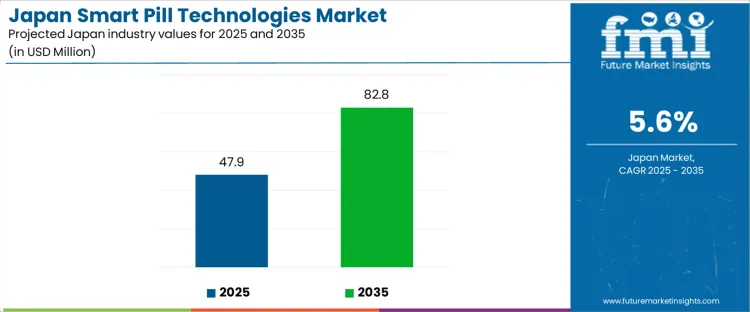
The demand for smart pill technologies in Japan is expected to grow from USD 47.9 million in 2025 to USD 82.8 million by 2035, reflecting a compound annual growth rate (CAGR) of 5.6%. This growth is driven by the increasing adoption of digital health technologies and the expanding role of smart pills in improving medication adherence, diagnosis, and personalized treatment. Smart pills, which are ingestible devices equipped with sensors to monitor and transmit health data, are gaining traction in Japan’s healthcare system, particularly in the areas of chronic disease management, gastrointestinal diagnostics, and drug delivery.
The market is further supported by advancements in medical technology and the growing trend towards remote monitoring and personalized medicine. As Japan’s population ages, the demand for effective, non-invasive health monitoring tools will likely increase, driving the need for smart pill technologies. Additionally, as healthcare providers and pharmaceutical companies continue to invest in innovative drug delivery systems, smart pills will become more prevalent in clinical settings, contributing to market growth over the next decade.
Quick Stats of the Demand for Smart Pill Technologies in Japan
- Demand for Smart Pill Technologies in Japan Value (2025): USD 47.9 million
- Demand for Smart Pill Technologies in Japan Forecast Value (2035): USD 82.8 million
- Demand for Smart Pill Technologies in Japan Forecast CAGR (2025-2035): 5.6%
- Demand for Smart Pill Technologies in Japan Leading Product Type: Capsule Endoscopy (51%)
- Demand for Smart Pill Technologies in Japan Key Growth Regions: Kyushu & Okinawa, Kanto, Kansai, Chubu, Tohoku, Rest of Japan
- Demand for Smart Pill Technologies in Japan Key Players: Medtronic, Boston Scientific, CapsoVision, Otsuka Pharmaceutical
What is the Growth Forecast for the Smart Pill Technologies Market through 2035?
The growth momentum analysis for the smart pill technologies market in Japan shows a steady upward trajectory, with incremental growth over the forecast period. Starting at USD 47.9 million in 2025, the market gradually increases to USD 50.6 million in 2026 and USD 53.4 million in 2027. This early-phase growth reflects the ongoing adoption of smart pill technologies as healthcare providers and patients begin to recognize their potential for improving treatment compliance and patient outcomes.
From 2027 to 2030, the market continues to expand at a steady pace, reaching USD 56.5 million in 2028, USD 59.6 million in 2029, and USD 63.0 million in 2030. The growth momentum accelerates slightly as smart pills become more integrated into clinical practice, driven by technological innovations and increasing demand for remote patient monitoring. By 2035, the market is expected to reach USD 82.8 million, reflecting sustained growth, with both volume adoption and technological advancements driving this expansion. The growth momentum analysis highlights a consistent upward trend, with early gradual increases followed by a more pronounced acceleration as smart pill technology becomes more widely recognized and utilized in Japan’s healthcare system.
Key Takeaways of Smart Pill Technologies Industry in Japan
| Metric | Value |
|---|---|
| Industry Sales Value (2025) | USD 47.9 million |
| Industry Forecast Value (2035) | USD 82.8 million |
| Industry Forecast CAGR (2025-2035) | 5.6% |
What Is Driving the Demand for Smart Pill Technologies in Japan?
The demand for smart pill technologies in Japan is driven by the high prevalence of gastrointestinal disorders and the ageing population that is more likely to develop chronic or digestive tract illnesses. Ingestible capsule devices and sensors offer non invasive diagnosis or monitoring that avoid the discomfort and risk associated with conventional endoscopy or invasive testing. Advances in miniaturized sensor and wireless communication technologies have made these devices more practical for routine use in hospitals and clinics. Medical institutions in Japan are increasingly open to diagnostic tools that improve patient comfort and reduce procedure burden.
Future demand for smart pill technologies in Japan is expected to grow as chronic disease rates remain steady and as efforts continue to shift medical diagnostics toward less invasive, patient friendly options. Wider adoption will likely be supported by improvements in device reliability, reductions in production cost, and integration of smart pills with digital health data systems. Demand may also expand if regulatory frameworks evolve to accommodate such technologies and reimbursement policies support their use. The growth trajectory will depend on acceptance by patients and healthcare providers, affordability and consistent performance of smart pill devices.
What Are the Key Segments in Smart Pill Technologies Market in Japan?
The smart pill technologies market in Japan is segmented by product type and disease indication. Capsule endoscopy leads the product type segment, holding 51% of the market share. In terms of disease indication, small bowel tumors represent 37% of the market. The increasing demand for minimally invasive diagnostic tools and advanced treatments for gastrointestinal conditions is driving the growth of smart pill technologies in Japan.
Which Product Type Drives Smart Pill Technologies Demand in Japan?
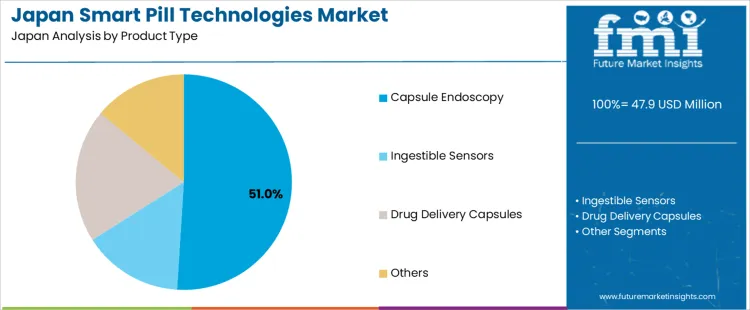
Capsule endoscopy is the dominant product type in the smart pill technologies market in Japan, accounting for 51% of the market share. Capsule endoscopy allows for non-invasive visualization of the gastrointestinal tract, particularly the small intestine, which is difficult to examine using traditional endoscopic methods. This technology is especially useful for diagnosing conditions such as small bowel tumors, Crohn’s disease, and gastrointestinal bleeding. The demand for capsule endoscopy is driven by its ability to provide detailed images of the gastrointestinal tract without the need for invasive procedures, making it a preferred choice for both doctors and patients. While ingestible sensors, drug delivery capsules, and other smart pill technologies are emerging in the market, capsule endoscopy remains the most widely adopted due to its proven effectiveness in diagnosing and monitoring various gastrointestinal conditions.
Which Disease Indication Drives Smart Pill Technologies Demand in Japan?
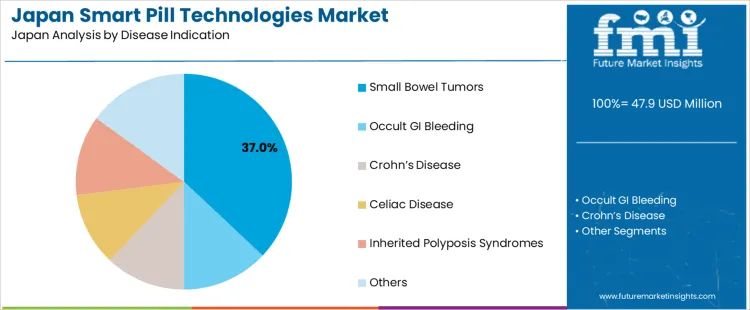
Small bowel tumors are the leading disease indication for smart pill technologies in Japan, representing 37% of the market share. Capsule endoscopy is particularly effective in detecting small bowel tumors, which are challenging to diagnose using traditional imaging techniques. The ability to visualize the entire small intestine with high accuracy has made capsule endoscopy a valuable tool in the diagnosis and monitoring of small bowel tumors. Additionally, smart pill technologies are also used for detecting conditions such as occult GI bleeding, Crohn’s disease, celiac disease, and inherited polyposis syndromes, which further contributes to the growth of this market. As the prevalence of these gastrointestinal conditions continues to rise, the demand for advanced diagnostic tools like smart pills is expected to increase, driving the market for these technologies in Japan.
What is the Demand for Smart Pill Technologies in Japan?
The demand for smart pill technologies in Japan is increasing as the healthcare industry seeks more efficient and innovative solutions for monitoring and managing patient health. Smart pills, which are ingestible devices that transmit data from within the body, are used to track medication adherence, monitor health conditions, and provide real-time diagnostic information. As Japan faces an aging population and growing healthcare demands, the adoption of smart pill technologies is expanding, offering the potential to improve patient care, enhance treatment outcomes, and reduce healthcare costs. The integration of these technologies into healthcare systems is expected to continue to grow.
What are the Drivers of Demand for Smart Pill Technologies in Japan?
Several factors are driving the demand for smart pill technologies in Japan. First, the aging population and the rising prevalence of chronic diseases are creating a need for more effective solutions for monitoring and managing patient health, particularly in elderly patients who may have difficulty adhering to complex treatment regimens. Second, the increasing focus on personalized medicine, which tailors treatments to individual patients, is encouraging the use of smart pill technologies to collect real-time data for more accurate and customized care. Third, the growing emphasis on remote patient monitoring and telemedicine is fueling demand for smart pill technologies that allow healthcare providers to track patient health from a distance, improving convenience and reducing hospital visits. Additionally, the advancement of digital health technologies, such as sensors and wireless communication systems, is making smart pills more effective, affordable, and accessible.
What are the Restraints on Demand for Smart Pill Technologies in Japan?
Despite the growing demand, there are several challenges that may limit the adoption of smart pill technologies in Japan. One major restraint is the high cost of smart pill devices, which can be a barrier for healthcare providers and patients, particularly in smaller or resource-limited settings. Another challenge is the need for regulatory approval and compliance with strict health standards, which can delay the development and distribution of new smart pill technologies. Additionally, privacy and data security concerns related to the transmission of sensitive health information may deter some patients from using smart pill devices. The complexity of integrating these technologies into existing healthcare systems and the need for specialized training for healthcare professionals to effectively use smart pill devices may also hinder adoption.
What are the Key Trends Influencing Demand for Smart Pill Technologies in Japan?
Several key trends are shaping the demand for smart pill technologies in Japan. One significant trend is the growing use of digital health technologies, such as mobile apps and wearable devices, which are increasing the demand for smart pills that provide real-time health data and integrate with other health-monitoring platforms. Another trend is the shift toward preventative healthcare, where smart pills are being used to monitor and manage chronic conditions before they become more severe, helping to reduce long-term healthcare costs. Additionally, advancements in biotechnology and miniaturization of devices are making smart pills more effective and comfortable for patients. The increasing acceptance of telemedicine and remote healthcare services is also driving demand for smart pill technologies, as they enable healthcare providers to monitor patient health remotely and adjust treatments accordingly. Lastly, the rising emphasis on patient-centered care and personalized treatments is boosting the demand for innovative technologies that allow for tailored healthcare solutions.
What is the Regional Demand Outlook for the Smart Pill Technologies Market in Japan?
The Smart Pill Technologies market in Japan is projected to experience steady growth, with Kyushu & Okinawa leading the way at a projected CAGR of 7.0%. Kanto follows closely with a growth rate of 6.5%, while Kansai is expected to grow at 5.7%. Chubu is projected to grow at a rate of 5.0%, while Tohoku and Rest of Japan show more moderate growth, with CAGRs of 4.4% and 4.2%, respectively. As healthcare providers and patients increasingly look for innovative, non-invasive ways to monitor health conditions, smart pill technologies—devices that allow for the monitoring of medication, digestion, and other internal health parameters—are gaining popularity across Japan.
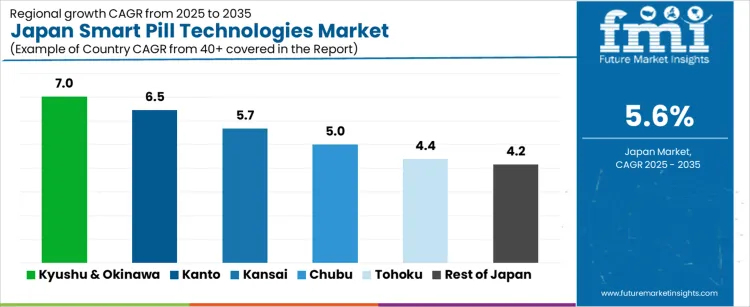
| Region | CAGR (2025-2035) |
|---|---|
| Kyushu & Okinawa | 7% |
| Kanto | 6.5% |
| Kansai | 5.7% |
| Chubu | 5% |
| Tohoku | 4.4% |
| Rest of Japan | 4.2% |
What is Driving the Growth of Smart Pill Technologies in Kyushu & Okinawa?
Kyushu & Okinawa is projected to experience the highest growth in the Smart Pill Technologies market, with a projected CAGR of 7.0%. The region’s aging population, which is more likely to experience chronic conditions such as gastrointestinal disorders, diabetes, and cardiovascular diseases, is a key driver of this growth. Smart pills offer a non-invasive solution for monitoring the health of patients, making them particularly appealing for the elderly. Additionally, Kyushu & Okinawa’s healthcare systems are increasingly adopting innovative technologies to improve patient care and reduce hospital visits. The region’s growing healthcare infrastructure, along with an emphasis on improving the quality of life for older individuals, is contributing to the rising demand for smart pill technologies. As patients and healthcare providers seek better ways to monitor health and manage chronic conditions, smart pills are expected to become a more integral part of treatment plans in Kyushu & Okinawa.
Why is the Smart Pill Technologies Market Expanding in Kanto?
In Kanto, the demand for smart pill technologies is projected to grow at a CAGR of 6.5%. Kanto, which includes Tokyo, is Japan’s most populous and urbanized region and a major center for healthcare innovation. The increasing prevalence of chronic diseases, such as gastrointestinal and metabolic disorders, is driving the demand for non-invasive monitoring technologies like smart pills. Kanto’s advanced healthcare infrastructure and a growing emphasis on personalized medicine and remote patient monitoring are also contributing to the market expansion. The region’s well-established medical research facilities and high concentration of healthcare providers are accelerating the adoption of smart pill technologies. As the population ages and healthcare systems focus on improving treatment efficiency and patient outcomes, the use of smart pills is expected to rise steadily in Kanto.
How is the Smart Pill Technologies Market Growing in Kansai?
In Kansai, the Smart Pill Technologies market is projected to grow at a CAGR of 5.7%. The region’s strong healthcare infrastructure, particularly in cities like Osaka and Kyoto, is helping drive the adoption of smart pill technologies. Kansai is seeing increasing demand for advanced medical solutions, as more healthcare providers focus on improving patient monitoring and disease management. Smart pills, with their ability to monitor a patient’s internal health in real time, are becoming an increasingly attractive option for both healthcare providers and patients. The region’s growing number of elderly individuals, who often experience chronic health conditions, is also contributing to the rise in demand for non-invasive monitoring solutions. As Kansai continues to invest in healthcare innovation, the market for smart pill technologies is expected to expand.
What is Contributing to the Growth of Smart Pill Technologies in Chubu?
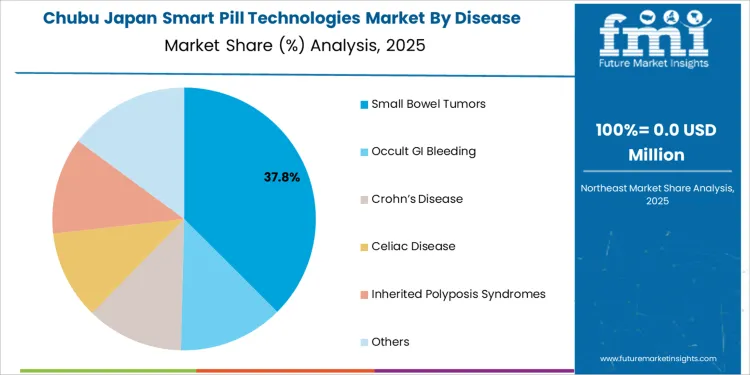
In Chubu, the Smart Pill Technologies market is expected to grow at a CAGR of 5.0%. The region, which includes cities like Nagoya, is experiencing steady growth in healthcare advancements, particularly in the area of personalized medicine. As healthcare providers in Chubu seek ways to improve treatment outcomes and monitor patients more effectively, the demand for smart pill technologies is increasing. The region’s aging population, which is more likely to suffer from chronic conditions that require regular monitoring, is contributing to the market growth. Additionally, Chubu’s growing focus on reducing healthcare costs and improving the quality of care through technological innovation is driving the adoption of smart pills as a non-invasive and efficient alternative to traditional monitoring methods.
What is Influencing the Growth of Smart Pill Technologies in Tohoku?
In Tohoku, the Smart Pill Technologies market is projected to grow at a CAGR of 4.4%. The region’s increasing awareness of the benefits of non-invasive monitoring and its growing healthcare infrastructure are key factors contributing to the growth of this market. As Tohoku’s population ages and the prevalence of chronic conditions rises, the demand for innovative solutions like smart pills is increasing. These devices are seen as a more convenient, efficient, and less intrusive option for managing health, particularly for elderly individuals who may have difficulty with traditional monitoring methods. Healthcare providers in Tohoku are gradually adopting smart pill technologies to help patients better manage their health and reduce the need for frequent hospital visits. As the region continues to develop its healthcare capabilities, the market for smart pills is expected to grow at a steady pace.
What is Contributing to the Growth of Smart Pill Technologies in Rest of Japan?
In Rest of Japan, the Smart Pill Technologies market is expected to grow at a more moderate rate of 4.2%. While this region may have fewer healthcare resources compared to major metropolitan areas, the demand for smart pill technologies is still on the rise due to the increasing prevalence of chronic diseases and the need for more efficient healthcare solutions. With a growing emphasis on improving healthcare access in rural areas, Rest of Japan is gradually adopting advanced technologies like smart pills to monitor patients remotely and manage diseases more effectively. The availability of smart pills in local clinics and pharmacies is contributing to their increasing use, as healthcare providers in these areas seek cost-effective and non-invasive ways to monitor their patients' health.
What is the Competitive Landscape for Demand for Smart Pill Technologies in Japan?
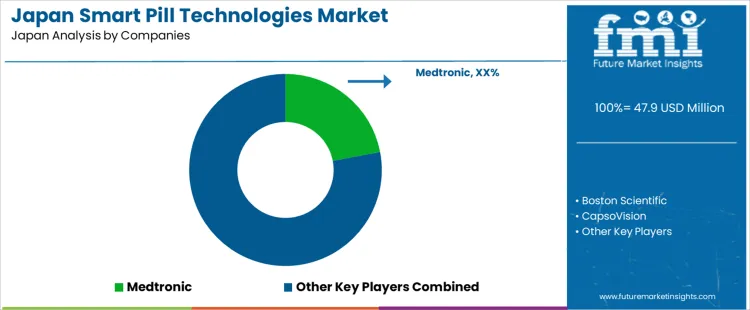
Demand for smart pill technologies in Japan is rising as the healthcare system adapts to ageing demographics, rising chronic disease burden, and growing demand for minimally invasive diagnostics and patient friendly drug delivery systems. Smart pills-ingestible devices or capsules that perform diagnostics, deliver drugs, or monitor physiological data from inside the body-appeal to patients and providers for their convenience, potential to reduce hospital stays, and ability to support remote care or minimally invasive diagnostics. In Japan, increasing incidence of gastrointestinal disorders, an aging population with comorbidities, and a growing focus on early diagnosis and patient comfort support adoption of such technologies. Moreover, regulatory support and rising acceptance of digital health tools and advanced medical devices help expand the market for ingestible diagnostics and therapeutic capsules.
On the supply side, several global and specialized firms are competing to meet this growing demand. Key players in the Japanese market include Medtronic, Boston Scientific, CapsoVision, and Otsuka Pharmaceutical. These companies offer a range of smart pill or capsule-based systems-from diagnostic capsules for imaging or GI tract visualization, to ingestible drug delivery capsules or sensor equipped capsules that monitor internal health parameters. Competition among suppliers is driven by product reliability, safety, regulatory approval in Japan, ease of-use, integration with clinical workflows, patient comfort, and cost effectiveness. Suppliers capable of combining advanced capsule technologies with strong local regulatory and clinical support infrastructure, broad distribution networks, and patient centric design are best positioned to capture growth as demand for smart pill technologies continues to expand in Japan.
Key Players of the Smart Pill Technologies Industry in Japan
- Medtronic
- Boston Scientific
- CapsoVision
- Otsuka Pharmaceutical
Scope of the Report
| Items | Details |
|---|---|
| Quantitative Units | USD Million |
| Regions Covered | Japan |
| Product Type | Capsule Endoscopy; Ingestible Sensors; Drug Delivery Capsules; Others (e.g. monitoring only capsules) |
| Disease Indication / Use Case | Small Bowel Tumors; Occult GI Bleeding; Crohn’s Disease; Celiac Disease; Inherited Polyposis Syndromes; Others (various GI disorders requiring capsule based diagnostics or monitoring) |
| Target Area (Anatomy) | Esophagus; Stomach; Small Intestine; Large Intestine (Colon) |
| End User | Hospitals; Diagnostic Centers; Ambulatory Surgical Centers (ASCs); Research Institutes / Clinical research centers |
| Key Companies Profiled | Medtronic; Boston Scientific; CapsoVision; Otsuka Pharmaceutical (among potential device/smart pill providers) |
| Additional Attributes | Dollar sales by product type reflect rising adoption of capsule endoscopy and ingestible sensor based diagnostics. Growth is driven by increasing gastrointestinal disease burden (cancer screening, GI disorders), preference for minimally invasive diagnostics over traditional endoscopy, and increased acceptance of digital health/connected diagnostics. Capsule endoscopy remains the largest sub segment; ingestible sensors are gaining share as part of remote monitoring and non invasive diagnostics. |
Key Segments in the Demand for Smart Pill Technologies in Japan
Product Type
- Capsule Endoscopy
- Ingestible Sensors
- Drug Delivery Capsules
- Others
Disease Indication
- Small Bowel Tumors
- Occult GI Bleeding
- Crohn’s Disease
- Celiac Disease
- Inherited Polyposis Syndromes
- Others
Target Area
- Esophagus
- Stomach
- Small Intestine
- Large Intestine (Colon)
End User
- Hospitals
- Diagnostic Centers
- Ambulatory Surgical Centers (ASCs)
- Research Institutes
Region
- Kyushu & Okinawa
- Kanto
- Kansai
- Chubu
- Tohoku
- Rest of Japan
Frequently Asked Questions
How big is the demand for smart pill technologies in Japan in 2025?
The demand for smart pill technologies in Japan is estimated to be valued at USD 47.9 million in 2025.
What will be the size of smart pill technologies in Japan in 2035?
The market size for the smart pill technologies in Japan is projected to reach USD 82.8 million by 2035.
How much will be the demand for smart pill technologies in Japan growth between 2025 and 2035?
The demand for smart pill technologies in Japan is expected to grow at a 5.6% CAGR between 2025 and 2035.
What are the key product types in the smart pill technologies in Japan?
The key product types in smart pill technologies in Japan are capsule endoscopy, ingestible sensors, drug delivery capsules and others.
Which disease indication segment is expected to contribute significant share in the smart pill technologies in Japan in 2025?
In terms of disease indication, small bowel tumors segment is expected to command 37.0% share in the smart pill technologies in Japan in 2025.
Preview the report firsthand - request a free sample
Get SampleGet the brochure for pricing and purchase details.
Get PDFTable of Content
- Executive Summary
- Japan Market Outlook
- Demand-side Trends
- Supply-side Trends
- Technology Roadmap Analysis
- Analysis and Recommendations
- Market Overview
- Market Coverage / Taxonomy
- Market Definition / Scope / Limitations
- Market Background
- Market Dynamics
- Drivers
- Restraints
- Opportunity
- Trends
- Scenario Forecast
- Demand in Optimistic Scenario
- Demand in Likely Scenario
- Demand in Conservative Scenario
- Opportunity Map Analysis
- Product Life Cycle Analysis
- Supply Chain Analysis
- Investment Feasibility Matrix
- Value Chain Analysis
- PESTLE and Porter’s Analysis
- Regulatory Landscape
- Regional Parent Market Outlook
- Production and Consumption Statistics
- Import and Export Statistics
- Market Dynamics
- Japan Market Analysis 2020 to 2024 and Forecast, 2025 to 2035
- Historical Market Size Value (USD Million) Analysis, 2020 to 2024
- Current and Future Market Size Value (USD Million) Projections, 2025 to 2035
- Y-o-Y Growth Trend Analysis
- Absolute $ Opportunity Analysis
- Japan Market Pricing Analysis 2020 to 2024 and Forecast 2025 to 2035
- Japan Market Analysis 2020 to 2024 and Forecast 2025 to 2035, By Product Type
- Introduction / Key Findings
- Historical Market Size Value (USD Million) Analysis By Product Type , 2020 to 2024
- Current and Future Market Size Value (USD Million) Analysis and Forecast By Product Type , 2025 to 2035
- Capsule Endoscopy
- Ingestible Sensors
- Drug Delivery Capsules
- Others
- Y-o-Y Growth Trend Analysis By Product Type , 2020 to 2024
- Absolute $ Opportunity Analysis By Product Type , 2025 to 2035
- Japan Market Analysis 2020 to 2024 and Forecast 2025 to 2035, By Disease Indication
- Introduction / Key Findings
- Historical Market Size Value (USD Million) Analysis By Disease Indication, 2020 to 2024
- Current and Future Market Size Value (USD Million) Analysis and Forecast By Disease Indication, 2025 to 2035
- Small Bowel Tumors
- Occult GI Bleeding
- Crohn’s Disease
- Celiac Disease
- Inherited Polyposis Syndromes
- Others
- Y-o-Y Growth Trend Analysis By Disease Indication, 2020 to 2024
- Absolute $ Opportunity Analysis By Disease Indication, 2025 to 2035
- Japan Market Analysis 2020 to 2024 and Forecast 2025 to 2035, By Target Area
- Introduction / Key Findings
- Historical Market Size Value (USD Million) Analysis By Target Area, 2020 to 2024
- Current and Future Market Size Value (USD Million) Analysis and Forecast By Target Area, 2025 to 2035
- Esophagus
- Stomach
- Small Intestine
- Large Intestine (Colon)
- Y-o-Y Growth Trend Analysis By Target Area, 2020 to 2024
- Absolute $ Opportunity Analysis By Target Area, 2025 to 2035
- Japan Market Analysis 2020 to 2024 and Forecast 2025 to 2035, By End User
- Introduction / Key Findings
- Historical Market Size Value (USD Million) Analysis By End User, 2020 to 2024
- Current and Future Market Size Value (USD Million) Analysis and Forecast By End User, 2025 to 2035
- Hospitals
- Diagnostic Centers
- Ambulatory Surgical Centers (ASCs)
- Research Institutes
- Y-o-Y Growth Trend Analysis By End User, 2020 to 2024
- Absolute $ Opportunity Analysis By End User, 2025 to 2035
- Market Structure Analysis
- Competition Dashboard
- Competition Benchmarking
- Market Share Analysis of Top Players
- By Regional
- By Product Type
- By Disease Indication
- By Target Area
- By End User
- Competition Analysis
- Competition Deep Dive
- Medtronic
- Overview
- Product Portfolio
- Profitability by Market Segments (Product/Age /Sales Channel/Region)
- Sales Footprint
- Strategy Overview
- Marketing Strategy
- Product Strategy
- Channel Strategy
- Boston Scientific
- CapsoVision
- Otsuka Pharmaceutical
- Medtronic
- Competition Deep Dive
- Assumptions & Acronyms Used
- Research Methodology


