

- Market Size (2026)
- USD 787.9 Mn
- Forecast (2036)
- USD 1209.2 Mn
- CAGR (2026 to 2036)
- 4.4%
How big is Lactates Market in 2026?
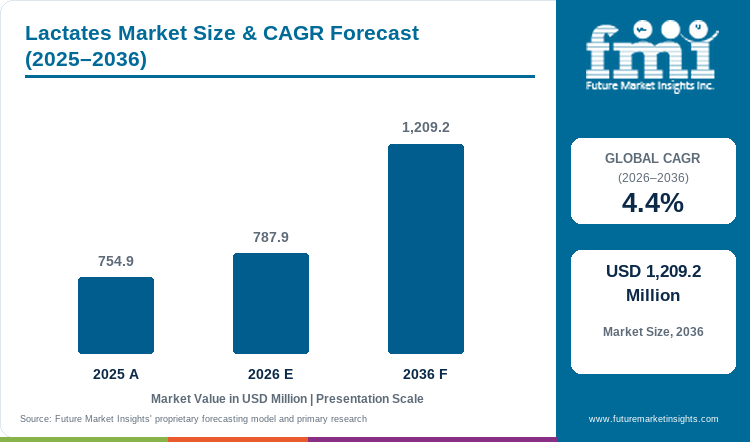
The lactates market is valued at USD 787.9 million in 2026 and is projected to reach USD 1,209.2 million by 2036, growing at a 4.4% CAGR.
Demand for lactates is projected to expand at 4.4% CAGR between 2026 and 2036. Industry value grows from USD 754.9 million in 2025 to USD 787.9 million in 2026 and is projected to reach USD 1,209.2 million by 2036. Food makers are using lactates as food preservatives, pH controls and mineral sources in approved recipes. Clear dose, form and use guidance is helping teams understand how each grade should perform. Approval is limiting faster supplier changes because salt strength and physical form can alter the final result. FDA listings recognize calcium lactate for firming, pH control, adding minerals and keeping food stable. FDA-approved uses are keeping lactates relevant, while buyers are testing each grade in the final recipe.
Buying conditions are changing by country because food output and additive rules shape what buyers check before approval. The UK has a large food-manufacturing base, while Japan is applying tighter rules to some food uses. In July 2026, ONS reported that food manufacturing made up 22.9% of UK manufacturers' product sales in 2025. The figure points to many domestic production lines using preservation and mineral ingredients.
Key Takeaways of Lactates Market
- Processors are using lactates for preservation and mineral fortification, while selected salts are helping control pH in approved applications.
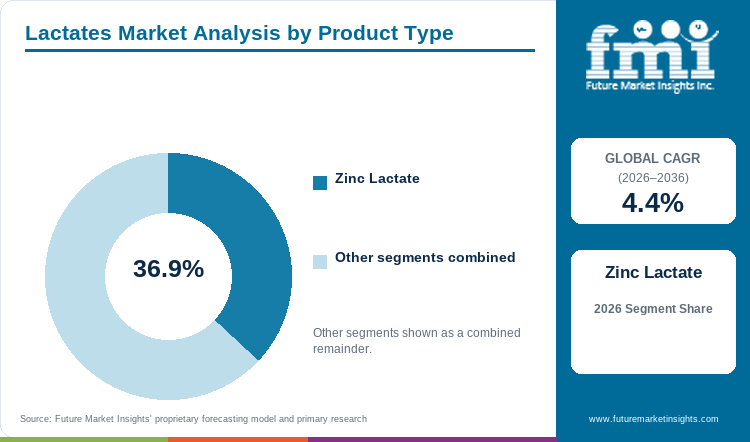
- By product type, zinc lactate is estimated to hold 36.9% in 2026 because it provides zinc with a mild taste.
- Solid is set to lead form with 62.2% share in 2026 as powders are supporting accurate dosing and simpler dry storage.
- By application, food and beverages industry is forecast to represent 43.7% in 2026, supported by preservation and mineral-fortification needs.
- Qualification is slowing supplier changes because concentration and physical form are affecting taste, mixing and processing results.
- Notable companies in the lactates market include Corbion, Galactic S.A., Jungbunzlauer, Archer Daniels Midland, and Musashino Chemical.
Analyst Perspective
"Food and personal-care formulators are adopting lactates that solve clear problems without harming sensory quality. Manufacturers should prepare dose, handling and compliance data early so technical teams can qualify new uses with fewer plant trials."
- Nandini Roy Choudhury, Principal Consultant, Future Market Insights.
How is the Lactates Market segmented?
The lactates market is segmented four ways: by Product Type, Form, Application, and Region.
The lactates market uses three segment axes with region as the geographic split.
Product type covers zinc lactate, calcium lactate, sodium lactate, potassium lactate, magnesium lactate, and others.
Form covers solid and liquid.
Application covers food and beverages industry, pharmaceutical industry, personal care industry, animal feed industry, agriculture industry, and others.
What makes Zinc Lactate central to the Product Type category?
Zinc lactate is a water-soluble mineral salt with a mild taste. Oral care teams are using the salt for plaque control and mineral delivery in suitable products. Food and drink teams are comparing taste, mixing behavior and local use rules before approving each grade.
- Within product type, zinc lactate is likely to capture 36.9% share in 2026. Its mild taste and water solubility are supporting oral-care and nutrition formulas that need a zinc source.
- In April 2025, Jungbunzlauer published tests using zinc lactate with lactic acid in personal-care formulas. The results are providing product teams with evidence for odor control beyond mineral delivery.
Why does Solid lead the Form category?
Plant teams are using solid lactates in dry systems because powders and granules allow accurate measuring. Manufacturers are adding these forms to tablets and premixes that need dry handling. Manufacturers are using liquid lactates in wet systems that need fast mixing during preservation or pH control. Buyers are choosing the form that matches their dosing equipment and the water allowed in each formula.
- In 2026, solid is expected to lead form with 62.2% share. Dry handling is helping plant teams measure doses accurately and simplify storage across several uses.
- Jungbunzlauer presents calcium and zinc lactates as powders for mineral fortification and personal-care applications.
What keeps Food and Beverages Industry at the center of the Application category?
Food processors are using lactates to extend shelf life and add minerals in approved recipes. Sodium and potassium lactates are helping control microbes in selected foods. Calcium lactate is providing calcium while keeping a mild taste in suitable products. Buyers are testing dose and flavor against the limits for each food use.
- The application category is forecast to be led by food and beverages industry at 43.7% share in 2026. Preservation and mineral addition are supporting lactate use across foods that need shelf-life or fortification functions.
- In June 2025, Jungbunzlauer published beverage guidance that lists potassium lactate for taste improvement. The guide is helping beverage teams compare mineral salts for fortification and flavor balance.
What are the drivers, restraints and opportunities in the Lactates Market?
In the lactates market, the key driver is the multifunctional use of lactate salts by food and beverage formulators for preservation, pH control and mineral fortification in approved recipes, since sodium and potassium lactates help control microbes in selected foods, calcium lactate provides mineral delivery with mild taste, and clear FDA and EU use conditions allow plant teams to match each grade with a defined processing purpose, the key restraint is the application-specific grade qualification that slows supplier changes because differences in salt concentration, pH behavior and physical form can alter taste, mixing performance and processing results in sensitive formulas, making buyers reluctant to switch sources without repeating plant trials and documentation reviews even when the alternative grade offers a lower price, and the key opportunity is growing demand for specialty solid mineral lactates in oral care, nutraceuticals, and fortified dry products, where powders and granules support accurate dosing, stable dry handling and predictable results without adding liquid to dry formulas.
- Driver: Food and beverage formulators are using lactates for preservation and mineral functions in approved recipes.
- Restraint: Buyers are retesting taste, handling and performance before approving a different lactate grade.
- Opportunity: Formulators are using specialty solid lactates in oral-care and nutraceutical ingredients that need accurate dosing and stable dry handling.
Specific formulation needs keep lactates relevant across approved food uses
Food makers are using lactates for specific jobs inside approved recipes. Sodium and potassium lactates are helping control microbes in meat and other prepared foods. FDA listings recognize calcium lactate for firming and mineral fortification. EU food additives rules define where several lactate salts can be used. EU use conditions are helping plant teams match each grade with a clear purpose. During source reviews, teams are comparing taste, handling and performance in the same recipe. Mineral lactates are giving formulators another way to add calcium or zinc without changing the finished product category. Clear application data is helping buyers judge each grade against the required processing result. Suppliers are shortening qualification work by showing dose ranges, handling limits and expected results for each use.
Qualification work slows supplier changes in sensitive formulas
Grade qualification is slowing supplier changes because dose, pH and physical form can alter the result. Food teams are comparing taste and handling before approving another source. Pharmaceutical excipients, the inactive ingredients used in medicines, need clear purity and production records for each lactate grade. Japan applies specific rules to sodium and potassium lactates in approved foods. Infant-food requirements place tighter limits on products for young children. Changing sources can alter powder flow or liquid strength during plant use. Buyers are avoiding switches that create more testing or document review. Approved suppliers need fewer checks because plant teams already know how their grades behave. Lower prices are not removing the work required to qualify a different grade.
Dry mineral lactates create targeted uses in oral care and fortified products
Plants are choosing solid lactates for products that need dry mineral salts and predictable handling. Powders and granules are helping teams measure doses without adding liquid to dry formulas. Oral-care teams are using zinc lactate as a mild zinc source in suitable products. Beverage teams are using calcium lactate gluconate because it dissolves well in liquids. Plant-based food teams are using sodium and potassium lactates to manage taste and moisture. Buyers are controlling particle size and flow so dosing stays consistent during production. Clear application data is reducing trial work during grade review. Stable dry handling is supporting supplements, oral care and functional food ingredients.
Which country CAGRs are included in the Lactates Market?
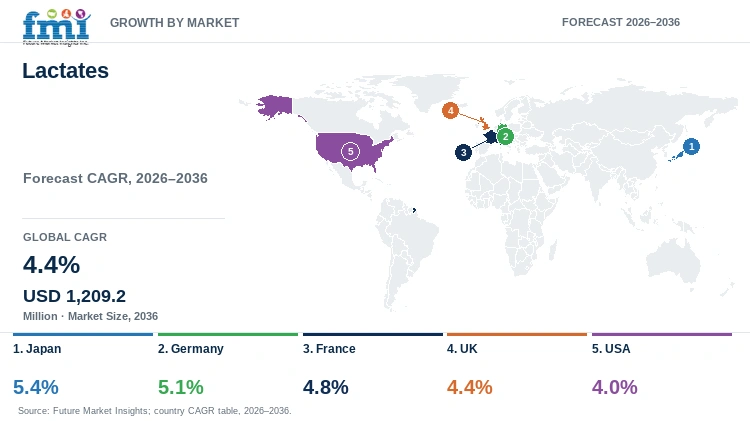
| Country | CAGR |
|---|---|
| Japan | 5.4% |
| Germany | 5.1% |
| France | 4.8% |
| UK | 4.4% |
| USA | 4.0% |
How do country-level CAGRs compare in the lactates market?
Food manufacturing, additive rules and supplier approval steps are creating different lactate buying conditions across these countries.
- Japan favors detailed grade records because national additive specifications shape how food makers approve sodium and potassium lactates.
- Germany's food production base gives suppliers many formulation points that need clear grade data and plant support.
- French food processors use lactates across dairy and beverage formulas with taste and solubility guiding source approval.
- UK food manufacturing supports a broad ingredient buyer base that needs dependable grade performance and simple use guidance.
- Across the USA, established FDA functions give buyers clear regulatory reference points for calcium lactate applications.
Local rules and food-processing practices are changing how much testing and paperwork suppliers must support in each country.
Country-wise Analysis
- In Japan, lactate demand is predicted to advance at 5.4% CAGR through 2036, shaped by national additive specifications. Food makers are following detailed rules for sodium and potassium lactates in approved products. Infant-food rules are placing extra limits on products for young children. In July 2026, MAFF published monthly food-industry results covering production across processed-food groups. The data is helping suppliers see where food production is active across the country. Buyers need grade records that match the recipe and intended consumer. Changing sources is creating more testing if taste or handling changes. Japanese buyers are choosing suppliers that explain use rules and help technical teams check formulas before approval.
- Lactate demand in Germany is forecast to rise at 5.1% CAGR through 2036, supported by EU food-use rules. Germany's food industry is creating demand across many plants with established ingredient requirements. In November 2025, Destatis reported 510,500 food-industry workers at the end of the third quarter. That workforce is supporting a large production base that needs consistent ingredient quality. Buyers are comparing taste and mixing behavior before changing an approved lactate source. Plant teams are using liquid grades in wet systems and solid salts in dry blends and premixes. Animal feed additives are creating another use route for selected lactate salts. German buyers are choosing suppliers that support both forms with clear grade records and practical use guidance.
- Adoption of lactates in France is estimated to expand at 4.8% CAGR through 2036, influenced by its broad food-processing base. EU rules define approved food uses for several lactate salts sold to French processors. Dairy and beverage plants are using mineral lactates for fortification and process control in approved formulas. In February 2026, France's agriculture ministry published a food-industry guide covering companies, jobs, sales and trade. The guide shows the size and reach of the national processing base. Plant teams are testing salt form because taste and handling can change during source approval. Calcium lactate needs to dissolve well without leaving an unwanted taste in beverages. French buyers are choosing suppliers that provide clear grade records and practical formulation help during source reviews.
- The UK lactates market is projected to record 4.4% CAGR during the assessment period, supported by its food-manufacturing base. In July 2025, ONS reported that food manufacturing represented 21% of UK manufacturers' product sales in 2024. The figure shows how widely food plants contribute to domestic manufacturing. Buyers are comparing taste and handling before approving a different lactate grade. Plant teams are avoiding source changes that add more testing or document review. Plants are using solid grades for dry blending and liquid grades for wet processing. Suppliers are providing clear use notes and consistent product behavior for every approved recipe. Practical technical support is reducing plant work during a source change.
- Lactate sales in the USA are forecast to expand at 4.0% CAGR by 2036, enabled by established FDA food-use functions. FDA listings recognize calcium lactate for firming, pH control, mineral supplementation and stabilization. These functions are giving buyers clear regulatory reference points during grade review. In December 2025, BLS recorded about 1.77 million employees across U.S. food manufacturing. The workforce figure points to a large plant base using many functional ingredients. Mature sourcing is making approved grades harder to replace inside existing quality plans. Buyers are comparing test data, delivery records and application support before approving another source. U.S. suppliers are reducing review work by linking grade records to the required product result.
Who are the notable companies in the Lactates Market?
Corbion, Galactic S.A., Jungbunzlauer, Archer Daniels Midland, and Musashino Chemical are notable companies active in this market.
Corbion and Galactic S.A. are selling lactate salts for food preservation and related processing needs in several regions. Jungbunzlauer is publishing salt data for food, supplements and personal-care formulas. Musashino Chemical is selling several lactates and publishing food-use guidance from Japan. Canadian trademark records list ADM calcium, sodium and potassium lactates. Current ADM food pages show nutrition teams serving food and beverage customers across several regions. ADM is providing less current lactate-use detail than the specialist suppliers. Buyers are comparing salt range, application guidance and grade records across all five companies. Local technical support is reducing review work during a source change.
- Corbion is listing food and regulated lactate grades, while Galactic S.A. is publishing preservation guidance for food processors.
- Jungbunzlauer and Musashino Chemical are publishing lactate guidance for food, supplements and personal care.
- Archer Daniels Midland maintains public records for calcium, sodium and potassium lactates within its nutrition business.
Competitive Benchmarking: Lactates Market
| Company | Lactate Salt Breadth | Food & Beverage Application Depth | Regulated-Grade / Specialty Capability | Geographic Reach |
|---|---|---|---|---|
| Corbion | High | High | High | Manufacturing and commercial presence across the Americas, Europe and Asia |
| Galactic S.A. | High | High | Medium | Belgium base with production and commercial activity in China and multiple export regions |
| Jungbunzlauer | High | High | Medium | Europe-centered platform serving global food, beverage, healthcare and personal-care customers |
| Archer Daniels Midland | High | Medium | Medium | Global nutrition network with food and beverage operations across multiple regions |
| Musashino Chemical | Medium | Medium | Medium | Japan-based production and R&D with documented international sales of lactate products |
Key Developments in the Lactates Market
- In November 2025, Corbion presented its renewable lactate platform for natural acidification and pH control at Capital Markets Day. The platform is giving food processors more lactate options for acidification and taste control in approved recipes.
- In May 2025, Galactic S.A. commissioned a spray-drying line in China for preservative powders including lactate-containing DIACE-N-47. The line is expanding solid-format production and giving food processors powders that are easier to handle.
- In March 2025, Musashino Chemical published guidance for sodium and potassium lactates in plant-based food formulas. The guidance is helping food makers manage taste and moisture in plant-protein recipes.
Key Players in the Lactates Market
Integrated fermentation and preservation platforms
- Corbion
- Galactic S.A.
Specialty mineral lactate and application suppliers
- Jungbunzlauer
- Musashino Chemical
Diversified ingredient and nutrition platform
- Archer Daniels Midland
Lactates Market - Report Scope
| Coverage field | Report scope |
|---|---|
| Market breakdown | Product Type; Form; Application |
| Quantitative Units | Revenue in USD Million and CAGR in % . |
| Market Definition | Revenue from lactate salts sold within the defined Product Type, Form and Application universe. Downstream finished-product revenue, lactic acid itself, lactate esters, substitute mineral salts and other adjacent products are excluded. Where a multifunctional blend contains lactate and non-lactate components, only revenue attributable to the defined lactate ingredient is in scope. |
| Regions Covered | North America; Latin America; Western Europe; Eastern Europe; East Asia; South Asia and Pacific; Middle East and Africa |
| Countries Covered | Japan; Germany; France; UK; USA |
| Key Companies Profiled | Corbion; Galactic S.A.; Jungbunzlauer; Archer Daniels Midland; Musashino Chemical |
| Forecast Period | 2026 to 2036 |
| Approach | Primary and secondary research with market triangulation. |
Lactates Market - Research Methodology
| Method | Approach |
|---|---|
| Primary Research | FMI analysts gathered input from manufacturers, service providers, technology developers, distributors, end users, procurement teams, and subject-matter experts. Interviews examined purchasing decisions, product or service evaluation, adoption barriers, approval requirements, pricing considerations, and expectations for technical or commercial support. Respondents were also asked what evidence is required before a trial, pilot, or initial order develops into regular purchasing. |
| Desk Research | Desk research covered government statistics, regulatory publications, trade data, industry associations, technical literature, standards, company filings, product information, and official corporate announcements. Sources were reviewed for relevance, publication date, geographic coverage, and consistency with the defined market scope. Claims relating to performance, applications, approvals, capacity, investment, and commercial activity were retained only when supported by credible public evidence. |
| Market Sizing and Forecasting | The market model combined the baseline value with historical performance, segment structure, pricing and volume indicators, adoption levels, company participation, and country-level demand conditions. Forecast assumptions considered economic activity, investment trends, regulatory developments, technology adoption, purchasing cycles, supply availability, and barriers to wider market use. Segment and regional estimates were reconciled before the final market total was calculated. |
| Data Validation | Estimates were checked against multiple independent indicators, including public data, company activity, trade patterns, industry developments, and findings from primary interviews. Validation also tested whether products, services, applications, and company revenues fell within the defined market boundaries. Adjacent categories, unsupported claims, overlapping revenues, and activities without direct market relevance were excluded to reduce double counting and maintain consistency across segments and countries. |
Lactates Market by Segments
Lactates Market segmented by Product Type:
- Zinc Lactate
- Calcium Lactate
- Sodium Lactate
- Pottasium Lactate
- Magnesium Lactate
- Others
Lactates Market segmented by Form:
- Solid
- Liquid
Lactates Market segmented by Application:
- Food and Beverages Industry
- Pharmaceutical Industry
- Personal Care Industry
- Animal Feed Industry
- Agriculture Industry
- Others
Lactates Market by Region:
- North America
- United States
- Canada
- Latin America
- Brazil
- Mexico
- Argentina
- Chile
- Western Europe
- Germany
- France
- United Kingdom
- Italy
- Spain
- Benelux
- Nordics
- Eastern Europe
- Poland
- Czech Republic
- Romania
- Hungary
- East Asia
- China
- Japan
- South Korea
- South Asia and Pacific
- India
- ASEAN
- Australia and New Zealand
- Middle East and Africa
- GCC Countries
- South Africa
- Türkiye
- Israel
Research Sources and Bibliography
- European Union / EUR-Lex (2024, December 16). Regulation (EC) No 1333/2008 on food additives - consolidated text.
- Japan Ministry of Health, Labour and Welfare (2013, May 15).
- Japan Ministry of Health, Labour and Welfare (n.d.). - lactate specifications.
- Japan Ministry of Agriculture, Forestry and Fisheries (n.d.).
- Federal Statistical Office of Germany (Destatis) (n.d.). Beschäftigte und Umsatz der Betriebe im Verarbeitenden Gewerbe.
- French Ministry of Agriculture and Food Sovereignty (2024, October 18). Le panorama des industries agroalimentaires 2024.
- Office for National Statistics (2025, July 22). UK manufacturers’ sales by product: 2024.
- U.S. Census Bureau (2026, September 3). Census Bureau Releases New Annual Integrated Economic Survey Data.
- U.S. Food and Drug Administration (2018, June 1). GRAS Notice No. 747 - Calcium lactate.
- U.S. Food and Drug Administration (n.d.). Substances Added to Food - Calcium Lactate.
- Corbion (n.d.). Lactic acid, lactates & derivatives for food and drinks.
- Corbion (n.d.). Lactates and gluconates for nutrition.
- Corbion (2024, May 9). Corbion expands partnership with IMCD to include Thailand.
- Corbion (2024, August 8). Corbion: first half-year 2024 results.
- Corbion (2026, February 26). Corbion announces strong full-year 2025 results.
- Galactic (2025, March 4). Traditional antimicrobials: a choice of effectiveness.
- Galactic (2025, April 7). Galactic appoints Laurent Guérindon as new CEO.
- Galactic (2025, May 21). New spray dryer boosts Galactic’s production capabilities in China.
- Galactic (n.d.). Mineral fortification.
- Jungbunzlauer (n.d.). Zinc Lactate.
- Jungbunzlauer (n.d.). Calcium Lactate Gluconate.
- Jungbunzlauer (2025, April 30). Bio-based preservation support with Zinc Lactate and Lactic Acid.
- Musashino Chemical Laboratory, Ltd. (n.d.). Lactic acid・Lactates.
- Musashino Chemical Laboratory, Ltd. (2024, May 1).
- Musashino Chemical Laboratory, Ltd. (2024, September 2).
- Canadian Intellectual Property Office (2012, March 20). ADM - 1362858 - Canadian Trademarks Database.
- Office for National Statistics (2026, July 24). UK manufacturers' sales by product: 2025.
- U.S. Department of Agriculture, Economic Research Service (2026, June 11). Total U.S. food spending reached $2.51 trillion in 2025.
- Ministry of Agriculture and Food Sovereignty, France (2026, February 20). Industries agroalimentaires : les chiffres et indicateurs clés 2026.
- Federal Statistical Office of Germany (Destatis) (2026, January 2). Employment figures largely unchanged in 2025.
- Corbion (2025, November 20). Capital Markets Day 2025: Natural Preservation.
- Jungbunzlauer (2025, April 30). Multifunctional ingredients for a minimalist deodorant: CITROFOL AI and Zinc Lactate.
- Jungbunzlauer (2025, June). Beverage formulation solutions.
- Musashino Chemical Laboratory, Ltd. (2025, March 5).
- Corbion (2026, March 17). Corbion releases its 2025 Annual Report: Preserving What Matters.
- Galactic (2026, March). 2025 Impact Report.
- Musashino Chemical Laboratory, Ltd. (2025, September 26).
- Galactic (2026, April 2). Antimicrobial agents for the meat industry: ensuring safety and quality.
- Canadian Intellectual Property Office (2007, October 2). ADM - 1054531 - Canadian Trademarks Database.
- Archer Daniels Midland Company (n.d.). Food & Human Nutrition Products. Retrieved September 24, 2026.
- Archer Daniels Midland Company (n.d.). ADM Nutrition Southeast Asia. Retrieved September 24, 2026.
- Federal Statistical Office of Germany (Destatis) (2025, November). Stellenabbau in der Automobilindustrie: 48 700 weniger Beschäftigte zum Ende des 3. Quartals 2025 als ein Jahr zuvor.
- U.S. Bureau of Labor Statistics (2025, December). Table B-1a. Employees on nonfarm payrolls by industry sector and selected industry detail, seasonally adjusted.
- Jungbunzlauer (2025, October 9). Jungbunzlauer champions sustainable, high-performance home care at SEPAWA 2025.
- Jungbunzlauer (2025). Soothing skin cream with zinc lactate and xanthan gum.
The bibliography lists the public sources that support evidence throughout this article. The full report includes the complete source list behind its claims and analysis.
This Report Answers
- How large is the Lactates Market in 2026 and what value is forecast for 2036?
- Which industry pressures support demand for lactates across food, nutrition and other applications?
- Why does zinc lactate lead product type in 2026?
- Why does solid lead form in 2026?
- How do country growth rates differ from 2026 to 2036?
- Which companies sell relevant lactate products or related formulation capabilities?
- What limits lactate use or supplier switching in qualified formulations?
- What should buyers evaluate during lactate grade purchasing or supplier changes?
Frequently Asked Questions
How big is the Lactates Market in 2026, and what is forecast for 2036?
The Lactates Market is valued at USD 787.9 million in 2026. Market value is expected to reach USD 1,209.2 million by 2036.
What is the CAGR of the Lactates Market from 2026 to 2036?
The lactates market is expected to expand at 4.4% CAGR from 2026 through 2036. Food and personal-care formulators are using lactates for preservation, mineral delivery, pH control and other approved functions.
Which product type segment leads the Lactates Market?
Zinc lactate leads product type with a 36.9% share in 2026. Buyers value its mild taste and mineral functions across oral-care and nutrition applications.
Which form segment leads the Lactates Market?
Solid leads the form category with a 62.2% share in 2026. Powders and granules are supporting dry blending, accurate dosing and simpler storage across several end uses.
Which countries have faster growth rates in the Lactates Market?
Japan is expected to grow at 5.4% CAGR through the 2036 forecast period. Germany is expected to grow at 5.1% over the same 2026 to 2036 period.
Which companies are active in the Lactates Market?
Notable companies in the lactates market include Corbion, Galactic S.A., Jungbunzlauer, Archer Daniels Midland, and Musashino Chemical.
Preview the report firsthand - request a free sample
Get SampleGet the brochure for pricing and purchase details.
Get PDFTable of Content
- Key Takeaways
- Market Size and CAGR
- Top Growth Driver
- Fastest Growing Segment
- Leading Region
- Key Companies
- Emerging Opportunities
- Executive Summary
- Global Market Outlook
- Demand-side Trends
- Supply-side Trends
- Technology Roadmap Analysis
- Analysis and Recommendations
- Analyst Perspective (What is happening? Why now? What should investors know?)
- Key Questions Answered
- How large is the market?
- What is the CAGR?
- What are key trends?
- Which region dominates?
- Who are the leaders?
- Market Overview
- Market Coverage / Taxonomy
- Market Definition / Scope / Limitations
- Research Methodology
- Chapter Orientation
- Analytical Lens and Working Hypotheses
- Market Structure, Signals, and Trend Drivers
- Benchmarking and Cross-market Comparability
- Market Sizing, Forecasting, and Opportunity Mapping
- Research Design and Evidence Framework
- Desk Research Programme (Secondary Evidence)
- Expert Input and Fieldwork (Primary Evidence)
- Tooling, Models, and Reference Databases
- Data Engineering and Model Build
- Quality Assurance and Audit Trail
- Market Background
- Market Dynamics (Drivers, Restraints, Opportunity, Trends)
- Scenario Forecast (Optimistic, Likely, Conservative)
- Impact Analysis
- AI Impact
- Sustainability Impact
- Regulatory Impact
- Technology Impact
- Consumer / Buyer Analysis
- Purchase Drivers
- Adoption Barriers
- Buyer Journey
- Opportunity Map Analysis
- Product Life Cycle Analysis
- Supply Chain Analysis
- Investment Feasibility Matrix
- Value Chain Analysis
- PESTLE and Porter's Analysis
- Regulatory Landscape
- Regional Parent Market Outlook
- Production and Consumption Statistics
- Import and Export Statistics
- Global Market Analysis and Forecast, 2021 to 2036
- Historical Market Size Value (USD Million) Analysis, 2021 to 2025
- Current and Future Market Size Value (USD Million) Projections, 2026 to 2036
- Y-o-Y Growth Trend Analysis
- Absolute $ Opportunity Analysis
- Global Market Pricing Analysis, 2021 to 2036
- Global Market Analysis and Forecast, By Product Type, 2021 to 2036
- Introduction / Key Findings
- Historical Market Size Value (USD Million) Analysis By Product Type, 2021 to 2025
- Current and Future Market Size Value (USD Million) Analysis and Forecast By Product Type, 2026 to 2036
- Zinc Lactate
- Calcium Lactate
- Sodium Lactate
- Pottasium Lactate
- Magnesium Lactate
- Others
- Y-o-Y Growth Trend Analysis By Product Type, 2021 to 2025
- Absolute $ Opportunity Analysis By Product Type, 2026 to 2036
- Global Market Analysis and Forecast, By Form, 2021 to 2036
- Introduction / Key Findings
- Historical Market Size Value (USD Million) Analysis By Form, 2021 to 2025
- Current and Future Market Size Value (USD Million) Analysis and Forecast By Form, 2026 to 2036
- Solid
- Liquid
- Y-o-Y Growth Trend Analysis By Form, 2021 to 2025
- Absolute $ Opportunity Analysis By Form, 2026 to 2036
- Global Market Analysis and Forecast, By Application, 2021 to 2036
- Introduction / Key Findings
- Historical Market Size Value (USD Million) Analysis By Application, 2021 to 2025
- Current and Future Market Size Value (USD Million) Analysis and Forecast By Application, 2026 to 2036
- Food and Beverages Industry
- Pharmaceutical Industry
- Personal Care Industry
- Animal Feed Industry
- Agriculture Industry
- Others
- Y-o-Y Growth Trend Analysis By Application, 2021 to 2025
- Absolute $ Opportunity Analysis By Application, 2026 to 2036
- Global Market Analysis and Forecast, By Region, 2021 to 2036
- Introduction
- Historical Market Size Value (USD Million) Analysis By Region, 2021 to 2025
- Current Market Size Value (USD Million) Analysis and Forecast By Region, 2026 to 2036
- North America
- Latin America
- Western Europe
- Eastern Europe
- East Asia
- South Asia and Pacific
- Middle East and Africa
- Market Attractiveness Analysis By Region
- North America Market Analysis and Forecast, By Country, 2021 to 2036
- Historical Market Size Value (USD Million) Trend Analysis By Market Taxonomy, 2021 to 2025
- Market Size Value (USD Million) Forecast By Market Taxonomy, 2026 to 2036
- By Country
- United States
- Canada
- By Product Type
- By Form
- By Application
- By Country
- Market Attractiveness Analysis
- By Country
- By Product Type
- By Form
- By Application
- Key Takeaways
- Latin America Market Analysis and Forecast, By Country
- Historical Market Size Value (USD Million) Trend Analysis By Market Taxonomy, 2021 to 2025
- Market Size Value (USD Million) Forecast By Market Taxonomy, 2026 to 2036
- By Country
- Brazil
- Mexico
- Argentina
- Chile
- By Product Type
- By Form
- By Application
- By Country
- Market Attractiveness Analysis
- By Country
- By Product Type
- By Form
- By Application
- Key Takeaways
- Western Europe Market Analysis and Forecast, By Country
- Historical Market Size Value (USD Million) Trend Analysis By Market Taxonomy, 2021 to 2025
- Market Size Value (USD Million) Forecast By Market Taxonomy, 2026 to 2036
- By Country
- Germany
- France
- United Kingdom
- Italy
- Spain
- Benelux
- Nordics
- By Product Type
- By Form
- By Application
- By Country
- Market Attractiveness Analysis
- By Country
- By Product Type
- By Form
- By Application
- Key Takeaways
- Eastern Europe Market Analysis and Forecast, By Country
- Historical Market Size Value (USD Million) Trend Analysis By Market Taxonomy, 2021 to 2025
- Market Size Value (USD Million) Forecast By Market Taxonomy, 2026 to 2036
- By Country
- Poland
- Czech Republic
- Romania
- Hungary
- By Product Type
- By Form
- By Application
- By Country
- Market Attractiveness Analysis
- By Country
- By Product Type
- By Form
- By Application
- Key Takeaways
- East Asia Market Analysis and Forecast, By Country
- Historical Market Size Value (USD Million) Trend Analysis By Market Taxonomy, 2021 to 2025
- Market Size Value (USD Million) Forecast By Market Taxonomy, 2026 to 2036
- By Country
- China
- Japan
- South Korea
- By Product Type
- By Form
- By Application
- By Country
- Market Attractiveness Analysis
- By Country
- By Product Type
- By Form
- By Application
- Key Takeaways
- South Asia and Pacific Market Analysis and Forecast, By Country
- Historical Market Size Value (USD Million) Trend Analysis By Market Taxonomy, 2021 to 2025
- Market Size Value (USD Million) Forecast By Market Taxonomy, 2026 to 2036
- By Country
- India
- ASEAN
- Australia and New Zealand
- By Product Type
- By Form
- By Application
- By Country
- Market Attractiveness Analysis
- By Country
- By Product Type
- By Form
- By Application
- Key Takeaways
- Middle East and Africa Market Analysis and Forecast, By Country
- Historical Market Size Value (USD Million) Trend Analysis By Market Taxonomy, 2021 to 2025
- Market Size Value (USD Million) Forecast By Market Taxonomy, 2026 to 2036
- By Country
- GCC Countries
- South Africa
- Türkiye
- Israel
- By Product Type
- By Form
- By Application
- By Country
- Market Attractiveness Analysis
- By Country
- By Product Type
- By Form
- By Application
- Key Takeaways
- Key Countries Market Analysis
- United States
- Pricing Analysis
- Market Share Analysis, 2025
- By Product Type
- By Form
- By Application
- Canada
- Pricing Analysis
- Market Share Analysis, 2025
- By Product Type
- By Form
- By Application
- Mexico
- Pricing Analysis
- Market Share Analysis, 2025
- By Product Type
- By Form
- By Application
- Brazil
- Pricing Analysis
- Market Share Analysis, 2025
- By Product Type
- By Form
- By Application
- Chile
- Pricing Analysis
- Market Share Analysis, 2025
- By Product Type
- By Form
- By Application
- Germany
- Pricing Analysis
- Market Share Analysis, 2025
- By Product Type
- By Form
- By Application
- United Kingdom
- Pricing Analysis
- Market Share Analysis, 2025
- By Product Type
- By Form
- By Application
- Italy
- Pricing Analysis
- Market Share Analysis, 2025
- By Product Type
- By Form
- By Application
- Spain
- Pricing Analysis
- Market Share Analysis, 2025
- By Product Type
- By Form
- By Application
- France
- Pricing Analysis
- Market Share Analysis, 2025
- By Product Type
- By Form
- By Application
- India
- Pricing Analysis
- Market Share Analysis, 2025
- By Product Type
- By Form
- By Application
- ASEAN
- Pricing Analysis
- Market Share Analysis, 2025
- By Product Type
- By Form
- By Application
- Australia and New Zealand
- Pricing Analysis
- Market Share Analysis, 2025
- By Product Type
- By Form
- By Application
- China
- Pricing Analysis
- Market Share Analysis, 2025
- By Product Type
- By Form
- By Application
- Japan
- Pricing Analysis
- Market Share Analysis, 2025
- By Product Type
- By Form
- By Application
- South Korea
- Pricing Analysis
- Market Share Analysis, 2025
- By Product Type
- By Form
- By Application
- Poland
- Pricing Analysis
- Market Share Analysis, 2025
- By Product Type
- By Form
- By Application
- Hungary
- Pricing Analysis
- Market Share Analysis, 2025
- By Product Type
- By Form
- By Application
- Türkiye
- Pricing Analysis
- Market Share Analysis, 2025
- By Product Type
- By Form
- By Application
- South Africa
- Pricing Analysis
- Market Share Analysis, 2025
- By Product Type
- By Form
- By Application
- United States
- Market Structure Analysis
- Competition Dashboard
- Competition Benchmarking
- Market Share Analysis of Top Players
- By Regional
- By Product Type
- By Form
- By Application
- Emerging Startups
- Innovation Benchmarking
- Competition Analysis
- Competition Deep Dive
- Corbion
- Overview
- Product Portfolio
- Profitability by Market Segments
- Sales Footprint
- Strategy Overview
- Marketing Strategy
- Product Strategy
- Channel Strategy
- Galactic S.A.
- Jungbunzlauer
- Archer Daniels Midland
- Musashino Chemical
- Corbion
- Case Studies
- Success Stories
- Recent Developments
- Competition Deep Dive
- Assumptions & Acronyms Used


