

- Industry Size (2026)
- USD 740.5 Mn
- Forecast (2036)
- USD 1769.2 Mn
- CAGR (2026 to 2036)
- 9.1%
Low-Leaching Wood Preservative Chemicals Market Forecast and Outlook 2026 to 2036
The low-leaching wood preservative chemicals market is projected to experience steady growth from 2026 to 2036. In 2026, the market value is expected to be USD 740.5 million, with growth anticipated to reach USD 1,769.2 million by 2036. The compound annual growth rate (CAGR) for the market is forecasted at 9.1%, driven by increasing demand for sustainable and eco-friendly wood preservation solutions. Low-leaching preservatives are gaining popularity due to their ability to provide long-lasting protection against wood decay while minimizing environmental impact, making them an attractive alternative to traditional chemicals.
The growth of the market is supported by rising environmental regulations, consumer demand for green building materials, and increased awareness of the harmful effects of conventional preservatives on ecosystems. The wood preservation industry is transitioning towards safer, more environmentally friendly products that align with sustainability goals. Additionally, advancements in preservative formulations and improved performance standards are expected to drive further market expansion. Over the forecast period, the market is expected to grow steadily, supported by these trends and innovations in wood preservation technologies.
Quick Stats of the Low-Leaching Wood Preservative Chemicals Market
- Low-Leaching Wood Preservative Chemicals Market Value (2026): USD 740.5 million
- Low-Leaching Wood Preservative Chemicals Market Forecast Value (2036): USD 1,769.2 million
- Low-Leaching Wood Preservative Chemicals Market Global Forecast CAGR (2026 to 2036): 9.1%
- Low-Leaching Wood Preservative Chemicals Market Leading Segment: Treatment Method (Pressure-Treated Wood - Vacuum/Vessel) 36%
- Key Growth Regions in Low-Leaching Wood Preservative Chemicals Market: India
- Top Players in Low-Leaching Wood Preservative Chemicals Market: Lonza Wood Protection, Koppers Holdings, BASF SE, Sika AG, AkzoNobel

What is the Growth Forecast for the Low-Leaching Wood Preservative Chemicals Market through 2036?
The long-term value accumulation curve for the low-leaching wood preservative chemicals market shows a consistent, steady upward trend. The market will start at USD 740.5 million in 2026 and gradually increase in value, reaching USD 1,171 million by 2031. This period reflects a moderate but consistent accumulation of value as industries and consumers become more aware of the benefits of low-leaching preservatives.
From 2031 to 2036, the growth rate will accelerate, with the market reaching USD 1,769.2 million by 2036. This reflects the growing demand for these environmentally friendly alternatives, driven by expanding regulations and consumer preferences for sustainable products. The value accumulation curve indicates that the market will see steady, incremental growth over the long term, supported by increasing adoption and the introduction of more advanced preservative formulations. The long-term growth is characterized by a gradual shift towards sustainable wood preservation methods, ensuring continued market expansion.
Low-Leaching Wood Preservative Chemicals Market Key Takeaways
| Metric | Value |
|---|---|
| Industry Sales Value (2026) | USD 740.5 million |
| Industry Forecast Value (2036) | USD 1,769.2 million |
| Industry Forecast CAGR (2026 to 2036) | 9.1% |
What Is Driving the Demand for the Low-Leaching Wood Preservative Chemicals Market Globally?
The global demand for low leaching wood preservative chemicals is being driven by increasing regulatory restrictions on traditional preservative chemistries and heightened awareness of environmental and human health impacts. Conventional wood preservatives often relied on heavy metals, arsenic, or other persistent substances that can leach into soil and water, posing risks to ecosystems and potable water sources. Environmental agencies in Europe, North America, and parts of Asia have implemented limits on leachable constituents and tighter standards for treated wood used in residential, commercial, and infrastructure applications.
At the same time, architects, builders, and end users are prioritising materials that meet green building certifications and sustainability criteria without sacrificing durability, decay resistance, and termite protection. Low leaching preservatives-often based on organic biocides, advanced chelates, or micronised formulations-offer effective performance while reducing environmental release of active ingredients. Growth in infrastructure, residential construction, outdoor structures, utility poles, and decking increases overall consumption of treated wood, reinforcing the need for preservatives that align with evolving safety and environmental criteria.
Future demand for low leaching wood preservative chemicals is expected to grow as performance expectations, regulatory frameworks, and sustainability commitments continue to evolve globally. Advances in preservative technology are improving leach resistance, efficacy against a broad range of wood pests and fungi, and compatibility with diverse timber species, which supports wider adoption in both new and retrofit applications. Regulatory alignment across regions and integration of life cycle assessment (LCA) requirements into procurement standards will further encourage use of low leaching systems in infrastructure and commercial projects.
Growth in environmentally focused construction standards-such as LEED, BREEAM, and national green building codes-will reinforce material specification that balances performance with reduced ecological impact. Expansion of outdoor wood applications in urban planning, public spaces, and utility projects will sustain demand for solutions that extend service life without contributing to environmental contamination. As wood continues to be valued as a renewable building material, demand for preservatives that maintain structural integrity while minimising chemical migration and environmental footprint is expected to expand steadily across markets worldwide.
What are the Leading Segments in the Global Low-Leaching Wood Preservative Chemicals Market?
The global low-leaching wood preservative chemicals market is segmented by preservative type and treatment method. Among preservative types, copper organic wood preservatives (CA, CCA, ACQ) lead the market, capturing 32% of the share, followed by bio-based & borate preservatives, microencapsulated low-leach coatings, waterborne silicone & polymer sealants, and other low-leaching preservative systems. Copper-based preservatives are preferred for their effective protection against fungi, insects, and decay while being less harmful to the environment due to their low leaching properties. On the treatment method side, pressure-treated wood (vacuum/vessel) dominates the market, holding 36% of the share, followed by dip & brush treatment, surface coating & barrier protection, thermal & modified wood treatment, and injection/deep penetration treatments. Pressure treatment is widely used due to its ability to deeply impregnate preservatives into wood, ensuring long-lasting protection.
What Drives the Growth of Copper Organic Wood Preservatives in the Low-Leaching Wood Preservative Chemicals Market?

Copper organic wood preservatives (CA, CCA, ACQ) are the leading preservative type in the low-leaching wood preservative chemicals market, holding 32% of the share. These preservatives are highly effective in protecting wood from decay, insects, and other environmental factors. Copper-based preservatives are widely used in outdoor and construction applications, such as decking, fencing, and utility poles, due to their strong performance and long-lasting effects. Additionally, these preservatives are favored for their low environmental impact, as they leach less into the environment compared to traditional chemicals. The growing demand for sustainable and eco-friendly wood treatment solutions, combined with stringent environmental regulations, has further boosted the adoption of copper organic preservatives. As industries continue to prioritize the durability and sustainability of wood products, the demand for copper organic wood preservatives is expected to remain strong, securing their position as a dominant solution in the market.
What is Driving the Demand for Pressure-Treated Wood (Vacuum/Vessel) in the Low-Leaching Wood Preservative Chemicals Market?

Pressure-treated wood (vacuum/vessel) is the leading treatment method in the low-leaching wood preservative chemicals market, capturing 36% of the share. This method is preferred because it allows preservatives to deeply penetrate the wood fibers, providing comprehensive protection against decay, insects, and fungi. The pressure treatment process involves placing the wood in a vacuum vessel where the preservative is forced into the wood under high pressure, ensuring uniform treatment and long-term effectiveness. This treatment method is commonly used in outdoor construction projects, such as decks, fences, and utility poles, where wood is exposed to harsh weather conditions. As the demand for durable, long-lasting wood products increases, particularly in the construction and outdoor industries, the use of pressure-treated wood continues to grow, driving the demand for pressure-treated wood in the low-leaching wood preservative chemicals market.
What are the Key Dynamics in the Global Low-Leaching Wood Preservative Chemicals Market?
The global low leaching wood preservative chemicals market is expanding as demand grows for wood protection solutions that deliver long lasting resistance to decay, insects and weathering while minimizing environmental and health impacts. Low leaching preservatives reduce chemical runoff into soil and waterways compared with traditional formulations that can release hazardous constituents. Growth is supported by stricter environmental regulations, sustainability commitments in construction and infrastructure, and increased use of treated wood in residential, commercial and outdoor applications. Adoption spans treated lumber, utility poles, decking, fencing and marine structures where durability and regulatory compliance are priorities.
What are the Key Drivers for the Global Low-Leaching Wood Preservative Chemicals Market?
Environmental regulations and building standards that restrict harmful chemical discharge are key drivers of the low leaching preservative market. Governments and industry bodies are tightening controls on traditional wood preservatives that can contaminate soil and groundwater, prompting manufacturers to shift toward safer alternatives. Growth in construction and outdoor timber use increases demand for effective wood protection that aligns with sustainability goals. Consumer and architect preference for green building materials and certification schemes (such as LEED) encourages adoption of preservatives with reduced environmental footprint. Technological advancements in formulation chemistry enable competitive performance with lower environmental burden, widening application opportunities globally.
What are the Restraints for the Global Low-Leaching Wood Preservative Chemicals Market?
One restraint is the technical challenge of matching long term protection performance of traditional, higher leaching preservative systems, especially in extreme exposure conditions or high decay risk environments. Some low leaching formulations require precise application conditions or re treatment intervals that differ from conventional products, which can affect adoption among contractors accustomed to legacy systems. Higher raw material and formulation costs for eco oriented preservatives can impact competitiveness in price sensitive segments. Variability in regional testing and approval standards creates complexity for global suppliers seeking harmonized product lines, and some markets lag in regulatory enforcement, reducing urgency for transition.
What are the Key Trends in the Global Low-Leaching Wood Preservative Chemicals Market?
A key trend is development of bio based and nano enhanced preservative systems that improve efficacy while lowering chemical mobility and leaching risk. Manufacturers are focusing on carriers, binders and controlled release technologies that lock active agents into wood matrices more effectively, reducing environmental exposure. Integration of low leaching preservatives with digital specification tools and life cycle assessment data supports greener product claims and procurement decisions. Partnerships among chemical suppliers, wood processors and certification bodies are increasing to validate performance and align with sustainability frameworks. Demand for treated wood products that meet both durability and eco friendly criteria is influencing product design, marketing and adoption in infrastructure, residential and outdoor timber markets globally.
What is the Country-Wise Analysis of the Low-Leaching Wood Preservative Chemicals Market?
The low-leaching wood preservative chemicals market is expected to grow steadily, driven by the increasing demand for eco-friendly and long-lasting solutions in the wood treatment industry. These chemicals are used to enhance the durability of wood, protect it from pests, fungi, and decay, and minimize environmental impact through reduced leaching into the surrounding environment. High-growth markets such as India and China are experiencing strong demand due to their expanding construction and infrastructure industries, coupled with increasing environmental awareness and regulatory pressures. Developed markets such as the United States, Germany, and Canada are also seeing steady growth, supported by stricter environmental standards and a growing focus on sustainability in construction and wood processing.
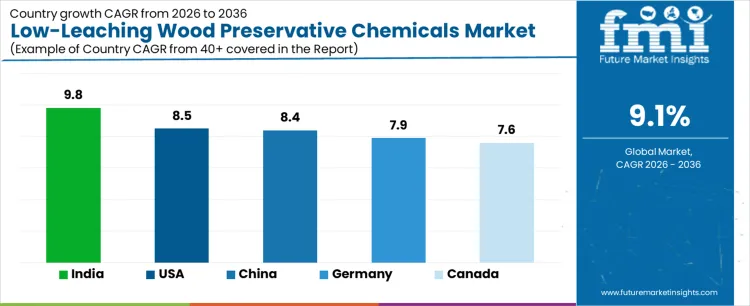
| Country | CAGR (2026-2036) |
|---|---|
| India | 9.8% |
| United States | 8.5% |
| China | 8.4% |
| Germany | 7.9% |
| Canada | 7.6% |
What is the Growth Outlook for the Low-Leaching Wood Preservative Chemicals Market in India?
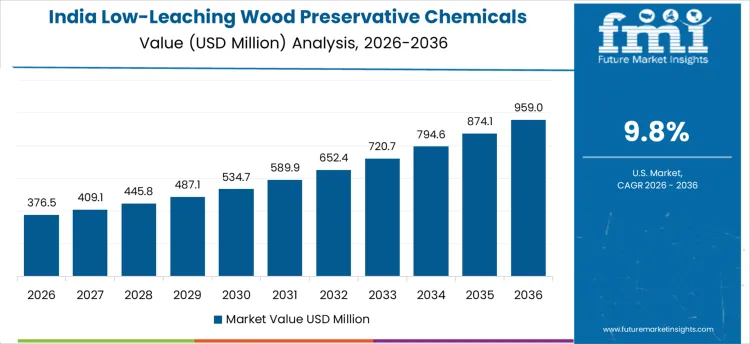
The low-leaching wood preservative chemicals market in India is expected to grow at the highest rate, with a projected CAGR of 9.8%. India’s booming construction, infrastructure, and furniture sectors are key drivers of demand for wood preservative chemicals, as the need for durable, long-lasting wood materials continues to grow. As the country focuses on expanding its urban infrastructure and modernizing its construction practices, the demand for safe and effective wood treatment solutions is rising. The increasing awareness of the environmental impact of traditional wood preservatives, coupled with the push for sustainable building materials, is driving the adoption of low-leaching alternatives. Furthermore, government regulations encouraging the use of eco-friendly products are expected to further fuel market growth. With India’s continued economic growth and expanding urbanization, the low-leaching wood preservative chemicals market is well-positioned for strong growth.
What is the Market Outlook for the Low-Leaching Wood Preservative Chemicals Market in the United States?
The low-leaching wood preservative chemicals market in the United States is projected to grow steadily, with a projected CAGR of 8.5%. In the U.S., the demand for sustainable and non-toxic wood treatment solutions is increasing, driven by stricter environmental regulations and growing consumer awareness of the harmful effects of traditional preservatives. The U.S. government has implemented stringent regulations regarding the use of chemicals in construction and wood preservation, encouraging the shift toward eco-friendlier alternatives. With an emphasis on reducing the environmental impact of construction materials and preserving the health of ecosystems, the adoption of low-leaching wood preservatives is expected to continue growing. The U.S. market is also benefiting from increasing demand for sustainable building materials, including those used in residential and commercial construction projects.
What is the Growth Forecast for the Low-Leaching Wood Preservative Chemicals Market in China?
The low-leaching wood preservative chemicals market in China is expected to grow at a steady pace, with a projected CAGR of 8.4%. China’s rapidly expanding construction, infrastructure, and furniture industries are creating strong demand for wood preservatives that can enhance durability while minimizing environmental impact. As the country focuses on improving environmental standards and reducing the use of harmful chemicals, there is a growing preference for low-leaching wood preservative chemicals that are both effective and eco-friendly. China’s government has introduced regulations encouraging the use of safer and more sustainable chemicals in construction and manufacturing, further supporting the adoption of these products. With the continued growth of the construction sector and a focus on sustainable building practices, the demand for low-leaching wood preservatives in China is expected to rise steadily.
What is the Market Outlook for the Low-Leaching Wood Preservative Chemicals Market in Germany?
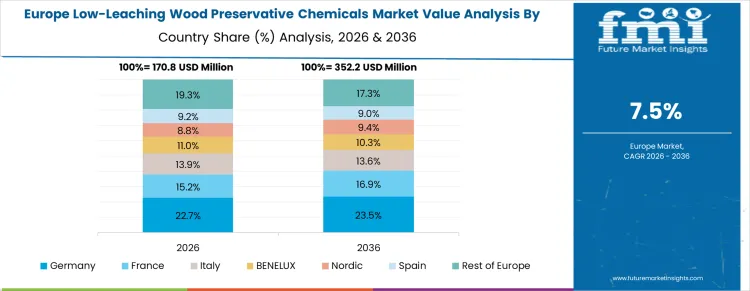
The low-leaching wood preservative chemicals market in Germany is projected to grow steadily, with a projected CAGR of 7.9%. Germany’s strong commitment to sustainability and environmental protection is driving the demand for safer, eco-friendlier wood treatment solutions. The country’s construction and furniture industries are increasingly adopting low-leaching wood preservatives as part of efforts to meet stringent environmental regulations and reduce chemical exposure. With a growing emphasis on green building materials and sustainable construction practices, Germany is well-positioned to see continued demand for these eco-friendly products. Additionally, Germany’s leadership in environmental policy and the growing awareness of the need to reduce the ecological impact of wood preservatives are expected to further support the market’s growth.
What are the Growth Prospects for the Low-Leaching Wood Preservative Chemicals Market in Canada?
The low-leaching wood preservative chemicals market in Canada is expected to grow at a moderate pace, with a projected CAGR of 7.6%. Canada’s increasing focus on sustainability and environmental protection in the construction and manufacturing sectors is driving the demand for eco-friendly wood preservatives. As the country strives to meet higher environmental standards, both in residential and commercial construction projects, the use of low-leaching wood preservative chemicals is becoming more prevalent. Additionally, Canada’s growing forestry and lumber industries, along with government regulations promoting the use of safer chemicals, are expected to contribute to the market’s growth. The demand for durable and sustainable materials, particularly in the context of Canada’s challenging climate conditions, will further support the adoption of low-leaching wood preservatives.
What is the Competitive Landscape for the Low-Leaching Wood Preservative Chemicals Market?

The low-leaching wood preservative chemicals market is experiencing growth as industries seek sustainable and eco-friendly solutions for protecting wood against decay, insects, and environmental damage. Lonza Wood Protection leads the market with its innovative low-leaching wood preservatives, offering high-performance chemicals that provide long-lasting protection while minimizing the release of harmful substances into the environment. Their focus on sustainability, product efficacy, and regulatory compliance has positioned them as a dominant player in this space.
Koppers Holdings, BASF SE, and Sika AG are significant competitors, each offering specialized wood preservative solutions that improve wood durability and extend product lifespan. Koppers Holdings specializes in providing environmentally responsible wood treatment chemicals, while BASF SE and Sika AG focus on developing sustainable, high-performance preservatives that enhance wood protection while reducing environmental impact.
AkzoNobel further contributes to the competitive landscape by offering its own range of low-leaching wood preservatives designed to protect wood products from weathering, fungi, and pests. AkzoNobel emphasizes the importance of eco-friendly and effective chemical solutions for the construction and wood treatment industries.
These companies compete by focusing on product innovation, sustainability, and the ability to provide wood preservatives that meet the growing demand for environmentally responsible, high-performance solutions. As environmental regulations tighten and consumer demand for safer, greener products increases, the market for low-leaching wood preservative chemicals is expected to continue expanding.
Key Players of the Low-Leaching Wood Preservative Chemicals Market
- Lonza Wood Protection
- Koppers Holdings
- BASF SE
- Sika AG
- AkzoNobel
Scope of the Report
| Items | Values |
|---|---|
| Quantitative Units (2026) | USD Million |
| Preservative Type | Copper Organic Wood Preservatives (CA, CCA, ACQ), Bio-Based & Borate Preservatives, Microencapsulated Low-Leach Coatings, Waterborne Silicone & Polymer Sealants, Other Low-Leaching Preservative Systems |
| Treatment Method | Pressure-Treated Wood (Vacuum/Vessel), Dip & Brush Treatment, Surface Coating & Barrier Protection, Thermal & Modified Wood Treatment, Injection / Deep Penetration Treatments |
| Application Sector | Outdoor Construction & Decking, Utility Poles & Fencing, Marine & Coastal Structures, Furniture & Decorative Wood, Industrial & Structural Timber |
| Companies | Lonza Wood Protection, Koppers Holdings, BASF SE, Sika AG, AkzoNobel |
| Regions Covered | North America, Latin America, Western Europe, Eastern Europe, South Asia and Pacific, East Asia, Middle East & Africa |
| Countries Covered | United States, Canada, Mexico, Brazil, Argentina, Germany, France, United Kingdom, Italy, Spain, Netherlands, China, India, Japan, South Korea, ANZ, GCC Countries, South Africa |
| Additional Attributes | Dollar sales by preservative type, treatment method, application sector, and region. Includes market trends in low-leaching wood preservative chemicals, focusing on copper organic, bio-based, microencapsulated coatings, and waterborne silicone preservatives. Highlights the role of outdoor construction, marine structures, and furniture in the wood preservation market. Focus on sustainability, cost-effectiveness, performance, regulatory compliance, market share, and competitive positioning of key companies in the wood preservation industry. |
Low-Leaching Wood Preservative Chemicals Market Segmentation
By Preservative Type:
- Copper Organic Wood Preservatives (CA, CCA, ACQ)
- Bio-Based & Borate Preservatives
- Microencapsulated Low-Leach Coatings
- Waterborne Silicone & Polymer Sealants
- Other Low-Leaching Preservative Systems
By Treatment Method:
- Pressure-Treated Wood (Vacuum/Vessel)
- Dip & Brush Treatment
- Surface Coating & Barrier Protection
- Thermal & Modified Wood Treatment
- Injection / Deep Penetration Treatments
By Application Sector:
- Outdoor Construction & Decking
- Utility Poles & Fencing
- Marine & Coastal Structures
- Furniture & Decorative Wood
- Industrial & Structural Timber
By Region:
- Asia Pacific
- China
- Japan
- South Korea
- India
- Australia & New Zealand
- ASEAN
- Rest of Asia Pacific
- Europe
- Germany
- United Kingdom
- France
- Italy
- Spain
- Nordic
- BENELUX
- Rest of Europe
- North America
- United States
- Canada
- Mexico
- Latin America
- Brazil
- Chile
- Rest of Latin America
- Middle East & Africa
- Kingdom of Saudi Arabia
- Other GCC Countries
- Turkey
- South Africa
- Other African Union
- Rest of Middle East & Africa
Frequently Asked Questions
How big is the low-leaching wood preservative chemicals market in 2026?
The global low-leaching wood preservative chemicals market is estimated to be valued at USD 740.5 million in 2026.
What will be the size of low-leaching wood preservative chemicals market in 2036?
The market size for the low-leaching wood preservative chemicals market is projected to reach USD 1,769.2 million by 2036.
How much will be the low-leaching wood preservative chemicals market growth between 2026 and 2036?
The low-leaching wood preservative chemicals market is expected to grow at a 9.1% CAGR between 2026 and 2036.
What are the key preservative types in the low-leaching wood preservative chemicals market?
The key preservative types in low-leaching wood preservative chemicals market are copper organic wood preservatives (CA, CCA, ACQ), bio-based & borate preservatives, microencapsulated low-leach coatings, waterborne silicone & polymer sealants and other low-leaching preservative systems.
Which treatment method segment to contribute significant share in the low-leaching wood preservative chemicals market in 2026?
In terms of treatment method, pressure-treated wood (vacuum/vessel) segment to command 36.0% share in the low-leaching wood preservative chemicals market in 2026.
Preview the report firsthand - request a free sample
Get SampleGet the brochure for pricing and purchase details.
Get PDFTable of Content
- Executive Summary
- Global Market Outlook
- Demand-side Trends
- Supply-side Trends
- Technology Roadmap Analysis
- Analysis and Recommendations
- Market Overview
- Market Coverage / Taxonomy
- Market Definition / Scope / Limitations
- Market Background
- Market Dynamics
- Drivers
- Restraints
- Opportunity
- Trends
- Scenario Forecast
- Demand in Optimistic Scenario
- Demand in Likely Scenario
- Demand in Conservative Scenario
- Opportunity Map Analysis
- Product Life Cycle Analysis
- Supply Chain Analysis
- Investment Feasibility Matrix
- Value Chain Analysis
- PESTLE and Porter’s Analysis
- Regulatory Landscape
- Regional Parent Market Outlook
- Production and Consumption Statistics
- Import and Export Statistics
- Market Dynamics
- Global Market Analysis 2021 to 2025 and Forecast, 2026 to 2036
- Historical Market Size Value (USD Million) Analysis, 2021 to 2025
- Current and Future Market Size Value (USD Million) Projections, 2026 to 2036
- Y-o-Y Growth Trend Analysis
- Absolute $ Opportunity Analysis
- Global Market Pricing Analysis 2021 to 2025 and Forecast 2026 to 2036
- Global Market Analysis 2021 to 2025 and Forecast 2026 to 2036, By Preservative Type
- Introduction / Key Findings
- Historical Market Size Value (USD Million) Analysis By Preservative Type , 2021 to 2025
- Current and Future Market Size Value (USD Million) Analysis and Forecast By Preservative Type , 2026 to 2036
- Copper Organic Wood Preservatives (CA, CCA, ACQ)
- Bio-Based & Borate Preservatives
- Microencapsulated Low-Leach Coatings
- Waterborne Silicone & Polymer Sealants
- Other Low-Leaching Preservative Systems
- Copper Organic Wood Preservatives (CA, CCA, ACQ)
- Y-o-Y Growth Trend Analysis By Preservative Type , 2021 to 2025
- Absolute $ Opportunity Analysis By Preservative Type , 2026 to 2036
- Global Market Analysis 2021 to 2025 and Forecast 2026 to 2036, By Treatment Method
- Introduction / Key Findings
- Historical Market Size Value (USD Million) Analysis By Treatment Method, 2021 to 2025
- Current and Future Market Size Value (USD Million) Analysis and Forecast By Treatment Method, 2026 to 2036
- Pressure-Treated Wood (Vacuum/Vessel)
- Dip & Brush Treatment
- Surface Coating & Barrier Protection
- Thermal & Modified Wood Treatment
- Injection or Deep Penetration Treatments
- Pressure-Treated Wood (Vacuum/Vessel)
- Y-o-Y Growth Trend Analysis By Treatment Method, 2021 to 2025
- Absolute $ Opportunity Analysis By Treatment Method, 2026 to 2036
- Global Market Analysis 2021 to 2025 and Forecast 2026 to 2036, By Application Sector
- Introduction / Key Findings
- Historical Market Size Value (USD Million) Analysis By Application Sector, 2021 to 2025
- Current and Future Market Size Value (USD Million) Analysis and Forecast By Application Sector, 2026 to 2036
- Outdoor Construction & Decking
- Utility Poles & Fencing
- Marine & Coastal Structures
- Furniture & Decorative Wood
- Industrial & Structural Timber
- Outdoor Construction & Decking
- Y-o-Y Growth Trend Analysis By Application Sector, 2021 to 2025
- Absolute $ Opportunity Analysis By Application Sector, 2026 to 2036
- Global Market Analysis 2021 to 2025 and Forecast 2026 to 2036, By Region
- Introduction
- Historical Market Size Value (USD Million) Analysis By Region, 2021 to 2025
- Current Market Size Value (USD Million) Analysis and Forecast By Region, 2026 to 2036
- North America
- Latin America
- Western Europe
- Eastern Europe
- East Asia
- South Asia and Pacific
- Middle East & Africa
- Market Attractiveness Analysis By Region
- North America Market Analysis 2021 to 2025 and Forecast 2026 to 2036, By Country
- Historical Market Size Value (USD Million) Trend Analysis By Market Taxonomy, 2021 to 2025
- Market Size Value (USD Million) Forecast By Market Taxonomy, 2026 to 2036
- By Country
- USA
- Canada
- Mexico
- By Preservative Type
- By Treatment Method
- By Application Sector
- By Country
- Market Attractiveness Analysis
- By Country
- By Preservative Type
- By Treatment Method
- By Application Sector
- Key Takeaways
- Latin America Market Analysis 2021 to 2025 and Forecast 2026 to 2036, By Country
- Historical Market Size Value (USD Million) Trend Analysis By Market Taxonomy, 2021 to 2025
- Market Size Value (USD Million) Forecast By Market Taxonomy, 2026 to 2036
- By Country
- Brazil
- Chile
- Rest of Latin America
- By Preservative Type
- By Treatment Method
- By Application Sector
- By Country
- Market Attractiveness Analysis
- By Country
- By Preservative Type
- By Treatment Method
- By Application Sector
- Key Takeaways
- Western Europe Market Analysis 2021 to 2025 and Forecast 2026 to 2036, By Country
- Historical Market Size Value (USD Million) Trend Analysis By Market Taxonomy, 2021 to 2025
- Market Size Value (USD Million) Forecast By Market Taxonomy, 2026 to 2036
- By Country
- Germany
- UK
- Italy
- Spain
- France
- Nordic
- BENELUX
- Rest of Western Europe
- By Preservative Type
- By Treatment Method
- By Application Sector
- By Country
- Market Attractiveness Analysis
- By Country
- By Preservative Type
- By Treatment Method
- By Application Sector
- Key Takeaways
- Eastern Europe Market Analysis 2021 to 2025 and Forecast 2026 to 2036, By Country
- Historical Market Size Value (USD Million) Trend Analysis By Market Taxonomy, 2021 to 2025
- Market Size Value (USD Million) Forecast By Market Taxonomy, 2026 to 2036
- By Country
- Russia
- Poland
- Hungary
- Balkan & Baltic
- Rest of Eastern Europe
- By Preservative Type
- By Treatment Method
- By Application Sector
- By Country
- Market Attractiveness Analysis
- By Country
- By Preservative Type
- By Treatment Method
- By Application Sector
- Key Takeaways
- East Asia Market Analysis 2021 to 2025 and Forecast 2026 to 2036, By Country
- Historical Market Size Value (USD Million) Trend Analysis By Market Taxonomy, 2021 to 2025
- Market Size Value (USD Million) Forecast By Market Taxonomy, 2026 to 2036
- By Country
- China
- Japan
- South Korea
- By Preservative Type
- By Treatment Method
- By Application Sector
- By Country
- Market Attractiveness Analysis
- By Country
- By Preservative Type
- By Treatment Method
- By Application Sector
- Key Takeaways
- South Asia and Pacific Market Analysis 2021 to 2025 and Forecast 2026 to 2036, By Country
- Historical Market Size Value (USD Million) Trend Analysis By Market Taxonomy, 2021 to 2025
- Market Size Value (USD Million) Forecast By Market Taxonomy, 2026 to 2036
- By Country
- India
- ASEAN
- Australia & New Zealand
- Rest of South Asia and Pacific
- By Preservative Type
- By Treatment Method
- By Application Sector
- By Country
- Market Attractiveness Analysis
- By Country
- By Preservative Type
- By Treatment Method
- By Application Sector
- Key Takeaways
- Middle East & Africa Market Analysis 2021 to 2025 and Forecast 2026 to 2036, By Country
- Historical Market Size Value (USD Million) Trend Analysis By Market Taxonomy, 2021 to 2025
- Market Size Value (USD Million) Forecast By Market Taxonomy, 2026 to 2036
- By Country
- Kingdom of Saudi Arabia
- Other GCC Countries
- Turkiye
- South Africa
- Other African Union
- Rest of Middle East & Africa
- By Preservative Type
- By Treatment Method
- By Application Sector
- By Country
- Market Attractiveness Analysis
- By Country
- By Preservative Type
- By Treatment Method
- By Application Sector
- Key Takeaways
- Key Countries Market Analysis
- USA
- Pricing Analysis
- Market Share Analysis, 2025
- By Preservative Type
- By Treatment Method
- By Application Sector
- Canada
- Pricing Analysis
- Market Share Analysis, 2025
- By Preservative Type
- By Treatment Method
- By Application Sector
- Mexico
- Pricing Analysis
- Market Share Analysis, 2025
- By Preservative Type
- By Treatment Method
- By Application Sector
- Brazil
- Pricing Analysis
- Market Share Analysis, 2025
- By Preservative Type
- By Treatment Method
- By Application Sector
- Chile
- Pricing Analysis
- Market Share Analysis, 2025
- By Preservative Type
- By Treatment Method
- By Application Sector
- Germany
- Pricing Analysis
- Market Share Analysis, 2025
- By Preservative Type
- By Treatment Method
- By Application Sector
- UK
- Pricing Analysis
- Market Share Analysis, 2025
- By Preservative Type
- By Treatment Method
- By Application Sector
- Italy
- Pricing Analysis
- Market Share Analysis, 2025
- By Preservative Type
- By Treatment Method
- By Application Sector
- Spain
- Pricing Analysis
- Market Share Analysis, 2025
- By Preservative Type
- By Treatment Method
- By Application Sector
- France
- Pricing Analysis
- Market Share Analysis, 2025
- By Preservative Type
- By Treatment Method
- By Application Sector
- India
- Pricing Analysis
- Market Share Analysis, 2025
- By Preservative Type
- By Treatment Method
- By Application Sector
- ASEAN
- Pricing Analysis
- Market Share Analysis, 2025
- By Preservative Type
- By Treatment Method
- By Application Sector
- Australia & New Zealand
- Pricing Analysis
- Market Share Analysis, 2025
- By Preservative Type
- By Treatment Method
- By Application Sector
- China
- Pricing Analysis
- Market Share Analysis, 2025
- By Preservative Type
- By Treatment Method
- By Application Sector
- Japan
- Pricing Analysis
- Market Share Analysis, 2025
- By Preservative Type
- By Treatment Method
- By Application Sector
- South Korea
- Pricing Analysis
- Market Share Analysis, 2025
- By Preservative Type
- By Treatment Method
- By Application Sector
- Russia
- Pricing Analysis
- Market Share Analysis, 2025
- By Preservative Type
- By Treatment Method
- By Application Sector
- Poland
- Pricing Analysis
- Market Share Analysis, 2025
- By Preservative Type
- By Treatment Method
- By Application Sector
- Hungary
- Pricing Analysis
- Market Share Analysis, 2025
- By Preservative Type
- By Treatment Method
- By Application Sector
- Kingdom of Saudi Arabia
- Pricing Analysis
- Market Share Analysis, 2025
- By Preservative Type
- By Treatment Method
- By Application Sector
- Turkiye
- Pricing Analysis
- Market Share Analysis, 2025
- By Preservative Type
- By Treatment Method
- By Application Sector
- South Africa
- Pricing Analysis
- Market Share Analysis, 2025
- By Preservative Type
- By Treatment Method
- By Application Sector
- USA
- Market Structure Analysis
- Competition Dashboard
- Competition Benchmarking
- Market Share Analysis of Top Players
- By Regional
- By Preservative Type
- By Treatment Method
- By Application Sector
- Competition Analysis
- Competition Deep Dive
- Lonza Wood Protection
- Overview
- Product Portfolio
- Profitability by Market Segments (Product/Age /Sales Channel/Region)
- Sales Footprint
- Strategy Overview
- Marketing Strategy
- Product Strategy
- Channel Strategy
- Koppers Holdings
- BASF SE
- Sika AG
- AkzoNobel
- Lonza Wood Protection
- Competition Deep Dive
- Assumptions & Acronyms Used
- Research Methodology


