

- Industry Size (2026)
- USD 763 Mn
- Forecast (2036)
- USD 1367 Mn
- CAGR (2026 to 2036)
- 6.0%
Low-Temperature Dishwashing Chemicals Market Forecast and Outlook 2026 to 2036
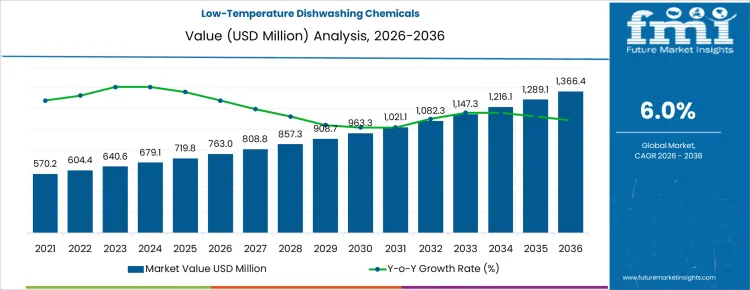
The Low-Temperature Dishwashing Chemicals Market market is expected to grow from USD 763 million in 2026 to USD 1,367 million by 2036, registering a CAGR of 6.0%. Early growth is fueled by rising adoption of energy-efficient dishwashing systems in commercial kitchens and hospitality, driven by operational cost reductions and regulatory energy-efficiency incentives. Between 2028 and 2032, demand accelerates as formulation improvements enhance performance at lower temperatures, enabling widespread replacement of conventional high-temperature detergents.
From 2032 onward, market expansion is reinforced by innovations in enzyme-based and concentrated chemistries that maintain cleaning efficacy while reducing water and energy usage. Increased focus on eco-friendly and low-residue solutions encourages adoption in institutional and residential segments. As traditional dishwashing systems reach maturity, suppliers target specialized applications, such as industrial laundries and high-volume foodservice operations, maintaining long-term growth momentum and reinforcing market penetration across diverse geographies.
Quick Stats of the Low-Temperature Dishwashing Chemicals Market:
- Low-Temperature Dishwashing Chemicals Market Value (2026): USD 763 million
- Low-Temperature Dishwashing Chemicals Market Forecast Value (2036): USD 1,367 million
- Low-Temperature Dishwashing Chemicals Market Forecast CAGR (2026 to 2036): 6.0%
- Leading Product Type in the Market: Machine Detergents (46%)
- Key Growth Regions in the Market: China, Brazil, USA, UK, Germany
- Top Players in the Market: Ecolab, Solenis (Diversey), Henkel, Procter & Gamble, Unilever Professional, Reckitt, Kao Corporation, Zep, Spartan Chemical, Betco
What is the Growth Forecast for the Low-Temperature Dishwashing Chemicals Market through 2036?
From 2026 to 2031, the low-temperature dishwashing chemicals market grows from USD 763 million to approximately USD 1,017 million, reflecting early adoption driven by commercial kitchens, hotels, and institutional foodservice operations aiming to reduce energy consumption while maintaining cleaning efficiency. Annual value additions increase from USD 55 million in 2026 to USD 73 million in 2031, with uptake concentrated in North America and Europe, where energy efficiency standards, regulatory incentives, and cost-saving initiatives encourage the switch to low-temperature formulations. Growth is supported by improved enzyme-based chemistries, optimized rinse performance, and integration into automated dishwashing systems.
Between 2031 and 2036, the market expands from roughly USD 1,017 million to USD 1,367 million, illustrating the late adoption curve characterized by broader deployment and higher penetration across global foodservice networks. Annual increments rise to USD 78-80 million, driven by portfolio-wide adoption, repeat procurement, and integration into multi-site operations. Growth is reinforced by regulatory support, energy efficiency mandates, and growing emphasis on sustainability in institutional and commercial kitchens. Early growth relied on pilot projects and high-value deployments, whereas later expansion reflects structural adoption across global foodservice and hospitality sectors.
Low Temperature Dishwashing Chemicals Market Key Takeaways
| Metric | Value |
|---|---|
| Market Value (2026) | USD 763 million |
| Forecast Value (2036) | USD 1,367 million |
| Forecast CAGR (2026 to 2036) | 6.0% |
Why Is Demand Increasing for Low-Temperature Dishwashing Chemicals Market?
Early use of low-temperature dishwashing chemicals developed from operational limits in traditional formulations when applied at lower wash temperatures. Conventional detergents were formulated to activate at higher heat levels typical of commercial dishwash machines. At lower temperatures, soils such as food residue, fats, and starches did not dissolve effectively, resulting in incomplete cleaning and increased rewash rates. Kitchen managers and operators adopted specialised low-temperature detergents to improve soil removal without raising wash temperatures, reducing energy use and thermal stress on delicate ware. Historical demand was tied to equipment capability and operational routines rather than formal energy-efficiency frameworks.
Future demand for low-temperature dishwashing chemicals will be driven by structured efficiency goals, regulatory compliance, and cost management strategies rather than incremental cleaning improvements alone. Energy codes and sustainability benchmarks in foodservice and institutional settings increasingly recognise the impact of wash temperature on operational energy consumption. Procurement of detergents that deliver effective cleaning at lower temperatures supports documented energy reduction targets and aligns with indoor environmental quality standards. Advances in surfactant and enzyme technologies are improving performance on a range of soils at reduced heat without compromising rinsing or leaving residues.
What Factors Are Affecting the Demand for Low Temperature Dishwashing Chemicals Market in Terms of Product Type and Chemistry or Performance Additives?
Demand for low temperature dishwashing chemicals is shaped by product type and chemistry or performance additive selection across commercial and institutional warewashing operations. Machine detergents account for about 46% of total demand, making them the leading product type. Rinse aids, pre soak or booster additives, and descalers or delimers represent additional product categories without disclosed share splits. These products differ in soil removal role, contact time, and interaction with wash cycles. Chemistry and performance additive segmentation reflects how cleaning efficacy is achieved at reduced temperatures. Non chlorinated alkaline systems account for about 34% of demand, followed by enzyme enhanced systems, oxygen bleach boosters, neutral or mild formulations, and other blends. Together, these segments explain demand formation driven by energy reduction goals, hygiene requirements, and equipment compatibility rather than wash volume alone.
What Drives Demand by Product Type in the Low Temperature Dishwashing Chemicals Market?
Machine detergents lead demand with a 46% share because they carry the primary cleaning load in shortened, lower energy wash cycles. These detergents are formulated to compensate for reduced thermal action through chemistry and surfactant performance. Rinse aids support drying and spotting control when water temperatures are lower. Pre soak and booster additives are applied where heavy soils require additional chemical action. Descalers and delimers maintain equipment efficiency under frequent low temperature operation. Product type selection reflects operational reliance on chemistry rather than heat to achieve hygiene standards. Demand therefore aligns with equipment operating practices and sanitation protocols rather than changes in dishwashing frequency.
Product driven demand remains stable because warewashing programs are standardized. Detergent systems are calibrated to machines and water conditions. Rinse aids and boosters are adjusted within defined ranges. Descaling products follow maintenance schedules. Operators avoid altering product mixes once cleaning outcomes are validated. This constrains rapid shifts between product types. Product type segmentation therefore reflects functional roles within low temperature wash systems rather than short term operational changes.
How Does Chemistry or Performance Additive Choice Shape Demand for Low Temperature Dishwashing Chemicals Market?
Non chlorinated alkaline systems account for about 34% of total demand, making them the leading chemistry category. These systems provide grease removal and soil suspension without reliance on chlorine activation. Enzyme enhanced systems are used to break down protein and starch soils at lower temperatures. Oxygen bleach boosters support stain removal where thermal bleaching is unavailable. Neutral and mild formulations are applied to protect sensitive wares and surfaces. Other blends address specific water or soil conditions. Chemistry selection depends on wash temperature limits, soil composition, and material compatibility. Demand follows cleaning performance under reduced heat rather than traditional high temperature formulations.
Alkaline systems maintain leadership due to broad effectiveness and regulatory acceptance. Enzyme systems expand where temperature reduction is aggressive. Oxygen boosters remain supplemental. Mild formulations persist for specialty ware. Formulators avoid frequent chemistry changes due to validation requirements. This stabilizes demand distribution. Chemistry segmentation therefore reinforces reliance on heat independent cleaning mechanisms within low temperature dishwashing programs.
How Are Low Temperature Dishwashing Chemicals Being Applied Across Commercial and Institutional Kitchens?
Use appears in facilities where energy efficiency, rapid turnover, and surface protection are critical. Restaurants, hotels, hospitals, and cafeterias adopt low-temperature dishwashing chemicals to achieve effective cleaning at reduced water temperatures, minimizing energy consumption and extending equipment life. Food processing plants apply them on sensitive items such as plastics, coated trays, and delicate utensils. These applications reflect operational and sustainability priorities rather than aesthetic or marketing considerations, with adoption driven by cleaning performance, cost reduction, and appliance preservation.
What Operational and Material Conditions Support Adoption of Low Temperature Dishwashing Chemicals?
Selection aligns with automated dishwashing systems optimized for lower heat cycles. Formulations are designed to maintain grease and protein removal efficacy without damaging dishware or cookware. Operators rely on chemicals compatible with water hardness variations and detergent dispensing systems. Health and safety teams favor products that comply with sanitation regulations and reduce chemical exposure. These conditions emerge from operational efficiency, hygiene maintenance, and energy reduction priorities in structured commercial and institutional kitchen workflows.
Which Practical Considerations Limit Wider Use of Low Temperature Dishwashing Chemicals?
Cleaning performance may be affected on heavily soiled or baked-on residues, necessitating pre-soaking or booster chemicals. Cost per cycle can be higher than conventional high-temperature detergents. Compatibility with existing wash programs, rinse aids, and water temperature settings must be ensured. Staff training and monitoring are required to maintain consistent cleaning results. These factors lead to selective deployment where cleaning efficacy, appliance longevity, and energy savings outweigh incremental cost and procedural adjustments.
What is the Demand for Low Temperature Dishwashing Chemicals by Country?
| Country | CAGR (%) |
|---|---|
| USA | 6.1% |
| Germany | 5.4% |
| China | 7.3% |
| UK | 5.6% |
| Brazil | 7.1% |
The demand for low temperature dishwashing chemicals varies across countries, driven by energy efficient cleaning requirements, commercial kitchen growth, and industrial hygiene standards. China leads with a 7.3% CAGR, supported by rapid expansion of foodservice operations and adoption of energy saving dishwashing solutions. Brazil follows at 7.1%, driven by growth in restaurants, hotels, and institutional kitchens. The USA grows at 6.1%, reflecting steady adoption in commercial and industrial cleaning. Germany records 5.4%, shaped by mature cleaning markets and energy efficiency regulations. The UK posts 5.6%, supported by sustainable cleaning initiatives and consistent demand in commercial kitchens and institutional facilities.
How Is Low-Temperature Dishwashing Driving Growth in the United States?
In the United States, revenue from the Low-Temperature Dishwashing Chemicals Market is expanding at a CAGR of 6.1% through 2035, driven by adoption of chemical formulations that maintain cleaning efficacy at reduced water temperatures, improving energy efficiency and operational cost savings. Manufacturers are integrating low-temperature dishwashing chemicals in commercial kitchens, hotels, hospitals, and industrial foodservice operations. Demand is concentrated in institutional kitchens, restaurants, and large-scale catering facilities. Domestic suppliers provide high-performance, surface-compatible chemicals suitable for manual and automated dishwashing systems. Energy efficiency standards, hygiene regulations, and recurring cleaning cycles are sustaining predictable procurement nationwide.
- Restaurants, hotels, hospitals, and industrial kitchens drive adoption
- Chemicals maintain cleaning efficacy at lower water temperatures
- Domestic suppliers provide high-performance, equipment-compatible formulations
- Recurring cleaning cycles sustain predictable procurement
How Are Energy Efficiency Standards Supporting Growth in Germany?
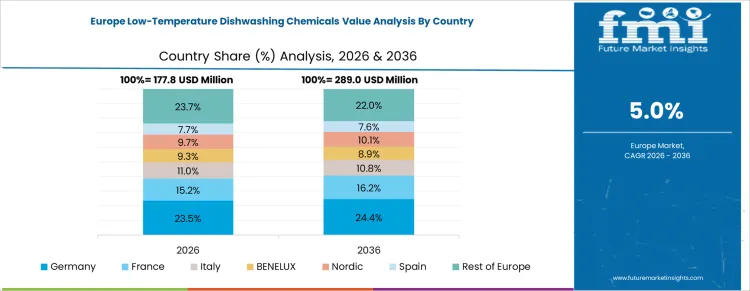
Germany continues to record steady growth in the Low-Temperature Dishwashing Chemicals Market at a CAGR of 5.4% through 2035, supported by energy efficiency requirements and hygiene regulations in commercial kitchens and institutional facilities. Manufacturers are adopting low-temperature dishwashing chemicals to ensure effective removal of grease, food residues, and stains while minimizing energy consumption. Demand is concentrated in restaurants, hotels, hospitals, and industrial kitchens. Domestic suppliers provide chemical formulations compatible with automated dishwashing systems and various surface materials. Regulatory compliance and recurring cleaning schedules are sustaining measured adoption nationwide.
- Restaurants, hotels, hospitals, and industrial kitchens anchor demand
- Chemicals remove grease and stains efficiently at low temperatures
- Domestic suppliers provide equipment-compatible, high-quality formulations
- Recurring cleaning schedules sustain steady procurement
How Is Foodservice Expansion Accelerating Adoption in China?
In China, revenue from the Low-Temperature Dishwashing Chemicals Market is growing at a CAGR of 7.3% through 2035, driven by rapid expansion of restaurants, hotels, and industrial kitchens. Manufacturers are integrating low-temperature dishwashing chemicals to enhance cleaning performance, improve energy efficiency, and reduce operational costs. Demand is strong across commercial kitchens, institutional facilities, and catering operations. Domestic suppliers are scaling production of high-performance, surface-compatible chemicals suitable for manual and automated dishwashing equipment. Expanding foodservice networks and structured cleaning programs are sustaining rapid adoption nationwide.
- Restaurants, hotels, and industrial kitchens drive chemical adoption
- Chemicals enhance cleaning performance and energy efficiency
- Domestic suppliers scale high-performance, surface-compatible formulations
- Structured cleaning programs sustain consistent adoption
How Is Hygiene and Energy Efficiency Supporting Growth in the United Kingdom?
In the United Kingdom, revenue from the Low-Temperature Dishwashing Chemicals Market is expanding at a CAGR of 5.6% through 2035, supported by adoption of low-temperature cleaning solutions in commercial kitchens, institutional facilities, and hospitality operations. Manufacturers are using these chemicals to remove grease and food residues effectively while conserving energy. Demand is concentrated in restaurants, hotels, hospitals, and industrial kitchens. Domestic suppliers provide high-quality, surface-compatible formulations suitable for automated and manual dishwashing. Recurring cleaning cycles, regulatory compliance, and energy efficiency initiatives are sustaining predictable procurement nationwide.
- Restaurants, hotels, hospitals, and industrial kitchens anchor demand
- Chemicals remove grease and residues while conserving energy
- Domestic suppliers provide surface-compatible, high-quality formulations
- Recurring cleaning cycles sustain predictable procurement
How Is Industrial and Commercial Kitchen Expansion Driving Adoption in Brazil?
Brazil is seeing strong growth in the Low-Temperature Dishwashing Chemicals Market at a CAGR of 7.1% through 2035, supported by increasing adoption in commercial kitchens, industrial facilities, and hospitality sectors. Manufacturers are integrating low-temperature dishwashing chemicals to maintain cleaning efficiency, reduce energy consumption, and comply with hygiene standards. Demand is concentrated in restaurants, hotels, hospitals, and large-scale catering operations. Domestic suppliers are expanding production of high-performance, equipment-compatible formulations suitable for automated and manual dishwashing systems. Growth in facilities and recurring cleaning programs are sustaining robust procurement nationwide.
- Restaurants, hotels, hospitals, and industrial kitchens drive chemical adoption
- Chemicals maintain cleaning efficiency and reduce energy usage
- Domestic suppliers expand high-performance, surface-compatible formulations
- Recurring cleaning programs sustain robust procurement
Which Companies Compete In The Low Temperature Dishwashing Chemicals Market Through Energy Efficiency And Wash Performance Requirements?
Low temperature dishwashing chemicals are specified to deliver effective soil removal and sanitation when wash temperatures are constrained by energy use, equipment limits, or safety considerations. In institutional and foodservice kitchens, these products must compensate for reduced thermal action through surfactant efficiency and enzyme or booster chemistry.
Ecolab and Solenis, through the Diversey platform, influence adoption by embedding low temperature solutions into complete warewashing programs that align chemistry, dosing, and machine parameters. Henkel, Procter and Gamble, Unilever Professional, and Reckitt supply formulations designed for consistent performance across short cycles and variable water conditions. Acceptance depends on residue control, glassware protection, and predictable results under sustained low heat operation.
Regional operating conditions and service models shape competitive structure. Kao Corporation supports demand in Asia through professional hygiene systems adapted to compact kitchens and lower temperature wash practices. Zep, Spartan Chemical, and Betco maintain relevance through distributor led approaches that tailor low temperature detergents to specific machine types and soil profiles.
These suppliers often focus on retrofitting existing warewashers rather than driving equipment replacement. Local service providers influence purchasing by calibrating dosing systems and validating performance on site. Competitive positioning is defined by reliability across peak service periods, compatibility with installed equipment, and ease of staff training rather than formulation complexity or brand prominence.
Key Players in the Low Temperature Dishwashing Chemicals Market
- Ecolab
- Solenis (Diversey)
- Henkel
- Procter & Gamble
- Unilever Professional
- Reckitt
- Kao Corporation
- Zep
- Spartan Chemical
- Betco
Scope of the Report
| Items | Values |
|---|---|
| Quantitative Units (2026) | USD million |
| Type / Product Type | Machine Detergents, Rinse Aids, Pre-Soak / Booster Additives, Descalers & Delimers |
| Chemistry / Performance Additives | Non-Chlorinated Alkaline Systems, Enzyme-Enhanced Systems, Oxygen Bleach Boosters, Neutral / Mild Formulations, Other Blends |
| Dishmachine Type | Undercounter, Hood-Type, Conveyor / Flight-Type, Glasswashers & Other |
| End-Use | Restaurants, Institutional Kitchens, Hotels & Catering, QSR & Other |
| Region | Asia Pacific (China, Japan, South Korea, India, Australia & New Zealand, ASEAN, Rest of Asia Pacific), Europe (Germany, UK, France, Italy, Spain, Nordic, BENELUX, Rest of Europe), North America (USA, Canada, Mexico), Latin America (Brazil, Chile, Rest of Latin America), Middle East & Africa (KSA, Other GCC, Turkey, South Africa, Other African Union, Rest of MEA) |
| Key Companies Profiled | Ecolab, Solenis (Diversey), Henkel, Procter & Gamble, Unilever Professional, Reckitt, Kao Corporation, Zep, Spartan Chemical, Betco |
| Additional Attributes | Dollar by sales (2026, 2036), CAGR (2026 to 2036), adoption by product type and chemistry, dishmachine type segmentation, end-use deployment, regional penetration, energy efficiency-driven adoption, regulatory alignment, operational and cleaning performance requirements, automated system compatibility, repeat procurement trends, market expansion across commercial, institutional, hospitality, and industrial kitchens |
Low Temperature Dishwashing Chemicals Market Segmentation
Product Type:
- Machine Detergents
- Rinse Aids
- Pre-Soak / Booster Additives
- Descalers & Delimers
Chemistry / Performance Additives:
- Non-Chlorinated Alkaline Systems
- Enzyme-Enhanced Systems
- Oxygen Bleach Boosters
- Neutral / Mild Formulations
- Other Blends
Dishmachine Type:
- Undercounter
- Hood-Type
- Conveyor / Flight-Type
- Glasswashers & Other
End-Use:
- Restaurants
- Institutional Kitchens
- Hotels & Catering
- QSR & Other
Region
- Asia Pacific
- China
- Japan
- South Korea
- India
- Australia & New Zealand
- ASEAN
- Rest of Asia Pacific
- Europe
- Germany
- United Kingdom
- France
- Italy
- Spain
- Nordic
- BENELUX
- Rest of Europe
- North America
- United States
- Canada
- Mexico
- Latin America
- Brazil
- Chile
- Rest of Latin America
- Middle East & Africa
- Kingdom of Saudi Arabia
- Other GCC Countries
- Turkey
- South Africa
- Other African Union
- Rest of Middle East & Africa
Frequently Asked Questions
How big is the low-temperature dishwashing chemicals in 2026?
The global low-temperature dishwashing chemicals is estimated to be valued at USD 763.0 million in 2026.
What will be the size of low-temperature dishwashing chemicals in 2036?
The market size for the low-temperature dishwashing chemicals is projected to reach USD 1,366.4 million by 2036.
How much will be the low-temperature dishwashing chemicals growth between 2026 and 2036?
The low-temperature dishwashing chemicals is expected to grow at a 6.0% CAGR between 2026 and 2036.
What are the key product types in the low-temperature dishwashing chemicals?
The key product types in low-temperature dishwashing chemicals are machine detergents, rinse aids, pre-soak / booster additives and descalers & delimers.
Which chemistry or performance additives segment to contribute significant share in the low-temperature dishwashing chemicals in 2026?
In terms of chemistry or performance additives, non-chlorinated alkaline systems segment to command 34.0% share in the low-temperature dishwashing chemicals in 2026.
Preview the report firsthand - request a free sample
Get SampleGet the brochure for pricing and purchase details.
Get PDFTable of Content
- Executive Summary
- Global Market Outlook
- Demand-side Trends
- Supply-side Trends
- Technology Roadmap Analysis
- Analysis and Recommendations
- Market Overview
- Market Coverage / Taxonomy
- Market Definition / Scope / Limitations
- Market Background
- Market Dynamics
- Drivers
- Restraints
- Opportunity
- Trends
- Scenario Forecast
- Demand in Optimistic Scenario
- Demand in Likely Scenario
- Demand in Conservative Scenario
- Opportunity Map Analysis
- Product Life Cycle Analysis
- Supply Chain Analysis
- Investment Feasibility Matrix
- Value Chain Analysis
- PESTLE and Porter’s Analysis
- Regulatory Landscape
- Regional Parent Market Outlook
- Production and Consumption Statistics
- Import and Export Statistics
- Market Dynamics
- Global Market Analysis 2021 to 2025 and Forecast, 2026 to 2036
- Historical Market Size Value (USD Million) Analysis, 2021 to 2025
- Current and Future Market Size Value (USD Million) Projections, 2026 to 2036
- Y-o-Y Growth Trend Analysis
- Absolute $ Opportunity Analysis
- Global Market Pricing Analysis 2021 to 2025 and Forecast 2026 to 2036
- Global Market Analysis 2021 to 2025 and Forecast 2026 to 2036, By Product Type
- Introduction / Key Findings
- Historical Market Size Value (USD Million) Analysis By Product Type , 2021 to 2025
- Current and Future Market Size Value (USD Million) Analysis and Forecast By Product Type , 2026 to 2036
- Machine Detergents
- Rinse Aids
- Pre-Soak / Booster Additives
- Descalers & Delimers
- Y-o-Y Growth Trend Analysis By Product Type , 2021 to 2025
- Absolute $ Opportunity Analysis By Product Type , 2026 to 2036
- Global Market Analysis 2021 to 2025 and Forecast 2026 to 2036, By Chemistry or Performance Additives
- Introduction / Key Findings
- Historical Market Size Value (USD Million) Analysis By Chemistry or Performance Additives, 2021 to 2025
- Current and Future Market Size Value (USD Million) Analysis and Forecast By Chemistry or Performance Additives, 2026 to 2036
- Non-Chlorinated Alkaline Systems
- Enzyme-Enhanced Systems
- Oxygen Bleach Boosters
- Neutral / Mild Formulations
- Other Blends
- Y-o-Y Growth Trend Analysis By Chemistry or Performance Additives, 2021 to 2025
- Absolute $ Opportunity Analysis By Chemistry or Performance Additives, 2026 to 2036
- Global Market Analysis 2021 to 2025 and Forecast 2026 to 2036, By Dishmachine Type
- Introduction / Key Findings
- Historical Market Size Value (USD Million) Analysis By Dishmachine Type, 2021 to 2025
- Current and Future Market Size Value (USD Million) Analysis and Forecast By Dishmachine Type, 2026 to 2036
- Undercounter
- Hood-Type
- Conveyor / Flight-Type
- Glasswashers & Other
- Y-o-Y Growth Trend Analysis By Dishmachine Type, 2021 to 2025
- Absolute $ Opportunity Analysis By Dishmachine Type, 2026 to 2036
- Global Market Analysis 2021 to 2025 and Forecast 2026 to 2036, By End-Use
- Introduction / Key Findings
- Historical Market Size Value (USD Million) Analysis By End-Use, 2021 to 2025
- Current and Future Market Size Value (USD Million) Analysis and Forecast By End-Use, 2026 to 2036
- Restaurants
- Institutional Kitchens
- Hotels & Catering
- QSR & Other
- Y-o-Y Growth Trend Analysis By End-Use, 2021 to 2025
- Absolute $ Opportunity Analysis By End-Use, 2026 to 2036
- Global Market Analysis 2021 to 2025 and Forecast 2026 to 2036, By Region
- Introduction
- Historical Market Size Value (USD Million) Analysis By Region, 2021 to 2025
- Current Market Size Value (USD Million) Analysis and Forecast By Region, 2026 to 2036
- North America
- Latin America
- Western Europe
- Eastern Europe
- East Asia
- South Asia and Pacific
- Middle East & Africa
- Market Attractiveness Analysis By Region
- North America Market Analysis 2021 to 2025 and Forecast 2026 to 2036, By Country
- Historical Market Size Value (USD Million) Trend Analysis By Market Taxonomy, 2021 to 2025
- Market Size Value (USD Million) Forecast By Market Taxonomy, 2026 to 2036
- By Country
- USA
- Canada
- Mexico
- By Product Type
- By Chemistry or Performance Additives
- By Dishmachine Type
- By End-Use
- By Country
- Market Attractiveness Analysis
- By Country
- By Product Type
- By Chemistry or Performance Additives
- By Dishmachine Type
- By End-Use
- Key Takeaways
- Latin America Market Analysis 2021 to 2025 and Forecast 2026 to 2036, By Country
- Historical Market Size Value (USD Million) Trend Analysis By Market Taxonomy, 2021 to 2025
- Market Size Value (USD Million) Forecast By Market Taxonomy, 2026 to 2036
- By Country
- Brazil
- Chile
- Rest of Latin America
- By Product Type
- By Chemistry or Performance Additives
- By Dishmachine Type
- By End-Use
- By Country
- Market Attractiveness Analysis
- By Country
- By Product Type
- By Chemistry or Performance Additives
- By Dishmachine Type
- By End-Use
- Key Takeaways
- Western Europe Market Analysis 2021 to 2025 and Forecast 2026 to 2036, By Country
- Historical Market Size Value (USD Million) Trend Analysis By Market Taxonomy, 2021 to 2025
- Market Size Value (USD Million) Forecast By Market Taxonomy, 2026 to 2036
- By Country
- Germany
- UK
- Italy
- Spain
- France
- Nordic
- BENELUX
- Rest of Western Europe
- By Product Type
- By Chemistry or Performance Additives
- By Dishmachine Type
- By End-Use
- By Country
- Market Attractiveness Analysis
- By Country
- By Product Type
- By Chemistry or Performance Additives
- By Dishmachine Type
- By End-Use
- Key Takeaways
- Eastern Europe Market Analysis 2021 to 2025 and Forecast 2026 to 2036, By Country
- Historical Market Size Value (USD Million) Trend Analysis By Market Taxonomy, 2021 to 2025
- Market Size Value (USD Million) Forecast By Market Taxonomy, 2026 to 2036
- By Country
- Russia
- Poland
- Hungary
- Balkan & Baltic
- Rest of Eastern Europe
- By Product Type
- By Chemistry or Performance Additives
- By Dishmachine Type
- By End-Use
- By Country
- Market Attractiveness Analysis
- By Country
- By Product Type
- By Chemistry or Performance Additives
- By Dishmachine Type
- By End-Use
- Key Takeaways
- East Asia Market Analysis 2021 to 2025 and Forecast 2026 to 2036, By Country
- Historical Market Size Value (USD Million) Trend Analysis By Market Taxonomy, 2021 to 2025
- Market Size Value (USD Million) Forecast By Market Taxonomy, 2026 to 2036
- By Country
- China
- Japan
- South Korea
- By Product Type
- By Chemistry or Performance Additives
- By Dishmachine Type
- By End-Use
- By Country
- Market Attractiveness Analysis
- By Country
- By Product Type
- By Chemistry or Performance Additives
- By Dishmachine Type
- By End-Use
- Key Takeaways
- South Asia and Pacific Market Analysis 2021 to 2025 and Forecast 2026 to 2036, By Country
- Historical Market Size Value (USD Million) Trend Analysis By Market Taxonomy, 2021 to 2025
- Market Size Value (USD Million) Forecast By Market Taxonomy, 2026 to 2036
- By Country
- India
- ASEAN
- Australia & New Zealand
- Rest of South Asia and Pacific
- By Product Type
- By Chemistry or Performance Additives
- By Dishmachine Type
- By End-Use
- By Country
- Market Attractiveness Analysis
- By Country
- By Product Type
- By Chemistry or Performance Additives
- By Dishmachine Type
- By End-Use
- Key Takeaways
- Middle East & Africa Market Analysis 2021 to 2025 and Forecast 2026 to 2036, By Country
- Historical Market Size Value (USD Million) Trend Analysis By Market Taxonomy, 2021 to 2025
- Market Size Value (USD Million) Forecast By Market Taxonomy, 2026 to 2036
- By Country
- Kingdom of Saudi Arabia
- Other GCC Countries
- Turkiye
- South Africa
- Other African Union
- Rest of Middle East & Africa
- By Product Type
- By Chemistry or Performance Additives
- By Dishmachine Type
- By End-Use
- By Country
- Market Attractiveness Analysis
- By Country
- By Product Type
- By Chemistry or Performance Additives
- By Dishmachine Type
- By End-Use
- Key Takeaways
- Key Countries Market Analysis
- USA
- Pricing Analysis
- Market Share Analysis, 2025
- By Product Type
- By Chemistry or Performance Additives
- By Dishmachine Type
- By End-Use
- Canada
- Pricing Analysis
- Market Share Analysis, 2025
- By Product Type
- By Chemistry or Performance Additives
- By Dishmachine Type
- By End-Use
- Mexico
- Pricing Analysis
- Market Share Analysis, 2025
- By Product Type
- By Chemistry or Performance Additives
- By Dishmachine Type
- By End-Use
- Brazil
- Pricing Analysis
- Market Share Analysis, 2025
- By Product Type
- By Chemistry or Performance Additives
- By Dishmachine Type
- By End-Use
- Chile
- Pricing Analysis
- Market Share Analysis, 2025
- By Product Type
- By Chemistry or Performance Additives
- By Dishmachine Type
- By End-Use
- Germany
- Pricing Analysis
- Market Share Analysis, 2025
- By Product Type
- By Chemistry or Performance Additives
- By Dishmachine Type
- By End-Use
- UK
- Pricing Analysis
- Market Share Analysis, 2025
- By Product Type
- By Chemistry or Performance Additives
- By Dishmachine Type
- By End-Use
- Italy
- Pricing Analysis
- Market Share Analysis, 2025
- By Product Type
- By Chemistry or Performance Additives
- By Dishmachine Type
- By End-Use
- Spain
- Pricing Analysis
- Market Share Analysis, 2025
- By Product Type
- By Chemistry or Performance Additives
- By Dishmachine Type
- By End-Use
- France
- Pricing Analysis
- Market Share Analysis, 2025
- By Product Type
- By Chemistry or Performance Additives
- By Dishmachine Type
- By End-Use
- India
- Pricing Analysis
- Market Share Analysis, 2025
- By Product Type
- By Chemistry or Performance Additives
- By Dishmachine Type
- By End-Use
- ASEAN
- Pricing Analysis
- Market Share Analysis, 2025
- By Product Type
- By Chemistry or Performance Additives
- By Dishmachine Type
- By End-Use
- Australia & New Zealand
- Pricing Analysis
- Market Share Analysis, 2025
- By Product Type
- By Chemistry or Performance Additives
- By Dishmachine Type
- By End-Use
- China
- Pricing Analysis
- Market Share Analysis, 2025
- By Product Type
- By Chemistry or Performance Additives
- By Dishmachine Type
- By End-Use
- Japan
- Pricing Analysis
- Market Share Analysis, 2025
- By Product Type
- By Chemistry or Performance Additives
- By Dishmachine Type
- By End-Use
- South Korea
- Pricing Analysis
- Market Share Analysis, 2025
- By Product Type
- By Chemistry or Performance Additives
- By Dishmachine Type
- By End-Use
- Russia
- Pricing Analysis
- Market Share Analysis, 2025
- By Product Type
- By Chemistry or Performance Additives
- By Dishmachine Type
- By End-Use
- Poland
- Pricing Analysis
- Market Share Analysis, 2025
- By Product Type
- By Chemistry or Performance Additives
- By Dishmachine Type
- By End-Use
- Hungary
- Pricing Analysis
- Market Share Analysis, 2025
- By Product Type
- By Chemistry or Performance Additives
- By Dishmachine Type
- By End-Use
- Kingdom of Saudi Arabia
- Pricing Analysis
- Market Share Analysis, 2025
- By Product Type
- By Chemistry or Performance Additives
- By Dishmachine Type
- By End-Use
- Turkiye
- Pricing Analysis
- Market Share Analysis, 2025
- By Product Type
- By Chemistry or Performance Additives
- By Dishmachine Type
- By End-Use
- South Africa
- Pricing Analysis
- Market Share Analysis, 2025
- By Product Type
- By Chemistry or Performance Additives
- By Dishmachine Type
- By End-Use
- USA
- Market Structure Analysis
- Competition Dashboard
- Competition Benchmarking
- Market Share Analysis of Top Players
- By Regional
- By Product Type
- By Chemistry or Performance Additives
- By Dishmachine Type
- By End-Use
- Competition Analysis
- Competition Deep Dive
- Ecolab
- Overview
- Product Portfolio
- Profitability by Market Segments (Product/Age /Sales Channel/Region)
- Sales Footprint
- Strategy Overview
- Marketing Strategy
- Product Strategy
- Channel Strategy
- Solenis (Diversey)
- Henkel
- Procter & Gamble
- Unilever Professional
- Reckitt
- Kao Corporation
- Zep
- Spartan Chemical
- Betco
- Ecolab
- Competition Deep Dive
- Assumptions & Acronyms Used
- Research Methodology


