

- Industry Size (2026)
- USD 456.0 Mn
- Forecast (2036)
- USD 1062.0 Mn
- CAGR (2026 to 2036)
- 8.8%
Multi-Sensor Barrier Packs Market Forecast and Outlook 2026 to 2036
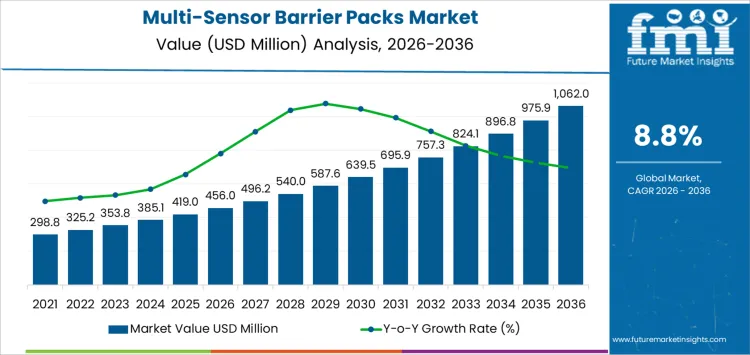
The multi-sensor barrier packs market is valued at USD 456 million in 2026 and is expected to reach USD 1,062 million by 2036, reflecting a CAGR of 8.8%. Between 2026 and 2031, the market experiences accelerated growth, with annual absolute additions increasing from roughly USD 35 million to USD 66 million. This phase is fueled by adoption in high-value food and pharmaceutical packaging, where rigid barrier pouches with integrated oxygen, time-temperature, and humidity sensors ensure product safety. Early growth is concentrated in specialized applications, supported by technological validation, pilot runs, and partnerships between packaging converters and sensor providers, driving structured expansion.
From 2031 to 2036, growth remains robust, expanding from approximately USD 777 million to USD 1,062 million. Absolute annual gains continue to widen, reflecting broader deployment across specialty foods, bulk pharmaceuticals, and e-commerce food segments. Standardization of high-barrier laminates and scalable sensor integration enhances production efficiency, while increased regulatory oversight and consumer demand for traceability further reinforce market adoption. During this phase, relative acceleration moderates slightly as the market shifts from adoption-driven growth to volume-led expansion. Structural demand remains strong, anchored in repeat procurement, established multi-sensor designs, and integration with IoT-enabled monitoring systems, ensuring sustainable long-term growth.
Quick Stats of the Multi-Sensor Barrier Packs Market:
- Multi-Sensor Barrier Packs Market Value (2026): USD 456.0 million
- Multi-Sensor Barrier Packs Market Forecast Value (2036): USD 1,062.0 million
- Multi-Sensor Barrier Packs Market Forecast CAGR (2026 to 2036): 8.8%
- Leading Packaging Format: Rigid Barrier Pouches / Packs (50%)
- Key Growth Regions: Asia Pacific, North America, and Europe
- Top Players: Sealed Air / Amcor, Mondi, UFlex, Klabin, Toray
What is the Growth Forecast for the Multi-Sensor Barrier Packs Market through 2036?
From 2026 to 2031, the multi-sensor barrier packs market rises from USD 456 million to approximately USD 723 million, representing the early growth curve driven by selective adoption in high-value food, beverage, and pharmaceutical packaging. Growth in this phase is shaped by initial integration of multi-sensor systems for oxygen, moisture, and freshness monitoring in premium SKUs. Uptake remains targeted, focusing on pilot programs, regulatory compliance, and validation of sensor reliability. Year-on-year value additions increase steadily, reflecting cautious expansion as manufacturers and brand owners test multi-sensor performance before broader deployment.
Between 2031 and 2036, the market expands from roughly USD 723 million to USD 1,062 million, illustrating the late growth curve where structural adoption and scaling dominate. Growth accelerates as multi-sensor barrier packs become embedded in mainstream packaging for mass-market foods, cold-chain products, and sensitive pharmaceuticals. Annual value additions widen, supported by repeat procurement, portfolio-wide deployment, and expanded SKU coverage. While early growth relied on validation and pilot programs, later expansion is driven by standardized integration, higher adoption rates, and consistent use across global supply chains.
Multi Sensor Barrier Packs Market Key Takeaways
| Metric | Value |
|---|---|
| Sales Value (2026) | USD 456 million |
| Forecast Value (2036) | USD 1,062 million |
| Forecast CAGR (2026–2036) | 8.8% |
What Is Driving the Demand for the Multi-Sensor Barrier Packs Market?
Demand for multi-sensor barrier packs developed historically from challenges in preserving perishable products using conventional packaging. Traditional barrier films provided passive protection against oxygen and moisture but lacked active monitoring of environmental conditions. Early use cases emerged in food and pharmaceutical supply chains where quality assurance and safety were critical. Multi-sensor barrier packs combined advanced barrier materials with embedded sensors that detect temperature shifts, gas composition, and humidity. Growth during early phases reflected rising cold chain logistics, stricter safety regulations, and retailer focus on reducing spoilage. Adoption remained concentrated in high value segments due to elevated costs and integration complexity with existing packaging equipment.
Future demand will be shaped by different growth drivers than in the past. Regulatory frameworks in major markets increasingly emphasize transparency, traceability, and waste reduction across food and pharmaceutical supply chains. Manufacturers will adopt multi-sensor barrier solutions that integrate with digital monitoring systems, enabling condition based inventory decisions and automated quality alerts. Advances in printed electronics and sensor materials are expected to reduce costs and support broader deployment across packaged foods and sensitive pharmaceuticals. Digital connectivity with enterprise quality systems will shift demand from isolated quality enhancements toward compliance driven, data enabled packaging strategies. Future growth will reflect technology standardization and operational integration rather than earlier fragmentation and pilot level use.
What Factors Are Affecting the Demand for Multi Sensor Barrier Packs Market in Terms of End Use Application and Packaging Format and Type?
Demand for multi sensor barrier packs is structured around end use application and packaging format and type across regulated food and pharmaceutical supply chains. High value food and pharmaceutical products account for about 45% of total demand, reflecting sensitivity to contamination, shelf life variation, and regulatory oversight. Specialty foods and bulk pharmaceutical products represent additional application areas with distinct handling requirements. E commerce food applications rely on barrier integrity across extended logistics timelines. Packaging format and type determine barrier performance, sensor placement, and compatibility with filling processes. Rigid barrier pouches, vacuum barrier packs, sensor enabled pouches, and retortable packs address different protection needs. Together, these segments explain demand formation based on risk exposure, compliance requirements, and packaging system constraints rather than discretionary adoption.
What Drives Demand by End Use Application in the Multi Sensor Barrier Packs Market?
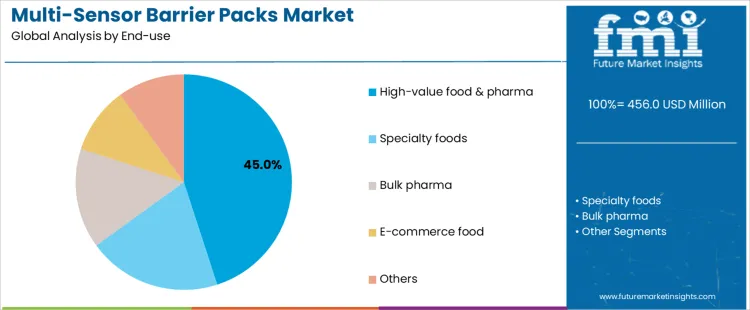
High value food and pharmaceutical applications dominate demand due to strict quality control and loss sensitivity. These products require continuous monitoring of environmental conditions to preserve efficacy and safety. Specialty foods adopt multi sensor packs to manage spoilage risk linked to premium ingredients and limited shelf life. Bulk pharmaceutical applications rely on barrier packs to maintain stability during storage and transport. E commerce food applications emphasize protection across handling points and delivery delays. Usage intensity varies by regulatory exposure and product value density. Adoption is concentrated where failure risks translate directly into financial or compliance penalties. End use demand therefore reflects exposure to spoilage, degradation, and audit requirements rather than volume throughput alone across distribution systems.
Application driven demand remains stable due to recurring shipment cycles and standardized packaging protocols. High value segments prioritize consistency over experimentation in packaging choices. Specialty food producers balance cost with protection needs, leading to selective adoption. Bulk pharmaceutical shipments rely on validated packaging formats with integrated monitoring. E commerce food adoption increases where delivery distances extend exposure duration. These patterns reinforce steady demand rather than rapid substitution. End use segmentation highlights where monitoring is operationally required rather than optional. As a result, application demand aligns with risk management practices embedded in supply chain design. This structure sustains demand concentration within regulated and premium product categories across global markets.
How Does Packaging Format and Type Shape Demand for Multi Sensor Barrier Packs Market?
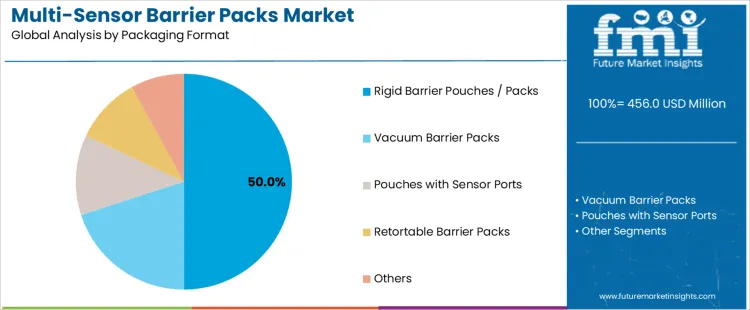
Rigid barrier pouches and packs account for about 50% of total demand, making them the leading packaging format. Their adoption is supported by structural stability, predictable barrier performance, and ease of sensor integration. Vacuum barrier packs are used where oxygen control is critical for product preservation. Pouches with sensor ports support modular monitoring and inspection access. Retortable barrier packs are applied in products requiring thermal processing and extended shelf life. Other formats address niche or transitional packaging needs. Format selection reflects compatibility with filling lines, sterilization processes, and monitoring requirements. Demand follows operational practicality and compliance reliability rather than packaging novelty across food and pharmaceutical producers.
Rigid barrier formats maintain leadership due to durability during transport and storage. Vacuum barrier packs address moisture and oxidation exposure in sensitive products. Sensor port pouches allow targeted monitoring without compromising seal integrity. Retortable packs are selected where heat resistance is essential. Packaging type decisions prioritize validated performance under known conditions. Producers avoid formats requiring major equipment changes or regulatory revalidation. This limits rapid shifts in format adoption. Packaging format and type therefore act as stabilizing factors within demand structure. Adoption mirrors existing packaging infrastructure across industries. These constraints explain why demand concentrates around proven barrier formats with integrated sensor capability rather than experimental designs.
How Are Multi Sensor Barrier Packs Being Applied Across Food and Pharmaceutical Packaging?
Use appears in environments where simultaneous monitoring of multiple conditions such as temperature, oxygen, and humidity is critical to product quality. Food distributors apply multi sensor packs for perishable items like seafood, dairy, and ready-to-eat meals to ensure safety during transport. Pharmaceutical companies use them for biologics and vaccines sensitive to environmental fluctuations. Meal kit providers integrate packs to track conditions from warehouse to consumer delivery. These applications reflect operational and quality control priorities rather than purely marketing objectives, with adoption focused on real-time product protection and traceability.
What Operational Conditions Support Adoption of Multi Sensor Barrier Packs?
Selection aligns with supply chains that require comprehensive environmental monitoring. Cold chain operators favor packs that provide data on multiple parameters without additional instrumentation. Quality assurance teams use integrated sensors to trigger alerts when conditions exceed thresholds. Packaging engineers incorporate sensor integration without altering pack dimensions or material compatibility. Logistics managers rely on data visibility for audit and compliance purposes. These conditions emerge from the need for precise monitoring, regulatory adherence, and risk reduction within high-value or sensitive product flows.
Which Practical Considerations Limit Broader Use of Multi Sensor Barrier Packs?
Cost per pack is higher than conventional barrier packaging, affecting adoption for low-margin items. Sensor calibration and validation must match specific environmental ranges. Integration into automated filling and sealing lines may require additional equipment or process adjustments. Data retrieval and storage systems are needed to interpret multi-sensor outputs. Shelf life of sensors can limit long-term storage. These factors lead to selective use where product sensitivity, regulatory requirements, and supply chain visibility justify increased cost and operational complexity.
What is the Demand for Multi Sensor Barrier Packs by Country?
2036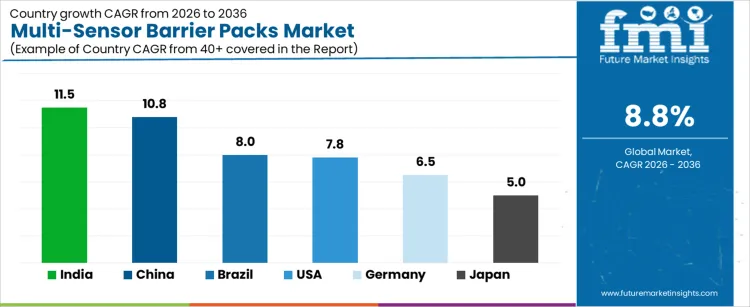
| Country | CAGR (%) |
|---|---|
| USA | 7.8% |
| Germany | 6.5% |
| China | 10.8% |
| India | 11.5% |
| Brazil | 8.0% |
| Japan | 5.0% |
The demand for multi sensor barrier packs varies across countries, driven by food and pharmaceutical preservation requirements, smart packaging adoption, and supply chain monitoring. India leads with an 11.5% CAGR, supported by rising packaged food consumption, expanding cold chain logistics, and adoption of sensor integrated barrier packs. China follows at 10.8%, driven by large scale manufacturing, export oriented logistics, and demand for enhanced product protection. The USA grows at 7.8%, reflecting adoption across healthcare, perishable food, and retail packaging. Brazil records 8.0%, shaped by growth in packaged food distribution. Germany posts 6.5%, supported by regulated packaging standards, while Japan grows at 5.0%, reflecting mature markets and steady adoption of sensor enabled barrier packs.
How Is Advanced Packaging Technology Driving Growth in the United States?
In the United States, revenue from the Multi-Sensor Barrier Packs Market is expanding at a CAGR of 7.80% through 2036, driven by adoption of multi-sensor barrier packaging to improve shelf life monitoring, product protection, and quality control. Manufacturers are integrating sensors to detect temperature, humidity, and spoilage across perishable foods, beverages, and pharmaceutical products. Demand is concentrated in dairy, ready-to-eat meals, and sensitive liquid formulations distributed through retail and food service channels. Domestic producers are providing packs with integrated sensors compatible with existing filling and packaging lines. Stable consumption and recurring product replenishment cycles are sustaining consistent procurement across packaging users nationwide.
- Dairy, ready-to-eat meals, and sensitive liquid products are adopting multi-sensor barrier packs for quality monitoring
- Integrated sensors detect temperature, humidity, and spoilage to maintain product integrity
- Domestic producers provide sensor-enabled packs compatible with existing packaging equipment
- Recurring product replenishment cycles sustain predictable procurement volumes
How Do Food Safety Standards Shape Market Expansion in Germany?
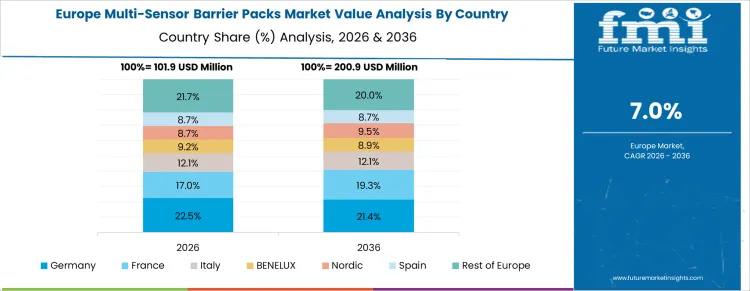
Germany continues to record steady growth in the Multi-Sensor Barrier Packs Market at a CAGR of 6.50% through 2036, supported by strict food safety regulations and quality standards. Manufacturers are using multi-sensor barrier packs to enhance traceability, freshness monitoring, and consumer safety in perishable products. Demand is concentrated in dairy, bakery, and ready-to-eat meal segments. Technical expertise in sensor integration ensures accurate readings and pack reliability. Stable production volumes and compliance-driven procurement practices are sustaining measured adoption across domestic packaging operations nationwide.
- Food safety and traceability requirements encourage adoption of multi-sensor barrier packs
- Dairy, bakery, and ready-to-eat meals anchor demand
- Technical integration ensures accurate sensor performance and pack reliability
- Compliance-driven procurement sustains steady adoption levels
How Is Processed Food Manufacturing Accelerating Adoption in China?
In China, revenue from the Multi-Sensor Barrier Packs Market is growing at a CAGR of 10.80% through 2036, driven by expansion of processed food manufacturing and modern distribution networks. Producers are adopting multi-sensor barrier packs to monitor spoilage, temperature exposure, and humidity for dairy, snacks, and ready-to-eat meals. Demand is strong across urban retail and e-commerce channels. Domestic manufacturers are scaling sensor-enabled packaging production with integrated quality control systems. High volume food production and structured procurement practices are sustaining rapid adoption nationwide.
- Processed food manufacturing growth drives demand for multi-sensor barrier packs
- Dairy, snacks, and ready-to-eat meals remain primary applications
- Domestic production scaling improves availability and quality control
- Urban retail and e-commerce networks sustain consistent adoption
How Is Organized Food Production Supporting Growth in India?
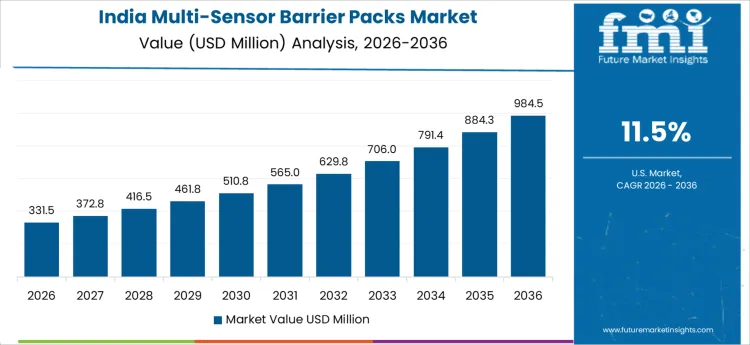
India is witnessing strong expansion in the Multi-Sensor Barrier Packs Market at a CAGR of 11.50% through 2036, supported by growth in organized food manufacturing and cold chain distribution. Manufacturers are adopting multi-sensor barrier packs for perishable foods, beverages, and pharmaceutical products to ensure quality and traceability. Demand is rising across urban retail, subscription channels, and institutional supply. Domestic suppliers are offering cost-aligned, sensor-integrated packs suited for high volume production. Expanding cold chain infrastructure and consumer safety awareness are sustaining robust procurement across packaging operations nationwide.
- Organized food production increases demand for multi-sensor barrier packs
- Perishable foods, beverages, and pharmaceuticals drive high volume usage
- Domestic suppliers provide cost-aligned sensor integration solutions
- Cold chain infrastructure expansion sustains predictable procurement
How Are Consumer Goods Shipments Supporting Adoption in Brazil?
Brazil is seeing steady growth in the Multi-Sensor Barrier Packs Market at a CAGR of 8.00% through 2036, supported by expansion of perishable food and beverage shipments. Manufacturers are using sensor-integrated barrier packs to monitor freshness, temperature, and spoilage during transport and storage. Demand is concentrated in retail and distribution hubs for dairy, ready-to-eat meals, and packaged beverages. Imports supply some advanced sensor components, while domestic converters expand integration capacity. Growth in packaged goods distribution and retail networks is sustaining recurring procurement across packaging operations nationwide.
- Perishable food and beverage shipments support multi-sensor barrier pack adoption
- Sensor integration improves monitoring of freshness, temperature, and spoilage
- Domestic converters expand capacity for sensor-enabled packaging
- Retail network growth sustains recurring procurement
How Does Mature Packaging Demand Influence Stability in Japan?
Japan is maintaining measured growth in the Multi-Sensor Barrier Packs Market at a CAGR of 5.00% through 2036, supported by mature retail markets and selective adoption of sensor-integrated packaging. Brands apply multi-sensor barrier packs for dairy, ready-to-eat meals, and pharmaceutical products. Demand remains focused on reliability, accuracy of sensor readings, and material quality. Domestic suppliers emphasize precision integration and pack consistency. Stable consumption patterns and replacement-driven purchasing are sustaining predictable procurement across established packaging operations nationwide.
- Mature retail markets favor selective adoption of multi-sensor barrier packs
- Dairy, ready-to-eat meals, and pharmaceuticals anchor baseline demand
- Domestic suppliers ensure precise sensor integration and pack consistency
- Replacement-driven purchasing sustains procurement continuity
Which companies are influencing competition in the Multi Sensor Barrier Packs Market across food and industrial packaging applications?
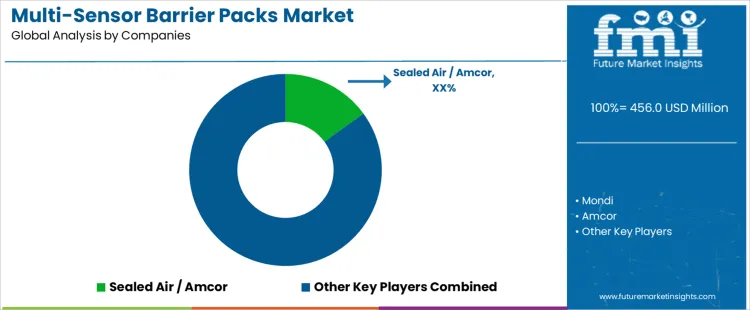
Competition in the Multi Sensor Barrier Packs Market reflects the intersection of advanced barrier materials and integrated sensing functionality. Sealed Air and Amcor play a central role through high performance packaging platforms that combine barrier protection with freshness, humidity, or gas monitoring features. Mondi maintains a strong position in Europe, where fiber based and hybrid barrier packs are adapted for monitored food and specialty product distribution. Toray contributes through materials science expertise, supplying multilayer films and functional polymers suited for sensor integration. These firms compete on material reliability, consistency in barrier performance, and the ability to embed sensing elements without disrupting packaging line efficiency or compliance requirements across regulated end uses.
Regional and application focused players add depth to the competitive structure. UFlex participates through flexible packaging solutions aimed at cost controlled applications, particularly in export oriented food processing and emerging consumption markets. Klabin brings regional strength in Latin America, combining paper based barrier structures with selective sensing features for freshness monitoring and logistics visibility. These companies often collaborate with sensor developers or technology licensors rather than developing proprietary sensing platforms. Competition centers on customization capability, scalability across product formats, and alignment with customer specific shelf life requirements. Market entry is shaped less by capital intensity and more by material qualification timelines, customer validation cycles, and compatibility with existing packaging infrastructure across food and industrial supply chains.
Key Players in the Multi-Sensor Barrier Packs Market
- Sealed Air / Amcor
- Mondi
- Amcor
- UFlex
- Klabin
- Toray
Scope of the Report
| Items | Values |
|---|---|
| Quantitative Units (2026) | USD million |
| End-use / Application | High-value food & pharma; Specialty foods; Bulk pharma; E-commerce food; Others |
| Packaging Format / Type | Rigid Barrier Pouches / Packs; Vacuum Barrier Packs; Pouches with Sensor Ports; Retortable Barrier Packs; Others |
| Material | High-barrier Laminates (Alu/PA/EVOH); Co-extruded Films; Metallized Films; High-temp Laminates; Others |
| Technology | Integrated O₂ / TTI / Humidity Sensors; Sensor Embedding; RFID + Sensor Integration; Printed Electronics; Others |
| Regions Covered | Asia Pacific; Europe; North America; Latin America; Middle East & Africa |
| Countries Covered | China; Japan; South Korea; India; Australia & New Zealand; ASEAN; Germany; United Kingdom; France; Italy; Spain; Nordic; BENELUX; United States; Canada; Mexico; Brazil; Chile; Kingdom of Saudi Arabia; Other GCC Countries; Turkey; South Africa; Other African Union; plus other countries across each region |
| Key Companies Profiled | Sealed Air / Amcor; Mondi; Amcor; UFlex; Klabin; Toray |
| Additional Attributes | Dollar by sales across packaging formats, materials, and sensor technologies; adoption across food, beverage, and pharmaceutical cold chains; rigid barrier pouches lead due to stability and sensor integration ease; vacuum packs and retortable packs used for moisture, oxygen, or thermal resistance; multi-sensor integration includes O₂, TTI, humidity, RFID, and printed electronics; deployment in high-value, specialty, bulk, and e-commerce applications; recurring procurement driven by regulatory compliance, spoilage risk, and operational monitoring; specification control on sensor accuracy, adhesion, barrier performance, and shelf life; integration with IoT-enabled quality systems for real-time monitoring; adoption reflects operational fit, material compatibility, and validated sensor performance across global supply chains |
Multi-Sensor Barrier Packs Market Segmentation
End-use / Application:
- High-value food & pharma
- Specialty foods
- Bulk pharma
- E-commerce food
- Others
Packaging Format / Type:
- Rigid Barrier Pouches / Packs
- Vacuum Barrier Packs
- Pouches with Sensor Ports
- Retortable Barrier Packs
- Others
Material:
- High-barrier Laminates (Alu/PA/EVOH)
- Co-extruded Films
- Metallized Films
- High-temp Laminates
- Others
Technology:
- Integrated O₂ / TTI / Humidity Sensors
- Sensor Embedding
- RFID + Sensor Integration
- Printed Electronics
- Others
Region
- Asia Pacific
- China
- Japan
- South Korea
- India
- Australia & New Zealand
- ASEAN
- Rest of Asia Pacific
- Europe
- Germany
- United Kingdom
- France
- Italy
- Spain
- Nordic
- BENELUX
- Rest of Europe
- North America
- United States
- Canada
- Mexico
- Latin America
- Brazil
- Chile
- Rest of Latin America
- Middle East & Africa
- Kingdom of Saudi Arabia
- Other GCC Countries
- Turkey
- South Africa
- Other African Union
- Rest of Middle East & Africa
Frequently Asked Questions
How big is the multi-sensor barrier packs market in 2026?
The global multi-sensor barrier packs market is estimated to be valued at USD 456.0 million in 2026.
What will be the size of multi-sensor barrier packs market in 2036?
The market size for the multi-sensor barrier packs market is projected to reach USD 1,062.0 million by 2036.
How much will be the multi-sensor barrier packs market growth between 2026 and 2036?
The multi-sensor barrier packs market is expected to grow at a 8.8% CAGR between 2026 and 2036.
What are the key product types in the multi-sensor barrier packs market?
The key product types in multi-sensor barrier packs market are high-value food & pharma, specialty foods, bulk pharma, e-commerce food and others.
Which packaging format segment to contribute significant share in the multi-sensor barrier packs market in 2026?
In terms of packaging format, rigid barrier pouches / packs segment to command 50.0% share in the multi-sensor barrier packs market in 2026.
Preview the report firsthand - request a free sample
Get SampleGet the brochure for pricing and purchase details.
Get PDFTable of Content
- Executive Summary
- Global Market Outlook
- Demand-side Trends
- Supply-side Trends
- Technology Roadmap Analysis
- Analysis and Recommendations
- Market Overview
- Market Coverage / Taxonomy
- Market Definition / Scope / Limitations
- Market Background
- Market Dynamics
- Drivers
- Restraints
- Opportunity
- Trends
- Scenario Forecast
- Demand in Optimistic Scenario
- Demand in Likely Scenario
- Demand in Conservative Scenario
- Opportunity Map Analysis
- Product Life Cycle Analysis
- Supply Chain Analysis
- Investment Feasibility Matrix
- Value Chain Analysis
- PESTLE and Porter’s Analysis
- Regulatory Landscape
- Regional Parent Market Outlook
- Production and Consumption Statistics
- Import and Export Statistics
- Market Dynamics
- Global Market Analysis 2021 to 2025 and Forecast, 2026 to 2036
- Historical Market Size Value (USD Million) Analysis, 2021 to 2025
- Current and Future Market Size Value (USD Million) Projections, 2026 to 2036
- Y-o-Y Growth Trend Analysis
- Absolute $ Opportunity Analysis
- Global Market Pricing Analysis 2021 to 2025 and Forecast 2026 to 2036
- Global Market Analysis 2021 to 2025 and Forecast 2026 to 2036, By End-use
- Introduction / Key Findings
- Historical Market Size Value (USD Million) Analysis By End-use , 2021 to 2025
- Current and Future Market Size Value (USD Million) Analysis and Forecast By End-use , 2026 to 2036
- High-value food & pharma
- Specialty foods
- Bulk pharma
- E-commerce food
- Others
- Y-o-Y Growth Trend Analysis By End-use , 2021 to 2025
- Absolute $ Opportunity Analysis By End-use , 2026 to 2036
- Global Market Analysis 2021 to 2025 and Forecast 2026 to 2036, By Packaging Format
- Introduction / Key Findings
- Historical Market Size Value (USD Million) Analysis By Packaging Format, 2021 to 2025
- Current and Future Market Size Value (USD Million) Analysis and Forecast By Packaging Format, 2026 to 2036
- Rigid Barrier Pouches / Packs
- Vacuum Barrier Packs
- Pouches with Sensor Ports
- Retortable Barrier Packs
- Others
- Y-o-Y Growth Trend Analysis By Packaging Format, 2021 to 2025
- Absolute $ Opportunity Analysis By Packaging Format, 2026 to 2036
- Global Market Analysis 2021 to 2025 and Forecast 2026 to 2036, By Material
- Introduction / Key Findings
- Historical Market Size Value (USD Million) Analysis By Material, 2021 to 2025
- Current and Future Market Size Value (USD Million) Analysis and Forecast By Material, 2026 to 2036
- High-barrier Laminates (Alu/PA/EVOH)
- Co-extruded Films
- Metallized Films
- High-temp Laminates
- Others
- Others
- Y-o-Y Growth Trend Analysis By Material, 2021 to 2025
- Absolute $ Opportunity Analysis By Material, 2026 to 2036
- Global Market Analysis 2021 to 2025 and Forecast 2026 to 2036, By Technology
- Introduction / Key Findings
- Historical Market Size Value (USD Million) Analysis By Technology, 2021 to 2025
- Current and Future Market Size Value (USD Million) Analysis and Forecast By Technology, 2026 to 2036
- Integrated O₂ / TTI / Humidity Sensors
- Sensor Embedding
- RFID + Sensor Integration
- Printed Electronics
- Others
- Others
- Y-o-Y Growth Trend Analysis By Technology, 2021 to 2025
- Absolute $ Opportunity Analysis By Technology, 2026 to 2036
- Global Market Analysis 2021 to 2025 and Forecast 2026 to 2036, By Region
- Introduction
- Historical Market Size Value (USD Million) Analysis By Region, 2021 to 2025
- Current Market Size Value (USD Million) Analysis and Forecast By Region, 2026 to 2036
- North America
- Latin America
- Western Europe
- Eastern Europe
- East Asia
- South Asia and Pacific
- Middle East & Africa
- Market Attractiveness Analysis By Region
- North America Market Analysis 2021 to 2025 and Forecast 2026 to 2036, By Country
- Historical Market Size Value (USD Million) Trend Analysis By Market Taxonomy, 2021 to 2025
- Market Size Value (USD Million) Forecast By Market Taxonomy, 2026 to 2036
- By Country
- USA
- Canada
- Mexico
- By End-use
- By Packaging Format
- By Material
- By Technology
- By Country
- Market Attractiveness Analysis
- By Country
- By End-use
- By Packaging Format
- By Material
- By Technology
- Key Takeaways
- Latin America Market Analysis 2021 to 2025 and Forecast 2026 to 2036, By Country
- Historical Market Size Value (USD Million) Trend Analysis By Market Taxonomy, 2021 to 2025
- Market Size Value (USD Million) Forecast By Market Taxonomy, 2026 to 2036
- By Country
- Brazil
- Chile
- Rest of Latin America
- By End-use
- By Packaging Format
- By Material
- By Technology
- By Country
- Market Attractiveness Analysis
- By Country
- By End-use
- By Packaging Format
- By Material
- By Technology
- Key Takeaways
- Western Europe Market Analysis 2021 to 2025 and Forecast 2026 to 2036, By Country
- Historical Market Size Value (USD Million) Trend Analysis By Market Taxonomy, 2021 to 2025
- Market Size Value (USD Million) Forecast By Market Taxonomy, 2026 to 2036
- By Country
- Germany
- UK
- Italy
- Spain
- France
- Nordic
- BENELUX
- Rest of Western Europe
- By End-use
- By Packaging Format
- By Material
- By Technology
- By Country
- Market Attractiveness Analysis
- By Country
- By End-use
- By Packaging Format
- By Material
- By Technology
- Key Takeaways
- Eastern Europe Market Analysis 2021 to 2025 and Forecast 2026 to 2036, By Country
- Historical Market Size Value (USD Million) Trend Analysis By Market Taxonomy, 2021 to 2025
- Market Size Value (USD Million) Forecast By Market Taxonomy, 2026 to 2036
- By Country
- Russia
- Poland
- Hungary
- Balkan & Baltic
- Rest of Eastern Europe
- By End-use
- By Packaging Format
- By Material
- By Technology
- By Country
- Market Attractiveness Analysis
- By Country
- By End-use
- By Packaging Format
- By Material
- By Technology
- Key Takeaways
- East Asia Market Analysis 2021 to 2025 and Forecast 2026 to 2036, By Country
- Historical Market Size Value (USD Million) Trend Analysis By Market Taxonomy, 2021 to 2025
- Market Size Value (USD Million) Forecast By Market Taxonomy, 2026 to 2036
- By Country
- China
- Japan
- South Korea
- By End-use
- By Packaging Format
- By Material
- By Technology
- By Country
- Market Attractiveness Analysis
- By Country
- By End-use
- By Packaging Format
- By Material
- By Technology
- Key Takeaways
- South Asia and Pacific Market Analysis 2021 to 2025 and Forecast 2026 to 2036, By Country
- Historical Market Size Value (USD Million) Trend Analysis By Market Taxonomy, 2021 to 2025
- Market Size Value (USD Million) Forecast By Market Taxonomy, 2026 to 2036
- By Country
- India
- ASEAN
- Australia & New Zealand
- Rest of South Asia and Pacific
- By End-use
- By Packaging Format
- By Material
- By Technology
- By Country
- Market Attractiveness Analysis
- By Country
- By End-use
- By Packaging Format
- By Material
- By Technology
- Key Takeaways
- Middle East & Africa Market Analysis 2021 to 2025 and Forecast 2026 to 2036, By Country
- Historical Market Size Value (USD Million) Trend Analysis By Market Taxonomy, 2021 to 2025
- Market Size Value (USD Million) Forecast By Market Taxonomy, 2026 to 2036
- By Country
- Kingdom of Saudi Arabia
- Other GCC Countries
- Turkiye
- South Africa
- Other African Union
- Rest of Middle East & Africa
- By End-use
- By Packaging Format
- By Material
- By Technology
- By Country
- Market Attractiveness Analysis
- By Country
- By End-use
- By Packaging Format
- By Material
- By Technology
- Key Takeaways
- Key Countries Market Analysis
- USA
- Pricing Analysis
- Market Share Analysis, 2025
- By End-use
- By Packaging Format
- By Material
- By Technology
- Canada
- Pricing Analysis
- Market Share Analysis, 2025
- By End-use
- By Packaging Format
- By Material
- By Technology
- Mexico
- Pricing Analysis
- Market Share Analysis, 2025
- By End-use
- By Packaging Format
- By Material
- By Technology
- Brazil
- Pricing Analysis
- Market Share Analysis, 2025
- By End-use
- By Packaging Format
- By Material
- By Technology
- Chile
- Pricing Analysis
- Market Share Analysis, 2025
- By End-use
- By Packaging Format
- By Material
- By Technology
- Germany
- Pricing Analysis
- Market Share Analysis, 2025
- By End-use
- By Packaging Format
- By Material
- By Technology
- UK
- Pricing Analysis
- Market Share Analysis, 2025
- By End-use
- By Packaging Format
- By Material
- By Technology
- Italy
- Pricing Analysis
- Market Share Analysis, 2025
- By End-use
- By Packaging Format
- By Material
- By Technology
- Spain
- Pricing Analysis
- Market Share Analysis, 2025
- By End-use
- By Packaging Format
- By Material
- By Technology
- France
- Pricing Analysis
- Market Share Analysis, 2025
- By End-use
- By Packaging Format
- By Material
- By Technology
- India
- Pricing Analysis
- Market Share Analysis, 2025
- By End-use
- By Packaging Format
- By Material
- By Technology
- ASEAN
- Pricing Analysis
- Market Share Analysis, 2025
- By End-use
- By Packaging Format
- By Material
- By Technology
- Australia & New Zealand
- Pricing Analysis
- Market Share Analysis, 2025
- By End-use
- By Packaging Format
- By Material
- By Technology
- China
- Pricing Analysis
- Market Share Analysis, 2025
- By End-use
- By Packaging Format
- By Material
- By Technology
- Japan
- Pricing Analysis
- Market Share Analysis, 2025
- By End-use
- By Packaging Format
- By Material
- By Technology
- South Korea
- Pricing Analysis
- Market Share Analysis, 2025
- By End-use
- By Packaging Format
- By Material
- By Technology
- Russia
- Pricing Analysis
- Market Share Analysis, 2025
- By End-use
- By Packaging Format
- By Material
- By Technology
- Poland
- Pricing Analysis
- Market Share Analysis, 2025
- By End-use
- By Packaging Format
- By Material
- By Technology
- Hungary
- Pricing Analysis
- Market Share Analysis, 2025
- By End-use
- By Packaging Format
- By Material
- By Technology
- Kingdom of Saudi Arabia
- Pricing Analysis
- Market Share Analysis, 2025
- By End-use
- By Packaging Format
- By Material
- By Technology
- Turkiye
- Pricing Analysis
- Market Share Analysis, 2025
- By End-use
- By Packaging Format
- By Material
- By Technology
- South Africa
- Pricing Analysis
- Market Share Analysis, 2025
- By End-use
- By Packaging Format
- By Material
- By Technology
- USA
- Market Structure Analysis
- Competition Dashboard
- Competition Benchmarking
- Market Share Analysis of Top Players
- By Regional
- By End-use
- By Packaging Format
- By Material
- By Technology
- Competition Analysis
- Competition Deep Dive
- Sealed Air / Amcor
- Overview
- Product Portfolio
- Profitability by Market Segments (Product/Age /Sales Channel/Region)
- Sales Footprint
- Strategy Overview
- Marketing Strategy
- Product Strategy
- Channel Strategy
- Mondi
- Amcor
- UFlex
- Klabin
- Toray
- Sealed Air / Amcor
- Competition Deep Dive
- Assumptions & Acronyms Used
- Research Methodology


