

- Market Size (2026)
- USD 812.4 Mn
- Forecast (2036)
- USD 1191.0 Mn
- CAGR (2026 to 2036)
- 3.9%
How big is the Muscle Stimulation Devices Market in 2026?
USD 812.4 million in 2026, reaching USD 1,191.0 million by 2036 at a 3.9% CAGR
The muscle stimulation devices market is estimated at USD 812.4 million in 2026 and is forecast to reach USD 1,191.0 million by 2036 at a 3.9% CAGR. TENS (Transcutaneous Electrical Nerve Stimulation) accounts for 38.0% of product revenue in 2026, while Pain Management leads application at 47.0%. Demand is shaped by buyers consolidating purchases around the TENS (transcutaneous electrical nerve stimulation) category to control cost and qualification effort.
Growth reflects steady replacement and upgrade cycles across healthcare end users rather than one-off spikes. Adoption is increasing due to buyers consolidating spend with vendors that minimize requalification and lead-time risk. The fastest expansion sits in China at 5.6% CAGR, followed by Brazil at 5.4%, where buying centers prioritize volume-based procurement (VBP) tenders.
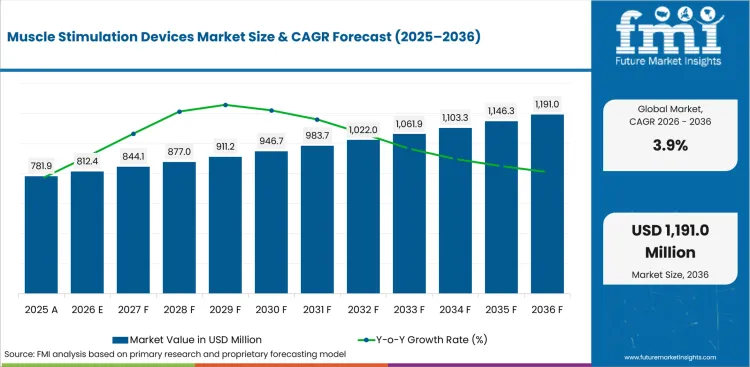
Key Takeaways for the Muscle Stimulation Devices Market
- Demand for muscle stimulation devices is led by equipment replacement and rehabilitation requirements, with healthcare providers favoring systems delivering measurable clinical and operational outcomes.
- Pain management is projected to garner 47.0% share of application in 2026, reflecting demand across chronic pain treatment and postoperative recovery programs.
- TENS devices are forecast to lead product with 38.0% share in 2026, influenced by established use across pain-relief and home-care applications.
- Certification requirements and device procurement costs represent primary barriers limiting wider adoption.
- Competition centers on DJO Global, Inc., Zynex, Inc., Omron Healthcare, Inc., NeuroMetrix, Inc., and BioMedical Life Systems, with suppliers differentiating through portfolio breadth and technical assistance.
Analyst Perspective
“Commercial adoption is based on suppliers demonstrating reliable pain-management and rehabilitation outcomes under practical healthcare conditions. Clinical teams favor vendors pairing device-performance evidence with training guidance and responsive technical assistance. Every stimulation system needs to improve patient support without weakening treatment efficiency or procurement economics.”
- Anurag Sharma, Principal Consultant at Future Market Insights
How is the Muscle Stimulation Devices Market segmented?
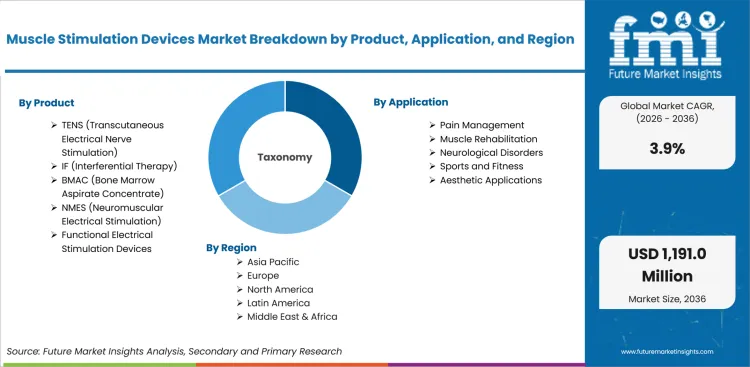
The muscle stimulation devices market is segmented by product, application, end user, technology, and distribution channel.
The product category separates TENS devices from neuromuscular electrical stimulation, functional electrical stimulation, and interferential current devices used for different treatment goals. Application analysis distinguishes pain management from neurological disorders, musculoskeletal disorders, and muscle rehabilitation across clinical and home-care settings. End-user analysis covers hospitals, specialty clinics, physiotherapy centers, sports clinics, and home-care users with different equipment and treatment requirements. Technology analysis separates battery-operated devices from wired and wireless systems based on portability, operating time, and ease of use. Distribution channel analysis distinguishes direct sales from hospital pharmacies, retail pharmacies, and online sales across institutional and personal-use purchases.
Why does TENS (Transcutaneous Electrical Nerve Stimulation) lead the Muscle Stimulation Devices Market?
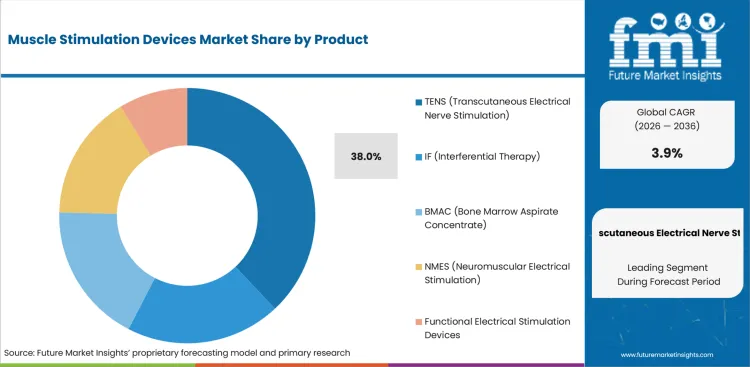
Muscle Stimulation Devices Market Analysis By Product
TENS devices deliver low-voltage electrical impulses through electrodes placed on the skin to support pain relief. The format is familiar to healthcare professionals and patients across hospitals, physiotherapy centers, and home-care settings. Portable designs also make these devices suitable for repeated use without requiring complex installation or specialist infrastructure. Product selection often depends on adjustable intensity levels, electrode quality, battery life, and ease of operation.
- TENS (Transcutaneous Electrical Nerve Stimulation) is expected to hold 38.0% of product revenue in 2026, reflecting its established use in pain management and rehabilitation programs. Familiar operating methods reduce training and product evaluation requirements across clinical settings.
- Hospitals and physiotherapy centers use TENS devices for patients with back pain, joint pain, nerve pain, and post-treatment discomfort. Compact home-use units also extend demand beyond institutional care by allowing patients to continue prescribed therapy between clinical visits.
How big is the Pain Management segment in the Muscle Stimulation Devices Market?
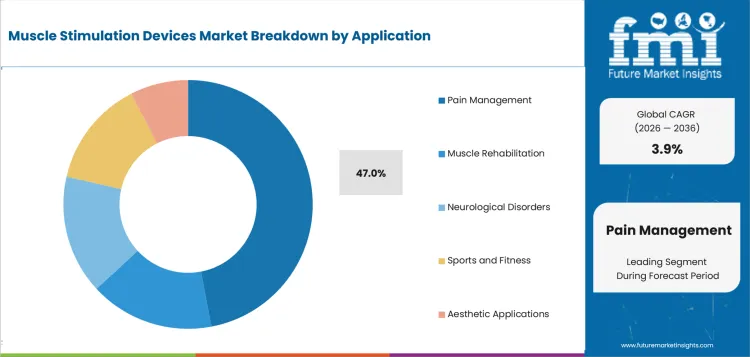
Muscle Stimulation Devices Market Analysis By Application
Pain management remains a major use of muscle stimulation devices across acute and long-term treatment programs. Electrical stimulation provides a non-invasive option for patients who require additional support alongside medication, exercise, or physical therapy. Device settings are adjusted according to the location and intensity of pain, treatment duration, and patient response. Demand spans back pain, arthritis, sports injuries, nerve pain, and discomfort linked to recovery after medical procedures.
- Pain Management is forecast to hold 47.0% of application revenue in 2026, making it the largest application category. Its position reflects the broad use of electrical stimulation across hospitals, rehabilitation centers, pain clinics, and home-care environments.
- Healthcare professionals use muscle stimulation devices as part of wider treatment plans that combine exercise, manual therapy, and clinical monitoring. Portable units also support repeated sessions for patients managing recurring pain outside formal care facilities.
Which end user leads the market?
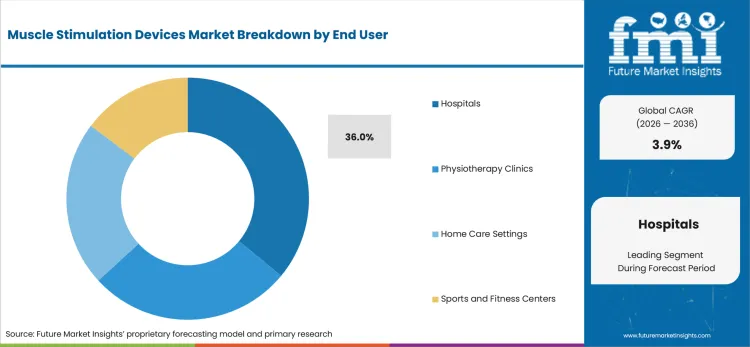
Muscle Stimulation Devices Market Analysis By End User
Hospitals use muscle stimulation devices across pain management, rehabilitation, orthopedics, neurology, and post-operative care. Their purchasing decisions consider device reliability, electrical safety, cleaning requirements, electrode availability, and compatibility with established treatment procedures. Hospitals also handle a wide range of patients, which creates demand for systems with adjustable programs and clear operating controls. Trained staff support device placement and monitor patient response during treatment.
- Hospitals are estimated to account for 36.0% share in 2026, the largest position within the end-user category. Their lead reflects regular use across several departments and access to trained clinical professionals.
- Hospital demand also includes equipment for recovery after surgery, injury treatment, and neurological rehabilitation. Central purchasing systems and recurring replacement of electrodes and related accessories further support this category.
What drives and restrains the Muscle Stimulation Devices Market?
Driven by TENS (transcutaneous electrical nerve stimulation) replacement demand; restrained by qualification and cost barriers
Recurring product procurement supports expansion, while upfront cost and certification effort limit faster adoption among smaller buyers.
- Driver: Hospitals sustain TENS (transcutaneous electrical nerve stimulation) demand through replacement and capacity additions, keeping procurement recurring across the forecast period.
- Restraint: Certification and requalification effort for new product specifications slows substitution, particularly for smaller buyers with limited engineering capacity.
- Opportunity: Suppliers offering pain management configurations that drop into existing workflows can widen adoption without full replacement.
Demand is shaped by buyers protecting continuity of supply, which rewards incumbents with broad product portfolios.
Which factors support expansion in the Muscle Stimulation Devices Market?
Replacement demand, standardization, and service coverage support market value
- Market value is supported by TENS (transcutaneous electrical nerve stimulation) replacement purchases before aftermarket and service revenue accrues.
- Supplier pricing reflects product performance and availability before service coverage affects renewal demand.
- Buyers compare qualification time and support response before committing to multi-site standardization on pain management.
Which countries are growing fastest in the Muscle Stimulation Devices Market?
China 5.6%, Brazil 5.4%, India 5.1%, USA 3.6%, Germany 3.2% through 2036
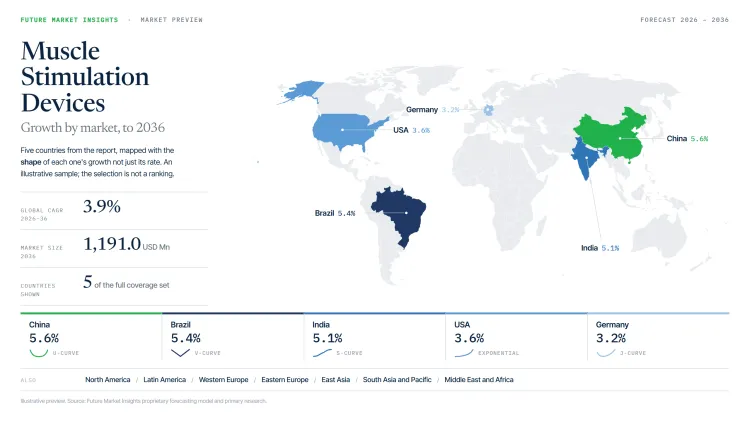
| Country | CAGR |
|---|---|
| China | 5.6% |
| Brazil | 5.4% |
| India | 5.1% |
| USA | 3.6% |
| Germany | 3.2% |
How do country-level CAGRs compare in the Muscle Stimulation Devices Market?
The country comparison spans 2.4 percentage points and reveals three defined growth positions across the muscle stimulation devices market. China, Brazil and India form the upper group, with only 0.5 percentage points separating the three countries. The USA remains 1.5 percentage points below India and begins the lower-growth group. Germany remains only 0.4 percentage points below the USA and stands at the lower end of the comparison. Countries with stronger hospital investment, public procurement programs and expanding pain management demand generally demonstrate faster market growth.
- China leads the comparison as volume-based procurement tenders and domestic device manufacturing support recurring demand across major healthcare and industrial regions.
- Brazil remains only 0.2 percentage points below China, supported by SUS procurement volumes and continued investment across São Paulo and the southeastern healthcare corridor.
- India remains 0.3 percentage points below Brazil as private tertiary hospitals expand pain management, rehabilitation and physiotherapy services across major cities.
- The USA remains 1.5 percentage points below India as FDA clearance requirements, reimbursement conditions and provider cost controls shape equipment purchasing decisions.
- Germany remains only 0.4 percentage points below the USA, reflecting a mature market where EU MDR recertification and statutory reimbursement reviews influence replacement schedules.
Comparable CAGRs can still produce different purchasing conditions. Differences in public procurement, regulatory approval, reimbursement coverage, domestic manufacturing and hospital investment influence device adoption and replacement plans. The full report provides country-level CAGR analysis across North America, Latin America, Europe, East Asia, South Asia, Oceania and the Middle East and Africa.
Country-wise Analysis
- Chinese hospitals and rehabilitation providers benefit from large procurement programs and a growing domestic medical device manufacturing base. The China muscle stimulation devices market is projected to grow at 5.6% CAGR over the assessment period, supported by volume-based procurement tenders and import-substitution policies. Multi-year procurement contracts improve demand visibility beyond short purchasing cycles. Domestic production also reduces dependence on imported systems across several price categories. Specification activity remains concentrated in the Yangtze River Delta and Pearl River Delta, where healthcare investment and manufacturing capacity are stronger. Equipment companies need competitive pricing, reliable service support and tender-ready documentation to expand across public and private treatment networks.
- Brazilian healthcare providers operate within a market where public procurement and regulatory approval strongly influence new equipment purchases. The Brazil muscle stimulation devices market is estimated to advance at 5.4% CAGR during the 2026-2036 forecast period, shaped by SUS procurement volumes and continuing demand for pain management devices. São Paulo and the southeastern region account for a large share of specification and distribution activity. ANVISA registration determines how quickly new products reach hospitals, rehabilitation centers and physiotherapy clinics. Public purchasing offers recurring demand, although long tender cycles may delay revenue recognition. Device companies require local registration knowledge, distribution partners and dependable maintenance coverage across regional healthcare networks.
- Indian rehabilitation providers benefit from expanding private hospitals and rising demand for non-surgical pain management across major cities. The India muscle stimulation devices market is forecast to grow at 5.1% CAGR between 2026 and 2036, due to private tertiary-care investment and wider healthcare coverage. Metro hospitals continue to add physiotherapy, rehabilitation and pain management services alongside broader specialty care. Ayushman Bharat expansion also supports patient access, although procurement conditions differ across public and private facilities. Equipment cost and service availability remain important outside large cities. Manufacturers with local training, spare parts and flexible purchasing arrangements are better placed to support expansion across regional hospitals and independent rehabilitation centers.
- American hospitals and rehabilitation providers operate within established regulatory and reimbursement systems for medical device adoption. The USA muscle stimulation devices market is projected to record 3.6% CAGR over the 2026-2036 assessment period, owing to FDA clearance pathways and CMS reimbursement codes. Providers review clinical evidence and reimbursement eligibility before adding new equipment to pain management programs. Integrated healthcare systems also face cost pressure that encourages closer comparison of device performance and long-term operating expense. Specification activity remains concentrated across major Northeast and West Coast metropolitan corridors. New device companies require clear regulatory status, reimbursement support and service coverage before broader account expansion becomes practical.
- German healthcare providers operate under strict European medical device rules and structured statutory reimbursement reviews. Germany’s muscle stimulation devices market is forecast to expand at 3.2% CAGR over the forecast period, driven by replacement demand and established pain management services. EU MDR recertification cycles influence which devices remain available for hospital and clinic procurement. Statutory health insurance review also affects when budgets are released for reimbursed treatment equipment. Mature purchasing systems favor products with documented clinical performance, complete technical files and reliable supply continuity. Equipment companies face slower account expansion when recertification costs rise or reimbursement decisions remain uncertain across hospital and rehabilitation settings.
Who are the leading companies in the Muscle Stimulation Devices Market?
DJO Global, Inc., Zynex, Inc., Omron Healthcare, Inc., NeuroMetrix, Inc. and BioMedical Life Systems
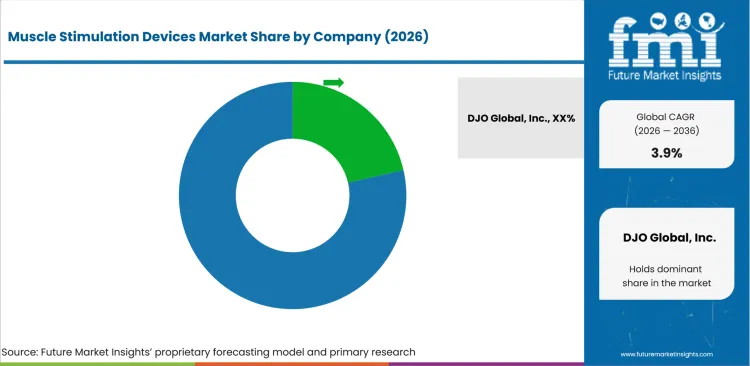
DJO Global, Inc. and Zynex, Inc. compete through supply depth and qualification support across healthcare buyers. Omron Healthcare, Inc. maintains position through portfolio breadth, while service coverage and lead-time reliability are further competitive levers.
Who are the key players in the Muscle Stimulation Devices Market?
Key global companies leading the market include:
- DJO Global, Inc., Zynex, Inc., Omron Healthcare, Inc., NeuroMetrix, Inc. and BioMedical Life Systems maintain leading positions through established manufacturing, portfolio breadth, and direct procurement relationships.
- EMS Physio Ltd., Tone-A-Matic and PowerDot compete through specialized configurations, competitive pricing, and localized distribution in high-growth markets.
- Smaller specialists target underserved applications within the muscle stimulation devices market to establish initial procurement positions.
How do top Muscle Stimulation Devices Market companies compare?
DJO Global, Inc. and Zynex, Inc. lead on scale; Omron Healthcare, Inc. also has a global footprint, while NeuroMetrix, Inc. and BioMedical Life Systems are more regionally concentrated.
| Company | Portfolio Breadth | Qualification Depth | Supply Scale | Geographic Footprint |
|---|---|---|---|---|
| DJO Global, Inc. | High | High | Strong | Global |
| Zynex, Inc. | High | High | Strong | Global |
| Omron Healthcare, Inc. | Medium | Medium | Moderate | Global |
| NeuroMetrix, Inc. | High | Medium | Moderate | Regional |
| BioMedical Life Systems | Medium | Medium | Moderate | Regional |
Source: Future Market Insights competitive analysis, 2026.
Key Players in the Muscle Stimulation Devices Market
Device and Equipment Manufacturers
- DJO Global, Inc.
- NeuroMetrix, Inc.
- Tone-A-Matic
Consumable and Specialty Suppliers
- Zynex, Inc.
- BioMedical Life Systems
- PowerDot
Emerging and Regional Providers
- Omron Healthcare, Inc.
- EMS Physio Ltd.
- AxioBionics
Muscle Stimulation Devices Market - Scope & Definition
| Attribute | Detail |
|---|---|
| Market Definition | Products and solutions within the muscle stimulation devices market spanning Product, Application and End User categories |
| Key Segments Covered | TENS (Transcutaneous Electrical Nerve Stimulation), Pain Management and Hospitals and related healthcare applications |
| Applications Covered | Pain Management, Muscle Rehabilitation, Neurological Disorders and Sports and Fitness |
| End-Use Industries | Hospitals, Physiotherapy Clinics, Home Care Settings and Sports and Fitness Centers |
| Inclusions | Commercially sold product, application, and associated configurations |
| Exclusions | Custom one-off systems, standalone services, and raw inputs outside the muscle stimulation devices market boundary |
Muscle Stimulation Devices Market - Research Methodology
| Method | Description |
|---|---|
| Primary Research | FMI analyst interviews with healthcare suppliers, distributors, and procurement teams across major markets |
| Desk Research | Review of official activity data, regulatory releases, company disclosures, and production statistics |
| Market Sizing & Forecasting | Bottom-up sizing using segment revenue, adoption rates, replacement demand, and country-level activity |
| Data Validation | Cross-verification against public evidence, supplier portfolios, and official indicators |
What does the Muscle Stimulation Devices Market report cover?
2021 to 2025 history and 2026 to 2036 forecasts across all segments and 30+ countries
| Parameter | Details |
|---|---|
| Forecast period | 2026 to 2036 |
| Historical period | 2021 to 2025 |
| Quantitative unit | Revenue in USD million |
| By Product | TENS (Transcutaneous Electrical Nerve Stimulation), IF (Interferential Therapy), NMES (Neuromuscular Electrical Stimulation) and Functional Electrical Stimulation Devices |
| By Application | Pain Management, Muscle Rehabilitation, Neurological Disorders, Sports and Fitness and Aesthetic Applications |
| By End User | Hospitals, Physiotherapy Clinics, Home Care Settings and Sports and Fitness Centers |
| By Technology | Battery Operated Devices, Wireless Technology and Wired Technology |
| By Distribution Channel | Direct Sales, Distributor Sales and Online Sales |
| Regions covered | North America, Latin America, Western Europe, Eastern Europe, East Asia, South Asia and Pacific, Middle East and Africa |
| Countries covered | USA, China, Brazil, India, Germany |
| Key companies profiled | DJO Global, Inc., Zynex, Inc., Omron Healthcare, Inc., NeuroMetrix, Inc. and BioMedical Life Systems |
| Approach | Bottom-up segment-boundary approach using adoption, replacement demand, and supplier disclosures |
Market Segmentation Analysis
Muscle Stimulation Devices Market Segmented by Product:
- TENS (Transcutaneous Electrical Nerve Stimulation)
- Pain Management Devices
- Rehabilitation Devices
- IF (Interferential Therapy)
- Deep Tissue Stimulation Systems
- NMES (Neuromuscular Electrical Stimulation)
- Clinical Grade Systems
- Portable Home Use Systems
- Functional Electrical Stimulation Devices
- Mobility Assistance Systems
- Neurological Rehabilitation Systems
Muscle Stimulation Devices Market Segmented by Application:
- Pain Management
- Chronic Pain Treatment
- Post Operative Pain Relief
- Muscle Rehabilitation
- Injury Recovery
- Physiotherapy Treatment
- Neurological Disorders
- Stroke Rehabilitation
- Spinal Cord Injury Treatment
- Sports and Fitness
- Muscle Strengthening
- Performance Enhancement
- Aesthetic Applications
- Body Toning
- Muscle Sculpting
Muscle Stimulation Devices Market Segmented by End User:
- Hospitals
- Public Hospitals
- Private Hospitals
- Physiotherapy Clinics
- Rehabilitation Centers
- Sports Injury Clinics
- Home Care Settings
- Personal Use Devices
- Sports and Fitness Centers
- Gyms
- Athletic Training Facilities
Muscle Stimulation Devices Market Segmented by Technology:
- Battery Operated Devices
- Rechargeable Systems
- Disposable Battery Systems
- Wireless Technology
- Bluetooth Enabled Devices
- App Connected Systems
- Wired Technology
- Conventional Systems
Muscle Stimulation Devices Market Segmented by Distribution Channel:
- Direct Sales
- Hospital Procurement Contracts
- Clinic Partnerships
- Distributor Sales
- Medical Device Distributors
- Regional Suppliers
- Online Sales
- E Commerce Platforms
- Company Websites
Muscle Stimulation Devices Market by Region:
- North America
- USA
- Canada
- Mexico
- Latin America
- Brazil
- Chile
- Rest of Latin America
- Western Europe
- Germany
- UK
- Italy
- Spain
- France
- Nordic
- BENELUX
- Rest of Western Europe
- Eastern Europe
- Russia
- Poland
- Hungary
- Balkan & Baltic
- Rest of Eastern Europe
- East Asia
- China
- Japan
- South Korea
- South Asia and Pacific
- India
- ASEAN
- Australia & New Zealand
- Rest of South Asia and Pacific
- Middle East & Africa
- Kingdom of Saudi Arabia
- Other GCC Countries
- Türkiye
- South Africa
- Other African Union
- Rest of Middle East & Africa
Research Sources and Bibliography
- World Bank. (2026, March). World development indicators database.
- International Trade Centre. (2025, November). Trade statistics for international business development.
- OECD. (2026, February). Economic outlook and industry statistics.
- World Health Organization. (2025, December). Global health observatory data repository.
- USA Food and Drug Administration. (2026, January). Medical device databases.
This bibliography is provided for reader reference and is not exhaustive.
This Report Answers
- Market size estimates for 2026 and forecasts through 2036 for the muscle stimulation devices market.
- Segment demand across product and application with leading sub-segment shares.
- Country-level growth analysis covering USA, China, Brazil, India and other markets.
- Company positioning across DJO Global, Inc., Zynex, Inc. and Omron Healthcare, Inc. and regional players.
- Assessment of drivers and restraints with procurement patterns across end-use buyers.
Frequently Asked Questions
What slows buyers down in the muscle stimulation devices market?
The main restraint is proof burden. Buyers slow down when muscle stimulation devices lacks the specification evidence, testing records or supplier response needed for account approval. Certification and requalification effort for new product specifications slows substitution, particularly for smaller buyers with limited engineering capacity.
Who buys in the Muscle Stimulation Devices Market?
Buying sits with hospitals, physiotherapy clinics, home care settings and sports and fitness centers. Pain Management leads application, reflecting where specifications are standardising across sites.
What is driving growth in the muscle stimulation devices market?
Growth is supported by demand that recurs rather than repeats once. Hospitals sustain tens (transcutaneous electrical nerve stimulation) demand through replacement and capacity additions, keeping procurement recurring across the forecast period. Buyers are consolidating around TENS (Transcutaneous Electrical Nerve Stimulation) to control cost and qualification effort.
Where is the opportunity in the Muscle Stimulation Devices Market?
Suppliers offering pain management configurations that drop into existing workflows can widen adoption without full replacement. That widens adoption without forcing a full replacement cycle, which is the slowest part of any buying decision.
Who are the key players in the Muscle Stimulation Devices Market?
Key companies include DJO Global, Inc., NeuroMetrix, Inc., Tone-A-Matic, Zynex, Inc., BioMedical Life Systems, PowerDot, Omron Healthcare, Inc. and EMS Physio Ltd. Competition is focused on qualification time, second-source availability, portfolio breadth and support response.
Preview the report firsthand - request a free sample
Get SampleGet the brochure for pricing and purchase details.
Get PDFTable of Content
- Key Takeaways
- Market Size and CAGR
- Top Growth Driver
- Fastest Growing Segment
- Leading Region
- Key Companies
- Emerging Opportunities
- Executive Summary
- Global Market Outlook
- Demand-side Trends
- Supply-side Trends
- Technology Roadmap Analysis
- Analysis and Recommendations
- Analyst Perspective (What is happening? Why now? What should investors know?)
- Key Questions Answered
- How large is the market?
- What is the CAGR?
- What are key trends?
- Which region dominates?
- Who are the leaders?
- Market Overview
- Market Coverage / Taxonomy
- Market Definition / Scope / Limitations
- Research Methodology
- Chapter Orientation
- Analytical Lens and Working Hypotheses
- Market Structure, Signals, and Trend Drivers
- Benchmarking and Cross-market Comparability
- Market Sizing, Forecasting, and Opportunity Mapping
- Research Design and Evidence Framework
- Desk Research Programme (Secondary Evidence)
- Expert Input and Fieldwork (Primary Evidence)
- Tooling, Models, and Reference Databases
- Data Engineering and Model Build
- Quality Assurance and Audit Trail
- Market Background
- Market Dynamics (Drivers, Restraints, Opportunity, Trends)
- Scenario Forecast (Optimistic, Likely, Conservative)
- Impact Analysis
- AI Impact
- Sustainability Impact
- Regulatory Impact
- Technology Impact
- Consumer / Buyer Analysis
- Purchase Drivers
- Adoption Barriers
- Buyer Journey
- Opportunity Map Analysis
- Product Life Cycle Analysis
- Supply Chain Analysis
- Investment Feasibility Matrix
- Value Chain Analysis
- PESTLE and Porter's Analysis
- Regulatory Landscape
- Regional Parent Market Outlook
- Production and Consumption Statistics
- Import and Export Statistics
- Global Market Analysis and Forecast, 2021 to 2036
- Historical Market Size Value (USD Million) Analysis, 2021 to 2025
- Current and Future Market Size Value (USD Million) Projections, 2026 to 2036
- Y-o-Y Growth Trend Analysis
- Absolute $ Opportunity Analysis
- Global Market Pricing Analysis, 2021 to 2036
- Global Market Analysis and Forecast, By Product, 2021 to 2036
- Introduction / Key Findings
- Historical Market Size Value (USD Million) Analysis By Product, 2021 to 2025
- Current and Future Market Size Value (USD Million) Analysis and Forecast By Product, 2026 to 2036
- TENS (Transcutaneous Electrical Nerve Stimulation)
- Pain Management Devices
- Rehabilitation Devices
- IF (Interferential Therapy)
- Deep Tissue Stimulation Systems
- NMES (Neuromuscular Electrical Stimulation)
- Clinical Grade Systems
- Portable Home Use Systems
- Functional Electrical Stimulation Devices
- Mobility Assistance Systems
- Neurological Rehabilitation Systems
- TENS (Transcutaneous Electrical Nerve Stimulation)
- Y-o-Y Growth Trend Analysis By Product, 2021 to 2025
- Absolute $ Opportunity Analysis By Product, 2026 to 2036
- Global Market Analysis and Forecast, By Application, 2021 to 2036
- Introduction / Key Findings
- Historical Market Size Value (USD Million) Analysis By Application, 2021 to 2025
- Current and Future Market Size Value (USD Million) Analysis and Forecast By Application, 2026 to 2036
- Pain Management
- Chronic Pain Treatment
- Post Operative Pain Relief
- Muscle Rehabilitation
- Injury Recovery
- Physiotherapy Treatment
- Neurological Disorders
- Stroke Rehabilitation
- Spinal Cord Injury Treatment
- Sports and Fitness
- Muscle Strengthening
- Performance Enhancement
- Aesthetic Applications
- Body Toning
- Muscle Sculpting
- Pain Management
- Y-o-Y Growth Trend Analysis By Application, 2021 to 2025
- Absolute $ Opportunity Analysis By Application, 2026 to 2036
- Global Market Analysis and Forecast, By End User, 2021 to 2036
- Introduction / Key Findings
- Historical Market Size Value (USD Million) Analysis By End User, 2021 to 2025
- Current and Future Market Size Value (USD Million) Analysis and Forecast By End User, 2026 to 2036
- Hospitals
- Public Hospitals
- Private Hospitals
- Physiotherapy Clinics
- Rehabilitation Centers
- Sports Injury Clinics
- Home Care Settings
- Personal Use Devices
- Sports and Fitness Centers
- Gyms
- Athletic Training Facilities
- Hospitals
- Y-o-Y Growth Trend Analysis By End User, 2021 to 2025
- Absolute $ Opportunity Analysis By End User, 2026 to 2036
- Global Market Analysis and Forecast, By Technology, 2021 to 2036
- Introduction / Key Findings
- Historical Market Size Value (USD Million) Analysis By Technology, 2021 to 2025
- Current and Future Market Size Value (USD Million) Analysis and Forecast By Technology, 2026 to 2036
- Battery Operated Devices
- Rechargeable Systems
- Disposable Battery Systems
- Wireless Technology
- Bluetooth Enabled Devices
- App Connected Systems
- Wired Technology
- Conventional Systems
- Battery Operated Devices
- Y-o-Y Growth Trend Analysis By Technology, 2021 to 2025
- Absolute $ Opportunity Analysis By Technology, 2026 to 2036
- Global Market Analysis and Forecast, By Distribution Channel, 2021 to 2036
- Introduction / Key Findings
- Historical Market Size Value (USD Million) Analysis By Distribution Channel, 2021 to 2025
- Current and Future Market Size Value (USD Million) Analysis and Forecast By Distribution Channel, 2026 to 2036
- Direct Sales
- Hospital Procurement Contracts
- Clinic Partnerships
- Distributor Sales
- Medical Device Distributors
- Regional Suppliers
- Online Sales
- E Commerce Platforms
- Company Websites
- Direct Sales
- Y-o-Y Growth Trend Analysis By Distribution Channel, 2021 to 2025
- Absolute $ Opportunity Analysis By Distribution Channel, 2026 to 2036
- Global Market Analysis and Forecast, By Region, 2021 to 2036
- Introduction
- Historical Market Size Value (USD Million) Analysis By Region, 2021 to 2025
- Current Market Size Value (USD Million) Analysis and Forecast By Region, 2026 to 2036
- North America
- Latin America
- Western Europe
- Eastern Europe
- East Asia
- South Asia and Pacific
- Middle East and Africa
- Market Attractiveness Analysis By Region
- North America Market Analysis and Forecast, By Country, 2021 to 2036
- Historical Market Size Value (USD Million) Trend Analysis By Market Taxonomy, 2021 to 2025
- Market Size Value (USD Million) Forecast By Market Taxonomy, 2026 to 2036
- By Country
- USA
- Canada
- By Product
- By Application
- By End User
- By Technology
- By Distribution Channel
- By Country
- Market Attractiveness Analysis
- By Country
- By Product
- By Application
- By End User
- By Technology
- By Distribution Channel
- Key Takeaways
- Latin America Market Analysis and Forecast, By Country
- Historical Market Size Value (USD Million) Trend Analysis By Market Taxonomy, 2021 to 2025
- Market Size Value (USD Million) Forecast By Market Taxonomy, 2026 to 2036
- By Country
- Brazil
- Mexico
- Chile
- Rest of Latin America
- By Product
- By Application
- By End User
- By Technology
- By Distribution Channel
- By Country
- Market Attractiveness Analysis
- By Country
- By Product
- By Application
- By End User
- By Technology
- By Distribution Channel
- Key Takeaways
- Western Europe Market Analysis and Forecast, By Country
- Historical Market Size Value (USD Million) Trend Analysis By Market Taxonomy, 2021 to 2025
- Market Size Value (USD Million) Forecast By Market Taxonomy, 2026 to 2036
- By Country
- Germany
- UK
- Italy
- Spain
- France
- Nordic
- BENELUX
- Rest of Western Europe
- By Product
- By Application
- By End User
- By Technology
- By Distribution Channel
- By Country
- Market Attractiveness Analysis
- By Country
- By Product
- By Application
- By End User
- By Technology
- By Distribution Channel
- Key Takeaways
- Eastern Europe Market Analysis and Forecast, By Country
- Historical Market Size Value (USD Million) Trend Analysis By Market Taxonomy, 2021 to 2025
- Market Size Value (USD Million) Forecast By Market Taxonomy, 2026 to 2036
- By Country
- Russia
- Poland
- Hungary
- Balkan & Baltic
- Rest of Eastern Europe
- By Product
- By Application
- By End User
- By Technology
- By Distribution Channel
- By Country
- Market Attractiveness Analysis
- By Country
- By Product
- By Application
- By End User
- By Technology
- By Distribution Channel
- Key Takeaways
- East Asia Market Analysis and Forecast, By Country
- Historical Market Size Value (USD Million) Trend Analysis By Market Taxonomy, 2021 to 2025
- Market Size Value (USD Million) Forecast By Market Taxonomy, 2026 to 2036
- By Country
- China
- Japan
- South Korea
- By Product
- By Application
- By End User
- By Technology
- By Distribution Channel
- By Country
- Market Attractiveness Analysis
- By Country
- By Product
- By Application
- By End User
- By Technology
- By Distribution Channel
- Key Takeaways
- South Asia and Pacific Market Analysis and Forecast, By Country
- Historical Market Size Value (USD Million) Trend Analysis By Market Taxonomy, 2021 to 2025
- Market Size Value (USD Million) Forecast By Market Taxonomy, 2026 to 2036
- By Country
- India
- ASEAN
- Australia & New Zealand
- Rest of South Asia and Pacific
- By Product
- By Application
- By End User
- By Technology
- By Distribution Channel
- By Country
- Market Attractiveness Analysis
- By Country
- By Product
- By Application
- By End User
- By Technology
- By Distribution Channel
- Key Takeaways
- Middle East and Africa Market Analysis and Forecast, By Country
- Historical Market Size Value (USD Million) Trend Analysis By Market Taxonomy, 2021 to 2025
- Market Size Value (USD Million) Forecast By Market Taxonomy, 2026 to 2036
- By Country
- Kingdom of Saudi Arabia
- Other GCC Countries
- Türkiye
- South Africa
- Other African Union
- Rest of Middle East and Africa
- By Product
- By Application
- By End User
- By Technology
- By Distribution Channel
- By Country
- Market Attractiveness Analysis
- By Country
- By Product
- By Application
- By End User
- By Technology
- By Distribution Channel
- Key Takeaways
- Key Countries Market Analysis
- USA
- Pricing Analysis
- Market Share Analysis, 2025
- By Product
- By Application
- By End User
- By Technology
- By Distribution Channel
- Canada
- Pricing Analysis
- Market Share Analysis, 2025
- By Product
- By Application
- By End User
- By Technology
- By Distribution Channel
- Mexico
- Pricing Analysis
- Market Share Analysis, 2025
- By Product
- By Application
- By End User
- By Technology
- By Distribution Channel
- Brazil
- Pricing Analysis
- Market Share Analysis, 2025
- By Product
- By Application
- By End User
- By Technology
- By Distribution Channel
- Chile
- Pricing Analysis
- Market Share Analysis, 2025
- By Product
- By Application
- By End User
- By Technology
- By Distribution Channel
- Germany
- Pricing Analysis
- Market Share Analysis, 2025
- By Product
- By Application
- By End User
- By Technology
- By Distribution Channel
- UK
- Pricing Analysis
- Market Share Analysis, 2025
- By Product
- By Application
- By End User
- By Technology
- By Distribution Channel
- Italy
- Pricing Analysis
- Market Share Analysis, 2025
- By Product
- By Application
- By End User
- By Technology
- By Distribution Channel
- Spain
- Pricing Analysis
- Market Share Analysis, 2025
- By Product
- By Application
- By End User
- By Technology
- By Distribution Channel
- France
- Pricing Analysis
- Market Share Analysis, 2025
- By Product
- By Application
- By End User
- By Technology
- By Distribution Channel
- India
- Pricing Analysis
- Market Share Analysis, 2025
- By Product
- By Application
- By End User
- By Technology
- By Distribution Channel
- ASEAN
- Pricing Analysis
- Market Share Analysis, 2025
- By Product
- By Application
- By End User
- By Technology
- By Distribution Channel
- Australia & New Zealand
- Pricing Analysis
- Market Share Analysis, 2025
- By Product
- By Application
- By End User
- By Technology
- By Distribution Channel
- China
- Pricing Analysis
- Market Share Analysis, 2025
- By Product
- By Application
- By End User
- By Technology
- By Distribution Channel
- Japan
- Pricing Analysis
- Market Share Analysis, 2025
- By Product
- By Application
- By End User
- By Technology
- By Distribution Channel
- South Korea
- Pricing Analysis
- Market Share Analysis, 2025
- By Product
- By Application
- By End User
- By Technology
- By Distribution Channel
- Russia
- Pricing Analysis
- Market Share Analysis, 2025
- By Product
- By Application
- By End User
- By Technology
- By Distribution Channel
- Poland
- Pricing Analysis
- Market Share Analysis, 2025
- By Product
- By Application
- By End User
- By Technology
- By Distribution Channel
- Hungary
- Pricing Analysis
- Market Share Analysis, 2025
- By Product
- By Application
- By End User
- By Technology
- By Distribution Channel
- Kingdom of Saudi Arabia
- Pricing Analysis
- Market Share Analysis, 2025
- By Product
- By Application
- By End User
- By Technology
- By Distribution Channel
- Türkiye
- Pricing Analysis
- Market Share Analysis, 2025
- By Product
- By Application
- By End User
- By Technology
- By Distribution Channel
- South Africa
- Pricing Analysis
- Market Share Analysis, 2025
- By Product
- By Application
- By End User
- By Technology
- By Distribution Channel
- USA
- Market Structure Analysis
- Competition Dashboard
- Competition Benchmarking
- Market Share Analysis of Top Players
- By Regional
- By Product
- By Application
- By End User
- By Technology
- By Distribution Channel
- Emerging Startups
- Innovation Benchmarking
- Competition Analysis
- Competition Deep Dive
- DJO Global, Inc.
- Overview
- Product Portfolio
- Profitability by Market Segments
- Sales Footprint
- Strategy Overview
- Marketing Strategy
- Product Strategy
- Channel Strategy
- Zynex, Inc.
- Omron Healthcare, Inc.
- NeuroMetrix, Inc.
- BioMedical Life Systems
- EMS Physio Ltd.
- Tone-A-Matic
- PowerDot
- AxioBionics
- DJO Global, Inc.
- Case Studies
- Success Stories
- Recent Developments
- Competition Deep Dive
- Assumptions & Acronyms Used


