- Market Size (2026)
- USD 14.35 Bn
- Forecast (2036)
- USD 20.79 Bn
- CAGR (2026 to 2036)
- 3.8%
How Big Is the Neckwear Market in 2026?
The global neckwear market is valued at USD 14.35 billion in 2026, up from USD 13.83 billion in 2025, and is projected by Future Market Insights (FMI) to reach USD 20.79 billion by 2036, expanding at a 3.8% CAGR from 2026 to 2036 and generating USD 6.44 billion in incremental revenue over the 10-year forecast period.
| Market Metric | Valuation / Share / Forecast Benchmark |
|---|---|
| 2025 Market Size (Historical) | USD 13.83 billion |
| 2026 Market Size (Estimated) | USD 14.35 billion |
| 2036 Market Size (Projected) | USD 20.79 billion |
| Compound Annual Growth Rate (2026 to 2036) | 3.8% CAGR |
| Incremental Dollar Opportunity (2026 to 2036) | USD 6.44 billion |
| Dominant Product Type (2026 to 2036 Share) | Scarves and Shawls (53.5% in 2026, rising to 54.5% by 2036) |
| Leading & Fastest-Growing Materials | Silk (29.5% share in 2026, 3.6% CAGR) │ Merino and Recycled Performance Blends (6.5% CAGR) |
| Leading & Fastest-Growing Channels | Specialty and Brand Boutiques (30.0% share in 2026) │ Online Retail (6.2% CAGR) |
| Largest Country Markets (2026 Global Share) | United States (18.8%), Japan (8.7%), Italy (5.7%) |
| Fastest-Growing Country Markets (2026 to 2036) | United Arab Emirates (5.7% CAGR), South Korea (4.6% CAGR), Brazil (4.3% CAGR) |
| Leading Tier-1 Companies | Hermès, Burberry, Ermenegildo Zegna Group, Original Buff |
Source: Future Market Insights analysis of the neckwear market, 2026.
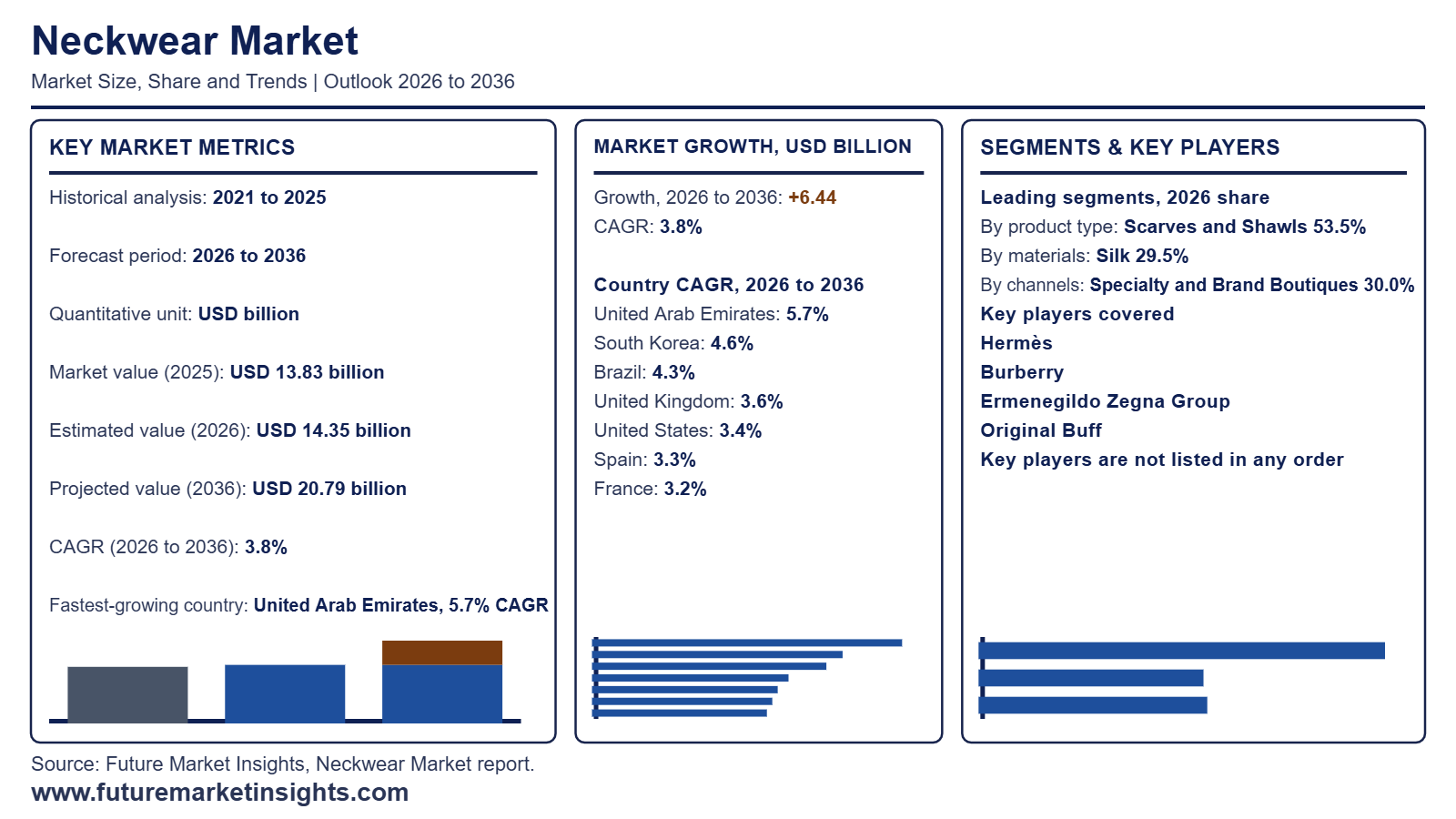
Executive Market Overview
Purchases of neckwear are driven by luxury scarf buying along with a return of the tie among younger shoppers. Scarves and shawls make up 53.5% of global sales in 2026, FMI estimates. The United States is the largest country market at 18.8%, with Japan next at 8.7%, and specialty and brand boutiques handle 30.0% of sales. Hermès (February 2026) reported 4.7% growth in sales of silk and textiles at constant exchange rates in 2025. Luxury demand gathered pace in 2026, with the same category up 9.7% at constant rates in the first half, per Hermès (July 2026). Ties are recovering from a low base in Britain. TM Lewin reported a 200% rise in sales of ties over summer 2026, according to The Guardian (October 2026).
Shoppers buy neckwear to complete an outfit and keep warm, as well as for gifting and for protection during outdoor sport. Prices range from mass polyester ties to luxury silk squares. At the mid-market level, Marks & Spencer (November 2026) features an Autograph Pure Cashmere Scarf at GBP 55 (USD 72.5) in the Christmas campaign. Within that range, scarves and outdoor neck gaiters offer the largest value gains. FMI projects merino and recycled performance blends to expand at a 6.5% CAGR and online retail at 6.2%, both faster than the 3.8% overall market CAGR. Neckties, by contrast, lag at a 2.1% CAGR. Market sizing covers scarves and shawls, neckties and neck gaiters, bow ties and pocket squares, along with neckerchiefs and bandanas. Hats and gloves are excluded, as are hair accessories, medical collars, certified protective balaclavas and jewelry chokers.
Analyst Perspective
"Sales of neckwear are likely to grow faster in value than in units as buyers trade up to silk and cashmere scarves, along with branded performance gaiters. The clearest commercial risk is the steady loosening of office dress codes, which removes the daily tie from many wardrobes."
- Rahul Pandita, Principal Consultant, Future Market Insights (FMI)
Major Market Trends and Insights
Luxury Houses Build Dedicated Scarf Spaces in Stores: Luxury brands are giving scarves more floor space as the category outperforms. Burberry (May 2026) opened 200 scarf bars during the 52 weeks to 28 March 2026, and outerwear and scarves both grew by double digits in the second half. Hermès is using new stores to launch special silk designs. When Maison Bond Street opened in London, Hermès reinterpreted the Bouquet Final and Cocoricooooo scarves and released The New Hermès Record scarf in an exclusive edition, per Hermès (July 2026).
Younger Buyers Revive the Tie: The necktie is regaining ground as younger men choose formal dress by preference. The Guardian (October 2026) reports that the tie revival is led by a younger generation returning to formal codes of dress. TM Lewin managing director Dan Ferris described ties as an add-on purchase with suits, in louder colors and prints, according to AOL (October 2026). James Sleater, owner of Savile Row tailor Norton & Sons, told The Guardian (September 2026) that the shop is selling more neckwear this year than in previous years. Retailers in the men's suits market are pairing ties with tailoring to lift basket size.
Outdoor Neckwear Expands into Safety and New Categories: Performance neckwear brands are moving into professional and adjacent markets. Ocean Safety (September 2026) became the exclusive UK distributor of BUFF Safety, which includes flame-resistant and arc flash-rated neckwear and balaclavas for commercial marine customers. Buff launched a first performance sock collection of six styles in June 2026, built on CoolNet and DryFlx, along with merino fabrics used in the brand's neckwear, per Trail & Kale (June 2026). These moves bring neck gaiter fabrics into the outdoor apparel market more broadly.
What Are the Main Drivers, Restraints, and Opportunities?
Luxury scarf demand and a renewed interest in ties among young men support growth, along with outdoor and work uses for gaiters. Relaxed office dress codes limit daily tie wear, so scarves and gaiters, along with online sales, offer the strongest gains.
Driver: Luxury Scarves, Gifting and Silk Craftsmanship
Silk scarves remain a core luxury product, and the supply base is concentrated in Europe. UNESCO (2026) states that about 70% of European silk is produced in the Como district, home to about 1,400 silk companies with more than 15,000 employees. Brand demand is strong at the top end. Hermès (February 2026) reported EUR 964 million (USD 1.06 billion) in sales of silk and textiles in 2025. Gifting adds a seasonal peak, as retailers such as Marks & Spencer feature cashmere scarves in Christmas campaigns.
Restraint: Relaxed Dress Codes in Offices and Parliaments
Formal dress rules that once guaranteed tie demand are being relaxed. Japan's Ministry of the Environment (April 2026) ran Cool Biz light office dress at the ministry from 1 May to 30 September 2026 and asked employers to support comfortable light dress beyond those dates. Britain moved in the same direction. Britain's upper chamber, the Lords, dropped the requirement for men to wear a tie in favor of business attire, as The Guardian (September 2026) reports. Norton & Sons told the newspaper that tie wearing at the office fell sharply after the pandemic.
Opportunity: Gulf Luxury Retail and Asian Fashion Markets
Luxury retail growth in the Gulf and fashion demand in Asia offer the fastest expansion. FMI projects the United Arab Emirates to expand at a 5.7% CAGR and South Korea at 4.6%, the two fastest rates in the country table. Luxury menswear groups are seeing this demand already. CPP-Luxury (February 2026) reports that direct-to-consumer sales of the ZEGNA brand in the fourth quarter of 2025 were driven by EMEA, particularly the Middle East, along with the Americas.
How Is the Neckwear Market Segmented?
The global neckwear market is segmented by product type, material, distribution channel, and region, with every scarf, tie, gaiter and bandana measured as one unit for volume comparison.
| Segmentation Axis | Sub-Segments Covered | 2026 Leading Segment & Share | Main Growth Benchmark (2026 to 2036) |
|---|---|---|---|
| Product Type | Scarves and Shawls, Neckties, Neck Gaiters and Tube Scarves, Neckerchiefs and Bandanas, Bow Ties and Pocket Squares | Scarves and Shawls (53.5% share) | Neck Gaiters and Tube Scarves grow fastest at a 5.8% CAGR |
| Material | Silk, Wool and Cashmere, Polyester and Microfiber, Cotton and Linen, Merino and Recycled Performance Blends | Silk (29.5% share) | Merino and Recycled Performance Blends (6.5% CAGR) vs. Silk (3.6% CAGR) |
| Distribution Channel | Specialty and Brand Boutiques, Department Stores, Online Retail, Mass Merchants and Discount Stores, Sporting Goods and Outdoor Stores | Specialty and Brand Boutiques (30.0% share) | Online Retail grows fastest at a 6.2% CAGR |
| Region | Europe, East Asia, North America, South Asia & Pacific, Latin America, Middle East & Africa | Europe (34.4% global share) | South Asia & Pacific (5.4% CAGR) and Middle East & Africa (5.2% CAGR) grow fastest |
Source: Future Market Insights analysis of the neckwear market, 2026.
Why Does the Scarves and Shawls Segment Lead by Product Type?
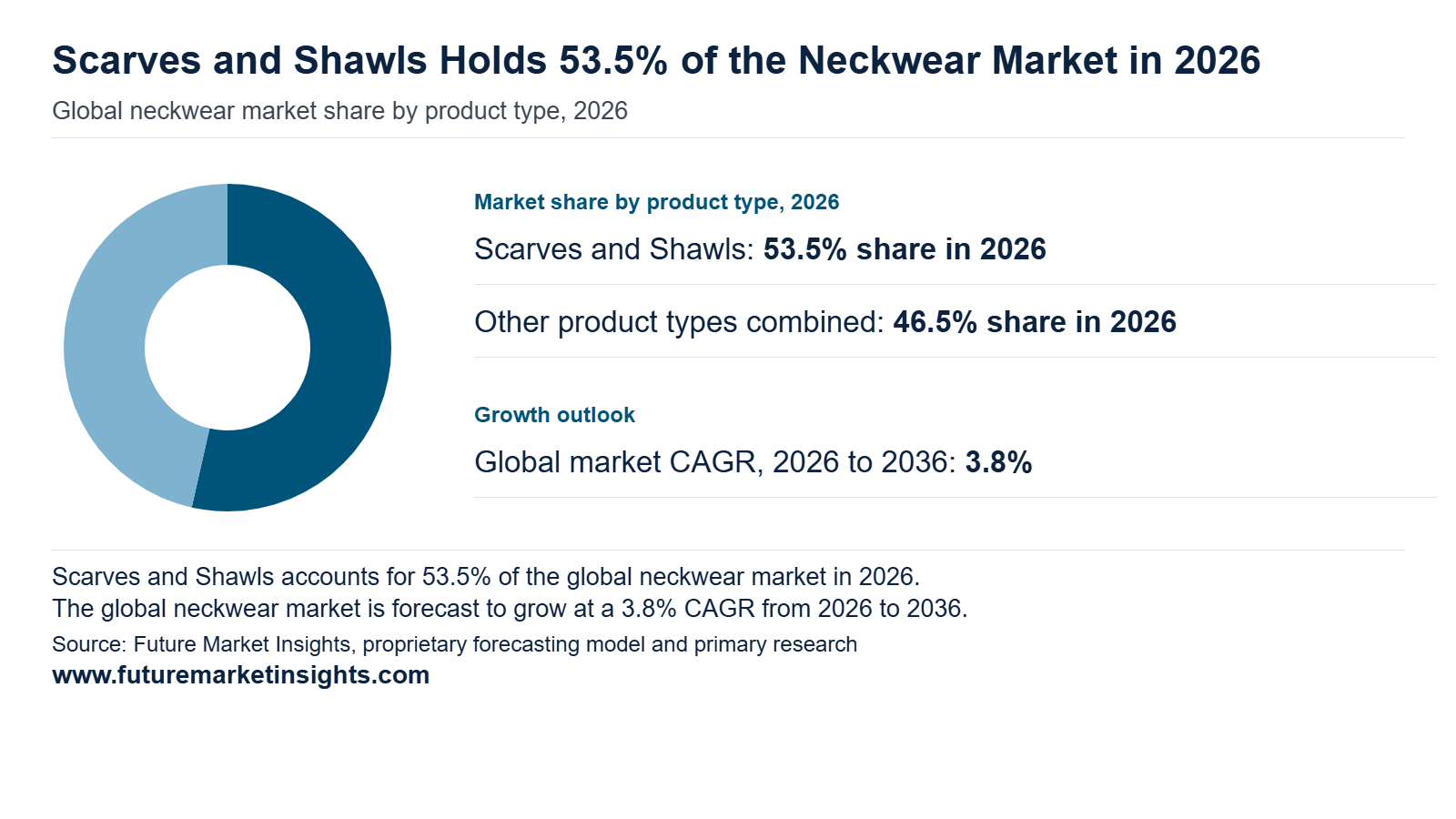
Scarves and shawls represent 53.5% of 2026 neckwear sales, moving to 54.5% by 2036, growing at a 4.0% CAGR. Women and men buy scarves for warmth and style, and luxury houses sell them at high prices. Burberry built 200 scarf bars during fiscal 2026 to sell the category alongside outerwear (Burberry, May 2026). Neck gaiters and tube scarves post the fastest product growth, a 5.8% CAGR, as runners and cyclists, along with site workers, adopt them. Neckties are expected to lose share, from 20.0% to 17.0%.
Why Does the Silk Segment Lead by Material?
Silk accounts for 29.5% of 2026 sales by material, ahead of wool and cashmere at 27.5%. Silk is the main fabric for luxury squares and ties, and the Como district supplies most European silk, per UNESCO (2026). The segment is expected to grow at a 3.6% CAGR. Merino and recycled performance blends lead material growth with a 6.5% CAGR, lifting the share from 5.0% to 6.5%. Buff uses merino fabric across neckwear and the new sock range, according to Trail & Kale (June 2026), which links the segment to the merino wool market.
Why Does the Specialty and Brand Boutiques Segment Lead by Distribution Channel?
Specialty and brand boutiques account for 30.0% of global neckwear sales in 2026. Luxury scarves and ties sell mainly in brand stores, and staff there help buyers choose colors and patterns. ZEGNA had 282 directly operated stores at the close of 2025, per CPP-Luxury (February 2026). Department stores hold 23.5% of sales but are losing share. Online retail is the fastest-growing channel, with a 6.2% CAGR, as brands sell limited scarf editions and gaiter colorways through brand websites.
Neckwear Market by Region and Country (2026 to 2036)
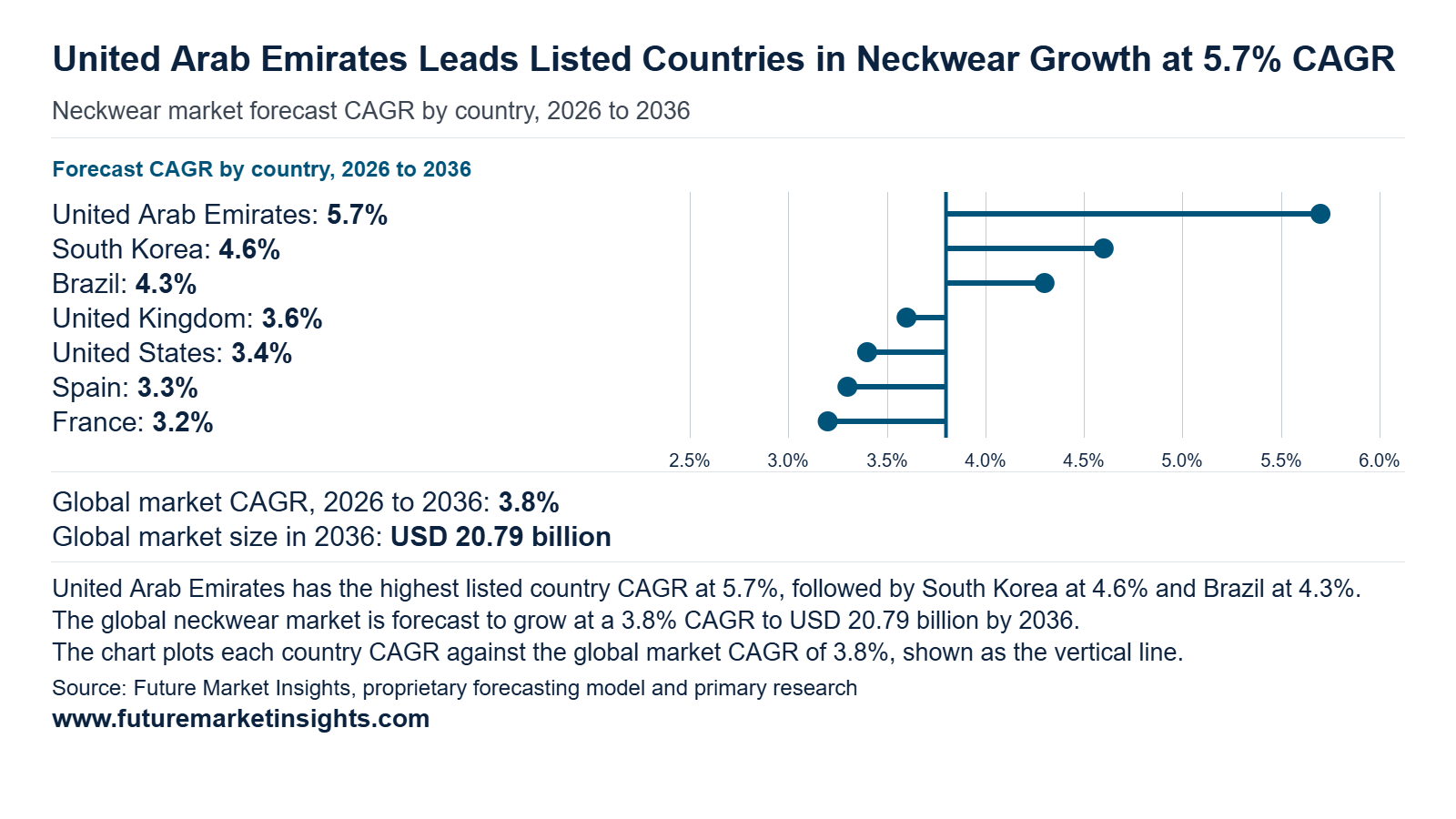
Europe is the largest neckwear region, with 34.4% of global sales in 2026, and the United States leads all countries at 18.8%. Core-country concentration eases slightly, with the ten markets in the table moving from 59.6% of global sales in 2026 to 57.0% in 2036. Over the period, the American market contributes USD 1.07 billion, or 16.6% of global growth. South Asia and Pacific is expected to post the fastest regional growth, a 5.4% CAGR. Middle East and Africa is set to grow from USD 0.78 billion in 2026 to USD 1.30 billion by 2036, led by Gulf luxury retail.
| Country | 2026 Revenue | 2036 Revenue | 10-Year Addition | 2026 to 2036 CAGR | Global Share (2026 → 2036) |
|---|---|---|---|---|---|
| United Arab Emirates | USD 0.30 billion | USD 0.52 billion | +USD 0.22 billion | 5.7% | 2.1% → 2.5% |
| South Korea | USD 0.48 billion | USD 0.75 billion | +USD 0.27 billion | 4.6% | 3.3% → 3.6% |
| Brazil | USD 0.38 billion | USD 0.58 billion | +USD 0.20 billion | 4.3% | 2.6% → 2.8% |
| United Kingdom | USD 0.76 billion | USD 1.08 billion | +USD 0.32 billion | 3.6% | 5.3% → 5.2% |
| United States | USD 2.70 billion | USD 3.77 billion | +USD 1.07 billion | 3.4% | 18.8% → 18.1% |
| Spain | USD 0.36 billion | USD 0.50 billion | +USD 0.14 billion | 3.3% | 2.5% → 2.4% |
| France | USD 0.72 billion | USD 0.99 billion | +USD 0.27 billion | 3.2% | 5.0% → 4.8% |
| Italy | USD 0.82 billion | USD 1.10 billion | +USD 0.28 billion | 3.0% | 5.7% → 5.3% |
| Germany | USD 0.78 billion | USD 1.03 billion | +USD 0.25 billion | 2.8% | 5.4% → 5.0% |
| Japan | USD 1.25 billion | USD 1.52 billion | +USD 0.27 billion | 2.0% | 8.7% → 7.3% |
Source: Future Market Insights analysis of the neckwear market, 2026.
United States
The United States is the largest neckwear market by country, with sales projected to rise from USD 2.70 billion in 2026 to USD 3.77 billion by 2036 at a 3.4% CAGR. The country's portion of world sales edges down from 18.8% to 18.1%. Luxury menswear demand is firm, as sales of the Zegna Group in the Americas rose 7.9% to EUR 566.1 million (USD 623.5 million) in 2025, per CPP-Luxury (February 2026). Winter scarves and holiday gifting make up much of American purchases.
Japan
Japan is the second-largest neckwear market, with sales expected to grow from USD 1.25 billion in 2026 to USD 1.52 billion by 2036. The 2.0% CAGR is the lowest among core countries, as the Cool Biz light dress campaign reduces tie wear in offices during summer. The Ministry of the Environment (April 2026) is promoting an office dress reform that lets workers choose clothing to suit the occasion. Scarves and stoles sell steadily through department stores in winter.
Italy
Italy is projected to grow at a 3.0% CAGR, from USD 0.82 billion in 2026 to USD 1.10 billion by 2036. The country is the main European producer of silk ties and scarves, and the Como textile district has an estimated turnover of USD 2.28 billion, according to UNESCO (2026). Domestic demand is mature, so Italian makers rely heavily on exports.
Germany
Germany is likely to grow from USD 0.78 billion in 2026 to USD 1.03 billion by 2036, a 2.8% CAGR that adds USD 0.25 billion. Cold winters support purchases of wool scarves. Department stores and online fashion platforms sell most pieces. Tie demand is weaker than before the pandemic, as in other Western European markets.
United Kingdom
The United Kingdom is forecast to grow from USD 0.76 billion in 2026 to USD 1.08 billion by 2036, a 3.6% CAGR, a faster pace than Germany or Italy. TM Lewin has started to reopen stores after closing all 66 shops during the pandemic, per AOL (October 2026). Burberry, based in London, reported sales of GBP 2,420 million (USD 3.19 billion) for the year to March 2026, with scarves outperforming (Burberry, May 2026).
France
Sales in France are projected to increase at a 3.2% CAGR, from USD 0.72 billion in 2026 to USD 0.99 billion by 2036. France is home to Hermès, whose sales of silk and textiles reached EUR 469 million (USD 516.6 million) in the first half of 2026 (Hermès, July 2026). Tourist purchases in Paris add to domestic demand for silk squares.
South Korea
South Korea is projected to expand at a 4.6% CAGR, the second-fastest pace in the country table, with sales rising from USD 0.48 billion in 2026 to USD 0.75 billion by 2036. Luxury accessories and fashion scarves sell strongly through department stores in Seoul. Online channels are likely to gain share faster here than in most other markets.
Brazil
Sales in Brazil are set to rise at a 4.3% CAGR, from USD 0.38 billion in 2026 to USD 0.58 billion by 2036. Brazil's warm climate limits winter scarf demand, so light cotton and silk scarves and office ties make up most purchases. Gifting around year-end holidays is the main sales peak.
Spain
Spain is expected to add USD 0.14 billion by 2036, with sales growing from USD 0.36 billion in 2026 to USD 0.50 billion (3.3% CAGR). The country is the home of Buff, the Spanish brand behind the original multifunctional neck gaiter, based in the Barcelona area, per Trail & Kale (June 2026). Outdoor neckwear sells well in Spain through sports chains.
United Arab Emirates
The United Arab Emirates posts the quickest growth among core neckwear markets, a 5.7% CAGR, with sales rising 1.73-fold from USD 0.30 billion in 2026 to USD 0.52 billion by 2036. Luxury malls and airport duty-free stores sell silk scarves and designer ties to residents and travelers. The Middle East helped lift sales at ZEGNA stores at the end of 2025 (CPP-Luxury, February 2026).
Competitive Environment and Notable Companies
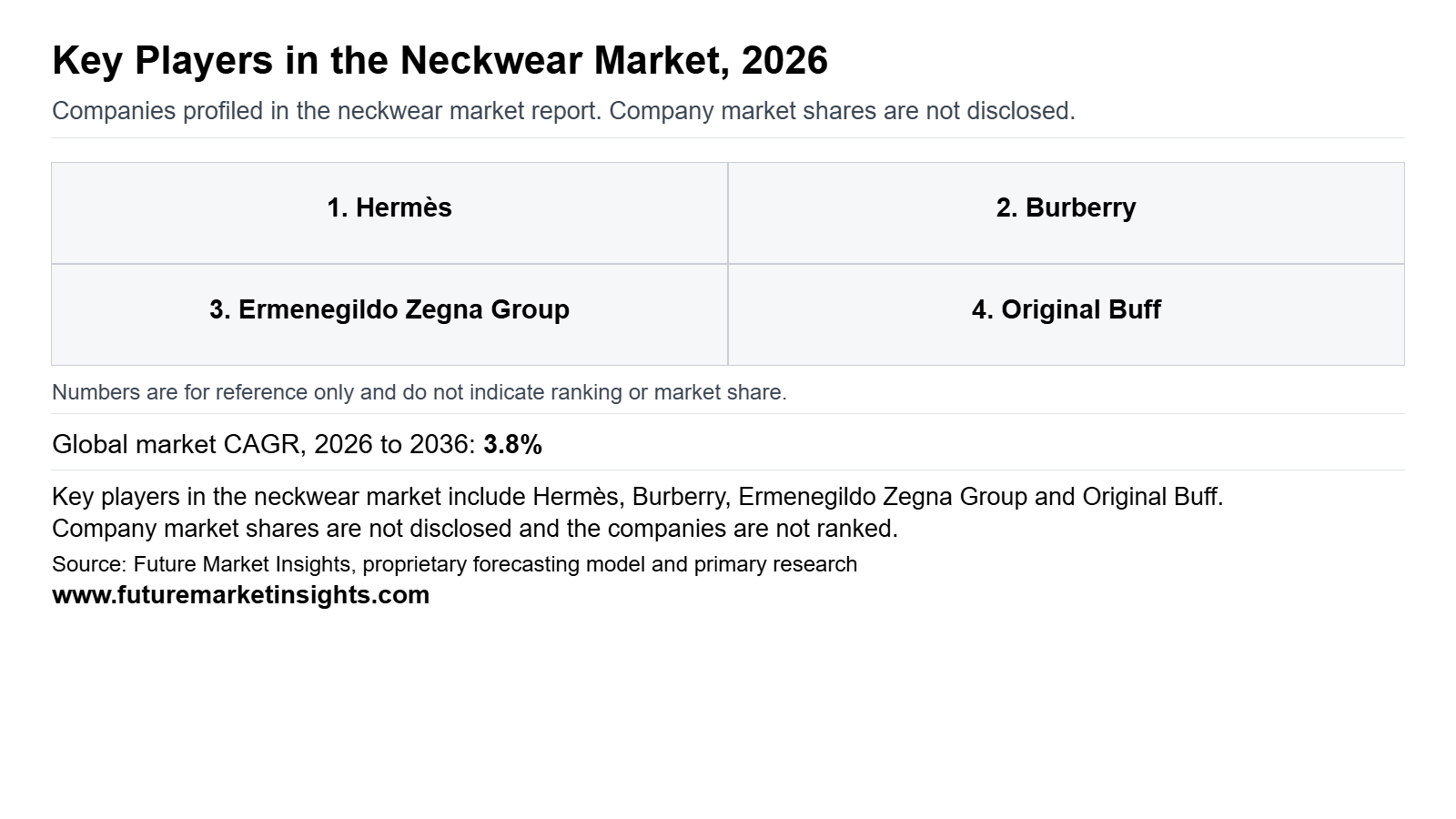
Major neckwear companies include Hermès and Burberry, along with the Ermenegildo Zegna Group and Original Buff. Mid-market retailers, including Marks & Spencer and TM Lewin, sell mid-priced ties and scarves in large volumes. Competition splits between luxury and function. Luxury houses compete on design and silk craftsmanship through brand stores, and outdoor brands compete on fabric technology through sports retailers. The tie business is more fragmented, with tailors and shirt retailers selling ties as add-on purchases.
How Are Companies Positioned in the Neckwear Market?
Hermès is a leading seller of luxury silk scarves and reported silk and textiles turnover of EUR 964 million (USD 1.06 billion) in 2025, per Hermès (February 2026). Burberry (May 2026) is rebuilding around outerwear and scarves, with scarves outperforming over fiscal 2026. The Ermenegildo Zegna Group reported 2025 sales of EUR 1,916.9 million (USD 2.11 billion), per CPP-Luxury (February 2026). Original Buff leads multifunctional neck gaiters and is moving into professional safety neckwear (Ocean Safety, September 2026).
What Matters When a Buyer Selects a Neckwear Brand?
Buyers compare fabric quality and design, along with price. Luxury buyers look for limited editions and brand heritage, as with the London scarf editions Hermès released at Maison Bond Street (Hermès, July 2026). Professional buyers of safety neckwear check certification, and BUFF Safety products have arc flash and flame-resistant ratings for commercial marine work, per Ocean Safety (September 2026). Tie buyers want bolder designs, per TM Lewin (AOL, October 2026).
Which Capabilities Distinguish Product Offers?
Neckwear offers vary by fabric technology and design archive, along with store format. Hermès draws on a large archive of scarf designs. Buff applies cooling and quick-dry fabric technologies across neckwear and socks (Trail & Kale, June 2026). Burberry sells scarves through dedicated in-store bars, and Marks & Spencer sells cashmere scarves at mass-market prices.
How Does Geographic Reach Affect Competition?
Luxury houses sell neckwear in many countries through owned boutiques, and ZEGNA alone ran 282 own stores as 2025 closed (CPP-Luxury, February 2026). European silk makers depend on export markets, since Italian and French brands sell most scarves abroad. Outdoor neckwear brands use distributors in each country, as Buff did with Ocean Safety in the UK. FMI expects the largest share increases among brands with store networks in the Gulf and East Asia.
| Verified Company Evidence (2026) | Commercial Effect | Buyer Action |
|---|---|---|
| 14 May 2026: Burberry reported opening 200 scarf bars in the year to March 2026, with outerwear and scarves up double digits in the second half (Burberry, May 2026). | Gives scarves dedicated selling space in luxury stores. | Review in-store scarf displays and cross-selling with outerwear. |
| 17 June 2026: Buff launched a first performance sock collection of six styles using neckwear fabrics (Trail & Kale, June 2026). | Extends a neckwear brand into new accessories. | Bundle gaiters and socks in outdoor and running displays. |
| 29 July 2026: Hermès reported first-half sales of silk and textiles at EUR 469 million (USD 516.6 million), up 9.7% at constant rates, and released London editions of scarves (Hermès, July 2026). | Confirms strong luxury demand for silk scarves. | Plan limited scarf editions around store openings and events. |
| 9 September 2026: Ocean Safety became exclusive UK distributor of BUFF Safety certified head and neck protection (Ocean Safety, September 2026). | Opens a professional channel for performance neckwear. | Assess certified neckwear for marine and offshore crews. |
| Summer 2026: TM Lewin recorded a 200% year-on-year rise in sales of ties (The Guardian, October 2026). | Signals renewed tie demand among younger shoppers. | Expand patterned tie ranges next to suits and shirts. |
Source: Verified corporate disclosures and Future Market Insights analysis, 2026.
| Company | Core Positioning | Verified Activity & Source Attribution |
|---|---|---|
| Hermès | Luxury silk scarves and ties | Sales of silk and textiles reached EUR 964 million (USD 1.06 billion) in 2025 (Hermès, February 2026). |
| Burberry | Luxury scarves and outerwear | Opened 200 scarf bars in the year to March 2026 (Burberry, May 2026). |
| Ermenegildo Zegna Group | Luxury menswear including ties | 2025 sales of EUR 1,916.9 million (USD 2.11 billion) (CPP-Luxury, February 2026). |
| Original Buff | Multifunctional neck gaiters and safety neckwear | Exclusive UK distribution of BUFF Safety through Ocean Safety (Ocean Safety, September 2026). |
| Marks & Spencer | Mass-market scarves and ties | Featured a GBP 55 (USD 72.5) cashmere scarf in the 2026 Christmas campaign (Marks & Spencer, November 2026). |
| TM Lewin | Shirts, suits and ties | Sales of ties up 200% year on year in summer 2026 (The Guardian, October 2026). |
Source: Verified corporate disclosures and Future Market Insights analysis, 2026.
Neckwear Market Report Scope and Research Methodology
The neckwear estimate starts from the pieces sold in each country, multiplied by the average price paid in stores, online or through wholesale. Company results and retailer statements, along with textile industry data, are used to test the figures. Data for the United States and Western Europe weigh most heavily, given the depth of company reporting there. Scarves, ties, gaiters and bandanas are recorded as one unit apiece. Values are recorded in the country of sale, and the country and segment series sum to the global total every year. Company announcements confirm launches and positioning, and no company-level sales estimates are made.
| Coverage Field | Report Scope |
|---|---|
| Market definition | Accessories worn around the neck for style, warmth, formal dress or outdoor protection, sold to adults and children. |
| Product types | Scarves and shawls, neckties, neck gaiters and tube scarves, neckerchiefs and bandanas, bow ties and pocket squares. |
| Materials | Silk, wool and cashmere, polyester and microfiber, cotton and linen, merino and recycled performance blends. |
| Features included | Printed and woven silk, knitted and brushed wool, cooling and moisture-wicking fabrics, sun-protective fabrics. |
| Price tiers | Mass, mid-range, premium and luxury. |
| Distribution channels | Specialty and brand boutiques, department stores, online retail, mass merchants and discount stores, sporting goods and outdoor stores. |
| End users | Women, men and children, along with outdoor and sports users. |
| Exclusions | Hats and gloves, hair accessories, medical collars, certified protective balaclavas and jewelry chokers. |
| Quantitative units | USD billion for value, million units for volume. |
| Volume basis | Pieces sold. |
| Value basis | Sales to buyers in each country, measured in the country of purchase. |
| Regions covered | Europe, East Asia, North America, South Asia and Pacific, Latin America, Middle East and Africa. |
| National coverage | United States, Japan, Italy, Germany, United Kingdom, France, South Korea, Brazil, Spain and United Arab Emirates. |
| Companies covered | Hermès, Burberry, Ermenegildo Zegna Group, Original Buff, Marks & Spencer and TM Lewin. |
Source: Future Market Insights analysis of the neckwear market, 2026.
Research Sources and Bibliography
- AOL. (2026, October 5). Ties back in fashion as men smarten up post-pandemic.
- Burberry. (2026, May 14). Preliminary results for 52 weeks ended 28 March 2026.
- CPP-Luxury. (2026, February 2). Ermenegildo Zegna Group 2025 revenues at 1.91 billion euros, down 1.5 percent.
- Hermès. (2026, February 12). 2025 full-year results.
- Hermès. (2026, July 29). First half results 2026.
- Marks & Spencer. (2026, November 5). M&S launches The Home of Christmas, uniting food, fashion, home and beauty in one campaign. https://corporate.marksandspencer.com/newsroom/press-releases/ms-launches-home-christmas-uniting-food-fashion-home-and-beauty-one
- Ministry of the Environment, Japan. (2026, April 21). Cool Biz in fiscal 2026 [translated title]. https://www.env.go.jp/press/press_04384.html
- Ocean Safety. (2026, September 9). Ocean Safety appointed exclusive UK distributor for BUFF Safety. https://www.oceansafety.com/latest-news/ocean-safety-appointed-exclusive-uk-distributor-for-buff-safety
- The Guardian. (2026, September 18). Is the tie dead? Fashion connoisseurs hope not as House of Lords relaxes rules. https://www.theguardian.com/politics/2026/sep/18/is-the-tie-dead-fashion-connoisseurs-house-of-lords-relaxes-rules
- The Guardian. (2026, October 7). Ties are back in fashion, thanks to gen Z. https://www.theguardian.com/fashion/2026/oct/07/ties-fashion-gen-z
- Trail & Kale. (2026, June 17). BUFF launches its first performance sock collection. https://trailandkale.com/buff-performance-socks-launch/
- UNESCO. (2026). Como, Creative Cities Network profile. https://www.unesco.org/en/creative-cities/como
Table of Content
- Key Takeaways
- Market Size and CAGR
- Top Growth Driver
- Fastest Growing Segment
- Leading Region
- Key Companies
- Emerging Opportunities
- Executive Summary
- Global Market Outlook
- Demand-side Trends
- Supply-side Trends
- Technology Roadmap Analysis
- Analysis and Recommendations
- Analyst Perspective (What is happening? Why now? What should investors know?)
Read More...
- Key Questions Answered
- How large is the market?
- What is the CAGR?
- What are key trends?
- Which region dominates?
- Who are the leaders?
- Market Overview
- Market Coverage / Taxonomy
- Market Definition / Scope / Limitations
- Research Methodology
- Chapter Orientation
- Analytical Lens and Working Hypotheses
- Market Structure, Signals, and Trend Drivers
- Benchmarking and Cross-market Comparability
- Market Sizing, Forecasting, and Opportunity Mapping
- Research Design and Evidence Framework
- Desk Research Program (Secondary Evidence)
- Expert Input and Fieldwork (Primary Evidence)
- Tooling, Models, and Reference Databases
- Data Engineering and Model Build
- Quality Assurance and Audit Trail
- Market Background
- Market Dynamics (Drivers, Restraints, Opportunity, Trends)
- Scenario Forecast (Optimistic, Likely, Conservative)
- Impact Analysis
- AI Impact
- Sustainability Impact
- Regulatory Impact
- Technology Impact
- Consumer / Buyer Analysis
- Purchase Drivers
- Adoption Barriers
- Buyer Journey
- Opportunity Map Analysis
- Product Life Cycle Analysis
- Supply Chain Analysis
- Investment Feasibility Matrix
- Value Chain Analysis
- PESTLE and Porter's Analysis
- Regulatory Landscape
- Regional Parent Market Outlook
- Production and Consumption Statistics
- Import and Export Statistics
- Global Market Analysis and Forecast, 2021 to 2036
- Historical Market Size Value (USD Billion) Analysis, 2021 to 2025
- Current and Future Market Size Value (USD Billion) Projections, 2026 to 2036
- Y-o-Y Growth Trend Analysis
- Absolute $ Opportunity Analysis
- Global Market Pricing Analysis, 2021 to 2036
- Global Market Analysis and Forecast, By Product Type, 2021 to 2036
- Introduction / Key Findings
- Historical Market Size Value (USD Billion) Analysis By Product Type, 2021 to 2025
- Current and Future Market Size Value (USD Billion) Analysis and Forecast By Product Type, 2026 to 2036
- Scarves and Shawls
- Neckties
- Neck Gaiters and Tube Scarves
- Neckerchiefs and Bandanas
- Bow Ties and Pocket Squares
- Y-o-Y Growth Trend Analysis By Product Type, 2021 to 2025
- Absolute $ Opportunity Analysis By Product Type, 2026 to 2036
- Global Market Analysis and Forecast, By Material, 2021 to 2036
- Introduction / Key Findings
- Historical Market Size Value (USD Billion) Analysis By Material, 2021 to 2025
- Current and Future Market Size Value (USD Billion) Analysis and Forecast By Material, 2026 to 2036
- Silk
- Wool and Cashmere
- Polyester and Microfiber
- Cotton and Linen
- Merino and Recycled Performance Blends
- Y-o-Y Growth Trend Analysis By Material, 2021 to 2025
- Absolute $ Opportunity Analysis By Material, 2026 to 2036
- Global Market Analysis and Forecast, By Distribution Channel, 2021 to 2036
- Introduction / Key Findings
- Historical Market Size Value (USD Billion) Analysis By Distribution Channel, 2021 to 2025
- Current and Future Market Size Value (USD Billion) Analysis and Forecast By Distribution Channel, 2026 to 2036
- Specialty and Brand Boutiques
- Department Stores
- Online Retail
- Mass Merchants and Discount Stores
- Sporting Goods and Outdoor Stores
- Y-o-Y Growth Trend Analysis By Distribution Channel, 2021 to 2025
- Absolute $ Opportunity Analysis By Distribution Channel, 2026 to 2036
- Global Market Analysis and Forecast, By Region, 2021 to 2036
- Introduction
- Historical Market Size Value (USD Billion) Analysis By Region, 2021 to 2025
- Current Market Size Value (USD Billion) Analysis and Forecast By Region, 2026 to 2036
- North America
- Europe
- East Asia
- South Asia and Pacific
- Latin America
- Middle East and Africa
- Market Attractiveness Analysis By Region
- North America Market Analysis and Forecast, By Country, 2021 to 2036
- Historical Market Size Value (USD Billion) Trend Analysis By Market Taxonomy, 2021 to 2025
- Market Size Value (USD Billion) Forecast By Market Taxonomy, 2026 to 2036
- By Country
- United States
- Canada
- By Product Type
- By Material
- By Distribution Channel
- By Country
- Market Attractiveness Analysis
- By Country
- By Product Type
- By Material
- By Distribution Channel
- Key Takeaways
- Europe Market Analysis and Forecast, By Country, 2021 to 2036
- Historical Market Size Value (USD Billion) Trend Analysis By Market Taxonomy, 2021 to 2025
- Market Size Value (USD Billion) Forecast By Market Taxonomy, 2026 to 2036
- By Country
- Italy
- Germany
- United Kingdom
- France
- Spain
- Rest of Europe
- By Product Type
- By Material
- By Distribution Channel
- By Country
- Market Attractiveness Analysis
- By Country
- By Product Type
- By Material
- By Distribution Channel
- Key Takeaways
- East Asia Market Analysis and Forecast, By Country, 2021 to 2036
- Historical Market Size Value (USD Billion) Trend Analysis By Market Taxonomy, 2021 to 2025
- Market Size Value (USD Billion) Forecast By Market Taxonomy, 2026 to 2036
- By Country
- Japan
- South Korea
- Rest of East Asia
- By Product Type
- By Material
- By Distribution Channel
- By Country
- Market Attractiveness Analysis
- By Country
- By Product Type
- By Material
- By Distribution Channel
- Key Takeaways
- Latin America Market Analysis and Forecast, By Country, 2021 to 2036
- Historical Market Size Value (USD Billion) Trend Analysis By Market Taxonomy, 2021 to 2025
- Market Size Value (USD Billion) Forecast By Market Taxonomy, 2026 to 2036
- By Country
- Brazil
- Rest of Latin America
- By Product Type
- By Material
- By Distribution Channel
- By Country
- Market Attractiveness Analysis
- By Country
- By Product Type
- By Material
- By Distribution Channel
- Key Takeaways
- Middle East and Africa Market Analysis and Forecast, By Country, 2021 to 2036
- Historical Market Size Value (USD Billion) Trend Analysis By Market Taxonomy, 2021 to 2025
- Market Size Value (USD Billion) Forecast By Market Taxonomy, 2026 to 2036
- By Country
- United Arab Emirates
- Rest of Middle East and Africa
- By Product Type
- By Material
- By Distribution Channel
- By Country
- Market Attractiveness Analysis
- By Country
- By Product Type
- By Material
- By Distribution Channel
- Key Takeaways
- Key Countries Market Analysis
- United States
- Pricing Analysis
- Market Share Analysis, 2025
- By Product Type
- By Material
- By Distribution Channel
- Japan
- Pricing Analysis
- Market Share Analysis, 2025
- By Product Type
- By Material
- By Distribution Channel
- Italy
- Pricing Analysis
- Market Share Analysis, 2025
- By Product Type
- By Material
- By Distribution Channel
- Germany
- Pricing Analysis
- Market Share Analysis, 2025
- By Product Type
- By Material
- By Distribution Channel
- United Kingdom
- Pricing Analysis
- Market Share Analysis, 2025
- By Product Type
- By Material
- By Distribution Channel
- France
- Pricing Analysis
- Market Share Analysis, 2025
- By Product Type
- By Material
- By Distribution Channel
- South Korea
- Pricing Analysis
- Market Share Analysis, 2025
- By Product Type
- By Material
- By Distribution Channel
- Brazil
- Pricing Analysis
- Market Share Analysis, 2025
- By Product Type
- By Material
- By Distribution Channel
- Spain
- Pricing Analysis
- Market Share Analysis, 2025
- By Product Type
- By Material
- By Distribution Channel
- United Arab Emirates
- Pricing Analysis
- Market Share Analysis, 2025
- By Product Type
- By Material
- By Distribution Channel
- United States
- Market Structure Analysis
- Competition Dashboard
- Competition Benchmarking
- Market Share Analysis of Top Players
- By Regional
- By Product Type
- By Material
- By Distribution Channel
- Emerging Startups
- Innovation Benchmarking
- Competition Analysis
- Competition Deep Dive
- Hermès
- Overview
- Product Portfolio
- Profitability by Market Segments
- Sales Footprint
- Strategy Overview
- Marketing Strategy
- Product Strategy
- Channel Strategy
- Burberry
- Ermenegildo Zegna Group
- Original Buff
- Marks & Spencer
- TM Lewin
- Hermès
- Competition Deep Dive
- Case Studies
- Success Stories
- Recent Developments
- Assumptions & Acronyms Used
List of Tables
- Table 1: Global Market Value (USD Billion) Forecast by Region, 2021 to 2036
- Table 2: Global Market Value (USD Billion) Forecast by Product Type, 2021 to 2036
- Table 3: Global Market Value (USD Billion) Forecast by Material, 2021 to 2036
- Table 4: Global Market Value (USD Billion) Forecast by Distribution Channel, 2021 to 2036
- Table 5: Global Market Volume (Million Units) Forecast by Region, 2021 to 2036
- Table 6: North America Market Value (USD Billion) Forecast by Country, 2021 to 2036
- Table 7: North America Market Value (USD Billion) Forecast by Product Type, 2021 to 2036
- Table 8: North America Market Value (USD Billion) Forecast by Material, 2021 to 2036
- Table 9: North America Market Value (USD Billion) Forecast by Distribution Channel, 2021 to 2036
- Table 10: Europe Market Value (USD Billion) Forecast by Country, 2021 to 2036
- Table 11: Europe Market Value (USD Billion) Forecast by Product Type, 2021 to 2036
- Table 12: Europe Market Value (USD Billion) Forecast by Material, 2021 to 2036
- Table 13: Europe Market Value (USD Billion) Forecast by Distribution Channel, 2021 to 2036
- Table 14: East Asia Market Value (USD Billion) Forecast by Country, 2021 to 2036
- Table 15: East Asia Market Value (USD Billion) Forecast by Product Type, 2021 to 2036
- Table 16: East Asia Market Value (USD Billion) Forecast by Material, 2021 to 2036
- Table 17: East Asia Market Value (USD Billion) Forecast by Distribution Channel, 2021 to 2036
- Table 18: Latin America Market Value (USD Billion) Forecast by Country, 2021 to 2036
- Table 19: Latin America Market Value (USD Billion) Forecast by Product Type, 2021 to 2036
- Table 20: Latin America Market Value (USD Billion) Forecast by Material, 2021 to 2036
- Table 21: Latin America Market Value (USD Billion) Forecast by Distribution Channel, 2021 to 2036
- Table 22: Middle East and Africa Market Value (USD Billion) Forecast by Country, 2021 to 2036
- Table 23: Middle East and Africa Market Value (USD Billion) Forecast by Product Type, 2021 to 2036
- Table 24: Middle East and Africa Market Value (USD Billion) Forecast by Material, 2021 to 2036
- Table 25: Middle East and Africa Market Value (USD Billion) Forecast by Distribution Channel, 2021 to 2036
List of Figures
- Figure 1: Global Market Pricing Analysis
- Figure 2: Global Market Value (USD Billion) Forecast 2021-2036
- Figure 3: Global Market Value Share and BPS Analysis by Product Type, 2026 and 2036
- Figure 4: Global Market Y-o-Y Growth Comparison by Product Type, 2026-2036
- Figure 5: Global Market Attractiveness Analysis by Product Type
- Figure 6: Global Market Value Share and BPS Analysis by Material, 2026 and 2036
- Figure 7: Global Market Y-o-Y Growth Comparison by Material, 2026-2036
- Figure 8: Global Market Attractiveness Analysis by Material
- Figure 9: Global Market Value Share and BPS Analysis by Distribution Channel, 2026 and 2036
- Figure 10: Global Market Y-o-Y Growth Comparison by Distribution Channel, 2026-2036
- Figure 11: Global Market Attractiveness Analysis by Distribution Channel
- Figure 12: Global Market Value (USD Billion) Share and BPS Analysis by Region, 2026 and 2036
- Figure 13: Global Market Y-o-Y Growth Comparison by Region, 2026-2036
- Figure 14: Global Market Attractiveness Analysis by Region
- Figure 15: North America Market Incremental Dollar Opportunity, 2026-2036
- Figure 16: Europe Market Incremental Dollar Opportunity, 2026-2036
- Figure 17: East Asia Market Incremental Dollar Opportunity, 2026-2036
- Figure 18: Latin America Market Incremental Dollar Opportunity, 2026-2036
- Figure 19: Middle East and Africa Market Incremental Dollar Opportunity, 2026-2036
- Figure 20: North America Market Value Share and BPS Analysis by Country, 2026 and 2036
- Figure 21: North America Market Value Share and BPS Analysis by Product Type, 2026 and 2036
- Figure 22: North America Market Y-o-Y Growth Comparison by Product Type, 2026-2036
- Figure 23: North America Market Attractiveness Analysis by Product Type
- Figure 24: North America Market Value Share and BPS Analysis by Material, 2026 and 2036
- Figure 25: North America Market Y-o-Y Growth Comparison by Material, 2026-2036
- Figure 26: North America Market Attractiveness Analysis by Material
- Figure 27: North America Market Value Share and BPS Analysis by Distribution Channel, 2026 and 2036
- Figure 28: North America Market Y-o-Y Growth Comparison by Distribution Channel, 2026-2036
- Figure 29: North America Market Attractiveness Analysis by Distribution Channel
- Figure 30: Europe Market Value Share and BPS Analysis by Country, 2026 and 2036
- Figure 31: Europe Market Value Share and BPS Analysis by Product Type, 2026 and 2036
- Figure 32: Europe Market Y-o-Y Growth Comparison by Product Type, 2026-2036
- Figure 33: Europe Market Attractiveness Analysis by Product Type
- Figure 34: Europe Market Value Share and BPS Analysis by Material, 2026 and 2036
- Figure 35: Europe Market Y-o-Y Growth Comparison by Material, 2026-2036
- Figure 36: Europe Market Attractiveness Analysis by Material
- Figure 37: Europe Market Value Share and BPS Analysis by Distribution Channel, 2026 and 2036
- Figure 38: Europe Market Y-o-Y Growth Comparison by Distribution Channel, 2026-2036
- Figure 39: Europe Market Attractiveness Analysis by Distribution Channel
- Figure 40: East Asia Market Value Share and BPS Analysis by Country, 2026 and 2036
- Figure 41: East Asia Market Value Share and BPS Analysis by Product Type, 2026 and 2036
- Figure 42: East Asia Market Y-o-Y Growth Comparison by Product Type, 2026-2036
- Figure 43: East Asia Market Attractiveness Analysis by Product Type
- Figure 44: East Asia Market Value Share and BPS Analysis by Material, 2026 and 2036
- Figure 45: East Asia Market Y-o-Y Growth Comparison by Material, 2026-2036
- Figure 46: East Asia Market Attractiveness Analysis by Material
- Figure 47: East Asia Market Value Share and BPS Analysis by Distribution Channel, 2026 and 2036
- Figure 48: East Asia Market Y-o-Y Growth Comparison by Distribution Channel, 2026-2036
- Figure 49: East Asia Market Attractiveness Analysis by Distribution Channel
- Figure 50: Latin America Market Value Share and BPS Analysis by Country, 2026 and 2036
- Figure 51: Latin America Market Value Share and BPS Analysis by Product Type, 2026 and 2036
- Figure 52: Latin America Market Y-o-Y Growth Comparison by Product Type, 2026-2036
- Figure 53: Latin America Market Attractiveness Analysis by Product Type
- Figure 54: Latin America Market Value Share and BPS Analysis by Material, 2026 and 2036
- Figure 55: Latin America Market Y-o-Y Growth Comparison by Material, 2026-2036
- Figure 56: Latin America Market Attractiveness Analysis by Material
- Figure 57: Latin America Market Value Share and BPS Analysis by Distribution Channel, 2026 and 2036
- Figure 58: Latin America Market Y-o-Y Growth Comparison by Distribution Channel, 2026-2036
- Figure 59: Latin America Market Attractiveness Analysis by Distribution Channel
- Figure 60: Middle East and Africa Market Value Share and BPS Analysis by Country, 2026 and 2036
- Figure 61: Middle East and Africa Market Value Share and BPS Analysis by Product Type, 2026 and 2036
- Figure 62: Middle East and Africa Market Y-o-Y Growth Comparison by Product Type, 2026-2036
- Figure 63: Middle East and Africa Market Attractiveness Analysis by Product Type
- Figure 64: Middle East and Africa Market Value Share and BPS Analysis by Material, 2026 and 2036
- Figure 65: Middle East and Africa Market Y-o-Y Growth Comparison by Material, 2026-2036
- Figure 66: Middle East and Africa Market Attractiveness Analysis by Material
- Figure 67: Middle East and Africa Market Value Share and BPS Analysis by Distribution Channel, 2026 and 2036
- Figure 68: Middle East and Africa Market Y-o-Y Growth Comparison by Distribution Channel, 2026-2036
- Figure 69: Middle East and Africa Market Attractiveness Analysis by Distribution Channel
- Figure 70: Global Market - Tier Structure Analysis
- Figure 71: Global Market - Company Share Analysis
Frequently Asked Questions
How big is the neckwear market in 2026?
At USD 14.35 billion in 2026, the global neckwear market is up from USD 13.83 billion in 2025, based on Future Market Insights estimates.
How fast is the neckwear market expected to grow through 2036?
Between 2026 and 2036, FMI projects the neckwear market to expand at a 3.8% CAGR to USD 20.79 billion by 2036, adding USD 6.44 billion.
Which product type leads the neckwear market?
Scarves and shawls make up the largest product group in the neckwear market, 53.5% of 2026 sales, and neck gaiters and tube scarves record the fastest growth, a 5.8% CAGR through 2036.
Which material leads the neckwear market?
Silk accounts for 29.5% of 2026 neckwear sales, growing at a 3.6% CAGR, as merino and recycled performance blends grow fastest at 6.5% per year.
Which distribution channel leads the neckwear market?
Specialty and brand boutiques represent 30.0% of 2026 neckwear sales, and online retail gains fastest, at 6.2% per year from 2026 to 2036.
Which country is the largest neckwear market?
Holding 18.8% of global sales in 2026 (USD 2.70 billion), the United States is the largest neckwear market, followed by Japan at 8.7% (USD 1.25 billion) and Italy at 5.7% (USD 0.82 billion).
Which countries are expected to grow fastest in the neckwear market?
Among core countries, the United Arab Emirates grows fastest in the neckwear market, at a 5.7% CAGR from 2026 to 2036, ahead of South Korea at 4.6% and Brazil at 4.3%.
What drives demand for neckwear?
Luxury scarves and seasonal gifting are the main drivers of neckwear demand, along with outdoor gaiters for sport and work. Younger buyers reviving the tie are adding sales, even as relaxed office dress codes reduce daily tie wear.
Preview the report firsthand - request a free sample
Get SampleGet the brochure for pricing and purchase details.
Get PDF