

- Market Size (2026)
- USD 3.0 Bn
- Forecast (2036)
- USD 4.7 Bn
- CAGR (2026 to 2036)
- 4.7%
Neurointerventional Device Market Size, Market Forecast and Outlook By FMI
The neurointerventional device market was valued at USD 2.8 billion in 2025. The market is set to reach USD 3.0 billion by 2026-end and grow at a CAGR of 4.7% between 2026-2036 to reach USD 4.7 billion by 2036. Embolic Coils will dominate with a 34.1% share, while Coiling Procedures will lead with a 41.7% share.
Summary of the Neurointerventional Device Market
- Demand and Growth Drivers
- Stroke treatment guideline updates endorsing mechanical thrombectomy as standard of care for large vessel occlusion ischemic stroke are expanding procedural volumes and device procurement at comprehensive stroke centers.
- Cerebral aneurysm screening programs and incidental finding rates from brain MRI scans are increasing the diagnosed patient pool requiring coiling, stenting, or flow diversion treatment decisions.
- Neurointerventional training program expansion in India, China, and Latin America is increasing the number of qualified neurointerventionists capable of performing complex endovascular procedures.
- Product and Segment View
- Cerebral aneurysm occlusion procedures use detachable platinum and bioactive coils, and embolic coils are estimated to represent 34.1% of the product segment in 2026.
- Coiling procedures are the leading technique segment with a 41.7% share owing to the established clinical evidence base and procedural familiarity for the endovascular aneurysm treatment.
- Hospitals are the primary end-use setting and comprehensive stroke centers and neurovascular intervention suites perform the majority of neurointerventional procedures.
- Geography and Competitive Outlook
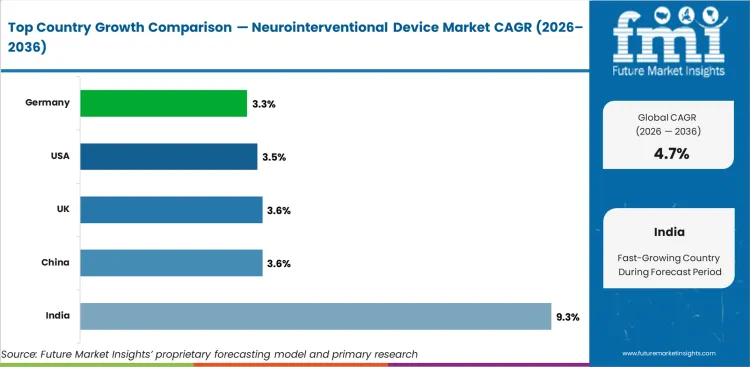
- The India market is leading the market at a CAGR of 9.3% due to the establishment of stroke centers, increased neurology training and growing private hospital investment in neurointerventional catheterization laboratories.
- The 3.6% rate in China reflects the growing coverage of the stroke network and the government stroke screening programs that identify patients for endovascular treatment.
- Medtronic is the leader with 21.0% of the market share with a complete portfolio of neurovascular devices including coils, stent retrievers, flow diverters and access catheters.
- Analyst Opinion
- The neurointerventional device market is expanding as clinical evidence supporting endovascular stroke treatment and aneurysm management drives procedural adoption at comprehensive stroke centers and tertiary care hospitals worldwide.
- Growth reflects the convergence of stroke treatment guideline evolution, aneurysm screening expansion, and neurointerventionalist training that together increase the volume of procedures requiring device procurement.
- Medtronic leads the way with its broad portfolio in Pipeline Flex flow diverters, Solitaire stent retrievers and coiling systems to treat the full spectrum of neurovascular pathologies.
- Next generation thrombectomy devices with higher first pass recanalization rates and lower procedural times will be able to take share from current generation stent retrievers.
- Capital allocation toward clinical trial evidence generation, emerging market training partnerships, and combination device development is expected to shape competitive positioning through 2036.
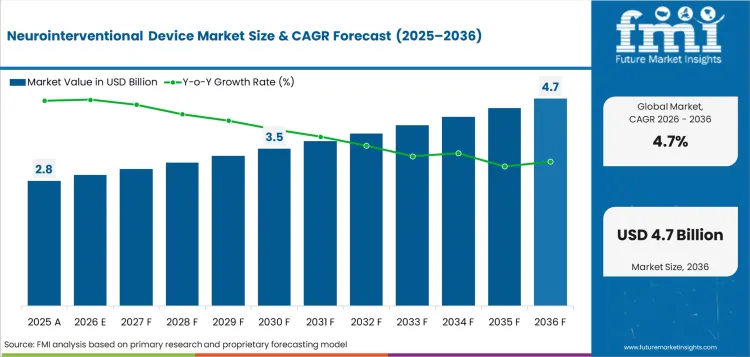
Key Takeaways, Market Size, and Forecast
- The neurointerventional device market was valued at USD 2.82 billion in 2025.
- By 2036, the Neurointerventional Device Market is expected to be worth USD 4.67 billion.
- From 2026 to 2036, the market is projected to expand at a CAGR of 4.7%.
- The market is projected to create an incremental opportunity of USD 1.72 billion between 2026 and 2036.
- In 2026, embolic coils are expected to account for 34.1% of the product segment, driven by widespread adoption in cerebral aneurysm treatment procedures across neurovascular centers.
- India (9.3%) and China (3.6%) are two of the fastest growing markets in the world.
Neurointerventional Device Market Definition
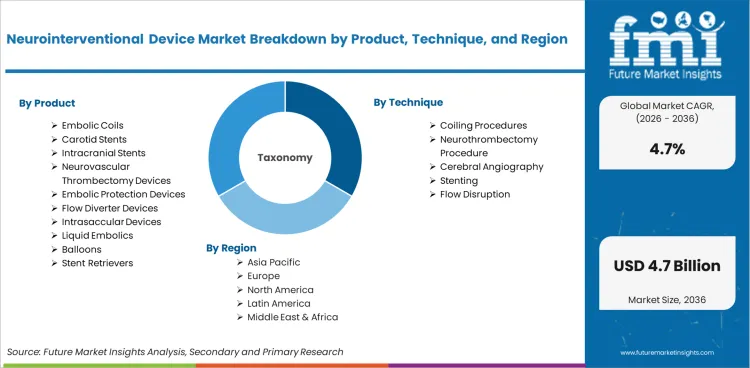
The neurointerventional device market includes medical devices used in minimally invasive endovascular procedures for treating cerebrovascular conditions. Products include embolic coils, carotid stents, intracranial stents, neurovascular thrombectomy devices, embolic protection devices, and flow diverter devices.
Neurointerventional Device Market Inclusions
Market scope includes all commercially marketed neurointerventional devices used in hospitals, ambulatory surgical centers, and specialty neurology centers. Revenue is tracked by product, technique (coiling, thrombectomy, angiography, stenting, flow disruption), end use, technology, component, and application (ischemic stroke, hemorrhagic stroke, cerebral aneurysm, AVM, carotid disease) from 2026 to 2036.
Neurointerventional Device Market Exclusions
The scope does not include diagnostic-only neuroimaging equipment, pharmaceutical thrombolytics (tPA), or neurosurgical instruments used in open craniotomy procedures.
Neurointerventional Device Market Research Methodology
- Primary Research: FMI analysts conducted interviews with neurointerventionalists, hospital procurement managers, stroke center directors, and device company commercial teams across key markets.
- Desk Research: Aggregated information from stroke registry databases, hospital procedure volume statistics, clinical trial publications and device manufacturer regulatory filings.
- Market Sizing & Forecasting: Bottom-up aggregation of procedure volumes by type and geography multiplied by average device cost per procedure triangulated with manufacturer revenue data.
- Data Validation: Quarterly checks against hospital procedure databases, financial disclosures of device companies and clinical registry reports.
Why is the Neurointerventional Device Market Growing?
- Mechanical thrombectomy for large vessel occlusion ischemic stroke has become standard of care based on clinical trial evidence (MR CLEAN, ESCAPE, EXTEND-IA), expanding procedural volumes at comprehensive stroke centers globally.
- India leads at 9.3% CAGR as stroke center establishment, private hospital catheterization laboratory investment, and neurology fellowship training expand the procedural capacity and patient access base.
- Flow diverters are increasingly used for the treatment of wide-neck or complex cerebral aneurysms unsuitable for standard coiling, and thus extending the range of patients who can be treated.
The neurointerventional device market is growing with clinical evidence, guideline updates and physician training supporting procedural volumes in the ischemic stroke, cerebral aneurysm and carotid disease indications. Mechanical thrombectomy has revolutionized ischemic stroke treatment after landmark trials showed dramatic benefit for patients with large vessel occlusion treated within 24 hours of symptom onset. This clinical evidence has resulted in reorganization of stroke networks, with health systems establishing comprehensive stroke centers capable of performing thrombectomy procedures 24/7.
Cerebral aneurysm treatment is evolving from surgical clipping toward endovascular approaches including coiling, stent-assisted coiling, and flow diversion. Incidental aneurysm detection is increasing as brain MRI utilization expands for headache evaluation, screening, and other indications. Flow diverter devices (Pipeline Flex, FRED, Surpass Evolve) are expanding the treatable aneurysm population to include wide-neck and complex morphologies. The market is projected to expand at 4.7% CAGR from 2026 to 2036.
Market Segmentation Analysis
- Embolic coils hold 34.1% of the product segment, with detachable platinum coils remaining the most widely used device for cerebral aneurysm endovascular treatment.
- Coiling procedures account for 41.7% of the technique segment, reflecting the established clinical evidence and procedural familiarity that make coiling the default endovascular aneurysm treatment approach.
- Ischemic stroke treatment is the fastest-growing application, driven by mechanical thrombectomy procedural expansion at comprehensive stroke centers worldwide.
The neurointerventional device market is segmented by product, technique, end use, technology, component, and application. Each dimension reflects clinical practice patterns, device technology evolution, and institutional capability.
Insights into the Embolic Coils Product Segment
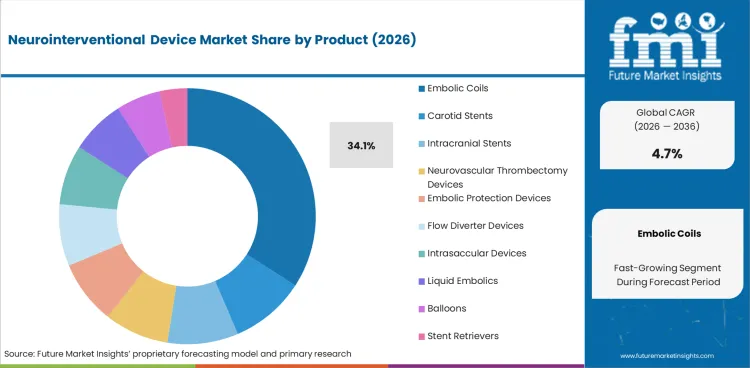
Embolic coils are projected to hold 34.1% share of the product segment by 2026. Platinum detachable coils are delivered via microcatheters to occlude cerebral aneurysms by inducing thrombosis within the aneurysm sac. Bioactive and hydrogel-coated coils offer increased packing density and reduced recanalization rates compared with bare platinum coils.
The second and third largest product share are held by flow diverter devices and neurovascular thrombectomy devices, respectively. Flow diverters (Pipeline Flex, FRED) divert blood flow away from aneurysms and are being adopted for complex aneurysm morphologies. Treatment of ischemic stroke: Thrombectomy devices (Solitaire, Trevo, Penumbra aspiration systems).
Insights into the Ischemic Stroke Application Segment
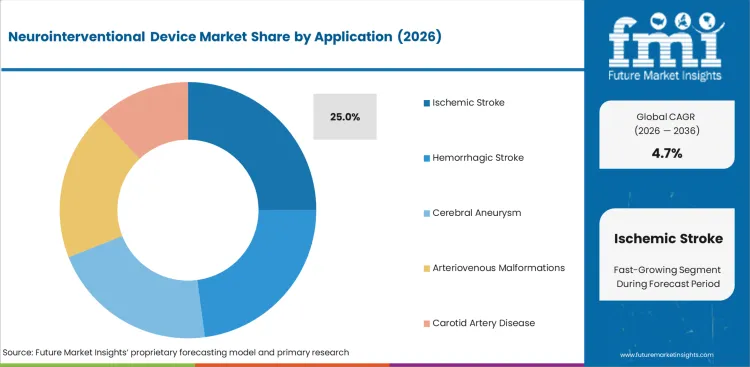
Ischemic stroke treatment is the fastest-growing application. Mechanical thrombectomy using stent retriever or aspiration devices restores blood flow in large vessel occlusion stroke patients. Clinical guidelines from AHA/ASA, ESO, and national stroke societies endorse thrombectomy as standard of care for eligible patients.
Cerebral aneurysm treatment remains the largest single application by device revenue. Hemorrhagic stroke, arteriovenous malformations, and carotid artery disease serve additional clinical indications requiring neurointerventional device use.
Neurointerventional Device Market Drivers, Restraints, and Opportunities
- Stroke treatment guideline evolution and thrombectomy clinical evidence are expanding procedural volumes and device procurement at comprehensive stroke centers.
- Limited neurointerventionalist availability constrains procedural access, particularly in emerging markets where training programs are still scaling capacity.
- Device costs are very sensitive in emerging markets and are a barrier to adoption, with thrombectomy and flow diverter procedures costing between USD 15,000 and 40,000 in device and procedural costs.
The neurointerventional device market is driven by clinical evidence, physician training capacity, and reimbursement economics. Procedural volume growth and device technology improvements are indicative of a 4.7% CAGR from 2026 to 2036 growth.
Thrombectomy Guideline Expansion
Demand reflects clinical guideline updates endorsing mechanical thrombectomy for extended time windows (up to 24 hours) and expanded patient selection criteria. Each guideline revision increases the eligible patient pool and supports health system investment in stroke center infrastructure.
Neurointerventionalist Training Constraints
Adoption is constrained by limited specialist availability. Neurointerventional training requires 1 to 2 year fellowships after neurology, neurosurgery, or interventional radiology residency. Emerging markets face physician supply gaps that limit procedural access despite growing patient demand.
Reimbursement and Cost-Effectiveness
The reimbursement models directly affect adoption rates. In Europe DRG-based hospital payments and in the USA insurance authorization requirements impose procedural volume ceilings. Evidence of cost-effectiveness in terms of reduced long-term disability costs supports the development of a positive reimbursement policy.
Next-Generation Device Development
Device innovation targeting higher first-pass recanalization rates, lower procedure times, and improved safety profiles in thrombectomy and flow diversion creates product cycle upgrade opportunities that drive device replacement and new product adoption.
Analysis of Neurointerventional Device Market By Key Countries
.webp "Top Country Growth Comparison Neurointerventional Device Market Cagr (2026 2036)")
| Country | CAGR |
|---|---|
| India | 9.3% |
| China | 3.6% |
| UK | 3.6% |
| USA | 3.5% |
| Germany | 3.3% |
- India at 9.3% CAGR reflects stroke center establishment, neurology training expansion, and private hospital investment in neurointerventional catheterization laboratory infrastructure.
- China at 3.6% is driven by national stroke screening programs and government investment in comprehensive stroke center networks across provincial and municipal hospitals.
- The UK at 3.6% reflects NHS thrombectomy service expansion to achieve 24/7 coverage at designated neuroscience centers.
- The USA at 3.5% is supported by the largest installed base of comprehensive stroke centers and mature thrombectomy procedural volumes.
The global neurointerventional device market is estimated at USD 2.95 billion in 2026 and is projected to expand at 4.7% CAGR from 2026 to 2036. The analysis covers key markets.
Demand Outlook for Neurointerventional Device Market in India
India is projected to expand at 9.3% CAGR through 2036. Stroke center establishment at corporate hospital chains including Apollo, Fortis, and Max Healthcare is expanding procedural capacity. The Indian Stroke Association training programs and international fellowship partnerships are increasing the number of qualified neurointerventionalists from approximately 200 to a target exceeding 500 over the forecast period.
- Apollo, Fortis, and Narayana Health catheterization laboratory investments are expanding neurointerventional procedure capacity at tertiary care hospitals in metro cities and tier-2 centers.
- Indian Stroke Association fellowship training and international partnerships with European and American neurovascular societies are building the specialist workforce required for procedural volume growth.
- Ayushman Bharat coverage expansion for stroke treatment procedures creates potential for broader patient access beyond private-pay and premium insurance populations.
Future Outlook for Neurointerventional Device Market in China
China is projected to grow at 3.6% CAGR through 2036. The National Stroke Screening and Prevention Project has established over 2,000 stroke centers across provincial and municipal hospitals. Government investment in stroke center grading and quality benchmarking is standardizing procedural capabilities and driving device procurement across the public hospital system.
- National Stroke Screening and Prevention Project has created over 2,000 designated stroke centers with tiered capability levels, creating a structured network for thrombectomy and aneurysm treatment delivery.
- Domestic neurointerventional device manufacturers including MicroPort Scientific and Shanghai HeartCare Medical are gaining market share through competitive pricing and local regulatory pathway advantages.
- NHSA (National Healthcare Security Administration) reimbursement coverage for thrombectomy and coiling procedures supports patient access expansion beyond self-pay populations.
Opportunity Analysis of Neurointerventional Device Market in the UK
The UK is projected to grow at 3.6% CAGR through 2036. NHS England is expanding mechanical thrombectomy service availability to achieve 24/7 coverage at all designated neuroscience centers. The 2019 NHS Long Term Plan committed to increasing thrombectomy procedures from approximately 1,500 to 10,000 annually, creating a multi-year ramp-up in device procurement.
- NHS England thrombectomy service expansion program targets 10,000 annual procedures, requiring investment in neurointerventional suite capacity, specialist staffing, and device procurement at designated centers.
- NICE technology appraisals for flow diverter devices and thrombectomy technologies provide NHS procurement guidance that determines device selection and reimbursement eligibility.
- Stroke research investment through NIHR (National Institute for Health and Care Research) clinical trials generates evidence that influences UK and international treatment guidelines and device adoption.
In-depth Analysis of Neurointerventional Device Market in the USA
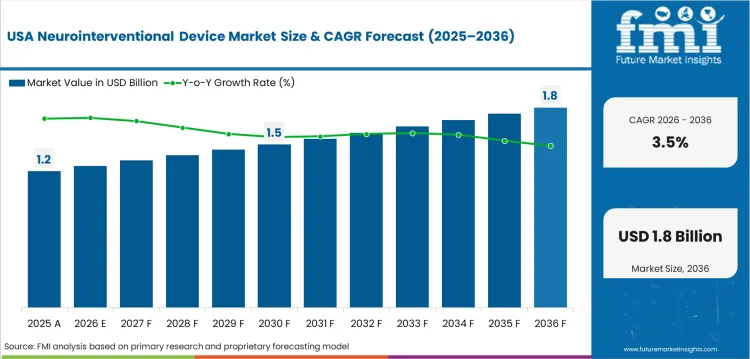
The USA is projected to expand at 3.5% CAGR through 2036. The USA has the largest installed base of comprehensive stroke centers and the most mature thrombectomy procedural volumes globally. Growth is driven by extended time window patient selection, thrombectomy in medium vessel occlusions, and flow diverter adoption for complex aneurysms.
- Over 1,200 designated stroke centers including approximately 350 comprehensive stroke centers perform thrombectomy and complex neurointerventional procedures, creating the largest device procurement base globally.
- CMS reimbursement for thrombectomy (DRG codes) provides financial viability for hospital stroke programs, supporting procedural volume growth and device procurement investment.
- StrokeNet and other NIH-funded clinical trial networks generate evidence for expanded patient selection criteria that increase eligible procedure volumes over time.
Sales Analysis of Neurointerventional Device Market in Germany
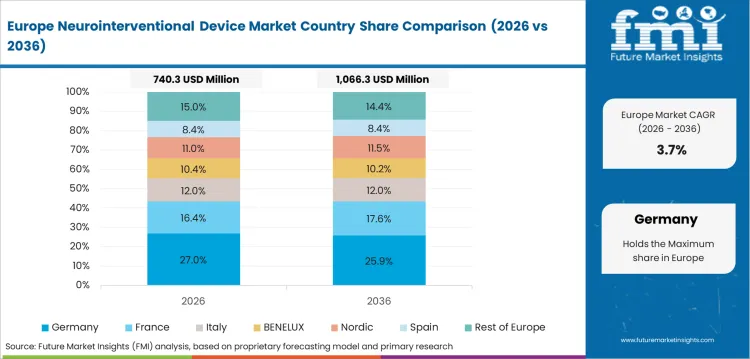
Germany is projected to grow at 3.3% CAGR through 2036. The German Stroke Society (DSG) and German Society of Neuroradiology (DGNR) maintain quality registries that track procedural outcomes. Over 100 neurovascular centers perform thrombectomy and coiling procedures, with established reimbursement through the DRG payment system.
- Over 100 neurovascular centers across Germany perform thrombectomy and endovascular aneurysm treatment, with quality registry data from DSG driving continuous improvement in procedural standards.
- DRG reimbursement for thrombectomy and neurointerventional procedures provides hospital financial viability, supporting device procurement and specialist staffing investment.
- German clinical trial participation in European stroke studies (TENSION, MR CLEAN LATE) generates evidence that shapes ESO guidelines and influences device adoption across European markets.
Competitive Landscape and Strategic Positioning
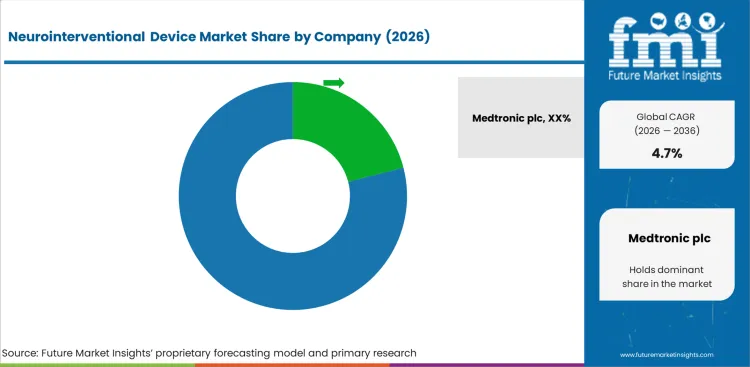
- Medtronic is the market leader with a 21.0% share, with a complete neurovascular portfolio including Pipeline Flex flow diverters, Solitaire stent retrievers and coiling systems.
- Stryker (Trevo stent retriever, Target coils) and Penumbra (aspiration systems) are challenged by differentiated thrombectomy approaches and robust clinical evidence portfolios.
- The competitive environment is high barrier due to clinical trial requirements, regulatory qualification and investment in physician training.
Medtronic leads the way with the breadth of its portfolio in flow diverters (Pipeline Flex), stent retrievers (Solitaire), coiling systems and neurovascular access devices. Flow diverters, particularly the Pipeline Flex flow diverter, are the most commonly used device for flow diversion in the management of cerebral aneurysms today.
Stryker's Trevo stent retriever and Target coil platforms compete with products that have clinical trial data from DAWN and DEFUSE 3 that expanded the thrombectomy treatment windows. Penumbra competes on its direct aspiration thrombectomy technology which takes a different approach to clot removal.
The barriers to entry are very high.” Neurovascular device clinical trials cost USD 50-200 million and take 3-7 years. Large amounts of safety and efficacy data are required for regulatory approval (FDA PMA, CE marking). There needs to be sustained commercial investment in physician training and preference.
Key Companies in the Neurointerventional Device Market
Key global companies leading the neurointerventional device market include:
- Medtronic (Ireland), Stryker Corporation (USA), and Penumbra Inc. (USA) hold leading positions through comprehensive neurovascular device portfolios and strong clinical evidence supporting thrombectomy and aneurysm treatment.
- Terumo/MicroVention (Japan), Johnson and Johnson/Cerenovus (USA), and Balt (France) maintain established positions in coiling, flow diversion, and neurovascular access device categories.
- Phenox GmbH (Germany) and Rapid Medical (Israel) represent emerging device companies with differentiated neurovascular technologies targeting specific procedural niches.
Competitive Benchmarking: Neurointerventional Device Market
| Company | Portfolio Breadth | Clinical Evidence | Physician Training | Geographic Reach |
|---|---|---|---|---|
| Medtronic | Comprehensive | Strong | Global | Global |
| Stryker Corporation | Broad | Strong | Global | Global |
| Penumbra | Focused (Aspiration) | Strong | Global | Global |
| Terumo/MicroVention | Broad | Strong | Regional | Global |
| J&J/Cerenovus | Broad | Moderate | Regional | Global |
| Balt | Broad | Moderate | Regional | Europe, Global |
| Phenox GmbH | Focused | Emerging | Regional | Europe |
| Rapid Medical | Focused | Emerging | Limited | Global |
Source: Future Market Insights competitive analysis, 2026.
Key Developments in Neurointerventional Device Market
- In 2025, Medtronic strengthened its leadership position with its comprehensive neurointerventional portfolio, leveraging strong clinical evidence and global reach to expand adoption of its Solitaire revascularization device and Riptide aspiration system across ischemic stroke treatment.
- In 2025, Stryker Corporation continued aggressive growth through its broad product range and strong clinical data, particularly with the Trevo stent-retriever and Surpass Evolve flow diverter, further consolidating its position in both acute stroke intervention and aneurysm treatment globally.
Key Players in the Neurointerventional Device Market
Major Global Players
- Medtronic plc
- Stryker Corporation
- Penumbra, Inc.
- Terumo Corporation
- MicroVention, Inc. (Terumo Group)
- Johnson & Johnson (Cerenovus)
Emerging Players/Startups
- Viz.ai (AI stroke detection)
- Anaconda Biomed
- Sensome
- InNeuroCo
- Imperative Care
Report Scope and Coverage
| Parameter | Details |
|---|---|
| Quantitative Units | USD 2.95 billion to USD 4.67 billion, at a CAGR of 4.7% |
| Market Definition | The neurointerventional device market includes medical devices for minimally invasive endovascular treatment of cerebrovascular conditions including stroke, aneurysms, and vascular malformations. |
| Regions Covered | North America, Latin America, Europe, East Asia, South Asia and Pacific, Middle East and Africa |
| Countries Covered | India, China, UK, USA, Germany, 30 plus countries |
| Key Companies Profiled | Medtronic plc, Stryker Corporation, Penumbra, Inc., Terumo Corporation, MicroVention, Inc. (Terumo Group), Johnson & Johnson (Cerenovus), Balt USA, Phenox GmbH, Rapid Medical |
| Forecast Period | 2026 to 2036 |
| Approach | Hybrid bottom-up methodology using procedure volumes by type and geography, multiplied by average device cost per procedure, triangulated with manufacturer revenue disclosures. |
Segmentation
Neurointerventional Device Market Segmented by Product:
- Embolic Coils
- Carotid Stents
- Intracranial Stents
- Neurovascular Thrombectomy Devices
- Embolic Protection Devices
- Flow Diverter Devices
- Intrasaccular Devices
- Liquid Embolics
- Balloons
- Stent Retrievers
Neurointerventional Device Market Segmented by Technique:
- Coiling Procedures
- Neurothrombectomy Procedure
- Cerebral Angiography
- Stenting
- Flow Disruption
Neurointerventional Device Market Segmented by End Use:
- Hospitals
- Ambulatory Surgical Centers
- Specialty Neurology Centers
- Other
Neurointerventional Device Market Segmented by Technology:
- Endovascular Technology
- Minimally Invasive Techniques
- Catheter Based Interventions
- Imaging Technology
- Real Time Fluoroscopy
- 3D Imaging Guidance
- Device Technology
- Self Expanding Devices
- Retrievable Devices
- Material Technology
- Nitinol Based Devices
- Polymer Based Devices
Neurointerventional Device Market Segmented by Component:
- Hardware
- Catheters
- Microcatheters
- Guide Catheters
- Guidewires
- Hydrophilic Guidewires
- Steerable Guidewires
- Imaging Support Systems
- Angiography Systems
- Navigation Systems
- Catheters
- Software
- Procedure Planning Software
- Imaging and Visualization Software
- Services
- Training and Education
- Maintenance and Support
- Clinical Support Services
Neurointerventional Device Market Segmented by Application:
- Ischemic Stroke
- Hemorrhagic Stroke
- Cerebral Aneurysm
- Arteriovenous Malformations
- Carotid Artery Disease
Neurointerventional Device Market by Region:
- North America
- USA
- Canada
- Mexico
- Latin America
- Brazil
- Chile
- Rest of Latin America
- Western Europe
- Germany
- UK
- Italy
- Spain
- France
- Nordic
- BENELUX
- Rest of Western Europe
- Eastern Europe
- Russia
- Poland
- Hungary
- Balkan & Baltic
- Rest of Eastern Europe
- East Asia
- China
- Japan
- South Korea
- South Asia and Pacific
- India
- ASEAN
- Australia & New Zealand
- Rest of South Asia and Pacific
- Middle East & Africa
- Kingdom of Saudi Arabia
- Other GCC Countries
- Turkiye
- South Africa
- Other African Union
- Rest of Middle East & Africa
Research Sources and Bibliography
- 1. American Heart Association. (2025). AHA/ASA Guidelines for Acute Ischemic Stroke Management. AHA.
- 2. European Stroke Organisation. (2025). ESO Guidelines for Mechanical Thrombectomy. ESO.
- 3. World Health Organization. (2025). WHO Global Stroke Fact Sheet and Burden of Disease Data. WHO.
- 4. USA Food and Drug Administration. (2025). FDA Neurovascular Device Approval Database. FDA.
- 5. National Institute for Health and Care Excellence. (2025). NICE Technology Appraisals for Neurovascular Devices. NICE.
This bibliography is provided for reader reference. The full Future Market Insights report contains the complete reference list with publication dates, URLs, and supporting data for all cited works.
This Report Answers
- Estimating the size of the neurointerventional device market and revenue projections from 2026 to 2036.
- Segmentation by product, technique, end use, technology, component, and application.
- Insights across key regional markets.
- Analysis of thrombectomy and flow diversion adoption trends.
- Assessment of the competitive landscape across major device manufacturers.
- Identification of investment opportunities in emerging market stroke center expansion and next-generation device development.
- Clinical evidence tracking for device adoption decisions.
- Delivery of data in PDF and Excel formats.
Frequently Asked Questions
What is the global market demand for Neurointerventional Devices in 2026?
In 2026, the global neurointerventional device market is estimated at USD 2.95 billion.
How big will the Neurointerventional Device Market be in 2036?
By 2036, the market is projected to reach USD 4.67 billion.
How much is demand for the Neurointerventional Device Market expected to grow between 2026 and 2036?
Between 2026 and 2036, the market is projected to expand at a CAGR of 4.7%.
Which product segment is expected to lead in the Neurointerventional Device Market in 2026?
Embolic coils are expected to hold 34.1% of the product segment in 2026, with detachable platinum and bioactive coils used in cerebral aneurysm treatment.
What is causing demand to rise in India?
India is expected to grow at 9.3% CAGR through 2036, driven by stroke center establishment, neurology training expansion, and private hospital catheterization laboratory investment.
What is causing demand to rise in China?
China is expected to grow at 3.6% CAGR through 2036, supported by national stroke screening programs and government investment in comprehensive stroke center networks.
What does this report mean by Neurointerventional Device Market definition?
The market includes medical devices for minimally invasive endovascular treatment of cerebrovascular conditions including stroke, cerebral aneurysms, and vascular malformations.
How does FMI make the Neurointerventional Device Market forecast and validate it?
Forecasting uses hybrid methodology with procedure volume data by type and geography, validated against device manufacturer revenue disclosures and clinical registry reports.
Preview the report firsthand - request a free sample
Get SampleGet the brochure for pricing and purchase details.
Get PDFTable of Content
- Executive Summary
- Global Market Outlook
- Demand-side Trends
- Supply-side Trends
- Technology Roadmap Analysis
- Analysis and Recommendations
- Market Overview
- Market Coverage / Taxonomy
- Market Definition / Scope / Limitations
- Research Methodology
- Chapter Orientation
- Analytical Lens and Working Hypotheses
- Market Structure, Signals, and Trend Drivers
- Benchmarking and Cross-market Comparability
- Market Sizing, Forecasting, and Opportunity Mapping
- Research Design and Evidence Framework
- Desk Research Programme (Secondary Evidence)
- Company Annual and Sustainability Reports
- Peer-reviewed Journals and Academic Literature
- Corporate Websites, Product Literature, and Technical Notes
- Earnings Decks and Investor Briefings
- Statutory Filings and Regulatory Disclosures
- Technical White Papers and Standards Notes
- Trade Journals, Industry Magazines, and Analyst Briefs
- Conference Proceedings, Webinars, and Seminar Materials
- Government Statistics Portals and Public Data Releases
- Press Releases and Reputable Media Coverage
- Specialist Newsletters and Curated Briefings
- Sector Databases and Reference Repositories
- FMI Internal Proprietary Databases and Historical Market Datasets
- Subscription Datasets and Paid Sources
- Social Channels, Communities, and Digital Listening Inputs
- Additional Desk Sources
- Expert Input and Fieldwork (Primary Evidence)
- Primary Modes
- Qualitative Interviews and Expert Elicitation
- Quantitative Surveys and Structured Data Capture
- Blended Approach
- Why Primary Evidence is Used
- Field Techniques
- Interviews
- Surveys
- Focus Groups
- Observational and In-context Research
- Social and Community Interactions
- Stakeholder Universe Engaged
- C-suite Leaders
- Board Members
- Presidents and Vice Presidents
- R&D and Innovation Heads
- Technical Specialists
- Domain Subject-matter Experts
- Scientists
- Physicians and Other Healthcare Professionals
- Governance, Ethics, and Data Stewardship
- Research Ethics
- Data Integrity and Handling
- Primary Modes
- Tooling, Models, and Reference Databases
- Desk Research Programme (Secondary Evidence)
- Data Engineering and Model Build
- Data Acquisition and Ingestion
- Cleaning, Normalisation, and Verification
- Synthesis, Triangulation, and Analysis
- Quality Assurance and Audit Trail
- Market Background
- Market Dynamics
- Drivers
- Restraints
- Opportunity
- Trends
- Scenario Forecast
- Demand in Optimistic Scenario
- Demand in Likely Scenario
- Demand in Conservative Scenario
- Opportunity Map Analysis
- Product Life Cycle Analysis
- Supply Chain Analysis
- Investment Feasibility Matrix
- Value Chain Analysis
- PESTLE and Porter’s Analysis
- Regulatory Landscape
- Regional Parent Market Outlook
- Production and Consumption Statistics
- Import and Export Statistics
- Market Dynamics
- Global Market Analysis 2021 to 2025 and Forecast, 2026 to 2036
- Historical Market Size Value (USD Million) Analysis, 2021 to 2025
- Current and Future Market Size Value (USD Million) Projections, 2026 to 2036
- Y-o-Y Growth Trend Analysis
- Absolute $ Opportunity Analysis
- Global Market Pricing Analysis 2021 to 2025 and Forecast 2026 to 2036
- Global Market Analysis 2021 to 2025 and Forecast 2026 to 2036, By Product
- Introduction / Key Findings
- Historical Market Size Value (USD Million) Analysis By Product , 2021 to 2025
- Current and Future Market Size Value (USD Million) Analysis and Forecast By Product , 2026 to 2036
- Embolic Coils
- Carotid Stents
- Intracranial Stents
- Neurovascular Thrombectomy Devices
- Embolic Protection Devices
- Flow Diverter Devices
- Intrasaccular Devices
- Liquid Embolics
- Balloons
- Stent Retrievers
- Embolic Coils
- Y-o-Y Growth Trend Analysis By Product , 2021 to 2025
- Absolute $ Opportunity Analysis By Product , 2026 to 2036
- Global Market Analysis 2021 to 2025 and Forecast 2026 to 2036, By Technique
- Introduction / Key Findings
- Historical Market Size Value (USD Million) Analysis By Technique, 2021 to 2025
- Current and Future Market Size Value (USD Million) Analysis and Forecast By Technique, 2026 to 2036
- Coiling Procedures
- Neurothrombectomy Procedure
- Cerebral Angiography
- Stenting
- Flow Disruption
- Coiling Procedures
- Y-o-Y Growth Trend Analysis By Technique, 2021 to 2025
- Absolute $ Opportunity Analysis By Technique, 2026 to 2036
- Global Market Analysis 2021 to 2025 and Forecast 2026 to 2036, By End Use
- Introduction / Key Findings
- Historical Market Size Value (USD Million) Analysis By End Use, 2021 to 2025
- Current and Future Market Size Value (USD Million) Analysis and Forecast By End Use, 2026 to 2036
- Hospitals
- Ambulatory Surgical Centers
- Specialty Neurology Centers
- Other
- Hospitals
- Y-o-Y Growth Trend Analysis By End Use, 2021 to 2025
- Absolute $ Opportunity Analysis By End Use, 2026 to 2036
- Global Market Analysis 2021 to 2025 and Forecast 2026 to 2036, By Technology
- Introduction / Key Findings
- Historical Market Size Value (USD Million) Analysis By Technology, 2021 to 2025
- Current and Future Market Size Value (USD Million) Analysis and Forecast By Technology, 2026 to 2036
- Endovascular Technology
- Minimally Invasive Techniques
- Catheter Based Interventions
- Imaging Technology
- Real Time Fluoroscopy
- 3D Imaging Guidance
- Device Technology
- Self Expanding Devices
- Retrievable Devices
- Material Technology
- Nitinol Based Devices
- Polymer Based Devices
- Endovascular Technology
- Y-o-Y Growth Trend Analysis By Technology, 2021 to 2025
- Absolute $ Opportunity Analysis By Technology, 2026 to 2036
- Global Market Analysis 2021 to 2025 and Forecast 2026 to 2036, By Component
- Introduction / Key Findings
- Historical Market Size Value (USD Million) Analysis By Component, 2021 to 2025
- Current and Future Market Size Value (USD Million) Analysis and Forecast By Component, 2026 to 2036
- Hardware
- Catheters
- Microcatheters
- Guide Catheters
- Guidewires
- Hydrophilic Guidewires
- Steerable Guidewires
- Imaging Support Systems
- Angiography Systems
- Navigation Systems
- Software
- Procedure Planning Software
- Imaging and Visualization Software
- Services
- Training and Education
- Maintenance and Support
- Clinical Support Services
- Hardware
- Y-o-Y Growth Trend Analysis By Component, 2021 to 2025
- Absolute $ Opportunity Analysis By Component, 2026 to 2036
- Global Market Analysis 2021 to 2025 and Forecast 2026 to 2036, By Application
- Introduction / Key Findings
- Historical Market Size Value (USD Million) Analysis By Application, 2021 to 2025
- Current and Future Market Size Value (USD Million) Analysis and Forecast By Application, 2026 to 2036
- Ischemic Stroke
- Hemorrhagic Stroke
- Cerebral Aneurysm
- Arteriovenous Malformations
- Carotid Artery Disease
- Ischemic Stroke
- Y-o-Y Growth Trend Analysis By Application, 2021 to 2025
- Absolute $ Opportunity Analysis By Application, 2026 to 2036
- Global Market Analysis 2021 to 2025 and Forecast 2026 to 2036, By Region
- Introduction
- Historical Market Size Value (USD Million) Analysis By Region, 2021 to 2025
- Current Market Size Value (USD Million) Analysis and Forecast By Region, 2026 to 2036
- North America
- Latin America
- Western Europe
- Eastern Europe
- East Asia
- South Asia and Pacific
- Middle East & Africa
- Market Attractiveness Analysis By Region
- North America Market Analysis 2021 to 2025 and Forecast 2026 to 2036, By Country
- Historical Market Size Value (USD Million) Trend Analysis By Market Taxonomy, 2021 to 2025
- Market Size Value (USD Million) Forecast By Market Taxonomy, 2026 to 2036
- By Country
- USA
- Canada
- Mexico
- By Product
- By Technique
- By End Use
- By Technology
- By Component
- By Application
- By Country
- Market Attractiveness Analysis
- By Country
- By Product
- By Technique
- By End Use
- By Technology
- By Component
- By Application
- Key Takeaways
- Latin America Market Analysis 2021 to 2025 and Forecast 2026 to 2036, By Country
- Historical Market Size Value (USD Million) Trend Analysis By Market Taxonomy, 2021 to 2025
- Market Size Value (USD Million) Forecast By Market Taxonomy, 2026 to 2036
- By Country
- Brazil
- Chile
- Rest of Latin America
- By Product
- By Technique
- By End Use
- By Technology
- By Component
- By Application
- By Country
- Market Attractiveness Analysis
- By Country
- By Product
- By Technique
- By End Use
- By Technology
- By Component
- By Application
- Key Takeaways
- Western Europe Market Analysis 2021 to 2025 and Forecast 2026 to 2036, By Country
- Historical Market Size Value (USD Million) Trend Analysis By Market Taxonomy, 2021 to 2025
- Market Size Value (USD Million) Forecast By Market Taxonomy, 2026 to 2036
- By Country
- Germany
- UK
- Italy
- Spain
- France
- Nordic
- BENELUX
- Rest of Western Europe
- By Product
- By Technique
- By End Use
- By Technology
- By Component
- By Application
- By Country
- Market Attractiveness Analysis
- By Country
- By Product
- By Technique
- By End Use
- By Technology
- By Component
- By Application
- Key Takeaways
- Eastern Europe Market Analysis 2021 to 2025 and Forecast 2026 to 2036, By Country
- Historical Market Size Value (USD Million) Trend Analysis By Market Taxonomy, 2021 to 2025
- Market Size Value (USD Million) Forecast By Market Taxonomy, 2026 to 2036
- By Country
- Russia
- Poland
- Hungary
- Balkan & Baltic
- Rest of Eastern Europe
- By Product
- By Technique
- By End Use
- By Technology
- By Component
- By Application
- By Country
- Market Attractiveness Analysis
- By Country
- By Product
- By Technique
- By End Use
- By Technology
- By Component
- By Application
- Key Takeaways
- East Asia Market Analysis 2021 to 2025 and Forecast 2026 to 2036, By Country
- Historical Market Size Value (USD Million) Trend Analysis By Market Taxonomy, 2021 to 2025
- Market Size Value (USD Million) Forecast By Market Taxonomy, 2026 to 2036
- By Country
- China
- Japan
- South Korea
- By Product
- By Technique
- By End Use
- By Technology
- By Component
- By Application
- By Country
- Market Attractiveness Analysis
- By Country
- By Product
- By Technique
- By End Use
- By Technology
- By Component
- By Application
- Key Takeaways
- South Asia and Pacific Market Analysis 2021 to 2025 and Forecast 2026 to 2036, By Country
- Historical Market Size Value (USD Million) Trend Analysis By Market Taxonomy, 2021 to 2025
- Market Size Value (USD Million) Forecast By Market Taxonomy, 2026 to 2036
- By Country
- India
- ASEAN
- Australia & New Zealand
- Rest of South Asia and Pacific
- By Product
- By Technique
- By End Use
- By Technology
- By Component
- By Application
- By Country
- Market Attractiveness Analysis
- By Country
- By Product
- By Technique
- By End Use
- By Technology
- By Component
- By Application
- Key Takeaways
- Middle East & Africa Market Analysis 2021 to 2025 and Forecast 2026 to 2036, By Country
- Historical Market Size Value (USD Million) Trend Analysis By Market Taxonomy, 2021 to 2025
- Market Size Value (USD Million) Forecast By Market Taxonomy, 2026 to 2036
- By Country
- Kingdom of Saudi Arabia
- Other GCC Countries
- Turkiye
- South Africa
- Other African Union
- Rest of Middle East & Africa
- By Product
- By Technique
- By End Use
- By Technology
- By Component
- By Application
- By Country
- Market Attractiveness Analysis
- By Country
- By Product
- By Technique
- By End Use
- By Technology
- By Component
- By Application
- Key Takeaways
- Key Countries Market Analysis
- USA
- Pricing Analysis
- Market Share Analysis, 2025
- By Product
- By Technique
- By End Use
- By Technology
- By Component
- By Application
- Canada
- Pricing Analysis
- Market Share Analysis, 2025
- By Product
- By Technique
- By End Use
- By Technology
- By Component
- By Application
- Mexico
- Pricing Analysis
- Market Share Analysis, 2025
- By Product
- By Technique
- By End Use
- By Technology
- By Component
- By Application
- Brazil
- Pricing Analysis
- Market Share Analysis, 2025
- By Product
- By Technique
- By End Use
- By Technology
- By Component
- By Application
- Chile
- Pricing Analysis
- Market Share Analysis, 2025
- By Product
- By Technique
- By End Use
- By Technology
- By Component
- By Application
- Germany
- Pricing Analysis
- Market Share Analysis, 2025
- By Product
- By Technique
- By End Use
- By Technology
- By Component
- By Application
- UK
- Pricing Analysis
- Market Share Analysis, 2025
- By Product
- By Technique
- By End Use
- By Technology
- By Component
- By Application
- Italy
- Pricing Analysis
- Market Share Analysis, 2025
- By Product
- By Technique
- By End Use
- By Technology
- By Component
- By Application
- Spain
- Pricing Analysis
- Market Share Analysis, 2025
- By Product
- By Technique
- By End Use
- By Technology
- By Component
- By Application
- France
- Pricing Analysis
- Market Share Analysis, 2025
- By Product
- By Technique
- By End Use
- By Technology
- By Component
- By Application
- India
- Pricing Analysis
- Market Share Analysis, 2025
- By Product
- By Technique
- By End Use
- By Technology
- By Component
- By Application
- ASEAN
- Pricing Analysis
- Market Share Analysis, 2025
- By Product
- By Technique
- By End Use
- By Technology
- By Component
- By Application
- Australia & New Zealand
- Pricing Analysis
- Market Share Analysis, 2025
- By Product
- By Technique
- By End Use
- By Technology
- By Component
- By Application
- China
- Pricing Analysis
- Market Share Analysis, 2025
- By Product
- By Technique
- By End Use
- By Technology
- By Component
- By Application
- Japan
- Pricing Analysis
- Market Share Analysis, 2025
- By Product
- By Technique
- By End Use
- By Technology
- By Component
- By Application
- South Korea
- Pricing Analysis
- Market Share Analysis, 2025
- By Product
- By Technique
- By End Use
- By Technology
- By Component
- By Application
- Russia
- Pricing Analysis
- Market Share Analysis, 2025
- By Product
- By Technique
- By End Use
- By Technology
- By Component
- By Application
- Poland
- Pricing Analysis
- Market Share Analysis, 2025
- By Product
- By Technique
- By End Use
- By Technology
- By Component
- By Application
- Hungary
- Pricing Analysis
- Market Share Analysis, 2025
- By Product
- By Technique
- By End Use
- By Technology
- By Component
- By Application
- Kingdom of Saudi Arabia
- Pricing Analysis
- Market Share Analysis, 2025
- By Product
- By Technique
- By End Use
- By Technology
- By Component
- By Application
- Turkiye
- Pricing Analysis
- Market Share Analysis, 2025
- By Product
- By Technique
- By End Use
- By Technology
- By Component
- By Application
- South Africa
- Pricing Analysis
- Market Share Analysis, 2025
- By Product
- By Technique
- By End Use
- By Technology
- By Component
- By Application
- USA
- Market Structure Analysis
- Competition Dashboard
- Competition Benchmarking
- Market Share Analysis of Top Players
- By Regional
- By Product
- By Technique
- By End Use
- By Technology
- By Component
- By Application
- Competition Analysis
- Competition Deep Dive
- Medtronic plc
- Overview
- Product Portfolio
- Profitability by Market Segments (Product/Age /Sales Channel/Region)
- Sales Footprint
- Strategy Overview
- Marketing Strategy
- Product Strategy
- Channel Strategy
- Stryker Corporation
- Penumbra, Inc.
- Terumo Corporation
- MicroVention, Inc. (Terumo Group)
- Johnson & Johnson (Cerenovus)
- Balt USA
- Phenox GmbH
- Rapid Medical
- Medtronic plc
- Competition Deep Dive
- Assumptions & Acronyms Used


