

- Market Size (2026)
- USD 487.1 Mn
- Forecast (2036)
- USD 1346.1 Mn
- CAGR (2026 to 2036)
- 10.7%
How big is the Paper-Based Fragile Goods Dividers Market in 2026?
USD 487.1 million in 2026 and USD 1,346.1 million by 2036 at a 10.7% CAGR.
Demand for paper-based fragile goods dividers exists because buyers need the product to perform inside a real operating workflow, beyond a trend label. EU Packaging and Packaging Waste Regulation references place compliance or claim evidence close to launch decisions, while EPA Sustainable Materials Management resources keep quality and safety expectations visible. ISO, FSC and FEFCO packaging standards add the country and standards context that procurement teams use when they compare suppliers, so paper-based fragile goods dividers suppliers need documented performance before accounts scale.
The commercial opportunity is clearest where paper-based fragile goods dividers reduces a specific pain point for brand owners, packaging engineers, e-commerce teams and fulfillment operators. Accounts are expected to compare SKU economics, supplier service and proof of drop performance, compression fit, material certification, line handling and waste-reduction claims before volume moves from trial runs to recurring purchase orders.
Country demand will not develop evenly. India shows the higher CAGR reference in the model, while Rest of World remains an important value pool because larger buyers ask for stricter evidence before switching formats, materials or suppliers.
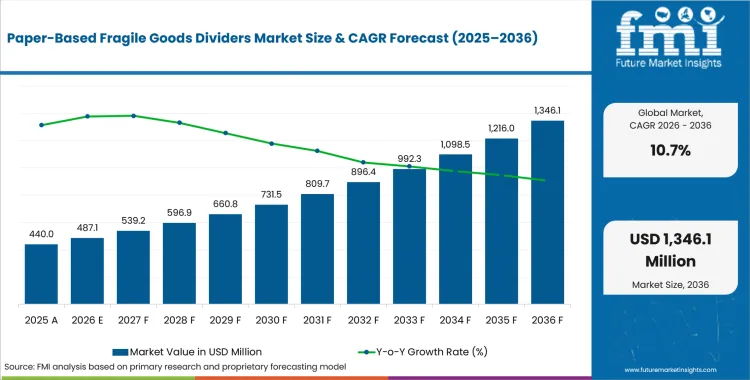
| Metric | Value |
|---|---|
| 2025 Market Size | USD 440.0 million |
| 2026 Market Size | USD 487.1 million |
| 2036 Market Size | USD 1,346.1 million |
| Forecast CAGR (2026-2036) | 10.7% |
| Leading End Use | Glassware |
| Glassware Share (2026) | 41.2% |
| Leading Product Type | Partition Dividers |
| Partition Dividers Share (2026) | 30.8% |
| Leading Material | Corrugated |
| Corrugated Share (2026) | 30.3% |
Summary of the Paper-Based Fragile Goods Dividers Market
| Market Signal | Commercial Impact |
|---|---|
| Demand and Growth Drivers |
|
| Product and Segment View |
|
| Geography and Growth Outlook |
|
| Competition |
|
| Analyst Perspective |
|
How is the paper-based fragile goods dividers market segmented?
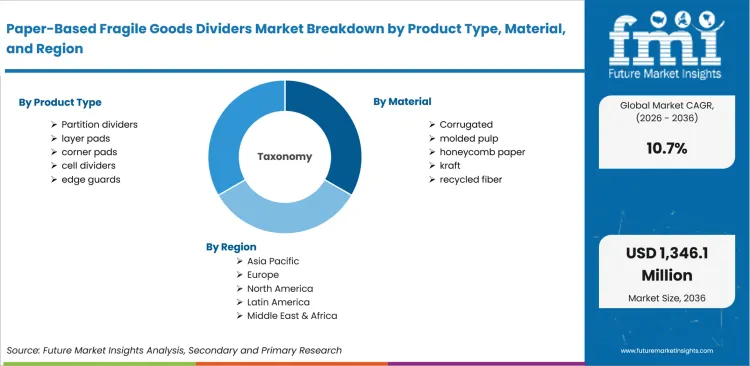
The paper-based fragile goods dividers market industry is segmented by Product Type, Material, Functionality, End Use and Region.
By Product Type, the market covers Partition dividers, layer pads, corner pads, cell dividers and edge guards By Material, the market covers Corrugated, molded pulp, honeycomb paper, kraft and recycled fiber By Functionality, the market covers Separation, cushioning, stacking strength, surface protection and void fill By End Use, the market covers Glassware, ceramics, electronics, lab supplies and homeware By Region, the market covers North America, Europe, East Asia, South Asia and Latin America. Regional coverage includes North America, Latin America, Europe, East Asia, South Asia and Pacific, and Middle East and Africa.
How does Partition dividers shape demand within the product type category?
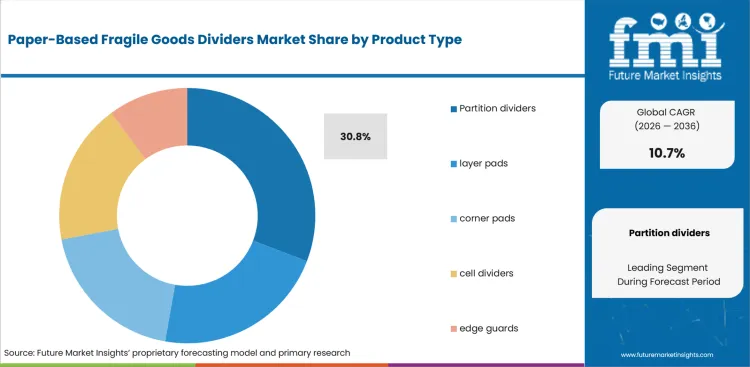
Partition dividers selection starts with the operating job the buyer needs paper-based fragile goods dividers to perform. The category is reviewed through drop performance, compression fit, material certification, line handling and waste-reduction claims, so technical proof matters before procurement compares price.
- By Product Type, Partition dividers is estimated to hold 30.8% share in 2026. EU Packaging and Packaging Waste Regulation references and EPA Sustainable Materials Management resources keep paper-based fragile goods dividers transit protection and fiber-material qualification visible in buyer reviews.
- The executive implication is practical: Partition dividers gives packaging teams a practical starting point for paper-based fragile goods dividers fit, cushioning and line handling. Suppliers that can show evidence for that point face fewer objections during account expansion.
What supports Corrugated purchasing within material?
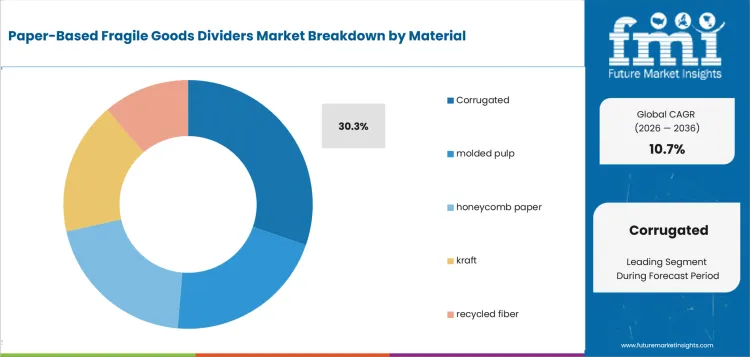
Corrugated selection starts with the operating job the buyer needs paper-based fragile goods dividers to perform. The category is reviewed through drop performance, compression fit, material certification, line handling and waste-reduction claims, so technical proof matters before procurement compares price.
- By Material, Corrugated is estimated to hold 30.3% share in 2026. EU Packaging and Packaging Waste Regulation references and EPA Sustainable Materials Management resources keep paper-based fragile goods dividers transit protection and fiber-material qualification visible in buyer reviews.
- The executive implication is practical: Corrugated is screened for recyclability, fiber supply and compression behavior before transit testing. Suppliers that can show evidence for that point face fewer objections during account expansion.
Where does Separation fit in the functionality mix?
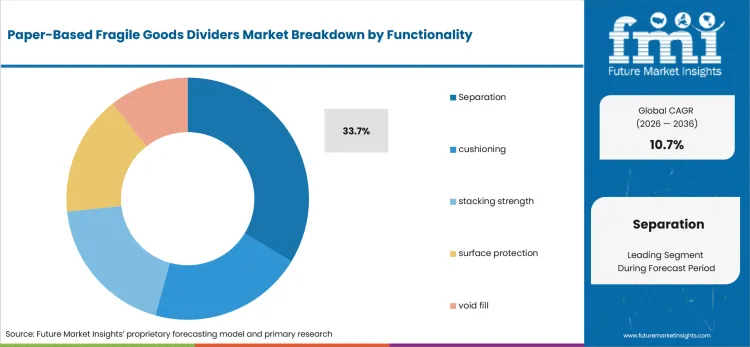
Separation selection starts with the operating job the buyer needs paper-based fragile goods dividers to perform. The category is reviewed through drop performance, compression fit, material certification, line handling and waste-reduction claims, so technical proof matters before procurement compares price.
- By Functionality, Separation is estimated to hold 33.7% share in 2026. EU Packaging and Packaging Waste Regulation references and EPA Sustainable Materials Management resources keep paper-based fragile goods dividers transit protection and fiber-material qualification visible in buyer reviews.
- The executive implication is practical: Separation gives packaging teams a practical starting point for paper-based fragile goods dividers fit, cushioning and line handling. Suppliers that can show evidence for that point face fewer objections during account expansion.
Why is Glassware important to buyer screening in end use?
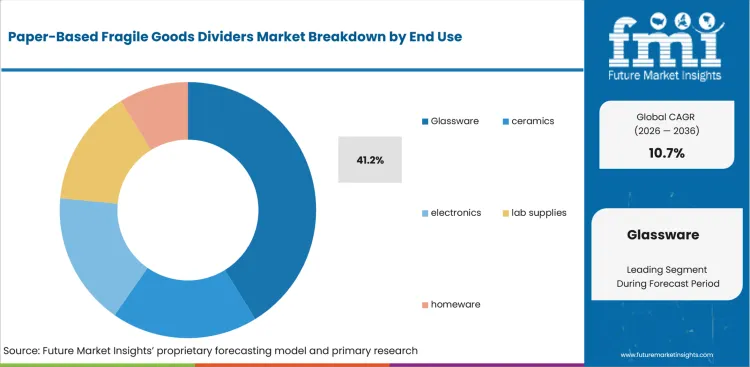
Glassware selection starts with the operating job the buyer needs paper-based fragile goods dividers to perform. The category is reviewed through drop performance, compression fit, material certification, line handling and waste-reduction claims, so technical proof matters before procurement compares price.
- By End Use, Glassware is estimated to hold 41.2% share in 2026. EU Packaging and Packaging Waste Regulation references and EPA Sustainable Materials Management resources keep paper-based fragile goods dividers transit protection and fiber-material qualification visible in buyer reviews.
- The executive implication is practical: Glassware buyers need product-specific protection because a failed shipment turns material savings into replacement cost. Suppliers that can show evidence for that point face fewer objections during account expansion.
How is North America positioned within region?
North America selection starts with the operating job the buyer needs paper-based fragile goods dividers to perform. The category is reviewed through drop performance, compression fit, material certification, line handling and waste-reduction claims, so technical proof matters before procurement compares price.
- By Region, North America is estimated to hold 33.3% share in 2026. EU Packaging and Packaging Waste Regulation references and EPA Sustainable Materials Management resources keep paper-based fragile goods dividers transit protection and fiber-material qualification visible in buyer reviews.
- The executive implication is practical: North America stays close to premium retailers, regulated accounts and early specification work for paper-based fragile goods dividers. Suppliers that can show evidence for that point face fewer objections during account expansion.
What are the drivers, restraints, and opportunities in the paper-based fragile goods dividers market?
Near-term purchases are being shaped by the operating requirement, implementation constraint and account-expansion route outlined below.
- Driver: Packaging buyers are testing paper-based fragile goods dividers because plastic and foam replacement has to protect products through fulfillment lanes, instead of serving only as a sustainability claim.
- Restraint: Adoption can slow if paper-based fragile goods dividers designs fail drop, abrasion, moisture or protective performance checks during ship tests.
- Opportunity: Suppliers that provide recyclable or compostable material files with transit-test evidence can win specification work for paper-based fragile goods dividers.
Demand for paper-based fragile goods dividers is tied to a specific buyer problem: drop performance, compression fit, material certification, line handling and waste-reduction claims. This is why account teams ask for evidence at the SKU, format or application level rather than accepting category growth as proof.
Buyer pressure is strongest where paper-based fragile goods dividers touches claims, product safety, shipment performance, GMP files or retailer scorecards. EU Packaging and Packaging Waste Regulation references, EPA Sustainable Materials Management resources and ISO, FSC and FEFCO packaging standards make those checks visible across national and cross-border programs.
Implementation friction sits in the handoff between product teams, quality managers and channel owners. Suppliers that answer questions on specifications, test results and service response before launch discussions move faster through buyer review.
Which country CAGRs are profiled in the paper-based fragile goods dividers market?
.webp "Top Country Growth Comparison Paper Based Fragile Goods Dividers Market Cagr (2026 2036)")
| Country | CAGR |
|---|---|
| United States | 6.9% |
| China | 8.3% |
| India | 9.7% |
| Germany | 6.0% |
| United Kingdom | 6.4% |
| Japan | 5.2% |
| South Korea | 6.7% |
Source: FMI's proprietary forecasting model and primary research.
How do country-level CAGRs compare in the paper-based fragile goods dividers market?
Country growth should be read as a buying-cycle signal, not a simple ranking. For paper-based fragile goods dividers, higher CAGR markets usually show faster channel formation or material substitution, while larger 2026 value pools such as Rest of World often require stricter proof before suppliers win recurring accounts.
- United States is projected at 6.9% CAGR through 2036. The country is modeled at USD 126.6 Mn in 2026 and USD 246.8 Mn by 2036. EPA SMM and federal trade data keep packaging material choices visible. Buyers use national accounts to test paper-based fragile goods dividers shelf economics before broader rollouts. For paper-based fragile goods dividers transit protection and fiber-material qualification, the United States differs because retailer and regulator-facing reviews come earlier in the launch cycle.
- China is projected at 8.3% CAGR through 2036. The country is modeled at USD 73.1 Mn in 2026 and USD 162.2 Mn by 2036. National statistics and customs signals point to large manufacturing and retail conversion pools. Local suppliers need paper-based fragile goods dividers formats that can handle high-volume platform and brand programs. For paper-based fragile goods dividers transit protection and fiber-material qualification, China differs because factory scale and platform selling can expose small specification failures quickly.
- India is projected at 9.7% CAGR through 2036. The country is modeled at USD 24.4 Mn in 2026 and USD 61.5 Mn by 2036. official industrial and e-commerce indicators keep regional scale-up visible. Price-tiered buyers need paper-based fragile goods dividers specifications that work across modern trade, pharmacy or online fulfillment without adding avoidable cost. For paper-based fragile goods dividers transit protection and fiber-material qualification, India differs because affordability and distribution reach decide whether a specification can survive outside metro accounts.
- Germany is projected at 6.0% CAGR through 2036. The country is modeled at USD 43.8 Mn in 2026 and USD 78.5 Mn by 2036. EU PPWR and German recycling discipline make material proof central. Engineering or category teams review paper-based fragile goods dividers against EU documentation, material or ingredient files before switching approved suppliers. For paper-based fragile goods dividers transit protection and fiber-material qualification, Germany differs because EU compliance records carry more weight before supplier substitution.
- United Kingdom is projected at 6.4% CAGR through 2036. The country is modeled at USD 34.1 Mn in 2026 and USD 63.4 Mn by 2036. ONS and UK regulator references keep retail-channel and import discipline visible. Retailer scorecards make paper-based fragile goods dividers availability, pack claims and import continuity part of the buying decision. For paper-based fragile goods dividers transit protection and fiber-material qualification, the United Kingdom differs because importer reliance and retailer scorecards make pack claims and supply assurance visible.
- Japan is projected at 5.2% CAGR through 2036. The country is modeled at USD 29.2 Mn in 2026 and USD 48.5 Mn by 2036. MHLW, METI and official trade indicators keep quality and audit expectations visible. Buyers place more weight on compact formats, consistency checks and low-defect presentation for paper-based fragile goods dividers. For paper-based fragile goods dividers transit protection and fiber-material qualification, Japan differs because low-defect presentation and compact usage matter more than speed of listing.
- South Korea is projected at 6.7% CAGR through 2036. The country is modeled at USD 19.5 Mn in 2026 and USD 37.3 Mn by 2036. MFDS, MOTIE and Statistics Korea references keep export-oriented product cycles visible. Short product cycles reward suppliers that can adjust paper-based fragile goods dividers packaging, claims or specifications quickly. For paper-based fragile goods dividers transit protection and fiber-material qualification, South Korea differs because rapid product refresh cycles favor suppliers that shorten sampling and approval loops.
Who are the notable companies in the paper-based fragile goods dividers market?
Ranpak, Pregis, Smurfit Westrock, International Paper, DS Smith, Sealed Air, Storopack and Mondi are the notable companies shaping this market.
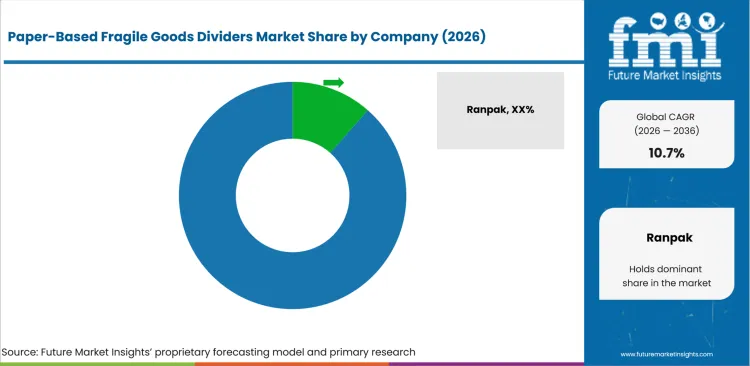
Competition is organized around protective performance, material certification, fulfillment fit and regional converting reach. Buyers compare suppliers on whether they can translate product claims into repeatable specifications, then support the account after launch.
- Global fiber packaging groups matter because Ranpak, Pregis and Smurfit Westrock bring account access, portfolio breadth or specialist support for paper-based fragile goods dividers. Their role is clearest where buyers want fewer supplier handoffs during qualification, listing or fulfillment review.
- Specialized protective packaging suppliers matter because International Paper, DS Smith and Sealed Air bring account access, portfolio breadth or specialist support for paper-based fragile goods dividers. Their role is clearest where buyers want fewer supplier handoffs during qualification, listing or fulfillment review.
- Material and converting specialists matter because Storopack and Mondi bring account access, portfolio breadth or specialist support for paper-based fragile goods dividers. Their role is clearest where buyers want fewer supplier handoffs during qualification, listing or fulfillment review.
Competitive Benchmarking: Paper-Based Fragile Goods Dividers Market
| Company | Portfolio Relevance | Format Fit | Application Support | Service Reach |
|---|---|---|---|---|
| Ranpak | Medium | Medium | Medium | Global |
| Pregis | Strong | High | Strong | Global |
| Smurfit Westrock | Medium | Strong | Medium | Global |
| International Paper | Strong | Strong | Medium | Global |
| DS Smith | High | High | Strong | Regional/Global |
| Sealed Air | High | Strong | Strong | Regional/Global |
| Storopack | Medium | High | Strong | Regional/Global |
| Mondi | Medium | Strong | Strong | Regional/Global |
Source: Future Market Insights competitive analysis, 2026. Ratings reflect relative portfolio relevance, workflow or project fit, service capability, and geographic reach.
Key Developments in the Paper-Based Fragile Goods Dividers Market
- The EU Packaging and Packaging Waste Regulation entered into force on February 11, 2025 and generally applies from August 12, 2026. This puts recyclability, packaging minimization and proof files close to paper-based fragile goods dividers specification decisions.
- International Paper completed its acquisition of DS Smith on January 31, 2025. The combination changed the competitive backdrop for fiber packaging programs that need North America and EMEA supply reach.
- Mondi expanded re/cycle MailerBAG capacity for e-commerce customers in May 2025. The expansion shows how paper-based shipping formats are being scaled for paper-based fragile goods dividers adjacent fulfillment needs.
- Smurfit Kappa and WestRock completed their combination in July 2024, forming Smurfit Westrock. The transaction increased the scale of corrugated and paper packaging support available to large brand-owner accounts.
Key Players in the Paper-Based Fragile Goods Dividers Market
Global fiber packaging groups
- Ranpak
- Pregis
- Smurfit Westrock
Specialized protective packaging suppliers
- International Paper
- DS Smith
- Sealed Air
Material and converting specialists
- Storopack
- Mondi
Paper-Based Fragile Goods Dividers Market - Report Scope
| Coverage field | Report scope |
|---|---|
| Market breakdown | Paper-Based Fragile Goods Dividers Market Breakdown By Product Type, Material, Functionality, End Use and Region |
| Market Definition | Paper-Based Fragile Goods Dividers products are paper, fiber or molded packaging formats designed to protect goods during shipping, storage, cold-chain handling or retail delivery while reducing plastic or foam dependence. |
| Regions Covered | North America, Latin America, Europe, East Asia, South Asia and Pacific, and Middle East and Africa |
| Countries Covered | United States, China, India, Germany, United Kingdom, Japan, South Korea, Rest of World and 30+ countries |
| Key Companies Profiled | Ranpak, Pregis, Smurfit Westrock, International Paper, DS Smith, Sealed Air, Storopack and Mondi |
| Forecast Period | 2026 to 2036 |
| Approach | Hybrid bottom-up and top-down methodology using segment share, country growth, drop performance, compression fit, material certification, line handling and waste-reduction claims, supplier portfolio depth and channel exposure |
Paper-Based Fragile Goods Dividers Market - Research Methodology
| Method | Approach |
|---|---|
| Primary Research | Primary interviews covered brand owners, packaging engineers, e-commerce teams and fulfillment operators, quality teams, suppliers and channel buyers. Discussions focused on drop performance, compression fit, material certification, line handling and waste-reduction claims, price sensitivity, changeover risk and account expansion. |
| Desk Research | Desk research reviewed EU Packaging and Packaging Waste Regulation references, EPA Sustainable Materials Management resources and ISO, FSC and FEFCO packaging standards along with company portfolio pages and official trade or country datasets. |
| Market Sizing and Forecasting | Market sizing used a hybrid model across segment mix, 2026 country values, forecast CAGR, channel route and supplier participation in paper-based fragile goods dividers. |
| Data Validation | Data validation compared segment shares, country CAGRs, company relevance and source signals to avoid category leakage and unsupported claims. |
Source: Future Market Insights (FMI) analysis, based on proprietary forecasting model and primary research.
Paper-Based Fragile Goods Dividers Market by Segments
Paper-Based Fragile Goods Dividers Market segmented by Product Type:
- Partition dividers
- layer pads
- corner pads
- cell dividers
- edge guards
Paper-Based Fragile Goods Dividers Market segmented by Material:
- Corrugated
- molded pulp
- honeycomb paper
- kraft
- recycled fiber
Paper-Based Fragile Goods Dividers Market segmented by Functionality:
- Separation
- cushioning
- stacking strength
- surface protection
- void fill
Paper-Based Fragile Goods Dividers Market segmented by End Use:
- Glassware
- ceramics
- electronics
- lab supplies
- homeware
Paper-Based Fragile Goods Dividers Market segmented by Region:
- North America
- Europe
- East Asia
- South Asia
- Latin America
Research Sources and Bibliography
- European Commission. Packaging and Packaging Waste Regulation 2025/40.
- USA Environmental Protection Agency. Sustainable Materials Management resources.
- International Organization for Standardization. Packaging and materials standards.
- Forest Stewardship Council. Chain-of-custody and fiber certification resources.
- European Federation of Corrugated Board Manufacturers. Corrugated packaging references.
- Future Market Insights. Proprietary forecasting model and primary research, 2026.
This bibliography is provided for reader reference and uses primary government, standards-body, official trade body and company sources.
This Report Answers
- What value is the paper-based fragile goods dividers market estimated at in 2026 and forecast to reach by 2036?
- What CAGR is expected for the paper-based fragile goods dividers market from 2026 to 2036?
- Which segments shape demand across Product Type, Material, Functionality, End Use and Region?
- Which operating pressures support purchase activity among brand owners, packaging engineers, e-commerce teams and fulfillment operators?
- How do country CAGRs differ across the profiled markets?
- Which companies compete across portfolio relevance, application support and service reach?
- How does FMI validate forecasts using a hybrid bottom-up and top-down approach?
- What factors should category, procurement or engineering teams address before broader account expansion?
- How do claims review, documentation and performance evidence affect supplier selection?
- What limits return on investment for buyers adding paper-based fragile goods dividers to their portfolio or operation?
Frequently Asked Questions
What is supporting growth in the Paper-Based Fragile Goods Dividers Market?
Growth is supported by buyer need for drop performance, compression fit, material certification, line handling and waste-reduction claims. Category teams are using paper-based fragile goods dividers to solve a defined product, channel or operations problem rather than adding another undifferentiated SKU.
Who are the key players in the Paper-Based Fragile Goods Dividers Market?
Key companies include Ranpak, Pregis, Smurfit Westrock, International Paper, DS Smith, Sealed Air, Storopack and Mondi. Competition is focused on protective performance, material certification, fulfillment fit and regional converting reach.
What is a restraint in the Paper-Based Fragile Goods Dividers Market?
The main restraint is proof burden. Buyers slow down when paper-based fragile goods dividers lacks specifications, testing records, label support or supplier response needed for account approval.
Why should executives track the Paper-Based Fragile Goods Dividers Market?
Executives should track the market because paper-based fragile goods dividers affects channel access, product claims, quality files, shipment performance or consumer repeat use. Those points influence margin and complaint risk.
What business problem does the Paper-Based Fragile Goods Dividers Market address?
The market addresses a practical operating gap: buyers need paper-based fragile goods dividers formats that perform in the intended use case while fitting current sourcing, packaging, quality and retail workflows.
What should procurement leaders evaluate before selecting suppliers?
Procurement leaders should evaluate specification evidence, scale-up history, service response, price discipline and fit with drop performance, compression fit, material certification, line handling and waste-reduction claims.
What limits return on investment for purchasing teams?
Return on investment weakens when product performance, documentation or channel acceptance is not proven before launch. Rework, relabeling, returns or substitution costs can erase the planned margin gain.
How do suppliers build long-term account confidence?
Suppliers build account confidence by giving buyers clear technical files, stable supply response and category-specific evidence for paper-based fragile goods dividers.
Preview the report firsthand - request a free sample
Get SampleGet the brochure for pricing and purchase details.
Get PDFTable of Content
- Key Takeaways
- Market Size and CAGR
- Top Growth Driver
- Fastest Growing Segment
- Leading Region
- Key Companies
- Emerging Opportunities
- Executive Summary
- Global Market Outlook
- Demand-side Trends
- Supply-side Trends
- Technology Roadmap Analysis
- Analysis and Recommendations
- Analyst Perspective (What is happening? Why now? What should investors know?)
- Key Questions Answered
- How large is the market?
- What is the CAGR?
- What are key trends?
- Which region dominates?
- Who are the leaders?
- Market Overview
- Market Coverage / Taxonomy
- Market Definition / Scope / Limitations
- Research Methodology
- Chapter Orientation
- Analytical Lens and Working Hypotheses
- Market Structure, Signals, and Trend Drivers
- Benchmarking and Cross-market Comparability
- Market Sizing, Forecasting, and Opportunity Mapping
- Research Design and Evidence Framework
- Desk Research Programme (Secondary Evidence)
- Expert Input and Fieldwork (Primary Evidence)
- Tooling, Models, and Reference Databases
- Data Engineering and Model Build
- Quality Assurance and Audit Trail
- Market Background
- Market Dynamics (Drivers, Restraints, Opportunity, Trends)
- Scenario Forecast (Optimistic, Likely, Conservative)
- Impact Analysis
- AI Impact
- Sustainability Impact
- Regulatory Impact
- Technology Impact
- Consumer / Buyer Analysis
- Purchase Drivers
- Adoption Barriers
- Buyer Journey
- Opportunity Map Analysis
- Product Life Cycle Analysis
- Supply Chain Analysis
- Investment Feasibility Matrix
- Value Chain Analysis
- PESTLE and Porter's Analysis
- Regulatory Landscape
- Regional Parent Market Outlook
- Production and Consumption Statistics
- Import and Export Statistics
- Global Market Analysis and Forecast, 2021 to 2036
- Historical Market Size Value (USD Million) Analysis, 2021 to 2025
- Current and Future Market Size Value (USD Million) Projections, 2026 to 2036
- Y-o-Y Growth Trend Analysis
- Absolute $ Opportunity Analysis
- Global Market Pricing Analysis, 2021 to 2036
- Global Market Analysis and Forecast, By Product Type, 2021 to 2036
- Introduction / Key Findings
- Historical Market Size Value (USD Million) Analysis By Product Type, 2021 to 2025
- Current and Future Market Size Value (USD Million) Analysis and Forecast By Product Type, 2026 to 2036
- Partition dividers
- layer pads
- corner pads
- cell dividers
- edge guards
- Partition dividers
- Y-o-Y Growth Trend Analysis By Product Type, 2021 to 2025
- Absolute $ Opportunity Analysis By Product Type, 2026 to 2036
- Global Market Analysis and Forecast, By Material, 2021 to 2036
- Introduction / Key Findings
- Historical Market Size Value (USD Million) Analysis By Material, 2021 to 2025
- Current and Future Market Size Value (USD Million) Analysis and Forecast By Material, 2026 to 2036
- Corrugated
- molded pulp
- honeycomb paper
- kraft
- recycled fiber
- Corrugated
- Y-o-Y Growth Trend Analysis By Material, 2021 to 2025
- Absolute $ Opportunity Analysis By Material, 2026 to 2036
- Global Market Analysis and Forecast, By Functionality, 2021 to 2036
- Introduction / Key Findings
- Historical Market Size Value (USD Million) Analysis By Functionality, 2021 to 2025
- Current and Future Market Size Value (USD Million) Analysis and Forecast By Functionality, 2026 to 2036
- Separation
- cushioning
- stacking strength
- surface protection
- void fill
- Separation
- Y-o-Y Growth Trend Analysis By Functionality, 2021 to 2025
- Absolute $ Opportunity Analysis By Functionality, 2026 to 2036
- Global Market Analysis and Forecast, By End Use, 2021 to 2036
- Introduction / Key Findings
- Historical Market Size Value (USD Million) Analysis By End Use, 2021 to 2025
- Current and Future Market Size Value (USD Million) Analysis and Forecast By End Use, 2026 to 2036
- Glassware
- ceramics
- electronics
- lab supplies
- homeware
- Glassware
- Y-o-Y Growth Trend Analysis By End Use, 2021 to 2025
- Absolute $ Opportunity Analysis By End Use, 2026 to 2036
- Global Market Analysis and Forecast, By Region, 2021 to 2036
- Introduction
- Historical Market Size Value (USD Million) Analysis By Region, 2021 to 2025
- Current Market Size Value (USD Million) Analysis and Forecast By Region, 2026 to 2036
- North America
- Latin America
- Western Europe
- Eastern Europe
- East Asia
- South Asia and Pacific
- Middle East & Africa
- Market Attractiveness Analysis By Region
- North America Market Analysis and Forecast, By Country, 2021 to 2036
- Historical Market Size Value (USD Million) Trend Analysis By Market Taxonomy, 2021 to 2025
- Market Size Value (USD Million) Forecast By Market Taxonomy, 2026 to 2036
- By Country
- USA
- Canada
- By Product Type
- By Material
- By Functionality
- By End Use
- By Country
- Market Attractiveness Analysis
- By Country
- By Product Type
- By Material
- By Functionality
- By End Use
- Key Takeaways
- Latin America Market Analysis and Forecast, By Country
- Historical Market Size Value (USD Million) Trend Analysis By Market Taxonomy, 2021 to 2025
- Market Size Value (USD Million) Forecast By Market Taxonomy, 2026 to 2036
- By Country
- Brazil
- Mexico
- Chile
- Rest of Latin America
- By Product Type
- By Material
- By Functionality
- By End Use
- By Country
- Market Attractiveness Analysis
- By Country
- By Product Type
- By Material
- By Functionality
- By End Use
- Key Takeaways
- Western Europe Market Analysis and Forecast, By Country
- Historical Market Size Value (USD Million) Trend Analysis By Market Taxonomy, 2021 to 2025
- Market Size Value (USD Million) Forecast By Market Taxonomy, 2026 to 2036
- By Country
- Germany
- UK
- Italy
- Spain
- France
- Nordic
- BENELUX
- Rest of Western Europe
- By Product Type
- By Material
- By Functionality
- By End Use
- By Country
- Market Attractiveness Analysis
- By Country
- By Product Type
- By Material
- By Functionality
- By End Use
- Key Takeaways
- Eastern Europe Market Analysis and Forecast, By Country
- Historical Market Size Value (USD Million) Trend Analysis By Market Taxonomy, 2021 to 2025
- Market Size Value (USD Million) Forecast By Market Taxonomy, 2026 to 2036
- By Country
- Russia
- Poland
- Hungary
- Balkan & Baltic
- Rest of Eastern Europe
- By Product Type
- By Material
- By Functionality
- By End Use
- By Country
- Market Attractiveness Analysis
- By Country
- By Product Type
- By Material
- By Functionality
- By End Use
- Key Takeaways
- East Asia Market Analysis and Forecast, By Country
- Historical Market Size Value (USD Million) Trend Analysis By Market Taxonomy, 2021 to 2025
- Market Size Value (USD Million) Forecast By Market Taxonomy, 2026 to 2036
- By Country
- China
- Japan
- South Korea
- By Product Type
- By Material
- By Functionality
- By End Use
- By Country
- Market Attractiveness Analysis
- By Country
- By Product Type
- By Material
- By Functionality
- By End Use
- Key Takeaways
- South Asia and Pacific Market Analysis and Forecast, By Country
- Historical Market Size Value (USD Million) Trend Analysis By Market Taxonomy, 2021 to 2025
- Market Size Value (USD Million) Forecast By Market Taxonomy, 2026 to 2036
- By Country
- India
- ASEAN
- Australia & New Zealand
- Rest of South Asia and Pacific
- By Product Type
- By Material
- By Functionality
- By End Use
- By Country
- Market Attractiveness Analysis
- By Country
- By Product Type
- By Material
- By Functionality
- By End Use
- Key Takeaways
- Middle East & Africa Market Analysis and Forecast, By Country
- Historical Market Size Value (USD Million) Trend Analysis By Market Taxonomy, 2021 to 2025
- Market Size Value (USD Million) Forecast By Market Taxonomy, 2026 to 2036
- By Country
- Kingdom of Saudi Arabia
- Other GCC Countries
- Türkiye
- South Africa
- Other African Union
- Rest of Middle East & Africa
- By Product Type
- By Material
- By Functionality
- By End Use
- By Country
- Market Attractiveness Analysis
- By Country
- By Product Type
- By Material
- By Functionality
- By End Use
- Key Takeaways
- Key Countries Market Analysis
- USA
- Pricing Analysis
- Market Share Analysis, 2025
- By Product Type
- By Material
- By Functionality
- By End Use
- Canada
- Pricing Analysis
- Market Share Analysis, 2025
- By Product Type
- By Material
- By Functionality
- By End Use
- Mexico
- Pricing Analysis
- Market Share Analysis, 2025
- By Product Type
- By Material
- By Functionality
- By End Use
- Brazil
- Pricing Analysis
- Market Share Analysis, 2025
- By Product Type
- By Material
- By Functionality
- By End Use
- Chile
- Pricing Analysis
- Market Share Analysis, 2025
- By Product Type
- By Material
- By Functionality
- By End Use
- Germany
- Pricing Analysis
- Market Share Analysis, 2025
- By Product Type
- By Material
- By Functionality
- By End Use
- UK
- Pricing Analysis
- Market Share Analysis, 2025
- By Product Type
- By Material
- By Functionality
- By End Use
- Italy
- Pricing Analysis
- Market Share Analysis, 2025
- By Product Type
- By Material
- By Functionality
- By End Use
- Spain
- Pricing Analysis
- Market Share Analysis, 2025
- By Product Type
- By Material
- By Functionality
- By End Use
- France
- Pricing Analysis
- Market Share Analysis, 2025
- By Product Type
- By Material
- By Functionality
- By End Use
- India
- Pricing Analysis
- Market Share Analysis, 2025
- By Product Type
- By Material
- By Functionality
- By End Use
- ASEAN
- Pricing Analysis
- Market Share Analysis, 2025
- By Product Type
- By Material
- By Functionality
- By End Use
- Australia & New Zealand
- Pricing Analysis
- Market Share Analysis, 2025
- By Product Type
- By Material
- By Functionality
- By End Use
- China
- Pricing Analysis
- Market Share Analysis, 2025
- By Product Type
- By Material
- By Functionality
- By End Use
- Japan
- Pricing Analysis
- Market Share Analysis, 2025
- By Product Type
- By Material
- By Functionality
- By End Use
- South Korea
- Pricing Analysis
- Market Share Analysis, 2025
- By Product Type
- By Material
- By Functionality
- By End Use
- Russia
- Pricing Analysis
- Market Share Analysis, 2025
- By Product Type
- By Material
- By Functionality
- By End Use
- Poland
- Pricing Analysis
- Market Share Analysis, 2025
- By Product Type
- By Material
- By Functionality
- By End Use
- Hungary
- Pricing Analysis
- Market Share Analysis, 2025
- By Product Type
- By Material
- By Functionality
- By End Use
- Kingdom of Saudi Arabia
- Pricing Analysis
- Market Share Analysis, 2025
- By Product Type
- By Material
- By Functionality
- By End Use
- Türkiye
- Pricing Analysis
- Market Share Analysis, 2025
- By Product Type
- By Material
- By Functionality
- By End Use
- South Africa
- Pricing Analysis
- Market Share Analysis, 2025
- By Product Type
- By Material
- By Functionality
- By End Use
- USA
- Market Structure Analysis
- Competition Dashboard
- Competition Benchmarking
- Market Share Analysis of Top Players
- By Regional
- By Product Type
- By Material
- By Functionality
- By End Use
- Emerging Startups
- Innovation Benchmarking
- Competition Analysis
- Competition Deep Dive
- Ranpak
- Overview
- Product Portfolio
- Profitability by Market Segments
- Sales Footprint
- Strategy Overview
- Marketing Strategy
- Product Strategy
- Channel Strategy
- Pregis
- Smurfit Westrock
- International Paper
- DS Smith
- Sealed Air
- Storopack
- Mondi
- Ranpak
- Case Studies
- Success Stories
- Recent Developments
- Competition Deep Dive
- Assumptions & Acronyms Used


