

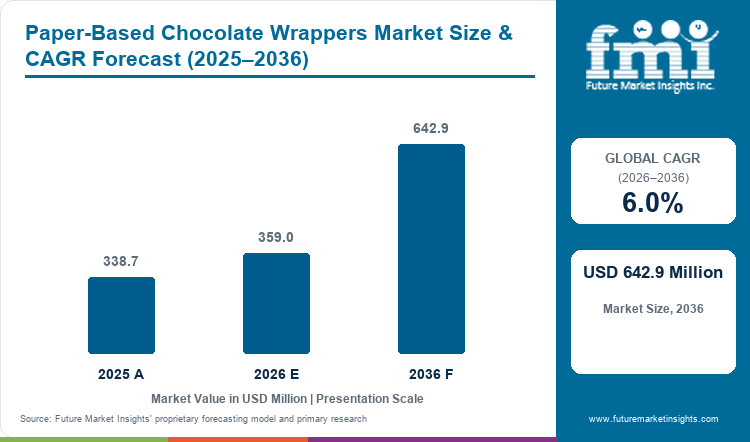
- Market Size (2026)
- USD 359.0 Mn
- Forecast (2036)
- USD 642.9 Mn
- CAGR (2026 to 2036)
- 6.0%
How big is Paper-Based Chocolate Wrappers Market in 2026?
USD 359.0 million in 2026 and USD 642.9 million by 2036 at a 6.0% CAGR.
Sales of paper-based chocolate wrappers are projected to rise at 6.0% CAGR through 2036, from USD 359.0 million in 2026 to USD 642.9 million. Paper structures enter trials once sustainable packaging briefs require lower plastic without weaker grease protection or seal performance. In August 2026, the European Commission said EU packaging waste could rise 19% by 2030 without further action. That projection brings recyclability into wrapper redesign earlier. The endpoints imply USD 283.9 million of additional modeled value.
Food packaging teams move paper wrappers into production only after food-contact chemistry and line behavior are documented. USA programs scrutinize coating and adhesive declarations before chocolate SKUs enter testing. In January 2025, the U.S. Food and Drug Administration made 35 PFAS-related food-contact notifications for grease-proof paper and paperboard no longer effective. European programs give recovery performance greater weight. Both routes reward technical files that explain barrier chemistry before approval.
Key Takeaways
- Packaging redesigns favor paper-dominant wrappers after recyclability rules and food-contact reviews make coating chemistry part of qualification.
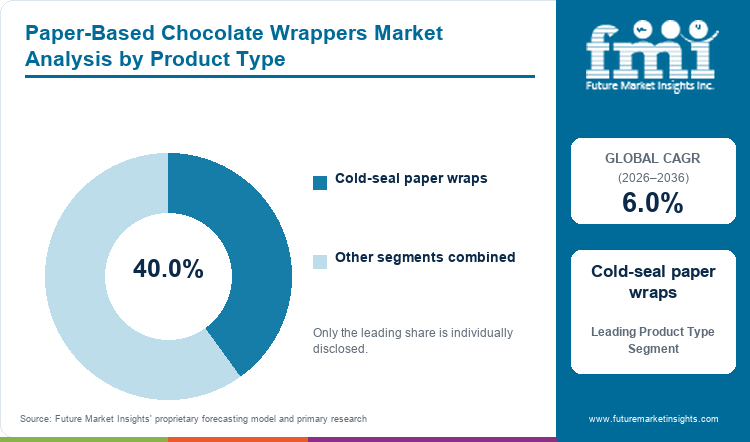
- By product type, cold-seal paper wraps are estimated to hold 40.0% in 2026 owing to pressure sealing that limits heat exposure.
- Virgin kraft & SBS is projected to hold 33.0% share in 2026 attributable to repeatable coating, print and web behavior.
- In 2026, standard retail is expected to lead format size with 40.0% share because repeated branded runs spread qualification work over more wrappers.
- Qualification can stall if barrier layers preserve shelf life but fail fiber-recovery tests or lose seal consistency at commercial speed.
- Some of the key players in this market include Graphic Packaging, Metsä Group, Huhtamaki, Ranpak, Smurfit Westrock, Mondi Group, Stora Enso, MM Group (Mayr-Melnhof Karton AG), International Paper, and Sonoco.
Analyst Perspective
"Paper-based chocolate wrappers earn approval only after grease barrier, shelf-life and seal behavior hold on the brand's actual flow-wrap line. A lower-plastic structure has little commercial value if it slows packing speed or shifts failure risk into distribution."
- Nandini Roy Choudhury, Principal Consultant, Future Market Insights
How is the paper-based chocolate wrappers market segmented?
Product Type, Material, Format Size, End Use, Sales Channel and Region.
The paper-based chocolate wrappers market is segmented by product type into cold-seal paper wraps, heat-seal barrier paper, twist papers and foil-replacement laminates. Material covers virgin kraft & SBS, recycled fiber, molded pulp and barrier-coated fiber. Format size includes standard retail, small unit packs and bulk & transit. End use covers food & foodservice, beverage, e-commerce & retail, personal care & pharma and industrial. Sales channel includes direct brand contracts, packaging distributors and online B2B.
What supports demand for cold-seal paper wraps within the product type category?
Cold-seal paper wraps suit chocolate bars that need pressure sealing without added heat. The paper still must resist grease and protect the product through storage. Barrier packaging evidence therefore needs to show a stable seal window at commercial speed.
- Based on product type, cold-seal paper wraps are projected to account for 40.0% in 2026 due to pressure sealing that limits heat exposure.
- In March 2025, UPM and Orkla Suomi began a six-month Panda Milk chocolate pilot using paper wrappers instead of PP plastic. UPM stated that cold-seal lacquer lets the structure run on existing flowpack machines, providing direct evidence for seal performance and runability.
How do packaging teams evaluate virgin kraft & SBS within the material category?
Virgin kraft & SBS gives coating and printing teams a uniform fresh-fiber surface during wrapper conversion. That consistency limits variation while barrier layers and graphics are tuned for the intended chocolate SKU. Flexible packaging paper trials can therefore favor tightly controlled surface and strength.
- By material, virgin kraft & SBS is estimated to hold 33.0% in 2026 owing to stable coating response, print quality and web handling.
- Stora Enso launched Performa Nova in April 2025 for food, chocolate and confectionery packaging after starting its Oulu consumer-board line. The fresh-fiber grade can use barrier coatings, giving trials a controlled base for testing protection and converting performance.
What role does standard retail play within the format size category?
Standard retail wrappers carry repeated artwork and specifications, so successful trials move into larger production runs. Long runs expose web tension, print registration and seal variation quickly. Chocolate bar packaging therefore gives brands a practical route for proving paper conversion.
- In 2026, standard retail is expected to lead format size with 40.0% share because repeated branded runs spread qualification work over larger wrapper volumes.
- In September 2025, Walkers Chocolates introduced a recyclable paper wrapper developed with UPM and EvoPak for retail and international customers. Walkers reported the same packaging-line speed as its previous plastic material with minor adjustments, providing evidence on runability after substitution.
How do direct brand contracts influence selection within the sales channel category?
Direct brand contracts keep barrier targets, artwork and line conditions inside one program. Material developers receive product and machine data before approval, while brands can trace decisions on coatings and recovery claims. Customized confectionery packaging therefore needs closer technical exchange than stock grades.
- Direct brand contracts are set to lead the sales channel with 48.0% share in 2026 due to coordinated material, sealing and line decisions.
- In May 2025, Metsä Group and Amcor announced joint development of recyclable molded-fiber food packaging with high-barrier lidding and liner technology. The collaboration shows why direct technical work precedes commercialization: product protection and recycling requirements must be resolved together.
What are the drivers, restraints and opportunities in the Paper-Based Chocolate Wrappers Market?
Recyclability-led redesign increases trial activity, barrier and line qualification restrict rapid substitution, and lower-plastic paper structures offer the clearest route to commercial conversion.
- Driver: Packaging rules put recyclability and material disclosure inside active chocolate-wrapper redesign programs.
- Restraint: Coatings, adhesives and seal systems can weaken fiber recovery or fail barrier requirements at full line speed.
- Opportunity: Material developers can win conversions by reducing polymer while proving barrier performance on existing wrapping equipment.
Paper packaging substitution gains commercial attention when redesign programs have defined plastic-reduction and recovery targets. ADEME's March 2025 review assessed 16 paper-cardboard packaging solutions for substitution, reduction and reuse. Chocolate wrapper projects face the same commercial test: fiber structures need enough barrier and converting stability to answer a live redesign brief.
Recyclable packaging testing can expose limits that a paper-facing construction does not reveal. Germany's Central Agency Packaging Register (ZSVR) published the 2025 minimum standard in agreement with the German Environment Agency (UBA), maintaining a uniform method for assessing sales-packaging recyclability. Coatings and laminates therefore need recovery evidence at construction level because poor fiber yield can weaken the case for substitution.
The clearest opening lies in barrier coated papers that reduce polymer without giving up food protection. Huhtamaki launched ProDairy in February 2025 with less than 10% plastic while retaining seal and barrier requirements for dairy packaging. Chocolate wrapper developers can apply the same design discipline, but revenue follows only after lower coating complexity survives shelf-life and line tests.
Which country CAGRs are profiled in the Paper-Based Chocolate Wrappers Market?
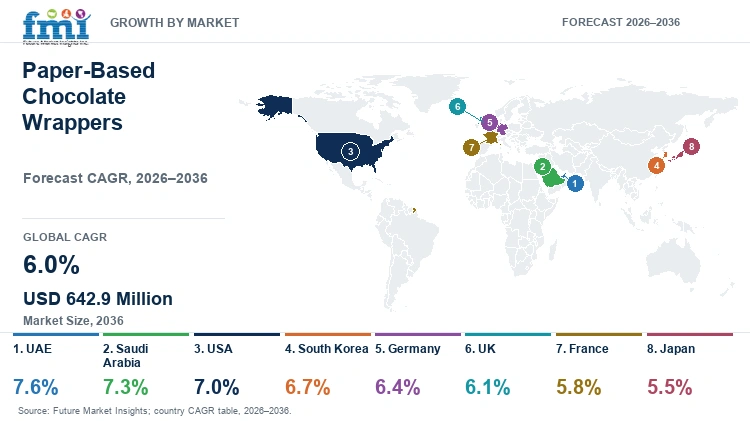
| Country | CAGR |
|---|---|
| UAE | 7.6% |
| Saudi Arabia | 7.3% |
| USA | 7.0% |
| South Korea | 6.7% |
| Germany | 6.4% |
| UK | 6.1% |
| France | 5.8% |
| Japan | 5.5% |
How do country-level CAGRs compare in the Paper-Based Chocolate Wrappers Market?
The 2.1-point spread masks distinct commercial routes. UAE and Saudi Arabia form the upper band because branded food activity converts packaging changes faster, while Japan records 5.5% with longer qualification cycles. USA, South Korea, Germany, UK and France occupy a middle cluster where technical documentation shapes conversion speed.
- UAE premium retail shortens launch cycles after approval.
- Saudi manufacturing depth broadens the domestic account base.
- USA national brands reward converters with repeatable scale.
- South Korea concentrated grocery channels speed repeat orders.
- Germany experienced converters handle tighter print specifications.
- UK retailer standards can shorten material-trial decisions.
- France packaging designers support premium-format changes locally.
- Japan finish-quality expectations extend artwork qualification.
Comparable CAGRs therefore imply different sales effort, trial cost and documentation depth. The full report provides country-level CAGR analysis across North America, Latin America, Western Europe, Eastern Europe, East Asia, South Asia and Pacific, and Middle East and Africa.
Country-wise Analysis
- Large USA chocolate brands usually route material changes through food-safety, packaging engineering and line trials before a national SKU converts. The FDA's May 2026 review covered eight phthalates still authorized as plasticizers for food-contact use and grouped four for future cumulative assessment. Deep converting capacity gives brands several trial routes, though coating and adhesive files remain a recurring burden. Paper-based chocolate wrapper demand in USA is forecast to rise at 7.0% CAGR over the forecast period, given active redesign programs and strong trial capacity. Companies that answer chemical and production questions in one technical file can shorten approval without relaxing barrier requirements.
- German brand owners can draw on experienced converters, but packaging approval now gives recyclability documentation a formal role beside print and barrier performance. In February 2026, the federal environment ministry said the cabinet approved a Packaging Law Implementation Act draft with new packaging-waste prevention duties. Paper-based chocolate wrapper sales in Germany are forecast to expand at 6.4% CAGR by 2036, tied to EU packaging implementation and established conversion capacity. Local technical depth supports detailed line trials, while market entry depends on proving that functional coatings do not undermine fiber recovery during formal recyclability assessment under the national recovery system.
- France gives packaging teams a mature producer-responsibility system and a large measured recycling base for testing fiber-led formats. Paper-based chocolate wrapper demand in France is forecast to rise at 5.8% CAGR over the assessment period, attributable to material-reduction goals and established sorting systems. ADEME's April 2026 data put household-packaging recycling at 69.6% in 2024 and recorded about 4,893 kilotonnes sorted for recycling. National design and converting expertise supports trials, but barrier coatings still need to fit recovery expectations before commercial approval. Clear layer descriptions also support consumer sorting instructions and reduce uncertainty during high-volume retail programs nationwide.
- UK packaging programs increasingly link recyclability assessment with producer reporting, which makes material data part of the commercial file before a wrapper reaches scale. PackUK stated in June 2025 that liable producers must submit recyclability assessments and that insufficient sustainability information can push packaging into the RED RAM subcategory. A clear assessment method gives brands an operating route for new paper structures. Paper-based chocolate wrapper demand in UK is predicted to advance at 6.1% CAGR through 2036, propelled by efforts to avoid hard-to-recycle formats. Coating and composite-layer data can delay classification, making complete declarations a practical advantage during commercial review.
- Japanese confectionery brands put heavy weight on finish quality, product protection and stable machine behavior, which makes material conversion deliberately cautious. The Ministry of the Environment reported in March 2026 that 1,740 municipalities had five-year collection plans and 904 planned separate collection of paper containers and packaging. Those local recovery arrangements make disposal fit a visible part of design review. Paper-based chocolate wrapper demand in Japan is anticipated to grow at 5.5% CAGR during the assessment period, supported by structured trials and municipal recovery planning. Suppliers win trust through repeated line tests and recovery guidance because conservative qualification can extend launch timing even after laboratory performance passes.
- South Korean packaging teams increasingly treat recyclability classification as a design input instead of a disposal-stage check. Adoption of paper-based chocolate wrappers in South Korea is estimated to expand at 6.7% CAGR through 2036, helped by pressure for simpler material structures. Branded food launches provide the commercial route, but composite coatings can complicate classification. In June 2026, the Ministry of Climate, Energy and Environment opened a national ideas contest to reduce unnecessary plastics and remove recycling barriers after industry consultation. Material developers gain a clearer entry path when structure documentation accompanies production trials and explains how coatings affect the recovery route.
- Saudi Arabia has a larger domestic chocolate-production base than an import-only view suggests, giving packaging companies a broad set of local manufacturing accounts. Paper-based chocolate wrapper demand is projected to record 7.3% CAGR during the assessment period, supported by repeat purchasing after brand and factory specifications are cleared. The Ministry of Commerce counted 3,532 active cocoa and chocolate production registrations at the end of the second quarter of 2025. Domestic manufacturing provides the volume base, while hot distribution conditions and importer-led checks raise the qualification threshold for moisture, grease and food-contact performance during repeat production runs and regional distribution.
- UAE premium food brands work through concentrated retail and hospitality channels, so a cleared wrapper can reach several outlets without a long regional rollout. In January 2025, the Ministry of Climate Change and Environment issued a single-use products guide for manufacturers, importers, distributors and retailers. Paper-based chocolate wrapper sales in UAE are forecast to expand at 7.6% CAGR by 2036, owing to faster branded-food launches and plastic-reduction policy. Local converters can shorten trial cycles, but heat and humidity favor moisture-resistant structures backed by food-contact files and distribution testing before supply expands through supermarket, hospitality and premium-food programs nationwide.
Who are the notable companies in the Paper-Based Chocolate Wrappers Market?
Mondi Group, Graphic Packaging, Metsä Group, Huhtamaki, Ranpak, Smurfit Westrock, Stora Enso, MM Group (Mayr-Melnhof Karton AG), International Paper, Sonoco.
Competition separates direct barrier-paper specialists from paperboard packaging groups and adjacent fiber systems. Mondi Group and Huhtamaki have the clearest direct flexible-paper fit. Stora Enso, Metsä Group and MM Group (Mayr-Melnhof Karton AG) deepen food-grade board supply. Graphic Packaging and Smurfit Westrock bring consumer conversion scale. Ranpak, International Paper and Sonoco participate mainly through adjacent fiber formats. Entry depends on barrier proof and line-level evidence.
- Flexible barrier-paper platforms: Mondi Group and Huhtamaki document paper structures designed for demanding flexible food applications.
- Food and consumer fiber conversion: Graphic Packaging, Metsä Group, Smurfit Westrock, Stora Enso and MM Group (Mayr-Melnhof Karton AG) provide board and converting depth.
- Adjacent fiber systems: Ranpak, International Paper and Sonoco focus mainly on protective, corrugated or rigid paper formats outside direct flexible wrappers.
Competitive Benchmarking: Paper-Based Chocolate Wrappers Market
| Company | Barrier-Paper Fit | Food-Converting Fit | Fiber Breadth | Geographic Reach |
|---|---|---|---|---|
| Graphic Packaging | Low | High | High | North America, Europe, Asia-Pacific |
| Metsä Group | Medium | High | High | Europe, international customers |
| Huhtamaki | High | High | High | Europe, Asia, Americas |
| Ranpak | Low | Low | Medium | North America, Europe, Asia-Pacific |
| Smurfit Westrock | Low | High | High | Europe, Americas, Asia-Pacific |
| Mondi Group | High | High | High | Europe, global flexible reach |
| Stora Enso | Medium | High | High | Europe, international material sales |
| MM Group (Mayr-Melnhof Karton AG) | Medium | High | High | Europe, international board sales |
| International Paper | Low | Medium | High | North America, EMEA, international customers |
| Sonoco | Low | Medium | High | Americas, EMEA, Asia-Pacific |
Scoring basis: High requires current official evidence of broad barrier-paper, food-converting or fiber-packaging capability. Medium records a narrower board or coated-paper route. Low marks adjacent fiber activity without direct flexible high-barrier evidence. Geographic reach follows current company reporting.
Key Developments in the Paper-Based Chocolate Wrappers Market
- In August 2025, Mondi Group ramped production of FunctionalBarrier Paper Ultimate with oxygen, water-vapor and grease protection. The added supply gives chocolate-wrapper trials a direct high-barrier paper route, subject to seal and shelf-life validation.
- In August 2025, Stora Enso inaugurated its Oulu consumer-board line for food-contact packaging. The capacity broadens fresh-fiber supply for confectionery programs that require stable printing, coating and converting performance.
- In July 2025, Huhtamaki launched recyclable and compostable paperboard ice cream cups with a bio-based coating containing less than 10% plastic. The launch demonstrates polymer reduction while keeping food-protection requirements inside qualification.
Key Players in the Paper-Based Chocolate Wrappers Market
Flexible Barrier-Paper and Coating Platforms
- Mondi Group
- Huhtamaki
Food and Consumer Fiber Packaging
- Graphic Packaging
- Metsä Group
- Smurfit Westrock
- Stora Enso
- MM Group (Mayr-Melnhof Karton AG)
Adjacent Protective, Corrugated and Rigid Paper Systems
- Ranpak
- International Paper
- Sonoco
Paper-Based Chocolate Wrappers Market - Report Scope
| Coverage field | Report scope |
|---|---|
| Market breakdown | Product Type, Material, Format Size, End Use, Sales Channel, Region |
| Quantitative Units | USD million. |
| Market Definition | Revenue includes paper-based wrapping substrates and converted wraps sold as the named chocolate-wrapper product, including specified barrier, printing and sealing features sold with the wrapper. It excludes downstream chocolate revenue, wrapping machinery, unrelated cartons or containers, and plastic or metal alternatives not sold as paper-based chocolate wrappers. |
| Regions Covered | North America, Latin America, Western Europe, Eastern Europe, East Asia, South Asia and Pacific, Middle East and Africa |
| Countries Covered | USA, Germany, France, UK, Japan, South Korea, Saudi Arabia, UAE, and more than twenty-five additional countries in the full report. |
| Key Companies Profiled | Graphic Packaging, Metsä Group, Huhtamaki, Ranpak, Smurfit Westrock, Mondi Group, Stora Enso, MM Group (Mayr-Melnhof Karton AG), International Paper, Sonoco |
| Forecast Period | 2026 to 2036. |
| Approach | Primary and secondary research with market triangulation. |
Paper-Based Chocolate Wrappers Market - Research Methodology
| Method | Approach |
|---|---|
| Primary Research | FMI analysts gathered input from manufacturers, service providers, technology developers, distributors, end users, procurement teams, and subject-matter experts. Interviews examined purchasing decisions, product or service evaluation, adoption barriers, approval requirements, pricing considerations, and expectations for technical or commercial support. Respondents were also asked what evidence is required before a trial, pilot, or initial order develops into regular purchasing. |
| Desk Research | Desk research covered government statistics, regulatory publications, trade data, industry associations, technical literature, standards, company filings, product information, and official corporate announcements. Sources were reviewed for relevance, publication date, geographic coverage, and consistency with the defined market scope. Claims relating to performance, applications, approvals, capacity, investment, and commercial activity were retained only when supported by credible public evidence. |
| Market Sizing and Forecasting | The market model combined the baseline value with historical performance, segment structure, pricing and volume indicators, adoption levels, company participation, and country-level demand conditions. Forecast assumptions considered economic activity, investment trends, regulatory developments, technology adoption, purchasing cycles, supply availability, and barriers to wider market use. Segment and regional estimates were reconciled before the final market total was calculated. |
| Data Validation | Estimates were checked against multiple independent indicators, including public data, company activity, trade patterns, industry developments, and findings from primary interviews. Validation also tested whether products, services, applications, and company revenues fell within the defined market boundaries. Adjacent categories, unsupported claims, overlapping revenues, and activities without direct market relevance were excluded to reduce double counting and maintain consistency across segments and countries. |
Paper-Based Chocolate Wrappers Market by Segments
Paper-Based Chocolate Wrappers Market segmented by Product Type:
- Cold-seal paper wraps
- Heat-seal barrier paper
- Twist papers
- Foil-replacement laminates
Paper-Based Chocolate Wrappers Market segmented by Material:
- Virgin kraft & SBS
- Recycled fiber
- Molded pulp
- Barrier-coated fiber
Paper-Based Chocolate Wrappers Market segmented by Format Size:
- Standard retail
- Small unit packs
- Bulk & transit
Paper-Based Chocolate Wrappers Market segmented by End Use:
- Food & foodservice
- Beverage
- E-commerce & retail
- Personal care & pharma
- Industrial
Paper-Based Chocolate Wrappers Market segmented by Sales Channel:
- Direct brand contracts
- Packaging distributors
- Online B2B
Paper-Based Chocolate Wrappers Market by Region:
- North America
- United States
- Canada
- Latin America
- Brazil
- Mexico
- Argentina
- Chile
- Western Europe
- Germany
- France
- United Kingdom
- Italy
- Spain
- Benelux
- Nordics
- Eastern Europe
- Poland
- Czech Republic
- Romania
- Hungary
- East Asia
- China
- Japan
- South Korea
- South Asia and Pacific
- India
- ASEAN
- Australia and New Zealand
- Middle East and Africa
- GCC Countries
- South Africa
- Türkiye
- Israel
Research Sources and Bibliography
- European Commission (2026, August 11). New EU rules on packaging enter into application
- U.S. Food and Drug Administration (2025, January 3). FDA Determines Authorization for 35 Food Contact Notifications Related to PFAS Are No Longer Effective
- UPM (2025, March 6). UPM and Orkla Suomi introduce paper packaging for Panda Milk chocolate
- Stora Enso (2025, April 29). Stora Enso launches Performa Nova, a high-yield folding boxboard for consumer packaging
- UPM (2025, September 9). Walkers Chocolates introduces recyclable paper wrapper co-created with UPM and EvoPak
- Metsä Group (2025, May 12). Metsä Group and Amcor partner to develop recyclable food packaging
- ADEME (2025, March 7). Évaluation de l'offre des emballages papiers-cartons en France
- Stiftung Zentrale Stelle Verpackungsregister (ZSVR). (2025, August 28). Mindeststandard zur Bemessung der Recyclingfähigkeit von systembeteiligungspflichtigen Verpackungen.
- Huhtamaki (2025, February 28). Huhtamaki launches recyclable single coated paper cups for yogurt and dairy
- Ministry of Climate Change and Environment, United Arab Emirates (2025, January 2). Ministry of Climate Change and Environment reveals details of comprehensive guide outlining regulations for single-use plastic products
- Ministry of Commerce, Saudi Arabia (2025, July 7). Ministry of Commerce: Over 3,500 Commercial Registrations in the Cocoa and Chocolate Production Industry
- U.S. Food and Drug Administration (2026, May 27). FDA Advances Post-Market Review of Phthalates Used in Food Contact Materials
- Ministry of Climate, Energy and Environment, Republic of Korea (2026, June 24). Public Invited to Help Turn Everyday Plastic Waste and Recycling Obstacles into Policy Solutions
- Federal Ministry for the Environment, Climate Action, Nature Conservation and Nuclear Safety (2026, February 11). Neues Verpackungsgesetz verbessert Abfallvermeidung und Recycling
- PackUK (2025, June 27). PackUK: 2025 recyclability assessment requirements
- ADEME (2026, April 7). Emballages ménagers et papiers graphiques : données 2024
- Ministry of the Environment, Government of Japan (2026, March 31).
- Mondi Group (2025, August 14). Mondi Ramps Up FunctionalBarrier Paper Ultimate to Meet Growing Demand for Sustainable High-Barrier Paper-Based Packaging
- Stora Enso (2025, August 18). Stora Enso’s billion-euro investment in renewable packaging - Europe's most modern consumer board production line inaugurated in Finland
- Huhtamaki (2025, July 16). Huhtamaki launches new compostable ice cream cups
- Graphic Packaging Holding Company (2026, March 2). Annual report on Form 10-K for the fiscal year ended December 31, 2025
- Metsä Group (2026, February 19). Annual Review 2025: Metsä Group Publishes Review of the Financial Year and Updated Climate Transition Plan
- Huhtamaki (2026, March 3). Huhtamaki's 2025 Annual Report published
- Ranpak Holdings Corp. (2026, March 5). Annual Report on Form 10-K
- Smurfit Westrock (2026, February 27). 2025 Annual Report on Form 10-K
- Mondi Group (2026, March 5). Mondi launches its 2025 Integrated and Sustainable Development reporting suite
- Stora Enso (2026, February 12). Stora Enso publishes its Annual Report and Remuneration Report 2025
- MM Group (Mayr-Melnhof Karton AG) (2026, April 8). Annual Report 2025 of the MM Group
- International Paper Company (2026, February 27). Annual Report on Form 10-K for the fiscal year ended December 31, 2025
- Sonoco Products Company (2026, February 16). Sonoco Reports Fourth Quarter and Full Year 2025 Results
- Metsä Board (2026, July 2). Brands face growing demands on packaging - Metsä Board rethinks packaging development with a new design studio in Milan
- Stora Enso (2026, June 10). Stora Enso’s Oulu pulp production granted internationally recognized food safety certification - first in Finland
- Graphic Packaging (2025, December 3). Graphic Packaging Launches Next-Generation Boardio Technology with Enhanced Multi-Footprint Capability
- Ranpak Holdings Corp. (2025, January 22). Ranpak announces three new automated packaging solutions to drive improved productivity
- Sonoco Products Company (2025, July 31). Lorenz Snaps Up Sonoco’s Paper-End Can for its Crunchips Stackers
- Mondi Group (2025, November 6). Mondi advances transition to PE-free wrappers for cut-size paper across European mills
- Graphic Packaging (2025, September 25). Scaling Sustainability: How Industry Leaders Are Rethinking Resources Together
- Metsä Board (2026, March 3). Metsä Board introduces a new product and service concept for fast moving brand packaging in Europe
- Huhtamaki (2025, April 24). Huhtamaki acquires Zellwin Farms Company
- Ranpak Holdings Corp. (2026, January 13). Ranpak and Medline Partner to Advance Automation and Sustainable Packaging Across High-Volume Distribution Operations
- Smurfit Westrock (2026, May 5). Smurfit Westrock launches prototype of glueline-free packaging solution
- Mondi Group (2025, April 1). Mondi completes acquisition of Schumacher Packaging’s Western Europe operations
- Stora Enso (2026, April 30). Stora Enso launches Performa Natura Aqua, a dispersion-coated board for foodservice and bakery packaging
- MM Group (2026, August 17). MM Board & Paper signs agreement to acquire the operations of R.D.M. Arnsberg
- Sonoco Products Company (2025, April 1). Sonoco Completes Sale of Thermoformed and Flexibles Packaging Business to TOPPAN Holdings, Inc.
This bibliography is provided for reader reference and is not exhaustive. The full report contains the complete reference list and detailed citations.
This Report Answers
- What are the 2026 and 2036 values for the paper-based chocolate wrappers market?
- How do recyclability and food-contact rules change paper-wrapper qualification?
- Why do cold-seal paper wraps hold the leading product type share?
- How do virgin kraft & SBS and standard retail formats affect qualification?
- How do country growth rates differ among the eight profiled countries?
- Which technical limits can delay paper-wrapper conversion?
- Which companies hold direct barrier-paper or adjacent fiber positions?
- What should packaging teams verify before approving a paper-based chocolate wrapper?
Frequently Asked Questions
How big is the paper-based chocolate wrappers market in 2026?
The paper-based chocolate wrappers market is valued at USD 359.0 million in 2026 and is projected to reach USD 642.9 million by 2036. Growth depends on recyclable paper structures meeting barrier and seal requirements.
What is the CAGR of the paper-based chocolate wrappers market from 2026 to 2036?
The paper-based chocolate wrappers market is projected to grow at a CAGR of 6.0% between 2026 and 2036. Expansion depends on lower-plastic structures passing food-contact, shelf-life and commercial line tests.
Which product type leads the paper-based chocolate wrappers market?
The cold-seal paper wraps segment is expected to hold 40.0% of the paper-based chocolate wrappers market in 2026, attributable to pressure sealing that limits heat exposure. Adoption still requires stable grease protection and line-speed sealing.
How much value will the paper-based chocolate wrappers market add between 2026 and 2036?
The paper-based chocolate wrappers market is expected to add USD 283.9 million in modeled value between 2026 and 2036. Additional revenue depends on paper structures moving from technical trials into repeat production.
Which companies are active in the paper-based chocolate wrappers market?
Key companies operating in the paper-based chocolate wrappers market include Graphic Packaging, Metsa Group, Huhtamaki, Ranpak, Smurfit Westrock, Mondi Group, Stora Enso, Mayr-Melnhof, International Paper, and Sonoco. Their positions span direct barrier paper and adjacent fiber packaging.
Preview the report firsthand - request a free sample
Get SampleGet the brochure for pricing and purchase details.
Get PDFTable of Content
- Key Takeaways
- Market Size and CAGR
- Top Growth Driver
- Fastest Growing Segment
- Leading Region
- Key Companies
- Emerging Opportunities
- Executive Summary
- Global Market Outlook
- Demand-side Trends
- Supply-side Trends
- Technology Roadmap Analysis
- Analysis and Recommendations
- Analyst Perspective (What is happening? Why now? What should investors know?)
- Key Questions Answered
- How large is the market?
- What is the CAGR?
- What are key trends?
- Which region dominates?
- Who are the leaders?
- Market Overview
- Market Coverage / Taxonomy
- Market Definition / Scope / Limitations
- Research Methodology
- Chapter Orientation
- Analytical Lens and Working Hypotheses
- Market Structure, Signals, and Trend Drivers
- Benchmarking and Cross-market Comparability
- Market Sizing, Forecasting, and Opportunity Mapping
- Research Design and Evidence Framework
- Desk Research Programme (Secondary Evidence)
- Expert Input and Fieldwork (Primary Evidence)
- Tooling, Models, and Reference Databases
- Data Engineering and Model Build
- Quality Assurance and Audit Trail
- Market Background
- Market Dynamics (Drivers, Restraints, Opportunity, Trends)
- Scenario Forecast (Optimistic, Likely, Conservative)
- Impact Analysis
- AI Impact
- Sustainability Impact
- Regulatory Impact
- Technology Impact
- Consumer / Buyer Analysis
- Purchase Drivers
- Adoption Barriers
- Buyer Journey
- Opportunity Map Analysis
- Product Life Cycle Analysis
- Supply Chain Analysis
- Investment Feasibility Matrix
- Value Chain Analysis
- PESTLE and Porter's Analysis
- Regulatory Landscape
- Regional Parent Market Outlook
- Production and Consumption Statistics
- Import and Export Statistics
- Global Market Analysis and Forecast, 2021 to 2036
- Historical Market Size Value (USD Million) Analysis, 2021 to 2025
- Current and Future Market Size Value (USD Million) Projections, 2026 to 2036
- Y-o-Y Growth Trend Analysis
- Absolute $ Opportunity Analysis
- Global Market Pricing Analysis, 2021 to 2036
- Global Market Analysis and Forecast, By Product Type, 2021 to 2036
- Introduction / Key Findings
- Historical Market Size Value (USD Million) Analysis By Product Type, 2021 to 2025
- Current and Future Market Size Value (USD Million) Analysis and Forecast By Product Type, 2026 to 2036
- Cold-seal paper wraps
- Heat-seal barrier paper
- Twist papers
- Foil-replacement laminates
- Y-o-Y Growth Trend Analysis By Product Type, 2021 to 2025
- Absolute $ Opportunity Analysis By Product Type, 2026 to 2036
- Global Market Analysis and Forecast, By Material, 2021 to 2036
- Introduction / Key Findings
- Historical Market Size Value (USD Million) Analysis By Material, 2021 to 2025
- Current and Future Market Size Value (USD Million) Analysis and Forecast By Material, 2026 to 2036
- Virgin kraft & SBS
- Recycled fiber
- Molded pulp
- Barrier-coated fiber
- Y-o-Y Growth Trend Analysis By Material, 2021 to 2025
- Absolute $ Opportunity Analysis By Material, 2026 to 2036
- Global Market Analysis and Forecast, By Format Size, 2021 to 2036
- Introduction / Key Findings
- Historical Market Size Value (USD Million) Analysis By Format Size, 2021 to 2025
- Current and Future Market Size Value (USD Million) Analysis and Forecast By Format Size, 2026 to 2036
- Standard retail
- Small unit packs
- Bulk & transit
- Y-o-Y Growth Trend Analysis By Format Size, 2021 to 2025
- Absolute $ Opportunity Analysis By Format Size, 2026 to 2036
- Global Market Analysis and Forecast, By End Use, 2021 to 2036
- Introduction / Key Findings
- Historical Market Size Value (USD Million) Analysis By End Use, 2021 to 2025
- Current and Future Market Size Value (USD Million) Analysis and Forecast By End Use, 2026 to 2036
- Food & foodservice
- Beverage
- E-commerce & retail
- Personal care & pharma
- Industrial
- Y-o-Y Growth Trend Analysis By End Use, 2021 to 2025
- Absolute $ Opportunity Analysis By End Use, 2026 to 2036
- Global Market Analysis and Forecast, By Sales Channel, 2021 to 2036
- Introduction / Key Findings
- Historical Market Size Value (USD Million) Analysis By Sales Channel, 2021 to 2025
- Current and Future Market Size Value (USD Million) Analysis and Forecast By Sales Channel, 2026 to 2036
- Direct brand contracts
- Packaging distributors
- Online B2B
- Y-o-Y Growth Trend Analysis By Sales Channel, 2021 to 2025
- Absolute $ Opportunity Analysis By Sales Channel, 2026 to 2036
- Global Market Analysis and Forecast, By Region, 2021 to 2036
- Introduction
- Historical Market Size Value (USD Million) Analysis By Region, 2021 to 2025
- Current Market Size Value (USD Million) Analysis and Forecast By Region, 2026 to 2036
- North America
- Latin America
- Western Europe
- Eastern Europe
- East Asia
- South Asia and Pacific
- Middle East and Africa
- Market Attractiveness Analysis By Region
- North America Market Analysis and Forecast, By Country, 2021 to 2036
- Historical Market Size Value (USD Million) Trend Analysis By Market Taxonomy, 2021 to 2025
- Market Size Value (USD Million) Forecast By Market Taxonomy, 2026 to 2036
- By Country
- United States
- Canada
- By Product Type
- By Material
- By Format Size
- By End Use
- By Sales Channel
- By Country
- Market Attractiveness Analysis
- By Country
- By Product Type
- By Material
- By Format Size
- By End Use
- By Sales Channel
- Key Takeaways
- Latin America Market Analysis and Forecast, By Country
- Historical Market Size Value (USD Million) Trend Analysis By Market Taxonomy, 2021 to 2025
- Market Size Value (USD Million) Forecast By Market Taxonomy, 2026 to 2036
- By Country
- Brazil
- Mexico
- Argentina
- Chile
- By Product Type
- By Material
- By Format Size
- By End Use
- By Sales Channel
- By Country
- Market Attractiveness Analysis
- By Country
- By Product Type
- By Material
- By Format Size
- By End Use
- By Sales Channel
- Key Takeaways
- Western Europe Market Analysis and Forecast, By Country
- Historical Market Size Value (USD Million) Trend Analysis By Market Taxonomy, 2021 to 2025
- Market Size Value (USD Million) Forecast By Market Taxonomy, 2026 to 2036
- By Country
- Germany
- France
- United Kingdom
- Italy
- Spain
- Benelux
- Nordics
- By Product Type
- By Material
- By Format Size
- By End Use
- By Sales Channel
- By Country
- Market Attractiveness Analysis
- By Country
- By Product Type
- By Material
- By Format Size
- By End Use
- By Sales Channel
- Key Takeaways
- Eastern Europe Market Analysis and Forecast, By Country
- Historical Market Size Value (USD Million) Trend Analysis By Market Taxonomy, 2021 to 2025
- Market Size Value (USD Million) Forecast By Market Taxonomy, 2026 to 2036
- By Country
- Poland
- Czech Republic
- Romania
- Hungary
- By Product Type
- By Material
- By Format Size
- By End Use
- By Sales Channel
- By Country
- Market Attractiveness Analysis
- By Country
- By Product Type
- By Material
- By Format Size
- By End Use
- By Sales Channel
- Key Takeaways
- East Asia Market Analysis and Forecast, By Country
- Historical Market Size Value (USD Million) Trend Analysis By Market Taxonomy, 2021 to 2025
- Market Size Value (USD Million) Forecast By Market Taxonomy, 2026 to 2036
- By Country
- China
- Japan
- South Korea
- By Product Type
- By Material
- By Format Size
- By End Use
- By Sales Channel
- By Country
- Market Attractiveness Analysis
- By Country
- By Product Type
- By Material
- By Format Size
- By End Use
- By Sales Channel
- Key Takeaways
- South Asia and Pacific Market Analysis and Forecast, By Country
- Historical Market Size Value (USD Million) Trend Analysis By Market Taxonomy, 2021 to 2025
- Market Size Value (USD Million) Forecast By Market Taxonomy, 2026 to 2036
- By Country
- India
- ASEAN
- Australia and New Zealand
- By Product Type
- By Material
- By Format Size
- By End Use
- By Sales Channel
- By Country
- Market Attractiveness Analysis
- By Country
- By Product Type
- By Material
- By Format Size
- By End Use
- By Sales Channel
- Key Takeaways
- Middle East and Africa Market Analysis and Forecast, By Country
- Historical Market Size Value (USD Million) Trend Analysis By Market Taxonomy, 2021 to 2025
- Market Size Value (USD Million) Forecast By Market Taxonomy, 2026 to 2036
- By Country
- GCC Countries
- South Africa
- Türkiye
- Israel
- By Product Type
- By Material
- By Format Size
- By End Use
- By Sales Channel
- By Country
- Market Attractiveness Analysis
- By Country
- By Product Type
- By Material
- By Format Size
- By End Use
- By Sales Channel
- Key Takeaways
- Key Countries Market Analysis
- United States
- Pricing Analysis
- Market Share Analysis, 2025
- By Product Type
- By Material
- By Format Size
- By End Use
- By Sales Channel
- Canada
- Pricing Analysis
- Market Share Analysis, 2025
- By Product Type
- By Material
- By Format Size
- By End Use
- By Sales Channel
- Mexico
- Pricing Analysis
- Market Share Analysis, 2025
- By Product Type
- By Material
- By Format Size
- By End Use
- By Sales Channel
- Brazil
- Pricing Analysis
- Market Share Analysis, 2025
- By Product Type
- By Material
- By Format Size
- By End Use
- By Sales Channel
- Chile
- Pricing Analysis
- Market Share Analysis, 2025
- By Product Type
- By Material
- By Format Size
- By End Use
- By Sales Channel
- Germany
- Pricing Analysis
- Market Share Analysis, 2025
- By Product Type
- By Material
- By Format Size
- By End Use
- By Sales Channel
- United Kingdom
- Pricing Analysis
- Market Share Analysis, 2025
- By Product Type
- By Material
- By Format Size
- By End Use
- By Sales Channel
- Italy
- Pricing Analysis
- Market Share Analysis, 2025
- By Product Type
- By Material
- By Format Size
- By End Use
- By Sales Channel
- Spain
- Pricing Analysis
- Market Share Analysis, 2025
- By Product Type
- By Material
- By Format Size
- By End Use
- By Sales Channel
- France
- Pricing Analysis
- Market Share Analysis, 2025
- By Product Type
- By Material
- By Format Size
- By End Use
- By Sales Channel
- India
- Pricing Analysis
- Market Share Analysis, 2025
- By Product Type
- By Material
- By Format Size
- By End Use
- By Sales Channel
- ASEAN
- Pricing Analysis
- Market Share Analysis, 2025
- By Product Type
- By Material
- By Format Size
- By End Use
- By Sales Channel
- Australia and New Zealand
- Pricing Analysis
- Market Share Analysis, 2025
- By Product Type
- By Material
- By Format Size
- By End Use
- By Sales Channel
- China
- Pricing Analysis
- Market Share Analysis, 2025
- By Product Type
- By Material
- By Format Size
- By End Use
- By Sales Channel
- Japan
- Pricing Analysis
- Market Share Analysis, 2025
- By Product Type
- By Material
- By Format Size
- By End Use
- By Sales Channel
- South Korea
- Pricing Analysis
- Market Share Analysis, 2025
- By Product Type
- By Material
- By Format Size
- By End Use
- By Sales Channel
- Poland
- Pricing Analysis
- Market Share Analysis, 2025
- By Product Type
- By Material
- By Format Size
- By End Use
- By Sales Channel
- Hungary
- Pricing Analysis
- Market Share Analysis, 2025
- By Product Type
- By Material
- By Format Size
- By End Use
- By Sales Channel
- Türkiye
- Pricing Analysis
- Market Share Analysis, 2025
- By Product Type
- By Material
- By Format Size
- By End Use
- By Sales Channel
- South Africa
- Pricing Analysis
- Market Share Analysis, 2025
- By Product Type
- By Material
- By Format Size
- By End Use
- By Sales Channel
- UAE
- Pricing Analysis
- Market Share Analysis, 2025
- By Product Type
- By Material
- By Format Size
- By End Use
- By Sales Channel
- Saudi Arabia
- Pricing Analysis
- Market Share Analysis, 2025
- By Product Type
- By Material
- By Format Size
- By End Use
- By Sales Channel
- United States
- Market Structure Analysis
- Competition Dashboard
- Competition Benchmarking
- Market Share Analysis of Top Players
- By Regional
- By Product Type
- By Material
- By Format Size
- By End Use
- By Sales Channel
- Emerging Startups
- Innovation Benchmarking
- Competition Analysis
- Competition Deep Dive
- Mondi Group
- Overview
- Product Portfolio
- Profitability by Market Segments
- Sales Footprint
- Strategy Overview
- Marketing Strategy
- Product Strategy
- Channel Strategy
- Huhtamaki
- Graphic Packaging
- Metsä Group
- Smurfit Westrock
- Stora Enso
- MM Group (Mayr-Melnhof Karton AG)
- Ranpak
- International Paper
- Sonoco
- Mondi Group
- Case Studies
- Success Stories
- Recent Developments
- Competition Deep Dive
- Assumptions & Acronyms Used


