

- Market Size (2026)
- USD 391.6 Mn
- Forecast (2036)
- USD 728.2 Mn
- CAGR (2026 to 2036)
- 6.4%
How big is Paper-Based Bakery Wraps Market in 2026?
USD 391.6 million in 2026 and USD 728.2 million by 2036 at a 6.4% CAGR.
Demand for paper-based bakery wraps is projected to expand at 6.4% CAGR between 2026 and 2036, lifting valuation from USD 391.6 million to USD 728.2 million. Bakery formats need dependable grease protection without forcing costly changes to established commercial packing equipment. UPM and Paramelt introduced a paper-based food packaging concept in March 2026 for bakery and convenience uses with strong grease protection plus VFFS compatibility. The development gives converters a direct qualification route for wrapped bakery items using existing lines.
The United Kingdom is projected at 6.3% CAGR versus Japan at 5.0% as packaging decisions follow different recovery routes. Defra reported in July 2025 that 74.3% of UK paper and cardboard packaging was recycled during 2024 under methodology 1. That recovery infrastructure supports paper formats designed to fit existing collection streams without weakening food-contact performance. Japan remains more qualification-sensitive as dimensions and disposal guidance must align with local collection systems and bakery workflows.
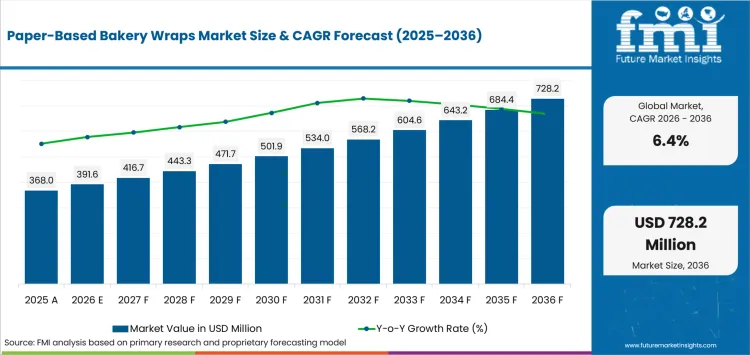
Key Takeaways
- Recurring bakery handling increases paper-wrap use as grease control and food-contact documentation remain necessary for repeat orders.
- By product type, greaseproof wraps are estimated to hold 30.0% in 2026 owing to oil-control needs during bakery handling.
- In 2026, greaseproof paper is expected to lead paper grade at 30.0% because fiber structure limits oil transfer during food contact.
- Sheets are set to lead format with 36.0% share in 2026 due to fast dispensing during manual bakery wrapping.
- Material changes slow qualification as oil resistance and converting performance must remain stable across commercial production before wider approval.
- Nordic Paper and Seaman Paper plus Novolex and Metsä Tissue plus Ahlstrom and Koehler Paper plus UPM-Kymmene Corporation and Mondi plc comprise the eight profiled companies.
Analyst Perspective
"Bakery wrap qualification should test foods and packing methods since grease holdout changes with temperature. Stronger offers pair documented chemistry with formats that preserve labor efficiency and machine settings across repeat orders."
- Nandini Roy Choudhury, Principal Consultant, Future Market Insights
How is the paper-based bakery wraps market segmented?
The paper-based bakery wraps market is segmented by product type, paper grade, format, application, end use, sales channel and region.
The paper-based bakery wraps market is segmented by product type, paper grade, format, application, end use, sales channel and region. Product types include greaseproof, kraft, glassine, parchment and other wraps. Paper grades cover greaseproof, kraft, glassine, vegetable parchment and others. Formats include sheets, rolls, pre-formed bags and wraps plus others. Applications cover bread and baguettes, pastries, cakes and sweet goods, sandwiches and others. End uses include in-store bakeries, commercial bakeries, foodservice cafes and households. Sales channels include packaging distributors, direct OEM supply, e-commerce and others.
What makes greaseproof wraps central to the product type category?
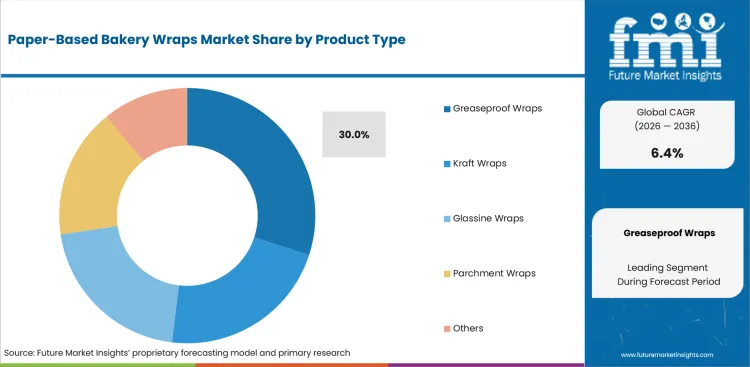
Greaseproof wraps use greaseproof paper sheets to control oil transfer during counter service without coated paperboard rigidity. Bakery operators need foldability and tear resistance as wraps protect presentation during repeated manual handling and fast counter handoff.
- By product type greaseproof wraps are estimated to hold 30.0% in 2026 owing to direct fit with oily pastries and bread service.
- The FDA determined in January 2025 that 35 food-contact notifications covering PFAS greaseproofing agents were no longer effective for paper and paperboard. The action increases qualification attention around alternative grease-resistant chemistry for direct food wrapping during bakery service.
How do bakery converters evaluate greaseproof paper within the paper grade category?
Greaseproof paper concentrates barrier performance in the fiber network instead of relying on a separate plastic film during food contact. Ahlstrom renewed CMA-W certification for its Genuine Vegetable Parchment food-grade portfolio in June 2026 which gives converters third-party compostability evidence for qualified food uses.
- Based on paper grade greaseproof is projected to account for 30.0% in 2026 due to reliable oil resistance across common bakery wrapping applications.
- Converters compare baking and cooking paper for grease holdout plus odor neutrality and print stability under warm service conditions during recurring production approval across routine commercial bakery orders.
What role do sheets play within the format category?
Sheets reduce preparation work at bakery counters as staff can dispense a fixed paper wrap without cutting material from a roll. Standard dimensions also make usage easier to forecast across recurring store orders and seasonal printed bakery programs.
- By format sheets are forecast to represent 36.0% in 2026 driven by fast manual dispensing and predictable per-item consumption.
- Seaman Paper launched heat-sealable recyclable paper packaging in September 2025 with flat-sheet and tube formats compatible with common converting equipment. The launch broadens sheet use beyond manual wrapping toward applications that need sealed paper packages and automated processing.
What supports packaging distributors within the sales channel category?
Packaging distributors combine paper wraps with foodservice paper bags and maintain stock near smaller commercial operators that cannot justify direct mill volumes. Metsä Tissue licensed SAGA consumer sales and distribution in Finland and the Baltics to Fredman Group in June 2025 while continuing to supply base paper.
- Packaging distributors are projected to hold 36.0% of sales channel demand in 2026 owing to local inventory and mixed-case purchasing across fragmented bakery accounts.
- Distributor stock of paper bags and wraps reduces replenishment gaps for independent bakeries and gives chain accounts a practical route for testing new paper grades during wider specification changes.
What are the drivers, restraints and opportunities in the Paper-Based Bakery Wraps Market?
Packaging rules and oil-control needs raise demand for paper wraps, but qualification cost can slow conversion as heat-sealable grades extend use into automated formats.
- Driver: Packaging rules are moving bakery wrap selection toward documented paper designs with verified food-contact and end-of-life performance.
- Restraint: Barrier chemistry changes can trigger another qualification cycle before bakeries approve a replacement wrap for recurring use.
- Opportunity: Heat-sealable paper extends addressable use into automated bakery applications that need dependable sealing on existing equipment.
Packaging Rules Tighten the Paper Substitution Test
Packaging rules are turning paper packaging selection into a documented design decision for bakery and foodservice programs. The EU Packaging and Packaging Waste Regulation entered into force in February 2025 and sets requirements for packaging composition plus recoverability across products placed on the EU market. Paper-wrap producers gain access as grease protection and food-contact documentation fit the recycling route used by the intended customer.
Food-Contact Qualification Slows Material Switching
Grease-resistant wraps contact food directly so any change in barrier chemistry can trigger another qualification cycle for a bakery program. FDA Food Contact Notification 2457 became effective in October 2025 and limits the listed paper additive to 0.75% of finished dry paper or paperboard. The authorization makes food-grade packaging qualification depend on exact food types and use conditions, so converters must match those conditions during bakery trials.
Heat-Sealable Papers Extend Automated Packaging Access
Automated bakery lines need paper that seals reliably on existing equipment without causing stoppages or weakening package protection. Koehler Paper reported in February 2025 that Astrabio packed pasta with NexPlus Seal Pure on standard packaging machines as a recyclable paper alternative. The operating proof gives bakery converters a practical parchment paper qualification route for suitable flow-wrapped products once seal strength and product-specific barriers pass line trials.
Which country CAGRs are profiled in the Paper-Based Bakery Wraps Market?
| Country | CAGR |
|---|---|
| Brazil | 6.8% |
| United Kingdom | 6.3% |
| Germany | 6.2% |
| United States | 5.8% |
| Japan | 5.0% |
How do country-level CAGRs compare in the Paper-Based Bakery Wraps Market?
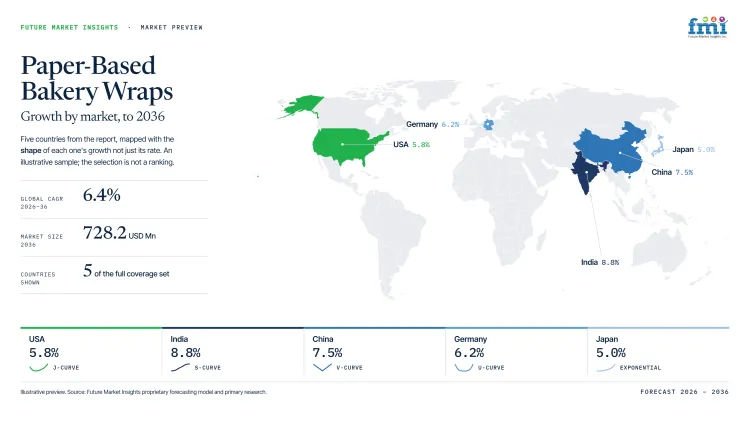
The country outlook forms a middle band between Brazil at 6.8% and Japan at 5.0% with the United Kingdom and Germany separated by 0.1 percentage point. The pattern reflects distinct qualification and recovery conditions that change market-entry timing for paper mills and foodservice converters instead of measuring current market size.
- Brazil links cellulosic food-contact rules with regional converting networks serving local bakeries.
- United Kingdom recyclability classifications make greaseproof-paper disposal claims a direct specification issue.
- Germany pairs established paper recovery with strict design expectations for food-contact wraps.
- United States qualification centers on FDA authorization requirements and national distribution scale.
- Japan combines precise bakery formats with paper-packaging collection routes that vary locally.
Comparable rates produce different entry conditions as qualification and disposal rules alter routes to recurring orders. The full report provides country-level CAGR analysis across North America, Latin America, Europe, East Asia, South Asia, Oceania and the Middle East and Africa.
Country-wise Analysis
- Brazilian bakery packaging often moves through regional converters that translate national food-contact rules into locally available paper grades for independent shops and chain accounts across major urban markets plus neighborhood cafes nationwide across Brazil. Paper-based bakery wrap demand in Brazil is forecast to rise at 6.8% CAGR over the forecast period, shaped by cellulosic food-contact rules that ANVISA advanced with an approved June 2025 revision proposal. The current rulemaking gives mills a clearer compliance reference for grease-resistant papers, yet humidity and long domestic transport routes can extend trials and delay acceptance of recurring orders across wider multi-city commercial rollouts nationally.
- United Kingdom bakery operators increasingly assess greaseproof wraps and flexible packaging paper against producer-responsibility recyclability rules plus handling needs for cakes pastries and hot counter products sold across mixed foodservice channels nationwide during service. The United Kingdom paper-based bakery wraps sector is projected to record 6.3% CAGR during the assessment period, influenced by September 2025 Defra guidance classifying greaseproof and parchment paper red unless qualifying take-back schemes exist. Distributor access supports smaller bakeries across local channels, yet disposal classification raises specification risk and can delay adoption until material design plus collection claims satisfy reporting requirements for recurring foodservice purchases nationwide.
- German bakery packaging programs operate inside a mature paper recovery system that makes material composition and end-of-life performance visible during redesign decisions for retail and foodservice applications across national bakery networks and store groups. Germany’s paper-based bakery wraps outlook is anticipated to advance at 6.2% CAGR over the assessment period, reinforced by the Federal Environment Agency’s May 2026 national report of 69.4% packaging recycling for 2023. Established recovery infrastructure favors fiber formats for food packaging, yet converters must preserve grease resistance and food-contact performance without adding layers that complicate recycling or raise delivered cost during detailed customer qualification at scale.
- American bakery chains and food packaging distributors operate within a formulation-specific food-contact system that makes coating chemistry a direct qualification issue for wraps touching oily pastries breads and prepared sandwiches across national accounts. The United States is estimated to post 5.8% CAGR over the forecast period, influenced by Food Contact Notification 2486 effective in March 2026 for an EVOH copolymer used in defined paper and paperboard coatings. National distribution supports broad availability across major accounts, yet each new barrier construction must match authorized food conditions plus packing performance for bakery chains to accept routine replacement of established wrap specifications nationwide.
- Japanese bakery and convenience channels place tight controls on dimensions surface cleanliness and disposal instructions as small format differences can disrupt presentation or store handling across dense urban retail networks and daily multi-store programs. Adoption of paper-based bakery wraps in Japan is estimated to expand at 5.0% CAGR through 2036, supported by paper collection routes that the Environment Ministry mapped across 904 municipalities in March 2026. The collection network gives paper formats a clearer disposal route, yet uneven municipal coverage and conservative material approval require precise converting trials ahead of recurring orders across regional store service formats and national programs.
Who are the notable companies in the Paper-Based Bakery Wraps Market?
Nordic Paper and Seaman Paper plus Novolex and Metsä Tissue plus Ahlstrom and Koehler Paper plus UPM-Kymmene Corporation and Mondi plc are notable companies in this market.
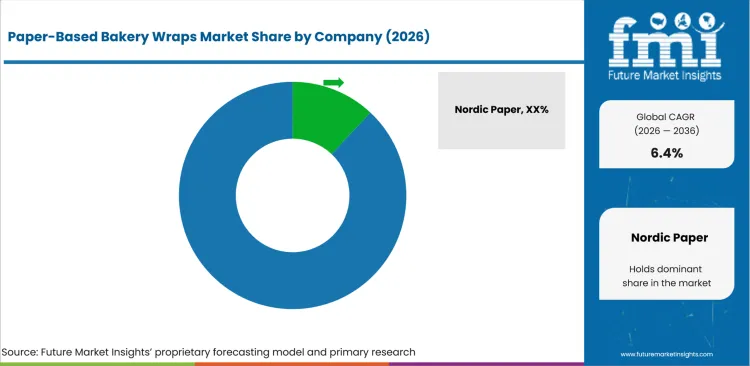
Competition separates greaseproof mills from converters and diversified barrier-paper groups that serve food packaging applications. Nordic Paper and Metsä Tissue focus on greaseproof papers while Ahlstrom and Koehler Paper add barrier routes. UPM-Kymmene Corporation and Mondi plc extend functional papers while Seaman Paper and Novolex cover converted formats or foodservice channels. Entry requires documented food contact plus stable oil resistance and converting performance across bakery orders.
- Nordic Paper and Metsä Tissue compete with dedicated greaseproof production supported by documented food-contact controls.
- Ahlstrom and Koehler Paper plus UPM-Kymmene Corporation and Mondi plc compete with barrier papers developed for food-packaging conversion.
- Seaman Paper supplies converted lightweight formats while Novolex adds bakery and foodservice access through paper-packaging channels.
Competitive Benchmarking: Paper-Based Bakery Wraps Market
| Company | Grease-Barrier Depth | Bakery Format Range | Foodservice Depth | Geographic Reach |
|---|---|---|---|---|
| Nordic Paper | High | Medium | Medium | Europe, North America and 80+ countries |
| Seaman Paper | Medium | High | High | North America, Europe and Asia |
| Novolex | Medium | High | High | North America and Europe |
| Metsä Tissue | High | Medium | High | Europe and about 80 countries |
| Ahlstrom | High | Medium | Medium | Europe, North America and Asia |
| Koehler Paper | High | Medium | Medium | Europe and international markets |
| UPM-Kymmene Corporation | High | Medium | Medium | Europe, Asia and international markets |
| Mondi plc | High | Medium | Medium | Europe and international markets |
Scoring basis: High grease-barrier depth requires multiple documented food-contact barrier routes while Medium requires one relevant route and Low identifies a documented limitation. High bakery-ready format range requires at least three verified formats while Medium requires one or two. High foodservice channel depth requires broad documented bakery or foodservice distribution while Medium requires a narrower route. Geographic reach remains descriptive and missing public evidence remains unscored instead of receiving an unsupported Low rating.
Key Developments in the Paper-Based Bakery Wraps Market
- In August 2025, Mondi ramped FunctionalBarrier Paper Ultimate production at Solec for grease-protective food packaging compatible with form-fill-seal lines.
- In May 2025, Ahlstrom inaugurated its PMZ5 parchmentizer in France and expanded grease-resistant vegetable parchment capacity for food packaging.
- In April 2025, Novolex completed its combination with Pactiv Evergreen and made the former public company its wholly owned subsidiary.
Key Players in the Paper-Based Bakery Wraps Market
Greaseproof and Parchment Paper Producers
- Nordic Paper
- Metsä Tissue
- Ahlstrom
- Koehler Paper
Functional Barrier Paper Platforms
- UPM-Kymmene Corporation
- Mondi plc
Converted Food-Wrap and Channel Providers
- Seaman Paper
- Novolex
Paper-Based Bakery Wraps Market - Report Scope
| Coverage field | Report scope |
|---|---|
| Market breakdown | By product type, paper grade, format, application, end use, sales channel and region. |
| Quantitative Units | USD million. |
| Market Definition | Commercial paper-based wraps used for direct bakery handling and food packaging across sheets, rolls, pre-formed bags and related converted formats. |
| Regions Covered | North America, Latin America, Europe, East Asia, South Asia and Pacific and Middle East and Africa. |
| Countries Covered | Brazil, United Kingdom, Germany, United States, Japan, and 20+ countries included in the full report. |
| Key Companies Profiled | Nordic Paper, Seaman Paper, Novolex, Metsä Tissue, Ahlstrom, Koehler Paper, UPM-Kymmene Corporation, Mondi plc. |
| Forecast Period | 2026 to 2036. |
| Approach | Primary and secondary research with market triangulation. |
Paper-Based Bakery Wraps Market - Research Methodology
| Method | Approach |
|---|---|
| Primary Research | FMI analysts gathered input from manufacturers, service providers, technology developers, distributors, end users, procurement teams, and subject-matter experts. Interviews examined purchasing decisions, product or service evaluation, adoption barriers, approval requirements, pricing considerations, and expectations for technical or commercial support. Respondents were also asked what evidence is required before a trial, pilot, or initial order develops into regular purchasing. |
| Desk Research | Desk research covered government statistics, regulatory publications, trade data, industry associations, technical literature, standards, company filings, product information, and official corporate announcements. Sources were reviewed for relevance, publication date, geographic coverage, and consistency with the defined market scope. Claims relating to performance, applications, approvals, capacity, investment, and commercial activity were retained only when supported by credible public evidence. |
| Market Sizing and Forecasting | The market model combined the baseline value with historical performance, segment structure, pricing and volume indicators, adoption levels, company participation, and country-level demand conditions. Forecast assumptions considered economic activity, investment trends, regulatory developments, technology adoption, purchasing cycles, supply availability, and barriers to wider market use. Segment and regional estimates were reconciled before the final market total was calculated. |
| Data Validation | Estimates were checked against multiple independent indicators, including public data, company activity, trade patterns, industry developments, and findings from primary interviews. Validation also tested whether products, services, applications, and company revenues fell within the defined market boundaries. Adjacent categories, unsupported claims, overlapping revenues, and activities without direct market relevance were excluded to reduce double counting and maintain consistency across segments and countries. |
Paper-Based Bakery Wraps Market by Segments
Paper-Based Bakery Wraps Market segmented by Product Type:
- Greaseproof Wraps
- Kraft Wraps
- Glassine Wraps
- Parchment Wraps
- Others
Paper-Based Bakery Wraps Market segmented by Paper Grade:
- Greaseproof
- Kraft
- Glassine
- Vegetable Parchment
- Others
Paper-Based Bakery Wraps Market segmented by Format:
- Sheets
- Rolls
- Pre-Formed Bags & Wraps
- Others
Paper-Based Bakery Wraps Market segmented by Application:
- Bread & Baguettes
- Pastries
- Cakes & Sweet Goods
- Sandwiches
- Others
Paper-Based Bakery Wraps Market segmented by End Use:
- In-Store Bakeries
- Commercial Bakeries
- Foodservice Cafes
- Household
Paper-Based Bakery Wraps Market segmented by Sales Channel:
- Packaging Distributors
- Direct - OEM Supply
- Online - E-commerce
- Others
Paper-Based Bakery Wraps Market by Region:
- North America
- United States
- Canada
- Latin America
- Brazil
- Mexico
- Chile
- Rest of Latin America
- Western Europe
- Germany
- United Kingdom
- Italy
- Spain
- France
- Nordics
- Benelux
- Rest of Western Europe
- Eastern Europe
- Russia
- Poland
- Hungary
- Balkan and Baltic States
- Rest of Eastern Europe
- East Asia
- China
- Japan
- South Korea
- South Asia and Pacific
- India
- ASEAN
- Australia and New Zealand
- Rest of South Asia and Pacific
- Middle East and Africa
- Kingdom of Saudi Arabia
- Other GCC Countries
- Türkiye
- South Africa
- Other African Union Countries
- Rest of Middle East and Africa
Research Sources and Bibliography
- UPM. (2026, March 24). UPM and Paramelt introduce bio-based food packaging concept.
- Department for Environment, Food & Rural Affairs. (2025, July 23). UK statistics on waste.
- USA Food and Drug Administration. (2025, January 3). FDA Determines Authorization for 35 Food Contact Notifications Related to PFAS Are No Longer Effective.
- Ahlstrom. (2026, June 17). Ahlstrom renews CMA-W compostability certification for GVP food-grade portfolio.
- Seaman Paper. (2025, September 18). Seaman Paper Launches Heat-Sealable Paper Packaging: A Scalable, Recyclable Alternative to Single-Use Plastics.
- Metsä Tissue. (2025, June 18). Metsä Tissue’s greaseproof paper business licenses SAGA consumer business to Fredman Group.
- European Commission, Directorate-General for Environment. (2025, February 11). New rules enter into force for a more sustainable and competitive packaging economy.
- USA Food and Drug Administration. (2026, April 30). Inventory of Effective Food Contact Substance (FCS) Notifications: FCN No. 2457.
- Koehler Paper. (2025, February 11). IRIS Bio and Koehler Paper Offer Recyclable Packaging Alternative.
- Agência Nacional de Vigilância Sanitária. (2025, June 4). Processos Deliberados na 8ª Reunião Ordinária Pública de 4 de junho de 2025.
- Department for Environment, Food & Rural Affairs. (2025, September 4). Recyclability assessment methodology: assessing materials.
- Umweltbundesamt. (2026, May 13). Verpackungsverbrauch 2023 gesunken, Recyclingquote gestiegen.
- USA Food and Drug Administration. (2026, June 30). Inventory of Effective Food Contact Substance (FCS) Notifications: FCN No. 2486.
- Ministry of the Environment, Government of Japan. (2026, March 31). 容器包装リサイクル法に基づく令和8年度以降の分別収集見込量の集計結果について.
- Nordic Paper. (2025, March 21). Nordic Paper’s annual report and sustainability report 2024.
- Seaman Paper. (n.d.). Specialized Converting. Retrieved August 9, 2026.
- Novolex. (n.d.). Brands. Retrieved August 9, 2026.
- Metsä Tissue. (2025, December 1). Greaseproof papers that bring peace of mind.
- Ahlstrom. (2025, March 17). Ahlstrom expands LamiBak™ portfolio with a new base paper for flexible food packaging.
- Koehler Paper. (2026, April 20). RUF Lebensmittelwerk KG Chooses Koehler Paper Barrier Paper for Its Porridge Packaging.
- UPM. (2025, September 9). Walkers Chocolates introduces recyclable paper wrapper co-created with UPM and EvoPak.
- Mondi. (2026, July 9). How can food and FMCG brands prepare for the future of packaging?.
- Mondi. (2025, August 14). Mondi ramps up FunctionalBarrier Paper Ultimate to meet growing demand for sustainable high-barrier paper-based packaging.
- Ahlstrom. (2025, May 21). Ahlstrom inaugurates new parchmentizer at the Saint-Séverin plant, strengthening customer partnerships and local commitment.
- Pactiv Evergreen Inc. (2025, April 1). Current Report on Form 8-K.
This bibliography is provided for reader reference and is not exhaustive. The full report contains the complete reference list and detailed citations
This Report Answers
- How large is the Paper-Based Bakery Wraps Market in 2026 and 2036?
- Which packaging requirements are increasing demand for paper-based bakery wraps?
- Why do greaseproof wraps lead the product type category?
- How does greaseproof paper influence wrap qualification?
- Why do sheets lead the format category?
- How do growth rates differ across the five profiled countries?
- Which operating frictions slow conversion from legacy packaging?
- Which companies combine greaseproof paper manufacturing with converting capability and foodservice access?
Frequently Asked Questions
How big is the Paper-Based Bakery Wraps Market in 2026?
The market is estimated to be valued at USD 391.6 million in 2026 and is projected to reach USD 728.2 million by 2036. Recurring use is supported by grease control and food-contact documentation across bakery counters and commercial packing lines.
What is the CAGR of the Paper-Based Bakery Wraps Market from 2026 to 2036?
The market is forecast to expand at a 6.4% CAGR from 2026 to 2036. Growth reflects the replacement of legacy grease barriers with paper constructions that combine food-contact compliance with stable handling or sealing performance.
Which product type is projected to account for 30.0% of the Paper-Based Bakery Wraps Market?
Greaseproof wraps are expected to account for 30.0% of the market by product type in 2026. Their position reflects direct oil control and the foldability required for bread, pastries and other products handled in flexible paper.
Which different format segment is projected to account for 36.0% of the Paper-Based Bakery Wraps Market?
Sheets are projected to account for 36.0% of the market by format in 2026. Pre-cut dimensions reduce counter preparation and make paper consumption easier to forecast across in-store bakery and foodservice workflows.
Which companies are active in the Paper-Based Bakery Wraps Market?
Key companies operating in the market include Nordic Paper, Seaman Paper, Novolex, Metsä Tissue, Ahlstrom, Koehler Paper, UPM-Kymmene Corporation and Mondi plc. Their verified positions span greaseproof paper production, converting systems and commercial foodservice channel access.
Preview the report firsthand - request a free sample
Get SampleGet the brochure for pricing and purchase details.
Get PDFTable of Content
- Key Takeaways
- Market Size and CAGR
- Top Growth Driver
- Fastest Growing Segment
- Leading Region
- Key Companies
- Emerging Opportunities
- Executive Summary
- Global Market Outlook
- Demand-side Trends
- Supply-side Trends
- Technology Roadmap Analysis
- Analysis and Recommendations
- Analyst Perspective (What is happening? Why now? What should investors know?)
- Key Questions Answered
- How large is the market?
- What is the CAGR?
- What are key trends?
- Which region dominates?
- Who are the leaders?
- Market Overview
- Market Coverage / Taxonomy
- Market Definition / Scope / Limitations
- Research Methodology
- Chapter Orientation
- Analytical Lens and Working Hypotheses
- Market Structure, Signals, and Trend Drivers
- Benchmarking and Cross-market Comparability
- Market Sizing, Forecasting, and Opportunity Mapping
- Research Design and Evidence Framework
- Desk Research Programme (Secondary Evidence)
- Expert Input and Fieldwork (Primary Evidence)
- Tooling, Models, and Reference Databases
- Data Engineering and Model Build
- Quality Assurance and Audit Trail
- Market Background
- Market Dynamics (Drivers, Restraints, Opportunity, Trends)
- Scenario Forecast (Optimistic, Likely, Conservative)
- Impact Analysis
- AI Impact
- Sustainability Impact
- Regulatory Impact
- Technology Impact
- Consumer / Buyer Analysis
- Purchase Drivers
- Adoption Barriers
- Buyer Journey
- Opportunity Map Analysis
- Product Life Cycle Analysis
- Supply Chain Analysis
- Investment Feasibility Matrix
- Value Chain Analysis
- PESTLE and Porter's Analysis
- Regulatory Landscape
- Regional Parent Market Outlook
- Production and Consumption Statistics
- Import and Export Statistics
- Global Market Analysis and Forecast, 2021 to 2036
- Historical Market Size Value (USD Million) Analysis, 2021 to 2025
- Current and Future Market Size Value (USD Million) Projections, 2026 to 2036
- Y-o-Y Growth Trend Analysis
- Absolute $ Opportunity Analysis
- Global Market Pricing Analysis, 2021 to 2036
- Global Market Analysis and Forecast, By Product Type, 2021 to 2036
- Introduction / Key Findings
- Historical Market Size Value (USD Million) Analysis By Product Type, 2021 to 2025
- Current and Future Market Size Value (USD Million) Analysis and Forecast By Product Type, 2026 to 2036
- Crate & Box Liners
- Tray Liners
- Interleaving & Layer Pads
- Wrapping Sheets
- Others
- Crate & Box Liners
- Y-o-Y Growth Trend Analysis By Product Type, 2021 to 2025
- Absolute $ Opportunity Analysis By Product Type, 2026 to 2036
- Global Market Analysis and Forecast, By Paper Grade, 2021 to 2036
- Introduction / Key Findings
- Historical Market Size Value (USD Million) Analysis By Paper Grade, 2021 to 2025
- Current and Future Market Size Value (USD Million) Analysis and Forecast By Paper Grade, 2026 to 2036
- Kraft Paper
- Tissue - MG Paper
- Greaseproof
- Recycled Liner
- Others
- Kraft Paper
- Y-o-Y Growth Trend Analysis By Paper Grade, 2021 to 2025
- Absolute $ Opportunity Analysis By Paper Grade, 2026 to 2036
- Global Market Analysis and Forecast, By Treatment, 2021 to 2036
- Introduction / Key Findings
- Historical Market Size Value (USD Million) Analysis By Treatment, 2021 to 2025
- Current and Future Market Size Value (USD Million) Analysis and Forecast By Treatment, 2026 to 2036
- Untreated
- Moisture-Resistant Treated
- Anti-Slip
- Others
- Untreated
- Y-o-Y Growth Trend Analysis By Treatment, 2021 to 2025
- Absolute $ Opportunity Analysis By Treatment, 2026 to 2036
- Global Market Analysis and Forecast, By Produce Type, 2021 to 2036
- Introduction / Key Findings
- Historical Market Size Value (USD Million) Analysis By Produce Type, 2021 to 2025
- Current and Future Market Size Value (USD Million) Analysis and Forecast By Produce Type, 2026 to 2036
- Fruits
- Vegetables
- Leafy Greens
- Others
- Mushrooms
- Fruits
- Y-o-Y Growth Trend Analysis By Produce Type, 2021 to 2025
- Absolute $ Opportunity Analysis By Produce Type, 2026 to 2036
- Global Market Analysis and Forecast, By End Use, 2021 to 2036
- Introduction / Key Findings
- Historical Market Size Value (USD Million) Analysis By End Use, 2021 to 2025
- Current and Future Market Size Value (USD Million) Analysis and Forecast By End Use, 2026 to 2036
- Growers & Packers
- Wholesale & Distribution
- Grocery Retail
- Others
- Growers & Packers
- Y-o-Y Growth Trend Analysis By End Use, 2021 to 2025
- Absolute $ Opportunity Analysis By End Use, 2026 to 2036
- Global Market Analysis and Forecast, By Sales Channel
- Introduction / Key Findings
- Historical Market Size Value (USD Million) Analysis By Sales Channel, 2021 to 2025
- Current and Future Market Size Value (USD Million) Analysis and Forecast By Sales Channel, 2026 to 2036
- Direct - OEM Supply
- Packaging Distributors
- Online - E-commerce
- Others
- Direct - OEM Supply
- Y-o-Y Growth Trend Analysis By Sales Channel, 2021 to 2025
- Absolute $ Opportunity Analysis By Sales Channel, 2026 to 2036
- Global Market Analysis and Forecast, By Region, 2021 to 2036
- Introduction
- Historical Market Size Value (USD Million) Analysis By Region, 2021 to 2025
- Current Market Size Value (USD Million) Analysis and Forecast By Region, 2026 to 2036
- North America
- Latin America
- Western Europe
- Eastern Europe
- East Asia
- South Asia and Pacific
- Middle East & Africa
- Market Attractiveness Analysis By Region
- North America Market Analysis and Forecast, By Country, 2021 to 2036
- Historical Market Size Value (USD Million) Trend Analysis By Market Taxonomy, 2021 to 2025
- Market Size Value (USD Million) Forecast By Market Taxonomy, 2026 to 2036
- By Country
- USA
- Canada
- By Product Type
- By Paper Grade
- By Treatment
- By Produce Type
- By End Use
- By Sales Channel
- By Country
- Market Attractiveness Analysis
- By Country
- By Product Type
- By Paper Grade
- By Treatment
- By Produce Type
- By End Use
- By Sales Channel
- Key Takeaways
- Latin America Market Analysis and Forecast, By Country
- Historical Market Size Value (USD Million) Trend Analysis By Market Taxonomy, 2021 to 2025
- Market Size Value (USD Million) Forecast By Market Taxonomy, 2026 to 2036
- By Country
- Brazil
- Mexico
- Chile
- Rest of Latin America
- By Product Type
- By Paper Grade
- By Treatment
- By Produce Type
- By End Use
- By Sales Channel
- By Country
- Market Attractiveness Analysis
- By Country
- By Product Type
- By Paper Grade
- By Treatment
- By Produce Type
- By End Use
- By Sales Channel
- Key Takeaways
- Western Europe Market Analysis and Forecast, By Country
- Historical Market Size Value (USD Million) Trend Analysis By Market Taxonomy, 2021 to 2025
- Market Size Value (USD Million) Forecast By Market Taxonomy, 2026 to 2036
- By Country
- Germany
- UK
- Italy
- Spain
- France
- Nordic
- BENELUX
- Rest of Western Europe
- By Product Type
- By Paper Grade
- By Treatment
- By Produce Type
- By End Use
- By Sales Channel
- By Country
- Market Attractiveness Analysis
- By Country
- By Product Type
- By Paper Grade
- By Treatment
- By Produce Type
- By End Use
- By Sales Channel
- Key Takeaways
- Eastern Europe Market Analysis and Forecast, By Country
- Historical Market Size Value (USD Million) Trend Analysis By Market Taxonomy, 2021 to 2025
- Market Size Value (USD Million) Forecast By Market Taxonomy, 2026 to 2036
- By Country
- Russia
- Poland
- Hungary
- Balkan & Baltic
- Rest of Eastern Europe
- By Product Type
- By Paper Grade
- By Treatment
- By Produce Type
- By End Use
- By Sales Channel
- By Country
- Market Attractiveness Analysis
- By Country
- By Product Type
- By Paper Grade
- By Treatment
- By Produce Type
- By End Use
- By Sales Channel
- Key Takeaways
- East Asia Market Analysis and Forecast, By Country
- Historical Market Size Value (USD Million) Trend Analysis By Market Taxonomy, 2021 to 2025
- Market Size Value (USD Million) Forecast By Market Taxonomy, 2026 to 2036
- By Country
- China
- Japan
- South Korea
- By Product Type
- By Paper Grade
- By Treatment
- By Produce Type
- By End Use
- By Sales Channel
- By Country
- Market Attractiveness Analysis
- By Country
- By Product Type
- By Paper Grade
- By Treatment
- By Produce Type
- By End Use
- By Sales Channel
- Key Takeaways
- South Asia and Pacific Market Analysis and Forecast, By Country
- Historical Market Size Value (USD Million) Trend Analysis By Market Taxonomy, 2021 to 2025
- Market Size Value (USD Million) Forecast By Market Taxonomy, 2026 to 2036
- By Country
- India
- ASEAN
- Australia & New Zealand
- Rest of South Asia and Pacific
- By Product Type
- By Paper Grade
- By Treatment
- By Produce Type
- By End Use
- By Sales Channel
- By Country
- Market Attractiveness Analysis
- By Country
- By Product Type
- By Paper Grade
- By Treatment
- By Produce Type
- By End Use
- By Sales Channel
- Key Takeaways
- Middle East & Africa Market Analysis and Forecast, By Country
- Historical Market Size Value (USD Million) Trend Analysis By Market Taxonomy, 2021 to 2025
- Market Size Value (USD Million) Forecast By Market Taxonomy, 2026 to 2036
- By Country
- Kingdom of Saudi Arabia
- Other GCC Countries
- Türkiye
- South Africa
- Other African Union
- Rest of Middle East & Africa
- By Product Type
- By Paper Grade
- By Treatment
- By Produce Type
- By End Use
- By Sales Channel
- By Country
- Market Attractiveness Analysis
- By Country
- By Product Type
- By Paper Grade
- By Treatment
- By Produce Type
- By End Use
- By Sales Channel
- Key Takeaways
- Key Countries Market Analysis
- USA
- Pricing Analysis
- Market Share Analysis, 2025
- By Product Type
- By Paper Grade
- By Treatment
- By Produce Type
- By End Use
- By Sales Channel
- Canada
- Pricing Analysis
- Market Share Analysis, 2025
- By Product Type
- By Paper Grade
- By Treatment
- By Produce Type
- By End Use
- By Sales Channel
- Mexico
- Pricing Analysis
- Market Share Analysis, 2025
- By Product Type
- By Paper Grade
- By Treatment
- By Produce Type
- By End Use
- By Sales Channel
- Brazil
- Pricing Analysis
- Market Share Analysis, 2025
- By Product Type
- By Paper Grade
- By Treatment
- By Produce Type
- By End Use
- By Sales Channel
- Chile
- Pricing Analysis
- Market Share Analysis, 2025
- By Product Type
- By Paper Grade
- By Treatment
- By Produce Type
- By End Use
- By Sales Channel
- Germany
- Pricing Analysis
- Market Share Analysis, 2025
- By Product Type
- By Paper Grade
- By Treatment
- By Produce Type
- By End Use
- By Sales Channel
- UK
- Pricing Analysis
- Market Share Analysis, 2025
- By Product Type
- By Paper Grade
- By Treatment
- By Produce Type
- By End Use
- By Sales Channel
- Italy
- Pricing Analysis
- Market Share Analysis, 2025
- By Product Type
- By Paper Grade
- By Treatment
- By Produce Type
- By End Use
- By Sales Channel
- Spain
- Pricing Analysis
- Market Share Analysis, 2025
- By Product Type
- By Paper Grade
- By Treatment
- By Produce Type
- By End Use
- By Sales Channel
- France
- Pricing Analysis
- Market Share Analysis, 2025
- By Product Type
- By Paper Grade
- By Treatment
- By Produce Type
- By End Use
- By Sales Channel
- India
- Pricing Analysis
- Market Share Analysis, 2025
- By Product Type
- By Paper Grade
- By Treatment
- By Produce Type
- By End Use
- By Sales Channel
- ASEAN
- Pricing Analysis
- Market Share Analysis, 2025
- By Product Type
- By Paper Grade
- By Treatment
- By Produce Type
- By End Use
- By Sales Channel
- Australia & New Zealand
- Pricing Analysis
- Market Share Analysis, 2025
- By Product Type
- By Paper Grade
- By Treatment
- By Produce Type
- By End Use
- By Sales Channel
- China
- Pricing Analysis
- Market Share Analysis, 2025
- By Product Type
- By Paper Grade
- By Treatment
- By Produce Type
- By End Use
- By Sales Channel
- Japan
- Pricing Analysis
- Market Share Analysis, 2025
- By Product Type
- By Paper Grade
- By Treatment
- By Produce Type
- By End Use
- By Sales Channel
- South Korea
- Pricing Analysis
- Market Share Analysis, 2025
- By Product Type
- By Paper Grade
- By Treatment
- By Produce Type
- By End Use
- By Sales Channel
- Russia
- Pricing Analysis
- Market Share Analysis, 2025
- By Product Type
- By Paper Grade
- By Treatment
- By Produce Type
- By End Use
- By Sales Channel
- Poland
- Pricing Analysis
- Market Share Analysis, 2025
- By Product Type
- By Paper Grade
- By Treatment
- By Produce Type
- By End Use
- By Sales Channel
- Hungary
- Pricing Analysis
- Market Share Analysis, 2025
- By Product Type
- By Paper Grade
- By Treatment
- By Produce Type
- By End Use
- By Sales Channel
- Kingdom of Saudi Arabia
- Pricing Analysis
- Market Share Analysis, 2025
- By Product Type
- By Paper Grade
- By Treatment
- By Produce Type
- By End Use
- By Sales Channel
- Türkiye
- Pricing Analysis
- Market Share Analysis, 2025
- By Product Type
- By Paper Grade
- By Treatment
- By Produce Type
- By End Use
- By Sales Channel
- South Africa
- Pricing Analysis
- Market Share Analysis, 2025
- By Product Type
- By Paper Grade
- By Treatment
- By Produce Type
- By End Use
- By Sales Channel
- USA
- Market Structure Analysis
- Competition Dashboard
- Competition Benchmarking
- Market Share Analysis of Top Players
- By Regional
- By Product Type
- By Paper Grade
- By Treatment
- By Produce Type
- By End Use
- By Sales Channel
- Emerging Startups
- Innovation Benchmarking
- Competition Analysis
- Competition Deep Dive
- Seaman Paper
- Overview
- Product Portfolio
- Profitability by Market Segments
- Sales Footprint
- Strategy Overview
- Marketing Strategy
- Product Strategy
- Channel Strategy
- Nordic Paper
- Cascades
- Smurfit Westrock
- Mondi
- Sirane
- McNairn Packaging
- Oren International
- Pudumjee Paper Products
- Twin Rivers Paper
- Seaman Paper
- Case Studies
- Success Stories
- Recent Developments
- Competition Deep Dive
- Assumptions & Acronyms Used


