

- Market Size (2026)
- USD 464.0 Mn
- Forecast (2036)
- USD 947.5 Mn
- CAGR (2026 to 2036)
- 7.4%
How big is Paper-Based Sachet Packaging Market in 2026?
USD 464.0 million in 2026 and USD 947.5 million by 2036 at a 7.4% CAGR.
Sales of paper-based sachet packaging are estimated to rise at 7.4% CAGR through 2036, increasing valuation from USD 464.0 million in 2026 to USD 947.5 million by 2036. Food and household brands need compact paper formats that protect dry products across established printing and filling operations. The American Forest & Paper Association reported in August 2025 that 60% to 64% of available paper was recycled during 2024. That recovery base supports paper packaging programs but does not prove recyclability for every coating and seal within a finished sachet. Commercial qualification therefore combines barrier testing with seal validation and documented repulpability across the final converted structure. Programs progress toward repeat orders through consistent results across intended products and normal production speeds.
German packaging programs apply a national recyclability standard to complete structures sold under broader European requirements. United States launches face state-specific producer rules and local collection differences across intended sales areas. Paper sachet packaging competes with film laminates that provide predictable moisture protection and output on high-speed equipment. In July 2025, the Oregon Department of Environmental Quality announced the statewide launch of producer responsibility for packaging and paper. Companies selling covered products must fund recycling system improvements through fees paid to the approved producer responsibility organization. The obligation shows why national programs cannot treat one recovery claim as sufficient across every state. Packaged-goods companies therefore evaluate sachet structures on dependable production performance and a documented recovery route for each complete coated design.
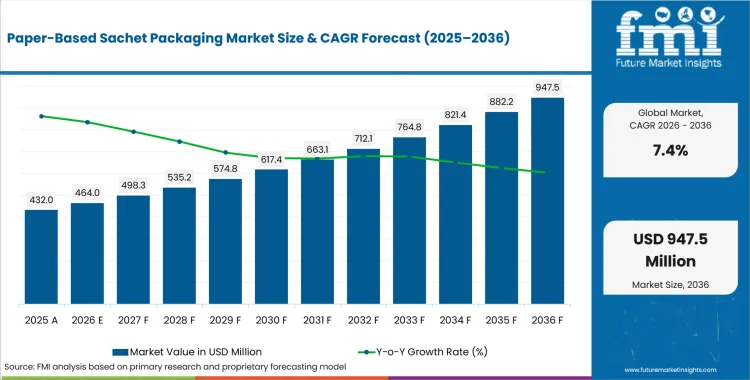
Key Takeaways of Paper-Based Sachet Packaging Market
- Brand plastic-reduction programs support paper sachet trials that preserve compact portion control and established filling-line output across qualified dry products.
- Paper is projected to account for 52.0% of material demand in 2026 owing to familiar printing processes and documented fiber-recovery routes.
- Food is estimated to hold 54.0% in 2026 due to recurring portion-pack use across seasonings and beverage powders.
- Grease-resistant structures are forecast to represent 29.0% in 2026 attributable to recurring oil-protection requirements in food packs.
- Narrow sealing windows and uncertain recovery acceptance limit wider paper substitution across moisture-sensitive products and established high-speed equipment.
- Amcor and Mondi compete through finished paper formats, while Huhtamaki and Constantia Flexibles operate across qualified commercial applications through converted rollstock and pouch platforms. ProAmpac adds high-barrier conversion capabilities and Sappi with Ahlstrom and Koehler Paper provide specialist substrates for downstream converting.
Analyst Perspective
"Paper sachets create commercial value through a careful balance of barrier protection and sealing speed across a recoverable finished pack. Small formats leave little room for weak folds or unstable heat windows during high-volume filling. Packaging developers that prove shelf life and repulpability on the same structure can shorten qualification without transferring performance risk to food manufacturers."
- Nandini Roy Choudhury, Principal Analyst, Future Market Insights
How is the Paper-Based Sachet Packaging Market segmented?
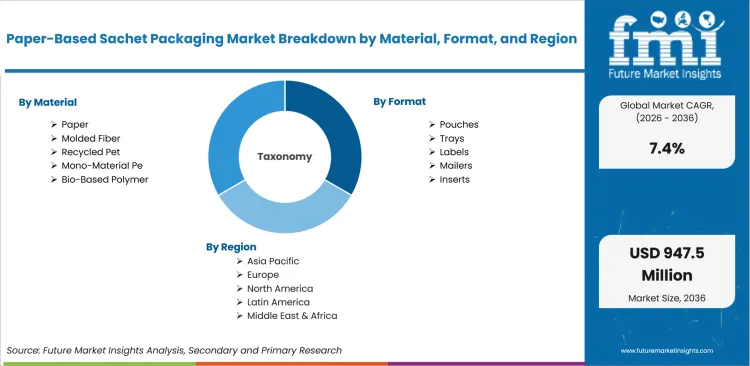
The paper-based sachet packaging industry is segmented by material, format, barrier or feature, end use, and region.
Material separates the primary sheet or fiber structure across paper, molded fiber, recycled PET, mono-material PE, and bio-based polymers. Format distinguishes pouches, trays, labels, mailers, and inserts through package geometry plus filling and consumer handling requirements. Barrier or feature groups grease resistance, high barriers, tamper evidence, traceability, and freshness indicators according to the function added to the pack. End use separates food, pharmaceutical, e-commerce, personal-care, and cold-chain requirements across distribution and storage conditions. Regional analysis compares packaging rules, collection systems, and local conversion capacity across sales areas for commercial programs.
What supports paper demand within the material category?
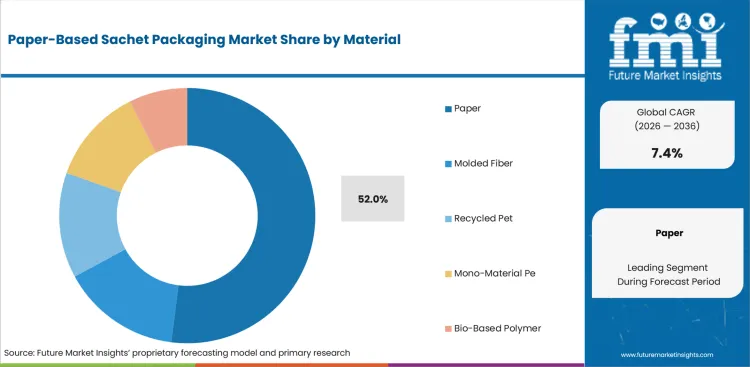
Paper gives food and household brands a visible fiber format that works with familiar printing and pouch-forming processes. In March 2025, Amcor launched an 85% fiber stand-up refill pouch for instant coffee and dry beverages with documented barrier and seal performance. CEPI and Aticelca certification covered the finished structure and provided a clearer recovery basis for targeted European sales. The launch shows that commercial paper formats need product protection and machine compatibility within the same tested structure.
- Paper is projected to hold 52.0% share in 2026 owing to established printability and accessible fiber-recovery routes. Food and beverage programs gain a direct route for reducing plastic content across portion packs and refill formats. Commercial strength depends on coatings and seals that protect products without blocking the intended paper-recovery process.
- Dry beverage and seasoning manufacturers use paper for contents with manageable oxygen and moisture exposure across normal storage periods. Shelf-life trials and measured sealing windows provide the operating evidence needed for repeat orders on established equipment. High-moisture products require stronger barriers that add nonfiber material and can reduce acceptance across several paper streams.
How do pouches shape demand within the format category?
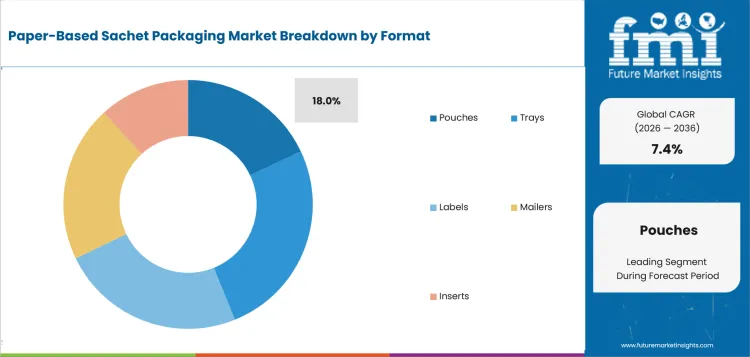
Pouches provide a larger print area and controlled opening features for refill products and dry household goods. Bottom gussets improve shelf presentation and support repeated handling across household and beverage refill applications. Their geometry creates more folds and seal junctions than flat sachets during package formation on commercial lines. Qualification therefore requires stable stiffness and reliable closure performance across the intended filling process on commercial equipment.
- By format, pouches are estimated to hold 18.0% share in 2026 owing to refill geometry that combines shelf presence with low transport weight. Refill applications reduce transport weight and storage space compared with rigid containers across repeated consumer use. Zippers and sealing layers require separate recovery assessment for the complete pouch structure within local paper systems.
- Household product manufacturers use premade pouch formats for refills that reduce rigid packaging weight during distribution and storage. In February 2025, Mondi and Proquimia launched paper-based pouches containing more than 85% paper for dishwashing tablets in Spain and Portugal. Integrated coating and conversion protected the tablets during normal handling without adding another rigid refill container.
Why do grease-resistant structures lead the barrier or feature category?
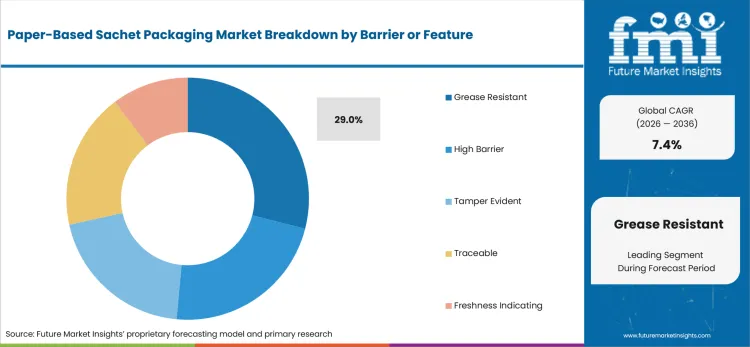
Grease protection allows paper to contain oily foods without staining printed surfaces or losing mechanical strength during distribution. Barrier performance must remain stable across the packaged product and its intended storage temperature throughout planned distribution. Coating selection also affects printing and sealing behavior during downstream conversion and commercial package-forming operations. Food applications therefore need a balanced structure that controls oil migration without weakening fiber recovery across local processing systems.
- Based on barrier or feature classification, grease-resistant structures are projected to account for 29.0% share in 2026 due to direct food-contact oil protection. In March 2025, Ahlstrom introduced LamiBak Flex for barrier coated papers used in pouches and sachets. The PFAS-free base paper combines natural grease protection with documented recyclability certified in both the United States and Europe across downstream converting programs.
- Bakeries and snack manufacturers use greaseproof paper sheets and sachets to protect printed surfaces and surrounding cartons from oil transfer. Migration testing and seal validation must match the exact food type and planned storage conditions. Coating control creates value through oil resistance that preserves fiber recovery across local sorting and pulping systems.
What makes food central to the end-use category?
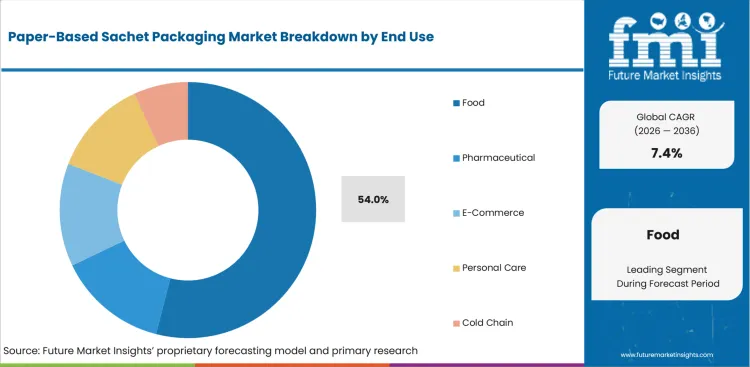
Food applications create recurring volume across sachets and stick packaging that need portion control and dependable product protection. In March 2025, UPM Specialty Materials and Orkla Suomi introduced a paper wrapper pilot for Panda Milk chocolate. The structure combined grease-barrier paper with cold-seal lacquer and ran on existing commercial flowpack machinery. Shelf-life and recyclability testing showed that food-grade packaging programs must validate product protection together with production compatibility.
- Food is set to lead the end use category with 54.0% share in 2026 due to repeat portion-pack demand across dry ingredients and beverage powders. Seasonings and beverage powders create repeat orders that support efficient converting runs across several sachet sizes. Each application requires food-contact compliance and shelf-life evidence for the complete coated or laminated structure.
- Food manufacturers favor paper sachets for dry products with controlled moisture exposure and stable storage conditions. These applications need fewer barrier layers than liquids or retort products and provide a practical qualification route. Wider use depends on consistent seals and verified migration limits for each recipe and intended distribution period.
What are the drivers, restraints, and opportunities in the Paper-Based Sachet Packaging Market?
Plastic-reduction programs and stronger barrier papers support paper sachet trials; narrow sealing windows and uncertain recovery routes restrict broader use, yet PFAS-free coatings create a qualified food-packaging opportunity.
- Driver: Food and household brands are funding paper sachet trials that preserve portion control and established filling-line output across qualified dry products.
- Restraint: Added barrier and sealing layers can narrow operating windows and weaken paper-recovery acceptance across moisture-sensitive applications.
- Opportunity: PFAS-free grease barriers create a verified route for food sachets that need direct-contact protection without conventional fluorinated treatments.
Dry-food applications create a practical entry route for paper sachets through measurable shelf-life targets and repeatable production volumes. Snack and confectionery formats also test aroma and grease protection without requiring the severe barriers used for liquids. In April 2026, UPM Specialty Materials and Felix Schoeller introduced a customizable recyclable barrier solution for chocolate and snack-bar packaging. The collaboration allows coating levels to match oxygen and moisture exposure across each product instead of using one fixed barrier design. Commercial adoption improves through material specifications that protect products and run reliably on high-speed coating lines.
European rules create a material restraint by applying composition and recyclability requirements to the complete package rather than its paper layer. In February 2025, the European Commission stated that Regulation 2025/40 had entered force and would generally apply from August 2026. The regulation covers all packaging placed on the European Union market and requires stronger evidence for composition and recoverability. Paper sachet developers therefore need technical files that describe coatings and sealing components within each final structure. Qualification costs rise across programs that need separate evidence for several recovery systems and national sales routes.
PFAS-free grease protection creates a commercial opening for coating developers that can prove migration safety and dependable oil resistance. Food manufacturers need alternatives that protect products and printed surfaces without using fluorinated grease-proofing treatments. In January 2025, the USA Food and Drug Administration ended authorization for 35 PFAS-related food-contact notifications. The action directly affects substances previously used for grease proofing in paper and paperboard food packaging. Verified alternatives can support pouch packaging projects that require direct contact and clear recovery documentation.
Which country CAGRs are profiled in the Paper-Based Sachet Packaging Market?
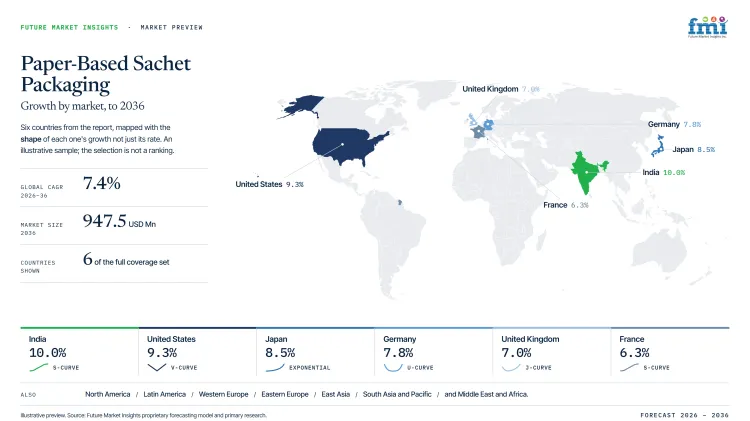
| Country | CAGR |
|---|---|
| India | 10.0% |
| United States | 9.3% |
| Japan | 8.5% |
| Germany | 7.8% |
| United Kingdom | 7.0% |
| France | 6.3% |
How do country-level CAGRs compare in the Paper-Based Sachet Packaging Market?
The country outlook span 3.7 percentage points and form three pairs with consistent 0.7-point internal gaps. India and the United States form the upper pair through broader conversion capacity and active food-packaging qualification programs. Japan and Germany occupy the middle pair through formal recovery systems and detailed technical validation requirements. The United Kingdom and France form the lower pair across mature packaging systems shaped by producer-responsibility rules.
- India's separation from the lower pair reflects broader expansion room across compact food formats and regional packaging networks.
- The United States remains 0.7 percentage points below India despite stronger conversion infrastructure and more complex state-level packaging rules.
- Japan's middle-pair position reflects formal producer obligations and detailed material specifications for compact paper packs across established recovery systems.
- Germany remains 0.7 percentage points below Japan through practical sorting tests that shape acceptable recyclability claims for coated paper structures.
- The United Kingdom enters the lower pair through fee-modulated producer responsibility and a mature base of flexible packaging capacity.
- France closes the comparison through measured substitution programs that require application-specific evidence for broader replacement of plastic structures.
Similar numerical gaps do not create identical entry conditions across coating capability and local collection acceptance. Commercial programs need local validation of the complete coated structure together with filling-line performance and recovery documentation. The full report provides country-level CAGR analysis across North America, Latin America, Europe, East Asia, South Asia, Oceania and the Middle East and Africa.
Country-wise Analysis
- Indian food packers serve products across varied climates and transport distances that demand consistent seals and documented food-contact performance. By 2036, paper-based sachet packaging demand in India is projected to grow at 10.0% CAGR supported by expanding dry-food and personal-care programs. In October 2025, the Food Safety and Standards Authority of India published draft packaging rules that would prohibit PFAS in food-contact materials. The proposal raises the value of documented coating chemistry and migration evidence for paper sachets used across national food programs. Large regional converting centers support commercial trials through established coating and printing capacity for dry foods and personal-care refills. Barrier expertise and paper-recovery access remain uneven outside those centers and can increase testing costs for national programs. Successful expansion depends on qualified partners that reproduce seal strength and migration results across each planned product.
- United States packaging programs combine federal food-contact rules with state producer-responsibility requirements and uneven municipal acceptance of coated paper. National packaging plants offer pilot coating and filling-line trials for dry products that need measured moisture and aroma protection. In the United States, paper-based sachet packaging demand is predicted to advance at 9.3% CAGR through 2036 underpinned by frequent brand trials and established packaging engineering capacity. CalRecycle reported in May 2026 that permanent SB 54 regulations became effective and assigned covered-packaging responsibilities to producers. Different state definitions can raise qualification costs and prevent one recovery claim from supporting every national sales area. Commercial teams need state-specific recovery evidence alongside stable line performance for the final coated sachet.
- Japan applies formal producer obligations to paper container packaging through municipal collection and established recycling plans. Japan's economy ministry set the fiscal 2026 paper-packaging recycling obligation at 27,720 metric tons and the producer responsibility ratio at 99% in September 2025. Clear obligations provide a defined basis for planning compliance and material classification across qualified paper structures. Paper-based sachet packaging sales in Japan are forecast to expand at 8.5% CAGR by 2036, shaped by formal paper-recovery obligations and exacting compact-pack specifications. Strict seal quality and limited print space increase development effort for sensitive contents in compact sachets. Packaging teams need materials with stable technical support and documented performance on intended Japanese filling equipment.
- Germany evaluates packaging recyclability through practical sorting and recovery routes rather than theoretical material claims. Adoption of paper-based sachet packaging in Germany is estimated to expand at 7.8% CAGR through 2036, enabled by practical recyclability assessment and strong barrier-paper expertise. The national testing network supports detailed sorting and pulping evidence for qualified commercial paper structures. Zentrale Stelle Verpackungsregister published its 2025 minimum standard in August 2025 and aligned the structure with future European classification requirements. Barrier coatings and small-format separation remain practical frictions during assessment of lightweight paper sachet designs. Packaging developers should complete recovery testing prior to using one design across German retail and food-service channels.
- United Kingdom producers operate under a packaging responsibility system that links reported tonnage with waste-management fees. PackUK published confirmed base fees in June 2025 and stated that recyclability-based fee modulation would begin during 2026. The fee system gives packaging teams a direct commercial reason to document coating choices and recovery routes. The United Kingdom paper-based sachet packaging sector is projected to record 7.0% CAGR during the assessment period, linked to retailer qualification programs and fee-modulated producer responsibility. Uncertainty around compact flexible-paper classification can delay material decisions and raise compliance costs across national launches. Commercial programs need specialist advisers and converters that can align product protection with current assessment rules.
- France combines established food and personal-care demand with detailed national evaluation of paper-packaging substitution routes. France's paper-based sachet packaging outlook is anticipated to advance at 6.3% CAGR over the assessment period, reinforced by application-specific paper substitution programs across mature packaged-goods sectors. Packaging developers need detailed application evidence across paper solutions with different technical maturity and value-chain requirements. ADEME published a March 2025 study evaluating sixteen paper and cardboard packaging solutions across several technologies and application sectors. Smaller production runs can increase coating and qualification costs for specialized sachets with narrow volume requirements. Commercial selection should balance barrier performance with local recycling compatibility across each national product portfolio.
Who are the notable companies in the Paper-Based Sachet Packaging Market?
Amcor, Mondi, Huhtamaki, Constantia Flexibles, ProAmpac, Sappi, Ahlstrom, and Koehler Paper are notable companies shaping the paper-based sachet packaging market.
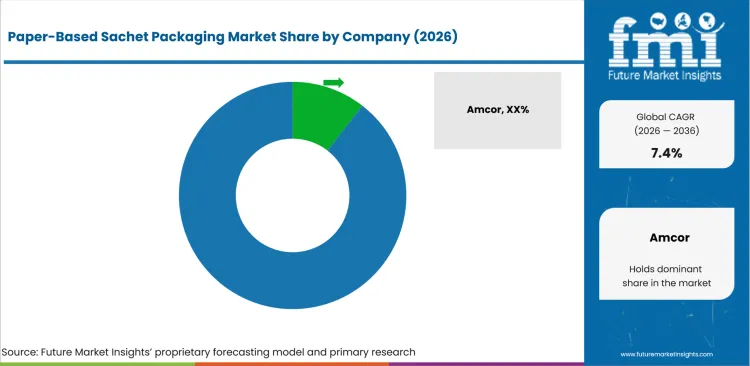
Competition combines integrated flexible packaging groups with paper manufacturers that supply barrier substrates for downstream sachet conversion. In February 2026, ProAmpac expanded its RP-2000 high-barrier fiber platform across pouches and rollstock for sensitive dry foods. The company documented a horizontal form-fill-seal trial reaching 900 packs per minute with minimum equipment adjustment. That trial shows how packing paper development must connect barrier performance with practical line speed across a finished flexible format. Integrated packaging groups compete through converted structures and application trials that support qualified food and household programs. Paper specialists compete through barrier chemistry and processing guidance that helps coating partners match product exposure. Selection depends on verified protection and usable production speed rather than corporate scale across adjacent packaging categories.
- Amcor and Mondi provide finished paper refill and pouch formats across food and household applications. In January 2025, Huhtamaki showcased sachet and stickpack formats from its blueloop portfolio at Pharmapack and received the Eco-Design Award at the Pharmapack Awards 2025 for its recyclable Omnilock Ultra Paper solution. Each manufacturer must prove finished-structure protection and recovery performance across intended applications without reducing normal production speeds.
- Constantia Flexibles and ProAmpac supply converted rollstock or pouch platforms with documented barriers and filling-line compatibility. Application trials determine whether coating and sealing changes preserve line speed across the selected product. Commercial programs benefit from formats that avoid a complete equipment redesign across established production assets.
- Sappi with Ahlstrom and Koehler Paper provide engineered barrier substrates for downstream sachet conversion across food and household applications. Their roles cover grease resistance and heat sealability together with verified oxygen or moisture protection. Packaging plants compare processing behavior and recovery documentation for the intended application rather than general paper capacity.
Competitive Benchmarking: Paper-Based Sachet Packaging Market
| Company | Commercial Sachet and Pouch Formats | Barrier Paper Technology | Conversion and Line Support | Geographic Reach |
|---|---|---|---|---|
| Amcor | High | Medium | High | Global |
| Mondi | High | High | High | Global |
| Huhtamaki | High | Medium | Medium | Global |
| Constantia Flexibles | High | High | Medium | Global |
| ProAmpac | High | High | High | Global |
| Sappi | Medium | High | Medium | Global |
| Ahlstrom | Low | Medium | Medium | Global |
| Koehler Paper | Low | Medium | Medium | Global |
Key Developments in the Paper-Based Sachet Packaging Market
- In August 2025, Mondi increased production of FunctionalBarrier Paper Ultimate through specialized coating capacity at its Solec plant. The paper provides oxygen transmission below 0.5 cm³/m²d and water-vapor transmission below 0.5 g/m²d for sensitive dry products. Compatibility with horizontal and vertical form-fill-seal equipment gives packaging plants a documented high-barrier route across existing production assets.
- In September 2025, Sappi launched Guard Pro OHS and Guard Pro OMH as recyclable high-barrier papers for primary packaging. Guard Pro OHS supports sachets and pouches with oxygen and moisture protection together with grease resistance and mineral oil barrier. Improved mechanical properties and heat-seal capability address machine-performance limits across commercial food applications that require dependable output on established production lines.
- In September 2025, Koehler Paper introduced NexPlus Seal Coat with high gloss and improved flex-crack resistance for paper packaging. The company reported equal machine speed to plastic structures and lower sealing temperatures across compatible packaging equipment. The development gives premium brands a recyclable surface option that protects processing speed and print quality during commercial conversion.
- In February 2026, Constantia Flexibles presented its commercially available EcoPaper family for food-contact packaging at CFIA. The PFAS-free range includes three barrier levels with CEPI certification for standard paper recycling streams. Compatibility with horizontal and vertical form-fill-seal equipment supports food formats that need grease protection together with aroma and oxygen barriers. The range allows food manufacturers to match protection levels with product exposure and normal line conditions.
Key Players in the Paper-Based Sachet Packaging Market
Integrated Flexible Packaging Groups
- Amcor
- Mondi
- Huhtamaki
Established Paper-Format Converters
- Constantia Flexibles
- ProAmpac
Barrier Paper Technology Specialists
- Sappi
- Ahlstrom
- Koehler Paper
Paper-Based Sachet Packaging Market - Report Scope
| Coverage field | Report scope |
|---|---|
| Market breakdown | Material, format, barrier or feature, end use, and region. |
| Quantitative Units | Revenue in USD Million, CAGR in %. |
| Market Definition | Commercially tracked revenue from paper-based sachet packaging across the defined material, format, barrier or feature, end-use, and regional categories. |
| Regions Covered | North America, Latin America, Western Europe, Eastern Europe, East Asia, South Asia and Pacific, and Middle East and Africa. |
| Countries Covered | India, United States, Japan, Germany, United Kingdom, France, and 30+ countries. |
| Key Companies Profiled | Amcor, Mondi, Huhtamaki, Constantia Flexibles, ProAmpac, Sappi, Ahlstrom, and Koehler Paper. |
| Forecast Period | 2026 to 2036. |
| Approach | Hybrid bottom-up and top-down market sizing supported by primary interviews and official desk research. |
Paper-Based Sachet Packaging Market - Research Methodology
| Method | Approach |
|---|---|
| Primary Research | FMI analysts gathered input from manufacturers, service providers, technology developers, distributors, end users, sourcing teams, and subject-matter experts. Interviews examined purchasing decisions, product or service evaluation, adoption barriers, approval requirements, pricing considerations, and expectations for technical or commercial support. Respondents were also asked what evidence is required before a trial, pilot, or initial order develops into regular purchasing. |
| Desk Research | Desk research covered government statistics, regulatory publications, trade data, industry associations, technical literature, standards, company filings, product information, and official corporate announcements. Sources were reviewed for relevance, publication date, geographic coverage, and consistency with the defined market scope. Claims relating to performance, applications, approvals, capacity, investment, and commercial activity were retained only when supported by credible public evidence. |
| Market Sizing and Forecasting | The market model combined the baseline value with historical performance, segment structure, pricing and volume indicators, adoption levels, company participation, and country-level demand conditions. Forecast assumptions considered economic activity, investment trends, regulatory developments, technology adoption, purchasing cycles, supply availability, and barriers to wider market use. Segment and regional estimates were reconciled before the final market total was calculated. |
| Data Validation | Estimates were checked against multiple independent indicators, including public data, company activity, trade patterns, industry developments, and findings from primary interviews. Validation also tested whether products, services, applications, and company revenues fell within the defined market boundaries. Adjacent categories, unsupported claims, overlapping revenues, and activities without direct market relevance were excluded to reduce double counting and maintain consistency across segments and countries. |
Paper-Based Sachet Packaging Market by Segments
Paper-Based Sachet Packaging Market segmented by Material:
- Paper
- Molded Fiber
- Recycled PET
- Mono-material PE
- Bio-based Polymer
Paper-Based Sachet Packaging Market segmented by Format:
- Pouches
- Trays
- Labels
- Mailers
- Inserts
Paper-Based Sachet Packaging Market segmented by Barrier or Feature:
- Grease Resistant
- High Barrier
- Tamper Evident
- Traceable
- Freshness Indicating
Paper-Based Sachet Packaging Market segmented by End Use:
- Food
- Pharmaceutical
- E-commerce
- Personal Care
- Cold Chain
Paper-Based Sachet Packaging Market segmented by Region:
- North America
- Europe
- East Asia
- South Asia and Pacific
- Latin America
- Middle East and Africa
Research Sources and Bibliography
- American Forest & Paper Association. (2025, August 12). Paper industry announces 2024 USA paper recycling rates.
- Oregon Department of Environmental Quality. (2025, July 1). Oregon leads the nation in implementing the Plastic Pollution and Recycling Modernization Act.
- Amcor. (2025, March 25). Amcor launches recycle-ready AmFiber™ paper refill pack for instant coffee and dry beverages.
- Mondi. (2025, February 12). Mondi and Proquimia launch paper-based stand-up pouches for dishwashing tabs.
- Ahlstrom. (2025, March 17). Ahlstrom expands LamiBak™ portfolio with a new base paper for flexible food packaging.
- UPM Specialty Materials. (2025, March 6). UPM and Orkla Suomi introduce paper packaging for Panda Milk chocolate.
- Amcor. (2025, April 3). Amcor partners with Riverside Natural Foods to introduce MadeGood Trail Mix bars in AmFiber™ paper-based packaging.
- UPM Specialty Materials. (2026, April 16). UPM and Felix Schoeller introduce customizable, fibre-based solution for flexible food packaging.
- European Commission. (2025, February 11). Packaging waste.
- USA Food and Drug Administration. (2025, January 3). FDA determines authorization for 35 food contact notifications related to PFAS are no longer effective.
- Food Safety and Standards Authority of India. (2025, October 6). Draft Food Safety and Standards (Packaging) Amendment Regulations, 2025.
- California Department of Resources Recycling and Recovery. (2026, May 1). Plastic Pollution Prevention and Packaging Producer Responsibility Act.
- Ministry of Economy, Trade and Industry. (2025, September 26).
- Zentrale Stelle Verpackungsregister. (2025, August 28). Minimum standard for determining the recyclability of packaging.
- PackUK. (2025, June 27). Extended Producer Responsibility for Packaging announcements.
- ADEME. (2025, March 7). Évaluation de l'offre des emballages papiers-cartons en France.
- ProAmpac. (2026, February 17). ProAmpac Pushes the Limits of Fiber Packaging with New High Barrier Packaging Innovation Platform.
- Huhtamaki. (2025, January 27). Huhtamaki at PharmaPack 2025.
- Mondi. (2025, August 14). Mondi ramps up FunctionalBarrier Paper Ultimate to meet growing demand for sustainable high-barrier paper-based packaging.
- Sappi. (2025, September 2). Sappi expands recyclable, high-barrier paper portfolio for primary packaging.
- Koehler Paper. (2025, September 11). High Gloss for Paper Packaging with Koehler Paper Barrier Paper.
- Constantia Flexibles. (2026, February 23). Constantia Flexibles highlights decarbonization and paper packaging advances at CFIA 2026.
This bibliography is provided for reader reference and is not exhaustive. The full report contains the complete reference list and detailed citations.
This Report Answers
- How large is the paper-based sachet packaging market in 2026 and 2036?
- Which material and end-use segments account for the largest 2026 shares?
- Why does paper hold the largest share of material demand?
- How do pouch formats and grease-resistant barriers affect commercial qualification?
- How do country growth conditions differ across the six profiled markets?
- Which companies provide converted paper formats or specialist barrier technologies?
- Which technical and regulatory factors limit wider substitution of film sachets?
- How do PFAS-free barriers and machine-compatible papers create commercial openings?
- Which evidence should brand owners request before approving a paper sachet program?
Frequently Asked Questions
How big is the Paper-Based Sachet Packaging Market in 2026?
The paper-based sachet packaging market is valued at USD 464.0 million in 2026 and is forecast to reach USD 947.5 million by 2036.
What is the CAGR of the Paper-Based Sachet Packaging Market from 2026 to 2036?
The paper-based sachet packaging market is projected to grow at a CAGR of 7.4% between 2026 and 2036, supported by food and household brands funding paper sachet trials that preserve portion control and established filling-line output across qualified dry products.
Which end use leads the Paper-Based Sachet Packaging Market?
Food accounts for 54.0% of the paper-based sachet packaging market by end use in 2026, driven by repeat portion-pack demand across dry ingredients and beverage powders requiring food-contact compliance and shelf-life evidence for the complete coated or laminated structure.
Which country is growing fastest in the Paper-Based Sachet Packaging Market?
India is the fastest-growing country in the paper-based sachet packaging market, expanding at a 10.0% CAGR through 2036, ahead of the market average of 7.4%, supported by expanding dry-food and personal-care programs and large regional converting centers with established coating and printing capacity.
Who are the leading companies in the Paper-Based Sachet Packaging Market?
Leading companies in the paper-based sachet packaging market include Amcor, Mondi, Huhtamaki, Constantia Flexibles, ProAmpac, Sappi, Ahlstrom, and Koehler Paper, competing across integrated flexible packaging formats, established paper-format conversion, and barrier paper technology development for downstream sachet programs.
Preview the report firsthand - request a free sample
Get SampleGet the brochure for pricing and purchase details.
Get PDFTable of Content
- Key Takeaways
- Market Size and CAGR
- Top Growth Driver
- Fastest Growing Segment
- Leading Region
- Key Companies
- Emerging Opportunities
- Executive Summary
- Global Market Outlook
- Demand-side Trends
- Supply-side Trends
- Technology Roadmap Analysis
- Analysis and Recommendations
- Analyst Perspective (What is happening? Why now? What should investors know?)
- Key Questions Answered
- How large is the market?
- What is the CAGR?
- What are key trends?
- Which region dominates?
- Who are the leaders?
- Market Overview
- Market Coverage / Taxonomy
- Market Definition / Scope / Limitations
- Research Methodology
- Chapter Orientation
- Analytical Lens and Working Hypotheses
- Market Structure, Signals, and Trend Drivers
- Benchmarking and Cross-market Comparability
- Market Sizing, Forecasting, and Opportunity Mapping
- Research Design and Evidence Framework
- Desk Research Programme (Secondary Evidence)
- Expert Input and Fieldwork (Primary Evidence)
- Tooling, Models, and Reference Databases
- Data Engineering and Model Build
- Quality Assurance and Audit Trail
- Market Background
- Market Dynamics (Drivers, Restraints, Opportunity, Trends)
- Scenario Forecast (Optimistic, Likely, Conservative)
- Impact Analysis
- AI Impact
- Sustainability Impact
- Regulatory Impact
- Technology Impact
- Consumer / Buyer Analysis
- Purchase Drivers
- Adoption Barriers
- Buyer Journey
- Opportunity Map Analysis
- Product Life Cycle Analysis
- Supply Chain Analysis
- Investment Feasibility Matrix
- Value Chain Analysis
- PESTLE and Porter's Analysis
- Regulatory Landscape
- Regional Parent Market Outlook
- Production and Consumption Statistics
- Import and Export Statistics
- Global Market Analysis and Forecast, 2021 to 2036
- Historical Market Size Value (USD Million) Analysis, 2021 to 2025
- Current and Future Market Size Value (USD Million) Projections, 2026 to 2036
- Y-o-Y Growth Trend Analysis
- Absolute $ Opportunity Analysis
- Global Market Pricing Analysis, 2021 to 2036
- Global Market Analysis and Forecast, By Material, 2021 to 2036
- Introduction / Key Findings
- Historical Market Size Value (USD Million) Analysis By Material, 2021 to 2025
- Current and Future Market Size Value (USD Million) Analysis and Forecast By Material, 2026 to 2036
- Paper
- Molded Fiber
- Recycled Pet
- Mono-Material Pe
- Bio-Based Polymer
- Paper
- Y-o-Y Growth Trend Analysis By Material, 2021 to 2025
- Absolute $ Opportunity Analysis By Material, 2026 to 2036
- Global Market Analysis and Forecast, By Format, 2021 to 2036
- Introduction / Key Findings
- Historical Market Size Value (USD Million) Analysis By Format, 2021 to 2025
- Current and Future Market Size Value (USD Million) Analysis and Forecast By Format, 2026 to 2036
- Pouches
- Trays
- Labels
- Mailers
- Inserts
- Pouches
- Y-o-Y Growth Trend Analysis By Format, 2021 to 2025
- Absolute $ Opportunity Analysis By Format, 2026 to 2036
- Global Market Analysis and Forecast, By Barrier or Feature, 2021 to 2036
- Introduction / Key Findings
- Historical Market Size Value (USD Million) Analysis By Barrier or Feature, 2021 to 2025
- Current and Future Market Size Value (USD Million) Analysis and Forecast By Barrier or Feature, 2026 to 2036
- Grease Resistant
- High Barrier
- Tamper Evident
- Traceable
- Freshness Indicating
- Grease Resistant
- Y-o-Y Growth Trend Analysis By Barrier or Feature, 2021 to 2025
- Absolute $ Opportunity Analysis By Barrier or Feature, 2026 to 2036
- Global Market Analysis and Forecast, By End Use, 2021 to 2036
- Introduction / Key Findings
- Historical Market Size Value (USD Million) Analysis By End Use, 2021 to 2025
- Current and Future Market Size Value (USD Million) Analysis and Forecast By End Use, 2026 to 2036
- Food
- Pharmaceutical
- E-Commerce
- Personal Care
- Cold Chain
- Food
- Y-o-Y Growth Trend Analysis By End Use, 2021 to 2025
- Absolute $ Opportunity Analysis By End Use, 2026 to 2036
- Global Market Analysis and Forecast, By Region, 2021 to 2036
- Introduction
- Historical Market Size Value (USD Million) Analysis By Region, 2021 to 2025
- Current Market Size Value (USD Million) Analysis and Forecast By Region, 2026 to 2036
- North America
- Latin America
- Western Europe
- Eastern Europe
- East Asia
- South Asia and Pacific
- Middle East & Africa
- Market Attractiveness Analysis By Region
- North America Market Analysis and Forecast, By Country, 2021 to 2036
- Historical Market Size Value (USD Million) Trend Analysis By Market Taxonomy, 2021 to 2025
- Market Size Value (USD Million) Forecast By Market Taxonomy, 2026 to 2036
- By Country
- USA
- Canada
- By Material
- By Format
- By Barrier or Feature
- By End Use
- By Country
- Market Attractiveness Analysis
- By Country
- By Material
- By Format
- By Barrier or Feature
- By End Use
- Key Takeaways
- Latin America Market Analysis and Forecast, By Country
- Historical Market Size Value (USD Million) Trend Analysis By Market Taxonomy, 2021 to 2025
- Market Size Value (USD Million) Forecast By Market Taxonomy, 2026 to 2036
- By Country
- Brazil
- Mexico
- Chile
- Rest of Latin America
- By Material
- By Format
- By Barrier or Feature
- By End Use
- By Country
- Market Attractiveness Analysis
- By Country
- By Material
- By Format
- By Barrier or Feature
- By End Use
- Key Takeaways
- Western Europe Market Analysis and Forecast, By Country
- Historical Market Size Value (USD Million) Trend Analysis By Market Taxonomy, 2021 to 2025
- Market Size Value (USD Million) Forecast By Market Taxonomy, 2026 to 2036
- By Country
- Germany
- UK
- Italy
- Spain
- France
- Nordic
- BENELUX
- Rest of Western Europe
- By Material
- By Format
- By Barrier or Feature
- By End Use
- By Country
- Market Attractiveness Analysis
- By Country
- By Material
- By Format
- By Barrier or Feature
- By End Use
- Key Takeaways
- Eastern Europe Market Analysis and Forecast, By Country
- Historical Market Size Value (USD Million) Trend Analysis By Market Taxonomy, 2021 to 2025
- Market Size Value (USD Million) Forecast By Market Taxonomy, 2026 to 2036
- By Country
- Russia
- Poland
- Hungary
- Balkan & Baltic
- Rest of Eastern Europe
- By Material
- By Format
- By Barrier or Feature
- By End Use
- By Country
- Market Attractiveness Analysis
- By Country
- By Material
- By Format
- By Barrier or Feature
- By End Use
- Key Takeaways
- East Asia Market Analysis and Forecast, By Country
- Historical Market Size Value (USD Million) Trend Analysis By Market Taxonomy, 2021 to 2025
- Market Size Value (USD Million) Forecast By Market Taxonomy, 2026 to 2036
- By Country
- China
- Japan
- South Korea
- By Material
- By Format
- By Barrier or Feature
- By End Use
- By Country
- Market Attractiveness Analysis
- By Country
- By Material
- By Format
- By Barrier or Feature
- By End Use
- Key Takeaways
- South Asia and Pacific Market Analysis and Forecast, By Country
- Historical Market Size Value (USD Million) Trend Analysis By Market Taxonomy, 2021 to 2025
- Market Size Value (USD Million) Forecast By Market Taxonomy, 2026 to 2036
- By Country
- India
- ASEAN
- Australia & New Zealand
- Rest of South Asia and Pacific
- By Material
- By Format
- By Barrier or Feature
- By End Use
- By Country
- Market Attractiveness Analysis
- By Country
- By Material
- By Format
- By Barrier or Feature
- By End Use
- Key Takeaways
- Middle East & Africa Market Analysis and Forecast, By Country
- Historical Market Size Value (USD Million) Trend Analysis By Market Taxonomy, 2021 to 2025
- Market Size Value (USD Million) Forecast By Market Taxonomy, 2026 to 2036
- By Country
- Kingdom of Saudi Arabia
- Other GCC Countries
- Türkiye
- South Africa
- Other African Union
- Rest of Middle East & Africa
- By Material
- By Format
- By Barrier or Feature
- By End Use
- By Country
- Market Attractiveness Analysis
- By Country
- By Material
- By Format
- By Barrier or Feature
- By End Use
- Key Takeaways
- Key Countries Market Analysis
- USA
- Pricing Analysis
- Market Share Analysis, 2025
- By Material
- By Format
- By Barrier or Feature
- By End Use
- Canada
- Pricing Analysis
- Market Share Analysis, 2025
- By Material
- By Format
- By Barrier or Feature
- By End Use
- Mexico
- Pricing Analysis
- Market Share Analysis, 2025
- By Material
- By Format
- By Barrier or Feature
- By End Use
- Brazil
- Pricing Analysis
- Market Share Analysis, 2025
- By Material
- By Format
- By Barrier or Feature
- By End Use
- Chile
- Pricing Analysis
- Market Share Analysis, 2025
- By Material
- By Format
- By Barrier or Feature
- By End Use
- Germany
- Pricing Analysis
- Market Share Analysis, 2025
- By Material
- By Format
- By Barrier or Feature
- By End Use
- UK
- Pricing Analysis
- Market Share Analysis, 2025
- By Material
- By Format
- By Barrier or Feature
- By End Use
- Italy
- Pricing Analysis
- Market Share Analysis, 2025
- By Material
- By Format
- By Barrier or Feature
- By End Use
- Spain
- Pricing Analysis
- Market Share Analysis, 2025
- By Material
- By Format
- By Barrier or Feature
- By End Use
- France
- Pricing Analysis
- Market Share Analysis, 2025
- By Material
- By Format
- By Barrier or Feature
- By End Use
- India
- Pricing Analysis
- Market Share Analysis, 2025
- By Material
- By Format
- By Barrier or Feature
- By End Use
- ASEAN
- Pricing Analysis
- Market Share Analysis, 2025
- By Material
- By Format
- By Barrier or Feature
- By End Use
- Australia & New Zealand
- Pricing Analysis
- Market Share Analysis, 2025
- By Material
- By Format
- By Barrier or Feature
- By End Use
- China
- Pricing Analysis
- Market Share Analysis, 2025
- By Material
- By Format
- By Barrier or Feature
- By End Use
- Japan
- Pricing Analysis
- Market Share Analysis, 2025
- By Material
- By Format
- By Barrier or Feature
- By End Use
- South Korea
- Pricing Analysis
- Market Share Analysis, 2025
- By Material
- By Format
- By Barrier or Feature
- By End Use
- Russia
- Pricing Analysis
- Market Share Analysis, 2025
- By Material
- By Format
- By Barrier or Feature
- By End Use
- Poland
- Pricing Analysis
- Market Share Analysis, 2025
- By Material
- By Format
- By Barrier or Feature
- By End Use
- Hungary
- Pricing Analysis
- Market Share Analysis, 2025
- By Material
- By Format
- By Barrier or Feature
- By End Use
- Kingdom of Saudi Arabia
- Pricing Analysis
- Market Share Analysis, 2025
- By Material
- By Format
- By Barrier or Feature
- By End Use
- Türkiye
- Pricing Analysis
- Market Share Analysis, 2025
- By Material
- By Format
- By Barrier or Feature
- By End Use
- South Africa
- Pricing Analysis
- Market Share Analysis, 2025
- By Material
- By Format
- By Barrier or Feature
- By End Use
- USA
- Market Structure Analysis
- Competition Dashboard
- Competition Benchmarking
- Market Share Analysis of Top Players
- By Regional
- By Material
- By Format
- By Barrier or Feature
- By End Use
- Emerging Startups
- Innovation Benchmarking
- Competition Analysis
- Competition Deep Dive
- Amcor
- Overview
- Product Portfolio
- Profitability by Market Segments
- Sales Footprint
- Strategy Overview
- Marketing Strategy
- Product Strategy
- Channel Strategy
- Mondi
- Huhtamaki
- Constantia Flexibles
- Tetra Pak
- UFlex
- Coveris
- Sappi
- Amcor
- Case Studies
- Success Stories
- Recent Developments
- Competition Deep Dive
- Assumptions & Acronyms Used


