

- Market Size (2026)
- USD 357.5 Mn
- Forecast (2036)
- USD 664.8 Mn
- CAGR (2026 to 2036)
- 6.4%
How big is Paper-Based Produce Liners Market in 2026?
USD 357.5 million in 2026 and USD 664.8 million by 2036 at a 6.4% CAGR.
Demand for paper-based produce liners is projected to expand at 6.4% CAGR between 2026 and 2036, increasing valuation from USD 357.5 million to USD 664.8 million. Export packhouses need formats that reduce abrasion without changing familiar shipping cases during seasonal loading and transport cycles. In July 2025, the USDA Foreign Agricultural Service awarded 22 grants for produce-packaging research that tests protective formats against overseas requirements. Those trials shorten the evidence path between a sample liner and a recurring export programme.
Brazil is forecast to outpace Japan owing to longer export routes and more handling stages for fruit. Brazil's Ministry of Agriculture reported in July 2025 that the country exported more than USD 1.38 billion and one million tonnes of fresh and prepared fruit during 2024. The scale of this trade raises the value of liners that control scuffing and localized moisture without changing the shipping case. Japanese packers emphasize presentation and smaller production runs, which require precise cutting but reduce the economics of large conversion batches.
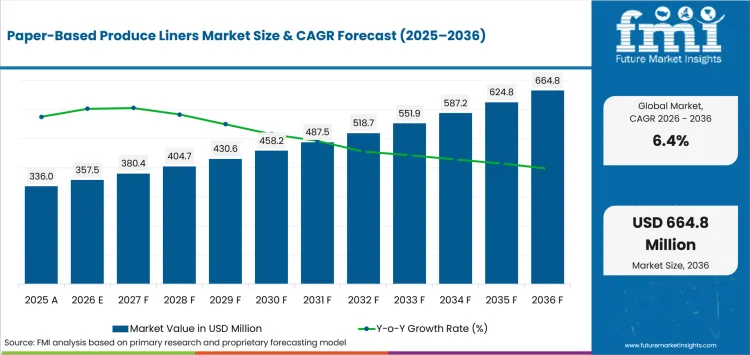
Key Takeaways of Paper-Based Produce Liners Market
- Packhouses adopt paper-based produce liners when reduced abrasion and staining improve saleable pack-out without disrupting established loading and ventilation routines.
- Crate and box liners are projected to account for 30.0% share in 2026 due to direct compatibility with corrugated transport cases.
- Kraft paper is estimated to hold 38.0% by paper grade in 2026 owing to dependable tear strength and flexible converting performance.
- Untreated papers are anticipated to represent 40.0% of treatment demand in 2026 because short routes often need clean separation without added barrier chemistry.
- Humidity exposure can weaken paper and extend qualification work for food-contact status, repulpability and reliable performance across normal packing conditions.
- Ahlstrom, McNairn Packaging, Nordic Paper, Oren International, Pudumjee Paper Products Limited, Seaman Paper Company, Sirane (Coppice Alupack Ltd) and Twin Rivers Paper Company serve this market.
Analyst Perspective
“Produce-liner selection should begin with crop damage and humidity trials at normal packing speed, not with unit price alone. Commercial value comes from papers that protect saleable appearance while preserving ventilation, food-contact records and seasonal delivery reliability.”
- Nandini Roy Choudhury, Principal Consultant, Future Market Insights
How is the Paper-Based Produce Liners Market segmented?
The paper-based produce liners market is segmented by product type, paper grade, treatment, produce type, end use, sales channel and region.
Paper-based produce liners are segmented by product type, paper grade, treatment, produce type, end use, sales channel and region. Product types include crate and box liners, tray liners, interleaving and layer pads, wrapping sheets and others. Paper grades cover kraft, tissue-MG, greaseproof, recycled liner and others. Treatments include untreated, moisture-resistant, anti-slip and others. Produce types comprise fruits, vegetables, leafy greens, mushrooms and others. End users include growers and packers, wholesalers, grocery retailers and others. Sales channels cover direct OEM supply, distributors, e-commerce and others.
What makes crate and box liners central to the product type category?
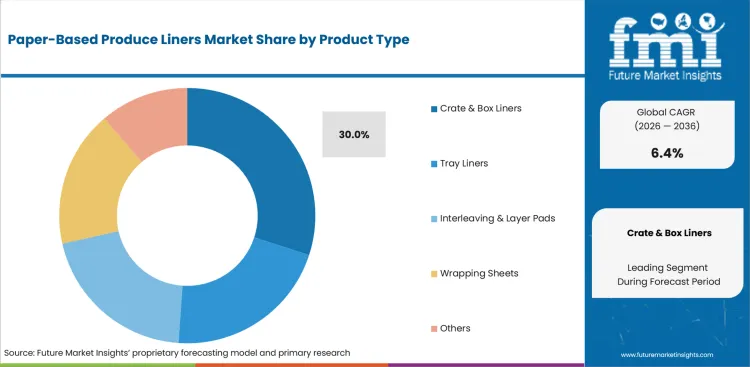
Crate and box liners protect produce at contact points between fruit and corrugated cases during loading. Packhouses can add the sheet without replacing cases, ventilation patterns or familiar daily handling equipment. Custom dimensions let converters match vent openings and reusable crate footprints without slowing line changes.
- The product type category is forecast to be led by crate and box liners at 30.0% share in 2026 due to their fit with high-volume transport cases.
- Packhouses compare cut sheets with unlined controls during normal runs to measure scuffing, staining and pack-out loss. Commercial approval depends on tear resistance and stable airflow across the complete distribution programme cycle.
How does kraft paper influence selection within the paper grade category?
Kraft paper provides the tensile strength and folding response required by specialty paper converters serving heavy produce loads. Predictable formation supports accurate cutting at lower basis weights, which protects handling performance while limiting unnecessary material use.
- Kraft paper is projected to hold 38.0% share in 2026 owing to dependable strength across crate liners, interleaving sheets and wrapping formats.
- Converters evaluate documented porosity and surface roughness before accepting seasonal volumes for each crop programme. Heavy vegetables need tear resistance during stacking, while delicate fruit needs a surface that limits visible marking. Stable mill formation reduces replacement-batch variation during compressed regional harvest windows and retailer approval cycles.
What role does untreated paper play within the treatment category?
Untreated uncoated paper remains practical for dry produce and short routes that need separation more than barrier performance. The simpler grade avoids coating cost and permits changes across seasonal packing programmes with limited condensate exposure.
- In 2026, untreated paper is expected to lead the treatment category with 40.0% share because many domestic packs need clean separation without added chemistry.
- Packers compare untreated sheets with moisture-resistant alternatives across the intended cold-chain cycle and normal packing speeds. They retain untreated grades if wet strength and tear performance remain adequate during routine handling. Longer humid routes require stronger moisture control and food-contact documentation before commercial approval can proceed.
What supports demand for fruits within the produce type category?
Fruit packs combine delicate skins with strict appearance standards across berries, grapes, stone fruit and citrus. Machine-glazed paper provides a smoother contact surface for selected liner and wrapping formats, which reduces direct abrasion during loading and transport.
- By produce type, fruits are forecast to represent 34.0% in 2026 driven by the cost of bruising, scuffing and staining across layered packs.
- Apple programmes prioritize scuff resistance across longer routes while berry packs need localized moisture control without changing crate ventilation. Converters therefore vary surface smoothness and absorbency by crop, then adjust tear strength as trials establish pack-out benefits and repeat seasonal orders.
What are the drivers, restraints and opportunities in the Paper-Based Produce Liners Market?
Lower produce damage and fiber-format requirements support demand, while moisture qualification restrains adoption and crop-specific converting provides the strongest revenue route.
- Driver: Packhouses seek lower scuffing and staining while preserving familiar cases, ventilation patterns and normal seasonal packing speeds.
- Restraint: Condensate can weaken paper and increase the evidence required for food contact, recovery claims and repeatable line performance.
- Opportunity: Paper mills and converters can qualify crop-specific grades that combine wet strength, absorbency and accurate dimensions for recurring programmes.
Packhouses compare produce packaging with unlined cases according to expected saleable yield and recurring material cost. The EU Packaging and Packaging Waste Regulation entered into force in February 2025 and generally applies from August 2026. The rule strengthens the case for fiber formats, but packers retain a liner if it protects produce without reducing airflow or line speed.
Moisture treatment improves wet strength but adds chemistry that must satisfy food-contact and recovery requirements across each intended use. In January 2025, the FDA determined that 35 food-contact notifications for PFAS grease-proofers on paper and paperboard were no longer effective. Food-grade packaging manufacturers therefore need replacement chemistry and clear intended-use records before packhouses approve recurring orders.
Crop-specific grades provide a practical route beyond standard separation sheets for humid or high-value produce programmes. Converters can combine parchment paper or treated kraft with accurate dimensions for berries, mushrooms and leafy greens. Commercial conversion depends on field trials and seasonal stock that reduce approval time between sample sheets and repeat orders.
Which country CAGRs are profiled in the Paper-Based Produce Liners Market?
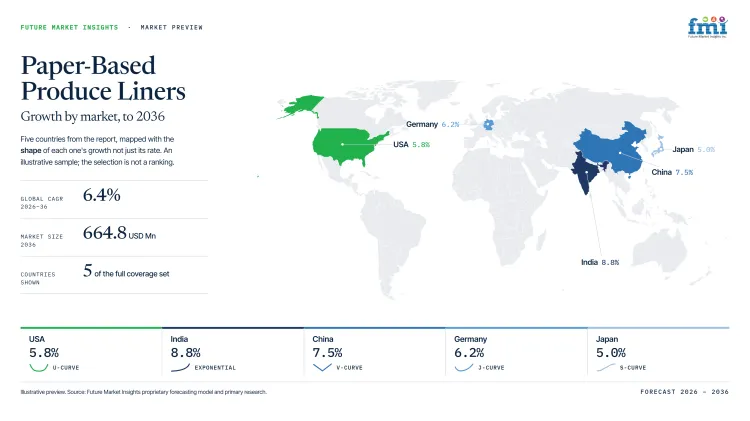
| Country | CAGR |
|---|---|
| Brazil | 6.8% |
| United Kingdom | 6.3% |
| Germany | 6.2% |
| United States | 5.8% |
| Japan | 5.0% |
How do country-level CAGRs compare in the Paper-Based Produce Liners Market?
The country rates span 1.8 percentage points between Brazil and Japan across the assessment period. The range measures forecast pace and does not establish current market size or packer concentration.
- Brazil's outlook is supported by export-oriented produce flows where moisture protection remains important across extended shipping distances.
- In the UK, packaging fee structures are encouraging closer evaluation of material efficiency and total pack performance.
- Germany places greater emphasis on recyclability documentation, particularly for treated paper grades entering established recovery streams.
- The USA market benefits from large-scale produce programs that depend on consistent converting quality and reliable seasonal supply.
- Japan's adoption path remains closely tied to presentation standards, with precise paper specifications often required before broader conversion.
Comparable CAGRs can produce different market entry conditions. The full report provides country-level CAGR analysis across North America, Latin America, Europe, East Asia, South Asia and Pacific, and the Middle East and Africa.
Country-wise Analysis
- Brazilian fruit exporters manage long routes for mangoes and grapes across humid loading conditions that increase abrasion and staining risk. Paper-based produce liner sales in Brazil are forecast to expand at 6.8% CAGR by 2036, aided by export activity documented in July 2025 by the Ministry of Agriculture at more than USD 1.38 billion and one million tonnes of fresh and prepared fruit. Local conversion reduces response time for seasonal orders, yet mills must provide wet-strength grades and destination-market records without delaying coastal packing schedules or forcing exporters into uneconomic minimum volumes during peak harvest windows across several crop programmes.
- United Kingdom retailers compare liner papers by material class and require packhouses to document recyclability without increasing bruising or condensate damage. The United Kingdom's paper-based produce liners outlook is anticipated to advance at 6.3% CAGR over the assessment period, supported by June 2025 base fees of GBP 196 per tonne for paper and card against GBP 423 for plastic. The fee gap favors fiber formats, yet distributors must hold absorbent grades for compressed harvest windows to prevent moisture-related tearing from erasing the value of lighter sheets across domestic and imported crop programmes during retailer specification reviews and weekly replenishment decisions across regional distribution centres.
- German packers operate within a retail system that applies formal recyclability criteria to sales packaging and scrutinizes avoidable material use. The German paper-based produce liners sector is projected to record 6.2% CAGR during the assessment period, shaped by the August 2025 minimum standard that Germany's Environment Agency and packaging register use to measure practical recycling yield. Treated papers must pass cold-storage trials alongside recovery review, so manufacturers need precise composition records and local technical support without adding more basis weight than each produce route requires during recurring retailer approvals and annual declarations for every approved commercial grade and seasonal programme.
- United States packhouses manage large domestic crop programmes and export specifications that vary by destination and seasonal harvest timing. Adoption of paper-based produce liners in the United States is estimated to expand at 5.8% CAGR through 2036, reinforced by official national trade data from the USDA Foreign Agricultural Service covering USD 13.53 billion and 7.47 million metric tonnes of fruit and vegetable exports during 2024. National volume supports direct contracts, yet regional harvest windows and food-contact review require converters to maintain cut-sheet capacity and technical response across several packing districts without delaying approvals ahead of major crop movements across refrigerated regional supply networks.
- Japanese produce channels emphasize clean presentation and dimensional consistency across smaller packs that expose surface defects quickly during retail handling. Japan is estimated to post 5.0% CAGR over the forecast period, influenced by loss-reduction programmes targeting the 4.61 million tonnes of food loss estimated by the Ministry of Agriculture for fiscal 2024 and 2.37 million tonnes from businesses. Paper substitutions face strict price and defect comparisons, so mills need stable formation and accurate cutting for retailer-specific runs while limited distributor inventory outside major metropolitan markets raises lead-time risk during short seasonal programmes and premium produce launches that demand rapid commercial replacement deliveries.
Who are the notable companies in the Paper-Based Produce Liners Market?
Ahlstrom, McNairn Packaging, Nordic Paper, Oren International, Pudumjee Paper Products Limited, Seaman Paper Company, Sirane (Coppice Alupack Ltd) and Twin Rivers Paper Company are the notable companies serving this market.
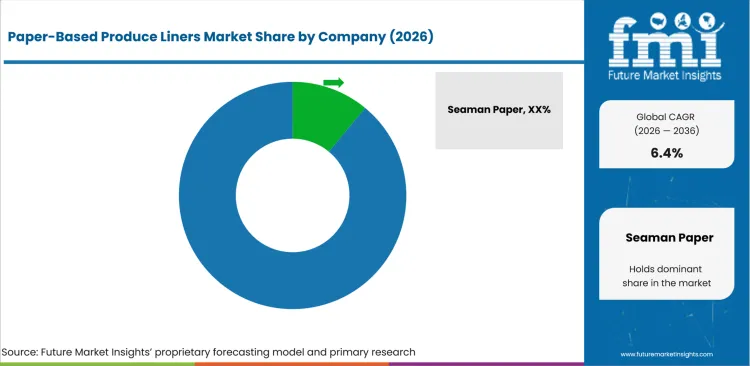
The competitive field remains fragmented across specialty papermaking, paper packaging conversion and produce-specific absorbency in fresh produce. No single operating model covers paper chemistry, precision cutting and seasonal packhouse service equally well. Entry depends on food-contact records plus moisture performance that survives the intended crop and distribution route, while reliable cut sizes determine whether a qualified grade reaches recurring programmes.
- Ahlstrom, Nordic Paper, Pudumjee Paper Products Limited and Twin Rivers Paper Company compete on food-contact paper chemistry, surface treatment and technical papermaking.
- McNairn Packaging, Oren International and Seaman Paper Company provide slitting, sheeting, printing and format conversion for recurring commercial specifications.
- Sirane (Coppice Alupack Ltd) concentrates on absorbent fruit pads and fresh food packaging formats that manage moisture, cushioning and produce presentation.
Competitive Benchmarking: Paper-Based Produce Liners Market
| Company | Produce-Contact Format Fit | Moisture & Surface Control | Custom Converting & Scale | Geographic Reach |
|---|---|---|---|---|
| Ahlstrom | Medium | High | High | Global |
| McNairn Packaging | High | Medium | High | North America |
| Nordic Paper | Medium | High | Medium | Europe and export markets |
| Oren International | Medium | Low | High | North America and international markets |
| Pudumjee Paper Products Limited | Medium | High | Low | India and export markets |
| Seaman Paper Company | Medium | Medium | High | North America, Europe and Asia |
| Sirane (Coppice Alupack Ltd) | High | High | High | Europe, North America and Mexico |
| Twin Rivers Paper Company | Low | High | Medium | North America and export markets |
Key Developments in the Paper-Based Produce Liners Market
- In May 2026, Twin Rivers Paper Company completed the acquisition of Potsdam Specialty Paper Inc. The transaction added 26,000 tons of annual capacity plus latex saturation and coating equipment that expand the treatment-ready base papers available for technical packaging development.
- In September 2025, Seaman Paper Company launched heat-sealable recyclable paper in flat sheets and tube formats. Compatibility with common form-fill-seal and horizontal flow-wrapper equipment gives packaging operations a paper substitution route without rebuilding established converting lines.
- In March 2025 Ahlstrom launched LamiBak Flex as a base paper for coating, metallization or extrusion in flexible food packaging. The platform gives converters a documented paper route for tailored barriers and dependable downstream processing, although each produce-liner use still requires separate qualification.
Key Players in the Paper-Based Produce Liners Market
Functional Paper Manufacturers
- Ahlstrom
- Nordic Paper
- Pudumjee Paper Products Limited
- Twin Rivers Paper Company
Food-Contact Converters
- McNairn Packaging
- Oren International
- Seaman Paper Company
Produce Absorbency Specialist
- Sirane (Coppice Alupack Ltd)
Paper-Based Produce Liners Market - Report Scope
| Coverage field | Report scope |
|---|---|
| Market breakdown | By product type, paper grade, treatment, produce type, end use, sales channel and region. |
| Quantitative Units | Revenue in USD million and CAGR in %. |
| Market Definition | Commercial revenue from paper sheets, pads and liners used inside produce crates, boxes, trays, layers and wraps. |
| Regions Covered | North America, Latin America, Europe, East Asia, South Asia and Pacific, and Middle East and Africa. |
| Countries Covered | Brazil, United Kingdom, Germany, United States, Japan, and 20+ countries included in the full report. |
| Key Companies Profiled | Ahlstrom, McNairn Packaging, Nordic Paper, Oren International, Pudumjee Paper Products Limited, Seaman Paper Company, Sirane (Coppice Alupack Ltd), Twin Rivers Paper Company. |
| Forecast Period | 2026 to 2036. |
| Approach | Primary and secondary research with market triangulation. |
Paper-Based Produce Liners Market - Research Methodology
| Method | Approach |
|---|---|
| Primary Research | FMI analysts gathered input from manufacturers, service providers, technology developers, distributors, end users, procurement teams, and subject-matter experts. Interviews examined purchasing decisions, product or service evaluation, adoption barriers, approval requirements, pricing considerations, and expectations for technical or commercial support. Respondents were also asked what evidence is required before a trial, pilot, or initial order develops into regular purchasing. |
| Desk Research | Desk research covered government statistics, regulatory publications, trade data, industry associations, technical literature, standards, company filings, product information, and official corporate announcements. Sources were reviewed for relevance, publication date, geographic coverage, and consistency with the defined market scope. Claims relating to performance, applications, approvals, capacity, investment, and commercial activity were retained only when supported by credible public evidence. |
| Market Sizing and Forecasting | The market model combined the baseline value with historical performance, segment structure, pricing and volume indicators, adoption levels, company participation, and country-level demand conditions. Forecast assumptions considered economic activity, investment trends, regulatory developments, technology adoption, purchasing cycles, supply availability, and barriers to wider market use. Segment and regional estimates were reconciled before the final market total was calculated. |
| Data Validation | Estimates were checked against multiple independent indicators, including public data, company activity, trade patterns, industry developments, and findings from primary interviews. Validation also tested whether products, services, applications, and company revenues fell within the defined market boundaries. Adjacent categories, unsupported claims, overlapping revenues, and activities without direct market relevance were excluded to reduce double counting and maintain consistency across segments and countries. |
Paper-Based Produce Liners Market by Segments
Paper-Based Produce Liners Market segmented by Product Type:
- Crate & Box Liners
- Tray Liners
- Interleaving & Layer Pads
- Wrapping Sheets
- Others
Paper-Based Produce Liners Market segmented by Paper Grade:
- Kraft Paper
- Tissue - MG Paper
- Greaseproof
- Recycled Liner
- Others
Paper-Based Produce Liners Market segmented by Treatment:
- Untreated
- Moisture-Resistant Treated
- Anti-Slip
- Others
Paper-Based Produce Liners Market segmented by Produce Type:
- Fruits
- Vegetables
- Leafy Greens
- Mushrooms
- Others
Paper-Based Produce Liners Market segmented by End Use:
- Growers & Packers
- Wholesale & Distribution
- Grocery Retail
- Others
Paper-Based Produce Liners Market segmented by Sales Channel:
- Direct - OEM Supply
- Packaging Distributors
- Online - E-commerce
- Others
Paper-Based Produce Liners Market by Region:
- North America
- United States
- Canada
- Latin America
- Brazil
- Mexico
- Argentina
- Chile
- Western Europe
- Germany
- France
- United Kingdom
- Italy
- Spain
- Benelux
- Nordics
- Eastern Europe
- Poland
- Czech Republic
- Romania
- Hungary
- East Asia
- China
- Japan
- South Korea
- South Asia and Pacific
- India
- ASEAN
- Australia and New Zealand
- Middle East and Africa
- GCC Countries
- South Africa
- Türkiye
- Israel
Research Sources and Bibliography
- USA Department of Agriculture, Foreign Agricultural Service. (2025, July 29). Research Funding Awarded for Packaging Innovations to Support American Fresh Produce Exporters
- Ministério da Agricultura e Pecuária. (2025, July 1). A fruta mais exportada pelo Brasil é a manga
- European Commission. (2025, February 11). Packaging waste
- USA Food and Drug Administration. (2025, January 3). FDA Determines Authorization for 35 Food Contact Notifications Related to PFAS Are No Longer Effective
- UK Government. (2025, June 30). Extended Producer Responsibility for Packaging: 2025 base fees
- Umweltbundesamt. (2025, August 29). Recyclingfähigkeit von Verpackungen: Mindeststandard 2025
- USA Department of Agriculture, Foreign Agricultural Service. (2025). Fruits and Vegetables
- Ministry of Agriculture, Forestry and Fisheries. (2026, June 30).
- Twin Rivers Paper Company. (2026, May 5). Twin Rivers Paper Expands its Specialty Paper Portfolio with Acquisition of Potsdam Specialty Paper Inc.
- Seaman Paper Company. (2025, September 18). Seaman Paper Launches Heat-Sealable Paper Packaging: A Scalable, Recyclable Alternative to Single-Use Plastics
- Ahlstrom. (2025, March 17). Ahlstrom expands LamiBak portfolio with a new base paper for flexible food packaging
- Ahlstrom. (2025, May 21). Ahlstrom inaugurates new parchmentizer at the Saint-Séverin plant, strengthening customer partnerships and local commitment
- Nordic Paper. (2025, March 21). Nordic Paper’s annual report and sustainability report 2024
- Sirane (Coppice Alupack Ltd). (2026). BRC Certificate
- McNairn Packaging. (n.d.). Certifications. Retrieved August 7, 2026.
- Pudumjee Paper Products Limited. (n.d.). Annual Reports. Retrieved August 7, 2026.
- Oren International. (2025, March 11). Sheeting, Slitting and Rewinding Services - How Can We Help?
- Nordic Paper. (n.d.). Policies and certificates. Retrieved August 7, 2026.
- Sirane (Coppice Alupack Ltd). (n.d.). Fresh Produce. Retrieved August 7, 2026.
- McNairn Packaging. (n.d.). Food Processing. Retrieved August 7, 2026.
This bibliography is provided for reader reference and is not exhaustive. The full report contains the complete reference list and detailed citations
This Report Answers
- How large is the Paper-Based Produce Liners Market in 2026 and 2036?
- Which packing conditions support recurring demand for paper-based produce liners?
- Why do crate and box liners account for 30.0% of product type demand?
- How does kraft paper affect strength and converting decisions?
- Why do untreated papers retain the largest treatment share?
- How do country growth rates differ across Brazil, the United Kingdom, Germany, the United States and Japan?
- Which companies combine food-contact paper chemistry with converting capacity?
- How do moisture exposure and food-contact qualification restrain adoption?
- What should packhouses test before approving a paper-based produce liner?
Frequently Asked Questions
How big is the Paper-Based Produce Liners Market in 2026?
The paper-based produce liners market is estimated at USD 357.5 million in 2026 and is projected to reach USD 664.8 million by 2036. Growth is driven by increasing use of paper liners to reduce produce damage, abrasion, and staining during handling and transportation.
What is the CAGR of the Paper-Based Produce Liners Market from 2026 to 2036?
The paper-based produce liners market is projected to grow at a CAGR of 6.4% between 2026 and 2036. Expansion is supported by rising adoption of fiber-based protective packaging solutions across fresh produce supply chains.
Which product type is projected to account for 30.0% of the Paper-Based Produce Liners Market?
Crate and box liners are projected to account for 30.0% of the market in 2026. Their leading share is supported by their ability to provide product protection without requiring changes to existing packaging or logistics systems.
Which produce type is projected to account for 34.0% of the Paper-Based Produce Liners Market?
Fruits are projected to account for 34.0% of the market in 2026. Their leading position reflects the need to minimize bruising, staining, and appearance-related losses during storage and transportation.
Which companies are active in the Paper-Based Produce Liners Market?
Key companies operating in the market include Ahlstrom, Nordic Paper, Seaman Paper Company, Sirane (Coppice Alupack Ltd), McNairn Packaging, Oren International, Pudumjee Paper Products Limited, and Twin Rivers Paper Company. These companies provide paper-based liner solutions across papermaking, converting, absorbency, and produce packaging applications.
Preview the report firsthand - request a free sample
Get SampleGet the brochure for pricing and purchase details.
Get PDFTable of Content
- Key Takeaways
- Market Size and CAGR
- Top Growth Driver
- Fastest Growing Segment
- Leading Region
- Key Companies
- Emerging Opportunities
- Executive Summary
- Global Market Outlook
- Demand-side Trends
- Supply-side Trends
- Technology Roadmap Analysis
- Analysis and Recommendations
- Analyst Perspective (What is happening? Why now? What should investors know?)
- Key Questions Answered
- How large is the market?
- What is the CAGR?
- What are key trends?
- Which region dominates?
- Who are the leaders?
- Market Overview
- Market Coverage / Taxonomy
- Market Definition / Scope / Limitations
- Research Methodology
- Chapter Orientation
- Analytical Lens and Working Hypotheses
- Market Structure, Signals, and Trend Drivers
- Benchmarking and Cross-market Comparability
- Market Sizing, Forecasting, and Opportunity Mapping
- Research Design and Evidence Framework
- Desk Research Programme (Secondary Evidence)
- Expert Input and Fieldwork (Primary Evidence)
- Tooling, Models, and Reference Databases
- Data Engineering and Model Build
- Quality Assurance and Audit Trail
- Market Background
- Market Dynamics (Drivers, Restraints, Opportunity, Trends)
- Scenario Forecast (Optimistic, Likely, Conservative)
- Impact Analysis
- AI Impact
- Sustainability Impact
- Regulatory Impact
- Technology Impact
- Consumer / Buyer Analysis
- Purchase Drivers
- Adoption Barriers
- Buyer Journey
- Opportunity Map Analysis
- Product Life Cycle Analysis
- Supply Chain Analysis
- Investment Feasibility Matrix
- Value Chain Analysis
- PESTLE and Porter's Analysis
- Regulatory Landscape
- Regional Parent Market Outlook
- Production and Consumption Statistics
- Import and Export Statistics
- Global Market Analysis and Forecast, 2021 to 2036
- Historical Market Size Value (USD Million) Analysis, 2021 to 2025
- Current and Future Market Size Value (USD Million) Projections, 2026 to 2036
- Y-o-Y Growth Trend Analysis
- Absolute $ Opportunity Analysis
- Global Market Pricing Analysis, 2021 to 2036
- Global Market Analysis and Forecast, By Product Type, 2021 to 2036
- Introduction / Key Findings
- Historical Market Size Value (USD Million) Analysis By Product Type, 2021 to 2025
- Current and Future Market Size Value (USD Million) Analysis and Forecast By Product Type, 2026 to 2036
- Crate & Box Liners
- Tray Liners
- Interleaving & Layer Pads
- Wrapping Sheets
- Others
- Crate & Box Liners
- Y-o-Y Growth Trend Analysis By Product Type, 2021 to 2025
- Absolute $ Opportunity Analysis By Product Type, 2026 to 2036
- Global Market Analysis and Forecast, By Paper Grade, 2021 to 2036
- Introduction / Key Findings
- Historical Market Size Value (USD Million) Analysis By Paper Grade, 2021 to 2025
- Current and Future Market Size Value (USD Million) Analysis and Forecast By Paper Grade, 2026 to 2036
- Kraft Paper
- Tissue - MG Paper
- Greaseproof
- Recycled Liner
- Others
- Kraft Paper
- Y-o-Y Growth Trend Analysis By Paper Grade, 2021 to 2025
- Absolute $ Opportunity Analysis By Paper Grade, 2026 to 2036
- Global Market Analysis and Forecast, By Treatment, 2021 to 2036
- Introduction / Key Findings
- Historical Market Size Value (USD Million) Analysis By Treatment, 2021 to 2025
- Current and Future Market Size Value (USD Million) Analysis and Forecast By Treatment, 2026 to 2036
- Untreated
- Moisture-Resistant Treated
- Anti-Slip
- Others
- Untreated
- Y-o-Y Growth Trend Analysis By Treatment, 2021 to 2025
- Absolute $ Opportunity Analysis By Treatment, 2026 to 2036
- Global Market Analysis and Forecast, By Produce Type, 2021 to 2036
- Introduction / Key Findings
- Historical Market Size Value (USD Million) Analysis By Produce Type, 2021 to 2025
- Current and Future Market Size Value (USD Million) Analysis and Forecast By Produce Type, 2026 to 2036
- Fruits
- Vegetables
- Leafy Greens
- Others
- Mushrooms
- Fruits
- Y-o-Y Growth Trend Analysis By Produce Type, 2021 to 2025
- Absolute $ Opportunity Analysis By Produce Type, 2026 to 2036
- Global Market Analysis and Forecast, By End Use, 2021 to 2036
- Introduction / Key Findings
- Historical Market Size Value (USD Million) Analysis By End Use, 2021 to 2025
- Current and Future Market Size Value (USD Million) Analysis and Forecast By End Use, 2026 to 2036
- Growers & Packers
- Wholesale & Distribution
- Grocery Retail
- Others
- Growers & Packers
- Y-o-Y Growth Trend Analysis By End Use, 2021 to 2025
- Absolute $ Opportunity Analysis By End Use, 2026 to 2036
- Global Market Analysis and Forecast, By Sales Channel
- Introduction / Key Findings
- Historical Market Size Value (USD Million) Analysis By Sales Channel, 2021 to 2025
- Current and Future Market Size Value (USD Million) Analysis and Forecast By Sales Channel, 2026 to 2036
- Direct - OEM Supply
- Packaging Distributors
- Online - E-commerce
- Others
- Direct - OEM Supply
- Y-o-Y Growth Trend Analysis By Sales Channel, 2021 to 2025
- Absolute $ Opportunity Analysis By Sales Channel, 2026 to 2036
- Global Market Analysis and Forecast, By Region, 2021 to 2036
- Introduction
- Historical Market Size Value (USD Million) Analysis By Region, 2021 to 2025
- Current Market Size Value (USD Million) Analysis and Forecast By Region, 2026 to 2036
- North America
- Latin America
- Western Europe
- Eastern Europe
- East Asia
- South Asia and Pacific
- Middle East & Africa
- Market Attractiveness Analysis By Region
- North America Market Analysis and Forecast, By Country, 2021 to 2036
- Historical Market Size Value (USD Million) Trend Analysis By Market Taxonomy, 2021 to 2025
- Market Size Value (USD Million) Forecast By Market Taxonomy, 2026 to 2036
- By Country
- USA
- Canada
- By Product Type
- By Paper Grade
- By Treatment
- By Produce Type
- By End Use
- By Sales Channel
- By Country
- Market Attractiveness Analysis
- By Country
- By Product Type
- By Paper Grade
- By Treatment
- By Produce Type
- By End Use
- By Sales Channel
- Key Takeaways
- Latin America Market Analysis and Forecast, By Country
- Historical Market Size Value (USD Million) Trend Analysis By Market Taxonomy, 2021 to 2025
- Market Size Value (USD Million) Forecast By Market Taxonomy, 2026 to 2036
- By Country
- Brazil
- Mexico
- Chile
- Rest of Latin America
- By Product Type
- By Paper Grade
- By Treatment
- By Produce Type
- By End Use
- By Sales Channel
- By Country
- Market Attractiveness Analysis
- By Country
- By Product Type
- By Paper Grade
- By Treatment
- By Produce Type
- By End Use
- By Sales Channel
- Key Takeaways
- Western Europe Market Analysis and Forecast, By Country
- Historical Market Size Value (USD Million) Trend Analysis By Market Taxonomy, 2021 to 2025
- Market Size Value (USD Million) Forecast By Market Taxonomy, 2026 to 2036
- By Country
- Germany
- UK
- Italy
- Spain
- France
- Nordic
- BENELUX
- Rest of Western Europe
- By Product Type
- By Paper Grade
- By Treatment
- By Produce Type
- By End Use
- By Sales Channel
- By Country
- Market Attractiveness Analysis
- By Country
- By Product Type
- By Paper Grade
- By Treatment
- By Produce Type
- By End Use
- By Sales Channel
- Key Takeaways
- Eastern Europe Market Analysis and Forecast, By Country
- Historical Market Size Value (USD Million) Trend Analysis By Market Taxonomy, 2021 to 2025
- Market Size Value (USD Million) Forecast By Market Taxonomy, 2026 to 2036
- By Country
- Russia
- Poland
- Hungary
- Balkan & Baltic
- Rest of Eastern Europe
- By Product Type
- By Paper Grade
- By Treatment
- By Produce Type
- By End Use
- By Sales Channel
- By Country
- Market Attractiveness Analysis
- By Country
- By Product Type
- By Paper Grade
- By Treatment
- By Produce Type
- By End Use
- By Sales Channel
- Key Takeaways
- East Asia Market Analysis and Forecast, By Country
- Historical Market Size Value (USD Million) Trend Analysis By Market Taxonomy, 2021 to 2025
- Market Size Value (USD Million) Forecast By Market Taxonomy, 2026 to 2036
- By Country
- China
- Japan
- South Korea
- By Product Type
- By Paper Grade
- By Treatment
- By Produce Type
- By End Use
- By Sales Channel
- By Country
- Market Attractiveness Analysis
- By Country
- By Product Type
- By Paper Grade
- By Treatment
- By Produce Type
- By End Use
- By Sales Channel
- Key Takeaways
- South Asia and Pacific Market Analysis and Forecast, By Country
- Historical Market Size Value (USD Million) Trend Analysis By Market Taxonomy, 2021 to 2025
- Market Size Value (USD Million) Forecast By Market Taxonomy, 2026 to 2036
- By Country
- India
- ASEAN
- Australia & New Zealand
- Rest of South Asia and Pacific
- By Product Type
- By Paper Grade
- By Treatment
- By Produce Type
- By End Use
- By Sales Channel
- By Country
- Market Attractiveness Analysis
- By Country
- By Product Type
- By Paper Grade
- By Treatment
- By Produce Type
- By End Use
- By Sales Channel
- Key Takeaways
- Middle East & Africa Market Analysis and Forecast, By Country
- Historical Market Size Value (USD Million) Trend Analysis By Market Taxonomy, 2021 to 2025
- Market Size Value (USD Million) Forecast By Market Taxonomy, 2026 to 2036
- By Country
- Kingdom of Saudi Arabia
- Other GCC Countries
- Türkiye
- South Africa
- Other African Union
- Rest of Middle East & Africa
- By Product Type
- By Paper Grade
- By Treatment
- By Produce Type
- By End Use
- By Sales Channel
- By Country
- Market Attractiveness Analysis
- By Country
- By Product Type
- By Paper Grade
- By Treatment
- By Produce Type
- By End Use
- By Sales Channel
- Key Takeaways
- Key Countries Market Analysis
- USA
- Pricing Analysis
- Market Share Analysis, 2025
- By Product Type
- By Paper Grade
- By Treatment
- By Produce Type
- By End Use
- By Sales Channel
- Canada
- Pricing Analysis
- Market Share Analysis, 2025
- By Product Type
- By Paper Grade
- By Treatment
- By Produce Type
- By End Use
- By Sales Channel
- Mexico
- Pricing Analysis
- Market Share Analysis, 2025
- By Product Type
- By Paper Grade
- By Treatment
- By Produce Type
- By End Use
- By Sales Channel
- Brazil
- Pricing Analysis
- Market Share Analysis, 2025
- By Product Type
- By Paper Grade
- By Treatment
- By Produce Type
- By End Use
- By Sales Channel
- Chile
- Pricing Analysis
- Market Share Analysis, 2025
- By Product Type
- By Paper Grade
- By Treatment
- By Produce Type
- By End Use
- By Sales Channel
- Germany
- Pricing Analysis
- Market Share Analysis, 2025
- By Product Type
- By Paper Grade
- By Treatment
- By Produce Type
- By End Use
- By Sales Channel
- UK
- Pricing Analysis
- Market Share Analysis, 2025
- By Product Type
- By Paper Grade
- By Treatment
- By Produce Type
- By End Use
- By Sales Channel
- Italy
- Pricing Analysis
- Market Share Analysis, 2025
- By Product Type
- By Paper Grade
- By Treatment
- By Produce Type
- By End Use
- By Sales Channel
- Spain
- Pricing Analysis
- Market Share Analysis, 2025
- By Product Type
- By Paper Grade
- By Treatment
- By Produce Type
- By End Use
- By Sales Channel
- France
- Pricing Analysis
- Market Share Analysis, 2025
- By Product Type
- By Paper Grade
- By Treatment
- By Produce Type
- By End Use
- By Sales Channel
- India
- Pricing Analysis
- Market Share Analysis, 2025
- By Product Type
- By Paper Grade
- By Treatment
- By Produce Type
- By End Use
- By Sales Channel
- ASEAN
- Pricing Analysis
- Market Share Analysis, 2025
- By Product Type
- By Paper Grade
- By Treatment
- By Produce Type
- By End Use
- By Sales Channel
- Australia & New Zealand
- Pricing Analysis
- Market Share Analysis, 2025
- By Product Type
- By Paper Grade
- By Treatment
- By Produce Type
- By End Use
- By Sales Channel
- China
- Pricing Analysis
- Market Share Analysis, 2025
- By Product Type
- By Paper Grade
- By Treatment
- By Produce Type
- By End Use
- By Sales Channel
- Japan
- Pricing Analysis
- Market Share Analysis, 2025
- By Product Type
- By Paper Grade
- By Treatment
- By Produce Type
- By End Use
- By Sales Channel
- South Korea
- Pricing Analysis
- Market Share Analysis, 2025
- By Product Type
- By Paper Grade
- By Treatment
- By Produce Type
- By End Use
- By Sales Channel
- Russia
- Pricing Analysis
- Market Share Analysis, 2025
- By Product Type
- By Paper Grade
- By Treatment
- By Produce Type
- By End Use
- By Sales Channel
- Poland
- Pricing Analysis
- Market Share Analysis, 2025
- By Product Type
- By Paper Grade
- By Treatment
- By Produce Type
- By End Use
- By Sales Channel
- Hungary
- Pricing Analysis
- Market Share Analysis, 2025
- By Product Type
- By Paper Grade
- By Treatment
- By Produce Type
- By End Use
- By Sales Channel
- Kingdom of Saudi Arabia
- Pricing Analysis
- Market Share Analysis, 2025
- By Product Type
- By Paper Grade
- By Treatment
- By Produce Type
- By End Use
- By Sales Channel
- Türkiye
- Pricing Analysis
- Market Share Analysis, 2025
- By Product Type
- By Paper Grade
- By Treatment
- By Produce Type
- By End Use
- By Sales Channel
- South Africa
- Pricing Analysis
- Market Share Analysis, 2025
- By Product Type
- By Paper Grade
- By Treatment
- By Produce Type
- By End Use
- By Sales Channel
- USA
- Market Structure Analysis
- Competition Dashboard
- Competition Benchmarking
- Market Share Analysis of Top Players
- By Regional
- By Product Type
- By Paper Grade
- By Treatment
- By Produce Type
- By End Use
- By Sales Channel
- Emerging Startups
- Innovation Benchmarking
- Competition Analysis
- Competition Deep Dive
- Seaman Paper
- Overview
- Product Portfolio
- Profitability by Market Segments
- Sales Footprint
- Strategy Overview
- Marketing Strategy
- Product Strategy
- Channel Strategy
- Nordic Paper
- Cascades
- Smurfit Westrock
- Mondi
- Sirane
- McNairn Packaging
- Oren International
- Pudumjee Paper Products
- Twin Rivers Paper
- Seaman Paper
- Case Studies
- Success Stories
- Recent Developments
- Competition Deep Dive
- Assumptions & Acronyms Used


